
A UAE mainland company typically costs AED 22,000 to AED 45,000 in its first year, far exceeding the simple licence fee shown in basic adverts. The licence alone may be only AED 10,000 to AED 15,000, while office requirements, Ejari registration, visa processing and professional support create the larger cash burden.
You may be looking at a Dubai business setup advert promising an attractive mainland trade licence price. The figure appears manageable until you start adding the requirements that turn a registered entity into an operating business. A physical office, lease-related charges, immigration processing and support with government procedures can change the budget substantially.
That difference matters because founders often compare jurisdictions using one line item, the licence fee. This approach can make a mainland setup appear more expensive than it really is in strategic terms, or make a low headline price look more affordable than the cash required during the first year.
The practical question isn't “How much is the licence?” It's, “How much cash must be available before the business can operate properly?”
The Real Cost of Starting Your Mainland Business
A founder sees an advert for a mainland trade licence and assumes the advertised amount covers the launch. They reserve a trade name, speak to a formation agent and begin planning around that figure. Then the quotation expands to include office space, Ejari, visa processing and professional assistance.
That experience is common because a licence-only price answers a narrow administrative question. It doesn't necessarily describe the cost of establishing a functioning mainland company. One independent 2026 breakdown places the first-year UAE mainland company formation cost at AED 22,000 to AED 45,000, with office and Ejari expenses adding AED 6,000 to AED 15,000 or more and visa processing adding AED 5,000 to AED 8,000 per person (independent Dubai mainland cost breakdown).

Why the advert and the budget differ
The advert usually focuses on the most visible administrative charge. Your actual budget must account for the conditions attached to operating the company:
- Licence and registration: The legal permission to conduct the selected activity.
- Office and Ejari: A physical premises and the associated tenancy registration.
- Immigration and visas: Processing for the owner, investor or employees.
- Professional support: Assistance with applications, documents, approvals and follow-up.
- Operational readiness: Banking preparation, accounting and compliance planning.
The licence is important, but it isn't the whole financial picture. Mainland structures typically require a physical office lease rather than a bundled virtual package, so rent-linked costs can become one of the largest initial expenses (independent Dubai mainland cost breakdown).
Practical rule: Build the budget around the business you need to operate, not the cheapest entity you can register.
A lean consultancy with one owner may need a different office arrangement and visa plan from a trading company that needs storage, staff and wider immigration capacity. The right starting figure depends on the activity, premises and people attached to the licence.
The cash-flow issue founders overlook
Formation costs arrive in stages, which can make the total feel deceptively manageable at first. A founder may pay for the initial application, then face lease costs, government charges and visa payments before revenue begins.
That's why a realistic first-year budget should separate licence-only cost from fully operational launch cost. The first figure helps you understand the government baseline. The second tells you whether the company can function without an immediate cash shortage.
Breaking Down Your License and Government Fees
The 5% municipal charge on annual office or warehouse rent can alter the budget even when the licence quotation looks fixed. For example, a quoted annual rent of AED 100,000 would produce a municipal charge of AED 5,000. The treatment and collection process can differ between emirates, so confirm the applicable authority and calculation before accepting a package.
A UAE registration guide lists mainland formation starting at AED 19,100, divided into AED 9,000 for professional services and AED 10,100 in official fees. It also identifies the municipal charge as 5% of annual office or warehouse rent (UAE company registration cost guide).
That quotation should be read as a breakdown, not a universal price. One provider may show only the licence, another may combine government charges with application work, and a third may include premises-related items. Ask for an itemised schedule before comparing offers.
What belongs in the baseline
| Cost area | What it covers | Why it matters |
|---|---|---|
| Licence | Permission to conduct the approved activity | The central legal requirement |
| Official fees | Government registration and issuance charges | Usually unavoidable |
| Professional services | Application preparation and administrative support | May be bundled or billed separately |
| Municipal rent charge | A charge linked to annual office or warehouse rent | Connects premises choice to government outlay |
The approved activity affects more than the licence label. Professional, commercial, industrial and trading activities can require different approvals, documents and premises arrangements. Selecting an activity solely because its quoted fee is lower can create problems if it does not match the company's invoices, contracts or actual services.
A low licence quote isn't necessarily a low-cost setup. Ask whether it includes official fees, professional work, immigration support and premises-related charges before comparing it with another provider.
Payment planning also belongs in the first-year review. The formation budget and payment infrastructure are separate decisions, but founders should compare UAE payment providers and check which company documents each provider may request. This can prevent a licensed company from opening with no workable way to collect customer payments.
Government cost versus business cost
Government charges establish the legal entity. Operating costs determine whether that entity can function. A licence may be issued while the founder is still arranging premises, residency processing and compliance support, so the initial invoice does not necessarily represent the cash required to start trading.
A UAE setup source describes licence-only Dubai mainland pricing as often ranging from AED 12,000 to AED 15,000. A first-year structure with one investor visa and a basic office solution typically rises to AED 18,000 to AED 28,000 or more (UAE company registration cost guide). Treat those figures as separate budgeting layers, and require the quotation to state whether it covers issuance alone or the wider first-year arrangement.
Office Space and Mandatory Lease Requirements
A mainland company's first-year cash burden often becomes clear when the licence is ready but the office arrangement is not. Mainland businesses generally need a physical office lease, rather than the bundled virtual setup offered by some lower-cost packages. The premises therefore form part of the legal and operating budget, not merely a branding choice.
Office and Ejari charges can add a substantial amount to the first-year outlay. The final figure depends on the premises, location, size and lease arrangement. A low licence quote can therefore understate the cash needed to activate and keep the company operating.
Choose the premises around the activity
A consultancy may manage with a modest office for meetings and administration. A trading or logistics business may require storage, customer access or a location that suits its approved operations. The least expensive room is poor value if it does not support the licence activity or the company's day-to-day work.
Before signing, check:
- Activity fit: Confirm that the premises support the approved business activity.
- Lease structure: Review the payment schedule, renewal terms and obligations.
- Ejari treatment: Ask who completes the registration and whether the quoted amount includes it.
- Municipal charges: Confirm how rent-linked charges are calculated.
- Expansion needs: Avoid paying for excess space before staffing or operations justify it.
Rent can affect more than the landlord's invoice. A municipal charge calculated against annual office or warehouse rent may also apply, so a higher lease can increase the wider setup cost. Confirm the calculation and payment responsibility before treating the rent as the full premises expense.
Office value versus office appearance
New founders sometimes prioritise a prestigious address before knowing how much space the team will use. A shared or serviced office can preserve working capital while providing a business address and meeting facilities. A private office may be justified when staffing, inventory or client requirements demand it.
Review available office spaces in Dubai before finalising the licence structure. Compare the total first-year cash requirement, including rent, Ejari, related municipal charges and any fit-out or service obligations. The objective is a compliant premises arrangement that supports the activity without consuming funds reserved for accounting, staff or working capital.
Visa Processing and PRO Service Expenses
A mainland licence does not give the founder automatic permission to work through the company. Immigration processing connects the entity with its owner, managers and employees, so visa requirements belong in the cash forecast before the licence package is approved. Comparing licence fees across jurisdictions while leaving visas out of the first-year budget creates a misleading total.
Visa processing can add a significant per-person cost, depending on the individual's role, visa category and required procedures. An investor visa and an employee visa should not be treated as interchangeable package items. Each additional person increases the cash needed to start and operate the business.
Build the visa plan in the right order
- Identify the people who need status. Start with the owner, investor and employees who must work in the UAE.
- Check the company's eligibility. The approved activity, office arrangement and establishment records can affect the available immigration options.
- Budget each person separately. Ask which application steps, government charges and professional fees are included in the quotation.
- Allow for document handling. Passport copies, photographs, medical procedures and identity processing require coordination and timely submission.
- Plan renewals. A first-year quotation is not the recurring cost of maintaining visas and the company.
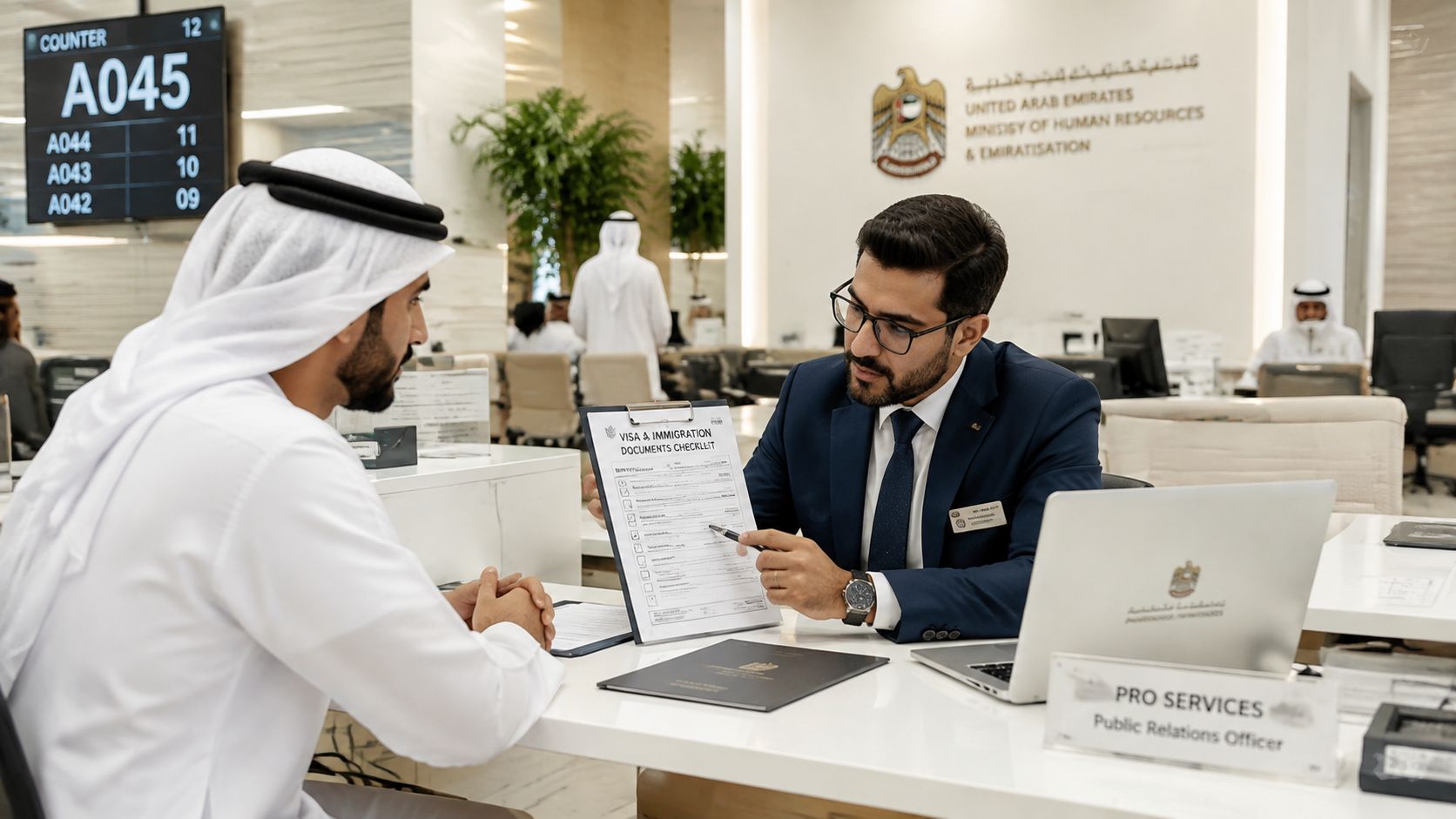
A Public Relations Officer, or PRO, coordinates government-facing administration. The work can include preparing forms, submitting documents, tracking applications and resolving requests for clarification. Handling these tasks internally may reduce professional fees in some cases, but it places responsibility for accuracy, timing and follow-up on the founder. Review what PRO services involve in Dubai before deciding which tasks to retain internally.
Match staffing to the launch stage
A solo founder may need only an investor or owner visa at launch. A company hiring immediately needs a wider plan covering employee onboarding, labour-related administration and the capacity required for those employees. The cash forecast should show these obligations before the staffing plan is approved.
Ask the provider to separate one-time formation work from recurring PRO support. They are different services, and combining them can hide the ongoing administrative burden.
Visa capacity should follow a hiring plan. It shouldn't be purchased because a package advertises a larger quota.
Real-World Budget Scenarios for Different Scales
A consultancy run by one founder has a different first-year cash burden from an SME with employees, a larger office and heavier administration. Comparing only the licence fee hides the money needed to make the company operational.
A basic mainland package with one investor visa and a basic office solution typically ranges from AED 18,000 to AED 28,000 or more, according to a UAE setup cost guide for 2026. Treat that figure as a starting scenario, not a standard quote. The activity, premises, visa plan and service scope can move the total substantially.
A lean launch
The lean model covers the structure a founder needs to operate legally:
- A suitable mainland activity.
- A basic office solution that meets the relevant requirements.
- One owner or investor visa.
- Necessary registration and professional assistance.
- A simple accounting and renewal process.
This can suit a consultancy or similar business with limited staffing and no need for storage, specialist premises or a large customer-facing location. It becomes a poor fit when the business depends on inventory, frequent hiring or a larger operating footprint. A low headline price is useful only if the underlying setup matches the work the company must perform.
A growing SME
A fuller first-year structure can reach AED 40,000 to AED 80,000 or more, reflecting stronger office requirements, additional immigration needs, administrative support or a more involved activity. Another UAE cost guide places end-to-end mainland formation with an office and one investor visa at about AED 35,000 to AED 75,000 or more, with some estimates reaching AED 40,000 to AED 90,000, depending on the activity and office choice (UAE setup cost guide for 2026).
These ranges overlap because mainland formation is not a standard package. Rent, staffing, government processing, professional support and renewal timing can all affect the amount paid during the first year.
How to use these scenarios
Ask for an itemised quotation and label each line one-time, annual, per person or rent-linked. Then calculate the cash required before launch, including the operational obligations that follow the licence.
A lean plan is sensible when it reflects genuine needs. It becomes risky when the founder chooses an undersized office or insufficient support solely to match an advertised price. The useful comparison is the cash required to operate for the first year, not the licence fee shown at the top of a package.
Cost-Saving Tips Without Compromising Compliance
Cost control works when it removes waste, not when it removes a legal requirement. The strongest savings usually come from matching the setup to the activity and launch plan.
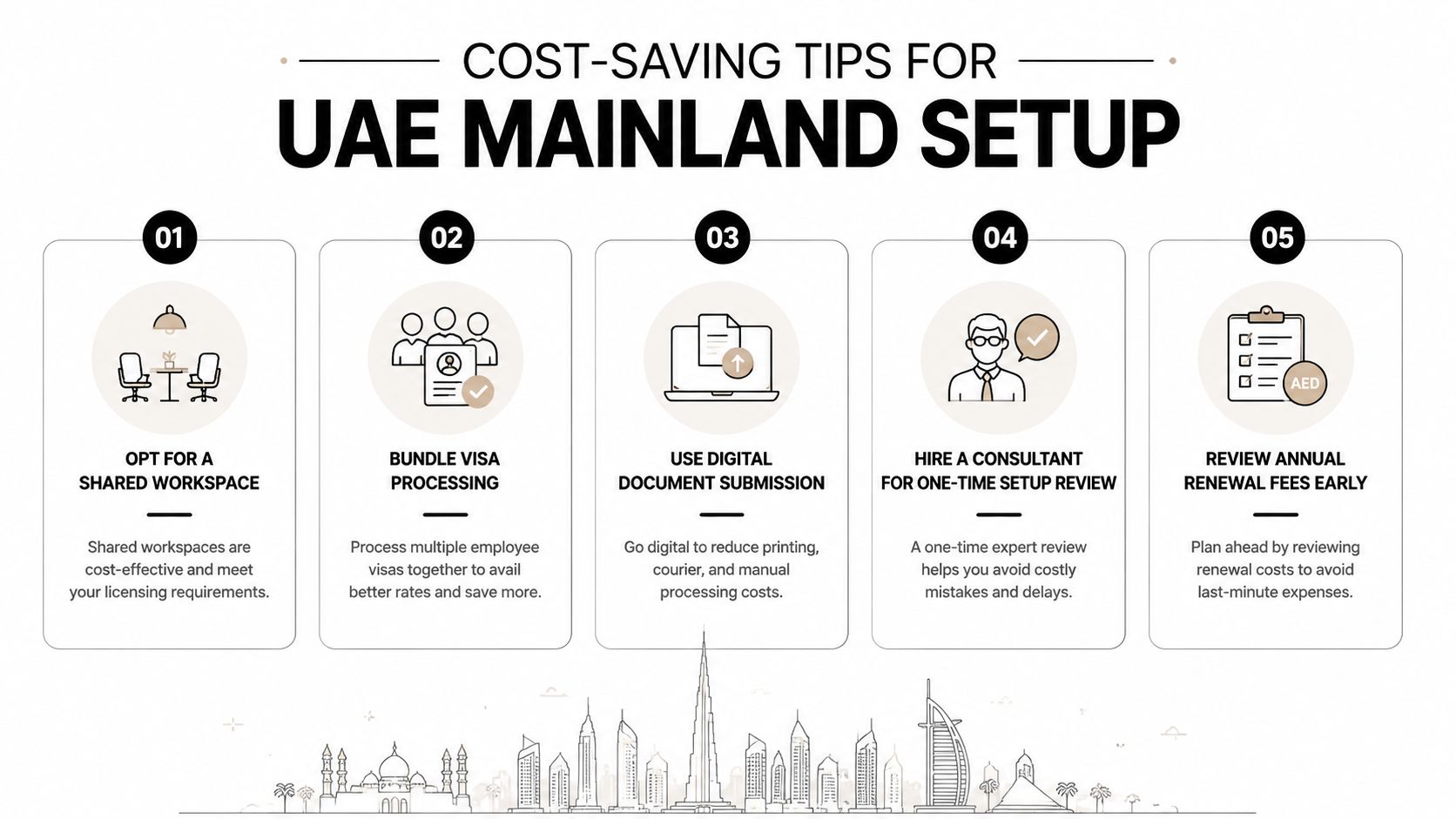
- Choose a right-sized office: Consider a compliant shared or serviced workspace before committing to a larger private lease.
- Set visa capacity realistically: Apply for the people you expect to onboard, rather than paying for unused capacity.
- Confirm activity codes early: An accurate activity choice can prevent later amendments, additional approvals or restructuring.
- Separate setup from recurring support: Ask which PRO, accounting and renewal services are included and which continue annually.
- Review the renewal calendar: Record licence, lease, visa and compliance deadlines from the first day.
You can also use broader practical cost-cutting strategies to examine office utilisation, administrative workflows and recurring overheads. Digital document submission may reduce handling time, but it doesn't remove the need for accurate documents or the correct government process.
Mainland can cost more than a free zone when the comparison includes premises and local operating requirements. The extra spend may still be justified if the business needs direct UAE market access, local contracts or a structure designed for broader domestic operations. The correct choice depends on what the company must do, not which advert displays the smallest starting figure.
Mainland Versus Free Zone Cost Comparisons
A free zone quotation may look cheaper because it bundles a licence with a shared office option. That price can suit a company whose activities, premises and visa allocation fit the selected zone. It does not automatically represent the cash required to operate elsewhere.
Mainland formation should be assessed against the company's actual route to market. Office and rent-related commitments can increase the first-year outlay, while the structure may better suit businesses seeking direct UAE domestic operations, local contracts or broader commercial activity. Comparing licence fees alone misses that trade-off.
| Decision point | Mainland | Free zone |
|---|---|---|
| Headline comparison | May include wider premises and operating requirements | May show a more packaged entry price |
| Office planning | Physical office requirements can materially affect first-year cash | Options depend on the selected zone and package |
| Market objective | Suited to businesses planning direct UAE domestic operations | Suited to businesses operating within the zone's permitted framework |
| Visa planning | Connected to office and establishment arrangements | Connected to the zone's allocated structure and package |
For a useful UAE mainland company formation cost comparison, itemise licence, office, Ejari, visas and professional support. A detailed mainland versus free zone Dubai comparison helps test the choice against market access, permitted activity and planned growth.
The higher first-year cash burden may be justified when domestic access is central to the business model. Ask for an itemised quotation, separate one-time charges from renewals, and compare the operating requirements rather than the advertised starting fee.
Smart Classic Business Hub helps founders compare mainland, free zone and offshore structures, organise formation and PRO requirements, and plan related accounting and compliance costs. Visit Smart Classic Business Hub to discuss your activity, office needs and visa plan before committing to a UAE setup budget.