
There's no single UAE free zone company setup cost. The Ministry of Economy and Tourism's company-establishment guidance gives a Dubai FZ-LLC registration benchmark of AED 3,520 before the activity licence and other requirements. DMCC's schedule of charges lists standard first-year authority charges of AED 34,185, before premises, visas and operating support. Neither figure is an all-inclusive formation price.
Comparing the cheapest licence packages can obscure the main budgeting issue: the offers may cover different obligations. A registration fee, a licence-only offer and a package with workspace and immigration services are not like-for-like costs. Compare the cost of becoming operational and staying compliant, then account separately for the fees that recur each year.
First-Year Budgets at a Glance
The AED 3,520 Dubai FZ-LLC registration benchmark and AED 34,185 DMCC first-year authority total measure different things. Treating them as competing formation offers would make the cheaper figure look more useful than it is.
The Ministry of Economy and Tourism's company-establishment guidance confirms that registration and licensing fees are determined by the free zone, activity and licence type; the Dubai FZ-LLC benchmark comprises AED 3,500 registration plus AED 10 Knowledge Dirham and AED 10 Innovation Dirham, before the activity-specific licence charge. The principal structures include a Free Zone Limited Liability Company (FZ-LLC), Free Zone Company (FZ Co.) and Free Zone Establishment (FZE).
By contrast, DMCC's schedule of charges gives a standard first-year authority total of AED 34,185, comprising application, registration, Articles of Association, annual licence and annual establishment-card charges. That total excludes visas, premises, medical testing, Emirates ID, banking, accounting and activity-specific additions.
First-year cost benchmarks by free zone
Every amount below is a benchmark, not a quotation. The Expo City figures distinguish basic and trading setups, with their fee composition addressed under licence selection.
| Free zone or benchmark | First-year figure (AED) | What the figure includes | Still to confirm |
|---|---|---|---|
| DMCC, Dubai | 34,185 | Application, registration, Articles of Association, annual licence, establishment card | Visas, office or flexi-desk, medical test, Emirates ID, banking, accounting |
| Expo City Dubai, basic package | About 18,000 | Initial approval, registration, company card, licence band floor | Visas, office rent |
| Expo City Dubai, general trading | 33,000–38,000 | Basic setup charges with the relevant trading licence | Premises, staff visas |
| Dubai FZ-LLC benchmark | 3,520 minimum | Registration, Knowledge Dirham and Innovation Dirham | Activity licence fee and all other setup items |
| SHAMS, Sharjah | Written quote required | Request an itemised inclusion list | Current published schedule |
| IFZA | Written quote required | Confirm registration, licence and workspace inclusions | Current published schedule |
| RAKEZ, Ras Al Khaimah | Written quote required | Confirm activity, premises and immigration inclusions | Current published schedule |
| JAFZA, Dubai | Written quote required | Request activity-specific authority and premises charges | Current published schedule |
| Abu Dhabi free zones | Quote each zone separately | Confirm the selected zone's structure and package | Current published schedule per zone |
An unpriced row isn't evidence that a zone is expensive. It means there isn't a supported comparable figure here, and inserting a promotional starting price would create false precision.
Budget for the business you'll actually operate
Licence-only founder. A basic Expo City setup provides a useful authority-charge baseline, but it doesn't establish the cost of a founder living and working in the UAE. Keep residence processing, premises and operating support outside the headline until the quotation explicitly includes them.
For a remote service business, ask whether the proposed package covers the exact activity, registered workspace arrangement and documentation you need. Don't purchase immigration services merely because they appear in a bundle, but don't remove them without checking your intended residence and working arrangements.
Trading business. The Expo City general-trading benchmark illustrates why activity selection matters before incorporation. A business handling products needs a different quotation from a consultant selling advice, particularly when storage, goods movement or customs-related steps enter the operating model.
Ask the authority to confirm the products covered and the premises acceptable for that activity. An affordable licence becomes a poor saving if you must amend it before accepting your intended orders.
Resident founder at DMCC. Start with the published authority total, then add the founder's visa processing, medical examination, Emirates ID and selected workspace. Banking support and accounting should remain separate lines, not assumptions hidden inside a contingency allowance.
A bank-account application service also shouldn't be mistaken for guaranteed account approval. Ask what the provider actually delivers and whether banking charges or balance requirements sit outside its fee.
Employer setup. Build the company-level budget first, then add a personnel schedule. Each sponsored employee needs an individual immigration-cost assessment, while the company needs confirmation that its premises and visa allocation support the planned team.
Don't multiply the establishment-card charge by headcount automatically. Separate the employer's immigration administration from each person's application costs, and confirm how the authority packages them.
Budgeting rule: An unquoted mandatory item is an unresolved liability, not a zero-cost item.
For online founders, Mazurly's cost-saving tactics for online founders provide a useful companion to the formation budget. Apply savings to discretionary software, outsourced work and launch spending rather than assuming statutory or activity-specific requirements can be removed.
Normalise competing quotations in a spreadsheet. Strip out optional bundled services to identify the comparable core, then add every excluded requirement as a separate line. Never subtract an excluded cost from the amount you need to fund. Keep the total marked provisional until the activity fee, workspace and immigration requirements are confirmed.
One-Time Fees and Annual Renewals Line by Line
A low formation price does not show the first-year cost or the renewal bill. Separate one-time transactions from recurring charges, then add any costs billed on different cycles.
Dubai's GDRFA establishment-card service lists AED 200 for issuance, plus 5% VAT and Knowledge and Innovation Dirham charges. It also lists AED 100 per year for issuance or renewal. Confirm which transaction applies before adding these amounts to a budget.
One-time and recurring fees for a UAE free-zone company
The figures below are authority-specific benchmarks, not a combined invoice. Charges from different zones and service channels should not be added together.
| Cost item | Type | Benchmark (AED) | Note |
|---|---|---|---|
| FZ-LLC registration | One-time | 3,500 | Plus Knowledge Dirham 10 and Innovation Dirham 10 |
| DMCC application | One-time | 1,035 | Standard DMCC tariff |
| DMCC registration | One-time | 9,020 | Standard DMCC tariff |
| DMCC Articles of Association | One-time | 2,020 | Standard DMCC tariff |
| DMCC annual licence | Yearly | 20,285 | Extra activities may increase the charge |
| DMCC establishment card | Yearly | 1,825 | Listed annual fee |
| Expo City initial approval | One-time | Check published tariff | Confirm the current charge with the authority |
| Expo City registration | One-time | Check published tariff | Confirm the current charge with the authority |
| Expo City company card | Yearly | Check published tariff | Confirm the current charge with the authority |
| Expo City licence | Yearly | 10,000–30,000 | Activity-specific band |
| Establishment card issue, GDRFA | Issue transaction | 200 plus 5% VAT | Knowledge and Innovation Dirham charges also apply |
| Establishment card annual issue or renewal | Yearly | 100 | Confirm the applicable transaction with the authority |
| Visa per person | Application and renewal cycle | Written quote required | Confirm quota and sponsorship route |
| Medical test and Emirates ID | Per-person processing cycle | Written quote required | Confirm validity and renewal requirements |
| Flexi-desk or office | Contractual recurring cost | Written quote required | Obtain premises terms from the zone |
| Banking and accounting | Provider-specific | Written quote required | Separate setup assistance from ongoing services |
The table is a categorisation aid, not a substitute for a zone's quotation.
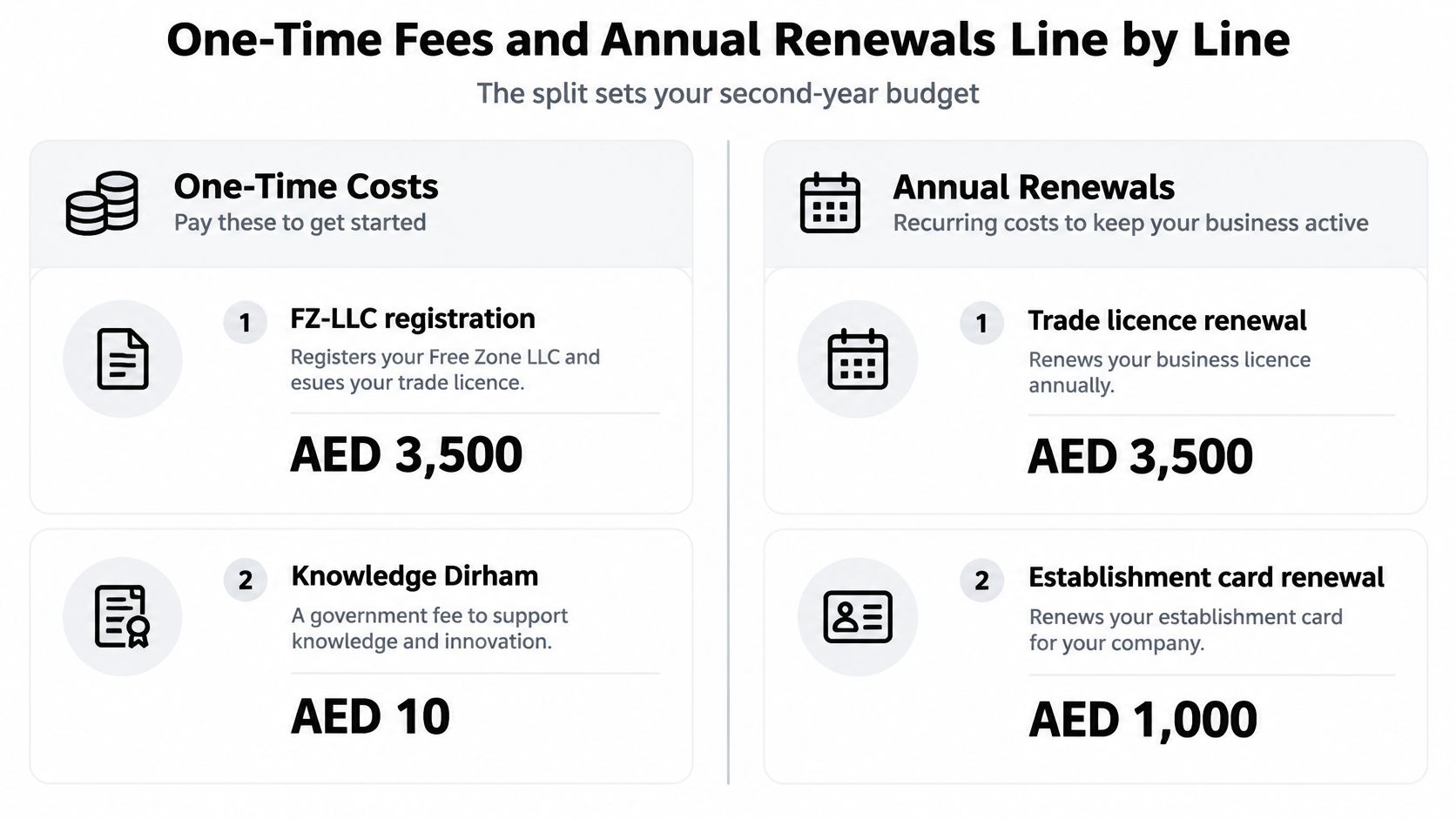
Build the renewal column independently
Copy confirmed recurring items into a separate renewal budget. Use each item's actual billing or validity period. A visa, identity document or premises contract may not renew on the licence date.
- Opening-year column: Include formation transactions, recurring charges due at launch and required personal processing.
- Renewal column: Include the licence, applicable cards, workspace and ongoing professional services.
- Confirmation column: Record unresolved billing cycles, VAT treatment and charges already included in a package.
This keeps the first-year total distinct from the annual renewal cost and reduces the risk of counting an included authority fee twice.
Which Licence Type Changes Your Budget
Ownership structure and business activity are different decisions. FZ-LLC, FZ Co. and FZE describe legal forms; service, trading and e-commerce describe activity categories. A useful quotation must identify both.
Start with who owns the company and whether that ownership is likely to change. Then describe what the company will sell, where products will be stored and how customers will receive them. A broad label such as online business doesn't tell the authority whether you provide digital services or import physical stock.
Licence types and what drives their cost
| Licence type | Suits | Main cost driver | Common upgrade trigger |
|---|---|---|---|
| FZ-LLC | Founders with partners or investors, subject to zone rules | Registration plus activity licence | Adding or restructuring shareholders |
| FZ Co. | Groups with a defined ownership structure | Registration plus activity licence | Ownership changes requiring review under zone rules |
| FZE | Single-owner businesses, subject to zone rules | Registration plus activity licence | Taking on a partner |
| Service licence | Consultants and agencies; confirm freelancer eligibility separately | Approved service activities and workspace | Expanding beyond the authorised service scope |
| Trading licence | Importers, distributors and retailers | Product scope, premises and customs-related steps | Holding stock or adding product categories |
| E-commerce licence | Online sellers within the approved activity scope | Selling model and permitted products | Moving into warehousing or goods handling |
Don't assume a service licence is always the cheapest or that an e-commerce licence covers every form of online selling. Ask for the permitted activity wording, not just the package name.
Price the change before choosing the entry package
The Expo City benchmark separates AED 500 initial approval, AED 5,000 registration, AED 2,500 annual company card and an annual licence band of AED 10,000–30,000, producing a basic first-year total of about AED 18,000 before rent and visas; general-trading totals can reach AED 33,000–38,000. These formation charges must be assessed separately from the corporate-tax framework explained by the Ministry of Finance.
Say an online seller initially outsources fulfilment, then decides to hold stock directly. Before incorporating, request the cost of the activity amendment, any replacement licence, premises upgrade and additional approvals that this change could require.
Buy the narrowest activity scope that covers your genuine operating plan, not the narrowest scope you can use to obtain a low quotation.
At DMCC, additional activities can affect the licence charge, so ask about the renewal consequence as well as the amendment fee. The cheapest licence is a poor fit when it excludes planned products, requires an immediate premises change or leaves the company unable to perform its intended contracts.
Visas, Office Space and Immigration Add-Ons
A planned hire can add several budget lines at once: residence processing, medical examination, Emirates ID and potentially more workspace. The employer also needs the appropriate immigration administration, but that company-level requirement should remain separate from each employee's costs.
Before issuing an offer, ask the zone to confirm available visa allocation against the proposed premises and activity. Use a free-zone visa planning guide to prepare the questions, then obtain the applicable charges and eligibility confirmation in writing.
Compare workspace by permitted use
A flexi-desk or co-working arrangement may suit an eligible service business, but the quotation must explain what access and registered-address rights it includes. Check the contract term, renewal conditions and whether the arrangement supports the intended staffing plan.
A private office or warehouse needs a different assessment. Ask about deposits, fit-out obligations, utilities, access and exit terms rather than comparing rent alone. Don't assume the shortest formation package gives you an equally short premises commitment.
Sort the add-ons by necessity:
- Mandatory for the proposed operation: Required immigration processing, acceptable premises and activity-specific approvals.
- Optional service choices: Urgent processing, document collection or premium administrative assistance where standard alternatives exist.
- Deferrable expansion costs: Additional seats, larger premises and sponsorship for hires who aren't yet joining.
Keep company and personal charges separate
Establishment-card activation belongs in the employer schedule. Visa applications, medical testing and identity-document processing belong against the relevant person, with their own validity and renewal dates.
This distinction becomes important when a provider offers an inclusive immigration package. Ask which authority charges it includes, which professional fees it adds and whether employee processing is capped or excluded.
For every unresolved line, write quote required, not zero. Record the quotation date, validity period, applicant assumptions and exclusions beside it. If a founder changes immigration status or the business changes premises, request a revised quote before relying on the old total.
The useful comparison isn't flexi-desk versus office in isolation. It's the lowest-cost premises arrangement that supports the company's activity, people and compliance obligations.
Corporate Tax Registration and Compliance Costs
Incorporation doesn't automatically deliver preferential corporate-tax treatment. A licence establishes the company's authorised activities; it doesn't by itself establish that the income qualifies for the free-zone tax regime.
The Federal Tax Authority's guide announcement on free-zone persons states that a Qualifying Free Zone Person must meet conditions including qualifying income, adequate UAE substance, transfer-pricing compliance and audited financial statements. It also explains the 0% rate on qualifying income, the general 9% treatment of non-qualifying income, and the de minimis requirement that non-qualifying revenue not exceed the lower of AED 5 million or 5% of total revenue.
Budget for evidence, not just registration
The FTA's corporate-tax topics guidance states that all free-zone persons must register for corporate tax, whether or not they qualify for preferential treatment. Registration is therefore not something to omit merely because a package advertises a tax advantage.
A company should be able to explain what it earns, who pays it and why the treatment applied is appropriate. The desk image below is illustrative, not proof that incorporation produces a certificate confirming tax eligibility.
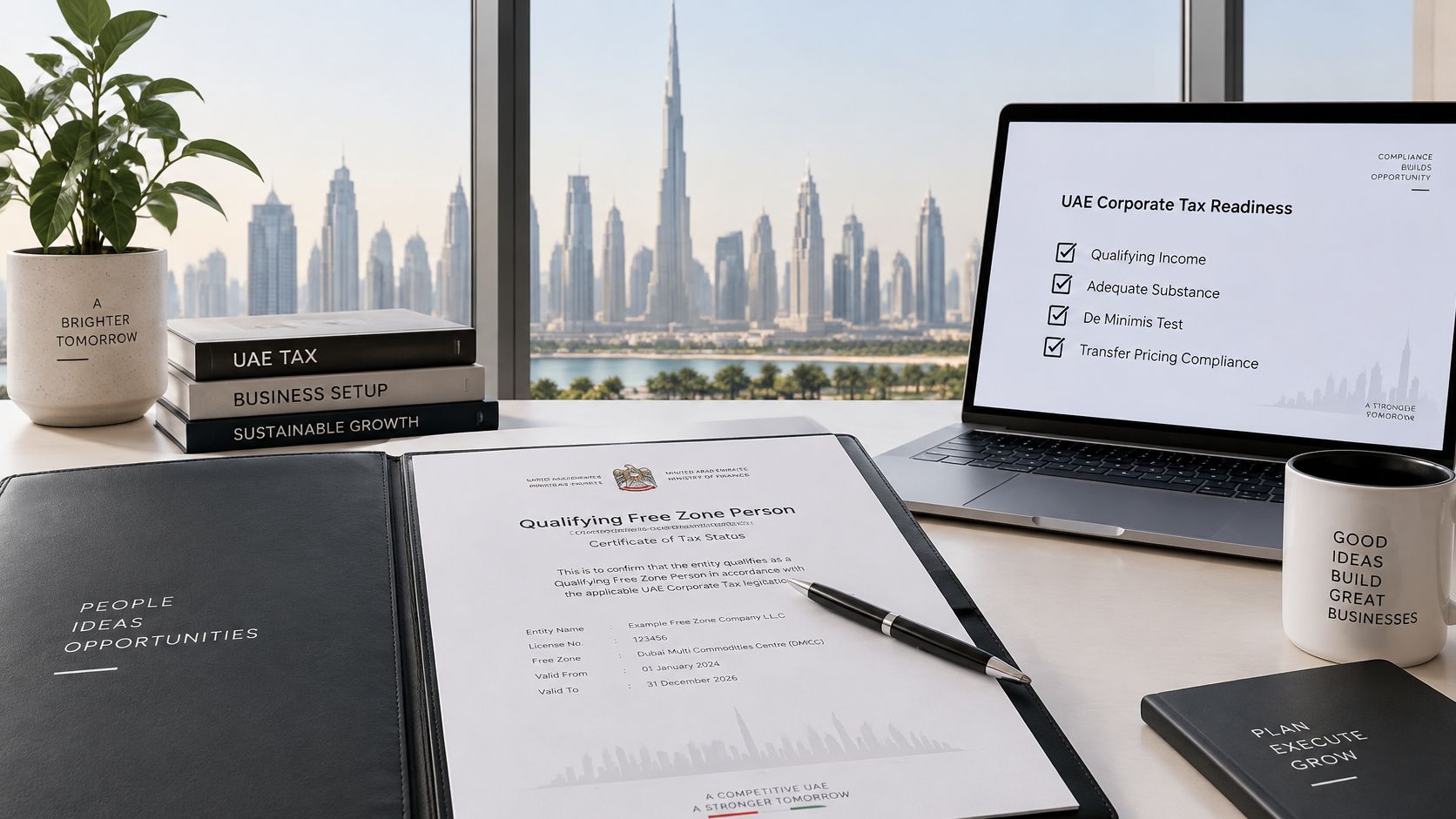
Obtain separate professional-service quotations:
| Compliance cost line | Budget treatment | Scope to confirm |
|---|---|---|
| Bookkeeping | Written quote required | Transaction volume, reconciliations and reporting |
| Tax registration and returns | Separate opening and recurring tasks | Registration assistance, return preparation and filing |
| Audit | Written quote required | Financial statements, audit scope and delivery timetable |
| Transfer-pricing documentation | Applicability assessment first | Related-party arrangements and required documentation |
| Substance advice | Scope-specific quote | Premises, people, functions and supporting records |
Test the revenue model before committing
Selling to UAE mainland customers warrants a transaction-specific assessment, not a blanket assumption that all revenue qualifies or that none does. Customer location, activity and the nature of the income need to be examined together.
Use the free-zone corporate-tax guidance to prepare a discussion with your tax adviser. Bring proposed contracts, customer categories, related-party arrangements and a description of where work will take place.
Compliance decision: Spending less on premises or audit isn't a saving if it leaves the intended tax treatment unsupported.
No adviser can preserve preferential treatment through documentation alone when the underlying conditions aren't met. Select a structure you can operate and substantiate, then include the necessary accounting and compliance work in the recurring budget.
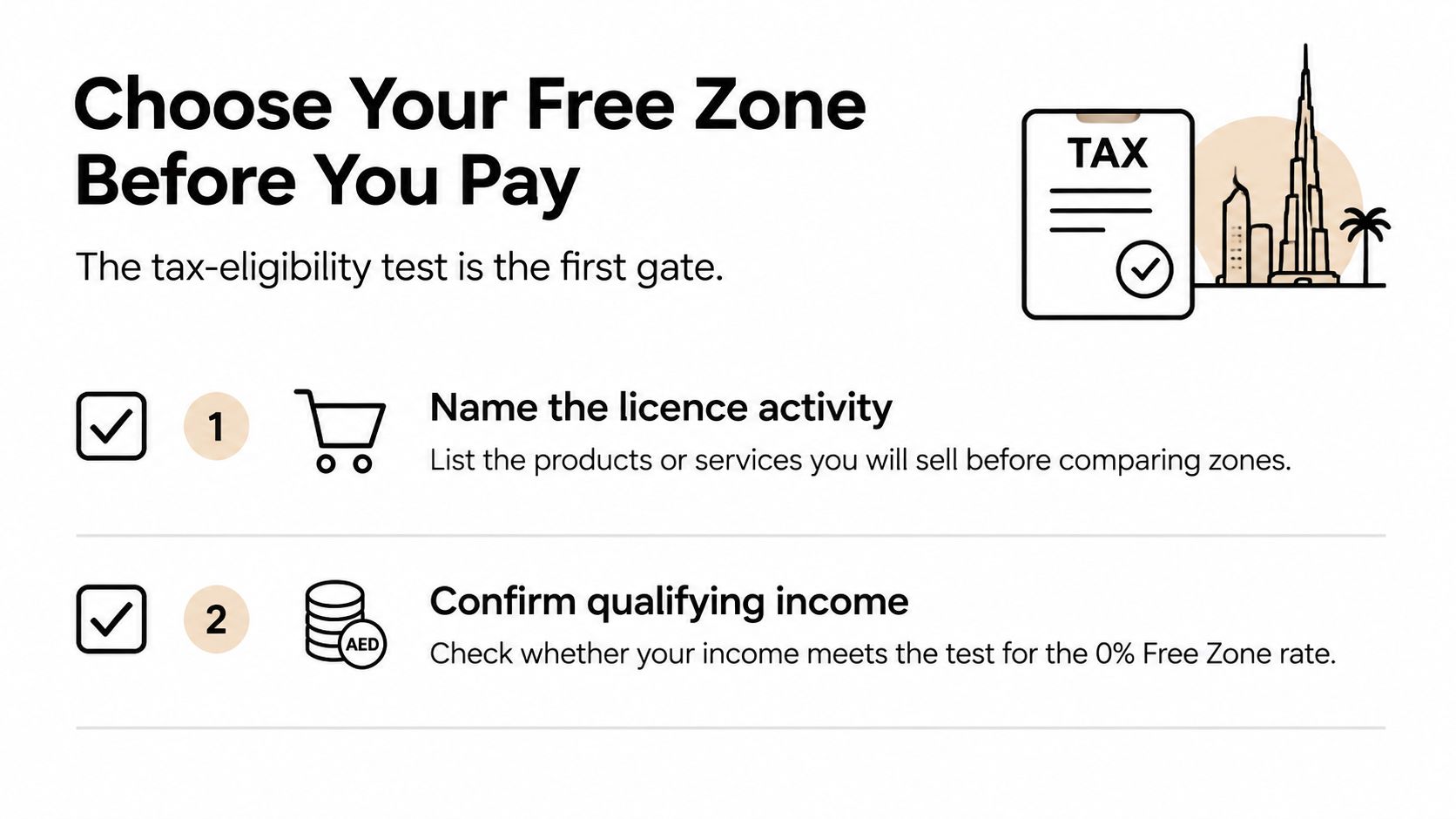
Choose Your Free Zone Before You Pay
Make tax eligibility the first decision gate, then test operational fit and price. Paying for a convenient licence before checking the revenue model can leave you funding a structure that doesn't support the business you intended to build.
Your shortlist should reflect activity permissions, premises, ownership and planned customers. A guide to designated free zones in the UAE can help frame the jurisdiction discussion, but don't treat a zone's designation as proof of your company's tax eligibility.
Follow a decision sequence
Define the activity precisely. List the products or services you'll sell, how you'll deliver them and whether you expect to handle goods. Include realistic expansion plans without buying permissions for unrelated activities.
Assess the intended income. Give a tax adviser the customer profile and draft contract structure. Ask for an explanation of the proposed treatment and the operational conditions it requires.
Request comparable written quotations. Send the same scope to several authorities or advisers. Include the unpriced options, SHAMS, IFZA, RAKEZ, JAFZA and relevant Abu Dhabi zones, rather than excluding them because a comparable figure isn't available.
Model subsequent operating years. Use confirmed renewal charges, premises terms, document-validity cycles and professional-service costs. Remove genuine formation-only transactions, but retain services that continue after incorporation.
Price an amendment before you need it. Ask about activity changes, shareholder changes and premises upgrades, including processing requirements and timing.
Use the checklist to keep eligibility and operating requirements ahead of payment.
Save by removing mismatches
Compare bundles by their individual components. If you don't need a premium workspace or urgent processing, ask for the standard alternative. If a package includes a service you'll purchase elsewhere, ask whether removing it changes the price.
Don't trim required substance, audit or bookkeeping merely to make the opening budget look smaller. Instead, agree clear deliverables with each provider so you aren't paying overlapping advisers for the same work.
Before authorising payment, obtain written confirmation of:
- Current authority schedule: The tariff and any promotional conditions applied.
- Activity fee: The exact approved activity list and additional approvals.
- Visa allocation: The quota supported by the selected package and premises.
- Workspace terms: Access, contract length, renewal and exit conditions.
- Compliance scope: Accounting, tax and audit deliverables, with exclusions.
Choose the quotation with the clearest sustainable operating cost, not merely the lowest amount on its first page.
Smart Classic Business Hub offers UAE company formation, PRO services, VAT-compliant accounting and audit support. Visit Smart Classic Business Hub to request an itemised setup assessment covering your activity, visa needs, premises and recurring compliance costs before committing to a free-zone package.