
A Dubai founder usually notices the problem after the invoice is already paid. The management fee went to a related company abroad, the accounts team posted it, and months later someone asks a simple question, can you prove that the charge was arm's length? That's where transfer pricing documentation stops being a technical phrase and becomes a real business record, because the file has to show what the related parties did, why the charge existed, and how the price was supported.
For UAE entrepreneurs, this is no longer a niche issue reserved for global groups with in-house tax teams. Once a business has related-party transactions, whether through a free zone parent, a mainland subsidiary, a holding company, or a family-owned structure, the documentation question becomes part of normal corporate tax readiness. The practical challenge is not just to file something. It's to build a file that matches how the business works, so it can stand up if the Federal Tax Authority asks for the evidence.
Why UAE Businesses Are Suddenly Talking About Transfer Pricing
A founder in a Dubai free zone often feels the issue first through ordinary operations, not tax theory. A parent entity pays for regional management, a mainland company charges the group for services, or an overseas affiliate owns the brand and invoices a royalty. The finance team records the entries, but later someone has to explain why the numbers make commercial sense, and that explanation needs more than a polite narrative.
That shift matters because the UAE corporate tax environment has widened the circle of businesses that need proper related-party support. Transfer pricing documentation is no longer something only large multinationals worry about. It now affects entrepreneurs, family groups, holding companies, and SMEs that have cross-border dealings inside a group structure.
The issue is evidentiary. If the file is weak, the business is left trying to reconstruct decisions after the fact, which is the worst possible posture in a review. A stronger file shows the transaction, the functions behind it, the pricing logic, and the financial trail in one place. That is a very different exercise from keeping a few invoices in a folder.
Practical rule: if the transaction is material enough to affect profit, it is material enough to document properly.
| Entity Type | Documentation Trigger | Typical Risk Level |
|---|---|---|
| Free zone operating company | Related-party services, royalties, loans, or recharge arrangements | Medium to high |
| Mainland subsidiary | Cross-border charges or intercompany allocations | Medium to high |
| Holding company | Centralised management fees, financing, IP ownership | Medium |
| Family-owned group | Informal pricing between connected entities | Medium to high |
| SME with overseas related parties | Even limited recurring charges can create support needs | Medium |
For a planning lens on how related-party charges fit into the wider tax picture, the corporate tax guidance on UAE corporate tax planning is a useful starting point. The key takeaway is simple. The cost of building a proper file is usually lower than the cost of explaining a weak one later.
What Transfer Pricing Documentation Actually Means
At its simplest, transfer pricing documentation is paperwork that proves your related-party prices were fair. That sounds basic, but in practice the file has to do something more demanding. It has to show that the pricing was grounded in actual business functions, not just set by habit or convenience.
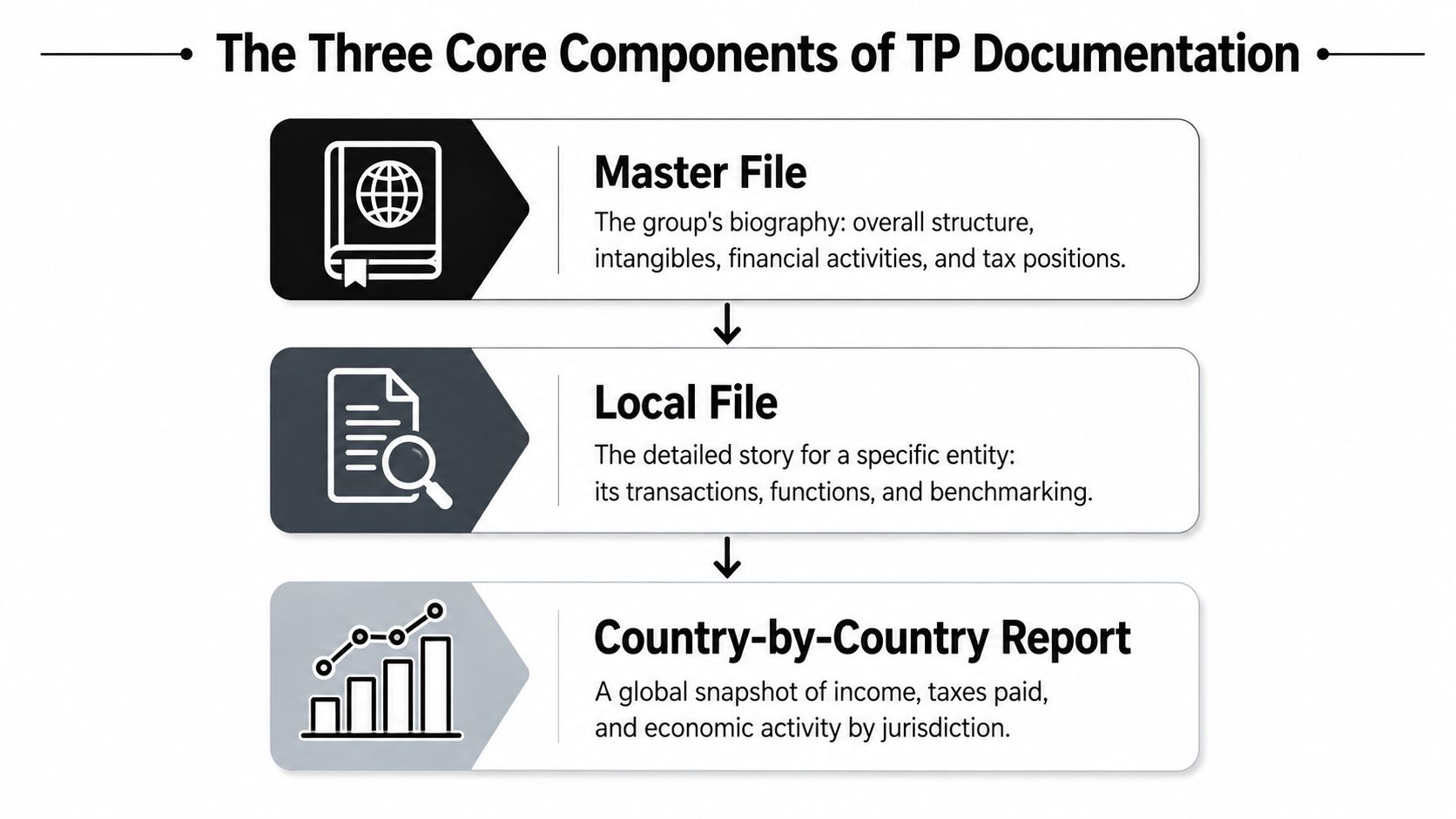
The global reference point is the OECD's Action 13 framework, finalised in 2015, which introduced the now-standard three-tier structure, a master file, a local file, and a country-by-country report. The OECD's CbCR template requires multinational groups to disclose consolidated data on revenue, profit before income tax, income tax paid and accrued, stated capital, accumulated earnings, number of employees, and tangible assets by jurisdiction. The local file, meanwhile, is meant to capture the scale of controlled transactions, the comparability analysis, the transfer pricing method selected, and the financial information used in the arm's-length analysis. OECD Action 13 final report
The reason this structure exists is straightforward. Tax authorities want structured evidence, not broad assertions. A business saying “the fee was reasonable” is not enough if the books, the contracts, and the functional analysis don't line up. The documentation package shifts the discussion from opinion to proof.
For practitioners who handle source evidence and audit support, Snyp on source documents is a useful parallel read, because transfer pricing files rely on the same discipline, original records, traceability, and clean reconciliations. In a UAE context, that's the point. The documentation isn't a single report. It's an evidentiary chain.
The Three Core Components Explained
The master file is the group biography. It describes the wider business, the group's structure, intangibles, financing, and overall tax positions. For a UAE group with offshore, free zone, and mainland entities, that means the file needs to make the group's architecture understandable at a glance, especially if decision-making sits in one entity and value creation sits in another.
The local file carries the operational weight for most UAE businesses. It is the entity case file, the part that documents each material controlled transaction, the amount involved, the functional analysis, the comparability review, the selected transfer pricing method, and the financial information used to support the arm's-length outcome. The OECD guidance is explicit that the local file should capture the controlled transactions, the associated enterprises involved, and the financial accounts for the fiscal year concerned. OECD guidance on documentation
The country-by-country report is the scoreboard. It gives the tax authority a jurisdiction-by-jurisdiction summary of group economic activity, which is why the OECD template asks for revenue, profit before tax, tax paid, tax accrued, capital, accumulated earnings, employees, and tangible assets. That makes the report useful as a high-level risk screen, even when the detailed pricing defence sits in the local file.
The files work as one chain of evidence. If the master file says the group owns the brand, the local file needs to explain how the UAE entity uses it, pays for it, and supports the charge.
For a typical UAE entrepreneur, the practical hierarchy is clear. The local file matters most because it ties the entity's actual transactions to the method used to defend them. The master file and CbCR add context, but they can't rescue a weak transaction analysis on their own.
UAE Corporate Tax Rules and Documentation Thresholds
UAE transfer pricing rules follow the OECD-style approach, but the local compliance reality is what matters for day-to-day planning. The Federal Tax Authority expects related-party dealings to be supportable with the right level of documentation, and for some groups that means preparing the three-tier package, while for others it means maintaining a proportionate file that can be produced quickly if asked.
One important practical benchmark is the AED 60 million related-party threshold often used as a trigger in UAE discussions about documentation intensity. It's not a signal to ignore smaller groups, though. Smaller structures can still have material exposure if the transactions are recurring, poorly documented, or spread across several entities. The issue is substance, not just size.
The OECD's Action 13 logic still shapes the UAE framework. A business with cross-border related-party activity needs to be able to explain what it did, what it paid, who it paid, and why the pricing is defensible. The local file becomes the centre of that analysis because it is where transaction-level evidence sits. The wider framework is only useful if the company can produce it when required.
A useful compliance benchmark is speed. In the U.S. framework often cited as a strong documentation standard, the IRS generally expects documentation to exist when the return is filed and to be produced within 30 days of request in an examination. The message for UAE businesses is the same, even if the procedures differ. Late reconstruction looks weak because it rarely matches original-entry books, invoices, and allocations. IRS transfer pricing documentation FAQs
For broader legal and compliance context, DocsBot legal compliance articles can help businesses understand how structured compliance content is usually organised. The practical UAE lesson is simpler, though. If your related-party transactions aren't documented as they happen, you're already behind.
For entity setup and tax administration, the guide on how to get a tax identification number online is useful if your finance function is still formalising its tax base. Documentation only works when the underlying registrations and records are in place.
A Practical Preparation Checklist
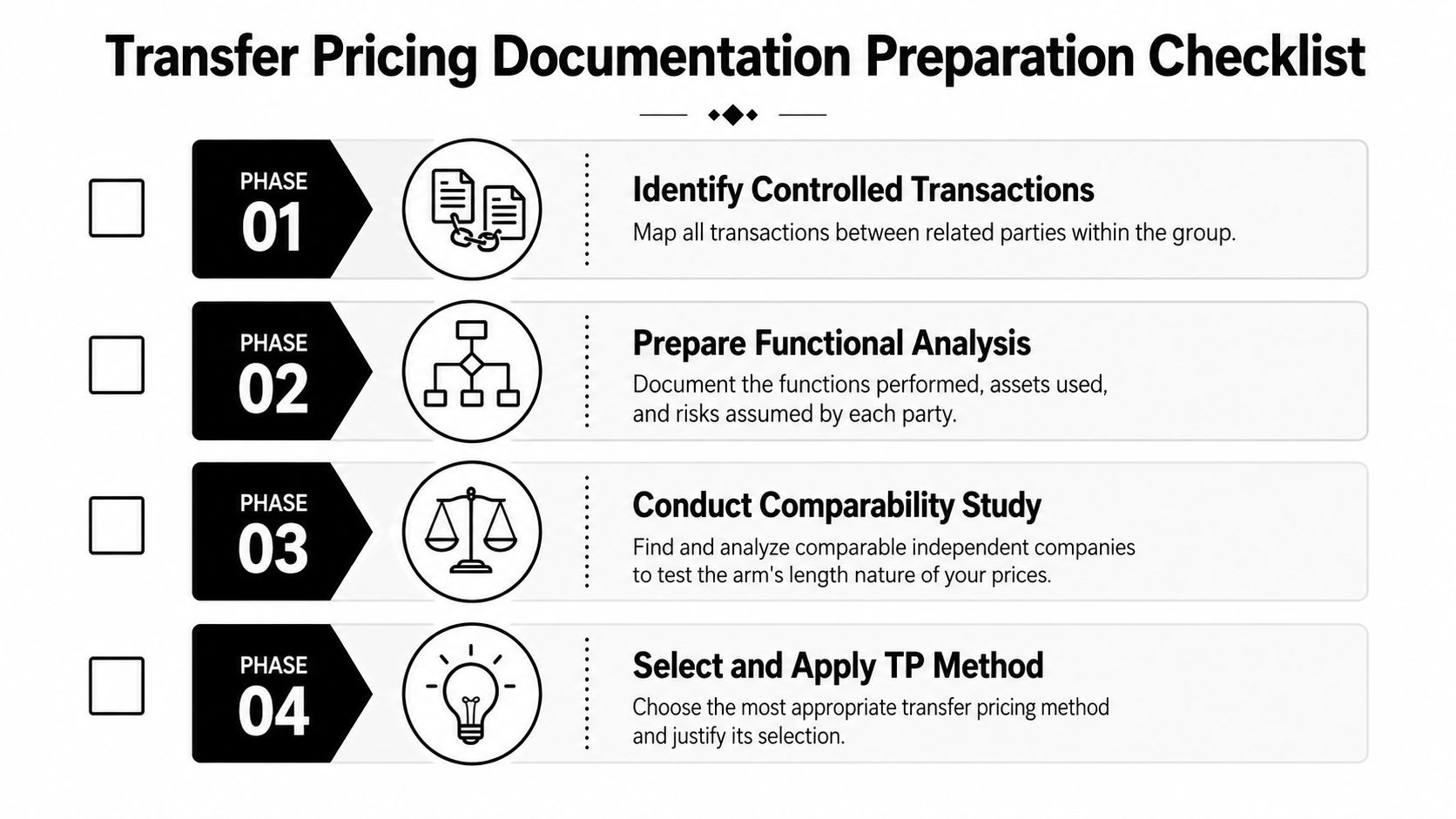
The cleanest files usually follow the same working sequence. First, map every controlled transaction. Then identify the functions, assets, and risks on each side. After that, test comparable independent pricing, select the most appropriate method, and reconcile everything back to the accounts. If any one of those steps is missing, the file may look neat but won't feel credible in an audit.
The working flow
Identify controlled transactions
List management fees, royalties, interest, service charges, reimbursements, and any other related-party entries. Don't rely on memory, because intercompany items often sit in different ledgers or cost centres.Prepare the functional analysis
Show what each entity does, what assets it uses, and what risks it carries. Many SME files become too generic.Run the comparability study
Look at independent benchmarks that fit the transaction and the industry. Thin, copied, or unrelated comparables usually weaken the analysis.Select and apply the transfer pricing method
Explain why the chosen method fits the facts better than the alternatives. For routine services, the logic should be clear and internally consistent.Reconcile to the financials
Tie the intercompany schedule to invoices, journals, management accounts, and statutory numbers. If the amounts don't reconcile, the file loses credibility fast.
A local file for a UAE entity usually has a practical structure like this:
| Section | What It Should Cover |
|---|---|
| Entity overview | Legal structure, business model, and local operations |
| Related-party map | Connected entities, ownership links, and transaction flow |
| Transaction schedule | Fees, royalties, loans, services, and charges by type |
| Functional analysis | Functions, assets, risks, and decision-making |
| Comparables | Independent benchmarks and selection logic |
| Method selection | Why the method fits the facts |
| Financial reconciliation | Link between the file and the accounts |
If the finance team can't trace a transaction from invoice to journal entry to filing support, the documentation isn't finished yet.
For SMEs, the best files are usually the ones that are complete enough to defend and simple enough to maintain annually. Over-engineering is expensive. Under-documenting is risky. The balance sits in the middle, where the file is proportional to the business and still auditable.
Common Pitfalls and Audit Triggers to Avoid
The most common mistake is treating the file as a year-end administrative task. That approach usually produces backdated narratives, missing reconciliations, and benchmarking that doesn't reflect how the business operated. Auditors notice the timing immediately, because a file built after a request often reads like an explanation assembled for convenience.
Another weak point is comparables. If the benchmark set is too thin, too generic, or obviously unrelated to the transaction, the analysis loses force. A family group in the UAE that uses a service-company model, for example, needs comparables that fit the actual functional profile, not just any company that happens to be easy to find.
Intercompany agreements also cause trouble when they're missing, unsigned, or inconsistent with the books. A contract that says one thing and invoices that say another creates doubt about substance. That's exactly the kind of mismatch auditors focus on first, because it tells them the transfer pricing policy may exist on paper only.
The same applies to charges that businesses often treat casually, like management fees, royalties, and shareholder loans. Those items need to be identified, supported, and tested, not just posted because the group has always done it that way.
| Do | Don't |
|---|---|
| Prepare contemporaneously with the transaction | Rebuild the file only after an audit request |
| Use industry-specific comparables that fit the facts | Copy a generic benchmark set from another case |
| Sign agreements before charging begins | Backdate contracts to match the accounting entries |
| Trace all intercompany charges to invoices and books | Assume management fees or royalties don't need support |
For a deeper look at the mechanics of related-party flows, intercompany transactions should be reviewed alongside the file itself, because the legal structure and the TP record have to match.
The strongest corrective move is usually boring, not clever. Clean up the ledger mapping, formalise the agreements, and refresh the benchmark before year-end closes. That work rarely makes a dramatic headline, but it prevents the kind of weak file that creates unnecessary scrutiny later.
How Smart Classic Business Hub Helps You Stay Compliant
Smart Classic Business Hub can help you turn the theory into an actual compliance file. The practical work usually starts with mapping related-party transactions, then moves into documentation drafting, corporate tax registration and filing support, and benchmarking studies where the transaction analysis needs external support. That matters because a file is only as strong as the data and reconciliations behind it.
The best result comes when the advisory work is tied to the client's records, not separated from them. You keep ownership of the commercial decisions, while the implementation partner helps structure the documentation, organise the evidence, and prepare the support pack in a way that's usable for tax compliance. That division keeps the process efficient and avoids the usual problem where advice and accounting never quite line up.
If your records are still scattered across invoices, journals, and spreadsheets, a useful first step is to get the documentation structure fixed before the next filing cycle. If you receive financial statements or supporting documents in PDF form, a free PDF to JPG conversion can make review and annotation easier during the organising stage, especially when multiple transaction schedules need to be compared side by side.
Smart Classic Business Hub also fits this work into the wider UAE compliance picture, including corporate finance, feasibility studies, and PRO support where needed. If your group is growing fast, that broader view helps because transfer pricing doesn't sit alone. It has to align with registration, bookkeeping, and the actual operating structure.
If you want a practical review of your related-party transactions and the documentation behind them, Smart Classic Business Hub can help you map what's missing and what's already defensible. Visit Smart Classic Business Hub to get support that connects transfer pricing documentation with real UAE compliance work.