
Your Dubai company has sent its invoice, the client has approved the work, and you're expecting payment. Then the client's finance team asks for proof of UAE tax residence before it will consider paying without withholding foreign tax.
A tax residency certificate for business may be the right document, but first you need to identify what the client wants. Evidence for a treaty claim, proof of your company's activities, and paperwork for recovering overseas VAT aren't interchangeable.
What a Company Tax Residency Certificate Proves
A UAE company has invoiced a client in a treaty country. Before applying treaty treatment to the payment, the client asks for evidence that the company is a UAE tax resident.
A TRC works like a passport stamp for a named treaty and period. It supports a request for treaty treatment, while the foreign authority decides whether the company and income meet that agreement's conditions. It does not create a foreign-tax holiday.
Under Ministerial Decision No. 247 of 2023, the Federal Tax Authority may issue a certificate when it is satisfied that the applicant meets the residency conditions in the relevant international agreement.
What the certificate identifies
Like a label on a file, the certificate links an applicant to a particular treaty and period. It identifies:
- Company identity: The applicant's name, commercial licence number and licensing authority.
- Tax registration: The Corporate Tax Tax Registration Number (TRN), where applicable.
- Treaty and dates: The relevant double taxation agreement and the certificate's validity dates.
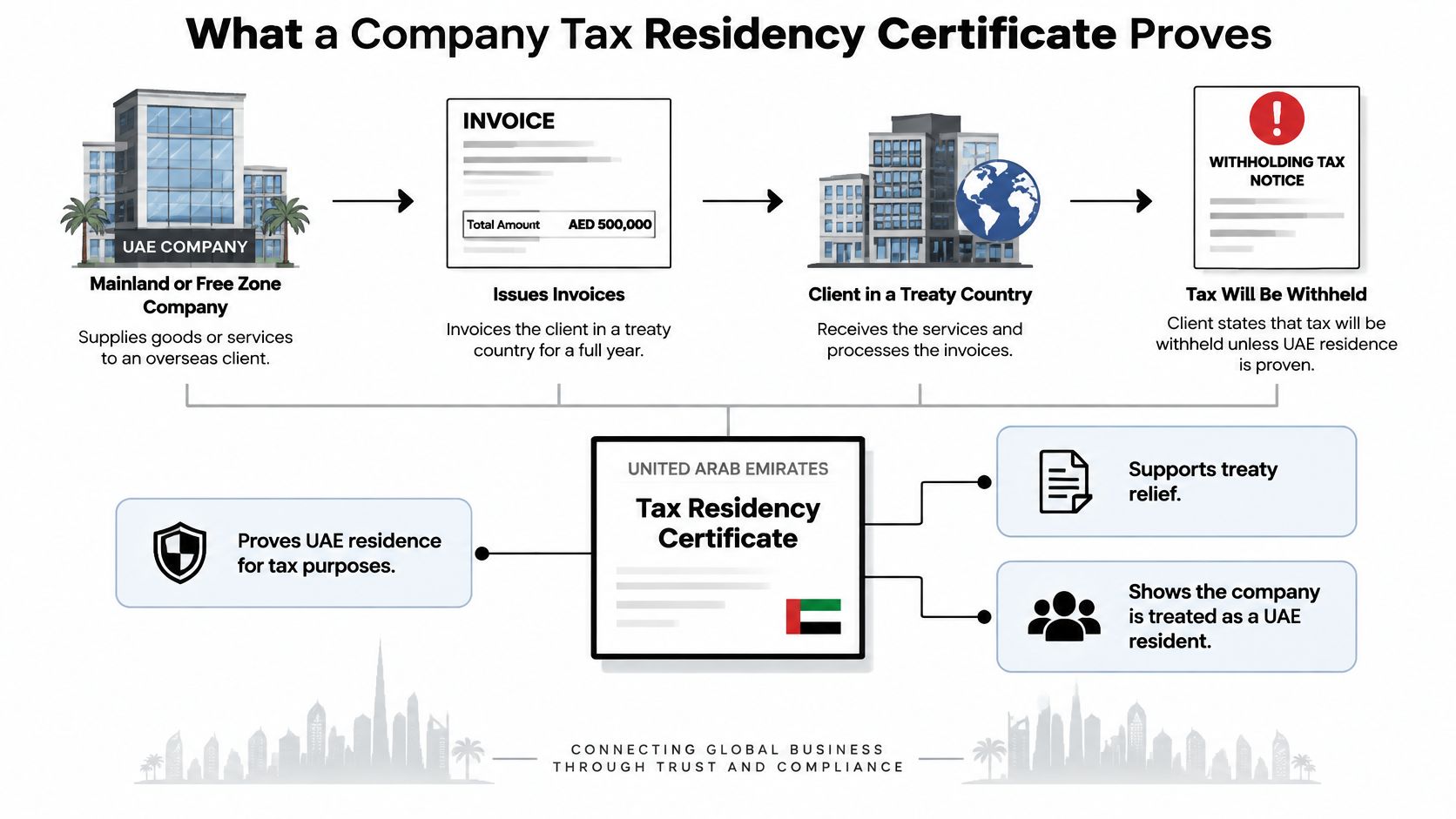
A double taxation agreement (DTA) can reduce or exempt tax on qualifying income and profits, and help prevent the same income being taxed in both countries. The agreement's income rules and benefit conditions still apply. Each treaty has its own terms, even within the UAE's broad network of agreements.
Separate the company from its owners
A shareholder's personal residence does not prove the company's residence. If the request concerns the founder rather than the invoicing entity, the guide to tax residency certificates for individuals explains the separate application route.
A company's position can also depend on the foreign country's rules. For an Australian connection, Australian residency tests for overseas companies provide context for assessing the company's position.
Before considering a treaty claim, identify the payer's country, the income type and the relevant period. Those details show which treaty and conditions the certificate needs to address.
Fees and Eligibility for a Business TRC
UAE business TRC fees and who can apply
The FTA's tax certificate service rules set the electronic certificate fee at AED 500 for a Corporate Tax registrant with a TRN and AED 1,750 for a legal person without one, charge AED 250 per requested hard copy, and require a juridical person to have been incorporated or established in the UAE for at least 12 months.
| Applicant | Electronic fee | Hard copy | Can apply |
|---|---|---|---|
| Company with a Corporate Tax TRN | Registered-applicant fee | Charged per copy | Yes, subject to the establishment requirement and other conditions |
| Legal person without a Corporate Tax TRN | Non-TRN legal-person fee | Charged per copy | Yes, subject to the establishment requirement and other conditions |
| Branch of a foreign company | Not issued | Not issued | No, not regarded as established in the UAE |
| Offshore company | Not issued | Not issued | No, not regarded as established in the UAE |
Think of eligibility as the entrance gate and the fee as the ticket price. Paying for the ticket can't get an excluded entity through the gate.
Read the applicant categories carefully
For a company with a Corporate Tax TRN, check that the registration belongs to the applicant itself. Don't use a shareholder's details or assume another group company's registration answers the application question.
A legal person without a Corporate Tax TRN has a separate fee category. That doesn't mean Corporate Tax registration is optional whenever a company prefers to apply without it. Registration obligations need their own assessment.
Foreign branches and offshore companies face a more fundamental issue: the FTA excludes these categories from issuance because it doesn't regard them as established in the UAE for this service. A Dubai address or local administrative support doesn't resolve that exclusion.
Budgeting rule: Check the legal entity before authorising payment. A document-preparation exercise can't fix an ineligible applicant type.
A newly licensed mainland or free zone company must also satisfy the establishment requirement. Incorporation gives you a starting date to check, not immediate access to treaty documentation.
Choose the period before ordering copies
Treat the certificate period like the dates on an insurance policy: paperwork for the wrong dates may not address the event you need covered. The FTA allows a selected tax period or another 12-month period, and a selected tax period must be current or previous.
Ask the payer which invoices or payments its residence request concerns. Then align the application with that request rather than automatically choosing the period that's easiest for your accounts team.
Electronic issuance and paper copies are separate purchasing decisions. Ask whether the recipient accepts the electronic certificate before ordering physical documents.
Corporate filing support is also distinct from treaty certification. For a group dealing with UK obligations, striveX company tax return support from striveX Ltd is a resource for that separate compliance task, not a replacement for the UAE application.
Don't build your payment timetable around an assumed same-week approval. Leave room for questions about the application, and prepare the evidence of your company's UAE presence before the foreign payer's deadline approaches.
Papers That Prove Management in the UAE
A shop sign tells you the business name. The lease, management records and accounting trail help explain whether the business is run from that address.
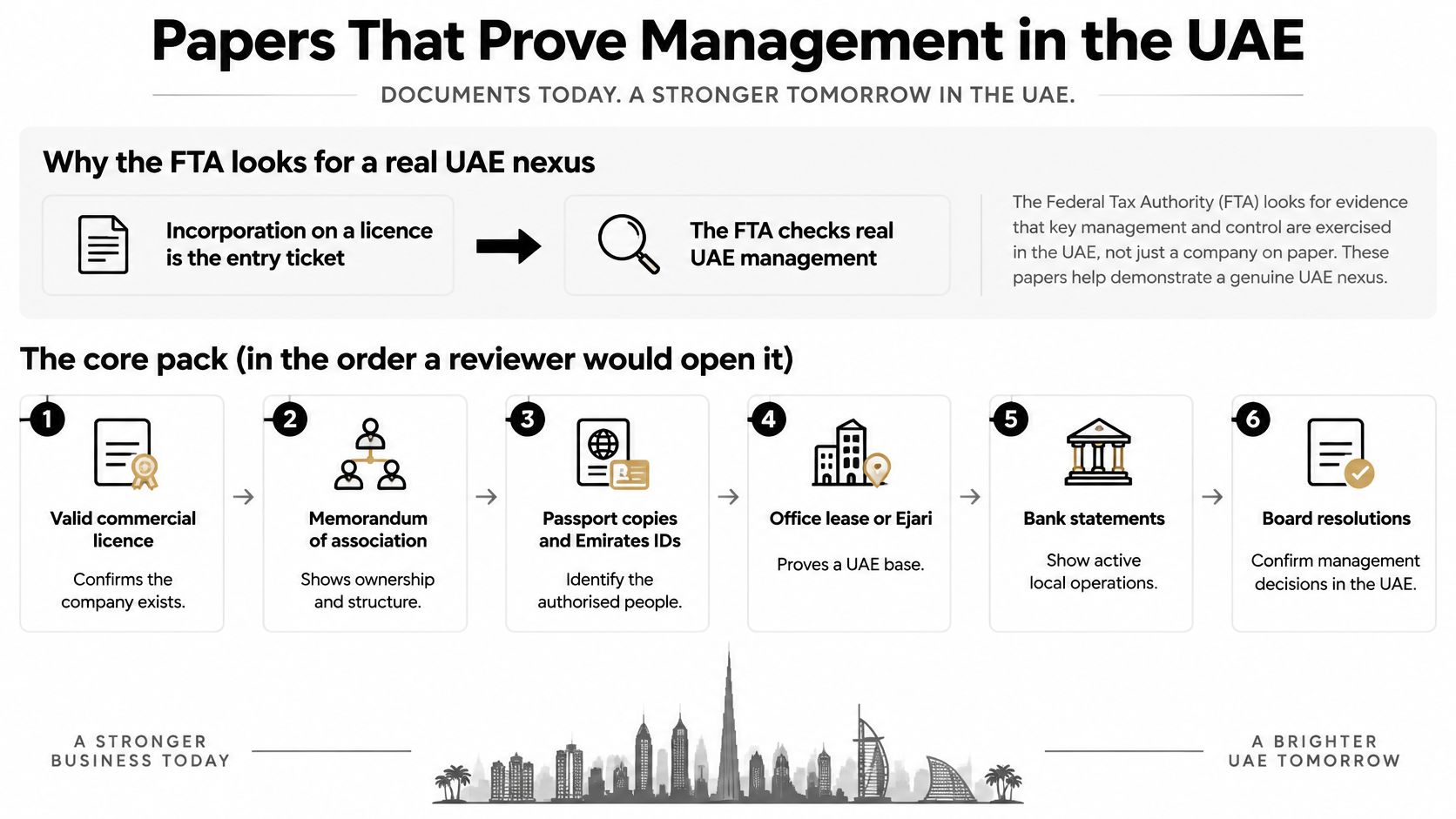
That's the distinction to keep in mind when preparing a TRC file. The FTA's certificate documentation requirements include corporate identity documents, premises evidence, authorised-signatory documents and, where applicable, evidence of effective management and control in the UAE.
Arrange the core file in review order
Don't upload a collection of loosely named scans. Build a readable pack that answers who the company is, where it operates and who can act for it.
- Valid commercial licence: Check the company name and licensing authority against the application.
- Certificate of incorporation: Establish the entity's formation details.
- Constitutional documents: Include the memorandum and other applicable governing documents.
- Lease agreement: Show the company's UAE premises arrangement for the relevant period.
- Authorised signatory identification: Identify the person submitting or authorising the application.
- Proof of authority: Include the resolution, authorisation or other applicable document showing that person may act.
Use consistent file names, such as “Commercial licence” and “Signatory authority”. If a document has been renewed or amended, make the relationship between the versions clear.
Show how decisions were actually made
Think of board minutes as the business's decision log, not decorative stationery. Where management evidence is relevant, minutes should accurately record the decisions taken, the participants and the meeting location.
Support them with management meeting records, UAE accounting records and Corporate Tax registration details. Don't manufacture a history of UAE decision-making immediately before filing.
Compare hypothetical files. A free zone holding company with a flexi-desk, no meeting records and directors making every strategic decision abroad has more to explain than a Dubai trading company with locally managed contracts, staff and documented board meetings.
That comparison isn't an automatic pass-or-fail test. It shows why consistent evidence matters more than a registered address alone.
Free zone status also raises separate Corporate Tax questions. Review free zone Corporate Tax considerations without assuming that a particular tax treatment settles treaty residence.
Check the pack before opening the service
- Names match: The applicant's name is consistent across the licence, incorporation papers and application.
- Dates connect: The documents support the period being requested.
- Authority is clear: The signatory's identity and permission to act are documented.
- Management evidence is genuine: Records describe what happened, rather than what would make the application look stronger.
Keep this file current throughout the period concerned. Reconstructing decisions from old emails is harder than preserving accurate records when those decisions are made.
Treaty Relief or a Foreign VAT Refund
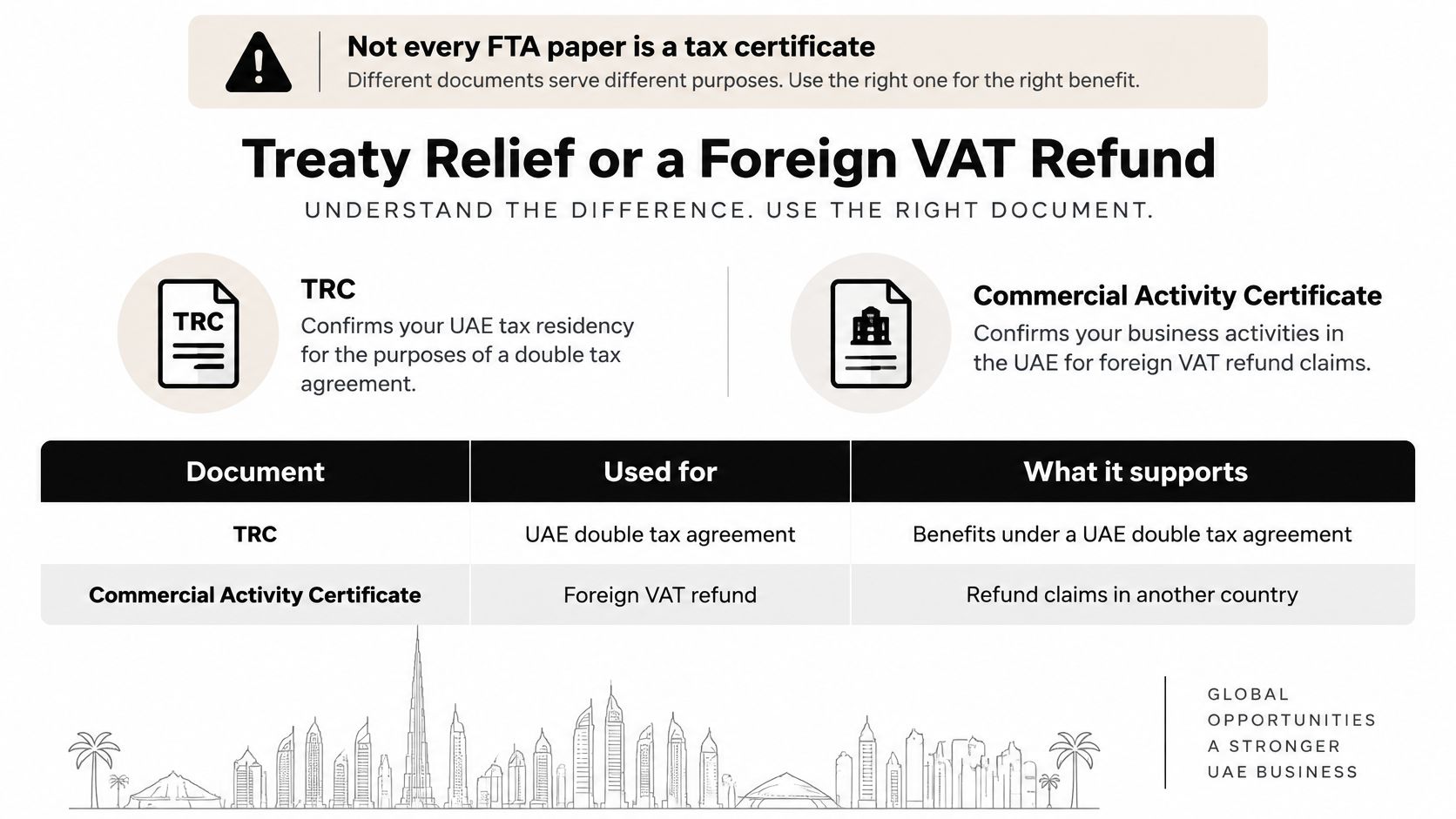
TRC versus Commercial Activity Certificate
| Goal | Document to request | What it supports | What it does not do |
|---|---|---|---|
| Reduce withholding under a named DTA | Tax Residency Certificate | Treaty relief on qualifying income such as services, interest or royalties | Does not itself reclaim foreign VAT |
| Recover VAT paid outside the UAE | Commercial Activity Certificate | Overseas VAT refund claims, with or without a DTA | Does not deliver treaty relief |
| Prove UAE tax residence for a treaty period | Tax Residency Certificate | Residence evidence for the selected certification period | Does not guarantee the foreign authority will allow the benefit |
Calling every FTA document a “tax certificate” is like calling every travel document a boarding pass. They may all concern the same journey, but they perform different jobs.
The FTA's certificate guidance distinguishes a TRC supporting DTA benefits from a Commercial Activity Certificate used to reclaim VAT paid outside the UAE, whether or not a DTA applies. Choose the document by the result you're seeking, not by the wording someone used in an email.
Match the document to the transaction
A Dubai consultancy faces withholding. Its overseas client says it must deduct tax from service fees unless treaty requirements are met. The consultancy should establish which agreement and income provision the payer intends to apply, then obtain the residence evidence supporting that claim.
The company shouldn't assume that describing an invoice as consultancy income determines its foreign tax treatment. Ask the payer to identify the basis for the deduction.
A free zone exhibitor pays overseas VAT. The company purchases a European conference stand and wants the VAT back. Its immediate task is to investigate the foreign refund procedure and the commercial-activity documentation required, rather than request proof of residence.
Keep invoices and expense details ready for that assessment. A certificate doesn't replace evidence that the expenditure qualifies under the foreign refund rules.
A group receives interest or royalties. The relevant treaty may offer relief for that income, but the group must still establish that the payment and recipient satisfy the applicable conditions. Don't infer entitlement merely because the payment reached a UAE bank account.
Obtaining a certificate is not the same as securing the money.
Define the outcome before filing
For treaty relief, identify the payer, the income classification and the relevant agreement. For foreign VAT, identify the country of expenditure, the expense type and the refund process.
Where the transaction sits within a wider group arrangement, Corporate Tax planning can help organise the UAE-side questions alongside the foreign review. It shouldn't blur the distinction between separate taxes or jurisdictions.
If the goal is less withholding, investigate the TRC route. If the goal is foreign VAT back, don't stop at a TRC.
How to File a Business TRC Application Without Costly Mistakes
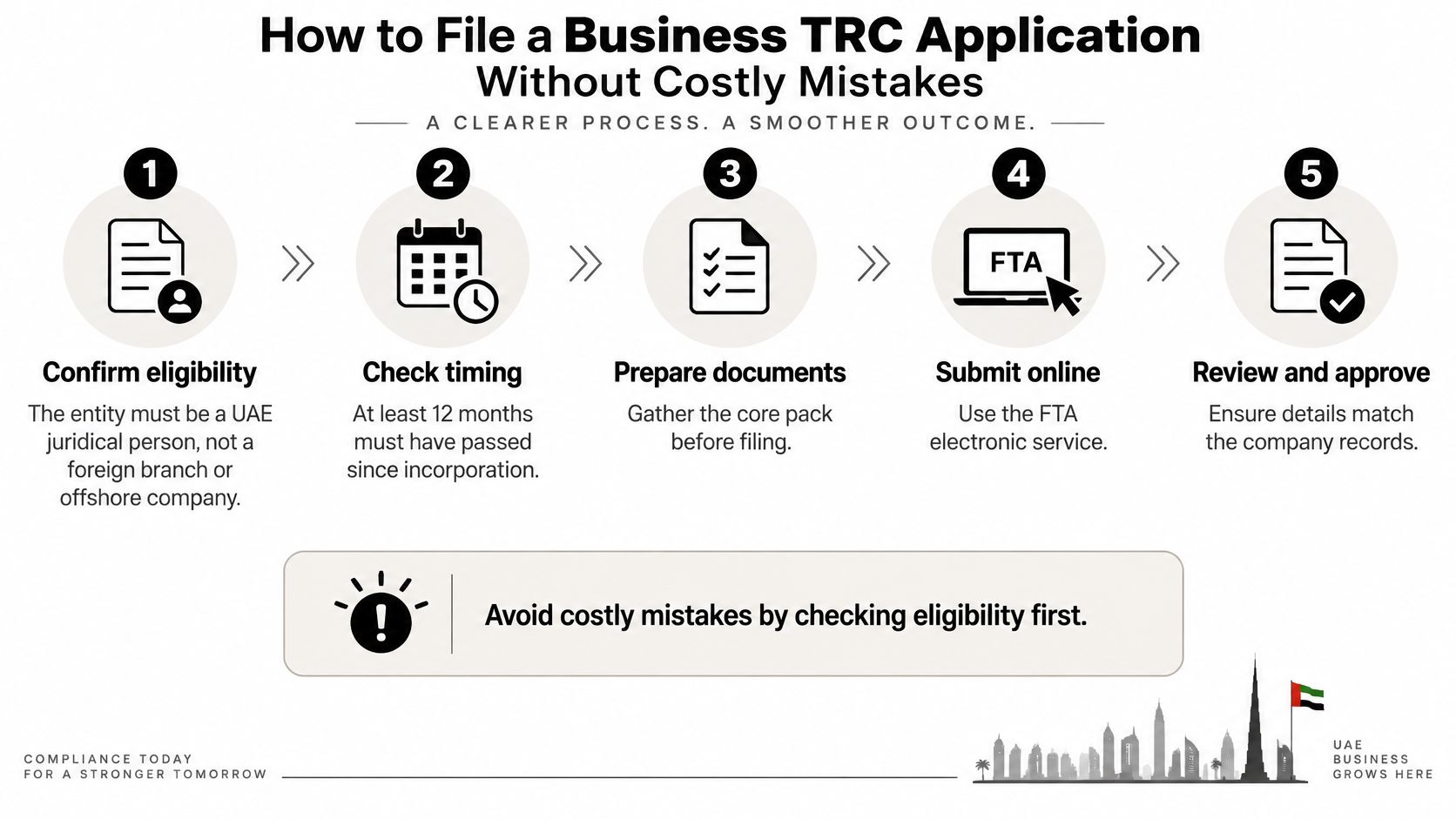
A company can have the right records and still lose time by applying for the wrong entity or period. Treat the application like a bank transfer: check the recipient and payment details before you submit. Assign one person to coordinate the FTA's electronic certificate application, collect records and follow up with the overseas payer.
Prepare the application in a controlled sequence
Confirm the applicant and its eligibility.
Start with the incorporation certificate and commercial licence, not the trading name used on your website. Record the incorporation date and check the legal form against the FTA's applicant categories.If an invoice came from another group company, resolve that before applying. The company seeking the certificate should be the entity whose treaty position the payer is reviewing.
Resolve Corporate Tax registration status.
Check whether the company has an active Corporate Tax TRN and whether its registration obligations have been addressed. If registration is required, coordinate it before applying for the certificate.A tax number is like a label on a file. Confirm its type and the legal entity it belongs to rather than copying an identifier from an invoice.
Agree on the treaty and certification period.
Ask the payer to state in writing what it needs. Note the treaty country, income concerned and dates its finance team will review.Use the payer's response as the application's instruction sheet. If the payer is focused on payment dates while your accounts team is using invoice dates, clarify which period matters before selecting one.
Upload a coherent document pack.
Review the files from the perspective of someone unfamiliar with the company. The reviewer should be able to identify the applicant, its premises, its authorised representative and relevant management evidence.Submit legible scans with complete pages. An internal index can help the application owner match each file to the information requested.
Submit electronically and pay the applicable fee.
Enter the company details and registration status carefully. Before paying, compare the form with the underlying records.Save the submission acknowledgement and payment record alongside the application. Assign someone to monitor messages and respond to requests for clarification.
Order a paper certificate only if the recipient requires it.
Ask the bank, payer or foreign authority whether it needs a physical copy. If it does, confirm delivery arrangements and the recipient's deadline before giving an expected arrival date.Send the certificate with the relevant claim.
Provide it to the person handling treaty treatment, along with the claim documents the payer requested. Check the company details and validity dates on the issued certificate before sending it.Keep the certificate, claim correspondence and payer's response together. The record should show whether the claim was accepted, not just that a file was emailed.
Identify what each mistake puts at risk
Each checkpoint protects a different part of the process: issuance, cost or use abroad. A mistake can affect one without affecting the others.
| Mistake | Where it causes trouble | Practical response |
|---|---|---|
| Applying before satisfying the establishment condition | Can block issuance | Check the incorporation record before submitting |
| Applying through an excluded entity type | Blocks issuance for that applicant category | Review the legal structure and the entity that issued the invoice |
| Selecting dates unrelated to the payer's request | Can undermine use of the certificate abroad | Agree on the relevant period with the payer |
| Submitting weak or inconsistent management evidence | Can prevent the FTA from being satisfied | Address gaps with genuine contemporaneous records |
| Leaving registration coordination until late | Can increase cost or delay preparation | Assign someone to check registration early |
| Treating the certificate as an automatic refund | Risks failure after issuance | Complete the applicable treaty claim or refund process |
| Ordering unnecessary paper copies | Adds avoidable cost | Ask the recipient what form of document it requires |
An incomplete management file needs careful attention. A spelling error is easy to correct; missing records of the decisions the company says were made in Dubai are a more serious gap.
If the records do not support the proposed position, pause and seek advice. Do not backdate minutes, change recorded meeting locations or present a newly signed lease as evidence of an earlier arrangement.
Keep treaty work separate from ordinary tax preparation
A residence certificate does not replace company accounts or an assessment of tax deductions. For US tax-preparation questions, Bookkeeping and Accounting of Florida Inc.’s resource on tax deductions for growing companies covers a separate workstream from UAE treaty certification.
Give each adviser a clear task. The UAE application owner prepares residence evidence; the foreign adviser or payer considers how it supports the local claim.
Deadline check: Work backwards from when the payer needs usable documents, not from when you hope to submit the application.
Leave time for internal approvals, missing records and foreign forms. If withholding has already occurred, ask the relevant foreign adviser about the recovery procedure instead of assuming that sending the certificate will reverse the deduction.
Close the task only when the outcome is recorded. An approved certificate, an accepted treaty claim and a recovered amount are separate milestones.
Ask Smart Classic Before the Treaty Deadline
Preparing the application in-house can make sense when your company's legal form, registration status and records are straightforward. You also need a clear request from the payer and someone able to coordinate the application through to its use abroad.
Think of outside support as a pre-flight check, not a way to change the destination after take-off. Bring in an adviser before filing when the uncertainty concerns the entity structure, the treaty purpose or the evidence behind the application.
Decide where you need help
- Handle internally: Your team has consistent corporate records, a known treaty purpose and an agreed certification period.
- Ask Smart Classic: A foreign branch has been invoicing, the group is comparing mainland, free zone and offshore structures, or registration remains unresolved.
- Request a cross-border review: The foreign payer disputes entitlement, or the request may concern an overseas VAT refund.
The Dubai consultancy, based in Baniyas Square, offers company-formation guidance, PRO handling and tax residency certificate support. Its accounting, audit and corporate-finance services can also help organise the records and wider structural questions surrounding an application.
Ask for a cost-calculator discussion that distinguishes government charges from professional work. Have the adviser check that the licensing authority and company details intended for the certificate match the commercial licence.
Before a consultation, prepare answers to these questions:
- Which country: Where is the payer withholding tax, or where was the VAT paid?
- Which transaction: What income or expenditure is involved?
- Which period: Which dates do the invoices and payments concern?
Book support before the payer's deadline, while there's still time to resolve an unclear or mismatched request.
Smart Classic Business Hub offers business TRC application support alongside company setup, PRO services and VAT-compliant accounting. Visit Smart Classic Business Hub with your payer's request, company licence and relevant invoice dates to discuss the right document and prepare your application before the treaty deadline.