
You've likely reached the point where the decision is already made. You're leaving your job, you want to do it properly, and you don't want a badly handled resignation to delay your salary, your handover, or your visa cancellation.
That's the right instinct in the UAE. A resignation letter isn't just a polite note to your manager. It's the document that starts a formal employment exit. If it's vague, submitted casually, or left undocumented, small mistakes can turn into larger problems later, especially when final settlement and immigration steps begin.
Why Your UAE Resignation Letter Is a Legal Document
A common UAE exit problem starts like this. An employee tells the manager, “I'm planning to leave,” sends a brief WhatsApp message later, and assumes notice has started. Two weeks pass, HR says no formal resignation was received, the last working day is disputed, and final settlement gets pushed back.
That is why the resignation letter matters. Under Federal Decree-Law No. 33 of 2021, resignation must be in writing. In practice, this document is the record both sides return to if there is any disagreement about notice, attendance, handover, salary cut-off, unused leave, gratuity, or visa cancellation timing.
A well-drafted letter does more than inform your employer. It fixes the resignation date, supports your notice calculation, and gives you evidence if the company later changes its position. If a dispute reaches MOHRE, the first question is often simple: what was submitted, when was it submitted, and can you prove receipt?
What the letter triggers
Once written notice is submitted, the employment exit process begins inside the company. HR may start reviewing your contract terms, payroll may check salary and leave balances, and the PRO team may prepare for later labour and immigration steps. If your records are not clean, delays tend to show up at the end, when you need your final dues and visa cancellation completed without friction.
This is also why payroll documentation matters. If you need context on how salary records are tracked in the UAE, this guide to what is WPS in UAE helps explain why formal employment records carry weight during an exit.
From a risk perspective, the resignation letter should achieve three things:
- State clear intent: there should be no ambiguity that you are resigning from your position.
- Fix the notice timeline: the date of submission and the intended last working day should be easy to verify.
- Create evidence: if the employer later disputes timing or receipt, your letter and proof of delivery become part of your protection.
I advise clients to treat the letter as the first document in their final settlement file, not as a courtesy note. That approach reduces arguments later.
Why precision matters more than tone
Employees often spend too much effort trying to sound diplomatic and too little effort making the document precise. Polite wording is fine, but legal clarity protects you better than a warm paragraph ever will.
The practical trade-off is straightforward. A shorter letter with a definite last working day is safer than a friendly message that leaves dates open to interpretation. Once dates are unclear, disputes usually spread into other areas, including whether full notice was served, whether salary should be deducted, and whether the company can hold up release paperwork.
If your contract has clauses on notice, handover, confidentiality, or restrictive terms, review them before resigning. That is one reason legal review of employment paperwork can matter, especially in senior or sensitive roles. For reference, Mayo Law for employment contracts discusses how contract clauses can affect employment disputes.
The safest position is simple. Submit written notice, keep the wording direct, identify the final working day, and preserve proof that the employer received it.
Crafting a Compliant Resignation Letter Clause by Clause
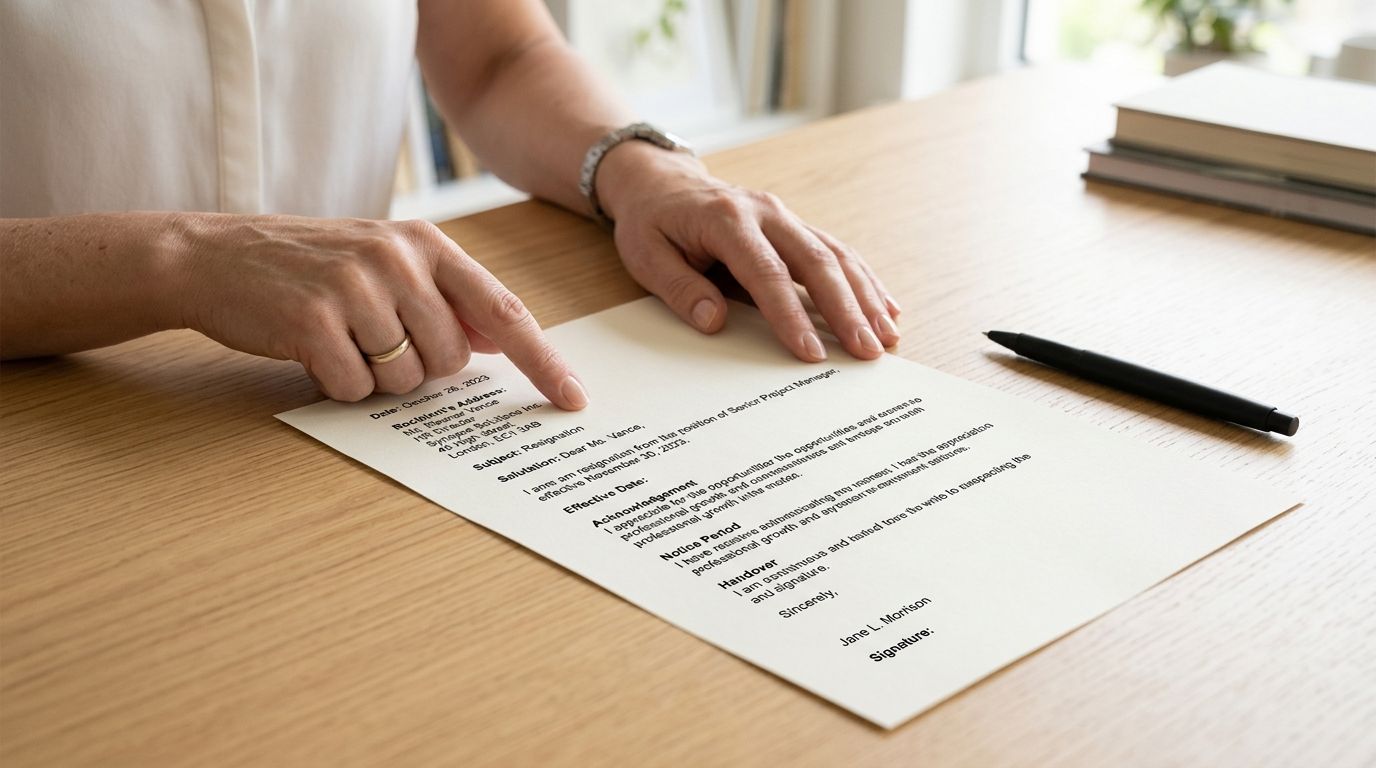
The strongest resignation letters in the UAE are simple, direct, and complete. They read like formal notice documents, not like emotional emails. That distinction matters because a compliant UAE resignation letter should include the employee's and employer's details, a direct statement of resignation, the effective last working day, and a signature. UAE-focused guidance also notes that the highest-risk failure point is omitting the exact last working day, because that creates ambiguity over whether the notice period was properly served, according to Huduri's UAE resignation format guidance.
Employee and employer details
Start with the basics. Include your full name, job title, department if relevant, and the name of the company. Address the letter to your reporting manager, HR manager, or the authorised person your company normally uses for employment notices.
This isn't bureaucracy for its own sake. It reduces room for someone to argue later that the letter was informal, misdirected, or not intended as formal notice.
If you're reviewing your contract before drafting the letter, it can help to understand how resignation clauses sit alongside wider Mayo Law for employment contracts issues, especially where dispute language or procedural obligations may affect how employment matters are handled.
Date of submission
Always date the letter. The date isn't decorative. It helps establish when the resignation was issued and supports your position if there's a later disagreement over when notice started to run.
If you submit by email, the timestamp adds another layer of proof. If you submit a hard copy, the date on the letter should match the date you hand it over.
The direct statement of resignation
This sentence should be unmistakable. Don't hide the point in a long paragraph. State that you are resigning from your role.
Use wording such as:
I hereby submit my resignation from my position as [Job Title].
That works because it is clear, formal, and difficult to reinterpret. Avoid vague phrases like “I am considering moving on” or “I may need to leave soon”. Those phrases create uncertainty, and uncertainty is the enemy of clean exits.
Defining your last working day
This is the most important line in the letter.
State the exact date of your final working day based on your contractual notice requirement. Don't leave HR to calculate it. Don't say “after serving my notice”. Don't write “effective next month”. Give the full date.
A better structure is:
- Your resignation date
- Your contractual notice period
- Your exact last working day
That gives everyone the same reference point. It also helps avoid payroll and leave-balance confusion.
Handover and transition support
A short line offering handover support is worth adding. It shows professionalism and reduces resistance from management.
You don't need to promise more than you can deliver. A concise statement is enough:
- Offer a handover: Mention that you'll support transition of tasks and documents.
- Keep it factual: Don't overexplain your reasons for leaving.
- Stay measured: This is not the place to list grievances.
A good resignation letter doesn't try to win an argument. It records a decision and makes the transition easier to manage.
Closing and signature
End formally with your name and signature. If the company uses physical files, signed originals still matter. Some UAE guidance also recommends retaining signed copies for both sides, which is sensible recordkeeping in any employment exit.
If you're using email, attach a signed PDF where possible. That creates a cleaner record than a casual message in the body of an email.
Resignation Letter Templates for Common UAE Scenarios
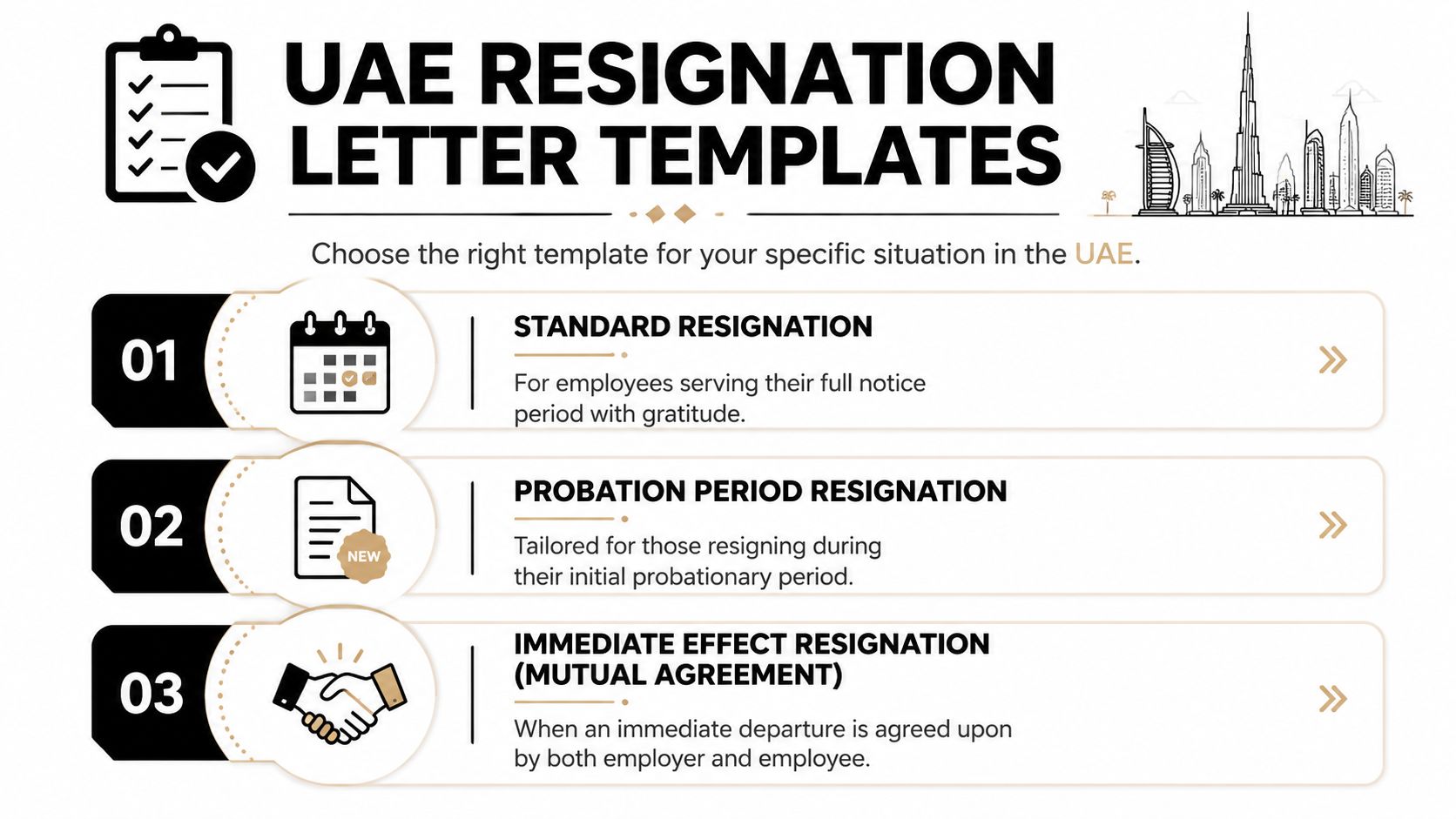
A typical problem in UAE resignations is not the decision itself. It is using the wrong template for the wrong employment situation, then discovering later that HR is disputing the notice period, the release date, or the final settlement. The letter should match the facts of your contract and the way you intend to leave.
In UAE practice, a resignation letter starts a formal process, not just a conversation. Your wording should support three practical goals: confirm that you are resigning, record the last working day you are proposing based on your contract, and avoid language that can be used against you later if there is a dispute over salary, gratuity, leave balance, or visa cancellation. If you need to check MOHRE labour inquiry services before submitting your resignation, do that first, especially during probation or if your employer has already challenged notice calculations.
Standard resignation from a permanent role
Use this version if you are leaving on ordinary terms and intend to work through the contractual notice period.
[Date]
To: [Manager Name / HR Department]
[Company Name]Dear [Name],
Please accept this letter as my formal resignation from my position as [Job Title] with [Company Name]. In accordance with my employment contract, I am serving my notice period, and my last working day will be [exact date].
I will continue to perform my duties during the notice period and support the handover of my responsibilities.
Please arrange my final settlement and exit formalities in accordance with applicable UAE labour requirements and company procedures.
Sincerely,
[Full Name]
[Signature]
This template works because it is controlled and complete. It does not argue. It does not explain more than necessary. It also gives HR a clear date to process payroll, unused leave, and end-of-service calculations.
Resignation during probation
Probation cases need more care. The notice rules may differ depending on whether you are moving to another UAE employer, leaving the UAE, or resigning under the terms stated in your contract. For that reason, the letter should stay precise and should not promise a notice period you have not checked. If you want to understand notice period best practices, start there, then compare them against your UAE contract and current labour rules.
[Date]
To: [Manager Name / HR Department]
[Company Name]Dear [Name],
I am writing to formally resign from my position as [Job Title] with [Company Name] during my probation period. Please treat this letter as written notice in accordance with my employment contract and applicable UAE employment law. My intended last working day is [exact date].
I will complete the handover of my current duties during this period and cooperate with any reasonable exit procedures.
Sincerely,
[Full Name]
[Signature]
I usually advise clients to keep probation letters tighter than standard resignations. The more extra language you add, the more room there is for disagreement later.
Immediate effect resignation by mutual agreement
Employees often ask whether they can resign with immediate effect. In most cases, that is not a safe assumption. If the company is willing to release you early, record it as a request for mutual agreement and get written acceptance.
[Date]
To: [Manager Name / HR Department]
[Company Name]Dear [Name],
I hereby submit my resignation from my position as [Job Title] with [Company Name]. I request that my employment end on [exact date] by mutual agreement, subject to your written approval and completion of all exit formalities.
I am available to assist with handover arrangements to support an orderly transition. Please confirm acceptance of this proposed release date in writing.
Sincerely,
[Full Name]
[Signature]
That final sentence matters. If the employer later says you abandoned work or failed to serve notice, written confirmation of the agreed release date becomes highly useful.
Short resignation where relations are strained
Some employees are leaving after salary delays, poor treatment, or a dispute with management. The instinct is to set all of that out in the resignation letter. In practice, that usually weakens your position. Keep the resignation clean, then raise the dispute separately through HR, MOHRE, or a formal written complaint if needed.
[Date]
To: [Manager Name / HR Department]
[Company Name]Dear [Name],
Please accept this letter as my formal resignation from my position as [Job Title] with [Company Name]. In accordance with my employment contract, my last working day will be [exact date].
I request that my final dues and exit procedures be completed in accordance with applicable UAE employment requirements.
Sincerely,
[Full Name]
[Signature]
This version is useful when trust is low. It keeps the record narrow and avoids mixing resignation with allegations.
What a good UAE template does
The strongest templates usually include the same practical elements:
- A direct resignation statement
- Your job title
- The exact last working day
- A short handover commitment
- A request to process final dues and exit formalities
- A formal signature block
What should stay out of the letter is just as important. Do not include threats, long explanations, accusations, or bargaining points about gratuity, unpaid salary, or visa issues unless a lawyer has told you to do so. Those matters are often better handled in separate written records.
A resignation template should do one job well. It should create a clear written record that supports a clean exit and leaves you in a stronger position if the employer later delays settlement or disputes your release.
How to Properly Submit Your Resignation and Get Proof
A common UAE exit problem starts the same way. An employee sends a resignation on WhatsApp or mentions it in a meeting, the employer later disputes the date, and the notice period turns into an argument about absconding, salary, or release. The letter matters, but the submission process is what protects you.
In practice, I advise clients to treat resignation like a legal handover, not a casual message. Start with a short verbal conversation with your manager, then send the formal resignation in writing without delay. That approach is consistent with Michael Page's UAE resignation advice, and it usually reduces friction while preserving a clear record.
Submit it through an official channel
Use the channel your employer already recognizes for formal HR actions. That usually means company email, the HR portal, or a signed hard copy delivered to HR or your line manager. If your workplace accepts both email and paper, use both.
Send the resignation from your own work email if that is the normal business channel, and keep a copy outside the company system if policy allows. If you submit a hard copy, ask the recipient to sign, stamp, or initial your duplicate copy with the date received. A resignation without proof of receipt is weaker than many employees expect.
What counts as proof
The best proof shows three points clearly. Who sent the resignation, what document was sent, and when the employer received it.
Use one or more of these records:
- Email trail: The sent email, attached resignation letter, timestamp, and any reply from HR or management.
- Signed acknowledgment copy: A duplicate hard copy signed or stamped by the company with the receipt date.
- HR portal confirmation: Screenshot or download showing the submission date and status.
- Courier receipt: Useful if the employer refuses to accept the letter in person.
If management refuses to acknowledge receipt, do not argue in the hallway. Send the letter again by email to HR and your manager, keep the delivery trail, and preserve any response that disputes or delays acceptance. Resignation does not depend on the employer liking the decision. It depends on your ability to prove proper notice.
If you want broader context from an employment practice angle, this guide can help you understand notice period best practices.
Build your evidence file before access is cut
Employees often keep only the resignation letter. That is rarely enough in a disputed exit.
Save a clean folder with:
- The final signed resignation letter
- Proof of delivery and acknowledgment
- Your employment contract and any notice period clause
- Relevant HR emails about acceptance, handover, or release date
- Screenshots from the HR system, if used
- Handover records and clearance messages
- Recent payslips, leave balance records, and any unpaid dues correspondence
Do this before your account access changes. Many disputes become harder because the employee can no longer retrieve emails, portal records, or handover confirmations after the employer disables access.
If the employer disputes the resignation
Keep the dispute separate from the resignation itself. Continue attending work during the notice period unless you have written instructions stating otherwise. Ask for written clarification if the company claims your letter was invalid, your notice period is different, or your last working day has changed.
If the issue starts affecting salary, final settlement, or visa processing, check the available Ministry of Labour inquiry services and prepare your records before escalating to MOHRE. In many cases, the side with the better paperwork is in the stronger position.
Do not rely on verbal reassurance. Save dated records while you still have access to them.
After Resigning Navigating Visa, Gratuity, and Final Settlement
Once the resignation is submitted, most employees start worrying about the next set of risks. Will the employer process the exit? Will final salary be delayed? What happens to the visa? Those are the right questions.
In practice, the post-submission stage is where many problems surface. The resignation letter starts the process, but your protection depends on what happens after the letter is delivered and whether you can prove each step.
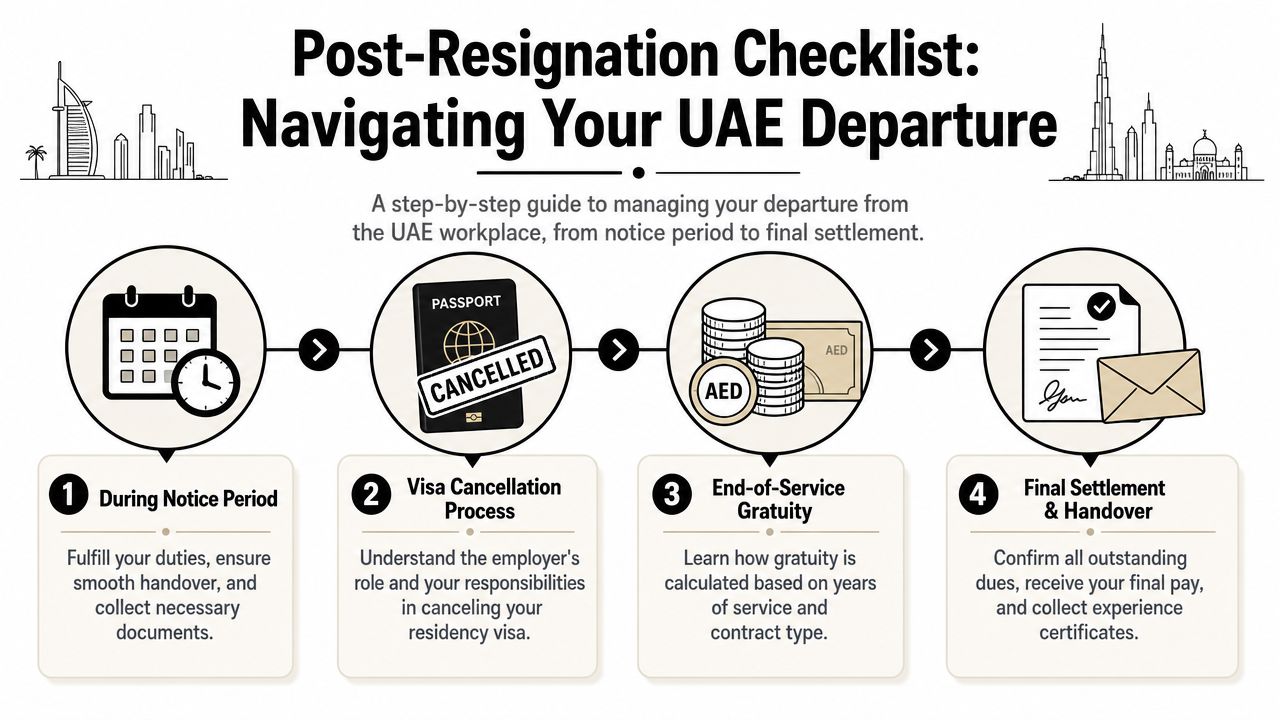
During the notice period
Your notice period isn't dead time. It is still active employment. Keep doing your job properly, complete handovers, and avoid conduct that gives the employer a separate disciplinary issue to raise.
Use this period to close out your side of the file:
- Document handover: Transfer files, passwords through approved channels, client updates, and pending tasks.
- Confirm company property return: Laptop, access card, SIM, documents, or any equipment assigned to you.
- Request written confirmations where practical: Especially for handover completion and clearance milestones.
A professional notice period often makes the final settlement stage smoother because fewer internal objections remain.
Final dues and settlement items
Many employees focus only on the last salary. That's too narrow. A proper exit review usually includes salary up to the final day worked, unused leave treatment where applicable, end-of-service benefits where applicable, and internal clearance.
Some UAE-focused guidance also notes that resignation letters may request final salary, leave encashment, end-of-service benefits, and exit clearance, while employers are responsible for cancelling the work visa and issuing exit-related documents, as explained in Prime Advices' UAE resignation legal guide.
If you want a practical backgrounder on one part of that calculation, this guide to how to calculate leave salary in UAE helps clarify how leave-related amounts are commonly approached.
For employees reviewing their broader end-of-service position, this resource on understanding UAE gratuity payments is also worth reading alongside your contract and HR records.
Visa cancellation and immigration timing
UAE resignations are distinct from those in many other markets. Your employment exit isn't just an HR matter. It can affect your legal stay, your next employer's onboarding timing, and your ability to complete a clean transition.
That's why delayed processing matters. If the employer sits on the resignation or drags out the administrative steps, the impact can move beyond payroll into immigration status. Keep copies of all exit documents, and don't hand over your only originals without retaining scans.
If your employer controls the visa process, your best protection is clean documentation and prompt follow-up in writing.
If the employer refuses to accept the resignation
A surprising number of employees think resignation requires approval. It doesn't work that way when the resignation is valid and properly submitted.
UAE guidance states that either party can terminate with a notice period between 30 and 90 days, and if an employer refuses a resignation, the employee may escalate the dispute to MOHRE under Article 54, as noted in Darwinbox's UAE notice period guidance. This is why proof of delivery matters so much after submission.
If that happens, take a measured approach:
- Resend the resignation in writing if acknowledgment is missing.
- Attach prior proof such as email trail or signed copy.
- Ask for written confirmation of the last working day and exit processing.
- Escalate to MOHRE if the employer still refuses to act.
Don't argue endlessly over chat or phone. Once the issue becomes procedural, keep the record procedural.
Common Resignation Pitfalls and How to Avoid Them
A common UAE exit problem looks like this. An employee sends a frustrated WhatsApp message, stops attending work after a verbal discussion, and assumes HR will sort out the paperwork later. A week later, there is a dispute over the notice period, the last working day, and whether the resignation was ever properly submitted. By then, the issue is no longer just about wording. It affects salary release, end-of-service processing, and visa closure.
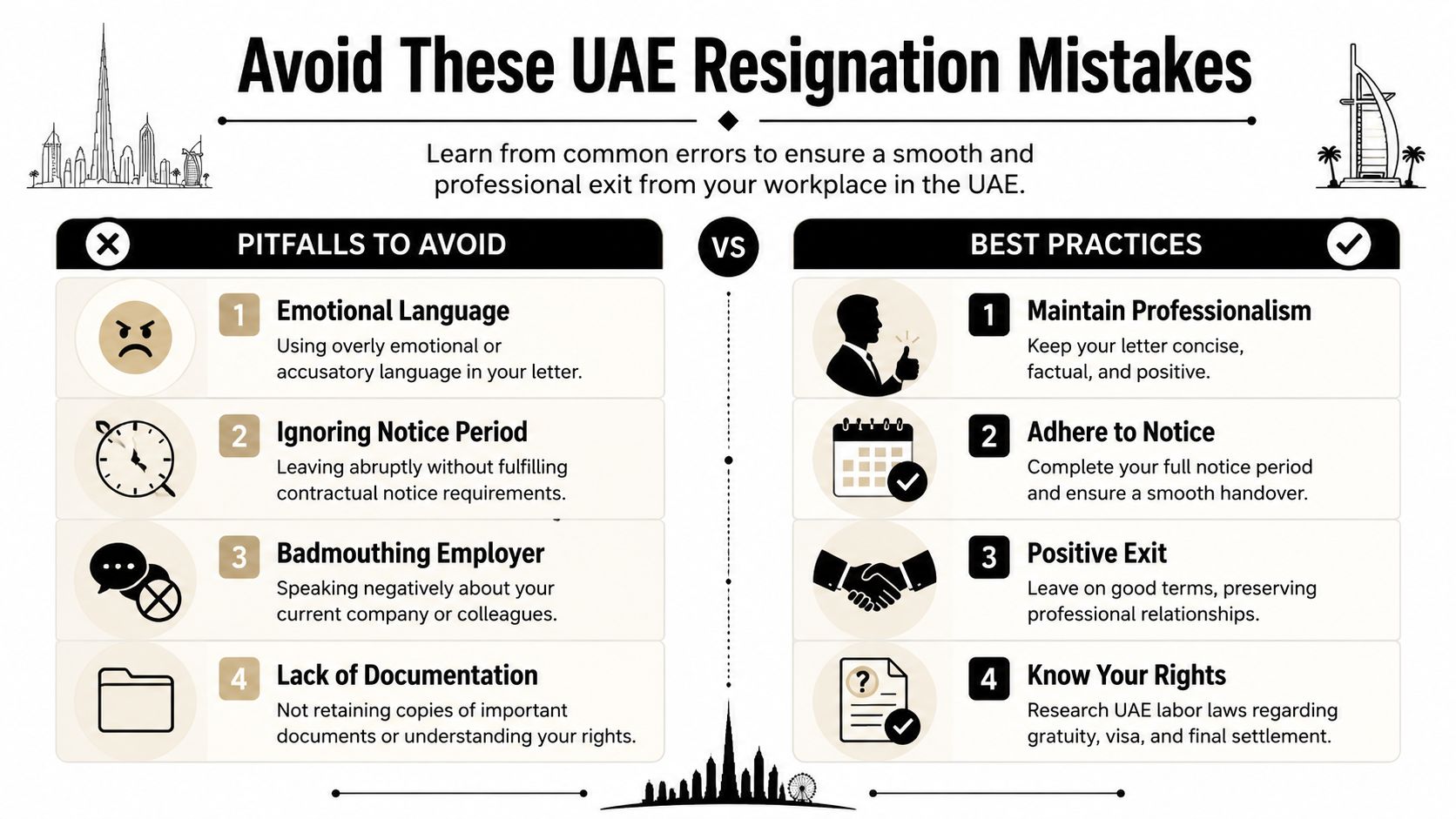
The pattern is consistent. Resignation disputes usually come from weak process control, not from the letter format itself. Employees create risk when they write emotionally, leave dates unclear, rely on verbal discussions, or sign final papers without checking what they are accepting.
The mistakes that cause the most trouble
-
Emotional wording: Accusations, threats, or long personal complaints can distract from the legal purpose of the letter.
Better approach: Keep the resignation letter factual, brief, and professional. Save any separate grievance for a different written record. -
No exact last working day: If the notice timeline is vague, the employer may calculate it differently.
Better approach: State the resignation date, notice period, and final working day in clear terms. -
Verbal resignation only: A meeting or phone call may start the conversation, but it does not give you a reliable record.
Better approach: confirm the resignation in writing the same day and keep proof of delivery. -
No acknowledgment record: If the employer later disputes receipt, the burden shifts to your evidence.
Better approach: retain email trails, screenshots, courier proof, and any signed copy. -
Combining resignation with a dispute claim: This often creates confusion about whether you are resigning normally or alleging a labour violation.
Better approach: submit the resignation as one document and raise salary, harassment, or contract issues through a separate written complaint. -
Signing the final settlement too quickly: Some employees sign before checking unpaid wages, leave balance, deductions, or gratuity treatment.
Better approach: review every amount first and ask for a breakdown in writing before signing.
Know when normal notice may not apply
Standard notice rules do not cover every case. If there is serious misconduct by the employer, such as persistent non-payment of wages or other material breaches, the employee may have stronger legal grounds than a routine resignation. The key point is to treat that situation as a labour dispute supported by records, not as an emotional exit.
That distinction matters in practice. A standard resignation should be clean, dated, and provable. A dispute-based exit should be documented with salary records, contract copies, messages, and formal complaints where needed. If the employer resists or withholds dues, the issue can move to MOHRE quickly, and your documents will carry more weight than any verbal account.
I usually advise clients to check four items before they treat the matter as finished: proof the resignation was sent, written confirmation of the last working day, a clear final settlement calculation, and confirmation that visa cancellation steps are being handled correctly. Missing any one of those can delay the exit or weaken your position if a disagreement starts later.
If you need practical support beyond the letter itself, Smart Classic Business Hub helps individuals and businesses handle UAE compliance matters that often sit around employment transitions, including PRO support, visa-related processes, company services, and documentation guidance. If your resignation affects a business setup, partner visa, payroll records, or wider compliance obligations, their team can help you move through the process with fewer delays and fewer loose ends.