
RAKEZ year-1 costs usually land between AED 10,000 and AED 40,000, and the licence fee is rarely the deciding factor. The primary constraint is visa allocation tied to office size, not the headline number on the brochure.
That is why so many founders get trapped by the cheapest advertised package. They buy a low-cost licence, then discover the facility is too small for the visa count they need, or the renewal stack pushes the cost far above the “from” price.
What Most Founders Get Wrong About RAK Free Zone
The most common mistake is treating RAK Free Zone like a single product with one price. It isn't. RAKEZ is a portfolio of facility classes, visa capacities, and activity permissions, and the package you choose changes your real cost far more than the licence line on the quote.
A founder usually starts with the wrong question. They ask, “What is the cheapest licence?” The better question is, “How many visas do I need, what facility class grants them, and what will renewal cost once I'm operating?” That is the decision that ultimately determines whether the setup stays lean or turns expensive.
Practical rule: if you need staff soon, size the facility first and the licence second.
I've seen this go wrong in a very predictable way. Someone picks the smallest flexi-desk because the upfront fee looks tidy, then realises the visa quota is too tight for the team they planned to hire. They end up upgrading later, which means they pay twice, once for the cheap start, then again for the correct structure.
RAKEZ makes sense when you understand it as a scale-and-load decision. For manufacturers, traders, and service firms that can live within the right facility class, it can be efficient. For founders chasing the absolute lowest headline licence, it can become a false economy.
Understanding What RAK Free Zone Actually Is
RAKEZ, the Ras Al Khaimah Economic Zone, came into its current form in 2017 after the merger of RAKIA and RAK FTZ. The UAE Ministry of Economy later recorded 16,682 licensed companies after the merger, including 16,208 free zone companies and 474 non-free-zone entities, which shows the scale of the platform rather than a small, isolated zone. The same ministry document also shows yearly free-zone incorporations rising from 528 in 2017 to 1,539 in 2018, 2,328 in 2019, and 3,470 in 2020. Oxford Business Group's 2013 report on Ras Al Khaimah gives useful historical context for how far the zone has expanded.
RAKEZ is not one monolithic site. It sits across different park types, including industrial and technology-focused facilities, and that distinction matters because it affects both operating cost and visa structure. The published warehouse rates show the gap clearly, with Industrial Park space at about AED 200 to AED 230 per m² per year and Technology Park space at about AED 280 to AED 320 per m² per year. The higher-load options also rise from 15 kW to 30 kW and 60 kW, which is why the facility class matters for energy-intensive users. RAKEZ's free zone material is blunt on this point, the building choice changes the cost structure.
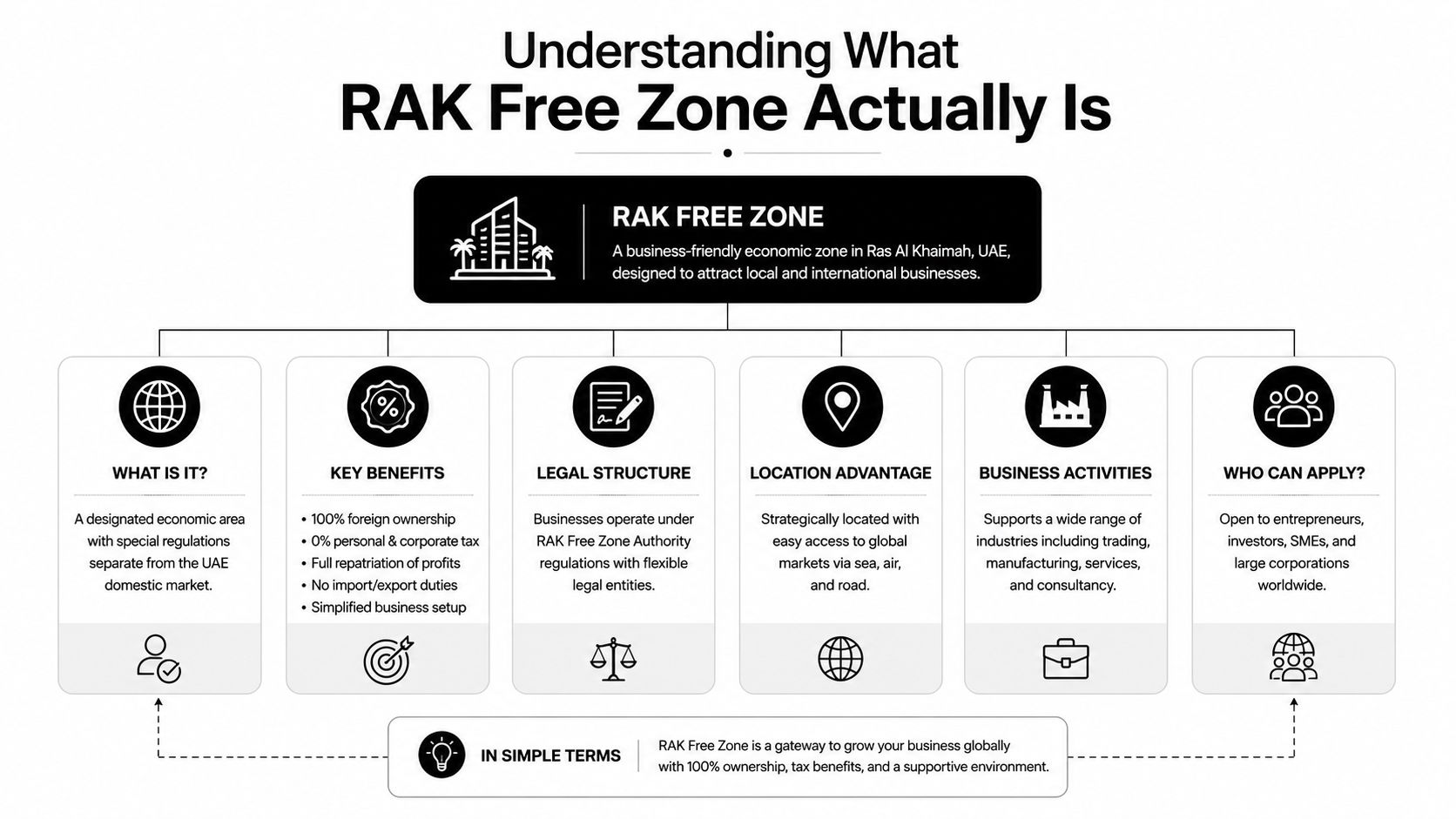
The practical takeaway is simple. RAKEZ is a portfolio, not a price tag. If you need warehouse capacity, assembly space, or a light industrial footprint, you compare facility class first. If you only need a small office-style presence, you should be comparing the quota rules just as closely as the licence fee.
Licence Types and Legal Forms Explained
RAKEZ licence choice is really a business model decision. The licence category should match what you do, not what sounds broad enough to cover future ideas. If you pick the wrong activity class, you slow yourself down later when banking, customs, or client contracts expose the mismatch.
How the licence categories map to real businesses
A commercial licence suits trading activity, especially import, export, and product distribution. A service or consultancy licence suits firms selling expertise, advisory work, digital services, and other non-physical delivery models. An industrial licence fits manufacturing, assembly, packaging, and processing, where the facility, power load, and plot size matter more than a desk.
The legal form sits underneath that choice. An FZE is usually the cleaner route for a solo founder because it keeps the structure lean. An FZ-LLC makes more sense when you want a small team, more operational flexibility, or a setup that feels closer to a conventional company. A branch works when an existing company wants to extend into RAKEZ without creating a fully separate parent structure.
My view: solo founders overcomplicate this. If you're the only shareholder and the activity is straightforward, an FZE is usually the least messy starting point.
| RAKEZ Licence Type and Legal Form Combinations | ||
|---|---|---|
| Licence Category | Legal Form | Best Fit For |
| Commercial | FZE or FZ-LLC | Traders, import-export firms, distributors |
| Service or Consultancy | FZE or FZ-LLC | Consultants, agencies, software and support services |
| Industrial | FZ-LLC or branch | Manufacturers, assemblers, processors, established operating groups |
There are limits too. RAKEZ is not the right jurisdiction for regulated financial services that need a specialist financial free zone framework. If your model depends on regulated finance, you should be looking at DIFC or ADGM, not forcing the activity into the wrong zone.
How the Setup Process Actually Works
The cleanest files move in a predictable order. First comes name reservation, then initial approval, then facility selection, and that last part is where people often lock in the wrong economics. After that you submit the documents, the licence gets issued, the establishment card follows, and then the visa process begins if you need residence.
For a straightforward file, the process is typically 7 to 14 working days, though specialised activities can take longer if another authority needs to review the application. That timeline only stays smooth when the activity is clear and the documents are ready before the file is opened.
The document pack should be staged before you start. Keep these ready:
- Passport copies, for each shareholder or applicant
- Passport photos, in the correct format
- CV, especially when the activity is consultancy or professional services
- No-objection letter, if you're already resident in the UAE and need one
- Proof of address, when the file asks for residential verification
A lot of delay comes from simple missing paperwork, not from the zone itself. The consultant's job is to stop the file from bouncing between steps, chase the right approvals, and make sure the facility choice matches the visa plan before anything is paid.
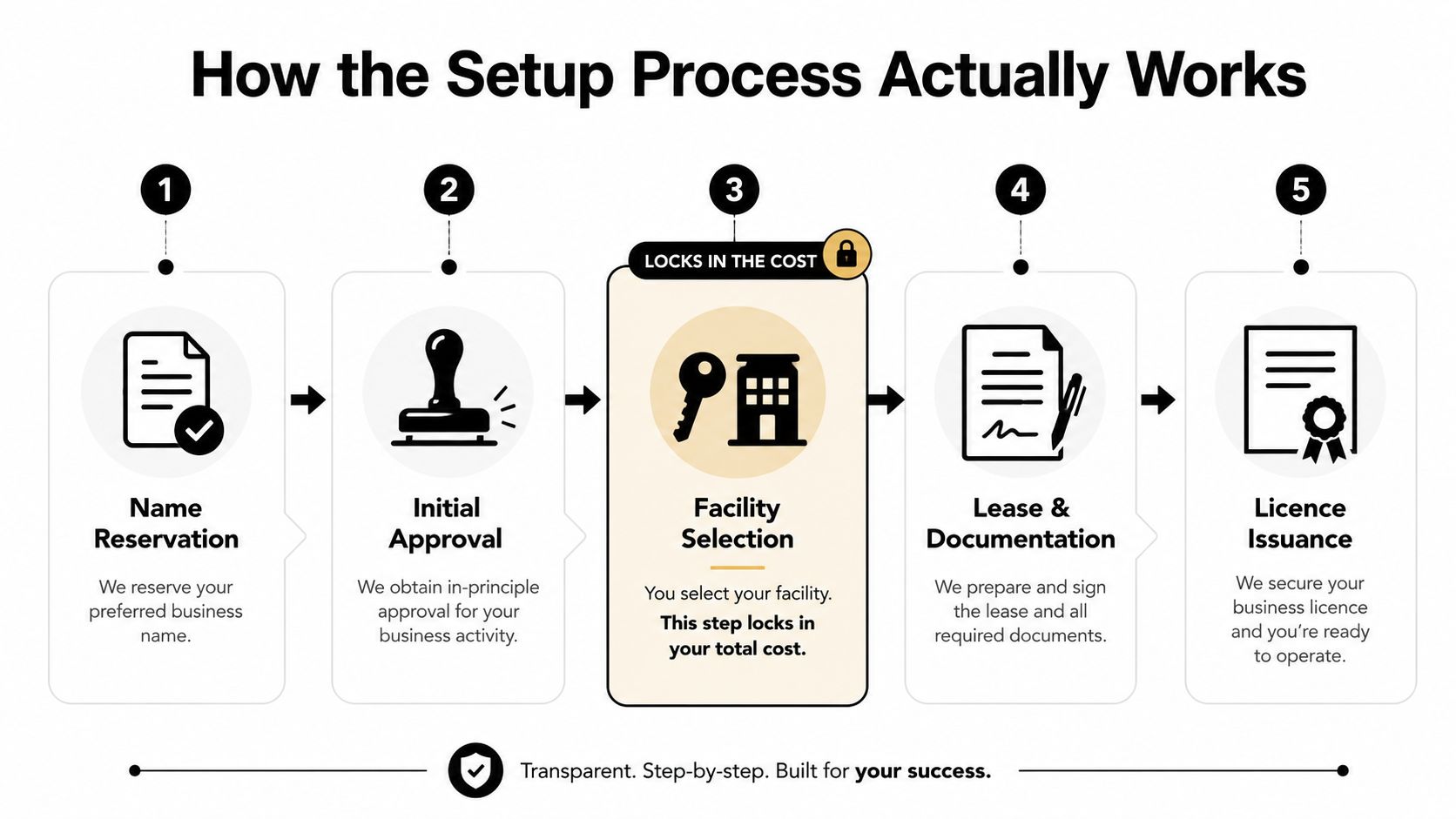
If you're setting up with a partner, the value is in sequencing, not paperwork copying. A proper setup advisor prevents the costly mistake of selecting a facility that looks cheap on day one but blocks the visa count you need a few weeks later.
Real Cost Breakdown Beyond the Headline Price
Headline pricing is where most comparison pages mislead founders. A licence-only figure tells you very little about what you'll spend in year one, because the true cost stack includes the facility, visa capacity, government processing, and renewal items that come later.
The simplest way to budget is to break the year-1 spend into five layers.
| RAKEZ Year-1 Cost Stack by Component | ||
|---|---|---|
| Cost Component | Typical Range (AED) | Notes |
| Licence fee | Varies by package | The starting point, not the full cost |
| Facility or flexi-desk | Varies by size and class | Often the factor that determines visa quota |
| Visa allocation | Varies by quota needs | Tied to facility size, not just the licence |
| PRO and government fees | Varies by filing needs | Includes filings and administrative steps |
| Share-capital considerations | Varies by structure | Depends on activity and legal form |
Independent market guides place RAKEZ year-1 costs from AED 6,000 to AED 40,000, with a licence-only option starting at AED 6,000 and zero-visa setups from AED 5,750. Another UAE setup guide shows a broader RAK formation band of about AED 10,000 for a basic licence up to AED 18,000 to AED 50,000 when visas and office solutions are included. That spread is exactly why two founders with the same business idea can end up at very different totals. Free Zone Match's comparison guide gives the clearest snapshot of how the low-entry offers sit beside visa-linked packages.
The renewal stack is what many cheap-package pages skip. Licence renewal, establishment card renewal, and visa renewal all sit behind the first invoice. If you want a neutral benchmark for budgeting adjacent costs in a launch plan, even a SaaS launch platform pricing page is a useful reminder that founders should compare the full operating stack, not just a headline entry fee.
Use the internal cost guide here if you want a broader setup comparison across structures and fees: https://smartclassic.ae/dubai-free-zone-company-setup-cost/
My view is blunt. If you only budget for the licence, you are not budgeting. You're guessing. The correct budget starts with the facility you need, then layers the licence, visa quota, and renewals on top.
How RAK Free Zone Compares to Other UAE Options
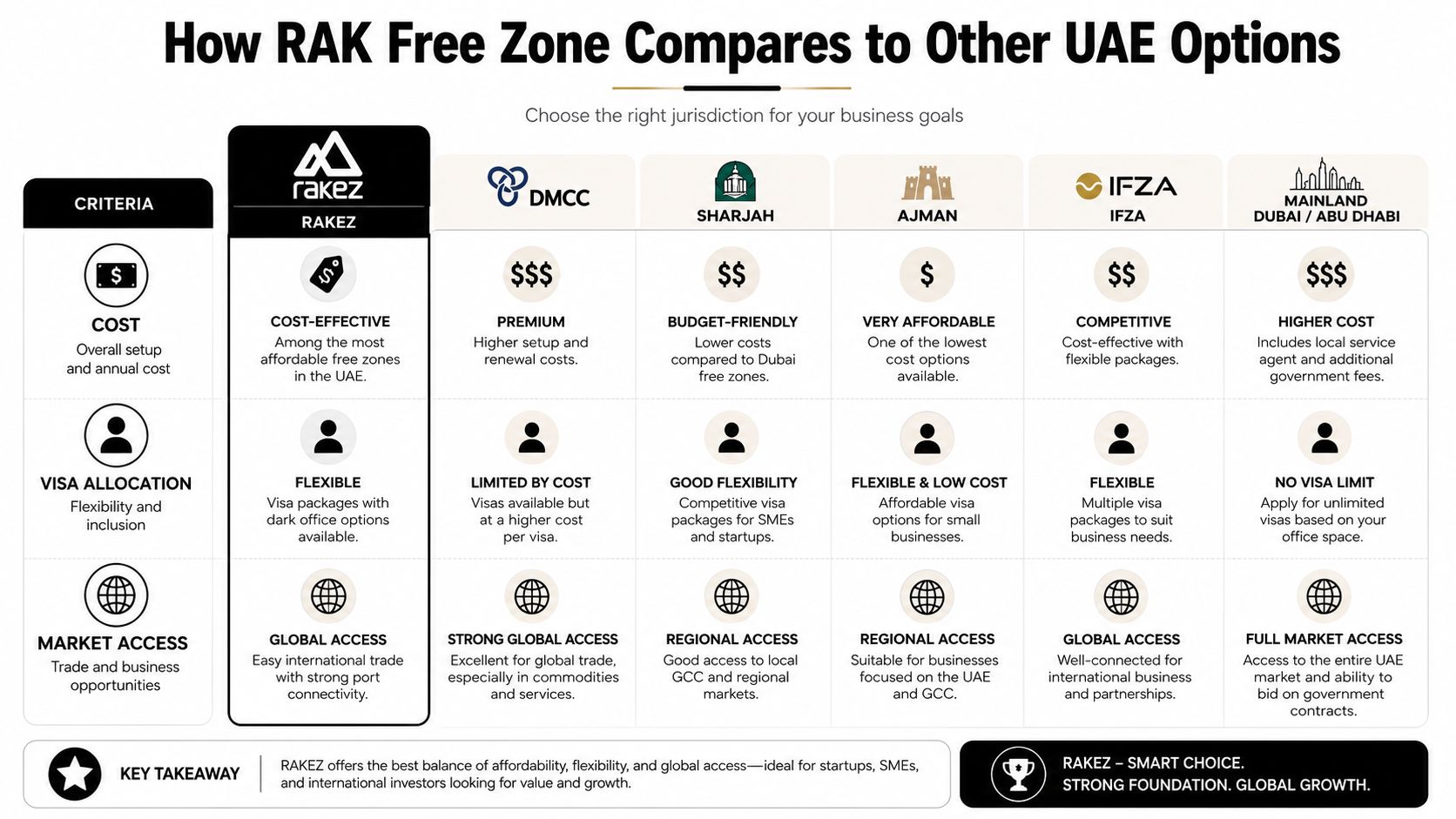
RAKEZ is attractive when total cost matters more than prestige. It competes well on setup economics, especially for founders who care about manufacturing, trading, logistics, e-commerce, or professional services and don't need a polished Dubai-city-centre address. The ownership side is straightforward too, because like other free zones, it supports 100% foreign ownership.
The comparison changes when market access becomes the main issue. Mainland Dubai or Abu Dhabi is the better choice if you need direct UAE retail without working through a distributor. If your business model depends on physical customer-facing presence in the local market, a free zone can be the wrong tool even if the licence looks cheaper.
Who should choose RAKEZ
Choose RAKEZ if you are cost-sensitive and your model is operational, not image-led. That includes manufacturers, e-commerce sellers, consultancies, and SMEs that want an efficient setup without paying Dubai premium pricing for a footprint they don't need. If your business is mainly export-oriented or B2B, RAKEZ is often the sensible choice.
Who should look elsewhere
Look elsewhere if your activity is regulated finance, if your brand absolutely needs a premium Dubai HQ address, or if your revenue depends on immediate, direct UAE retail presence. In those cases, the wrong jurisdiction can create friction long after the licence is issued.
Use this internal guide if you're still comparing location logic across the UAE: https://smartclassic.ae/designated-free-zones-in-uae/
One extra point matters now. Recent coverage around RAK Innovation City frames Ras Al Khaimah as part of a broader tech and industrial re-positioning, not just a place to buy a licence. Pinsent Masons' coverage of RAK Innovation City reflects that shift, and it helps explain why RAK is no longer just competing on entry price.
Visa Residency and Banking After Setup
The visa process is usually where founders realise the facility choice was the critical decision. Once the company is active, the sequence is straightforward, but the paperwork needs to be exact: entry permit, medical test, Emirates ID, then visa stamping. If you're already in the UAE, some steps may happen as a status change rather than a clean entry flow, but the logic stays the same.
Visa capacity is not free-floating. A useful rule of thumb in the market is roughly 1 visa per 9 m² of office area, and some starter shared-workspace packages can allow up to 6 visas. That's why founders who only looked at the licence fee often hit a wall later. They bought the wrong size, then had to upgrade the facility just to support the staff plan.
Banking takes longer than most founders expect
RAKEZ-licensed companies can apply for UAE corporate bank accounts, but the compliance process is tighter across the sector now. Expect deep KYC, beneficial-owner checks, and document review, and plan realistically for 4 to 8 weeks rather than assuming the account opens immediately. If your setup depends on bank access from day one, you need to prepare the business profile, activity explanation, and source-of-funds story early.
Practical rule: don't approach banking before the licence and establishment card are ready. It wastes time and creates avoidable compliance friction.
Use this if banking is part of your current setup plan: https://smartclassic.ae/rak-business-account/
Residency tax certificates can also be arranged separately, and they matter for cross-border structuring where proof of UAE residency supports tax planning. The mistake I see most often is founders trying to solve visa, banking, and tax residency in the wrong order. The file moves faster when the company structure is final before the bank conversation starts.
Common Pitfalls and How to Avoid Them
The mistakes repeat because the brochure language looks cleaner than the operating model. RAKEZ can be efficient, but only if you match the package to the business you're building.
1. Buying the cheapest desk and then needing more visas
This is the classic false economy. A founder picks a tiny flexi-desk because the entry price is low, then needs to bring in staff and discovers the quota is too tight. The corrective move is to define the visa count first, then choose the facility that can carry it.
2. Choosing the wrong facility class for the activity
Manufacturing in a service-style setup, or a consulting firm in an industrial-style package, creates friction later. The file may still open, but banking, operations, and renewal discussions become clumsy. The corrective move is to match activity, power needs, and space requirements before you sign anything.
3. Ignoring renewals
A lot of founders focus on first-year setup and forget that the renewal stack comes back every cycle. Licence renewal, establishment card renewal, and visa renewal all matter, and the cheapest start can become the most expensive long-term choice if the structure is weak. The corrective move is to ask for the full renewal picture before you pay the initial invoice.
4. Approaching banking too early
Banks want a clean corporate story, not just a licence copy. If you apply before the company is properly live, you often create more back-and-forth than progress. The corrective move is to wait until the company documents are complete, then submit a properly documented account application.
5. Using the wrong zone for regulated finance
This is essential. If your business falls into regulated financial activity, forcing it into RAKEZ is a mistake. The corrective move is to route regulated models into the correct specialist jurisdiction from the start.
If you want to take this seriously this week, do three things. First, use the Smart Classic cost calculator and test the full year-1 budget, not just the licence. Second, send a short brief with your activity, the number of visas you need, and your preferred facility type so you can get a quote. Third, book a consultation before paying anything, because the licence-versus-facility decision is where most expensive mistakes happen. Smart Classic Business Hub handles company formation, PRO, tax residency certificates, accounting, audit, and ongoing compliance, so the setup can stay consistent after the licence is issued.
Smart Classic Business Hub helps founders set up in RAKEZ with the right activity, facility, and visa structure from the start. If you want a straight answer on total cost of ownership, banking readiness, and the package that fits your plan, visit Smart Classic Business Hub and send your brief today.