
You're probably not short on banking options. You're short on time, patience, and clean answers. A founder in Dubai usually hits the same wall after incorporation, the trade licence is ready, invoices are coming in, payroll is looming, and the bank still wants more paperwork, more signatures, and one more clarification about how the company moves money.
That's why online banking for businesses matters in the UAE. The question isn't whether the app looks good. It's whether it can handle cash handling limits, trade-licence-linked paperwork, VAT reconciliation, and cross-border compliance without turning every payment into a fire drill. The Central Bank's Financial Infrastructure Transformation (FIT) Programme reflects the direction of travel, with instant payment rails and digital identity infrastructure built to support faster corporate transfers and account servicing, and UAE payments data points to a formal system that has been moving toward real-time, mobile-first use as described in the FIT programme brief.
If you run a mainland trading company, a free-zone consultancy, or a foreign-owned entity with mixed revenue streams, you need a banking setup that works in the background while your business keeps moving. If your current account still makes you chase branch appointments, re-upload the same documents, or manually match payments to invoices, the problem isn't your bookkeeping team. The problem is the banking stack.
Choosing Between Traditional Banks and Fintech Platforms
The easiest way to choose a business banking path in the UAE is to stop thinking in abstract labels and start with the actual job you need the account to do. A mainland importer doesn't need the same setup as a lean free-zone consultancy, and a startup burning runway has different priorities again. One founder may need trade finance, cash deposits, and a relationship manager. Another just wants clean onboarding, fast transfers, and multi-user controls that don't require a weekly phone call.
What traditional banks do better
Traditional banks still win when your business needs more than app-based transfers. A trading company that expects letters of credit, cash handling, or more complex credit discussions usually gets further with an incumbent bank than with a lightweight digital platform. The reason is simple, they are set up for broader corporate servicing, and they're still the safer choice when your banking relationship has to support loan conversations, guarantees, or branch-supported operations.
Where fintech platforms make sense
Fintech platforms tend to be stronger when speed, visibility, and workflow matter more than physical banking services. A consultancy, digital agency, or early-stage tech business often benefits from faster onboarding, cleaner UX, and better API access. That matters if your team wants to move money quickly and connect banking to accounting without sitting through the usual paperwork loop.
Practical rule: if your business handles cash, trade documents, or heavy compliance paperwork, keep a traditional bank in the mix. If your team lives in software, invoices clients electronically, and rarely needs branch support, a fintech-first setup can be the cleaner operating choice.
Decision matrix for UAE business profiles
| Feature | Traditional Banks | Fintech Platforms |
|---|---|---|
| Trade finance | Better suited | Usually limited |
| Cash deposits and withdrawals | Stronger option | Weak fit |
| Onboarding speed | Slower | Faster |
| Multi-user digital controls | Available, but often clunkier | Usually stronger |
| Relationship management | More direct | Often lighter-touch |
| API access | Varies | Usually more flexible |
| Best fit | Trading firms, regulated operators, complex entities | Startups, consultancies, digital-first SMEs |
If you're comparing institutions, it helps to look at a curated business account shortlist rather than guessing from marketing pages. A practical starting point is this overview of good banks for business accounts in the UAE, then match the features to your actual workload. Also, if cash pressure is already hitting your operations, the resource on small business cash flow problems is worth reading before you commit to a banking model that slows collections or settlements.
The clean recommendation is this. Use a traditional bank if your company needs heavier servicing, and use fintech platforms if your priority is speed, digital control, and smoother day-to-day operations. For many UAE firms, the smartest answer is not either-or. It's a hybrid structure.
Required Documentation and Account Opening Process
Account opening in the UAE is where many founders lose time because they assume “business bank account” means a standard form and a few signatures. It doesn't. Banks and digital providers care about ownership structure, who controls the company, what the money flow looks like, and whether the business is credible enough for their risk framework. That is why the documentation has to be complete before submission, not patched together after the compliance team asks questions.
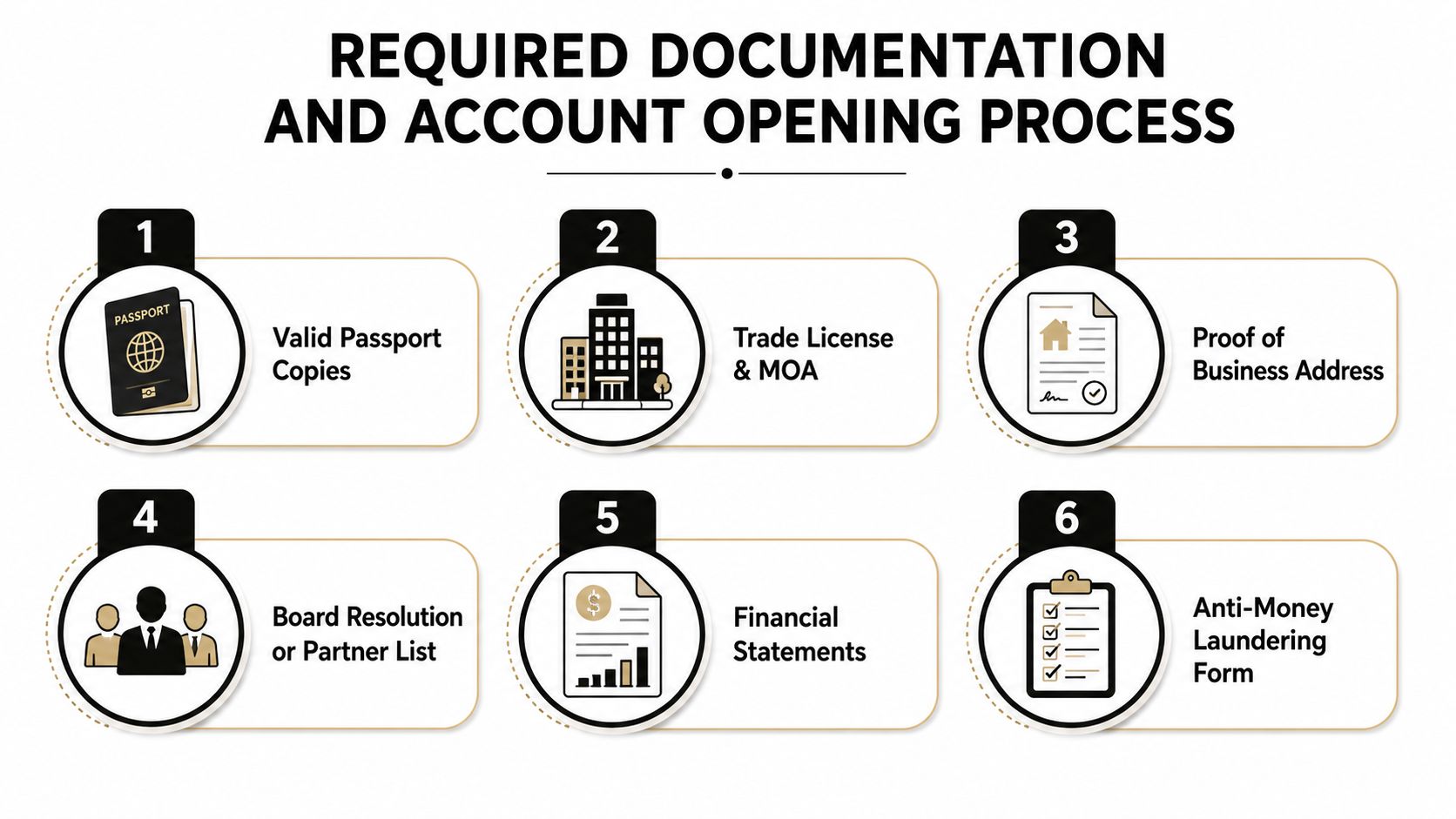
The documents that usually matter
The core package normally includes passport copies, the trade licence and MOA, proof of business address, board resolution or partner list, financial statements, and the AML form. Some banks will ask for additional ownership or visa documents depending on the structure, and foreign-issued papers may need attestation. If any shareholder is missing from the file, or the company's signatory structure doesn't line up with the incorporation documents, the file stalls fast.
Where mainland, free-zone, and offshore cases diverge
Mainland companies often face more scrutiny around operational substance, especially if the activity involves higher-risk sectors or significant movement of funds. Free-zone companies usually get judged on whether the business model, licence activity, and expected transactions fit the profile. Offshore entities can face tighter checks because the bank wants to understand why the structure exists and how the company will use the account in practice. That's not a formality. It's the bank testing whether the entity has a real operating purpose.
Best practice: prepare the KYC file as if a compliance officer will read it without your explanation, because that's exactly what happens.
How the process usually unfolds
Submit the documents, complete the compliance interview, wait for review, and respond quickly to follow-up requests. The faster you answer, the fewer doubts the bank builds into the case. If the company is foreign-owned, expect sharper questions about source of funds, beneficial ownership, and how the team will operate the account from abroad.
If you need a deeper checklist, this guide on opening a business bank account in the UAE is a useful reference point before you apply. The key point is simple. Don't treat account opening as an administrative formality. Treat it like a risk assessment, because that's how the bank sees it.
Setting Up and Configuring Your Online Banking Account
Approval is only the handover point. The value comes from how you configure the account on day one, because a badly set-up banking profile creates avoidable errors later. The first mistake most businesses make is giving too many people full access. The second is leaving payment limits, alerts, and approval workflows on default settings, which is a bad idea for any company with more than one person touching the cash flow.
Lock down access before the first payment
Start with two-factor authentication and then assign roles properly. One person should prepare payments, another should approve them. That maker-checker split sounds basic, but it prevents a lot of messy internal mistakes and gives you a cleaner audit trail. Set transaction limits by user, not by hope, and remove admin access from anyone who doesn't need it.
Configure the account around real business tasks
Once the access structure is in place, link the account to your accounting software and set up recurring payments for rent, salaries, and supplier invoices. Then turn on alerts for low balances, large transfers, and login attempts. Those alerts do not stop every problem, but they do catch issues before they spread across payroll or vendor payments.
“If a bank app can't be explained to the team in ten minutes, the setup is too complicated.”
A sensible configuration checklist for a small team looks like this.
- Two-factor authentication enabled, with recovery access held by a second director.
- Role-based permissions set, so staff cannot approve their own payments.
- Payment limits configured, especially for international transfers.
- Accounting software connected, so reconciliation is not manual every week.
- Alerts switched on, for balance drops, logins, and large-value movements.
- Recurring instructions tested, before salary and rent dates arrive.
Test the awkward transactions early
Do a small international transfer test before you need to send something time-sensitive. Check whether the bank's online portal handles beneficiary details cleanly, whether approvals trigger properly, and whether the payment lands where you expect. A lot of companies only discover friction when a supplier is waiting or payroll is due, and by then you're the one explaining delays.
The clean setup is boring, and that's exactly what you want. If your account is structured properly, your team spends less time asking for approval and more time doing the work that earns money.
Navigating UAE Compliance and Security Requirements
Online banking only helps if it fits the compliance work a UAE business already has to do. VAT, AML, audit support, and transaction records are not separate from banking, they depend on it. If your bank statements are messy, incomplete, or hard to export, your finance team ends up fixing problems at the point of filing instead of keeping the business clean during the month.
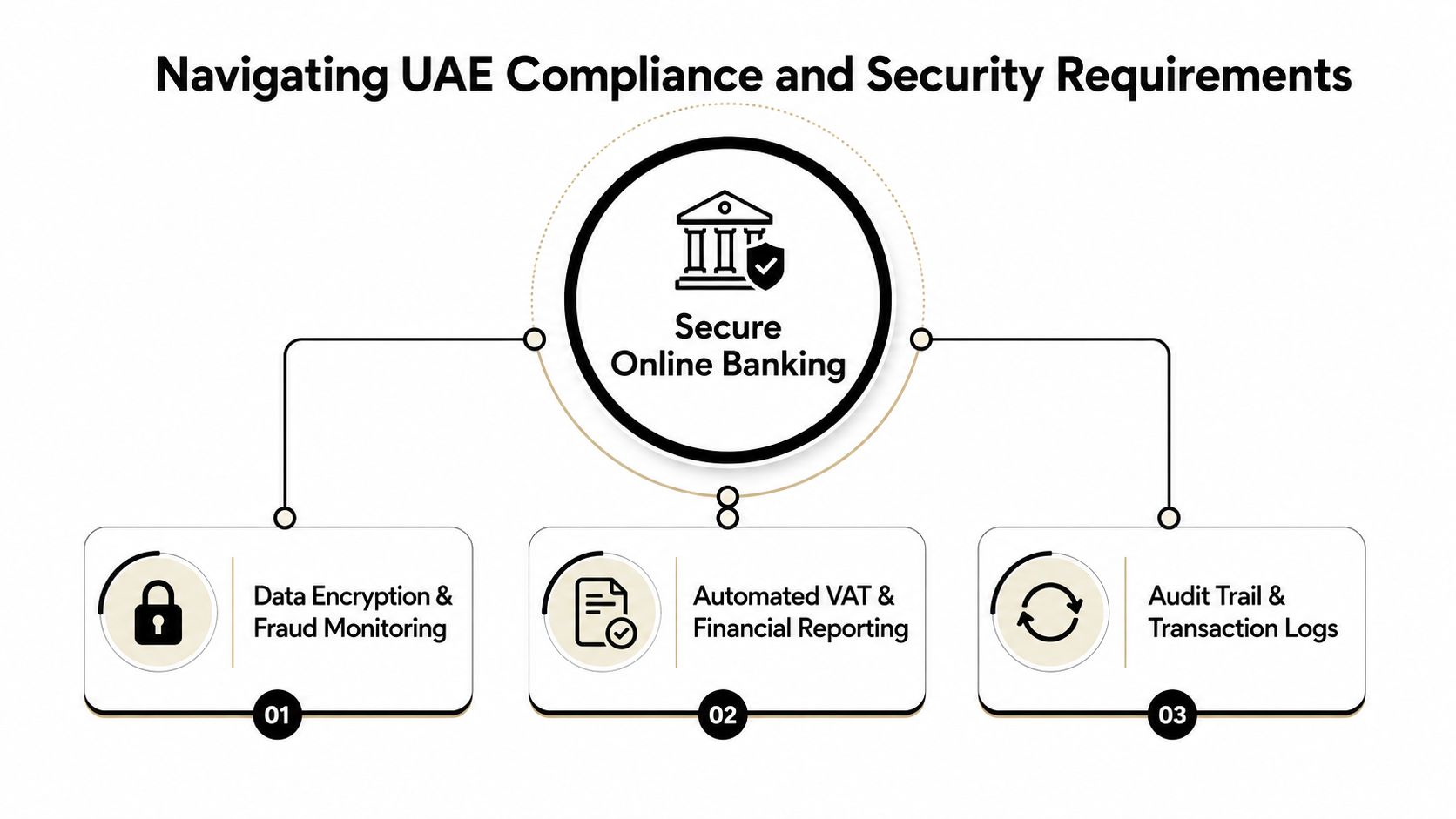
Keep VAT and bank records aligned
A strong setup starts with clean categorisation. If your company collects VAT on sales, keep that money visible in the bank records and in your accounting system so the amount is easy to trace during filing. The point is not to create extra accounts for the sake of it. The point is to make sure the trail from invoice to receipt to filing stays obvious.
That same discipline helps with audits. When the bank statement layout is easy to export and the reference fields are used properly, reconciliation stops becoming a guessing game. If the business has multiple revenue streams or currencies, this separation matters even more because mixed entries make reviews slower and less reliable.
Treat AML as an operating habit
For AML, keep transaction support documents where they can be found. Contracts, invoices, shipment records, and ownership documents should sit alongside the payment history, not in a forgotten shared drive. If a compliance officer asks why a transfer was made, the answer should be visible in minutes, not reconstructed from old emails.
For businesses that need support with documentation discipline, this resource on anti-money laundering compliance is a useful reminder of how quickly weak records create unnecessary friction.
Security needs to be practical, not theoretical
Banking apps should live on secure devices only. Staff should not be logging in from random phones, shared laptops, or public WiFi. Phishing is still the easiest route into a busy company's accounts, so your team needs a simple rule, never approve a payment request unless the request itself has been verified through the company's normal process.
If a suspicious transaction appears, freeze the workflow immediately and contact the bank before people start arguing about what probably happened. That saves time, and it often limits the damage. Online banking is convenient, but convenience without process is how businesses create avoidable risk.
Integrating Banking with Accounting and Payroll Systems
A business bank account becomes much more useful when it stops behaving like a standalone app. The gains come when it feeds cleanly into accounting, payroll, and invoice systems. That's where the manual admin drops, because your finance team no longer has to re-enter the same transaction details in three different places.
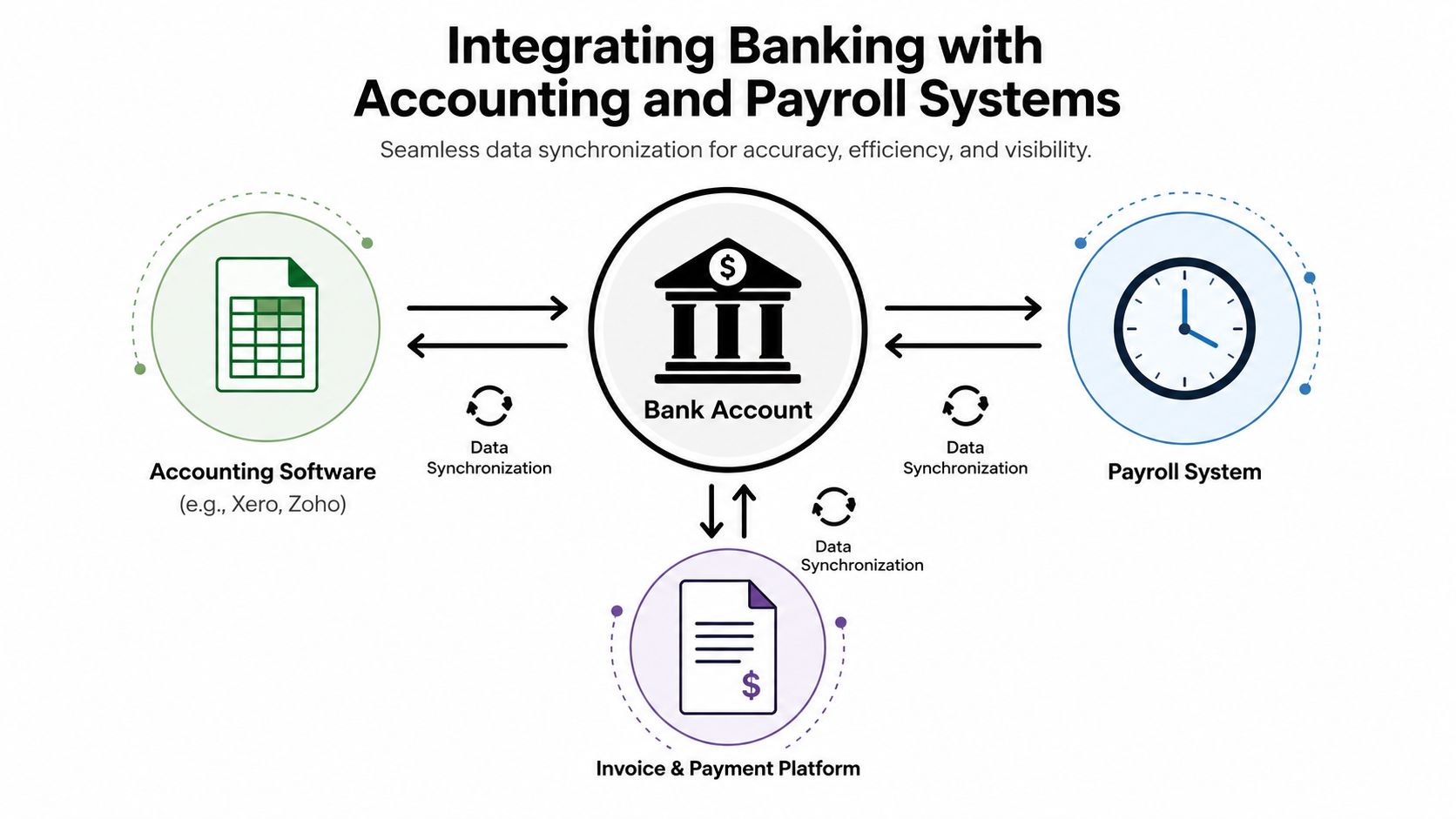
Start with the accounting feed
Connect the bank to your accounting platform first, whether you use Xero, QuickBooks, or Zoho Books. The priority is getting bank feed imports working cleanly so reconciliation happens against actual transactions rather than screenshots and emailed statements. If the account supports it, map the chart of accounts before the first month-end close, not after everything is already messy.
Build payroll around the bank, not around spreadsheets
Salary runs should be treated as a repeatable process, not a monthly rescue mission. Use payroll tools that connect properly to the bank and support batch uploads where appropriate. That keeps the payment trail more consistent and reduces the chance of someone sending an employee payment to the wrong place because a spreadsheet was edited by hand.
If you want a practical set of integration habits, the Cloudvara integration best practices for QuickBooks Online are worth reviewing alongside your setup, especially if your business already relies on cloud accounting and recurring payment workflows.
Fix integration failures quickly
Duplicate entries usually mean the bank feed and the manual upload are both active. Mismatched currencies usually mean the chart of accounts was configured too loosely. Broken feeds usually come down to expired access, changed credentials, or a platform update that nobody checked after deployment.
Operational rule: if the numbers in the bank, payroll, and accounting system don't match, stop adding new transactions until the feed issue is fixed.
For UAE SMEs, the best setup is one where invoice payment, payroll approval, and reconciliation all move in the same direction. If the systems disagree, the finance team loses hours. If they sync properly, month-end becomes manageable instead of dramatic.
When Online Banking Is Not Enough
Digital banking is useful, but it's not a complete substitute for every business need in the UAE. That's the part many glossy guides skip. A cash-heavy business still needs a way to deposit and withdraw physical money. A company negotiating guarantees or trade finance still needs a bank that can handle those instruments properly. A foreign-owned entity with layered ownership may also need more than a slick mobile interface.
The red flags that tell you to keep a hybrid setup
If your business still handles cash regularly, do not force everything through an online-first account. If you need letters of guarantee, trade-related documents, or more complex credit conversations, keep a traditional bank relationship alive. If your activity will trigger higher scrutiny, physical document submission and direct banker interaction may still be part of the process.
The FDIC's caution from the wider digital-banking discussion matters. Digital channels can improve access, but they do not automatically solve every access problem for SMEs that still rely on branch services and document-heavy compliance. For many UAE firms, the right answer is a hybrid model, one account for daily movement, another for specialised banking needs.
How to split the work between accounts
Use the fintech or digital-first account for collections, supplier payments, and day-to-day visibility. Use the traditional bank for cash handling, trade finance, and anything that needs a deeper relationship with a corporate banker. That division keeps the faster account doing the simple work while the more established bank handles the heavier stuff.
Keep the operational account light, and keep the relationship account useful.
A business that proves clean digital behaviour also tends to look more organised to a traditional bank later. That doesn't remove documentation, but it does make the case easier to explain. Banks like companies that know exactly why each account exists, because that usually means fewer surprises in the ledger.
Ongoing Administration and Troubleshooting Common Issues
Most banking problems in UAE companies are not dramatic. They're administrative. A user leaves, the signatory list stays unchanged, a bank review freezes the account, or a cross-border transfer fails because someone entered the beneficiary details badly. The businesses that stay calm are the ones that treat banking administration as a monthly task, not a crisis response.
The monthly routine that keeps accounts usable
Reconcile statements every month, review which staff still have access, and update signatories when directors or managers change. Check fee deductions too, because quiet leakage on transfer and service charges often goes unnoticed until finance starts wondering why the cash position feels tighter than expected.
If the bank requests a compliance refresh, answer quickly and keep the supporting documents current. Delayed responses usually make reviews worse, not better. The same applies to international transfer failures. In many cases, the issue is not the bank “blocking” the transaction, it's incomplete beneficiary data, missing purpose details, or a sanctions check that needs clarification.
A simple troubleshooting view
- Frozen account, usually a compliance review. Respond with the documents the bank asked for, and don't keep retrying payments until the review is cleared.
- Failed international transfer, check beneficiary details, payment purpose, and approval status before escalating.
- Disputed transaction, gather the reference number, statement line, and supporting invoice immediately.
- Login problem after an app update, remove and reinstall only if the bank confirms it's safe, otherwise escalate through business support first.
Annual reviews should be straightforward. Ask whether the current account structure still fits the company, whether the fee schedule still makes sense, and whether all compliance records are still current. If the answer to any of those is no, fix it before the next operating cycle starts.
The businesses that handle business banking well are not the ones with perfect apps. They're the ones with boring routines, clear approvals, and no tolerance for sloppy records. That's what keeps money moving.
If you want help choosing the right UAE banking structure, tightening your KYC file, or aligning your account setup with VAT, payroll, and compliance work, visit Smart Classic Business Hub. Their team helps founders and SMEs set up practical banking-ready structures, so you can open, manage, and use corporate accounts without losing weeks to avoidable delays.