
A Dubai retailer can look busy and still be losing money. One week the shelves look full, the next week a seller is apologising for a stockout, while the back office is trying to reconcile sales, returns, and transfers from handwritten sheets and scattered spreadsheets. That is usually the moment founders realise they do not need more effort, they need inventory management systems that update stock the moment something moves.
For UAE businesses, this shift is not just about convenience. The cloud-based retail inventory management market in the UAE is valued at USD 1.2 billion, which shows this is a serious enterprise software segment tied to retail digitisation, not a niche tool for large chains alone (Research and Markets). In practical terms, that means the same system that helps a small shop in Deira track sales can also help a distributor in Jebel Ali keep multiple locations aligned without waiting for end-of-day spreadsheets.
A good starting point is a clear, plain-English overview like the 2026 inventory management guide, especially if you're still separating the idea of stock counting from stock control. Once that distinction clicks, the rest becomes easier to judge, because the primary question is not whether you can count items, it's whether you can trust the count when orders, returns, and transfers are happening all day.
Introduction to Inventory Management Systems
A founder I met in Dubai had a simple problem that kept becoming a bigger one. Her team sold through a shop, a WhatsApp order flow, and a marketplace channel, but each channel kept its own numbers. By Thursday, the team had sold items that were already reserved elsewhere, and the warehouse staff were chasing missing boxes instead of preparing the next dispatch.
That kind of mismatch drains time fast. It also creates the kind of operational confusion that damages customer trust, because a missing unit is never just a missing unit, it can become a delayed delivery, a refund, and a frustrated repeat buyer. Modern inventory management systems solve this by acting like an automated stock controller, updating quantities after every sale, return, or transfer so teams can see what is available in real time.
Practical rule: if your stock truth lives in more than one place, your team will spend too much time reconciling instead of selling.
The best way to think about the software is as a digital operations assistant. It doesn't just record what came in and went out, it helps owners stop guessing, which matters in fast-moving UAE markets where retail, logistics, and multi-channel selling all overlap. For a founder, that means fewer surprise stockouts, fewer embarrassing oversells, and a cleaner handoff between sales, purchasing, and fulfilment.
The bigger point is strategic. When stock is accurate, reordering becomes calmer, cash planning gets easier, and managers can focus on growth rather than chasing errors. In a market where cloud-based tools are already a major category, the businesses that adopt them early usually get better control long before their competitors do.
Understanding Key Concepts of Inventory Management Systems
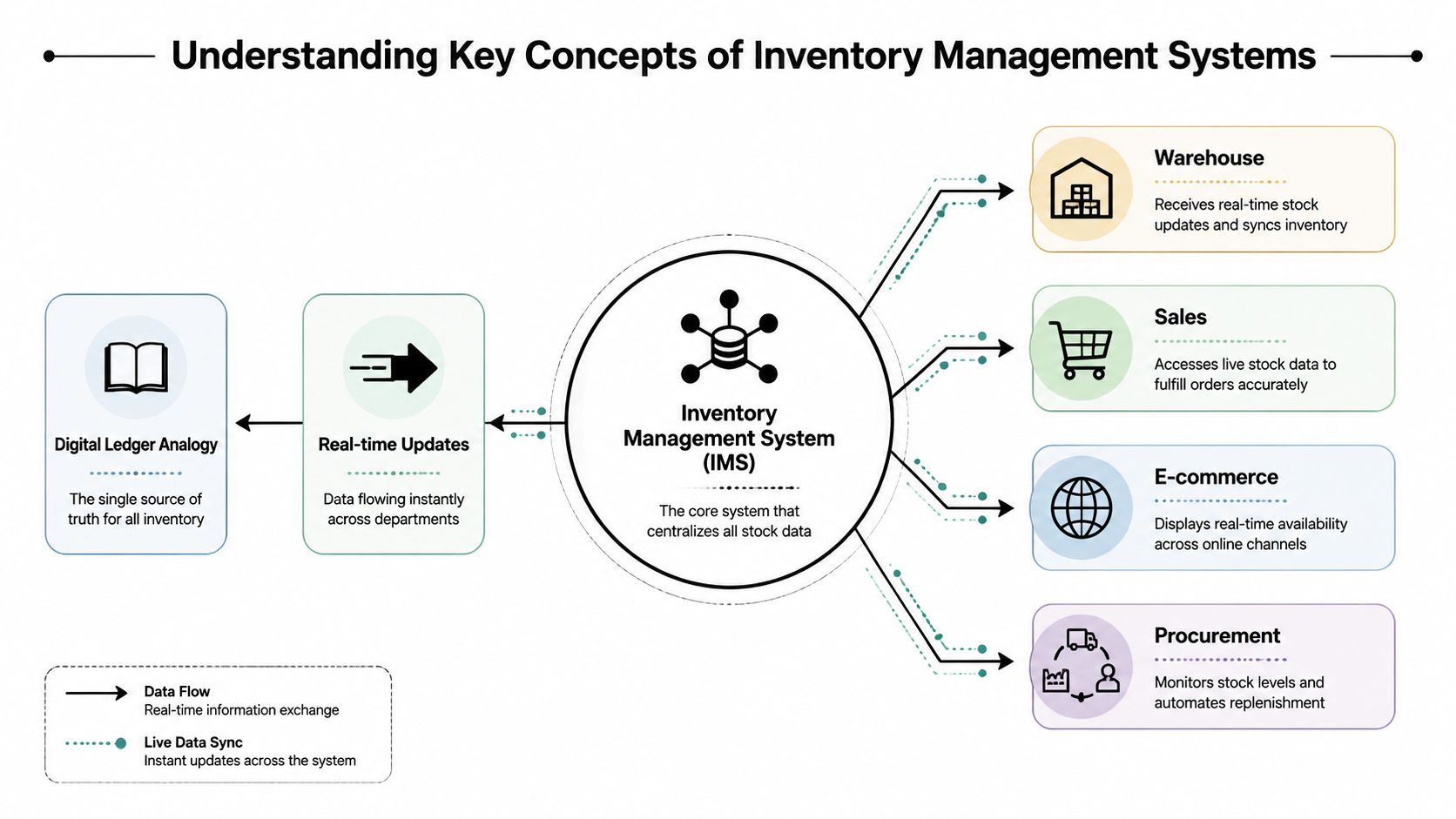
Think of an Inventory Management System (IMS) as a digital ledger for stock. Every item has one source of truth, and every department reads from the same record instead of maintaining its own version of reality. That matters because once data is split across sales, warehouse, and purchasing files, the business starts arguing with itself about what is available.
The core idea is simple. A sale reduces stock, a return adds it back, a transfer moves it between locations, and a receipt from a supplier increases it. In a proper cloud setup, those changes update the same database immediately, which is why teams with multiple outlets or warehouses tend to prefer centralised systems over manual logs.
How the core workflow fits together
Receiving, stocking, picking, packing, and shipping all sit on top of the same inventory record. When master data is clean, the warehouse sees the same SKU name that procurement uses, and finance sees the same item that sales just invoiced. That shared structure is what keeps the system usable as the business grows.
The UAE market context reinforces why this matters. The cloud-based retail inventory management segment is already large, and that size reflects demand from retailers, distributors, and SMEs who need central visibility across outlets and channels (Research and Markets). In plain terms, a single ledger is not a luxury, it's the only practical way to keep fast-moving stock under control without multiplying errors.
One clean record beats five messy spreadsheets every time.
Why master data comes first
Before adding advanced features, businesses need to lock down item names, barcodes, units of measure, and location rules. If that base is sloppy, every report above it becomes less reliable. That is why implementation guidance in the UAE keeps returning to the same point, own the stock truth first, then expand the workflow later.
Core Features and Benefits Explained
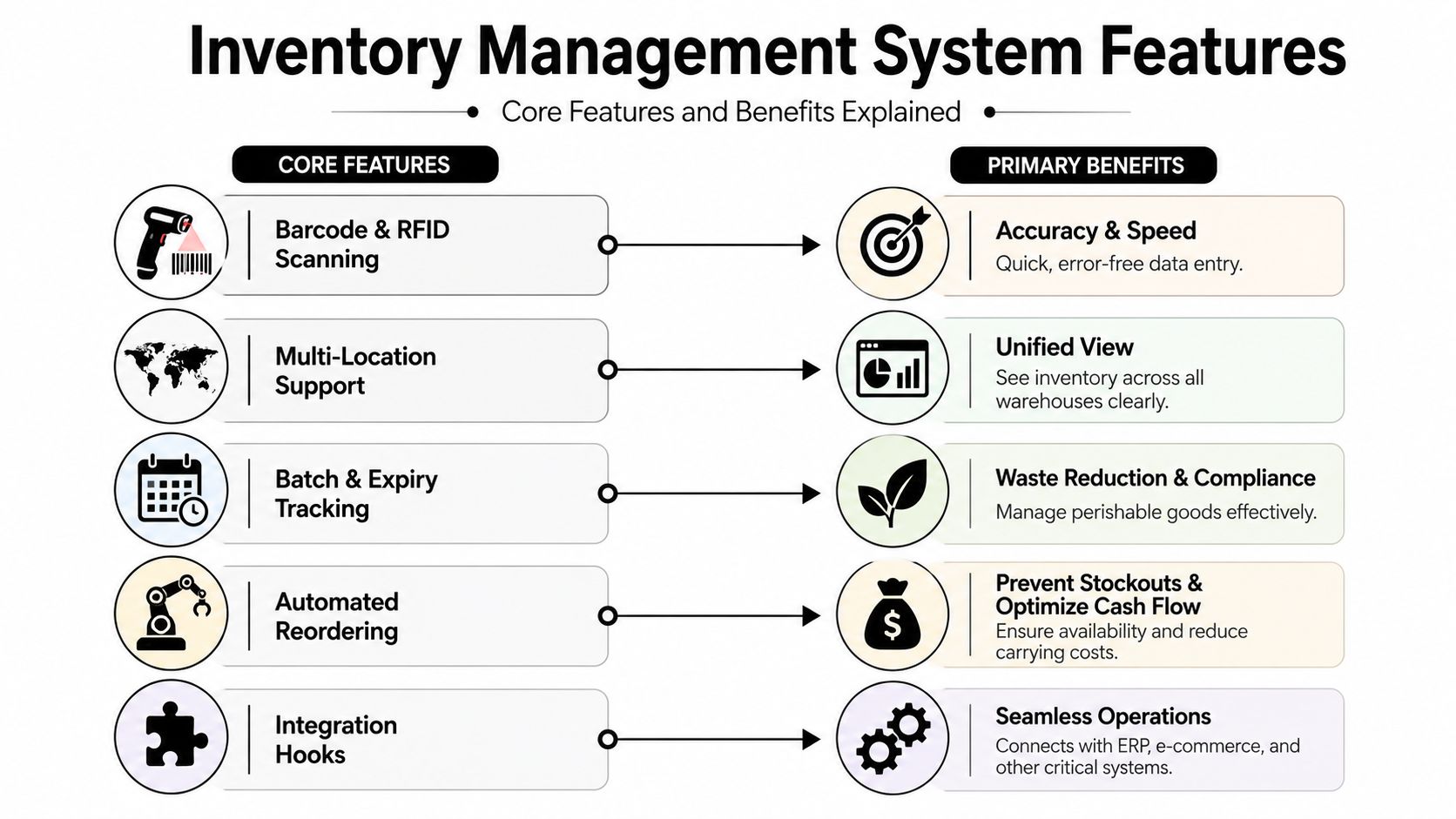
The feature list only matters if it solves a real operational problem. In the UAE, that usually means one of five things, slower manual receiving, disconnected outlets, expiry risk, surprise stockouts, or weak integrations between sales and accounts. That is why good inventory management systems are judged by the way they reduce friction across the day, not by how long the vendor's brochure is.
The price point also tells a useful story. UAE SME inventory management software commonly costs AED 180 to AED 300 per month, while enterprise platforms are priced on request, which shows how the category has moved from heavy ERP-style spending to subscription tools that smaller firms can trial (MaxHR). For startups, that changes the buying question from “Can we afford software?” to “Which problems need solving first?”
The features that usually matter first
Barcode and RFID scanning reduce typing errors and speed up receiving and picking. A Dubai distributor handling dozens of daily line items feels the difference immediately, because every scan is one less manual correction later.
Multi-location support gives managers one view of inventory across stores, warehouses, and free-zone facilities. If a product sits in one outlet but sells online from another, the system can still show the actual position instead of a guessed one.
Batch and expiry tracking matter for food, cosmetics, and other shelf-life-sensitive stock. Automation protects margins, because the system can flag what should move first instead of leaving staff to remember it from memory.
Automated reordering helps avoid empty shelves and overbuying. It keeps the purchasing team focused on thresholds and replenishment rather than chasing sudden shortages after the fact.
Integration hooks connect stock records to ERP, e-commerce, and accounting tools. That connection is what lets a sale in one system update the inventory record without someone re-entering the same data twice.
A useful way to evaluate these features is to ask which problem they remove from the day. If scanning saves time but your biggest issue is stock visibility across outlets, then multi-location control should rank higher. If your stock expires, then expiry logic matters more than fancy dashboards.
For vendor-side feature comparisons, a concise directory like essential vendor inventory control can help you compare capabilities without losing sight of the operational basics.
Integrating with Accounting and VAT Compliance in UAE
Inventory only becomes reliable for compliance when every movement leaves a trace. In the UAE, that matters because stock receipts, sales, returns, and write-offs all affect the accounting trail, and the inventory file needs to support VAT-ready records as well as day-to-day control. A frequent gap is that teams track quantity, but not the movement history behind it.
That gap creates trouble during audits and stock counts. Independent UAE inventory guidance recommends meticulous movement tracking, regular stock audits, and cycle counts for loss investigation, which is exactly what a compliant workflow needs to show when figures don't match the shelf (UniCommerce UAE retail inventory system). If the business can't explain where stock went, the numbers lose credibility.
How inventory and VAT work together
The cleanest setup is simple. Purchase invoices update incoming stock, sales orders reduce stock, and the ledger stays aligned with what the warehouse holds. That way, finance does not have to rebuild the story every month from email threads and manual counts.
For founders who want a broader VAT context, the compliance workflow should sit alongside proper VAT filing guidance in the UAE. The point is not to turn inventory software into an accounting package, but to make sure the transaction trail is strong enough for VAT reporting, internal review, and audit response.
What good documentation should show
A useful inventory record should make it easy to answer three questions. What moved, when did it move, and who recorded it. Once those answers are visible, discrepancy investigations become much faster because managers can trace the problem to a receipt issue, a transfer issue, or a sales sync issue.
That is especially important for UAE firms with multiple channels. A stock adjustment in a retail outlet should not be a mystery to finance, and a return from e-commerce should not sit unrecorded until month-end. The closer the inventory system sits to the accounting workflow, the fewer surprises the business has to explain later.
How to Choose the Right System for Startups and SMEs
Choosing the wrong system usually comes from buying for the future instead of the current operating model. A startup with one storage room and a few SKUs does not need the same setup as a growing SME with multiple warehouses, returns handling, and seasonal stock. The better approach is to match the tool to the way the business works today, then check whether it can scale without forcing a full replacement.
For perishable or fast-changing stock, UAE guidance emphasises expiry tracking to minimise spoilage and demand forecasting using historical data and trend analysis (UniCommerce UAE ecommerce inventory strategies). That means a café supply business, a cosmetics seller, and a general trading company won't all need the same feature priority list, even if they have similar budgets.
A practical decision matrix
Startups usually need speed, clarity, and a low-friction rollout. They should ask whether the system handles basic scanning, simple stock counts, and easy reporting without demanding a long implementation cycle.
Growing SMEs need location control, purchase visibility, and better integration. They should ask how the platform handles multiple warehouses, returns, batch tracking, and finance handoffs once sales volume starts spreading across channels.
Perishable or fast-changing businesses should prioritise expiry logic and forecasting first. If the software can't help reduce spoilage or spot replenishment patterns, it may be the wrong fit even if the dashboard looks polished.
A consultant would also check local support and compliance fit. If the vendor can't explain how the workflow maps to UAE operations, the team may end up creating manual workarounds that cancel out the software's value. For businesses building their online presence, the setup process often needs to align with broader e-commerce business setup in Dubai.
If you're comparing options that also touch finance workflow, solving SME inventory finance problems is a helpful lens because it keeps the discussion focused on cash flow, reporting, and stock accuracy rather than surface-level features. Smart Classic Business Hub is one option that can sit alongside other implementation and compliance providers when a business wants inventory control tied to UAE accounting and setup needs.
Implementation Checklist and Common Pitfalls
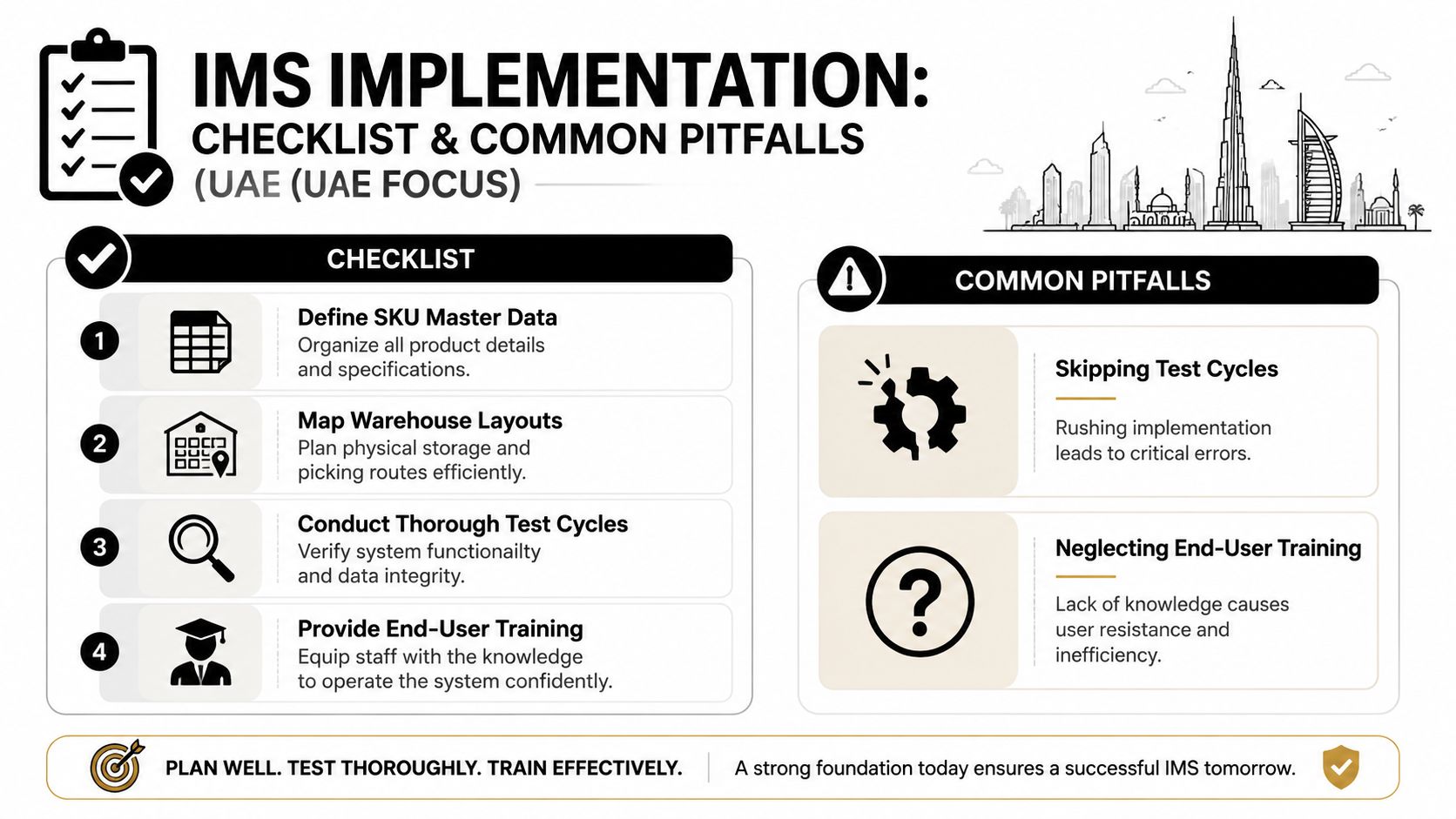
A clean rollout starts before the software goes live. The first job is defining the stock structure, because if item names, units, and locations are inconsistent, no system can save the result. That is why UAE implementation guidance keeps stressing multi-location support, barcode scanning, bin-level tracking, batch and expiry control, and fallback procedures before launch (AlameenSoft UAE inventory solution).
Checklist for a safer rollout
Define SKU master data so every product has one approved record. That avoids duplicate items, inconsistent naming, and confusing stock reports.
Map warehouse layouts so the system reflects the physical flow. If staff pick from bins or zones, the software should know it too.
Run thorough test cycles before the first live transaction. A pilot catches bad field mapping, broken alerts, and sync issues while the risk is still low.
Train end users properly so the warehouse team, sales staff, and finance team know their roles. A tool can be technically sound and still fail if the team avoids using it.
Practical rule: if staff can't explain the process in their own words after training, the rollout isn't ready.
Common mistakes to avoid
Skipping cycle counts leaves errors hidden until the mismatch becomes expensive to fix. Regular counts create the discipline needed to keep the system honest.
Neglecting bin-location mapping makes picking slower and more chaotic. Staff may find the stock eventually, but they'll waste time doing it.
Ignoring outage fallback procedures is a serious risk in any live operation. If the system is unavailable, the team needs a manual workaround that preserves stock truth until the connection returns.
A good implementation plan also needs an internal owner. Someone must decide how exceptions are handled, how adjustments are approved, and how new locations are added. That person doesn't need to be technical, but they do need authority over process, otherwise the software drifts into the same mess the business was trying to escape.
Measuring ROI and Cost Considerations
The ROI question is not “Does software cost money?” Every tool does. Instead, the question is whether the business is paying a manageable monthly amount to avoid bigger losses from stock errors, manual labour, and poor visibility. In the UAE, the subscription model matters because it gives smaller firms access to software without the burden of a large upfront ERP project (MaxHR).
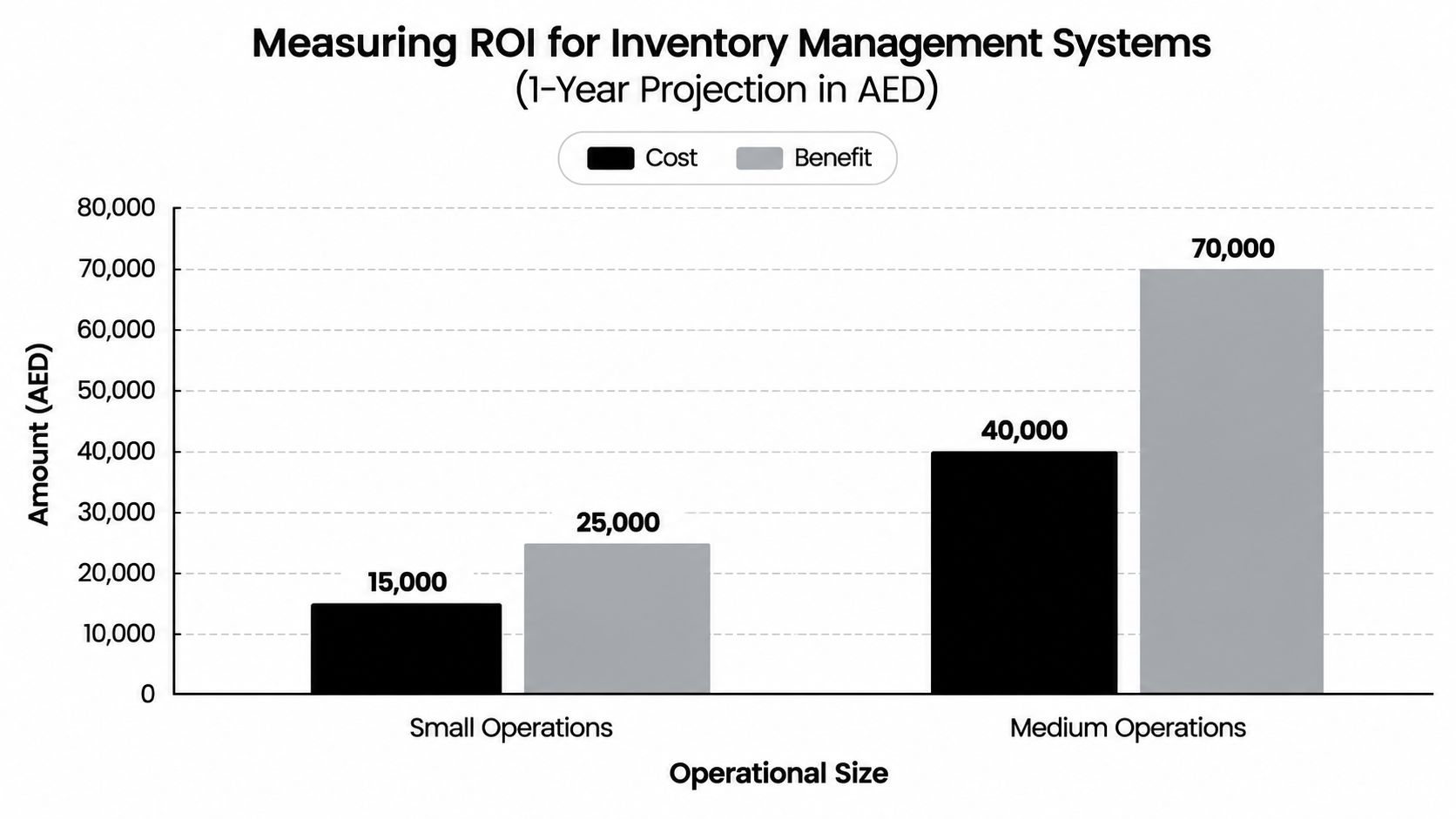
A simple way to judge value
For a small operation, the software should save more time than it consumes. For a medium operation, the primary benefit usually comes from fewer stock mismatches, cleaner replenishment, and faster order handling across more than one location.
The USD 1.2 billion UAE cloud inventory market benchmark suggests the category is mature enough that vendors are serving real operational demand, not experimental interest (Research and Markets). That does not guarantee ROI for every buyer, but it does show there's a large and established market around the problem.
A quick checklist helps. If the software reduces manual reconciliation, supports cleaner purchasing, and prevents missed sales from stockouts, it is likely earning its keep. If the team still maintains duplicate sheets after go-live, the system may be adding cost without enough control in return.
Action Plan for Businesses Setting Up in UAE
Start with the business model, not the software catalogue. A mainland retailer, a free-zone distributor, and an online seller all have different stock flows, and the right inventory setup depends on how goods move through those channels. If the company is already forming in the UAE, the inventory workflow should be designed alongside licensing, accounting, and operational setup rather than patched in later.
The first step is to shortlist vendors that match your stock pattern. Ask whether they support your warehouse count, SKU volume, barcode process, and audit trail needs, then check whether the team can explain the workflow in plain language. If they can't, the implementation will probably rely on workarounds.
Next, define master data before migration. Clean item names, units of measure, location codes, and return rules should be ready before the first live transaction, because bad master data spreads errors across every report. Then configure VAT-related process points so receipts, sales, and stock adjustments line up with accounting records from day one.
After that, run a pilot in one location or one channel. A small test is better than a full launch with hidden sync problems, especially when the business needs to stay audit-ready. Once the pilot is stable, train staff, document fallback procedures, and expand location by location so the system grows with the operation instead of overwhelming it.
If you're setting up now, schedule three things this week, a vendor demo, a master-data clean-up, and a compliance review with your accountant or consultant. That sequence keeps inventory control tied to real operations, not wishful planning, and it gives you a cleaner path to scale across free zones or mainland sites without losing stock visibility.
A CTA for Smart Classic Business Hub.