
You've chosen a product. You've tested demand informally. You may even have suppliers, branding, and a Shopify draft ready. Then friction starts. Which licence do you need? Can a free zone company sell to UAE customers the way you think it can? When do customs, banking, and payment gateways enter the picture? Most founders discover that Dubai ecommerce launch advice often stops at “get a licence” when the harder part is becoming operational.
That's where ecommerce business setup in Dubai needs a more practical lens. A clean launch depends on two decisions that are often handled badly: choosing the right jurisdiction for your actual revenue model, and getting post-licence infrastructure in place so you can collect money, move stock, and stay compliant without scrambling later.
Your Ecommerce Idea Meets the Dubai Opportunity
You have a product shortlist, a supplier, and a store that looks close to ready. Then the serious questions start. Can this company legally sell the way you plan to sell? Will a bank open the account quickly enough? Will a payment gateway approve the business model, or hold the application because the structure does not match the activity?

Dubai attracts ecommerce founders for good reason. Online buying is already normal consumer behavior in the UAE, and the market outlook remains strong over the next several years. The opportunity is not the hard part. Converting that opportunity into a company that can collect payments, clear goods, and fulfil orders without expensive rework is where many launches slow down.
I see the same mistake repeatedly. Founders treat setup as a paperwork task instead of an operating model decision. They focus on speed to licence, then discover later that the harder work starts after incorporation. Banks ask for more substance. Payment providers want clarity on goods, delivery flows, and refunds. Customs and importer arrangements affect margin long before the first ad campaign goes live.
A Dubai ecommerce business is ready when four pieces line up: legal structure, money flow, goods flow, and compliance.
That is the practical standard.
If you sell physical products, landed cost planning should start early, not after stock is ordered. Founders comparing SKUs, origin countries, duty exposure, and import assumptions can use verified customs data for ecommerce before fixing retail pricing or choosing a fulfilment model.
Why good ecommerce ideas stall after setup
The friction usually comes from a mismatch between the business model and the company structure.
A founder plans to sell directly to UAE consumers, but chooses a licence because it was cheaper, faster, or recommended in generic terms. Another founder secures a licence without checking whether the bank and gateway will be comfortable with the product category, transaction pattern, and source of inventory. Someone else imports stock first and only later works out who is acting as importer of record, where goods will sit, and how VAT and documentation will be handled.
None of these problems are unusual. All of them cost time.
The practical advantage in Dubai goes to founders who make setup decisions in the order operations require, not in the order a sales brochure presents them.
What a stronger launch plan looks like
The companies that get to market with fewer resets usually work through three questions early:
- How will revenue be earned? Own website, marketplace selling, wholesale supply, cross-border fulfilment, and social commerce can point to different setup choices.
- Who controls the money flow? Bank account timing, payment gateway approval, settlement terms, and refund handling need attention before launch.
- Who controls the goods flow? Importer status, warehousing, customs clearance, and final-mile delivery shape both cost and customer experience.
This is the difference between getting incorporated and becoming operational. In Dubai, that gap matters more than many first-time founders expect.
Choosing Your Business Jurisdiction
The first serious decision in ecommerce business setup in Dubai isn't your website platform. It's your jurisdiction. Many founders often lose time during this decision, because they're given generic “mainland versus free zone” summaries that don't answer the only question that matters: how will you make money?
The better way to decide is to map the licence to the revenue channel. That's the gap most setup advice misses. Independent UAE guidance notes that a mainland licence allows unrestricted trade across the UAE, while free zones are designed around zone-based operations and are often better suited to foreign market focus, as explained in this mainland versus free zone ecommerce setup guide.
Start with the sales model
If you plan to build a local direct-to-consumer brand and sell across the UAE under your own store, a mainland licence is usually the cleaner choice. It aligns with a business that wants direct domestic reach, local delivery, and fewer structural limitations on local trade.
If your ecommerce company is built around cross-border trading, overseas customers, or a logistics-led model connected to a particular zone ecosystem, a free zone licence may fit better.
If you're starting very small, testing a home-based concept, or operating as an individual seller before building a fuller company structure, the e-trader route may be relevant at the early stage. The issue is scale. What works for proving a concept often stops working once inventory, staff, warehousing, or broader sales channels enter the picture.
Choose the setup that matches the transaction path, not the cheapest headline package.
Mainland vs. Free Zone Ecommerce Setup at a Glance
| Factor | Mainland License (DET) | Free Zone License |
|---|---|---|
| Best fit | Local UAE direct-to-consumer trading | Cross-border trading or zone-based models |
| UAE market access | Can trade across the UAE | Often structured around zone operations |
| Operational logic | Better where local selling is core | Better where foreign markets or logistics ecosystems drive the model |
| Common mistake | Taking it without a clear local sales plan | Assuming it automatically gives unrestricted local selling |
| Scale consideration | Useful for businesses built for domestic expansion | Useful for founders optimising around a specific hub or foreign market focus |
A practical decision tree
Use these questions before you file anything:
- Will most revenue come from UAE customers? If yes, mainland deserves serious priority.
- Will you import, store, and fulfil products for local buyers? Your setup needs to support that operationally, not just legally on paper.
- Are you mainly selling abroad? A free zone structure may align better.
- Are you testing a side business first? Start with the smallest lawful setup that still leaves room to graduate later.
- Will you sell through marketplaces only, or through your own site as well? Marketplace dependence can hide structural limits until you try to expand into your own sales channels.
What doesn't work
What usually goes wrong is simple. A founder hears that free zones are cheaper or faster, chooses one without modelling the revenue path, then discovers the business needs a different structure once local trade becomes the priority. At that point, the “savings” disappear into restructuring, paperwork, and delay.
Another weak approach is choosing a jurisdiction based only on visa marketing or office package language. Those details matter, but they shouldn't drive the core legal decision.
If you're unsure, the right move isn't to compare brochures. It's to map your sales flow, stock flow, and customer location first, then choose the jurisdiction that supports those realities.
Navigating the Official Setup and Licensing Process
A founder picks the right jurisdiction, files fast, gets the licence, announces a launch date, and then runs into the part that delays trading. Customs is not ready. The website still needs regulatory clearance. The bank account is pending. The payment gateway wants more documents. That is the true setup process in Dubai.
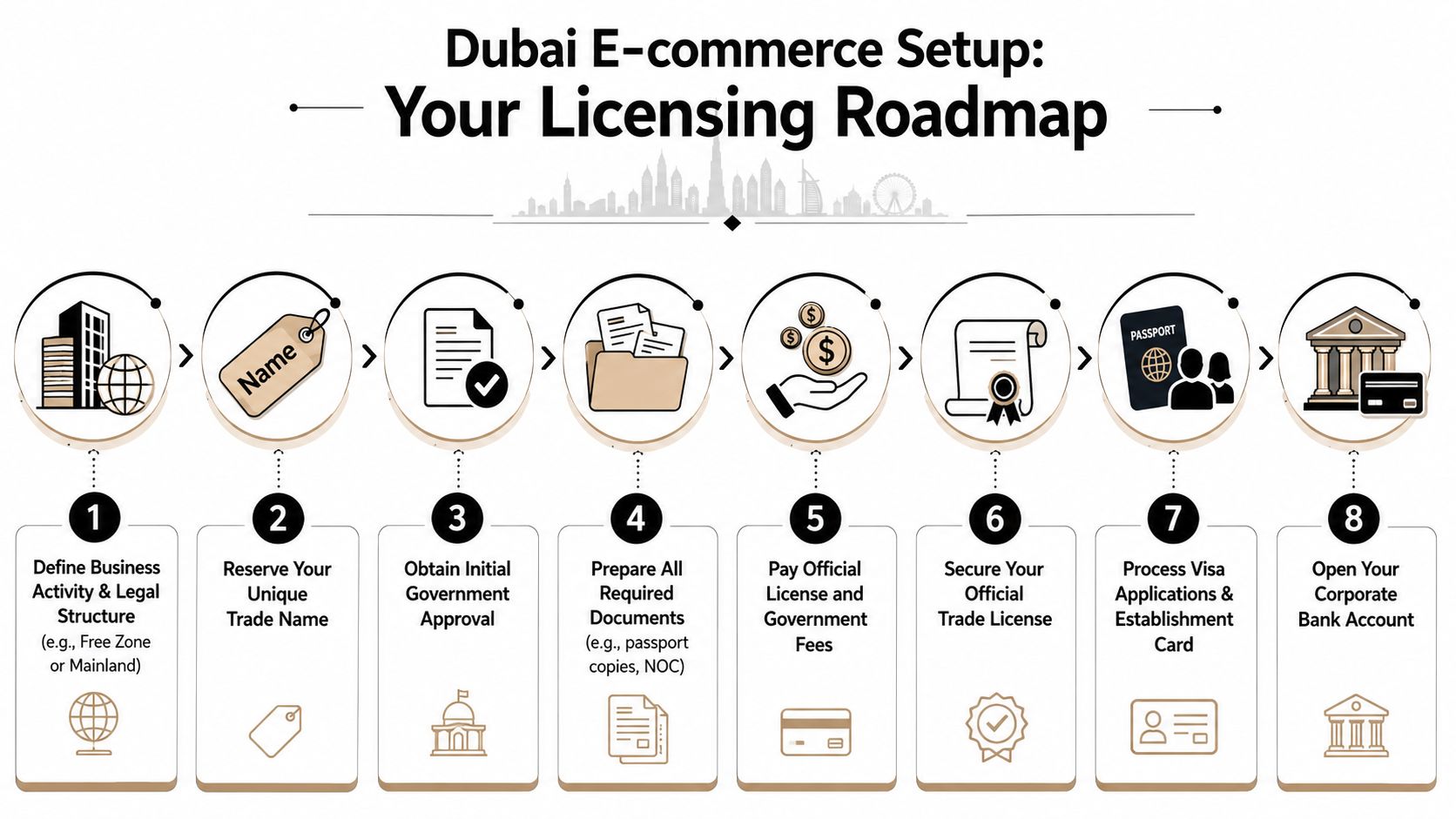
Once the jurisdiction decision is made, the job is to build the file in the right order and prepare for the checks that come immediately after incorporation. A licence alone does not make the business operational. It gives the company legal standing. Operational readiness comes from aligning the activity, approvals, banking, and payment flow before the first sale.
The paperwork path that usually works
Most ecommerce companies move through the same core sequence:
Define the business activity and legal structure
Match the activity to the effective revenue model. A vague or overly broad activity can create problems later with banks, payment providers, and customs documentation.Reserve the trade name
Keep backup options ready. Name issues are small until they stop the application.Submit the initial application and supporting documents
Passport copies, shareholder details, and incorporation forms are standard. I also advise founders to prepare a short business summary at this stage. The same summary often gets reused for banking and gateway underwriting.Pay the government and licence fees
According to a guide from StratRich, licence fees are commonly quoted in the AED 8,000 to AED 15,000 range, issuance is often estimated at 5 to 10 business days, and the TDRA NOC can take up to 10 business days, depending on the authority, activity, and document quality.
The sequence matters because each step affects the next one. If the activity is poorly chosen, the rest of the file becomes harder to defend.
What happens after the licence is issued
This is the point many new founders underestimate.
If you will import goods, store stock, or fulfil UAE orders, you may still need Dubai Customs importer registration before operations are ready. If you are selling online, TDRA clearance may also be part of the process. Then come the commercial checks that slow many launches: the corporate bank account and merchant approval.
That creates a practical rule. Do not build your launch calendar around the day the licence is issued. Build it around the day the company can collect money, clear goods, and fulfil orders without interruption.
A realistic setup checklist often includes:
- Trade licence issued
- Relevant customs registration in place
- TDRA approval cleared where required
- Corporate bank account application submitted early
- Payment gateway underwriting started with full documents
- Website checkout, tax settings, and delivery flow tested
Plan for commercial readiness, not just legal completion
At this point, founders either save weeks or lose them.
A low-cost licence package can look attractive on paper, then become expensive if it creates friction with banking, merchant onboarding, or future restructuring. That is why setup decisions should be measured against the actual operating model, not just the first invoice. If you need a better sense of how structure affects spend, this guide to Dubai e-commerce licence costs is useful.
Payment planning should also start early if you expect overseas customers. Founders selling across borders need to think beyond card acceptance inside the UAE and set up flows that simplify international transactions.
The founders who get to market faster are usually not the ones who filed first. They are the ones who treated licensing, approvals, banking, and payments as one connected setup job.
Activating Your Financial Operations
Many founders believe the hard part ends when the trade licence arrives. In practice, that's when the most commercially sensitive part begins. If the company can't open the right bank account, satisfy merchant underwriting, and build compliant payment flow, it still can't trade properly.

Neutral UAE guidance makes this point clearly. Incorporation is not the finish line. Founders often underestimate the friction involved in banking, merchant approval, and proving transaction legitimacy. Without a corporate account, merchant ID, and VAT-compliant accounting, a licensed business still can't collect revenue, as outlined in this UAE ecommerce company checklist.
Why banks don't treat every ecommerce company the same
Banks want to understand substance. They're not just checking whether the company exists. They want to know what it sells, where goods come from, who the customers are, and whether transaction patterns make sense.
Be ready to provide:
- Trade licence and incorporation documents
- Shareholder and authorised signatory information
- Proof of address and business presence
- A clear explanation of products, suppliers, and sales channels
- Supporting material that shows the business is legitimate and organised
A vague answer like “general ecommerce” makes life harder. Specificity helps. “We import skincare accessories from approved suppliers and sell through our own UAE store plus selected marketplaces” is easier for a bank or processor to assess.
Payment gateways need more than a website
Common integrations in the UAE setup flow include Stripe UAE, PayTabs, Telr, and Foloosi. The technology side is usually straightforward. The underwriting side isn't.
Processors will look at what you sell, refund exposure, fulfilment logic, delivery territories, and how transparent the customer experience is. If your policies are unclear, your documentation is thin, or your bank account isn't ready, the gateway process slows down.
For founders selling beyond one market, it helps to understand how providers handle settlements, charge flows, and customer geography. This overview on how to simplify international transactions is useful when you start evaluating cross-border payment behaviour and not just domestic checkout.
Operational insight: Payment activation is usually a risk review exercise disguised as a technical integration.
Accounting must start before revenue starts
Many ecommerce businesses create preventable mess. They wait until the first sales arrive, then try to reconstruct records after payouts, refunds, shipping charges, and supplier invoices have already started moving.
Set up accounting logic from the beginning:
- Separate business and personal spend
- Track gateway settlements cleanly
- Record refunds and chargebacks properly
- Prepare for VAT-compliant bookkeeping
- Make sure inventory and sales reporting can reconcile
If you need support on the banking side, opening a corporate bank account in Dubai is one of the areas many founders handle with specialist help because document preparation and positioning make a difference. Smart Classic Business Hub is one Dubai consultancy that supports setup, banking coordination, and VAT-compliant accounting as part of broader UAE business formation work.
Managing Logistics, Customs, and Visas
Your licence is approved, the bank account is open, and the website is nearly ready. Then the first shipment gets held because the goods were classified incorrectly, the courier asks for importer details no one clarified, and a planned hire cannot start because the visa path was treated as an afterthought. This is the stage where ecommerce setup in Dubai becomes real.
For product businesses, operations have to be designed around the actual sales model. A founder shipping small parcels across the UAE needs a different setup from a brand importing pallets, storing stock, and serving multiple GCC markets. The right answer depends on where inventory sits, who clears goods, how quickly you need delivery, and how much control you want over fulfilment.
Customs and fulfilment should match the business model
Many founders leave logistics decisions too late. They assume a courier will solve everything. It will not.
Start with four decisions:
- Where stock will be stored
- Who will act as importer of record
- How products will be classified for customs
- How returns will be received, checked, and restocked
Dubai gives ecommerce businesses strong fulfilment options, including 3PL providers, local warehousing, and logistics-focused zones built for high-volume trade. But access to infrastructure is not the same as operational fit. Early-stage brands often do better with a 3PL because it reduces fixed cost and staffing pressure. Businesses with heavier volumes, tighter margin control, or regional distribution plans may benefit from securing warehouse arrangements earlier.
Product classification causes more delays than founders expect. If your team is still unsure how goods should be declared, get clarity before the shipment leaves the supplier. This guide to HS code support in Dubai is useful because customs issues usually show up after stock is already in motion, which is the worst time to solve them.
Inventory systems break before marketing does
The first operational failure in ecommerce is rarely ads or website traffic. It is usually stock accuracy.
Once orders start coming from your website, marketplaces, social channels, or offline sales, manual tracking becomes unreliable very quickly. Overselling creates refund pressure. Poor returns handling ties up stock. Bad purchasing visibility leads to stockouts on products that are selling.
The systems worth setting up early usually cover:
- Live inventory visibility across sales channels
- Returns tracking and disposition
- Warehouse or 3PL coordination
- Order status updates for customers
- Basic demand planning linked to purchasing
A simple tool can be enough at the start, but only if it can keep stock, orders, and fulfilment aligned. If you are comparing options, this overview of software for online stores is a practical place to start.
Visas affect operations more than founders expect
Visa planning is part of launch planning, not a separate admin task.
For foreign founders, residency often matters personally and commercially. For growing businesses, the ability to sponsor staff matters just as much. Operations hires, customer service staff, procurement support, and warehouse coordinators all depend on a company structure that can support the required visa activity.
Cheap setup decisions can become expensive. A licence package that looks fine on paper may create limitations later if office requirements, establishment records, or staffing plans were never matched to the operating model. If you have co-founders, expect to hire early, or need someone on the ground to manage fulfilment, build the visa plan into the original company setup.
Founders who treat logistics and visas as post-licence tasks usually lose time fixing preventable problems. Founders who plan for customs, fulfilment, and staffing from day one reach operational readiness much faster.
Common Pitfalls and Your Next Steps for Growth
Most ecommerce delays in Dubai don't happen because founders lack ambition. They happen because someone simplified the setup too much.
The mistakes that cost founders time
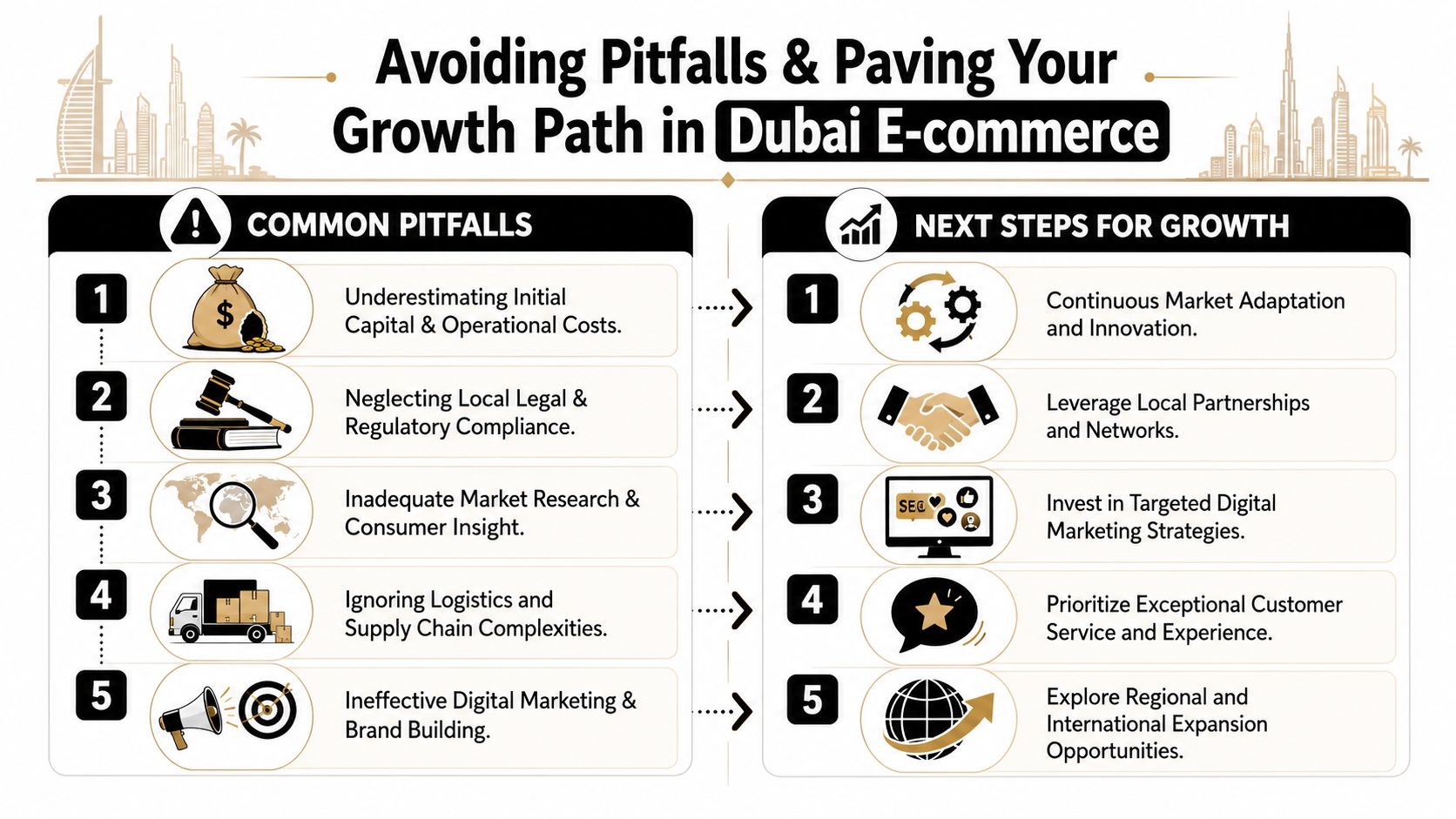
A few pitfalls come up repeatedly:
- Choosing the wrong jurisdiction because the package looked cheaper, not because it fit the business model
- Treating the licence as the finish line and discovering too late that banking, customs, or gateway approval still block launch
- Under-planning compliance so accounting, record-keeping, and internal controls are added after the business is already transacting
- Ignoring fulfilment detail until stock arrives and there's no clean process for imports, storage, or returns
The expensive part of a bad setup usually isn't the first invoice. It's the correction work after the business has already started moving.
What growth-ready founders do differently
The businesses that scale well tend to build for the second stage early. They don't just ask, “How do I get incorporated?” They ask better questions.
They ask who will manage finance once sales are live. They ask whether hiring support will be needed when operations move beyond the founder. They ask whether a flexible office or co-working arrangement makes more sense than committing too early. They ask whether the business model can expand across the UAE first, then regionally, without restructuring.
That's the right mindset because growth in the UAE is rarely only a licensing question. It becomes a finance question, a recruitment question, and an operational control question.
If you need hands-on support after setup, that usually means combining services rather than treating each issue separately. A consultancy that can assist with formation, PRO work, VAT-compliant accounting, recruitment coordination, and practical expansion support can reduce handoff risk as the business grows.
The best next step is to map your exact operating model before you submit anything. Product category, sales geography, stock movement, payment flow, and founder residency plans should all sit in one launch plan, not five disconnected conversations.
Frequently Asked Questions
How much does ecommerce business setup in Dubai usually cost?
Founders usually focus on the licence fee first. That is only one part of the budget.
As noted earlier in this guide, licence costs often sit in the AED 8,000 to AED 15,000 range, depending on the jurisdiction and activity mix. The total number goes up once you add bank account setup, payment gateway onboarding, visa costs if needed, customs registration, warehousing or fulfilment, and the software required to run orders, inventory, and returns. A low headline setup cost can become expensive later if it puts you in the wrong jurisdiction for your actual sales model.
How long does the setup usually take?
Licence issuance can be relatively quick if the documents are clean and the business activity is straightforward. Many founders get the licence approved within days, not weeks.
Operational readiness takes longer. Banking reviews, payment gateway underwriting, compliance checks, and import-related registrations often decide the actual launch date. If you plan to sell imported goods, hold stock locally, or process a high volume of card payments, build extra time into the plan from the start.
Can I set up remotely?
Yes, in many cases.
Remote incorporation is common, but founders should not assume the full process stays remote from start to finish. Bank KYC, identity verification, visa processing, and some authority-specific steps may still require original documents, a local visit, or both. The practical question is not only whether the company can be formed remotely. It is whether the business can become operational without delays after the licence is issued.
If you want a customized launch plan instead of generic setup advice, Smart Classic Business Hub can help map your jurisdiction, licensing, banking, compliance, and operational readiness around your actual ecommerce model. That approach usually reduces the risk of paying twice for the same setup.