
You've got the formula, maybe a supplier contact, maybe a logo draft, and now you're staring at the question, not the romantic one. Is Dubai the right place to launch a fragrance brand, or is it just the place where a lot of expensive ideas go to get licensed, boxed, and forgotten?
The answer depends on how you structure the launch. How to start a perfume business in Dubai is not a branding problem first. It's a licensing, compliance, and distribution problem that only works if the order is right. Dubai can absolutely support a serious perfume brand, but only if you treat the launch as a regulated manufacturing and sales workflow, not a casual retail experiment.
The UAE perfume market gives you the scale you need to take that decision seriously. One independent estimate places the UAE fragrance market at USD 688.1 million in 2023 and USD 730.8 million in 2024, with a forecast of USD 1,087.7 million by 2030 at 6.9% CAGR PS Market Research. Another 2025 estimate puts it at USD 1,366.4 million, rising to USD 1,958.84 million by 2032 at 5.28% CAGR PS Market Research. For a founder, that means Dubai is not a novelty market. It's part of a sizeable national fragrance economy where premium, oriental, and multi-brand retail already have proven demand.
If you're deciding whether to launch, the question is simpler. Can your brand survive the licensing sequence, the SKU registration burden, the label rules, and the export decisions that come after first sales? This guide answers that in the order that matters, starting with jurisdiction, then licence activity, then compliance, then sourcing, then launch.
For a broader overview of the commercial environment, Smart Classic's guide on the benefits of setting up a business in Dubai is a useful companion read, but the perfume-specific decisions still need their own logic.
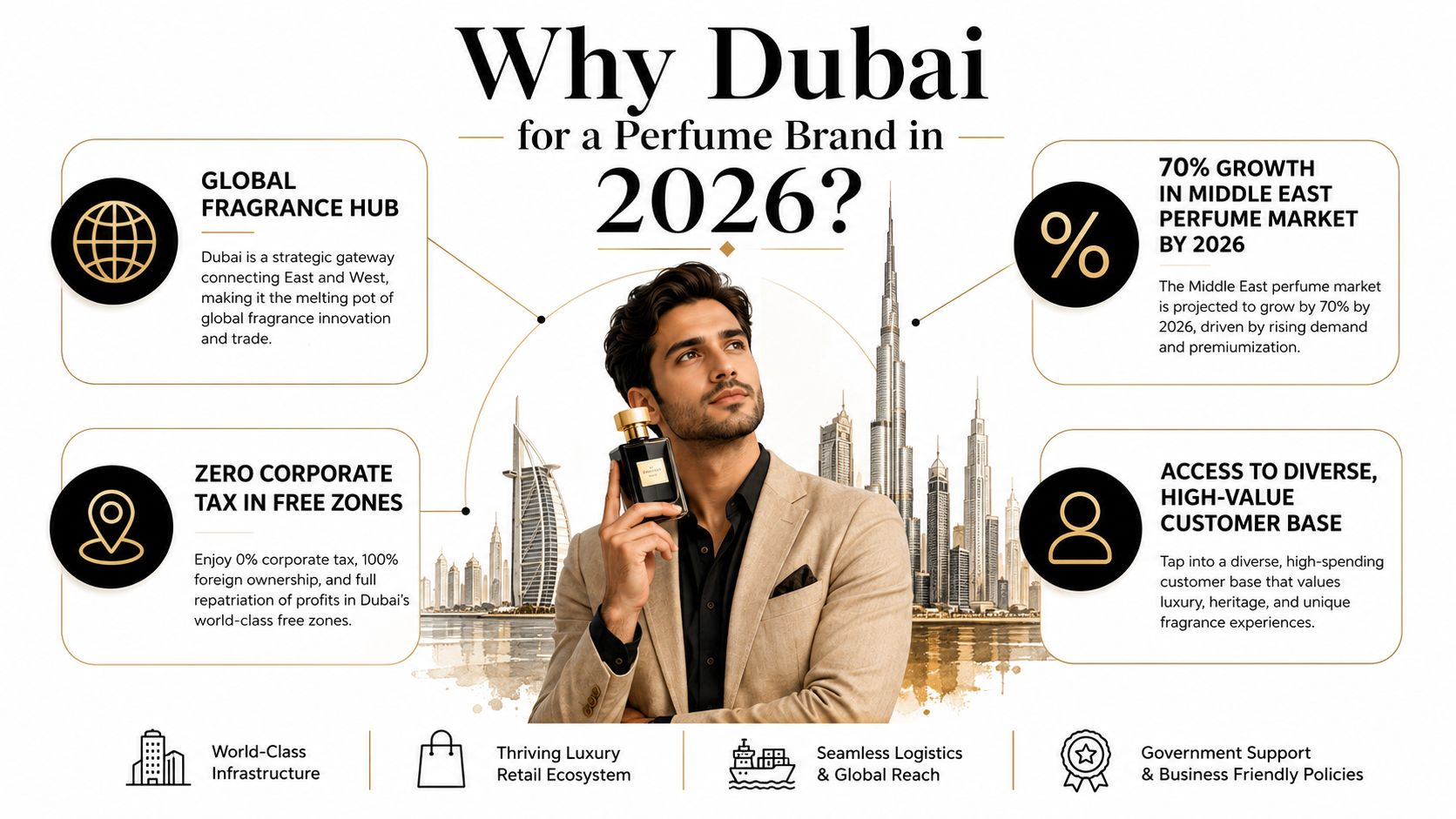
Why Dubai for a Perfume Brand in 2026
Dubai already has the customer base fragrance founders want. Buyers here understand scent as part of daily routine, gifting, hospitality, and personal presentation, so you are not trying to explain why perfume matters. You are entering a market where fragrance already has cultural weight and commercial traction, which is a much better starting point for a new brand.
Market depth matters more than headline hype
A founder should read the market through its channel mix, not just its size. Premium boutiques, duty-free counters, multi-brand beauty stores, and gifting-focused retail all sit side by side in Dubai, and each one supports a different type of fragrance brand. That means there is room for niche oils, concentrated attars, prestige eau de parfums, and more accessible lines, provided the product and pricing are aligned with the channel.
Tourism adds another layer. Visitors buy perfume in Dubai because it fits the city's retail habits, its gifting culture, and its cross-border shopping flow. Residents buy as well, but the tourist audience gives a fragrance brand a second path to sales, especially if the packaging, scent profile, and assortment work for carry-on purchases and gift sets. That is why a perfume launch here should be built for retail movement, not just local brand awareness.
For a founder, this changes the launch math. You do not need to build a giant catalogue on day one, but you do need a line that can survive compliance costs, controlled packaging, and the realities of retail, e-commerce, and wholesale. If you are still mapping the broader commercial context, the benefits of setting up a business in Dubai are worth reviewing, but perfume still needs its own operating logic.
Practical rule: Build for the channels that already sell fragrance in Dubai. A brand that only works on social media is not ready for the market.
The order of operations decides whether you waste money
Founders usually start with bottles, names, and ads. That is the expensive way to do it. The cleaner sequence is jurisdiction, activity code, approvals, product registration, label compliance, then sales readiness. If you skip that order, you pay for reprinted labels, revised packaging, and licence changes after the brand has already started spending.
That matters even more for perfume because the business is not just retail. It is a licensed manufacturing and distribution workflow, with decisions on who can blend, who can import, where product can be stored, and how each SKU is cleared for sale. Dubai rewards brands that set up for that workflow from the start, especially if they plan to expand beyond the UAE later.
This article follows that reality instead of the usual setup cliché. It starts with the business structure, then the licence and activity code, then compliance, Montaji registration, sourcing, and the choices that keep the brand export-ready. That is the difference between opening a shop and building a perfume business that can scale without rework.
Choosing Mainland Free Zone or Offshore
Jurisdiction decides who you can sell to, where you can store product, and how much friction you'll face when you try to move from setup to trade. Founders often choose by price alone. That's a mistake. For perfume, the jurisdiction has to match your sales model.
Mainland suits local selling, free zone suits controlled structure
Mainland is the cleanest fit if you want direct access to the UAE market and physical retail. A DED-licensed mainland company can trade across the UAE and sell directly to consumers without needing a local distributor to bridge the gap. That makes sense if you want a shop, kiosk, concession, or direct retail relationships.
Free zone works well if you want 100% ownership and a more controlled operating model. It's attractive for founders using Dubai as a production, holding, or export base, but the trade-off is access. If you stay purely inside a free zone structure, you usually need a mainland distributor or a dual licence arrangement to serve the broader UAE market directly. The setup is cleaner for some export-led businesses, but weaker for straightforward storefront retail.
Offshore is not a retail solution. It's typically used for IP holding, international structuring, and ownership separation. If your perfume business needs a physical shelf in Dubai, offshore is the wrong tool.
| Jurisdiction | Ownership | Best for perfume businesses when |
|---|---|---|
| Mainland | Varies by structure | You want UAE retail, direct consumer sales, and broader local distribution |
| Free zone | Usually 100% foreign ownership | You want controlled operations, export orientation, or a dual-licence model |
| Offshore | Usually 100% foreign ownership | You want IP holding or international structuring, not physical perfume sales in the UAE |
Decision rule: Trading and retail point to mainland or a free zone with a dual licence. Pure IP holding and international structuring point to offshore.
If you want a general comparison before deciding, Smart Classic's mainland versus free zone overview at mainland versus free zone in Dubai is relevant, but for perfume the answer should be driven by your channel plan, not your comfort with paperwork.
Getting the Right Trade Licence and Activity Code
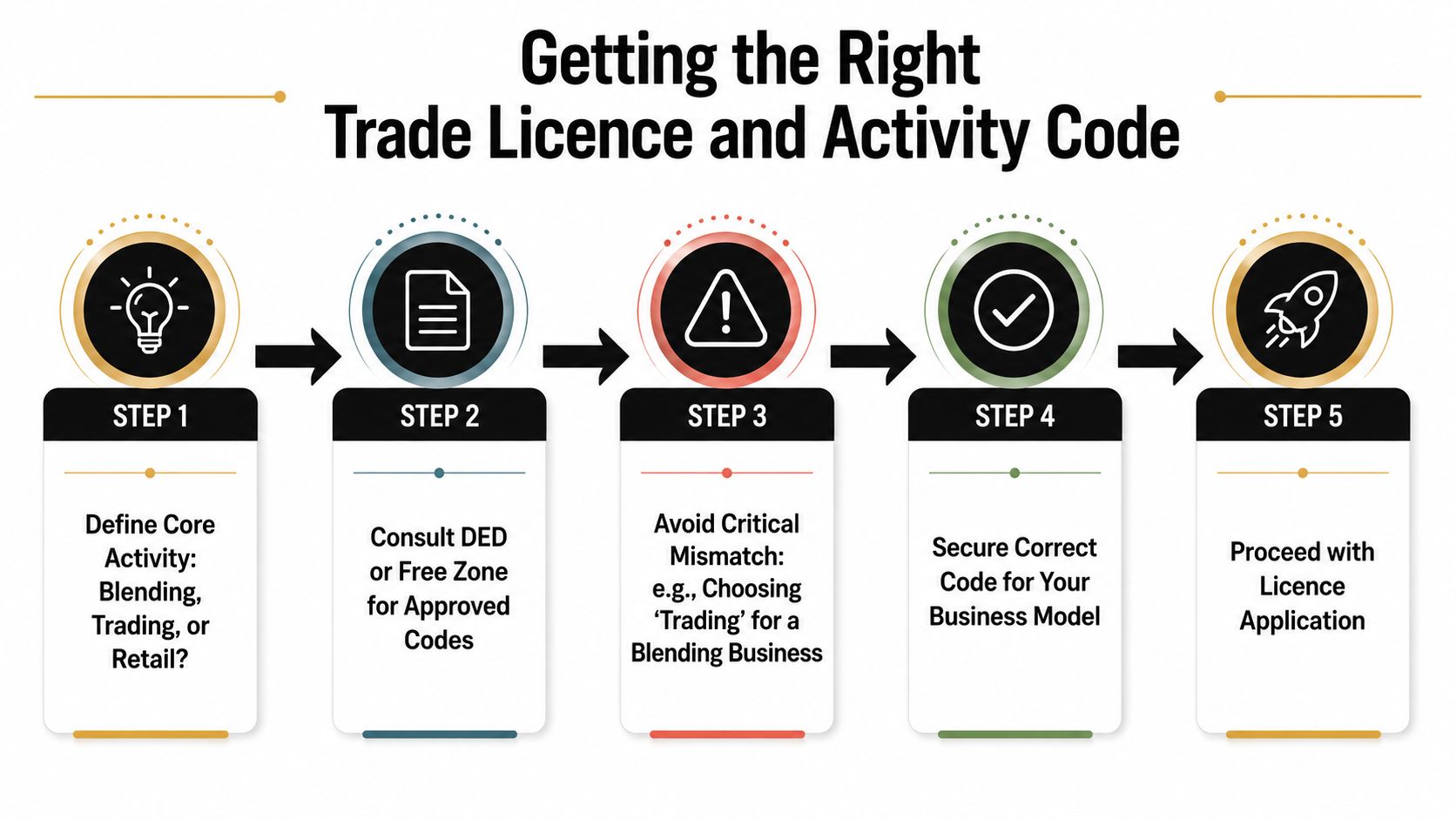
A perfume launch in Dubai fails fast when the licence says one thing and the business does another. The mistake is usually cheap at the start, then expensive later. If you plan to blend, bottle, trade, or retail fragrance, the activity code has to match the operating model from day one.
Start with the activity, not the brand story
Choose the activity first, then reserve the trade name, obtain initial approval, lease premises that fit the activity, and only then apply for the trade licence. For manufacturers and blenders, product registration and local approvals come before sales, not after. Founders often pick a generic trading activity because it sounds flexible, then discover they are running a blending or manufacturing operation.
That mismatch creates avoidable rework. A perfume trading licence does not cover blending operations just because the brand sells fragrance. Retail and manufacturing touch different regulators and different documents, so once you have signed a lease or printed packaging, the correction becomes more painful.
Budget for approvals, not just the licence
One Dubai licensing guide says setup usually takes 4 to 8 weeks depending on jurisdiction and approvals, and that many free-zone perfume-blending structures under activity code 8292.97 have no mandatory minimum capital Meydan Free Zone. The same source says MOHAP approval is required for blending operations, and that FTA VAT registration becomes relevant once turnover exceeds AED 375,000. Independent industry guidance also places initial licensing costs at roughly AED 40,000+ depending on model and location Meydan Free Zone.
Treat that as the budget structure. The licence is only one line item. Facility approval, external approvals, and compliance work sit around it, and they are the parts founders underestimate.
The fastest route is rarely the cheapest route. The cheapest route is the one that does not force you to refile later.
For founders who need support with company formation and government approvals, Smart Classic Business Hub can handle the setup process alongside compliance and PRO coordination. The licence still has to match the activity from the beginning.
A separate point matters once you move from setup into shipping and customs. If the fragrance will be imported, exported, or distributed through multiple channels, check the HS code for perfume products in Dubai before you commit to product labels, customs paperwork, or a warehouse model. A wrong classification creates friction later, especially when the business starts to scale beyond one sales channel.
Product Registration and Labelling Compliance
Perfume founders either build a serious business or create avoidable chaos from the start. Compliance is not a one-time filing. It is a SKU-by-SKU operating system, and if you treat it like admin, you will pay for it later in rework, delayed launches, and wasted packaging.
Register the product, not just the company
Dubai-market guidance says perfume SKUs are registered through Dubai Municipality's Montaji system, with one cited benchmark cost of AED 220 per SKU LinkedIn guide on launching luxury perfume manufacturing. The practical meaning is straightforward. Each fragrance variant, each size, and each artwork change can become a separate compliance item. A three-size bottle line is not one product from a regulatory point of view if the SKU setup changes.
Build the sequence properly. Finalise the formula first. Lock the Safety Data Sheet. Lock the artwork. Then register. Do not print boxes before approval. Do not order final sleeves before you know the label content is compliant. The failure mode is predictable, packaging goes out early, approval comes back with changes, and the whole batch needs rework.
Labels and approvals need discipline
Dubai-market guidance also notes that labels must include Arabic and English ingredients plus batch and expiry information. For blending or manufacturing, MOHAP touchpoints sit alongside the product registration process, so your documentation set needs to be ready before you go public. If your supplier cannot provide clean paperwork, change suppliers.
A simple rule keeps founders out of trouble.
- Lock the formula first: Do not build packaging around a scent that can still change.
- Lock the SDS next: Your documentation needs to match the actual product.
- Lock the artwork last: Labels must reflect the approved composition and mandatory information.
- Register each SKU deliberately: Assume every size or variant can carry its own compliance burden.
The visa stack is tied to the licence, not to wishful thinking. An investor or partner visa is typically linked to ownership structure, while employee visas depend on the office or warehouse Ejari and the available quota. The dependency chain is licence first, then establishment card, then quota allocation, then visa stamping. A founder who expects a visa to appear automatically after licence issuance is going to waste time.
Freelance and golden visa pathways can be relevant for some creative-sector founders, but they do not replace business licensing. If your model involves actual product trade, the company structure still comes first.
For founders who need a practical import and product documentation reference, the HS code guidance for Dubai businesses is worth reading before shipment planning starts. If you are also trying to understand how packaging and landed cost affect your margin, the product costing guide for sellers is the right companion read before you commit to a final bottle or box spec.
Startup Costs and a Realistic First-Year Budget
A perfume business in Dubai can start lean, but compliant launch costs add up fast. The first bill is rarely the licence. Costs spread across approvals, facility choice, registrations, packaging, inventory, and the admin work that keeps the business usable after launch.
What a small launch actually spends on
A realistic first-year plan for a small brand should cover licence fees, external approvals, facility costs, SKU registration, branding and packaging, initial stock or contract-manufacturing runs, visas, accounting, VAT setup, and marketing. A founder launching five SKUs with two employees and a small retail-plus-online presence needs to treat each of those lines as a real budget item, not an afterthought.
Founders usually get the order wrong. They put too much into rent and packaging, then leave too little for compliance, trademark work, and product paperwork. That turns into delays and rework. The bottle can wait. The paperwork cannot.
- Licence and approvals: Mainland and free-zone structures vary, but this is one of the first serious outlays in the launch plan.
- Facility choice: A shared office or co-working setup keeps early overhead lower, while a small shop changes the cost profile quickly.
- SKU registration: Five fragrances with multiple sizes can become a meaningful compliance line item, not a side note.
- Visas: Government fees can add up quickly for investor, partner, and employee files.
- VAT setup: Once turnover exceeds AED 375,000, registration becomes mandatory, as set out by Meydan Free Zone.
Use product costing before you fix retail pricing
Price the product from unit economics, not instinct. The product costing guide for sellers is useful for testing materials, packaging, and margin discipline before you lock the catalogue. That matters because perfume founders often price from gut feel, then find that freight, packing, and compliance have already eaten the margin.
A basic finance rule applies here. If the brand cannot cover compliance, packaging, and replenishment on the first small run, the model is too thin. You do not need a huge catalogue at launch. You need a catalogue that can survive real costs.
The visa and PRO side needs its own budget line. Employee visas do not follow automatically from the licence, and founder visas do not appear by default. Clean accounting and VAT processes also need to start at the beginning if you want books that can support growth or distribution discussions later.
Suppliers Contract Manufacturers and Sourcing
A perfume founder's supply chain needs to be boring in the best way. Reliable paperwork, consistent batches, usable documentation, and no drama at registration time. If a supplier is good at talking and bad at filing, walk away.
Choose suppliers for compliance first, creativity second
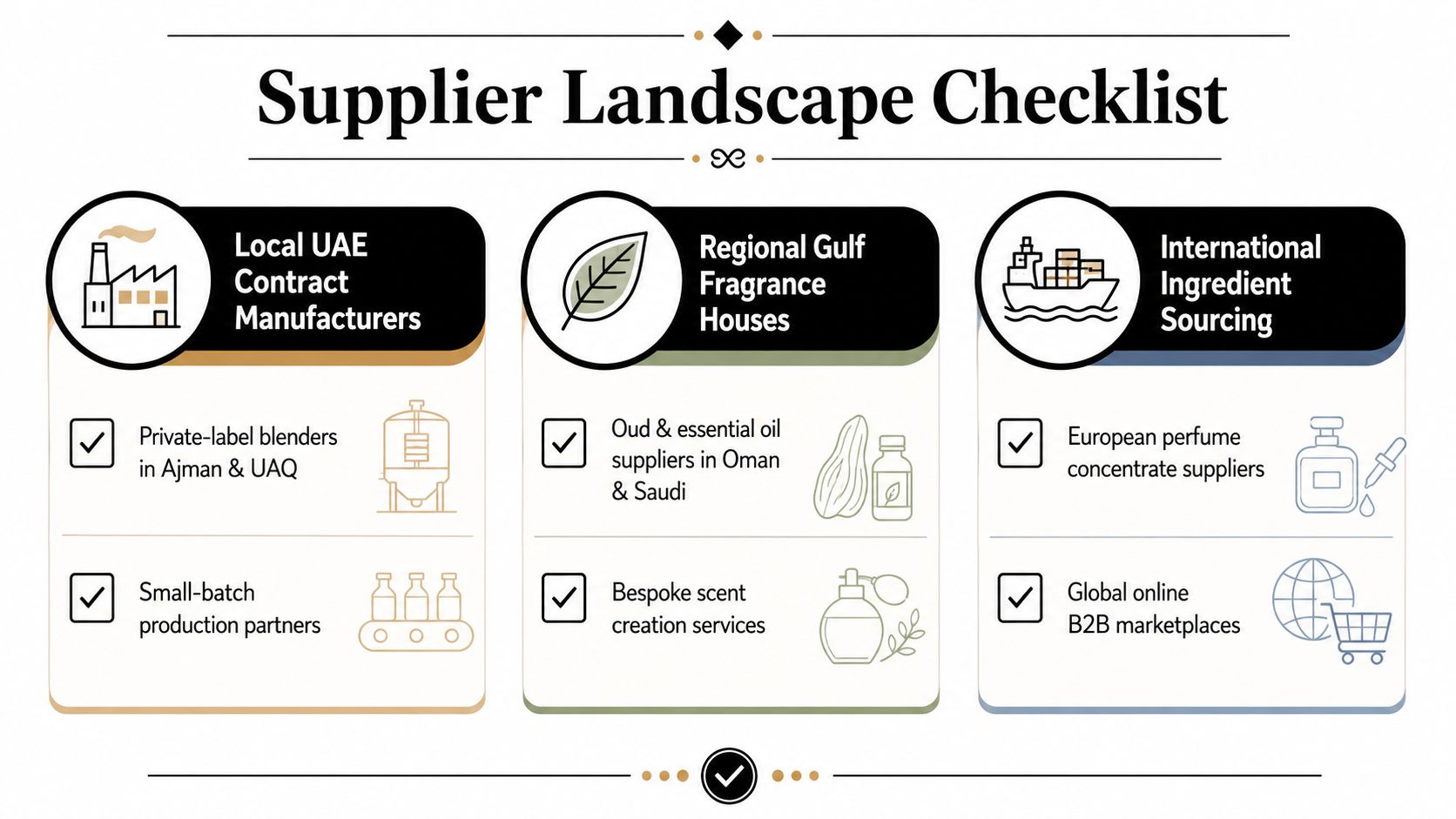
Local contract manufacturers and private-label blenders in the UAE are useful because they understand the approval environment and can support small first runs. Regional fragrance houses in the Gulf are valuable when you need oud, amber, or bespoke scent development with stronger ingredient heritage. International sourcing still has a place for fine fragrance concentrates, essential oils, and specialist raw materials, but only if the supplier can provide the documentation your business will need later.
The qualification checklist is stricter than most founders expect. You want UAE-compliant formulations, IFRA documentation, Safety Data Sheets, and a willingness to support SKU-level paperwork for Montaji. If a supplier can't support that, they're not a launch partner, they're a future problem.
Packaging comes after the formula, not before
Bottle suppliers love early commitment. Founders should resist it. Lock the formula first, because the liquid often dictates the bottle, cap, atomiser, and label format. If you buy packaging too early, you'll often end up with boxes that don't match final approvals or a bottle that doesn't fit the actual production workflow.
A smart first-year catalogue is tight, not sprawling. Choose one reliable manufacturer, build a narrow line, and test demand before adding more variants. Launching 30 SKUs sounds ambitious. It usually creates compliance overload, inventory confusion, and dead stock.
Build for the channels you can actually serve
A first-year Dubai perfume brand usually sells through a mix of its own e-commerce site, marketplaces like Amazon UAE and Noon, social commerce, a small retail presence, and selective wholesale to boutiques or hotel channels. That mix works only if the brand has the operational discipline to support each channel without confusing the stock file.
Brand protection also matters early. Register the trademark in the UAE before the market starts to recognise the name, especially if export is on the roadmap. A UAE trademark gives you a cleaner base for GCC and international filings later. If the brand moves beyond the UAE, requirements can shift materially, and some export routes may bring in certification expectations such as ESMA or the Emirates Quality Mark. Build the file now, not after the first regional order lands.
For founders who want a framework for the broader D2C path, real D2C brand growth examples can be a useful reference point, but the perfume sector only works when growth is matched with documentation and channel discipline.
Your 90-Day Dubai Perfume Launch Checklist
A 90-day launch works if you stop improvising after week one. The founder who tries to do everything at once usually ends up with unfinished approvals, packaging that needs revision, and a launch date that slips.
Weeks 1 to 2, make the structural calls
Decide jurisdiction, choose the activity code, reserve the trade name, and submit the initial licence application. Do not touch packaging yet. Do not brief a photographer yet. The structure has to exist before the brand starts pretending it's already live.
Weeks 3 to 6, build the legal and supplier base
Secure premises, whether that means a compliant office, warehouse, or retail space. Start external approvals, including Dubai Municipality and MOHAP where applicable. Shortlist suppliers who can support compliant paperwork, not just attractive prices. If a manufacturer can't explain how they handle documentation, they're not your partner.
Weeks 5 to 8, lock the product file
Finalise the formula, lock the SDS, lock the artwork, and prepare Montaji SKU registrations. File the trademark as soon as the name is stable. This is the stage where founders lose time by changing the label after the regulatory work has already started.
Weeks 7 to 12, launch only what is ready
Build the e-commerce site, finish photography, line up retail discussions, and start the first production run. Then go live with a small, controlled launch. The first batch should teach you about demand, not punish you for overcommitting.
Most common founder mistake: choosing the activity code too early, then skipping SKU-level compliance budgeting because the licence already feels “done”.
A setup consultant makes sense when the founder is juggling jurisdiction choice, product compliance, and visa planning at the same time. If the business is a very small online-first brand with one supplier and no physical retail, a founder can run much of the process alone. The moment manufacturing, multiple SKUs, or export planning enters the picture, the process gets more expensive to learn by trial and error.
If you want a perfume launch in Dubai that doesn't collapse under licensing, packaging rework, or the wrong activity code, Smart Classic Business Hub can help with company formation, approvals, PRO work, VAT setup, and ongoing compliance. Visit Smart Classic Business Hub to get the structure right before you print the boxes.