
You've chosen an activity, spoken to a few formation agents, and seen license adverts that appear attractively simple. One quote covers a free zone licence, another recommends a mainland company, and a third promises a fast setup without explaining what happens after incorporation. The difficult part of how to start a business in Dubai isn't submitting a form. It's choosing a structure that still works when you need customers, staff, visas, banking, premises, and tax compliance.
Dubai can offer a fast route into the UAE market, but speed only helps when the underlying decisions are correct. Your activity, jurisdiction, legal form, ownership arrangements, office requirement, and approval path will shape the company's operating scope and future costs. Treat formation as a jurisdiction-first decision, not as a search for the cheapest licence.
Why Dubai Works for New Businesses Right Now
A consultancy founder may start by asking, “How quickly can I get the licence?” The better question is where clients will be located and what the company must do after incorporation. A free zone structure can suit a digital service sold internationally. A mainland entity may fit a consultancy serving clients directly across the UAE. Both can work, but they address different operating requirements.
That jurisdiction choice affects more than the initial licence quote. It can influence office arrangements, visa capacity, access to UAE customers, banking preparation, and the company's tax and reporting obligations. Under the 2026 Commercial Companies Law changes, founders should treat incorporation as a jurisdiction-first decision, then test the legal form and activity against the intended business model.
Dubai's official setup process is increasingly digital. The UAE Ministry of Economy and Tourism says the federal Basher eService can complete company establishment through an integrated online platform in “a few minutes.” Its company-establishment guidance also lists service-time targets as short as 15 minutes and 4 days, depending on the pathway and approvals required. The relevant milestones appear in the UAE Ministry of Economy and Tourism company-establishment guidance.
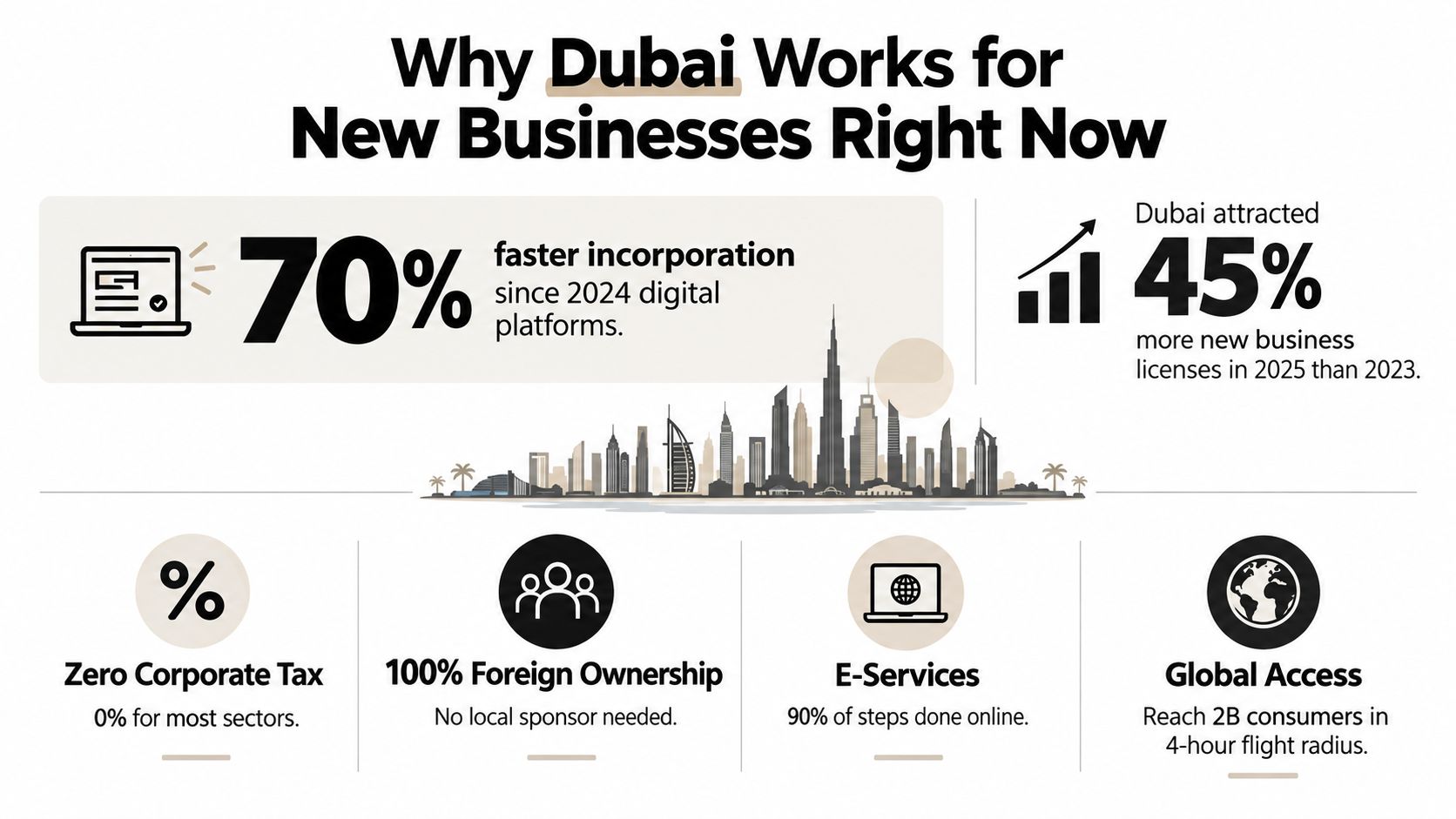
Digital registration reduces administrative friction. It does not make every application immediate. Activity-specific approvals, shareholder documents, legal-form requirements, office arrangements, immigration processing, and tax registration can extend the practical timeline. Accurate decisions before submission still matter.
A regional base, not just a local licence
Dubai's business network continues to grow. The Dubai Chamber of Commerce added 71,830 new companies in 2025, bringing active membership to 292,486 and recording 13.2% year-on-year growth, described as the Chamber's strongest annual growth. These figures are reported in coverage of Dubai Chamber's 2025 company growth.
The same source reports 1,117 greenfield FDI projects in 2024 and a ranking as the world's No. 1 destination for greenfield FDI projects for four consecutive years. For founders, the practical benefit is access to suppliers, professional services, partnerships, and cross-border commercial relationships. Competition is also stronger, so a licence alone does not create demand.
Fundraising requires separate preparation. Incorporation does not guarantee investment. Build a credible business plan, ownership summary, use-of-funds explanation, and financial model. A UAE startup funding directory can help identify possible funding routes while the company's legal and commercial foundation is being built.
Practical rule: Use Dubai's fast registration process to reduce delay, not to skip the jurisdiction and activity analysis that determines whether the company can operate as intended.
Define the activity and customer base first. Then choose mainland, free zone, or offshore. After that, align the legal form, licence, premises, visas, banking plan, tax registration, and compliance system. This sequence prevents a low initial quote from becoming an expensive restructuring exercise.
For a broader review, see the benefits of setting up a business in Dubai, then test each stated benefit against the company's actual customers, premises, staffing, and tax position.
Choosing Your Jurisdiction and License Type in Dubai
Jurisdiction comes before price. Mainland companies can generally trade across the UAE, while free zone entities are typically limited to activity within their zone or abroad unless they obtain the appropriate mainland authorisation. Dubai's official business guidance presents mainland and free zone selection as an early structuring decision, as explained in Dubai's company setup options.
Compare the operating models
| Criteria | Mainland | Free Zone | Offshore |
|---|---|---|---|
| UAE market access | Generally suitable for direct UAE trading | Usually restricted for direct mainland trading without appropriate authorisation | Intended for activity outside the UAE |
| Ownership | Depends on the activity and current legal framework | Commonly supports foreign ownership, subject to the zone and activity | Structure and local operating rights require careful review |
| Premises | Often linked to the activity and licensing requirements | Options vary by zone, activity, and visa plan | Not a substitute for an operating UAE office |
| Visas | Linked to the company, premises, and authority requirements | Linked to the zone, licence, and facility allocation | Local residency and banking suitability can be limited |
| Best fit | UAE-facing trade, services, and broad operating access | International services, zone-linked activities, and focused structures | Holding or international arrangements where UAE trading isn't required |
A mainland company normally makes more sense when your customers, contracts, staff, or physical operations are spread across the UAE. A free zone can be more efficient when your revenue comes from international clients or when the chosen zone offers the right activity and facility package. Offshore formation should not be selected because it appears inexpensive. If you need UAE customers, local staff, resident visas, or a UAE operating bank relationship, its limitations may outweigh the initial saving.
The choice also affects visa capacity and premises. A flexi-desk may support a lean structure in one free zone, while a mainland activity or a growing team may require a more substantial lease. Your intended headcount, client meetings, storage, regulated equipment, and immigration needs should be mapped before the application is submitted.
Match the activity to the licence
A consultancy, trading company, manufacturer, technology provider, and tourism operator won't use the same licensing route. The authority may require additional approvals where the activity touches regulated services, health, education, finance, transport, food, construction, or professional practice. A broad description such as “general business” isn't a substitute for selecting the precise permitted activity.
The legal form matters as well. It influences shareholder arrangements, constitutional documents, liability, approval requirements, and how the company presents itself to banks and counterparties. Compare the practical differences in free zones versus mainland Dubai before accepting a packaged recommendation.
The legal position is also moving. The UAE Commercial Companies Law was amended by Federal Decree-Law No. 20 of 2025, and Ministry of Economy guidance says all new mainland licence applications from January 2026 must comply with the amended framework, as reported in the British Chamber of Commerce Dubai update. That means founders should confirm current ownership eligibility, MOA and AOA templates, legal-form restrictions, office rules, and sector approvals before filing.
For a practical comparison of the main structures, see mainland versus free zone in Dubai. The best option is the one that supports your expected customers and operating permissions, not the one with the lowest advertised licence fee.
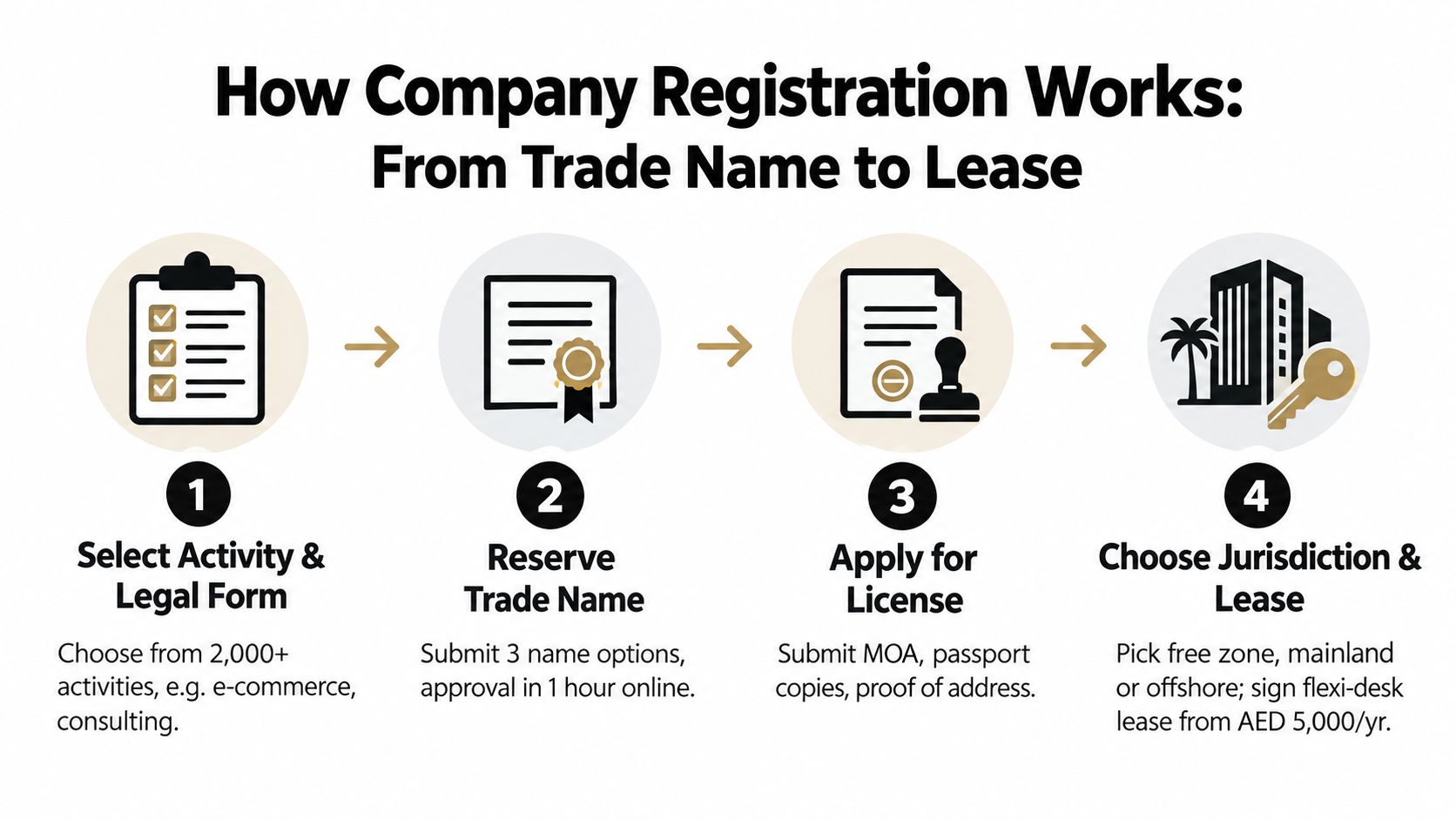
How Company Registration Works From Trade Name to Lease
Start with the activity, not the brand name. The activity determines the licence category, authority, possible external approvals, premises expectations, and whether the proposed legal form is available. Write down what you'll sell, who will buy it, where delivery will happen, and whether the company will import, store, manufacture, advise, or provide regulated services.
Your legal form should reflect the ownership and liability model. If there are multiple shareholders, agree on ownership, management authority, capital commitments, and exit arrangements before preparing constitutional documents. Informal assumptions made at formation often become disputes when a shareholder wants to sell, raise funds, or change the business scope.
Reserve a name that can survive review
Prepare several trade-name options rather than becoming attached to one. Authorities may reject names that conflict with existing registrations, imply prohibited affiliations, contain offensive or religiously inappropriate wording, refer to political groups, or use a person's name without the required connection to an owner or partner.
The name should also match the activity and future positioning. A narrow name can become restrictive if you later add related services, while an overly broad name can create an unclear application. Check the proposed name in the relevant authority's system, then reserve it before spending on signage, design, domains, or marketing.
Prepare documents before requesting approvals
The exact checklist depends on the jurisdiction, activity, legal form, and shareholder profile. Common requirements can include passport copies, proof of address, application forms, constitutional documents, and corporate documents for entity shareholders. Documents issued outside the UAE may need notarisation, legalisation, or attestation, and translation requirements can apply.
Initial approval confirms that the authority has no objection in principle to the proposed formation. It doesn't always mean you can begin every aspect of trading. Activity-specific approvals may still be required from the relevant government body, and regulated sectors should be identified before the application reaches the final stage.
Under the amended framework, new mainland applications from January 2026 must follow the updated legal requirements. Confirm that the MOA and AOA templates and ownership structure are current rather than recycling documents from an earlier setup.
Secure the address at the right point
The lease or facility arrangement links the company to its operating location. Depending on the authority and activity, this may mean a physical office, shared workspace, flexi-desk, warehouse, shop, or specialist facility. Don't pay for a space that doesn't support your licence requirements, and don't assume a low-cost desk provides the visa capacity or operational permissions your business needs.
PRO support can be useful where several authorities, attestations, translations, or approvals are involved. It adds the most value when the adviser manages a documented checklist and explains dependencies. It adds little value when the service submits an incomplete application and passes every delay back to the founder.
Once the required approvals, documents, address arrangements, and payments are complete, the authority can issue the trade licence. Treat the licence as the start of operations. Banking, tax registration, accounting records, visas, contracts, and renewals still need active management.
Banking Visas and Tax Compliance After Incorporation
A trade licence gives you a legal vehicle, but a functioning company needs a bank account, immigration plan, accounting process, and tax calendar. Founders often delay these tasks because they expect them to happen automatically. Banks and authorities assess the substance of the business, so prepare before the licence is issued.
Make the bank application credible
A bank will typically want to understand the shareholders, business activity, expected transactions, source of funds, customer geography, suppliers, and purpose of the account. A non-resident founder may be able to explore corporate banking options, but account acceptance depends on the bank's internal policies and the company's profile.
Prepare a consistent file containing the licence, constitutional documents, shareholder identification, business plan, contracts or invoices where available, source-of-funds evidence, and an explanation of expected incoming and outgoing payments. Inconsistencies between the licence activity, website, business plan, and answers given to the bank can create avoidable questions.
For help organising the account-opening process, review business banking account support. Don't choose a bank solely because an intermediary says it's quick. Check whether it supports your currencies, payment flows, online banking requirements, and expected transaction profile.
Put tax dates on the calendar
UAE companies must register for corporate tax within 3 months of incorporation, according to the UAE entity incorporation compliance checklist. The same guidance states that VAT registration becomes mandatory when taxable supplies exceed AED 375,000 in a rolling 12-month period.
A free zone licence doesn't mean zero obligations. Tax registration, recordkeeping, returns, related-party documentation where applicable, and audit readiness can still matter. Many free zones require annual audited financial statements, so set up bookkeeping and document retention from the first invoice rather than trying to reconstruct records before renewal or filing.
Compliance habit: Keep invoices, contracts, bank records, expense evidence, and shareholder resolutions organised by month. Clean records make tax work, banking reviews, audits, and due diligence easier.
Align visas with the structure
Visa routes can include investor, employment, freelance, family, and other residency categories, subject to the relevant authority and eligibility requirements. The company's jurisdiction, facility allocation, shareholder role, and immigration file affect what can be applied for and how many people the structure can support.
A founder planning to relocate should also consider personal administration, insurance, accommodation, dependants, and access to healthcare. Practical guidance on essential steps for digital nomads can help remote founders think beyond the company licence. Apply only after confirming the company's immigration eligibility and the documents required for the chosen visa route.
Timelines Costs and What Cheap License Ads Hide
A cheap Dubai licence advertisement often covers only the headline fee. The actual launch budget may also include the activity fee, legal documents, establishment card, office or flexi-desk, visa processing, medical checks, authority approvals, translation, attestation, PRO work, banking support, accounting, and tax registration. Request an itemised quotation that separates mandatory charges from optional services.
Dubai's strong business demand can affect appointment availability, authority workload, professional-service capacity, and the time required to correct missing documents. Build that uncertainty into your schedule instead of treating the advertised licence price or promised completion date as fixed.
Build the quote around your operating plan
A solo consultant serving international clients may need a focused activity, modest facilities, one visa, banking support, and accounting. A UAE-facing trading company may require a different jurisdiction, customs or sector approvals, suitable premises, staff visas, and working capital. Mainland and free zone choices can therefore change the total cost, visa capacity, customer access, and tax administration. Comparing licence prices alone gives a misleading result.
Use a cost calculator for planning, not as a promise. Before paying, ask:
- What's included: Does the quote cover the exact activity, legal form, authority fees, establishment card, and required approvals?
- What changes the price: Do additional shareholders, visas, office space, or regulated activities create separate charges?
- What happens at renewal: Are recurring licence, premises, accounting, audit, immigration, and tax costs identified clearly?
- What happens if plans change: Can the company add activities, increase visa capacity, or trade outside the zone without restructuring?
A practical timeline has several separate tracks. Name reservation and initial approval may move quickly, while document attestation, external approvals, lease registration, banking, and visas may take longer. The 2026 Commercial Companies Law changes make the initial jurisdiction decision even more important, because ownership, operating permissions, premises, and compliance requirements can affect later steps. Do not promise customers a launch date until the relevant authority confirms the licence, and allow time for post-incorporation work.
Save intelligently
Reduce risk by choosing only the activities you need, avoiding unnecessary office space, and matching visa capacity to your hiring plans. Cutting costs through an unsuitable jurisdiction, neglected accounting, or an unclear tax position usually shifts the expense into renewal, restructuring, banking, or filing work.
The strongest formation quote states its assumptions. It explains what the founder receives, what the authority requires, what renews annually, and which charges depend on future decisions. That clarity helps you judge cost of launching, not just the price shown in an advertisement.
Avoiding Pitfalls and Launching With Confidence
Most delayed formations don't fail because the founder lacks ambition. They fail because the commercial plan and legal structure don't match. A company may hold a valid licence but still lack the right authority to serve its intended customers, the premises needed for its visas, or the records required for tax and banking reviews.
Check the structure before filing
Review the following points with the proposed formation provider, authority, legal adviser, or accountant:
- Activity fit: Confirm the exact activities cover the services or goods you'll sell.
- Customer access: Establish whether the chosen jurisdiction permits direct trading with your target customers.
- Ownership: Verify eligibility under the current framework, especially for mainland applications made from January 2026.
- Premises: Confirm that the office, flexi-desk, warehouse, or facility supports the activity and intended visa capacity.
- Approvals: Identify every external authority involved before committing to a launch date.
- Documents: Check passport validity, shareholder records, attestations, translations, and corporate paperwork.
- Banking: Prepare a business plan and source-of-funds file that matches the licence and expected transactions.
- Compliance: Assign responsibility for corporate tax, VAT monitoring, bookkeeping, audit preparation, and renewals.
The recurring mistake is treating the licence as the finish line. Incorporation creates the entity. It doesn't create a sales process, reliable bookkeeping, bank acceptance, immigration eligibility, or permission to conduct activities outside the licence scope.
Know when support pays for itself
A straightforward professional setup can often be managed with limited assistance if the activity, shareholders, documents, and jurisdiction are clear. Specialist support becomes more valuable when the business has multiple shareholders, overseas corporate owners, regulated activities, foreign documents, urgent relocation plans, complex banking requirements, or an intended mainland expansion.
PRO specialists can coordinate government submissions and immigration administration. Legal advisers can review ownership, contracts, constitutional documents, and regulatory exposure. Accountants can establish VAT and corporate tax processes, maintain records, and prepare for audit requirements. Recruitment and co-working partners can support expansion after the company has a compliant base.
Launch standard: Don't ask only whether the company can be incorporated. Ask whether it can invoice the right customers, hire the right people, open a suitable bank account, and remain compliant after the first renewal.
A confident launch follows a simple sequence. Define the activity and customer base, compare jurisdictions, confirm the updated legal requirements, budget for the complete operating model, prepare documents, secure the correct facility, and install the compliance calendar before trading. That approach is slower than clicking on the cheapest advert, but it's far less likely to produce an expensive correction later.
Smart Classic Business Hub helps founders compare mainland, free zone, and offshore structures, prepare formation documents, coordinate PRO and licensing requirements, and arrange VAT-compliant accounting, audit, banking guidance, visas, and related support. Visit Smart Classic Business Hub to discuss your activity, operating location, ownership plan, and the setup route that fits your Dubai launch.