
Corporate Tax registration is mandatory for nearly every UAE company, generally within 3 months of incorporation for a newly formed juridical person. The Federal Tax Authority (FTA) issues a Corporate Tax Registration Number after processing the application, which may take approximately 20 business days, and late registration can trigger an AED 10,000 administrative penalty (FTA Corporate Tax registration service).
You may be sorting out a new trade licence, comparing a mainland setup with a free zone, or trying to work out whether a company managed from Dubai counts as a UAE tax presence. The practical answer depends on your legal structure and where the business is managed or carried on. Getting those details straight before opening EmaraTax can save you from a rejected application, a missed deadline, or the mistaken assumption that a free-zone licence means you can skip registration.
Who Must Register for Corporate Tax in the UAE
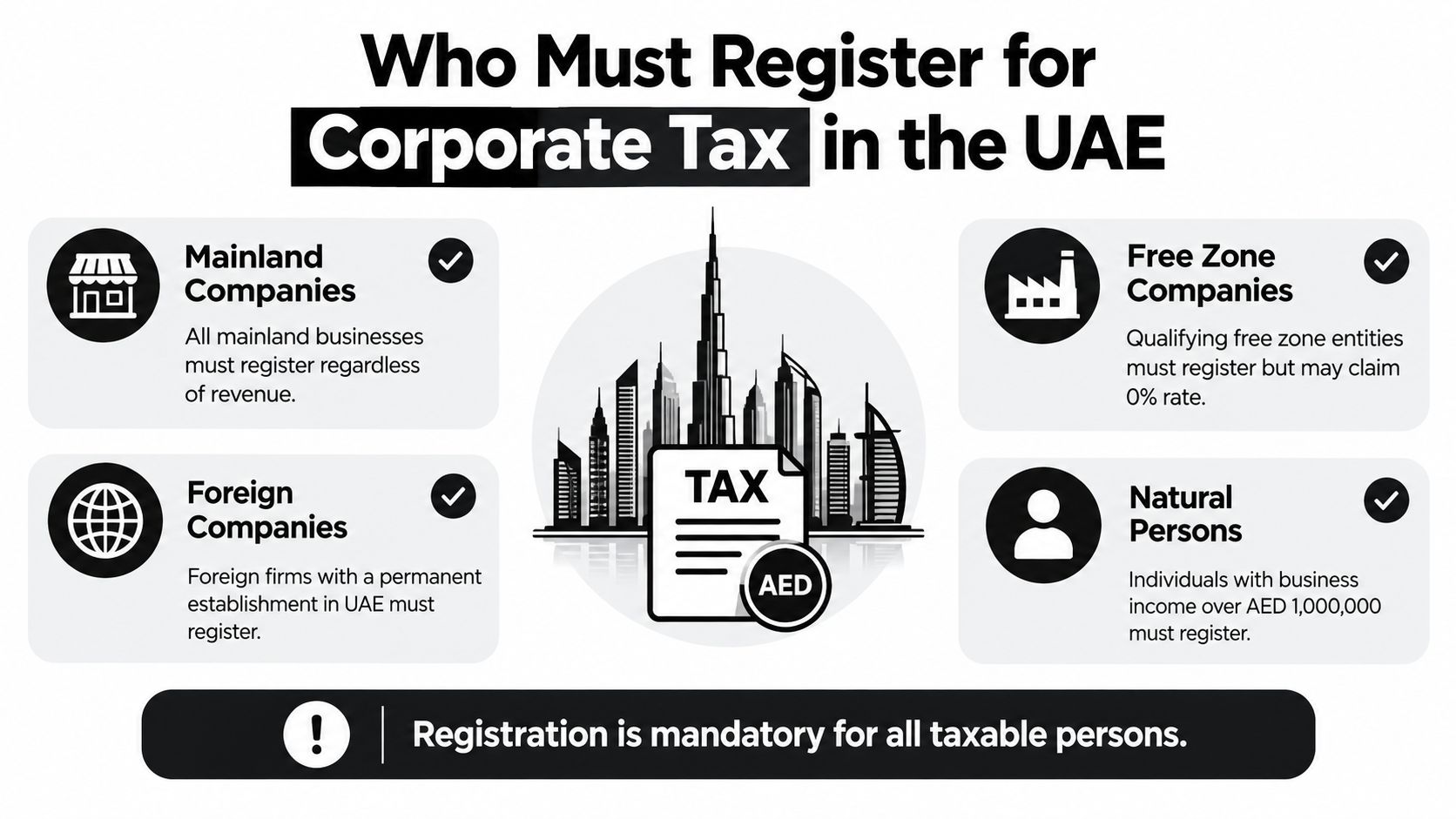
Start with the legal entity you will register in EmaraTax. A UAE-incorporated company is generally a taxable juridical person, whether its licence comes from a mainland authority or a free zone, and must obtain a Corporate Tax Registration Number through the FTA Corporate Tax registration service.
Registration and the tax treatment of income are separate questions. A mainland LLC cannot skip registration because revenue is low or it expects no tax payable. A free-zone company must also register when claiming eligibility for a 0% incentive. The free-zone trap is treating a possible tax benefit as permission to leave the company unregistered.
Offshore status needs closer examination. Establish where the entity was incorporated and what it does in the UAE before deciding whether it falls within the taxable-person rules. An offshore label alone does not resolve the obligation.
Check whether the rule applies to you
For a branch or foreign company, examine both its UAE presence and where management decisions are made. A UAE permanent establishment and a foreign company managed and controlled from the UAE create different registration considerations. Review the actual arrangements: who makes company-level decisions, where those decisions are taken, and how the UAE operation conducts business. A licence or overseas incorporation certificate cannot answer those questions by itself.
Classification comes before calculating the deadline.
A permanent establishment's registration timing is linked to when it came into existence; a foreign company managed and controlled from the UAE follows a financial-year-end trigger. Choosing the wrong category can therefore mean working towards the wrong filing date.
Individuals follow a separate rule. From 1 January 2024, a UAE-resident natural person must register if turnover from UAE business activities exceeds AED 1 million in a Gregorian calendar year (FTA registration timelines for taxable persons). Individuals outside that business-activity test should not register under this rule.
Practical rule: Identify the legal person named on the licence, then assess any separate business carried on by the shareholder. Keep the company's turnover and the shareholder's personal income separate.
Founders comparing structures can use this overview of startup tax thresholds in the UAE to frame questions about their own registration position.
Registration Deadlines You Cannot Afford to Miss
A foreign company with a 31 December year-end is run from Dubai, and its founder assumes registration can wait until the tax return is due. That assumption can put the registration at risk. Registration and return filing have separate clocks, and the correct registration clock depends on the entity's category.
| Entity situation | Deadline trigger | Typical deadline |
|---|---|---|
| UAE juridical person incorporated, established, or recognised on or after 1 March 2024 | Incorporation, establishment, or recognition date | Generally within 3 months |
| UAE resident juridical person established before 1 March 2024 | Month in which the business licence was issued | Deadline depends on the licence month |
| Company without a licence as of 1 March 2024 | Specific FTA deadline | 31 May 2024 |
| Foreign company managed and controlled from the UAE | End of its financial year | Generally within 3 months after year-end |
| Non-resident company with a UAE permanent establishment | Date the permanent establishment came into existence | Generally within 9 months, subject to the applicable category and establishment date |
In the foreign-company scenario, if the managed-and-controlled category applies, the three-month period after 31 December points to 31 March. The founder should resolve the classification before using that date in the compliance calendar. An overseas incorporation certificate alone does not settle which deadline applies.
Late registration can attract an AED 10,000 administrative penalty, as stated on the FTA Corporate Tax registration service.
Work from the right trigger
Record the trigger date and the reason for selecting it before starting the EmaraTax application. This gives the person submitting the registration a consistent basis for the dates entered and supporting records uploaded. Where management arrangements are mixed, obtain advice before committing to a category; choosing the longest available period is a poor substitute for classification.
For a permanent establishment, retain evidence of when it came into existence. A later licence, document or first invoice may record a different event. Check the applicable deadline against the establishment date rather than treating 9 months as a universal allowance.
Free-zone founders should also put registration on the setup calendar. An expectation of favourable tax treatment does not, by itself, remove the registration obligation.
Practical rule: Assign a filing owner and set an internal submission date ahead of the applicable deadline. Leave room to resolve inconsistent records or portal queries. These techniques for meeting targets without burnout can help organise competing compliance tasks.
Keep registration and return-filing dates as separate calendar entries. Use the UAE corporate tax filing deadlines to check ongoing filing obligations without substituting them for the registration deadline.
Documents and Information You Need Before You Start
A free-zone licence shows the company's current name, while an older incorporation certificate uses its previous name. Uploading both without the supporting change-of-name record leaves a discrepancy to resolve. Before opening EmaraTax, check that your document pack supports one consistent set of company details.
Compile the file by entity type
For a mainland company, prepare the trade licence, memorandum and articles of association where applicable, share or partner register, and identity documents for the authorised signatory. Keep a lease or office agreement available to support business address details, plus current financial information if requested.
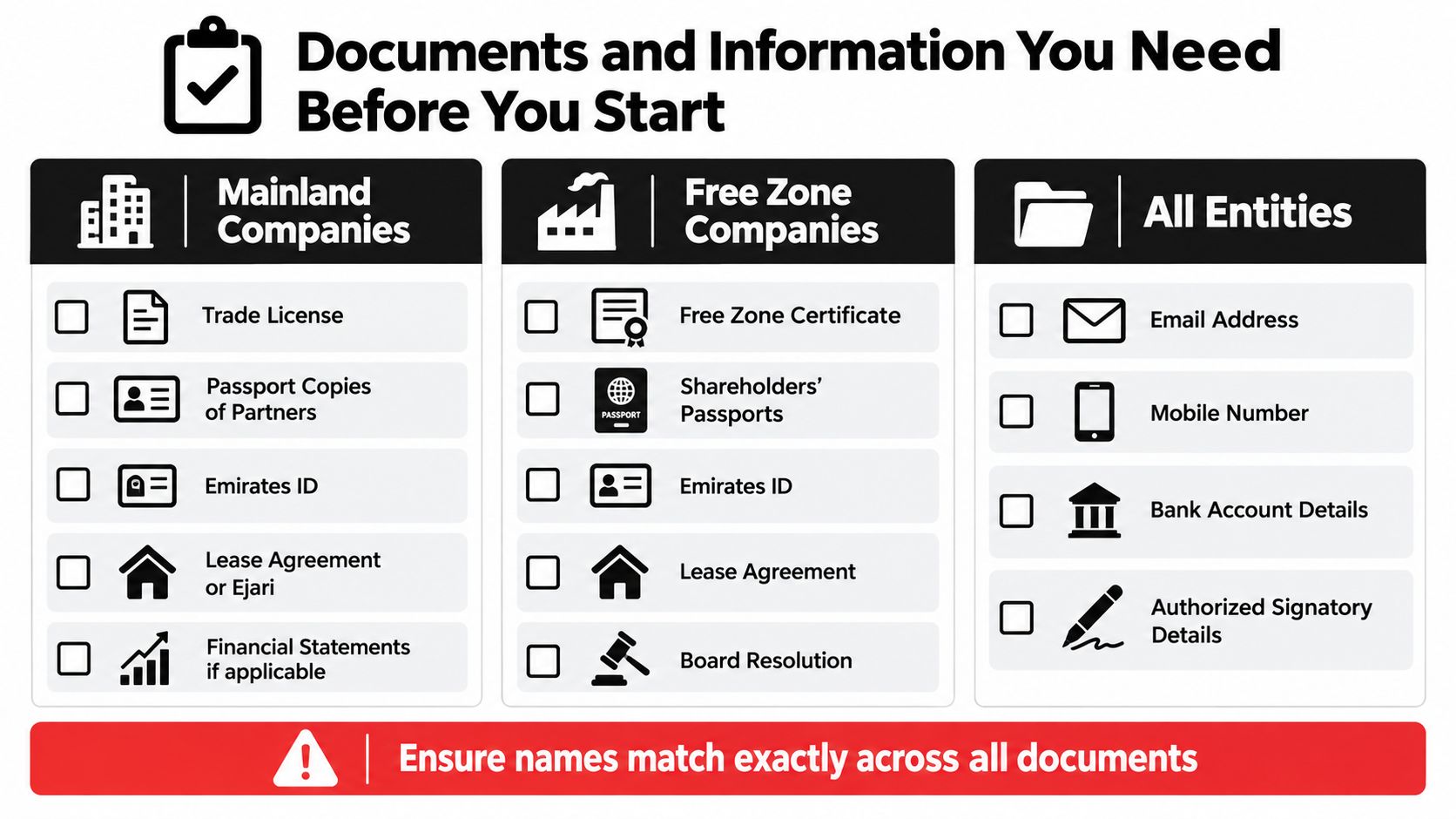
For a free-zone company, gather the free-zone licence, certificate of incorporation, constitutional documents, shareholder and beneficial-owner details, and any relevant board resolution. Compare the legal name, legal form and shareholder details across those records. If amendments explain a difference, keep them with the original documents so the connection is clear.
Free-zone status alone doesn't make the document pack complete.
For a branch or foreign company, include parent-company records, evidence of the UAE presence and documents establishing authority to act for the entity. Upload requests can differ by legal structure. Where management arrangements affect classification, retain supporting records rather than relying on the licence alone. Keep dated records accessible for checking the applicable FTA registration timelines for taxable persons.
Individuals subject to the turnover test should prepare their trade licence or freelance permit and business turnover records, with supporting invoices or accounts organised for reference.
Make the signatory details consistent
The Authorised Signatory must be entitled to act for the taxable person. Match their name and identification details to the supporting documents, check the evidence of authority, and use contact details they can access.
Use readable scans and descriptive filenames. Resolve expired documents or inconsistent company names before uploading. Gathering every historical file creates clutter; prioritise current records and the amendments needed to explain discrepancies.
Filing the Application on the FTA EmaraTax Portal
If your EmaraTax account already contains a VAT profile or another company, check the selected legal entity before starting. Registering under the wrong profile creates a problem that accurate uploads cannot resolve. Sign in using the available account access method, then select the Corporate Tax registration option for the relevant taxable person.

Complete the profile carefully
Enter the taxable person's identifying details and legal structure, using the legal name shown on its licence or incorporation documents. Treat the structure selection as a decision about the entity you are registering, rather than choosing whichever description looks closest.
Keep Date of Establishment or Incorporation separate from Licence Issue Date.
These fields describe different events. Copy each date from the corresponding record instead of using the current licence date for both. Where your registration deadline depends on establishment facts, that distinction deserves particular attention.
Complete the business and contact fields, then add the authorised signatory. Use details for someone who has authority to represent the company and can respond to verification requests. Check the financial year-end against the accounting arrangements and corporate records before selecting it. Choosing a convenient date can leave the registration inconsistent with the company's records.
Upload, review, and submit
Place each supporting document in its relevant upload field. Review the completed application against the records, including the legal name, licence details, dates, ownership information and signatory particulars. A final check takes time, but resolving discrepancies before submission avoids a preventable clarification cycle.
Complete the declaration, submit the application and save the submission confirmation. The FTA Corporate Tax registration service gives an approximate processing time of 20 business days for a completed application. Allow for that processing period when organising follow-up. Once approved, save the Corporate Tax Registration Number and confirmation with the company's permanent compliance records.
VAT remains a separate obligation with different form fields. If you also need to register for VAT in the UAE, handle that application separately.
Mainland, Free Zone, Offshore, and Branch Compared
The licence authority tells you where the business was formed; it doesn't replace the FTA registration analysis. Mainland and free-zone companies established in the UAE are both within the registration framework for taxable juridical persons. A free-zone company can't treat a potential 0% incentive as an exemption from registering.
| Structure | What to assemble | Registration point to check |
|---|---|---|
| Mainland company | Trade licence and company constitutional and ownership records | Register the taxable juridical person with the FTA |
| Free-zone company | Free-zone licence, incorporation documents, ownership details | Register with the FTA; assess any incentive separately |
| Offshore company | Offshore company records and evidence of UAE activities | Establish whether a UAE permanent establishment or other relevant connection exists |
| Branch of a foreign company | Parent-company licence and authorising documents | Review the UAE presence and the parent's management and financial-year facts |
An offshore label doesn't answer whether a foreign company has a UAE permanent establishment. A branch also shouldn't assume that its parent's registration automatically resolves the branch's position. Determine which legal person is carrying on the activity and what facts establish its UAE presence.
The important distinction is between registration and tax treatment. A free-zone entity that may qualify for an incentive must still meet the relevant conditions and comply with its obligations. Registration doesn't itself establish that income qualifies for a particular treatment, and a licence alone doesn't prove that the conditions are satisfied. For planning considerations that sit beyond the application, review UAE corporate tax planning.
Common Registration Mistakes and How to Avoid Them
A founder pauses an EmaraTax application to calculate profit, while the registration deadline keeps approaching. Assuming registration means tax is payable can turn an accounting question into a missed submission. Establish whether registration is required and proceed on that basis; calculate the tax position through the accounting and return-preparation work.
Check the financial year-end against the company's constitutional documents and accounting arrangements before entering it. A date chosen for convenience can leave the application inconsistent with the records used to prepare the company's accounts.
Resolve that discrepancy before submitting.
Check the people and the dates
The authorised signatory needs legal authority and access to the contact channel used during the application. Compare their identity details with the uploaded evidence, and confirm they can respond to requests during filing. Delegating data entry does not remove the need for an available signatory.
For individual founders, use a turnover tracker separate from the company's accounts. The registration test concerns UAE business turnover exceeding AED 1 million during a Gregorian calendar year, with registration generally due by 31 March of the following Gregorian calendar year, under the FTA registration timelines for taxable persons. Using profit as the tracker risks overlooking the threshold.
Match the licence entry to the uploaded document
Selecting the wrong licence type or uploading an expired licence creates an avoidable mismatch. Read the licence itself when completing the relevant EmaraTax fields, rather than relying on how the founder describes the business. Check the licence details and validity before uploading, including for a free-zone company.
An independent pre-submission review is worth the extra time when several people have assembled the application. Ask the reviewer to compare the form with the licence and company documents, then check the deadline category, financial year-end and signatory details. Correct inconsistencies while the application is still under your control.
Practical Tips and a 30-Day Action Plan
A registration task can stall if no one owns the next step. Use the first month to assign responsibility, prepare the application, and track the FTA's response.
| Timing | Action |
|---|---|
| Week 1 | Confirm the legal structure, applicable deadline, and required documents |
| Week 2 | Verify the authorised signatory and agree the company's financial year-end |
| Week 3 | Complete and submit the EmaraTax application |
| Week 4 | Check for FTA messages, respond to requests, and save the registration record once issued |
Do free-zone companies have to register? Yes. A taxable juridical person established in the UAE must register, even if it may qualify for a free-zone incentive. Registration and incentive eligibility are separate matters.
Do individuals need to register? A UAE-resident natural person must register if annual UAE business turnover exceeds AED 1 million in a Gregorian calendar year. The application is generally due by 31 March of the following year, as noted earlier.
Submission does not complete the compliance process. Check EmaraTax for updates after filing, and respond promptly if the FTA requests clarification or further documents. Keep the application details and registration record with the company's tax files.
Organise the books and supporting records, then assess filing and any other applicable obligations with a qualified professional. Smart Classic Business Hub provides company formation, PRO services, and tax and accounting support in the UAE. Contact Smart Classic Business Hub to discuss the support your business needs.