
Stop following the advice that tells you to gather a passport, upload a few documents, pay a single fee and wait. That's how eligible founders and investors waste weeks. The Golden Visa application process doesn't reward speed at the portal. It rewards correct sequencing before you ever open it.
I've walked clients through this in Dubai and Abu Dhabi, and the pattern is consistent. People who qualify stall because they chose the wrong category, skipped a nominating body, or filed in the wrong emirate. Fix those three decisions first, and the rest becomes administration.
Why the Golden Visa Is Not One Application
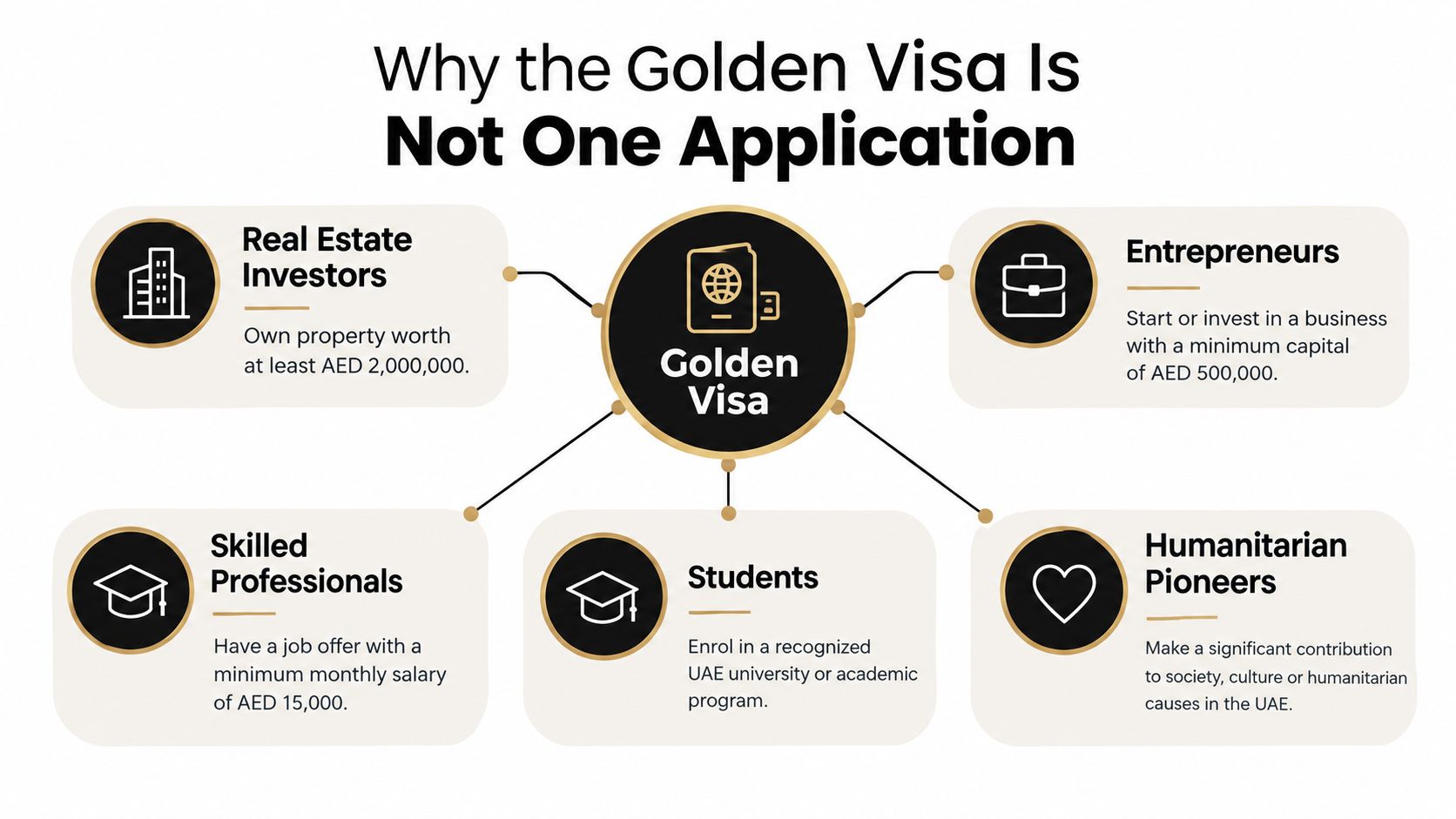
You aren't applying for one visa. You're entering a category-based system with separate gates, and confusing those gates is the most expensive mistake I see.
The Federal Authority for Identity, Citizenship, Customs and Port Security introduced the Golden Visa platform in November 2019, establishing the UAE's long-term residency programme for investors, entrepreneurs, specialised talents, researchers, and outstanding students. That origin matters. It was never designed as a single investor form with one universal checklist.
The Two Gates You Must Clear
Gate one is eligibility. You must match a recognised category, not a vague profile like successful business owner or high earner. Gate two is nomination or endorsement by the competent authority for that category. Pass gate one and fail gate two, and your file doesn't move.
Don't treat a strong CV, a large bank balance or a property purchase as automatic approval. The authority still needs to see the evidence in the format it owns. If you're reviewing broader residency in UAE options and routes, compare them on this basis first, who endorses you, not just how long the residence lasts.
The framework provides renewable residence for either 5 or 10 years without requiring a traditional local sponsor. That benefit is real, but it creates a false sense of simplicity. Without a sponsor doing the legwork, document ownership sits with you.
Practical rule: Name your category, your nominating body and your emirate in one sentence before you prepare a single document. If you can't, you're not ready to apply.
Why Sequencing Decides Outcomes
A researcher, a property investor and a founder don't fail for the same reason. One lacks a recommendation, another lacks an official valuation document, the third files through the wrong portal. Generic checklists hide those differences.
Organise your approach around three questions instead. Which category fits the evidence you can prove today? Which authority must verify that evidence before residence issuance? Which emirate will process the final file? Answer those in order, and you'll avoid the rework that delays otherwise qualified applicants.
Don't start with forms. Start with category fit.
Matching Your Profile to the Right Category
Pick the category your documents can prove, not the one that sounds most prestigious. Advisers earn their fee because the wrong choice forces you to manufacture evidence you don't naturally have.
UAE government guidance on Golden Visa eligibility and investment thresholds specifies a minimum investment of AED 2 million for the public-investment route, with public investors generally qualifying for 10-year residence while real-estate investors qualify for 5-year renewable residence. Investors are threshold-driven. You're either at the threshold with official proof, or you're not in that category.
Golden Visa Categories at a Glance
| Category | Key Evidence | Visa Duration |
|---|---|---|
| Public investor | Accredited fund letter, licence and memorandum showing qualifying capital, or tax evidence | 10 years |
| Real-estate investor | Land department letter proving qualifying ownership value, plus accommodation proof where requested | 5 years |
| Entrepreneur | Innovative or technical project evidence, project-value documentation, incubator or authority recommendation | 5 years |
| Exceptional talent and specialists | Recommendation letters, accredited degrees or proof of specialised experience by profession | 10 years |
| Researchers and outstanding students | Category-specific academic or research credentials | Varies by track |
For public investors, acceptable proof can include an accredited fund letter confirming the deposit, a valid commercial or industrial licence with a memorandum, or Federal Tax Authority evidence linked to at least AED 250,000 in annual tax paid. Don't bring bank statements alone and expect them to substitute for those documents.
Real-estate applicants face a different trap. The qualifying value must be established through official registration, not your purchase contract or an agent's valuation, and government guidance states that value must be unencumbered by loans. If your property is heavily mortgaged, discuss that before filing, not after a rejection query.
Founders and Talents Need a Different File
Entrepreneurs don't win on revenue claims. You need evidence of a technical project, proof of project value, and a recommendation from a business incubator or relevant authority. A polished pitch deck without that recommendation is an incomplete file.
Exceptional talents face the opposite problem. Evidence varies sharply by profession, so a doctor, scientist, artist and senior executive shouldn't copy each other's checklists. Build your file around what your regulator or endorsing body recognises, including accredited qualifications and documented specialised experience where relevant.
My recommendation is blunt. If you fit two categories, choose the one with documents already issued by an official body. A clean land department letter or fund letter will usually move faster than a subjective talent case you still need to assemble.
The Step-by-Step Application Workflow
Once your category is locked, the workflow is orderly. Don't improvise the order.
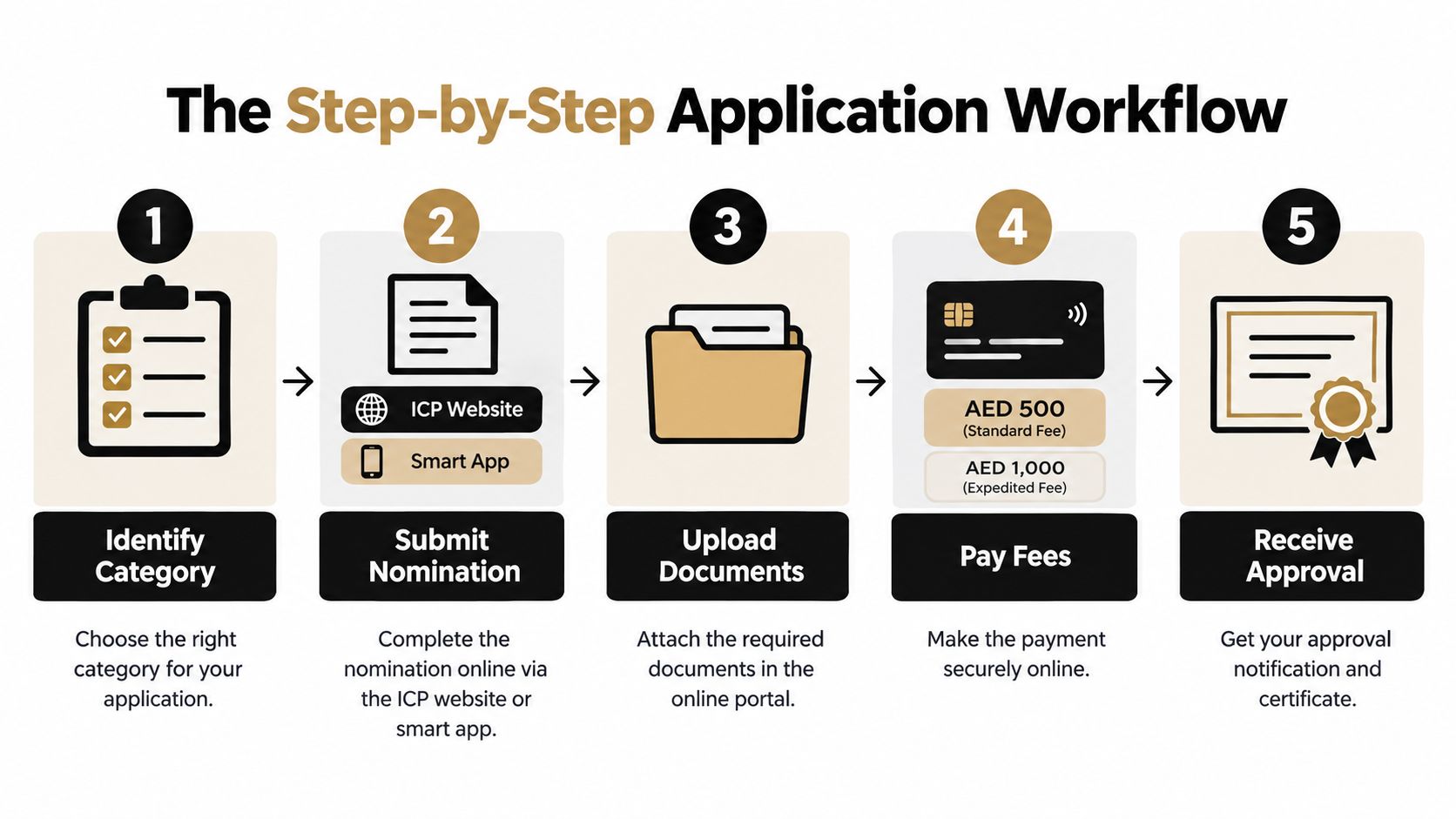
ICP's published Golden Residency nomination service workflow confirms that outside Dubai, you submit a nomination through the ICP website or smart app, review prefilled data, upload supporting evidence, and then complete the residence-issuance stage after nomination approval. Dubai files follow a different authority, which the next sections cover in detail.
The Sequence I Use With Clients
- Confirm the category first: Lock the eligibility route and the exact evidence list for that route. Don't start a nomination to discover what you'll need.
- Check the passport: Ensure it has at least six months' validity before submission. A short passport validity creates avoidable friction later.
- Submit the nomination: Enter through the correct channel, review and correct any prefilled data carefully, and retain the submission reference for tracking.
- Upload what integration doesn't retrieve: Government data integration may pull some records automatically. Where it doesn't, upload clear supporting evidence that matches the selected category.
- Pay and move to issuance: Pay the applicable charges, then complete residence formalities after approval, including steps linked to your medical fitness certificate requirements where required.
Document preparation is where small errors multiply. If a supporting form arrives as a PDF, understand the difference between interactive vs flat PDF forms before you complete and upload it, because a flat form printed, signed and rescanned badly can look incomplete or illegible to a reviewer.
Don't pay anyone who quotes you one guaranteed all-in government fee without itemising it. The fee structure isn't built that way.
ICP lists a Smart Services fee of AED 100 for the nomination service, while category-specific issuance services can add separate application, issuance and smart-service charges. That's why a single bundled quote is unreliable unless it separates government charges from professional fees.
Prepare your file as if a reviewer will check category fit first. They will. An entrepreneur file that opens with trade licence and revenue, but buries the incubator recommendation, is organised backwards. Lead with the qualifying evidence, then support it.
Real Scenarios That Stall Eligible Applicants
Eligible people stall in predictable ways. I see the same three patterns, and none of them involves a mysterious rejection policy.
The Property Investor With the Wrong Proof of Value
A buyer purchases a high-value apartment, submits the sales agreement and a broker valuation, and assumes the numbers speak for themselves. They don't. The file stalls because the authority needs an official property-registration certificate or land department letter establishing the qualifying amount.
Mortgage financing makes this worse. If the applicant relies on the headline purchase price while a loan encumbers the value, the qualifying evidence doesn't match the route's requirement. The correction is simple but must happen before submission. Obtain the official department documentation first and build the nomination around that figure, not the marketing price.

The Founder Without the Endorsement
A founder with a genuine technical product submits a business plan, licence and financial projections. The file looks commercial, but it's missing the document that grants access to the entrepreneur route, a recommendation from an approved incubator or relevant authority.[END]]]
Don't mistake investor interest for government endorsement. They're different signals from different bodies. Secure the recommendation, document the project value properly, and only then file the nomination. Filing early to save time usually costs more time.
The Healthcare Professional Who Filed in Reverse
Abu Dhabi shows why sequencing matters for regulated roles. Abu Dhabi's Department of Health Golden Visa guidance states that eligible healthcare professionals first obtain a verification letter and then present it to the Abu Dhabi Residency Office for processing before the residence application moves forward.
Submit directly without that letter and you've skipped the nominating step. Your clinical qualifications may be excellent, but the residency office isn't the body that verifies them for this route. Get the regulator's letter, then proceed.
Founders, researchers, creatives and regulated professionals face the highest sequencing risk because their evidence isn't limited to an investment certificate. Their files depend on another authority saying yes first. Plan that dependency into your timeline from day one, including who signs, who issues, and who receives the final file.
Choosing the Right Portal and Submission Channel
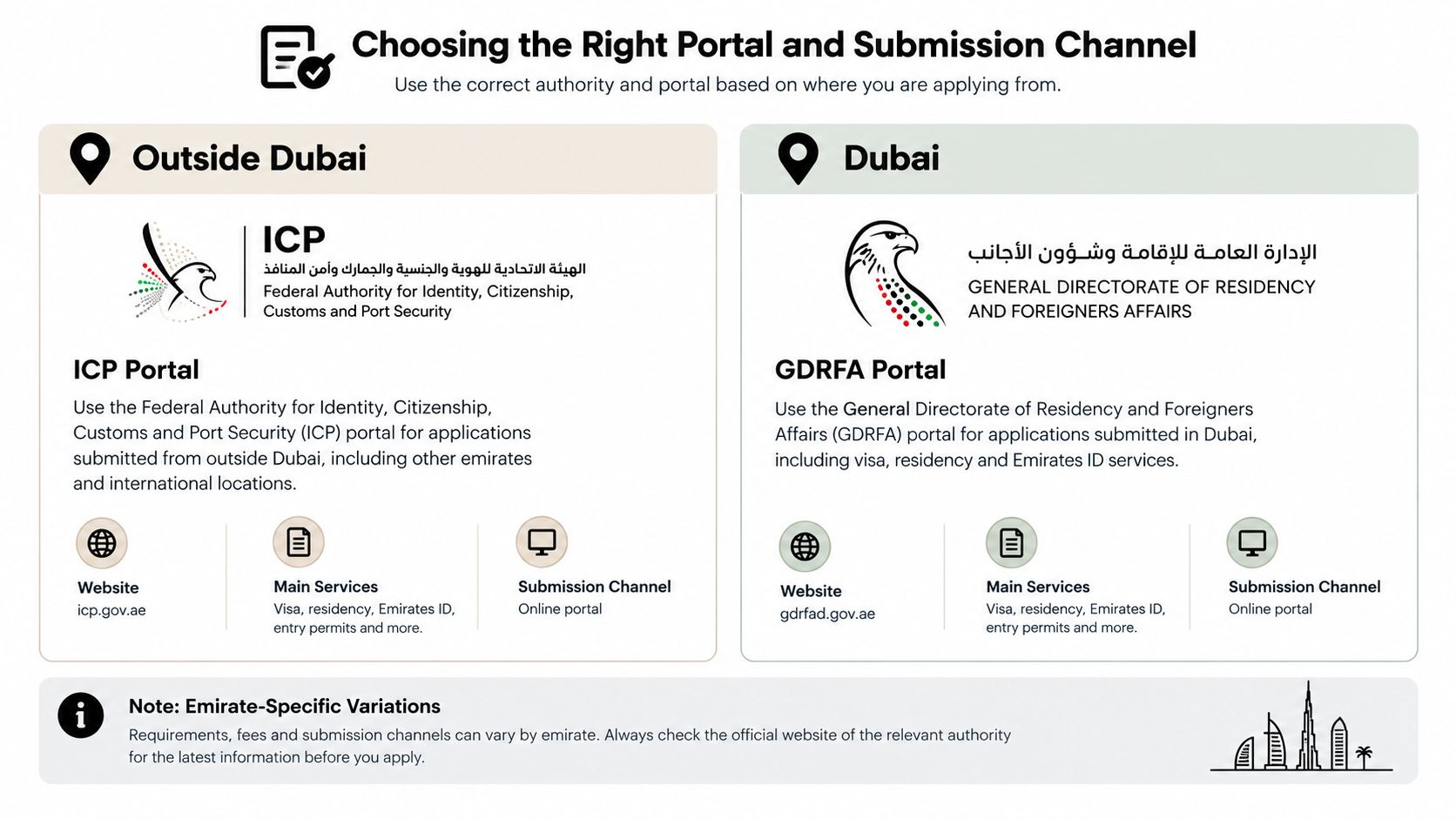
There's no single national door for every applicant. Your emirate decides your portal, and filing through the wrong one is a self-inflicted delay.
Outside Dubai, applicants generally use the Federal Authority for Identity, Citizenship, Customs and Port Security, known as ICP. Within Dubai, applications are handled by the General Directorate of Residency and Foreigners Affairs-Dubai, known as GDRFA-Dubai. Abu Dhabi applicants can use the Abu Dhabi Residents Office through the TAMM platform.
What Applicants Actually Prefer
Digital submission dominates. In an ICP e-decision survey on Golden Residency permit channels, 62.38% of respondents preferred the official website as the nomination-application channel, followed by the smart application at 21.78% and typing centres at 15.84%, with 85.50% reporting they understood the decisions related to Golden Residency permits.
Use that preference sensibly. The website suits applicants who want to review prefilled data carefully on a larger screen and upload multiple documents in an organised way. The smart app works for straightforward updates and tracking. A typing centre can help if you're uncomfortable with digital forms, but it doesn't remove your responsibility to check category and personal data.
- Choose ICP if: Your application sits outside Dubai and you're following the federal nomination route.
- Choose GDRFA-Dubai if: Your residence file belongs in Dubai. Don't submit through ICP and expect a transfer.
- Choose TAMM and ADRO if: You're processing through Abu Dhabi and your category involves that emirate's residency office.
- Keep your reference safe: Retain the submission reference from the moment you file. You'll need it for status tracking and follow-up.
My advice is to decide the portal before you decide the submission device. Website versus app is a preference. ICP versus GDRFA-Dubai is jurisdiction. Confusing preference with jurisdiction is how clean files end up in the wrong queue.
Timelines, Fees, and Post-Approval Steps
Nomination approval isn't the finish line. It's permission to complete residence issuance, and applicants who relax at that point create their own delays.
Budget realistically before you start. Review the current Golden Visa cost breakdown and fee components alongside the category you intend to use, because issuance charges vary by service and route. As covered earlier, government charges are itemised across stages, so separate those from any consultant or typing-centre fees in your own spreadsheet.
What Happens After Approval
- Residence issuance: Complete the formalities that convert an approved nomination into active residence status. Follow the instructions for your emirate and category exactly.
- Medical and biometrics: Schedule required fitness testing and Emirates ID biometrics promptly when directed. Leaving appointments until the last moment compresses every later step.
- Emirates ID collection: Your residence becomes practical for banking, tenancy, telecoms and government services once your identity documents are issued and consistent.
- Family linkage: If family members will reside with you, plan their applications as a connected second phase, with their own documents and formalities, rather than assuming they're added automatically.
Don't treat family planning as an afterthought. Schooling, housing and health cover decisions often depend on when dependants receive their own residence documents. Map those dates before you commit to leases or school start dates.
Adviser note: Keep a single tracker with your submission reference, appointment dates, document expiry dates and every payment receipt. Scattered screenshots in a phone gallery aren't a filing system.
Renewal also needs forethought. Your status is renewable, but renewal will be easier if you maintain the qualifying basis and keep official evidence current throughout the residence period. Investors should retain registration and investment records, entrepreneurs should preserve endorsement and project documentation, and professionals should keep licences and credentials organised.
Timelines vary because categories and authorities vary. I won't give you a universal completion promise, and you shouldn't accept one from anyone else. What you can control is response speed. Answer queries quickly, attend appointments on schedule, and keep your passport validity comfortable. That discipline removes the delays that are within your power.
Readiness Checklist and Common Pitfalls
Audit yourself before you file. If you can't tick every item below, pause and fix the gap.
- Category named: You've matched your profile to one recognised route, not a blend of two.
- Qualifying evidence issued: Your main proof comes from the relevant official body, fund, land department, incubator, regulator or academic authority.
- Nomination sequence clear: You know who endorses you, who receives that endorsement, and which portal handles the final residence stage.
- Emirate confirmed: You're filing through ICP, GDRFA-Dubai or Abu Dhabi's channel because it matches your case, not because a friend used it.
- Fees itemised: You've separated nomination, application, issuance and professional charges instead of relying on one bundled quote.
- Post-approval planned: Medical, biometrics, Emirates ID and family steps are diarised as part of the same project.
The pitfalls are the mirror image. Applicants rely on purchase prices instead of official certificates, submit entrepreneur files without incubator recommendations, skip regulator verification letters, choose the wrong portal, and then blame processing. Don't.
There's also no universal success rate you can use to judge your odds, because UAE government sources don't publish one. Ignore anyone selling approval percentages. Document completeness and category-specific authority verification are the benchmarks that matter. If your evidence is fragmented across bodies or emirates, professional support, including the Golden Visa assistance offered by Smart Classic Business Hub as part of its PRO and residency services, can help you sequence ownership of each document. Use support for coordination, not as a substitute for qualifying evidence.
If you're ready to move from category confusion to a properly sequenced submission, Smart Classic Business Hub can review your eligibility route, organise your category-specific documents and guide your filing through the correct ICP, GDRFA-Dubai or Abu Dhabi channel. Visit the team to discuss your Golden Visa plan, post-approval formalities and wider UAE business or residency needs before you submit.