
You've found a supplier, defined your products and perhaps even chosen a Dubai address. Then the licensing form asks a deceptively simple question: what exactly will your company trade, where will it sell, and which authority should issue its licence? A first-time founder can quickly become stuck between a free zone and mainland setup, especially when advertised prices appear to tell only part of the story.
A free zone trade license can be a practical route for importing, exporting, distributing or conducting approved commercial activities within a designated business jurisdiction. It isn't a universal permission to do everything everywhere in the UAE. The issuing authority, approved activity, operating location, sales route, office solution and renewal obligations all shape what your company can do.
This guide breaks the decision into practical questions. You'll learn how the licence works, how activity categories differ, why free zones aren't interchangeable, what documents authorities commonly request, how to assess fees beyond the headline quote and how Dubai's Mainland Operating Permit is changing the old free zone-versus-mainland choice. For broader background, see this guide to what a free zone is in the UAE.
Introduction to Free Zone Trade Licensing in the UAE
A founder importing kitchen equipment may buy from overseas suppliers, store stock in a warehouse and re-export it to retailers in other countries. A free zone can fit this model because the company's activity, premises and logistics sit within one specialised jurisdiction.
Another founder may sell directly to restaurants across Dubai mainland. That business must examine mainland deliveries, customer contracts, distribution arrangements and any required approvals before choosing a free zone. A low starting fee can become expensive if the setup later needs extra premises, permits or a different route to customers.
Dubai is a common starting point for this comparison. By November 2024, it accounted for approximately 53% of all free zone licences in the UAE, with more than 112,000 licences, according to the reported UAE free zone licensing figures. Across the UAE, the same data set recorded more than 210,000 free zone licences by the end of November 2024, while free zone licences represented 22.3% of all commercial licences registered across the country. These figures show the sector's scale, not which jurisdiction suits a particular business.
Dubai's new Mainland Operating Permit also changes the old free zone-versus-mainland decision. Founders can no longer compare only the headline licence fee. They should compare the full cost of operating, including premises, storage, delivery access, approvals, staffing and the route used to serve customers.
The questions founders should answer first
Before comparing packages, define four points:
- Your activity: Are you trading goods, storing stock, offering consultancy or manufacturing?
- Your sales route: Will revenue come from re-export, free-zone transactions, international customers or Dubai mainland buyers?
- Your infrastructure: Do you need a flexi-desk, office, warehouse, showroom or production facility?
- Your compliance scope: Could the activity require external approvals, specialist premises or additional permits?
A licence provides the legal foundation, but it does not describe the entire operating model. Match the authority's approved activity list and premises rules with the way products, payments and customers will move through the business. For broader background, read this guide to what a free zone is in the UAE.
Practical rule: Choose the jurisdiction after mapping daily operations. The lowest application quote is not automatically the lowest total cost.
What a Free Zone Trade License Is and How It Works
A Dubai founder choosing between jurisdictions may start with a licence price, then discover that customer access, storage, delivery and approvals shape the operating cost. A free zone trade licence is not a universal permission to trade everywhere in the UAE. It is a legal authorisation issued by one specific free zone authority, within that authority's rules.
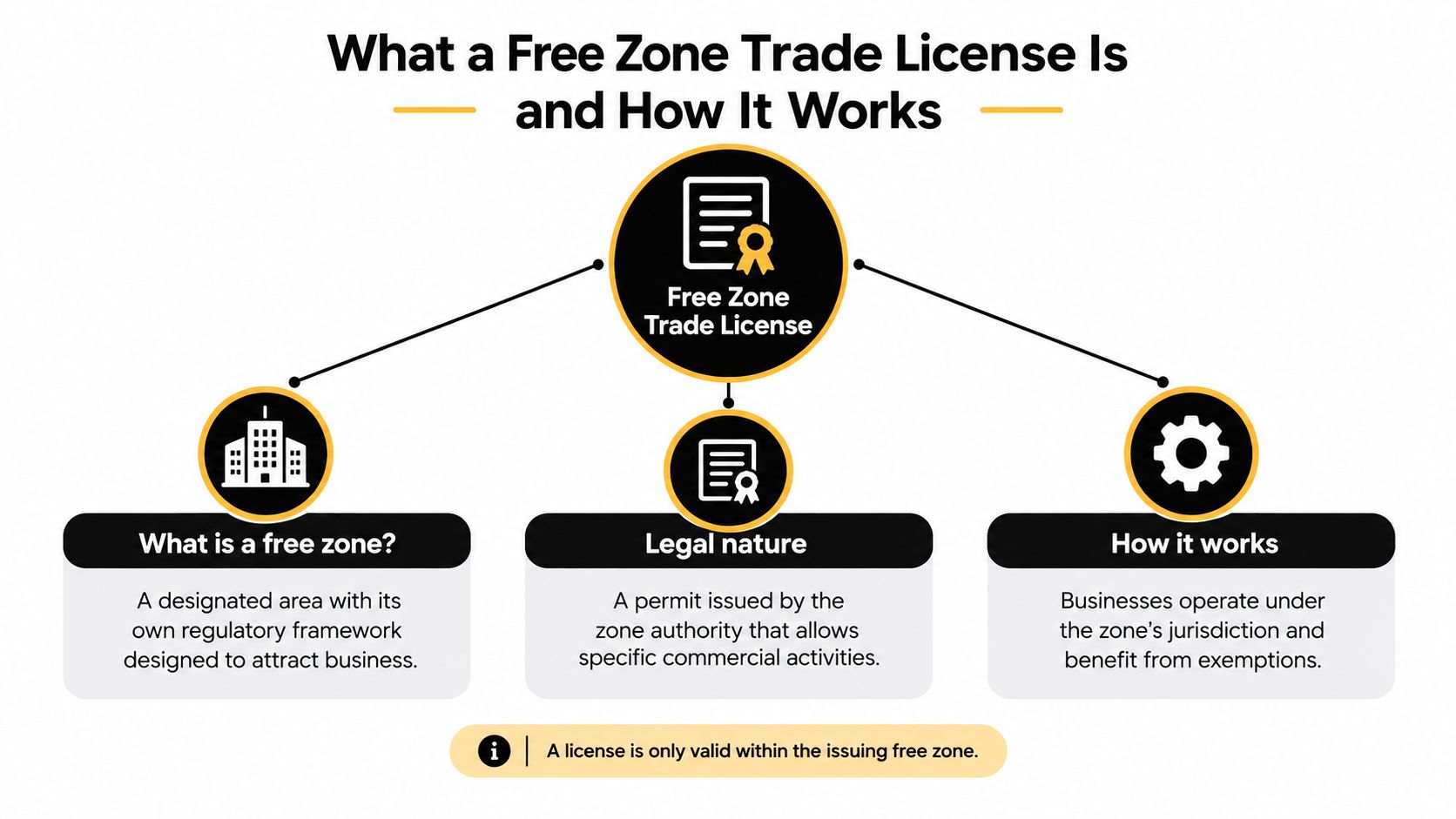
That structure works like joining a business community with its own entry rules. The authority registers companies, approves activities, sets document requirements, manages premises and issues licences. A licence from one free zone does not automatically give the company rights in another free zone or across the mainland.
What the licence authorises
The licence allows the company to perform the activities approved by its issuing authority. For a trading company, this can include importing, exporting, distributing or selling specified goods within the permitted framework. The exact activity wording matters. Approval for one product category does not automatically cover another category or a service activity.
The official UAE business platform guidance states that a free zone authority typically issues the licence, rather than the emirate's mainland economic department. After the application is reviewed and approved, the platform says issuance commonly takes 14 working days. Complete documents and accurate activity selection therefore affect the practical setup schedule.
Where the licence is valid
A free zone trade licence is generally valid within the issuing free zone. Trading inside the zone and internationally is described as unrestricted within the applicable framework, while direct mainland access remains regulated. A company serving mainland customers may need a licensed distributor, a mainland licence or another approved route.
The old free zone-versus-mainland choice is now less rigid in Dubai because of the Mainland Operating Permit. That permit can provide a newer route for eligible free zone businesses to operate on the mainland, subject to the applicable conditions and approvals. It does not turn every free zone licence into a general mainland licence.
The practical question is how the transaction will work. A business may sell through an approved intermediary, use a permitted Dubai route or establish a mainland structure. The suitable option depends on the activity, customer location, delivery model and authorisation in force.
Why the authority matters
Each authority may use different activity descriptions, forms, premises conditions, renewal procedures and compliance checks. Two free zones can both offer commercial licences while differing in warehouses, logistics connections, customer access and permitted activities.
Read the licence as an operating boundary. It identifies which entity is authorised, for what activity, under which authority and until what expiry date. Compare those boundaries with the full cost of ownership, including premises, storage, delivery access, approvals, staffing and the route used to reach customers. A lower licence quote can still produce a higher operating cost if the business later needs facilities or permissions that were not included.
Types of Activities Covered by a Free Zone Trade License
A free zone trade license isn't one standard product. Authorities classify licences by activity, and the classification influences the permissions, facilities and approvals attached to the company.
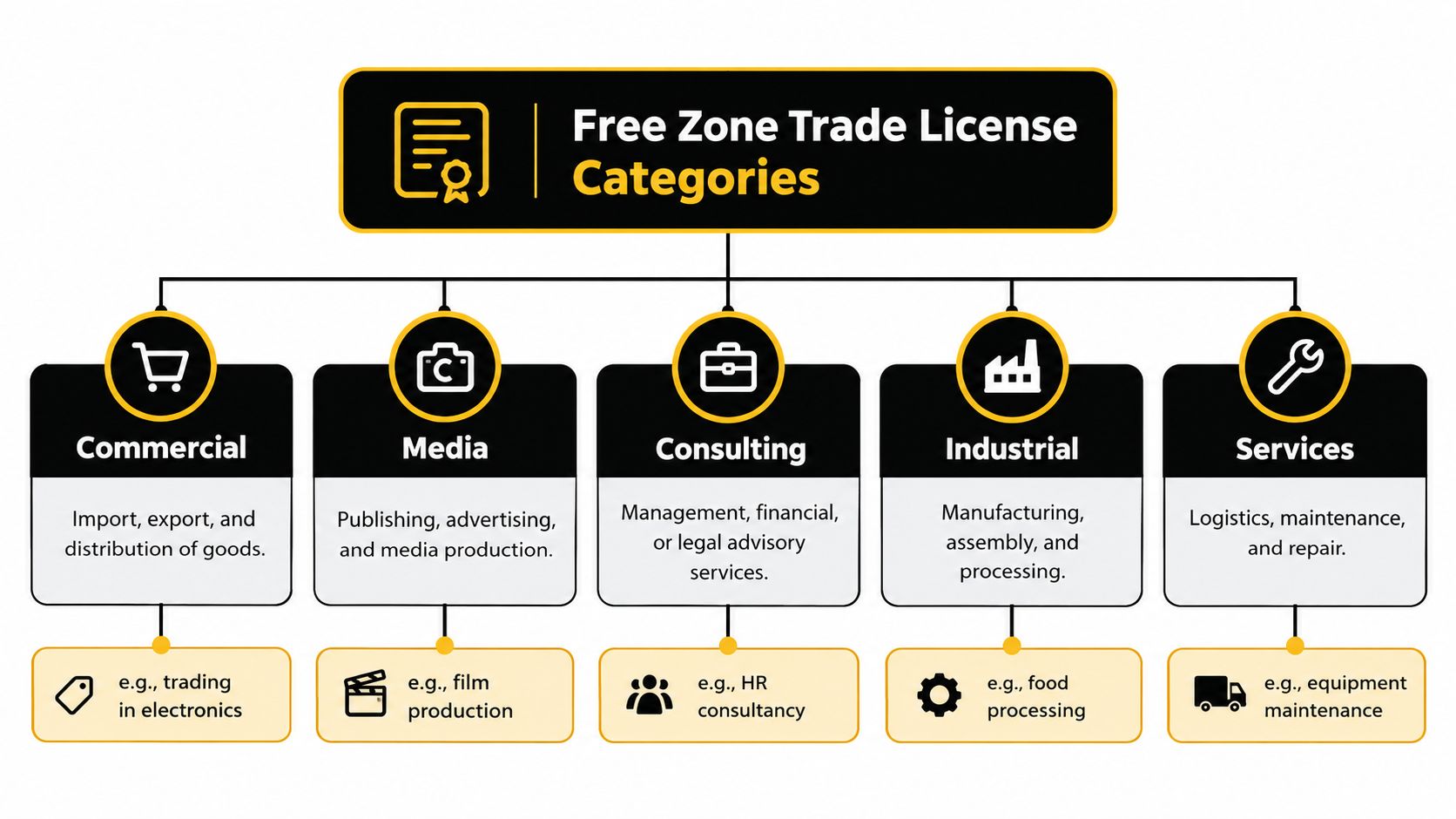
The UAE Ministry of Economy explanation of free zone establishment identifies distinct licence types, including commercial, media and warehouse licences. Free zones may also use service, consulting or industrial classifications. The label is more than marketing. It links the legal activity to the way the company operates.
Commercial activities
A commercial licence generally suits buying, selling, importing, exporting and distributing goods. A founder trading electronics, for example, should confirm that the chosen authority permits the specific product category and intended trading scope. General trading may have different requirements from trading a defined product group.
This category works best when the business handles goods rather than primarily selling expertise. Product descriptions, storage needs, supplier documents and customs arrangements should match the activity selected.
Warehouse and logistics activities
A warehouse-oriented licence is designed around storage and distribution use cases. It may be more suitable for a company that receives inventory, stores it and dispatches orders than a simple commercial licence attached to a small office.
The founder should separate two questions: what the company sells and where it keeps or moves stock. A trading activity may authorise the sale of goods, while the premises and logistics arrangement determine whether the operational model is workable.
Media activities
Media licences can cover publishing, advertising, content creation and production-related work, subject to the authority's approved activities. A company producing branded video content may need a media classification rather than a trading licence.
The activity should describe the company's revenue-producing work. If the business sells production services but also imports equipment for resale, it may need to discuss whether multiple activities or a separate approval is required.
Consulting and professional services
Consulting activities cover businesses that sell knowledge, advice or professional support. Examples can include management, financial, marketing or other advisory work, but regulated professional activities may require additional approval.
A consultancy shouldn't select a commercial trading activity because it expects to invoice corporate clients. The key question is what the company delivers to the customer.
Industrial activities
Industrial licensing is aimed at manufacturing, assembly, processing or related production. It normally requires stronger alignment between the activity, facility and operational permissions than a desk-based service company.
Avoid the mismatch: If your revenue model, premises and licence category describe different businesses, resolve the conflict before filing the application. Activity correction is usually easier before issuance than after operations begin.
How Major UAE Free Zones Differ for Trade Licensing
A trading company that imports stock, needs warehouse space and depends on port-linked logistics will assess a free zone differently from a technology consultancy that mainly needs an office and a professional activity. The right choice depends on how the company will operate after licensing, not only on the name of the jurisdiction.
Free zones differ in sector focus, infrastructure, approved activities, customer access and premises model. Dubai has a large concentration of free zone businesses, which gives founders access to a wide network of advisers, banks, logistics providers and commercial partners. That scale does not make every Dubai free zone suitable. The authority's approved activity list still decides whether the proposed business fits.
The guide to designated free zones in the UAE provides a useful starting point for comparing how designated jurisdictions are structured. Confirm the current activity rules, premises options and customer-access conditions with the selected authority before applying.
Compare the operating environment, not just the fee
A practical shortlist should examine:
| Selection factor | What to examine |
|---|---|
| Activity fit | Whether the exact product or service appears on the authority's approved list |
| Infrastructure | Office, flexi-desk, warehouse, showroom, manufacturing or storage options |
| Customer route | Re-export, free-zone trade, international sales, distributor arrangements or approved mainland activity |
| Authority process | Application review, document format, external approvals and renewal procedure |
| Growth needs | Additional activities, staff, premises, visas and future restructuring |
| Location | Access to ports, airports, suppliers, customers and logistics partners |
A low-cost office package may be unsuitable for a company holding physical inventory. A premium logistics location may add little value to a remote consultancy. Compare the full operating model, including premises, staffing, banking, transport and customer access.
Dubai's position in the national context reflects its strong free zone presence, but the headline licence fee is only one part of the decision. Dubai's Mainland Operating Permit can also affect how a free zone company serves customers within Dubai. The practical comparison is therefore between complete operating arrangements, not a simple free zone versus mainland choice.
Treat each free zone as a separate regulatory community. Select the authority that fits the business activity and delivery model, then assess the total cost of ownership and administrative workload before filing.
Application Requirements Documents and Timelines
A founder who submits a vague activity description may face repeated questions, even when the business itself is straightforward. The application works more like a compliance file than a simple form. The authority must identify the owners, understand the proposed activity and confirm that the business fits the zone's rules.
Start with the activity and structure
Describe how the company will earn revenue in plain language. Match that description to the authority's approved activity wording, then choose the company structure available for that activity. A trading company selling physical goods may need different supporting information from a consultancy delivering services remotely.
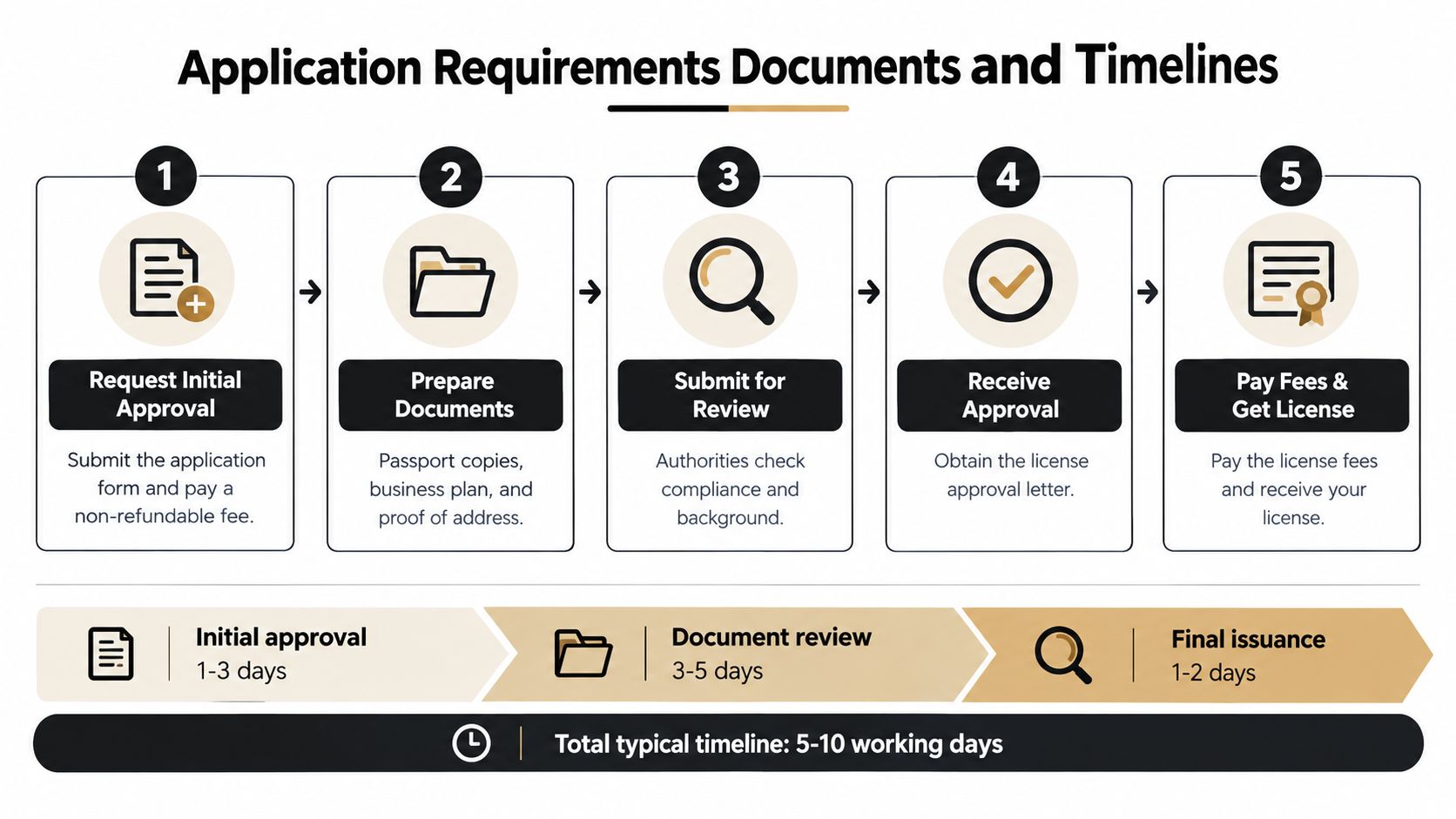
Prepare an initial package that may include:
- Application form: Complete the authority's form with matching company and shareholder details.
- Business plan: Explain the products, customers, suppliers, expected operations and premises needs.
- Identity documents: Provide the requested passport copies and shareholder information.
- Address evidence: Include proof of residential address where the authority requests it.
- Existing registration records: Supply a commercial registration copy if the authority requires one.
- Corporate documents: Prepare parent company or branch documents where relevant.
- External approvals: Identify approvals for regulated activities before submission.
The business plan does not need to be lengthy. It should show that the activity, premises and commercial model support one another. If the company will import, store or distribute goods, the proposed facilities should make sense for that workflow.
Follow the review sequence
Applications generally pass through a recognisable sequence:
- Initial submission: File the application and select the proposed activity.
- Document preparation: Upload identity, address, business and corporate records.
- Authority review: Respond to compliance questions or requests for clarification.
- Approval: Receive confirmation that the proposed structure and activity are accepted.
- Issuance: Pay the applicable charges and receive the licence from the authority.
The official UAE platform states that issuance is commonly completed within 14 working days after review and approval, according to its UAE free zone application guidance. This is a general timeframe, not a guarantee for every file. Missing documents, inconsistent names, unclear activities or pending external approvals can extend the process.
Prevent avoidable delays
Check names, addresses, passport details and ownership information across every document before submission. Ask the authority whether the proposed activity needs special approval before paying for premises or finalising a package. Clear records reduce the chance of returning to an earlier review stage.
Document discipline saves time: A precise activity description and complete file usually help more than selecting a legal form and leaving unresolved details for the authority to correct.
Fees Renewals and the True Cost of a Free Zone License
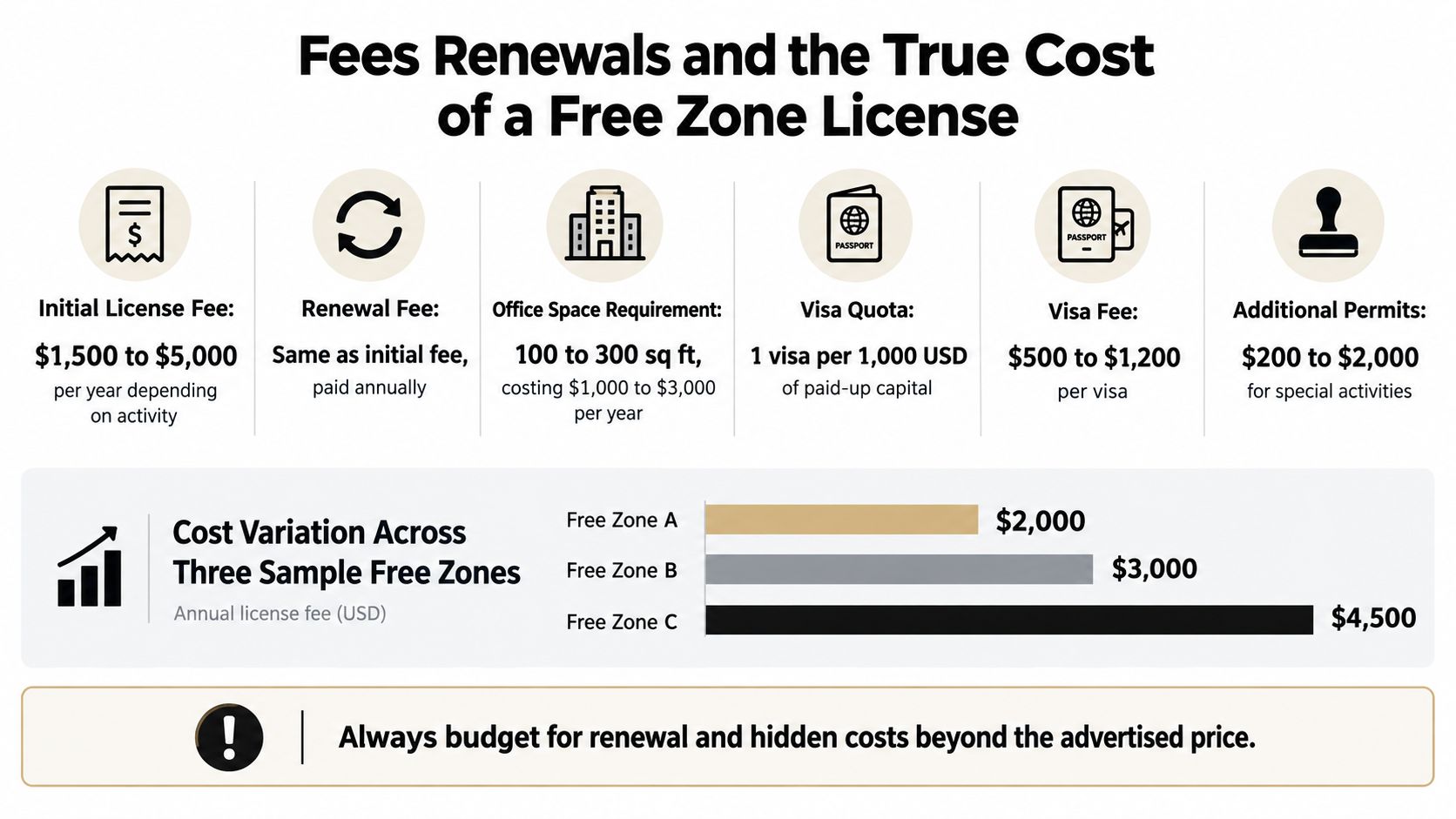
Free zone pricing varies widely. A quote that looks inexpensive may cover only the licence, while the operating business also needs premises, visas, establishment services, approvals, accounting and renewal support.
Published pricing illustrates the spread. The UAE Free Zone Price Index reports a cheapest standard licence of AED 4,949, a median of AED 12,500 across 33 priced zones and 8 zones under AED 10,000. Another pricing comparison based on official tariff data reports first-year costs ranging from AED 5,500 to AED 367,250, with a median of approximately AED 22,125, demonstrating why a single “average free zone price” can mislead.
Build a total cost view
Compare each quotation under separate headings instead of looking only at the first invoice:
- Licence fee: Identify the activity, validity period and included services.
- Premises: Check whether a flexi-desk, shared office, private office or warehouse is required.
- Visa and establishment costs: Confirm which immigration and company-card charges are included.
- Activity approvals: Ask whether regulated or specialist activities trigger extra authority fees.
- Banking and accounting: Budget for practical support, bookkeeping, VAT work where applicable and annual compliance.
- Renewal: Request the renewal price and conditions in writing, not only the promotional first-year package.
The Dubai free zone company setup cost guide can help founders organise the cost discussion around setup components rather than a single advertised figure.
Renewal economics deserve equal attention
A company can afford its first year and still struggle with the second if the package depends on temporary discounts or excludes essential premises and compliance services. Review the expiry date, renewal procedure, activity continuation requirements and any changes in office or visa costs before incorporating.
The best comparison is not “which zone has the lowest licence?” It is “which structure remains practical when the company renews, hires, stores goods, adds activities and serves its intended customers?”
Budget for the business you will operate, not the package you first see. The licence is one line in the cost model, not the whole model.
How to Choose the Right Free Zone for Your Business Model
Choose a free zone by tracing the business from supplier to customer. If products arrive from overseas, ask where customs handling and storage will occur. If you sell services, ask whether the authority's professional activity matches your invoices and contracts. If customers sit in Dubai mainland, identify the approved route before incorporation.
Use a practical decision filter
Start with these questions:
- What creates revenue? Goods, consulting, media production, manufacturing or logistics?
- What physical setup is necessary? A desk, office, warehouse, showroom or industrial facility?
- Where are customers located? International markets, the free zone, other emirates or Dubai mainland?
- How will delivery happen? Directly, through a distributor, through a mainland entity or under a specific permit?
- What could change? New products, staff, regulated activities, investors or a larger facility?
- What is the renewal plan? Can the company carry the recurring licence, premises and compliance costs?
This approach replaces a simplistic location debate with a business-model test. A free zone may suit a re-exporter, international consultancy or warehouse-led distributor, while a mainland structure may fit a company whose central activity depends on direct local operations. Some founders may also need a hybrid arrangement.
Dubai's Mainland Operating Permit changes the old binary
Dubai issued Executive Council Resolution No. 11 of 2025 and introduced a Mainland Operating Permit for free zone entities conducting specified mainland activities. The Dubai Media Office announcement states that the permit costs AED 5,000 for six months and is renewable.
This doesn't mean every free zone company can automatically sell every product or service across Dubai. The permit applies within its approved scope, so founders must confirm the permitted activity, compliance conditions, application requirements and interaction with their existing free zone licence.
The practical question is no longer, “Can a free zone company sell in Dubai?” Ask instead:
- Which mainland activity is approved?
- Does the company need the permit or another route?
- What contracts, premises, staff and delivery arrangements fall within scope?
- Would a mainland licence remain more efficient as operations expand?
Make the choice with written assumptions
Before signing, request a written comparison covering the activity, premises, licence fee, renewal, visa route, external approvals and mainland access. A setup adviser can then test the assumptions against the authority's current rules, but the founder should still understand the commercial logic.
Smart Classic Business Hub supports UAE company formation, compliance, accounting, PRO services and related planning, so founders can compare free zone structures with their intended operating model before filing. Visit Smart Classic Business Hub to discuss your activity, mainland sales route, premises needs and total setup and renewal costs with a Dubai-based consultancy.