
You're probably here because you've seen two different labels, DWC and Dubai South, and you're trying to work out whether they're the same place, what the licence costs, and whether the setup friction is being hidden from you. That instinct is correct. A lot of marketing content sells the easy headline, 100% foreign ownership, then skips the part where capital requirements, documents, and activity approvals decide whether the setup is smooth or painful.
If you're forming a company in the dwc free zone dubai ecosystem, treat it like a proper jurisdiction decision, not a branding exercise. The right answer depends on your business activity, your capital position, and how much operational structure you're willing to carry from day one.
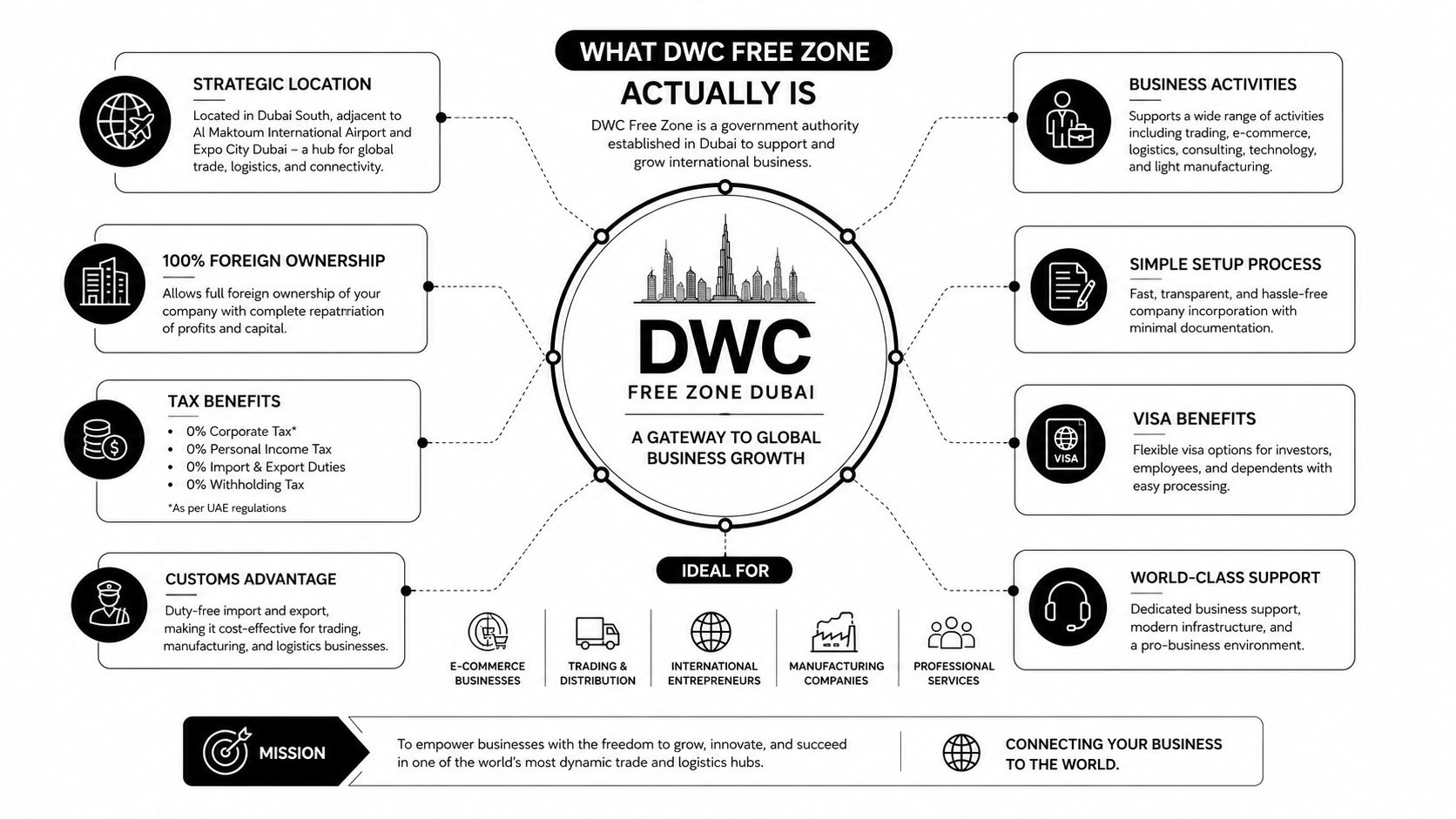
What DWC Free Zone Dubai Actually Is
A founder I worked with recently came in asking for “DWC,” then a second consultant told him to apply in “Dubai South,” and a third sent paperwork that referred to the free zone authority in completely different terms. That confusion is common because the market uses the old and new names interchangeably, but the legal reality is simpler. The Dubai World Trade Centre Authority is formally listed by the UAE Ministry of Economy as the free-zone authority at the Dubai World Trade Centre complex in Za'abeel, Dubai, which shows that DWC is an officially recognised UAE free-zone jurisdiction, not an informal business label. The Ministry's listing also reflects the authority-based model that free zones use, where licensing sits with a zone-specific regulator rather than the mainland system. Ministry of Economy authority listing
That matters because founders don't buy a name, they enter a regulatory structure. In practical terms, the authority model is what enables zone-level licensing pathways, defined office requirements, and compliance processes that differ from mainland company formation. It also explains why people talk about DWC as a structured legal environment inside Dubai's central business district.
DWC, Dubai South, and the scale question
The branding confusion got worse because the earlier DWC / Dubai World Central identity was re-used and restructured into the Dubai South free-zone ecosystem. Dubai South says Dubai World Central was officially rebranded as Dubai South in 2014, and that the site covers 145 square kilometres south of Dubai city. It also says the master plan targets around 1 million residents and 500,000 jobs at full build-out, which gives you a sense of the scale behind the name. Dubai South overview
For founders, that scale is not just a branding line. It points to a zone built around aviation, logistics, and trade, with room for long-term expansion and infrastructure depth. Dubai South's own materials also describe the same geographic zone as supporting 100% foreign ownership and full profit repatriation, which are the standard free-zone structural advantages business owners expect.
Practical rule: if a consultant cannot explain whether they mean the old DWC naming, the Dubai South ecosystem, or the specific authority on the licence, stop the conversation and get clarity before you pay anything.
Who Should Set Up in DWC and Which Activities Are Permitted
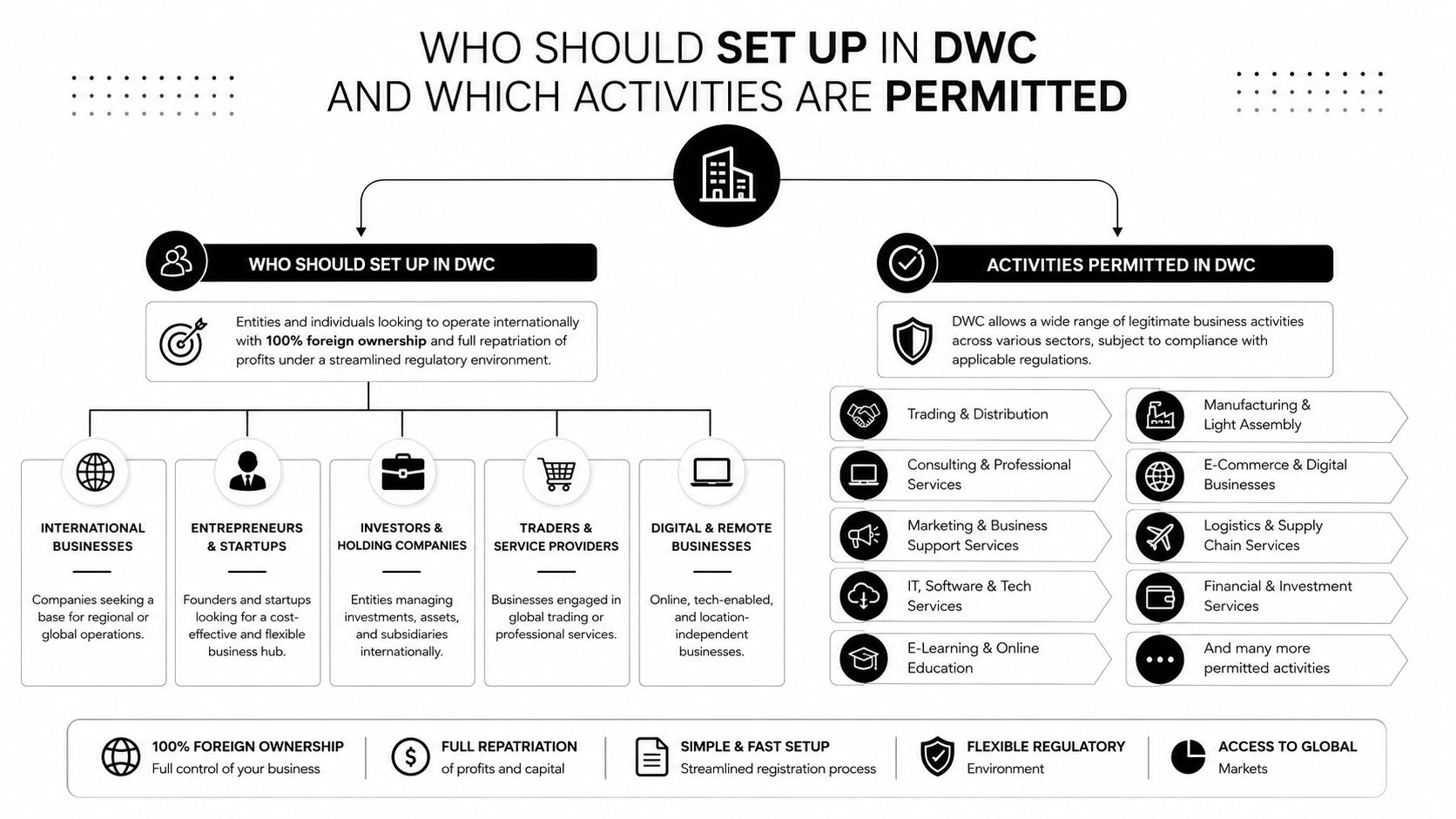
DWC is not the right home for every founder. It makes sense when the business needs proximity to aviation, logistics corridors, trade flows, or a zone structure that supports international operations without mainland complexity. It is a strong match for importers, exporters, warehouse-led businesses, aviation-related service providers, e-commerce fulfilment operators, and professional firms that want a free-zone base with room to scale.
The zone's appeal comes from its infrastructure profile. Dubai South positions the area around Al Maktoum International Airport, and the development's size makes it well suited to businesses that need storage, freight movement, or a long runway for expansion. For a logistics company, that can mean easier planning for cargo handling and distribution. For a consultancy, it can mean a credible Dubai base, but not necessarily the cheapest one.
Licence fit matters more than the marketing slogan
The right licence type depends on what the company does. In the market, DWC is commonly positioned for commercial, professional, industrial, and service activity structures. Trading and logistics models are the clearest fit, while service businesses can work well if they need a free-zone presence and can live with the office and compliance requirements.
A simple way to test fit is to ask whether your revenue depends on movement of goods, specialised facilities, or cross-border service delivery. If yes, DWC deserves attention. If your business is mainly local, retail-facing, or tied to a dense sector cluster elsewhere in Dubai, another zone may fit better.
For companies that deal with international clients and documents across multiple jurisdictions, accurate paperwork is not a side issue. If your setup involves contracts, technical manuals, or incorporation packs in more than one language, a resource like professional business translation services can save time and reduce filing errors when the application is being assembled.
DWC is strongest when the business model benefits from movement, storage, or a strategic Dubai base. If you're just chasing a free-zone badge, you're probably looking in the wrong place.
What I'd tell a founder before applying
If you're a trader, logistics operator, aviation supplier, or a service firm serving international clients, DWC can work well. If you're a solo consultant with no need for facilities, the structure may be heavier than you need. The right answer is not “Is DWC good?”. The right answer is, “Does my activity justify this zone?”
Step-by-Step Company Formation Process in DWC
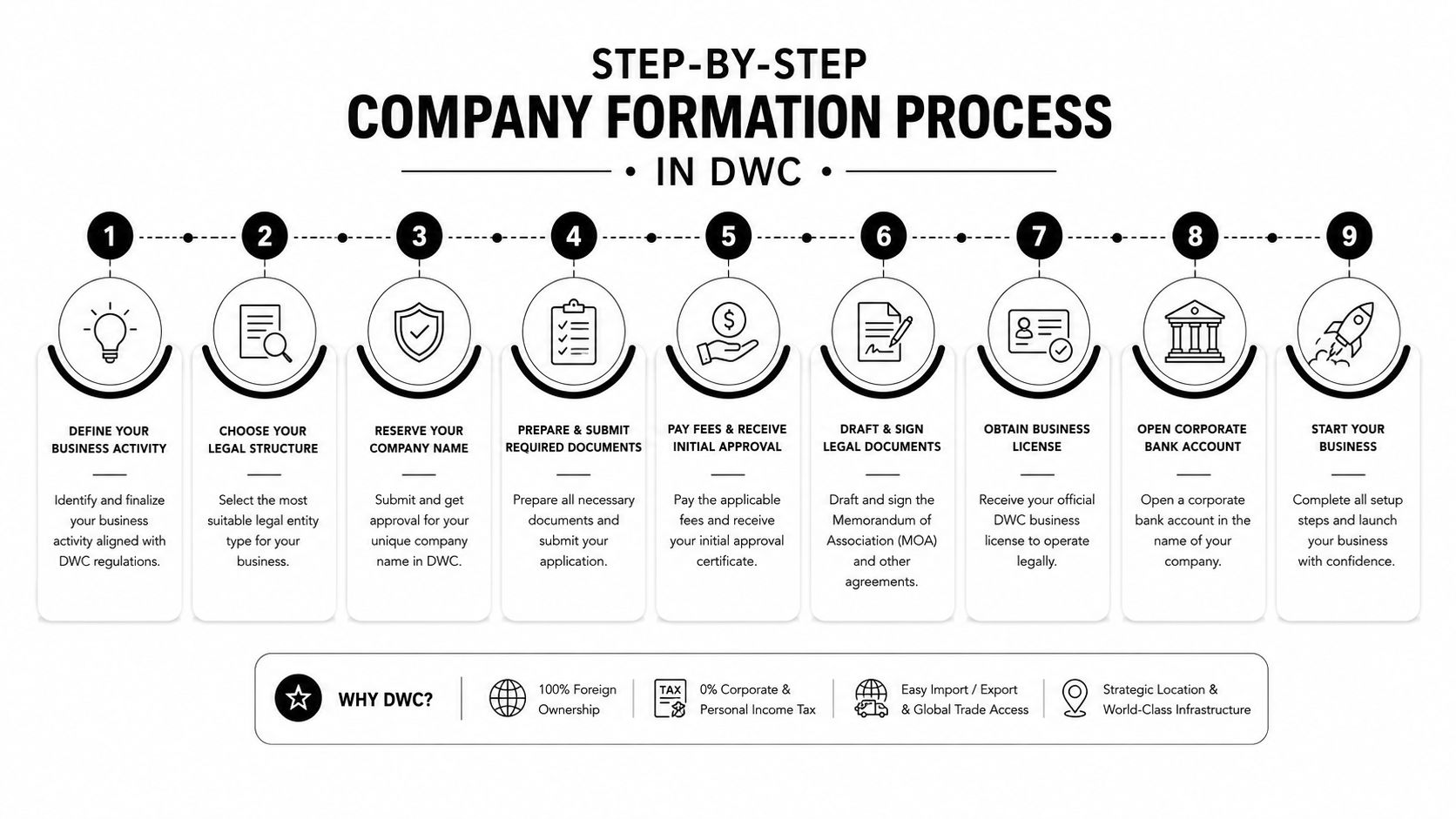
A founder who treats DWC as a quick licence desk usually gets delayed. The process starts with the business activity, then moves through document review, capital setup, facility selection, authority approvals, licence issuance, and visa work. Skip that order and you create rework, extra back-and-forth, and avoidable cost.
What gets requested early
The documents that matter most are the ones marketing pages usually hide. Independent advisory material says setup checklists can call for passport copies, business plans, bank statements, and letters of undertaking, depending on the activity and application type. Files slow down when founders submit an idea before they have the paperwork to support it, because the zone will not move the application forward until the file makes sense. UAE consultants on DWC prerequisites
The capital side needs the same discipline. For a DWC-LLC, the minimum share capital is AED 300,000, the capital must be denominated in UAE dirhams, and the share capital is divided into AED 1 shares. That affects how much cash or committed funding you need to have ready before you start filing. PKF UAE DWC update
The fee structure founders actually face
The published guidance also shows a standard package can be processed with registration and licence fees of AED 10,000 each, with the licence covering up to 5 activities and additional activities costing AED 5,000 each. That changes the economics fast if your company needs more than one activity, because the structure stops being cheap once you add scope. PKF UAE DWC update
A clean formation sequence looks like this:
- Confirm the activity. Check that the business activity fits the licence structure you want.
- Prepare the core documents. Have the file ready before the authority asks for it.
- Set the capital structure. For DWC-LLC formations, the capital rule needs to be built in from day one.
- Choose the facility. Office and space requirements affect the application path and visa planning.
- Submit and follow up. The authority reviews the file and may request clarifications.
- Receive the licence. Treat the company as live only after the licence is issued.
- Handle visas and post-setup filings. That work begins after licensing.
- Keep compliance active. Renewal and tax obligations continue after formation.
- Document every approval. Banks and regulators may ask for the paper trail later.
For founders comparing DWC with Dubai South branding and setup details, a close look at this Dubai South setup guide is worth doing before you commit.
Where e-signatures fit
Paperwork is often filed digitally, but remote filing does not make signatures casual. If your team is collecting approvals from different places, the rules around acceptable e-signing matter, and UAE eSignature legality explained is the kind of reference that helps you avoid a document challenge later.
How DWC Compares to Other Dubai Free Zones
DWC wins on scale, logistics connectivity, and strategic location. It loses ground when a founder wants the lowest-friction entry, the deepest sector community, or a zone that is already a default choice for their industry. That's the honest comparison. You should not choose DWC because it sounds bigger. You should choose it because the business benefits from its operating environment.
For traders and logistics-led companies, the attraction is obvious. For tech or knowledge businesses, a different free zone may offer stronger peer networks or simpler starting costs. For industrial users, the availability of space and infrastructure may matter more than brand recognition. DWC sits in the middle of those needs, which makes it useful for some founders and unnecessary for others.
A useful lens is whether you need facility-led growth or ecosystem-led growth. DWC is the first type. Some other zones are the second.
| Criteria | DWC / Dubai South | DMCC | JAFZA | IFZA |
|---|---|---|---|---|
| Core fit | Logistics, aviation, trade, scalable operations | Trading, commodities, business services | Port-linked trade, large-scale commerce | Broad business setup, flexible entry |
| Capital feel | Higher structural seriousness because of DWC-LLC capital guidance | Varies by activity and structure | More established for large trade models | Often chosen for lighter entry |
| Geographic logic | South Dubai, near airport-led infrastructure | Central Dubai commercial ecosystem | Jebel Ali, sea-linked commerce | Dubai-wide convenience for many firms |
| Best use case | Businesses that need space, logistics, and expansion room | Firms that want an established business district | Companies tied to port and international trade | Founders prioritising flexibility and simpler starts |
| Where it struggles | Not the leanest option for tiny startups | Can feel less logistics-focused | May be overkill for service firms | Less specialised for aviation-led models |
If you're still comparing structures, this free zone setup overview is worth reading before you commit to an authority just because a salesperson pushed it first.
Decision rule: if your business model does not benefit from infrastructure, space, or trade logistics, don't pay for a jurisdiction that was built around those advantages.
Hidden Costs and Common Pitfalls to Avoid
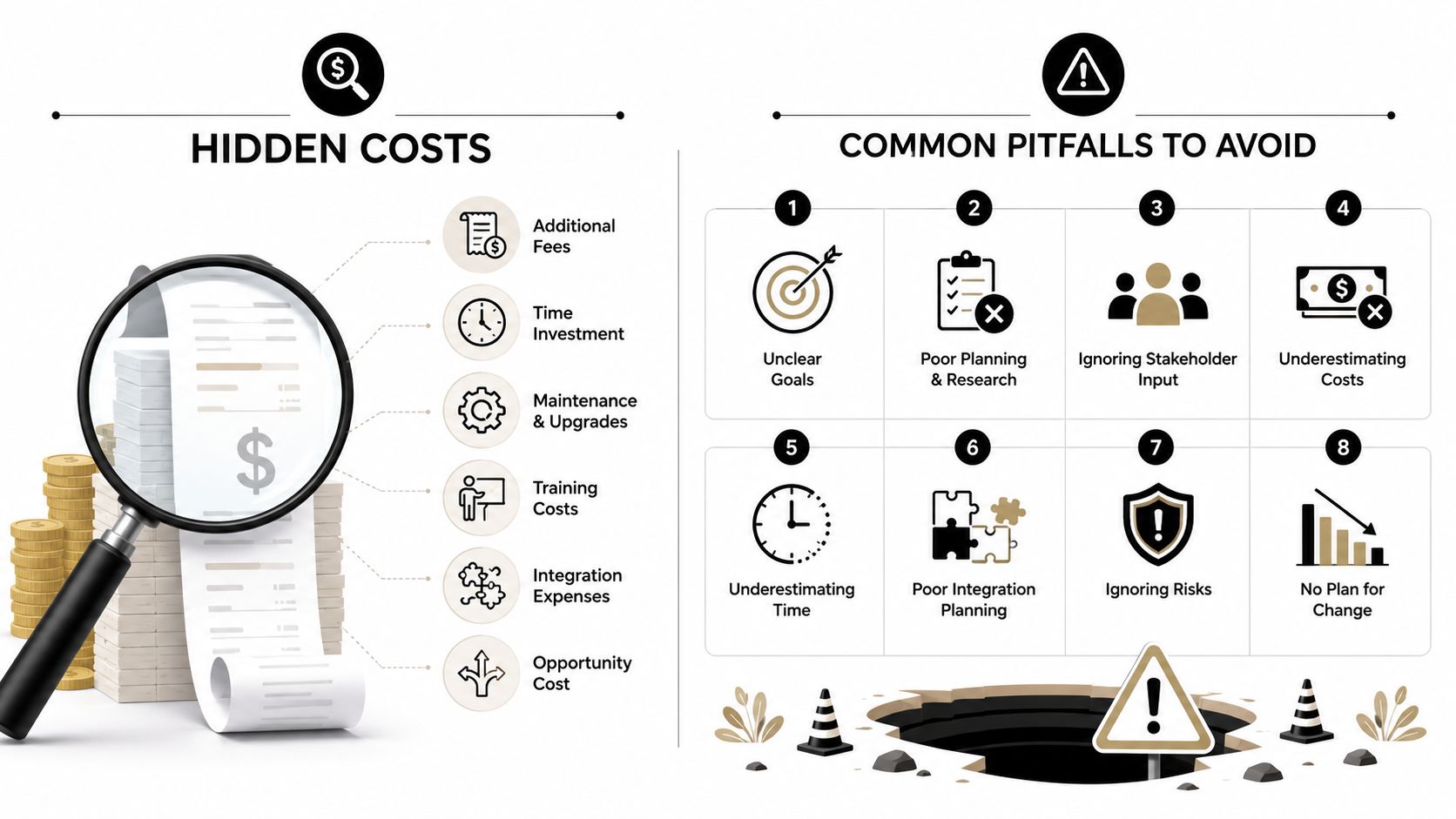
Marketing for free zones loves clean numbers and clean promises. The process is messier. The first hidden cost is documentation friction. The second is capital structuring. The third is the ongoing admin that starts after the licence lands in your inbox.
The most common mistake is assuming the advertised setup number is the total cost. It rarely is. Once you add activity-specific documents, possible facility requirements, visa planning, and the time spent correcting incomplete files, the budget rises. A separate cost guide like Dubai free zone company setup cost is useful because it forces founders to look past the headline fee.
Where founders get tripped up
The DWC versus Dubai South naming issue causes paperwork errors when founders copy the wrong authority wording into forms or bank documents. The capital requirement for a DWC-LLC can also catch people off guard because they expected a lightweight launch structure and instead find a more formal share capital requirement. That mismatch matters if you're comparing DWC with other free zones that market themselves as easier to start in.
There's also the compliance side. A licence is not the finish line. Annual renewal, audit expectations where applicable, and tax compliance still sit on the company's calendar, and those tasks need someone accountable. If you ignore them, the company becomes expensive in the worst possible way, through delays, penalties, and bank friction.
The cheapest setup is the one you don't have to correct later.
What to check before you pay
- Name consistency: Confirm the exact authority name that will appear across licence, banking, and application files.
- Capital handling: Ask whether the capital is just a nominal requirement or whether the file needs proof and timing coordination.
- Document list: Get the activity-specific checklist in writing before submission.
- Post-setup duties: Clarify renewal, audit, and tax filing expectations before incorporation.
- Visa assumptions: Don't assume visa access until the facility and structure are confirmed.
The founders who avoid trouble in DWC are the ones who ask boring questions before they sign. The ones who rush because the sales pitch sounds clean usually spend longer cleaning up afterwards.
Tailored Advice for Different Business Profiles
Solo founders should be blunt with themselves. If your business is consultancy-heavy, asset-light, and doesn't need storage, a DWC structure may be more formal than necessary. The AED 300,000 DWC-LLC capital rule alone is enough to push many small operators towards a lighter free zone. If you still want DWC, treat it as a deliberate choice, not a default one.
Growing SMEs are the best-fit group for DWC when logistics, supply chain work, or international service delivery is part of the model. These businesses tend to benefit from a proper office or facility, a clearer corporate structure, and the ability to plan staffing around a zone designed for growth. The first step should be a licence and activity review, not a lease negotiation.
Foreign investors need to think beyond the company shell. They usually care about profit repatriation mechanics, residency planning, and how the UAE entity fits into a broader international structure. DWC can support that, but only if the entity type, banking setup, and compliance trail are aligned from the outset.
If you're a foreign investor, I'd also look at how the UAE company fits into your tax residency, accounting, and cross-border documentation before you incorporate. The formation itself is only one piece. The operating model is what keeps the structure usable.
Recommendation: solo founders should only choose DWC if they need the zone's infrastructure. SMEs should prioritise it when logistics and scale matter. Foreign investors should use it as part of a wider structuring plan, not as a standalone badge.
Your Next Steps for DWC Free Zone Setup
Start with activity eligibility. If your business model doesn't match DWC's infrastructure-led profile, stop there and choose a zone that fits better. If it does fit, prepare your documents, confirm the exact capital position, and get the authority wording right before you submit anything.
Budget for the actual file, not the brochure version. That means licence fees, possible additional activities, facility costs, and the time cost of correcting incomplete paperwork. Ask any consultant whether they handle the activity review, document collation, filing, and post-setup compliance, because those are the parts that save you time.
If you want a cleaner path through the paperwork and the authority process, work with a team that understands DWC's specific requirements rather than a generic setup desk. Ask them what they do when capital requirements trigger questions, how they handle document gaps, and how they keep the entity compliant after incorporation.
Smart Classic Business Hub helps founders set up free zone companies in Dubai, handle PRO work, and manage compliance after incorporation. If you're serious about the dwc free zone dubai route, visit Smart Classic Business Hub and ask for a setup review that starts with your activity, budget, and document readiness, not a recycled sales pitch.