
You're probably comparing Dubai South with two or three other UAE setup options right now. On paper, they can all look similar. You get a licence, office package, visas, and a company in a recognised jurisdiction.
In practice, business setup in dubai south free zone only makes sense when the location, activity scope, office model, and tax position support how the company will operate. That's where many founders go wrong. They choose a free zone for speed, then discover the primary issue wasn't registration. It was whether the structure matched warehousing, fulfilment, aviation support, consulting delivery, banking expectations, or future hiring plans.
Dubai South can be an excellent fit. It can also be the wrong fit. The difference usually comes down to substance, scalability, and whether your business belongs in an airport-led logistics ecosystem or needs a low-friction incorporation vehicle.
Why Dubai South is More Than Just a Free Zone
Dubai South wasn't created as a basic registration district. It was built as a large economic zone around Al Maktoum International Airport, with a long-term role in trade, aviation, logistics, and connected commercial activity. That matters because some free zones are mainly administrative. Dubai South is operational.
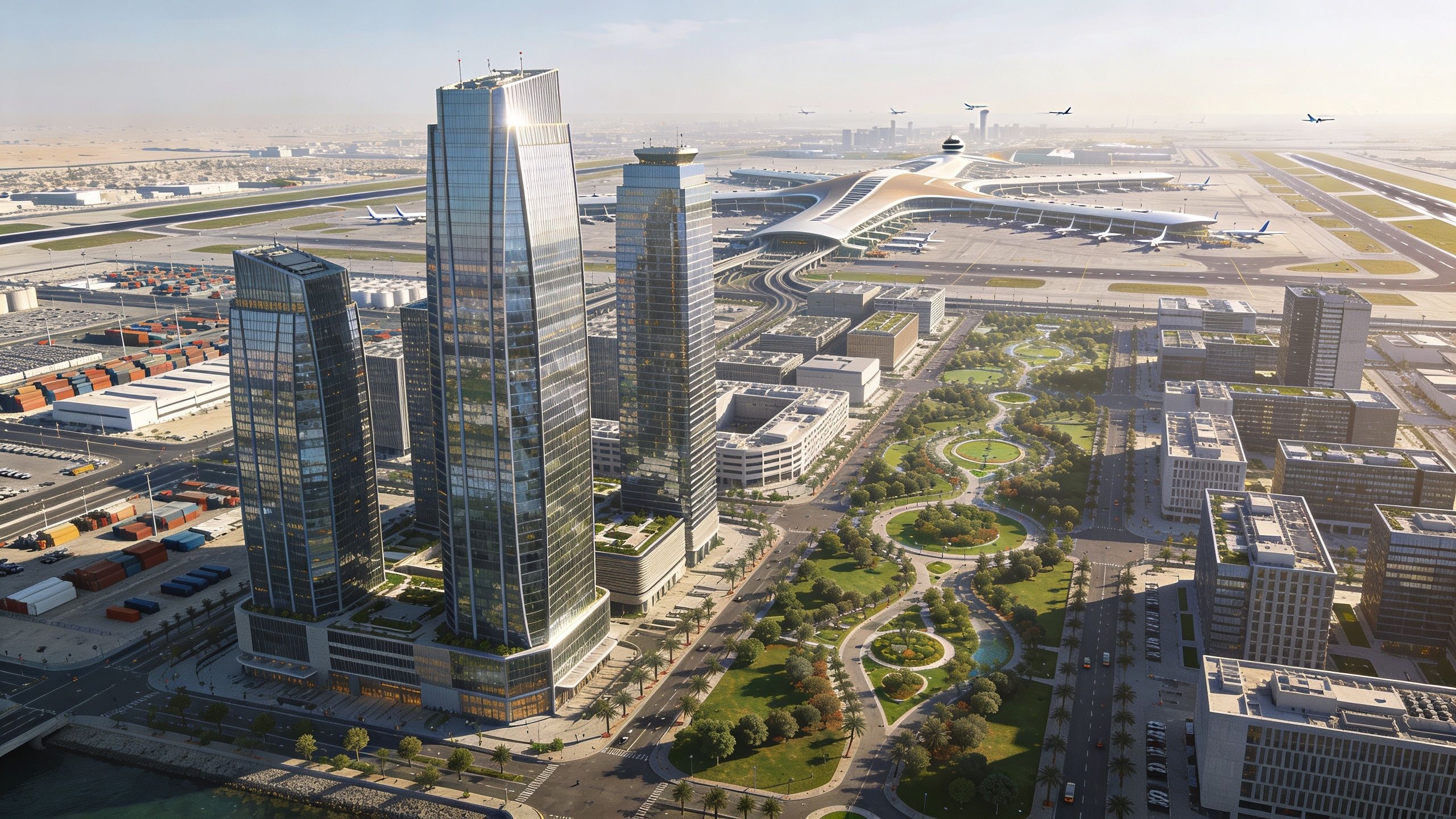
According to Dubai South Free Zone planning details, the zone was launched in 2006, spans over 145 square kilometres, and was designed as a multimodal trade and logistics hub with planned annual capacity for 12 million tonnes of cargo. Those aren't just impressive planning figures. They explain why the area attracts businesses that care about movement of goods, freight coordination, aviation-linked services, and regional distribution.
Why the ecosystem matters
A founder setting up a consultancy can often work from many UAE jurisdictions. A company handling fulfilment, aviation support, supply chain coordination, or trade operations usually can't think that way. It needs a place where the legal setup and the physical environment support each other.
That's the practical advantage of Dubai South:
- Airport proximity matters for businesses that move goods, support cargo, or rely on fast international logistics.
- Sector alignment matters when your business plan needs to sound credible to banks, counterparties, and authorities.
- Room to scale matters if you expect to move from a desk package to a larger office, warehouse, or more operational footprint later.
Dubai South tends to work best when the company will use the location as part of its operating model, not just as a place to print a licence.
Who usually sees the strongest fit
The strongest strategic fit is usually found in businesses such as:
- Logistics and freight operators that need airport-linked positioning
- Trading businesses that want a base in a transport-oriented zone
- E-commerce businesses with fulfilment or inventory ambitions
- Aviation support firms that benefit from the surrounding ecosystem
- Supply-chain service providers whose clients care where they are based
For these businesses, Dubai South isn't just an address. It can become part of the commercial story they tell to customers, vendors, and banking teams. That's a very different proposition from choosing a jurisdiction only because the first-year package looked cheaper.
Choosing Your Path Licence and Company Types in Dubai South
Most setup delays start before the application is filed. They start when the founder uses broad language such as “trading”, “consulting”, or “online business” without matching that description to the exact licence class and legal structure.
In Dubai South, the first job is to separate what the company is legally from what the company is allowed to do. Those are related, but they are not the same thing.
Company type first, licence second
Your company type answers the ownership and legal identity question. In practical terms, founders usually think in terms of a free zone limited liability structure or a branch.
A free zone LLC is usually the cleaner choice when you're creating a new UAE entity with its own shareholders, manager, and operating profile. If you're comparing legal structures more broadly before committing, this guide to a limited liability company in the UAE is useful background.
A branch is usually considered when an existing foreign company wants a UAE presence that reflects the parent business more directly. That can be suitable, but only if the parent company's activity, documents, and compliance posture support it.
The main licence paths in real terms
The label on the licence matters less than the actual business model behind it. Here's how the common paths usually translate in practice.
Commercial activity
This suits companies that buy, sell, import, export, distribute, or trade in goods. If you're launching an e-commerce brand, product trading company, or distribution business, this is usually where the conversation begins.
Typical fit:
- product trading
- e-commerce goods sales
- import and export models
- distribution operations
What often goes wrong is that founders describe themselves as “online” and assume that covers everything. It doesn't. The authority still wants the underlying activity described properly.
Service activity
A service licence is generally for businesses that sell expertise, execution, or non-tangible outputs. Think consultancy, advisory, design, marketing support, technical services, or management support functions.
Typical fit:
- consultancy firms
- marketing and creative services
- management support businesses
- technical and professional service providers
This category needs careful drafting because the business plan and activity wording have to align cleanly.
Industrial activity
This route is relevant where the company will manufacture, process, assemble, or conduct certain production-related operations. It's more technical and usually needs stronger pre-qualification clarity than a standard desk-based service company.
Typical fit:
- light manufacturing
- processing or assembly operations
- operational businesses with facility needs
Aviation-related activity
Dubai South has obvious relevance for aviation-linked businesses. If the company supports cargo handling, aviation services, or related ecosystem functions, the location becomes more than a setup choice. It becomes part of the business model.
A simple way to choose correctly
Use this test before you file anything:
| Business model | Usually points to | Main thing to validate |
|---|---|---|
| Selling physical products | Commercial | Product scope and trading activity wording |
| Selling expertise or deliverables | Service | Exact service description and business plan |
| Producing or assembling goods | Industrial | Facility requirement and operational detail |
| Supporting airport or cargo ecosystem | Aviation-related or specialised class | Whether the selected activity matches real operations |
Practical rule: if your revenue model, invoice description, and licence wording don't match each other, fix that before you reserve the trade name.
That one discipline prevents a surprising amount of rework.
The Dubai South Setup Process A Practical Walkthrough
Dubai South setup works best when you treat it as a gated workflow, not a single application. Founders who rush to submit documents often create delays that could have been avoided in the planning stage.
The official UAE process for free zone applications describes online submission of company information and documents, with licence approval typically taking about 14 working days after review in general free zone processing, as outlined in the UAE free zone business setup guidance. That review window is where weak applications usually get exposed.
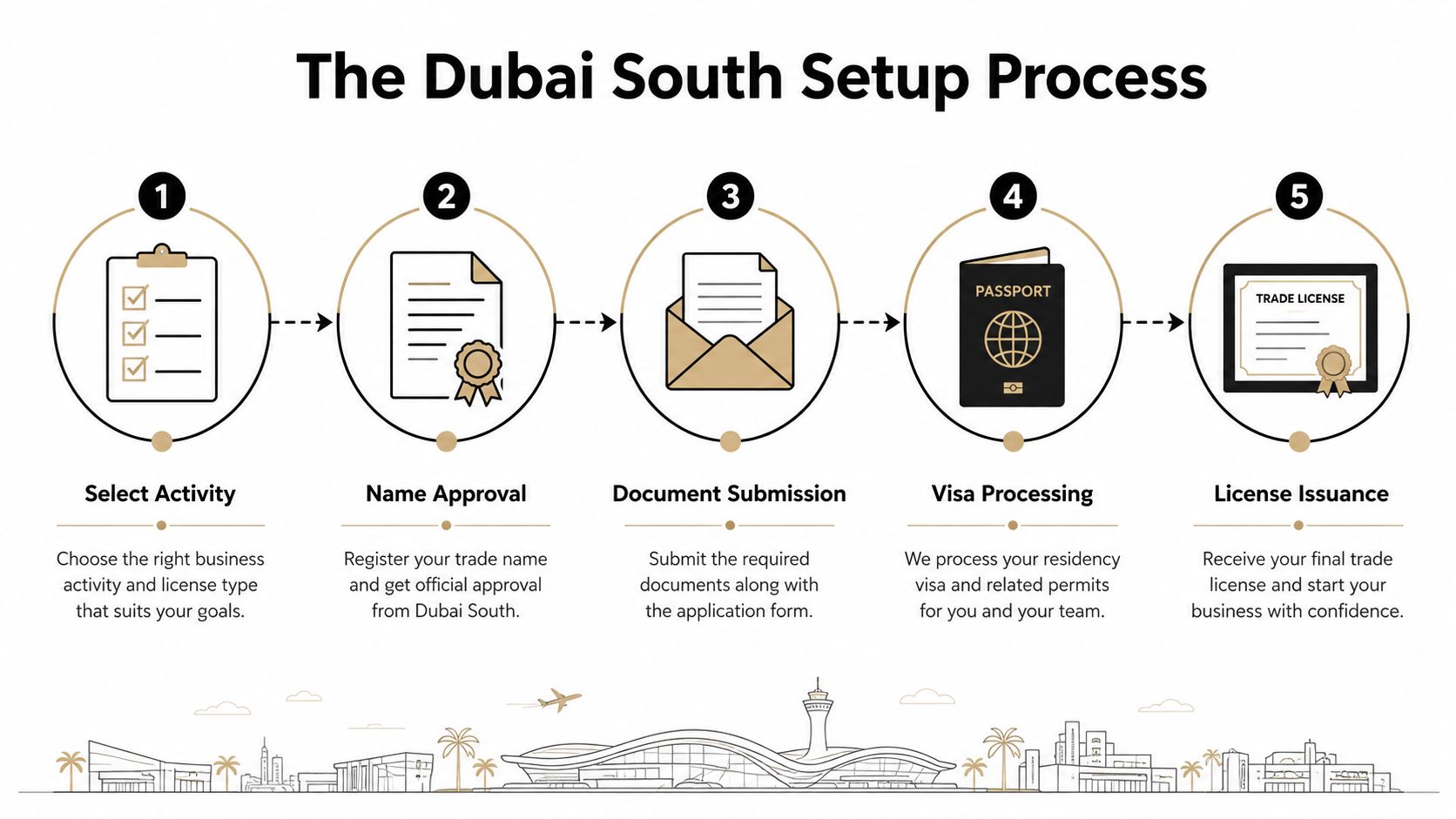
Step one, pre-qualify the activity properly
This is the stage entrepreneurs frequently underestimate. Before trade name reservation, confirm the actual activity code and licence class. Don't rely on broad terms like “general services” or “trading and consulting”.
For service and industrial businesses, the description has to reflect what the company will really do. If the business model is too vague, the application may need clarification later.
The most common avoidable problem is simple. The founder describes one business in conversation, submits a different activity on paper, and attaches a business plan that points somewhere else again.
Step two, reserve the trade name
Once the activity path is right, reserve the business name. This sounds administrative, but it's a control point. If the activity and legal structure are still unresolved, don't lock in the name first and hope the rest will catch up.
At this stage, also confirm who the shareholders and manager will be, because that affects the document pack and later approvals.
Step three, prepare the document pack
For most straightforward applications, the common file set includes passport copies, passport photos, and proof of address. For some licences, especially Service and certain Industrial activities, a business plan is often mandatory according to the same UAE free zone setup guidance.
A good business plan for setup purposes isn't a glossy investor deck. It should answer practical questions:
- What does the company do
- Who are the customers
- How is revenue generated
- Where will operations happen
- Why does the selected activity code fit
Core document checklist
| Document | Shareholders | Manager |
|---|---|---|
| Passport copy | Required | Required |
| Passport photo | Required | Required |
| Proof of address | Required | Required |
| Business plan, where applicable | May be required | May be required |
Step four, choose the facility before final submission
Many low-cost setups become expensive later. A founder picks the smallest office option, then realises the visa allocation or business needs don't fit. The lease choice affects more than rent. It affects operating practicality.
If the company expects staffing growth, regulated client visits, inventory handling, or future expansion, the office decision should reflect that from the start. Don't buy a package that only works on day one.
Step five, submit, pay, and wait for review
Once the activity, name, documents, and facility are aligned, the application can move cleanly through review. If something is inconsistent, the issue surfaces at that stage.
Common reasons for rework include:
- Activity mismatch with the business plan
- Incomplete document pack for shareholders or manager
- Wrong office selection for the intended visa or operational need
- Under-explained service model in applications that look too generic
What actually makes the process smoother
The smoothest incorporations usually follow a disciplined sequence:
- Validate the business model early so the activity selection is defensible
- Draft the business plan to support the licence, not as a separate exercise
- Check lease and visa logic together before payment
- Use consistent wording across the application form, plan, and supporting documents
That's the practical difference between a file that moves and a file that stalls.
Estimating Your Investment Costs Timelines and Office Options
Most founders ask two questions first. How much will this cost, and how long will it take. In Dubai South, the honest answer is that both depend on the chosen activity, office model, and visa plan.
According to this Dubai South setup cost overview, company incorporation can take 7–10 working days, licence fees may range from AED 10,000 to AED 50,000, and office options can start from a flexi-desk package. The same source also notes that a Smart Desk Office package can allow up to two residence visas, with visa allocation typically linked to office size at around one visa per 9 square metres.

Break the budget into the right categories
A lot of budgeting mistakes happen because founders treat setup as one number. It isn't. You should separate the spend into at least these buckets:
- Licence cost based on the approved activity
- Facility cost based on flexi-desk or larger office choice
- Visa-related spending tied to shareholder and staff plans
- Ongoing renewal costs that continue after incorporation
One of the more useful ways to think about this is to budget for the business, not just the certificate. If you're relocating staff or founders as part of the move, this broader Go Hires Dubai relocation budget can help you estimate personal and operational living costs alongside setup costs.
Office choice changes more than rent
Founders often choose the cheapest available office package and only later realise that the office is doing three jobs at once. It supports the licence, affects visa entitlement, and influences how credible the company looks operationally.
A flexi-desk can be sensible when:
- the business is early stage
- the team is very small
- the company doesn't need regular in-person operations
- the visa requirement is limited
A larger office becomes more sensible when:
- the business expects hiring
- client meetings matter
- staff need a regular workplace
- substance and operational presence matter more
Small office packages are useful. They're not neutral. They lock in certain limits, especially around visas and how the business presents itself.
Timelines in the real world
The published timeline can be fast when the file is clean. It slows down when the business description is unclear, the office selection has to be redone, or the shareholder documents are inconsistent.
That's why experienced founders build for a realistic working window instead of planning around the most optimistic scenario. If the business launch depends on visas, hiring, banking, and client onboarding, the incorporation date is only one milestone.
For companies comparing jurisdictions and package styles more broadly, this collection of free zone company setup UAE articles helps frame what cost differences mean in operational terms.
Beyond the Licence Is Dubai South Right For Your Business
The biggest mistake in UAE setup is assuming every free zone serves the same purpose. They don't. Dubai South has a strong identity. That's useful when your business fits it, and limiting when it doesn't.
A key point that many generic guides skip is tax positioning. As explained in this Dubai South company setup analysis, Dubai South is discussed as a Designated Zone for VAT and Corporate Tax purposes, and the company's tax treatment depends heavily on its activities and where transactions take place. In other words, a free zone address doesn't automatically mean every part of the business is treated the same way for tax purposes.
When Dubai South is the right choice
Dubai South tends to suit businesses that can demonstrate real operational logic for being there.
Good fit examples include:
- logistics businesses that need an airport-led environment
- e-commerce fulfilment operations planning stock movement and warehousing support
- aviation support companies operating close to sector infrastructure
- trading companies whose supply chain story matters commercially
- growing SMEs that may need to scale from a small office footprint to a larger one over time
If your office environment is part of the value you offer to members, tenants, or clients, practical infrastructure also matters. For operators planning shared workspace or flexible office models, these Splash Access co-working Wi-Fi solutions are worth reviewing as part of the operating setup, not just the registration phase.
When another option may be better
Dubai South may be the wrong fit if your company mainly needs one of the following:
- broader local UAE trading flexibility without free zone constraints
- an activity profile better matched elsewhere
- simpler alignment with a business model that has little connection to logistics, aviation, or physical operations
- a setup designed primarily for local service delivery outside the zone
This doesn't make Dubai South weaker. It just means it isn't universal.
Decision filter: choose Dubai South when the jurisdiction strengthens the business model. Don't choose it only because the setup package looks neat.
Substance is not a marketing phrase
Substance matters more now because authorities, banks, and tax analysis all look beyond the trade licence itself. They look at where the company operates, how it earns revenue, what office footprint it maintains, and whether its activities make sense in context.
That's why the right question isn't “Can I register there?” It's “Will this still be the right structure after the first clients, first hires, first compliance review, and first banking questions?”
Your Post-Setup Checklist Compliance and Growth
Getting the licence issued is only the start. The first few months after incorporation are where many businesses either become properly organised or start accumulating compliance problems they have to fix later.

Your first 90 days should cover these priorities
Open the corporate bank account
Banks will usually want a coherent story. Your licence, business plan, office arrangement, shareholder profile, and expected transaction pattern should all line up.Process shareholder and staff visas
Visa planning should follow the office package you selected. If the company expects hiring soon, don't leave this until the first employee is ready to join.Set up bookkeeping from day one
Don't wait for the first tax deadline. Businesses that postpone accounting often struggle to reconstruct records later.
- Review VAT and corporate tax obligations Many founders make assumptions here based on the phrase “free zone”. If you need operational support on reporting and compliance, this guide to VAT filing in UAE is a practical starting point.
Build controls before growth exposes the gaps
The businesses that stay organised usually put a few basic controls in place early:
| Priority area | What to do early |
|---|---|
| Banking readiness | Keep documents and business narrative consistent |
| Tax compliance | Track invoices, contracts, and transaction locations |
| Record keeping | Maintain organised books and supporting files |
| Staffing | Match hiring plans to visa and office capacity |
One useful approach is to appoint support for setup-adjacent work before it becomes urgent. That may include PRO coordination, accounting support, business planning, or compliance review. Smart Classic Business Hub is one provider in this space, offering company formation, PRO support, feasibility planning, and VAT-compliant accounting for UAE businesses.
A well-set-up company doesn't just hold a licence. It can explain its activity, support its tax position, satisfy banking checks, and scale without rewriting its structure six months later.
If you treat post-setup as part of the setup, Dubai South can work very well. If you stop at incorporation, problems usually show up when money starts moving, people need visas, and reporting obligations begin.
If you're assessing whether Smart Classic Business Hub can help with business setup in dubai south free zone, the most useful starting point is a practical review of your activity, office needs, visa plan, and tax position before any application is filed. That early review usually saves more time than fixing a mismatched structure after incorporation.