
A standard Dubai employment residence visa is normally valid for two years and renewable. After arrival, the employment process typically runs through medical testing, Emirates ID, and residence formalisation within about two months.
You've probably seen the pattern already. A candidate lands in Dubai, gets handed an entry permit, and assumes the visa is done. It isn't, and that misunderstanding causes more avoidable problems than most employers expect.
The Dubai Employment Visa Process Overview
A new hire can land in Dubai with the right papers and still be blocked on day one. The entry permit opens the residence process, and the Dubai employment visa only becomes complete after the labour and residence steps are finished. In practice, the sequence starts with the employer's offer and ends after residence formalisation, Emirates ID, and labour contract registration.
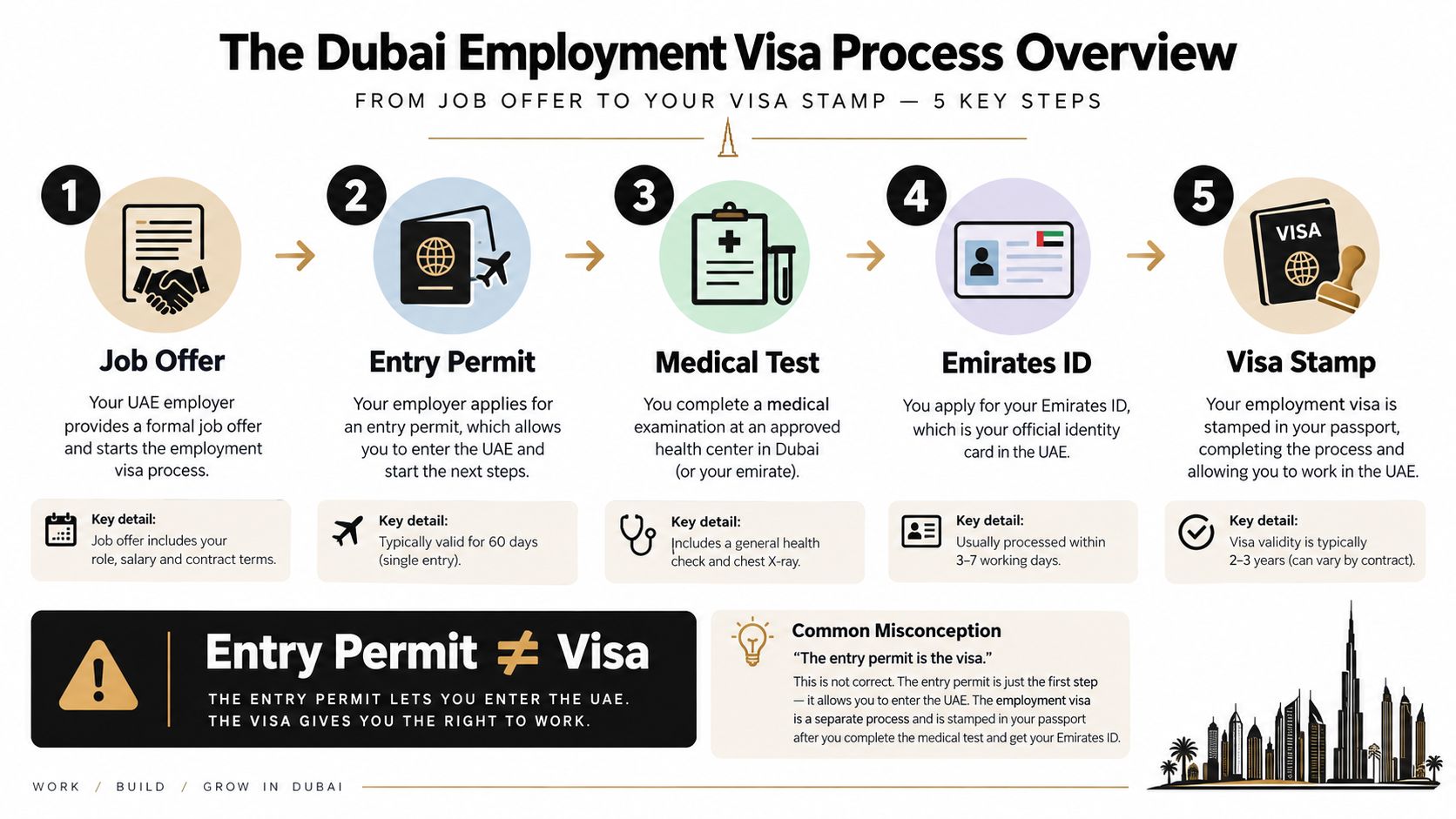
A five-step timeline helps first-time sponsors keep the order straight. The path is broadly the same for hires arriving from abroad and for people changing status inside the UAE, although the paperwork branch changes once the worker is already onshore. The government's UAE work permit guidance also makes one point plain, the person may not work without a valid permit, and the employer may not recruit or employ without it.
What the process really looks like
A Dubai employer first issues a formal offer and submits the initial work-permit application. After approval, the employer applies for the entry permit, or for a status change if the employee is already in the UAE. Once the worker arrives, the medical fitness exam and Emirates ID biometrics come next, followed by residence visa completion and ID formalisation.
The order matters because each document depends on the one before it. If the contract is not submitted within the required window after arrival or an in-country status change, the file can drift out of compliance even when the first approval was clean. For readers who want a simple explanation of the first approval step, this Dubai entry permit overview connects that stage to the rest of the process.
The common mistake is treating the entry permit as the visa itself. In practice, it starts the residence process.
For employers, the practical model is a sponsored workflow with legal checkpoints. Each checkpoint ties back to the employer's file, the worker's identity, and the contract status. A missing signature, an expired passport page, or a job title that does not match the licensed activity can slow the whole chain. Payment responsibility also sits inside that same chain. Employer obligations and applicant expenses should be separated clearly before anyone starts, because confusion over who pays for permits, medical checks, or related processing is one of the easiest ways to create friction later.
Preparing for Your Dubai Work Permit Application
The file should be clean before anyone submits it. The employer, not the applicant, carries the main filing responsibility, and the cost split should be clear before work starts. In practice, that means separating company obligations from worker-side expenses at the outset, because confusion over fees, document checks, or processing steps is one of the fastest ways to slow a file down.
Start with the employer's MoHRE establishment file, trade licence, and activity-occupation match before the candidate resigns, relocates, or books travel. The job title has to fit the licensed activity, and the submission should come from the authorised company representative, not a third party with no filing authority. If the role needs a professional approval, get that in place before submission rather than after a refusal.
The candidate file should read like a compliance pack. A signed, MoHRE-compliant job offer is the base document. The passport needs enough validity, the photo should meet the usual white-background standard, and any qualifications that require authentication should be handled early. Roles that are technical, regulated, or tied to licensing are especially sensitive to missing paperwork.
A solid file usually includes:
- Passport copy and validity check, because expired or near-expiry passports predictably slow things down.
- Signed offer and role description, because the contract has to match the sponsor's filing.
- Authenticated qualifications, when the occupation calls for proof.
- Employer contact and file details, so the PRO team can verify the submission route.
The payment question should be settled before the applicant moves. Employer obligations and applicant expenses are not the same thing, and mixing them up creates avoidable disputes later. If the employer is covering permit processing, say so clearly. If the applicant is expected to pay for personal document handling or side costs, define that too. Vagueness here usually costs more later than a clean split would have cost at the start.
If the candidate is moving from another market, the CV often needs a local reset as well. A practical guide on adapting your resume across borders helps align job titles and achievements with international expectations without overpromising.
If the trade licence and the offered role do not line up, the file becomes fragile before it reaches the authority. That is why the most useful pre-check is simple: make sure the sponsor, the title, the documents, and the payment responsibility all point in the same direction.
For teams that want outside help, a Dubai consultancy can handle the sponsorship workflow, document clearing, and government submissions. Smart Classic Business Hub is one option that supports company formation and PRO processing, including visa-related submissions and coordination, alongside broader setup work.
Post-Arrival Medical Testing and Visa Stamping
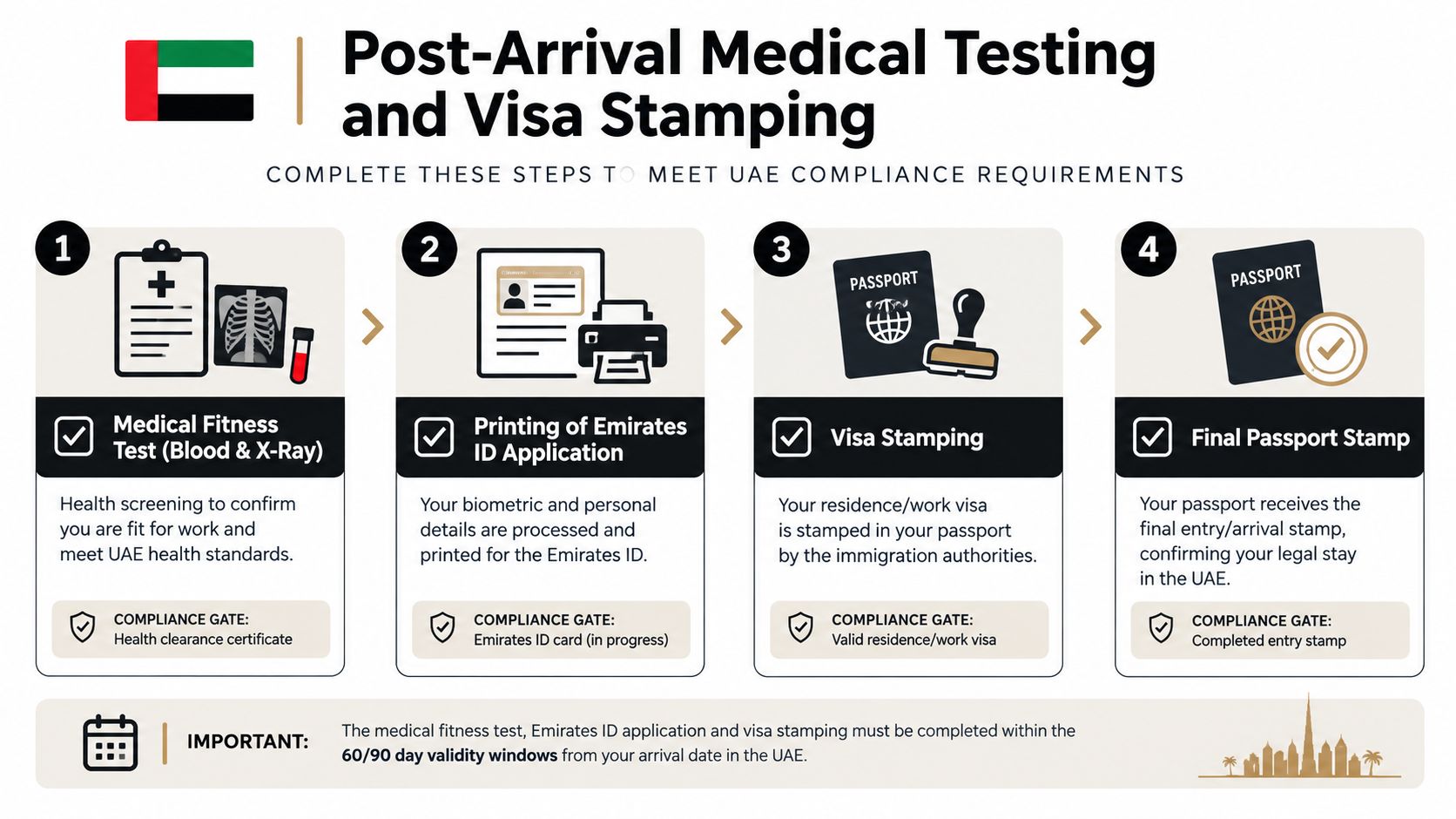
The post-arrival window is where urgency becomes real. The worker has entered the UAE, but the residence process is still incomplete until the medical fitness result clears, the Emirates ID biometrics are captured, and the residence steps are finalised. The employment contract also has to be registered with MoHRE within 14 days of arrival or the in-country status change, which is easy to miss when teams assume the “hard part” is already over.
What happens after arrival
Medical fitness screening is a mandatory technical gate for residency and work-visa issuance under federal requirements. The standard screening includes HIV/AIDS and tuberculosis testing, while additional tests can apply depending on the applicant category, such as hepatitis B, syphilis, leprosy, or pregnancy testing for certain domestic-worker roles (medical fitness requirements). If the medical result is delayed, everything behind it slows down too.
For practical scheduling, many applicants benefit from lining up a doctor on call for job checks before the formal screening date, especially if they need a quick reassurance about paperwork, timing, or health-history questions. A useful reference is doctor on call for job checks, which can help employees understand what to expect before they attend the official test.
Why the sequence matters on the ground
Medical clearance is followed by Emirates ID biometrics and application processing, then the residence formalisation step. The employment entry permit is generally valid for about two months, which gives the worker time to complete these steps, but that window disappears faster than most first-timers expect. Treating the entry permit as a completed visa is the mistake that causes missed appointments and last-minute panic.
If the medical test or Emirates ID appointment slips, the residence file doesn't stay “open” on goodwill. It just sits incomplete until someone fixes it.
For readers who like a document-focused checkpoint, the residence process becomes much easier to manage with a written pack of passport copies, entry permit, medical receipt, and biometrics confirmation. A medical fitness certificate reference is useful if you need a practical sense of what the fitness stage is meant to produce, although the official tests still remain the binding step.
The safest mindset is simple. The worker is not fully settled until the medical result is cleared, the Emirates ID path is underway, and the contract has been registered in time.
Understanding Visa Costs and Who Must Pay
Many Dubai hiring guides become vague here, and that vagueness is expensive. UAE government guidance states that the employer must pay the costs of issuing the entry visa, the employee's travel to the UAE, post-arrival medical testing, and residence-permit issuance (employer payment obligations). If a recruiter asks the applicant to absorb those mandatory employer costs, that request deserves scrutiny before anything is signed.
Separate employer obligations from personal expenses
The cleanest way to handle the budget is to divide the file into two buckets. One bucket belongs to the sponsor, because the law places those costs on the employer. The other bucket belongs to the applicant, and it covers personal admin such as passport renewal, document attestation, or other outside-the-process services when they're optional.
A useful payment checklist looks like this:
- Employer-paid items, entry visa, travel to the UAE, post-arrival medical testing, residence permit.
- Applicant-paid items, personal document renewals, optional attestations, and any non-mandatory convenience services.
- Evidence to keep, signed offer, payment receipt, permit number, and contract copy before travel.
That recordkeeping matters because payment disputes usually start when nobody can prove who paid for what. A signed offer is useful, but it's stronger when paired with receipts and the company's permit reference.
Read the warning signs early
The biggest red flag is an intermediary who bundles lawful employer costs into the candidate's invoice without explaining why. Another is pressure to pay before the company has issued a formal, MoHRE-compliant offer. A third is a promise that the applicant can “sort it later”, which often means the file is being pushed forward before the sponsor is ready.
If a sponsor wants the worker to finance mandatory company obligations, pause the process and ask for the breakdown in writing.
The practical trade-off is straightforward. Paying for true personal services is normal. Paying for the employer's mandatory visa obligations is not the same thing, and it should be challenged politely but firmly. Where the distinction is unclear, ask for an itemised list and compare it against the permit stage of the file.
Mainland versus Free Zone Employment Paths
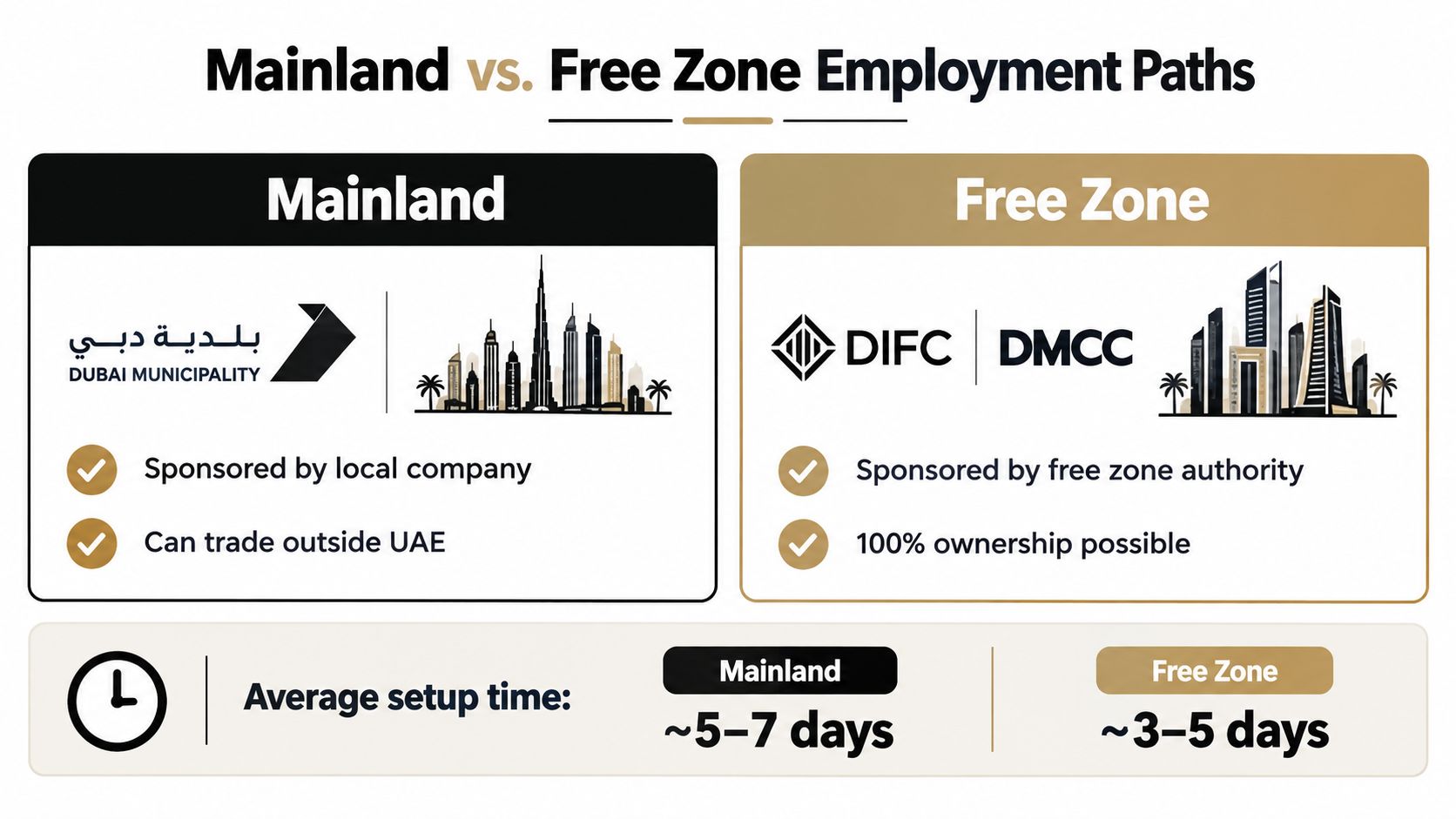
The core federal rules stay in place either way, but the operating environment changes depending on where the company is licensed. Mainland Dubai entities usually work through MoHRE-linked employment procedures, while free zone employers may run parallel authority processes with their own sponsorship workflow. For the candidate, that difference shows up in who issues the documents, who signs off first, and which portal or authority handles the next step.
How to read the difference
A mainland sponsor is usually the cleaner fit when the business trades broadly in the UAE market and wants direct MoHRE handling. A free zone route can be smoother when the employer is fully inside a specific zone's ecosystem and wants that authority's internal process. The applicant shouldn't assume one is automatically easier. The better route is the one that matches the company's licence, headcount structure, and intended work location.
What changes for the applicant
The paperwork still needs to be consistent. The job title, contract, sponsor entity, and permit route all need to match, regardless of whether the file starts in mainland Dubai or a free zone. The labour-market expansion reported by MoHRE between 2021 and 2025, including 101.76% workforce growth, 49.92% skilled labour growth, and 45.76% more companies, shows why compliant hiring infrastructure has become a core business issue rather than a back-office detail (MoHRE labour-market figures).
For candidates, the safest question is not “mainland or free zone?”. It's “which authority is actually sponsoring me, and does every document match that route?”
That question avoids most confusion about signature flows, contract templates, and filing responsibility. It also helps HR teams catch mismatches before the file is submitted, when the correction is still cheap.
Alternatives for Freelancers and Remote Workers
The idea that a freelancer can land on a tourist visa, start working, and convert later is still floating around, but it's a bad habit to build a career on. The lawful route depends on the person's actual work pattern, because independent professionals need a structure that lets them operate without pretending they have an employer sponsor when they don't. For people in that position, the better comparison is not “employee visa or nothing”, but “which legal alternative fits the work model”.
The legal routes are different from employment sponsorship
A freelance permit or a self-sponsored route gives the worker a compliance framework without a standard employment contract. That matters for consultants, creatives, and digital workers whose income doesn't come from one Dubai employer. A remote worker still needs the right status if the intention is to live and work from the UAE, because the visa type has to fit the activity, not just the location.
For people comparing remote options globally, fully distributed work opportunities can help clarify how international jobs are organised before they choose a visa path. The point isn't to chase any job abroad. It's to align the legal status with the way the money is earned.
What to compare before choosing a route
A good decision usually depends on three questions. Does the work require a single employer sponsor, can it be done independently, or does the person need a business structure with room for multiple clients? Once that's clear, the visa discussion becomes more concrete and less emotional.
A practical comparison looks like this:
- Employee route, best when one company controls the role, salary, and sponsorship.
- Freelance or independent route, better when the person sells services to multiple clients.
- Remote worker setup, useful when the employer is outside the UAE and the person needs legal residence without a local employment contract.
For readers researching a self-sponsored path, this freelance visa in Dubai guide can help frame the options without confusing them with standard employment sponsorship. The key is not to force a tourist-visa workaround into a long-term plan, because that usually creates avoidable exposure later.
Choose the route that matches the work, not the route that feels fastest. If you're hiring in Dubai and need the sponsorship sequence handled properly, or you're trying to move a candidate from offer to residence without payment mistakes, visit Smart Classic Business Hub and speak with a team that works on company setup, PRO processing, and visa coordination in the UAE.