
A Dubai founder gets the letter on a Tuesday afternoon. A former investor is alleging misrepresentation in the funding round, the company is in a messy cash conversation, and the founder's first instinct is simple, the business will handle the lawyers. Then the uncomfortable answer lands, if solvency is in doubt, the company may not be able to stand behind the director the way everyone assumed it would.
That is why directors and officers insurance matters in the UAE. It protects people, not just entities, when shareholders, creditors, regulators, or employees start pointing at management decisions. In a market where formal insolvency and restructuring rules have tightened, and where boards carry more compliance weight than most founders expect, personal exposure is not theoretical, it's part of the job now. For a useful primer on the insolvency side of that risk, read protect yourself from wrongful trading alongside your wider governance review. If your articles of association are still generic, your liability posture is usually weaker than you think, so start by checking your articles of association against how the company operates.
Why UAE Founders and Boards Need Personal Liability Protection
A founder-led company often feels informal right up until a dispute turns personal. One investor claims they were misled, a co-founder disputes a cap table entry, or a creditor starts asking whether management kept trading too long. At that moment, directors and officers insurance stops being a box-ticking policy and becomes a defence fund for the people in the crosshairs.
The point is straightforward. D&O cover exists to protect directors and officers from personal liability tied to management decisions, governance failures, and claims from shareholders or creditors. In the UAE, that matters even more because the legal and insolvency environment has tightened since the federal Bankruptcy Law was introduced in 2016 and then overhauled by Federal Decree-Law No. 9 of 2022, which sits within a restructuring framework that is designed to support formal processes rather than casual workarounds. That change raises the stakes for anyone signing off on decisions under pressure. Allianz's UAE D&O overview makes the same basic point, and it is the right mental model for founders too.
Practical rule: if the company cannot reliably indemnify you, your personal asset exposure is real. That's exactly when Side A matters most.
Private companies often make the biggest mistake here. They assume D&O is for listed groups with noisy shareholders, not for free-zone startups, family businesses, or mainland SMEs with a small board and a tight cap table. That's wrong. Private-company guidance notes that the cover can also protect closely held firms, family-owned businesses, advisory-board members, employees, and de facto directors, which is exactly the group many UAE businesses have.
The answer is not to hope nothing goes wrong. It is to decide, in advance, who pays when a claim hits. If you want the logic spelled out in more detail for private-company boards, Howard Insurance's private company guide is useful background.
How D&O Policy Structure Works in Practice
A strong D&O policy is built in layers. Those layers decide who gets paid, when the insurer responds, and whether the board member has real personal protection or just comforting wording on a brochure. If you understand the structure, you can spot weak cover fast.
Side A, Side B, and Side C
Side A is the personal safety net. It protects individual directors and officers when the company cannot indemnify them, which is exactly why it becomes critical in insolvency, restructuring, or legal restriction scenarios. It is the layer that matters to the person on the hook, not to the company balance sheet.
Side B reimburses the company when the company has paid an indemnity to a director or officer. That helps protect corporate cash flow from being hit twice, once by the underlying dispute and again by the defence bill. It matters, but it does not rescue an individual if the company cannot pay.
Side C extends entity coverage in some policies. In private-company settings, this is often narrower or more variable than founders expect, so do not assume “entity cover” means broad protection for every claim. The wording controls the result, not the sales sheet.
A board should read those layers as a governance tool, not as a marketing feature. Side A protects the person, Side B protects the company's reimbursement position, and Side C protects the entity in certain claims.
The first question is never “What's the premium?” It's “Which layer responds if the company can't indemnify me?”
Claims Made and Notified Is the Critical Trap
Most UAE and AE market policies are written on a claims-made-and-notified basis with a 12-month policy period and a specific limit of indemnity. The key issue is not when the management act happened, it is when the claim is first made and reported. Late notice can wipe out coverage even if the alleged conduct happened earlier, so internal notification discipline is part of the policy itself. AICD's explanation of claims-made-and-notified cover is directly relevant here.
Founders should treat claim reporting like a board resolution, not an afterthought. The minute a letter, demand, regulator query, or threatened suit lands, someone needs to escalate it immediately. The company cannot save a stale claim by hoping the insurer will be flexible.
Why the Fine Print Changes the Outcome
Sub-limits, deductibles, and reinstatement provisions can change the actual protection available. A headline limit looks impressive until you discover defence costs erode it quickly or a sub-limit caps the very risk you thought was covered. Read the policy as if a claim is already underway, because that is the only way to see whether the structure works in real life.
For a concise explanation of how the pieces fit together, the Clyde & Co summary of D&O insuring sides is worth keeping nearby.
UAE Legal and Regulatory Drivers of D&O Demand
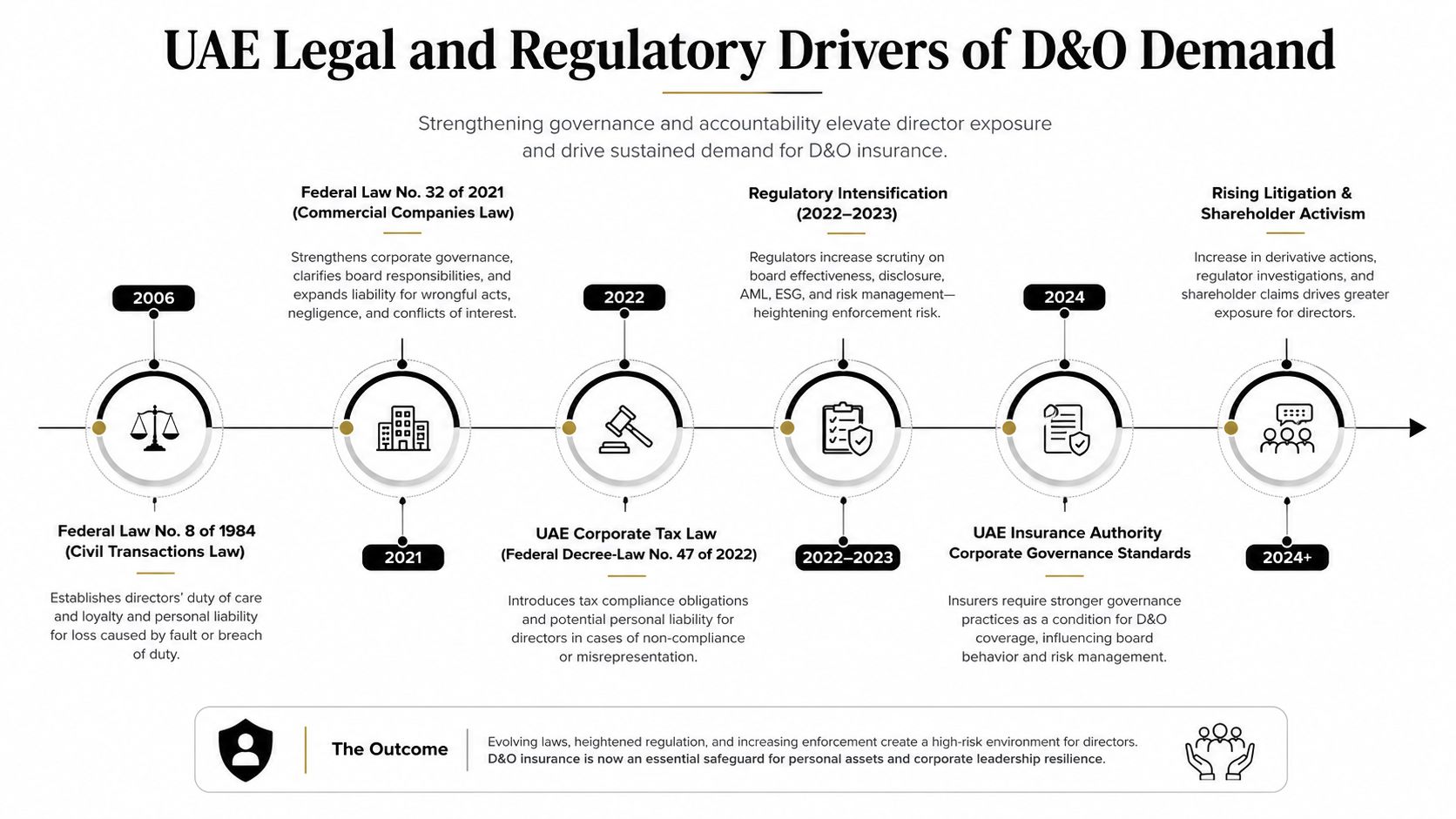
A UAE board seat now carries a different kind of risk. Governance mistakes that once stayed inside the company can now spill into personal exposure fast, especially for private companies, free-zone startups, and founder-led SMEs that still assume the corporate veil will do all the work. That assumption is outdated. A director who signs the wrong approval, misses a disclosure issue, or mishandles a distressed company decision can face a much more formal path to liability than many founders expect. Allianz's UAE market overview reflects that shift in the market.
Insolvency Reform Changed the Board's Risk Profile
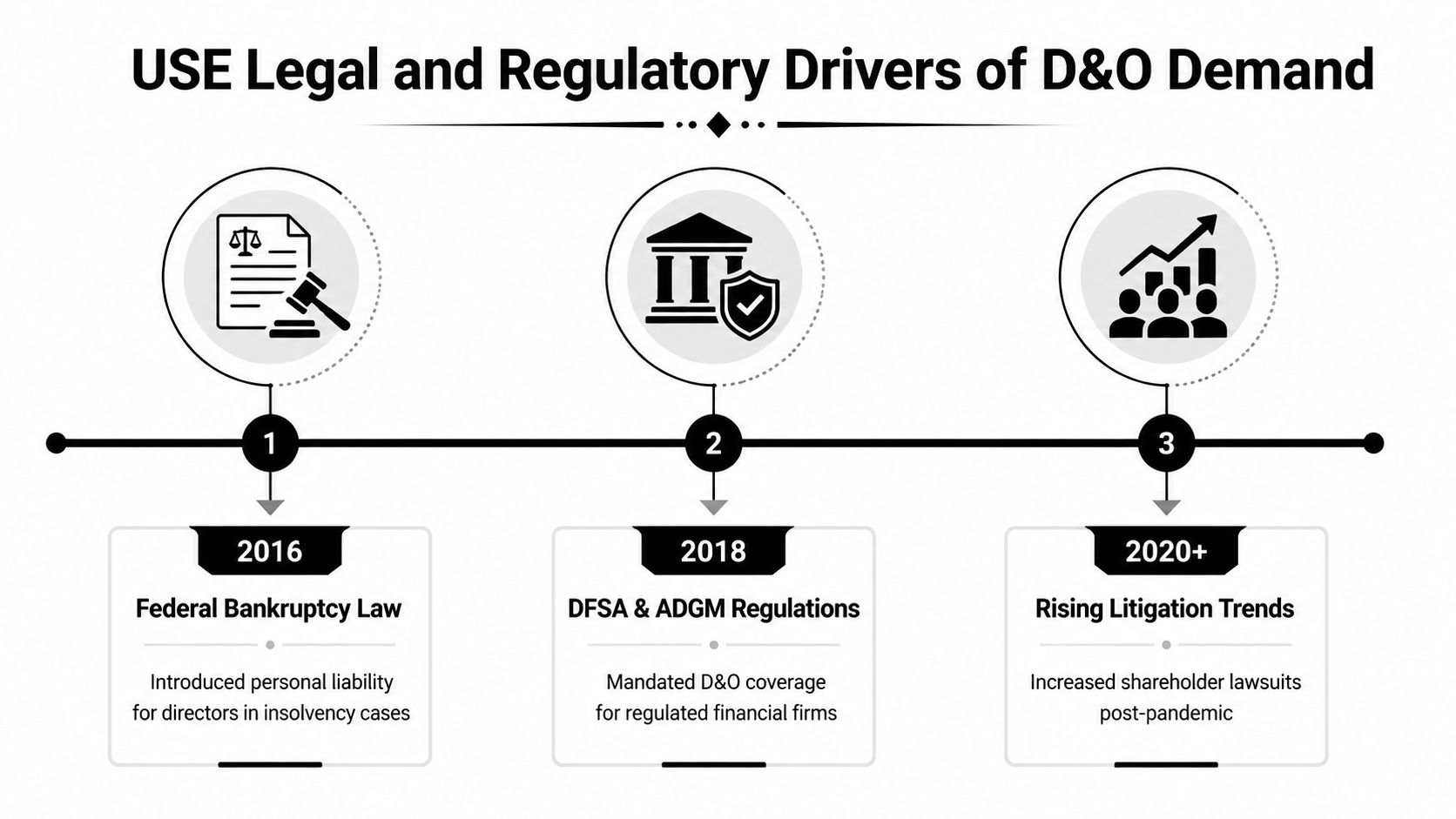
The federal Bankruptcy Law introduced in 2016, and the later overhaul in Federal Decree-Law No. 9 of 2022, changed the board's exposure in a meaningful way. Once a company is in trouble, directors are no longer judged only on commercial judgment. They are examined on conduct during distress, the accuracy of disclosures, and whether they took the right steps while creditors were pressing and cash flow was under strain.
Informal rescue deals carry less comfort than they used to. If management waited too long, overpromised, or made the wrong call at the wrong time, the dispute quickly becomes personal for the people who made those decisions. D&O is the buffer between that claim and a director's own finances.
Compliance Burdens Create More Entry Points for Claims
The compliance load in the UAE is heavier now, and boards feel it directly. VAT, economic substance, AML, and audited reporting obligations all create more points where regulators, investors, lenders, and counterparties can question how the business was run. A board that treats compliance as an admin task is inviting trouble.
That risk is sharper for free-zone firms and scaling SMEs. They usually run with lean finance teams, founder sign-off on too many documents, and board meetings that are too infrequent to catch problems early. Once a dispute starts, the allegation is rarely limited to one event. It usually turns into an attack on governance, oversight, and whether the directors did their jobs properly.
Mainland and Free-Zone Entities Need the Same Discipline
Mainland status versus free-zone status does not lower the need for D&O. In practice, the structure can make coverage choices more important, because operating arrangements, employment terms, and decision chains are often more layered than they appear on paper. Directors should review how governance documents, meeting minutes, and indemnity rights sit alongside the policy wording.
For DIFC companies, employee disputes can also feed straight into management liability claims, so Smart Classic's DIFC employment law resource is useful background for boards that want to understand where exposure starts. If your board is active, your compliance burden is real, or the company is heading into growth, restructuring, or investor scrutiny, D&O is a core governance control.
What D&O Policies Cover and What They Exclude
D&O policies are designed to respond to management risk, not every bad outcome a company experiences. That distinction matters because too many buyers assume the policy is broader than it is. It isn't. The wording decides whether the insurer pays, and the wording changes the result more than the brand name on the front page.
Common Coverage Areas
Typical D&O protection includes defence costs and claims arising from alleged breach of fiduciary duty, misrepresentation in financial statements, wrongful termination, regulatory investigations, and shareholder disputes. That's the heart of the product. If a director is accused of managing badly, misleading stakeholders, or failing to discharge oversight duties, D&O is the first policy to check.
The most important piece is often the defence bill. Even when a claim is weak, legal costs can mount quickly because the board has to respond, preserve documents, instruct counsel, and deal with procedure. That's why I tell founders not to think in terms of “will I win?” but “how quickly will this become expensive?”
Common Exclusions and Why They Matter
Fraud, criminal acts, personal profit, prior known claims, and contractual liabilities are usually excluded. That doesn't mean every accusation of wrongdoing removes cover, but it does mean the policy is not a shield for intentional misconduct or a substitute for contractual risk management. If a founder relies on D&O to cover a broken commercial promise, they are already in the wrong lane.
Cross-border wording is another issue most UAE businesses underweight. Many directors serve across jurisdictions, and claims do not always arrive where the board expected. If the policy is silent or awkward on where a claim can be brought, the company can end up paying for a dispute over the policy before it even gets to the substantive claim.
Common D&O Coverage Scenarios in the UAE
| Claim Scenario | Typically Covered | Key Consideration |
|---|---|---|
| Shareholder alleges misrepresentation in a funding round | Usually, if the wording responds to management claims | Watch notification timing and any exclusions tied to fundraising disclosures |
| Regulator opens an investigation into board oversight | Often, depending on wording and the stage of the investigation | Check whether pre-claim inquiries are included |
| Former employee sues a director over termination-linked governance decisions | Sometimes, if the claim is framed as a management issue | Distinguish D&O from employment practices cover |
| Company enters insolvency and directors face creditor claims | Often a key Side A situation | Confirm the company can't indemnify and Side A is not eroded by other claims |
| Board dispute over disclosure, valuation, or governance | Usually, if it involves wrongful acts by directors or officers | Watch insured-versus-insured language and any carve-outs |
That table is the essential buyer checklist. A policy that looks broad on paper can be weak where UAE boards need it most, especially around insolvency, investigations, and the line between personal protection and entity protection. If you want the basic private-company angle in plain English, keep the distinction between what the company does and what the board decides front of mind.
Factors That Determine Your D&O Insurance Cost
D&O pricing is not random, but it is definitely more nuanced than most founders expect. Two businesses can have similar headcount and very different quotes because the underwriter is pricing governance risk, not just size. That means the cheapest policy is often cheap for a reason, and the expensive one is often reacting to something you can identify and fix.
What Underwriters Actually Weigh
Industry matters. So does the number of directors, the claims history, the jurisdictions where the company operates, and the policy limits requested. A business with international subsidiaries, regulatory touchpoints, or an expanding investor base usually looks more exposed than a local trading company with a simple structure.
Free-zone versus mainland registration can also affect the assessment because the legal and operational context is not identical. Underwriters want to know who signs, who controls, where claims might arise, and whether the company has the discipline to report issues fast. If they don't like the answer, the quote rises or the terms tighten.
My rule of thumb: if your board meetings are sloppy, your D&O quote usually tells the truth before your lawyers do.
The Levers You Can Use
You can influence cost without gutting protection. Higher deductibles can reduce premium, but they only work if the company can absorb the first layer of loss. Side A sub-limits can help balance personal protection against price, and some extensions for regulatory investigations can be added or removed depending on how much exposure the company has.
Don't cut cover blindly to make the quote look neat. That's a false economy for SMEs, especially founder-led businesses where the same person is often the shareholder, director, and executive. The right approach is to align the policy with the company's governance profile, then negotiate from there.
Why SMEs Should Not Assume D&O Is Out of Reach
Small companies often think D&O is only for bigger corporates with expensive investor relations problems. In reality, smaller businesses with clean claims histories and stronger governance can often secure meaningful cover without treating it as a luxury spend. What drives the decision is not whether the company is “small”, it's whether the people making decisions could be sued personally if something goes wrong.
If you want a quick way to pressure-test a quote, ask what changed the price. Was it geography, industry, board structure, or the requested limit? If the broker can't explain it clearly, the programme probably needs another round of review.
Your D&O Procurement Checklist for UAE Companies
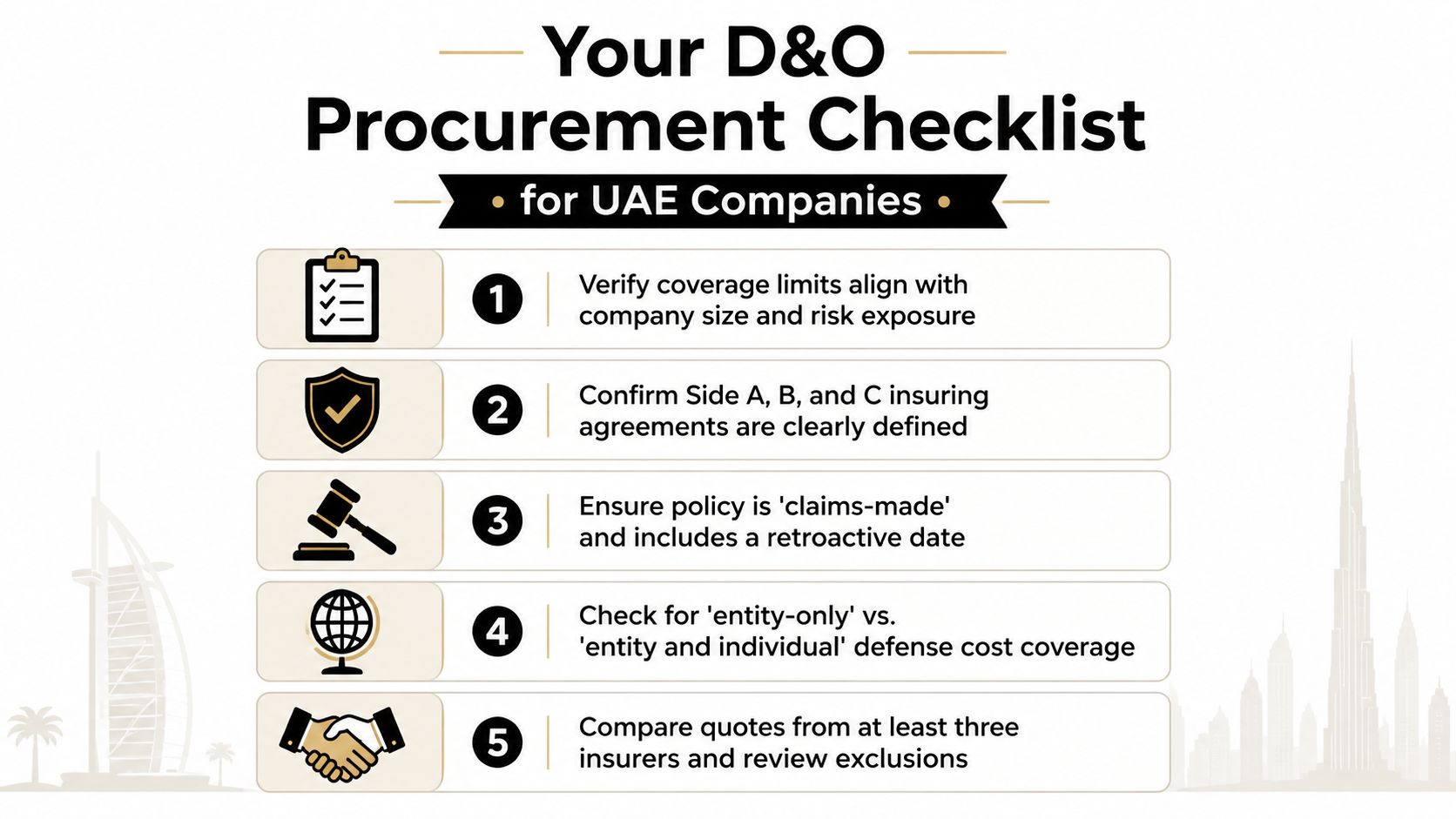
A good D&O purchase starts with the questions you ask before signing anything. If you wait until a dispute is already brewing, you've left the most important negotiations too late.
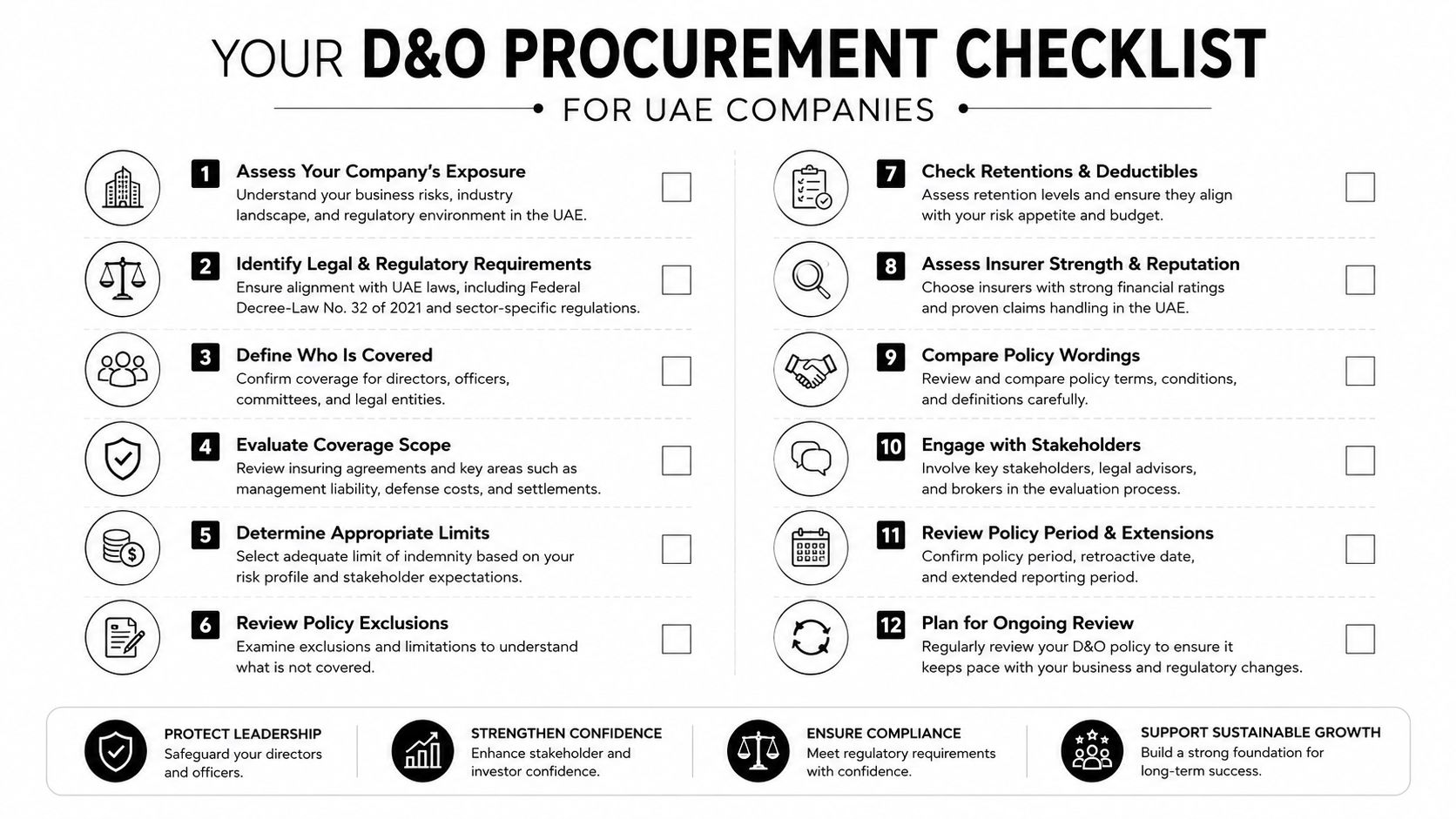
What to verify before you bind cover
- Confirm the claim trigger. Ask exactly how the policy defines a claim, what counts as first notice, and whether regulatory investigations are included or only formal lawsuits.
- Check Side A carefully. If the company cannot indemnify a director, Side A is the layer that should still protect the individual. If that wording is weak, the whole programme is weaker.
- Test the notification process. Build an internal reporting rule so that any demand letter, regulator query, or threatened suit reaches the board and broker immediately.
- Read the entity language. Don't assume the same policy wordings protect the company and each individual in the same way. They often don't.
- Ask about counsel choice. If the policy steers you to insurer-appointed lawyers only, that can become a problem fast in a real dispute.
- Review who counts as insured. Founder-led UAE businesses should check coverage for de facto directors, shadow directors, advisers, and others who influence decisions.
- Match the policy period to your governance calendar. Renewals, board changes, restructurings, and fundraising cycles should line up with when the cover is active.
- Compare exclusions line by line. Fraud, prior knowledge, and contractual liability carve-outs are where many disputes start.
- Evaluate insurer behaviour, not just the logo. Claims handling and responsiveness matter when the board is under pressure.
- Get written clarity on defence costs. Defence spend can erode a policy quickly, so you need to know exactly how it is treated.
The main mistake is buying a policy and assuming it will behave like a general liability form. It won't. D&O is a governance instrument, and it has to fit the way the company runs.
For companies formalising their structure or adding new entities, Smart Classic's UAE business setup services are useful because the legal structure and the insurance structure need to match. If they don't, the gaps show up later, usually at the worst possible time.
Securing the Right Protection for Your Business Growth
D&O should move with the business. A startup with one founder and one investor, a family company adding independent directors, and a group preparing for exit all need different protection, even if they operate under the same brand. Static coverage is weak coverage.
The smart move is to review D&O before the company adds directors, raises capital, expands cross-border, or enters a transaction that could trigger post-exit claims. Investors notice when the board is uninsured or underinsured, because they know weak governance becomes expensive fast. Pairing D&O with professional indemnity, cyber, and employment practices cover also helps close the gaps that appear when policies are bought in isolation.
If your board is serious about protecting personal assets while still growing aggressively, don't leave this to a quick broker email chain. Review the wording, test the notification process, and make sure the company can survive a claim without putting the directors on the hook personally.
Smart Classic Business Hub helps UAE founders, SMEs, and investors build the right legal and operational foundation, from company setup to compliance and ongoing corporate support. If you want practical guidance on structuring your business and reducing liability gaps around board risk, visit Smart Classic Business Hub and speak with a team that understands how UAE companies work.