
You're probably at one of two points right now. Either you're forming a company in the UAE and someone has sent you a draft Articles of Association to “just sign”, or you already have a company and have discovered, usually during a dispute or investor review, that the document says far less than you assumed.
That's where many founders get caught.
In practice, the Articles of Association aren't an admin form. They decide who can appoint directors, who can remove them, how profits are distributed, what happens if a shareholder wants to exit, and how deadlocks are handled. If those points are vague, the business doesn't stay flexible. It becomes fragile.
In the UAE, that fragility has real consequences. A template that works in one jurisdiction can fail in another. A clause that sounds commercially sensible can still be unenforceable if it conflicts with mandatory law. And a mismatch between your chosen jurisdiction and your Articles is one of the fastest ways to delay incorporation.
Why Your Articles of Association Can Make or Break Your UAE Business
A common founder mistake is thinking the problem starts when there's a dispute. Usually, it starts much earlier, on the day the company is formed.
Two partners set up a UAE business. They agree verbally that one will manage operations and the other will stay passive until expansion. The Articles of Association are lifted from a standard template, lightly edited, and filed. Months later, the passive partner wants to replace the manager, block a payment, or challenge a profit decision. Everyone goes back to the document. It doesn't answer the question clearly.
That's when the cost appears. Bank instructions stall. Investor due diligence gets messy. Staff hear mixed instructions. The company may still exist on paper, but decision-making becomes unstable.
What the document really does in the real world
A well-drafted set of articles of association acts like a pressure-tested operating agreement. It tells people what happens when interests diverge, not when everyone is still getting along.
It should deal with issues such as:
- Control: Who has authority to act for the company.
- Money: How profits are distributed and when they are retained.
- Ownership: Whether shares can be transferred freely or only with approval.
- Leadership changes: How directors are appointed, challenged, or removed.
- Disputes: What the parties do before a disagreement turns into paralysis.
A weak Articles of Association doesn't fail when the company launches. It fails when the first serious disagreement arrives.
In the UAE, that matters more than many founders expect because incorporation authorities look closely at whether the Articles comply with the applicable framework. Investors do the same for different reasons. They want to see whether control rights, transfer rights, and governance mechanics are coherent.
Why UAE founders can't treat this as boilerplate
Many entrepreneurs coming from the UK, Europe, India, or North America assume the concept is universal. It isn't. The name may be familiar, but the legal effect and drafting expectations shift by jurisdiction.
In the UAE, articles of association need to work on two levels at once. They must satisfy the authority that registers the company, and they must also work commercially once the company starts operating. If you only solve the first problem, you may still create governance trouble later. If you only solve the second, the authority may reject the application.
That's why this document often ends up being either a business shield or a future dispute file.
Decoding the Articles of Association Your Company Constitution
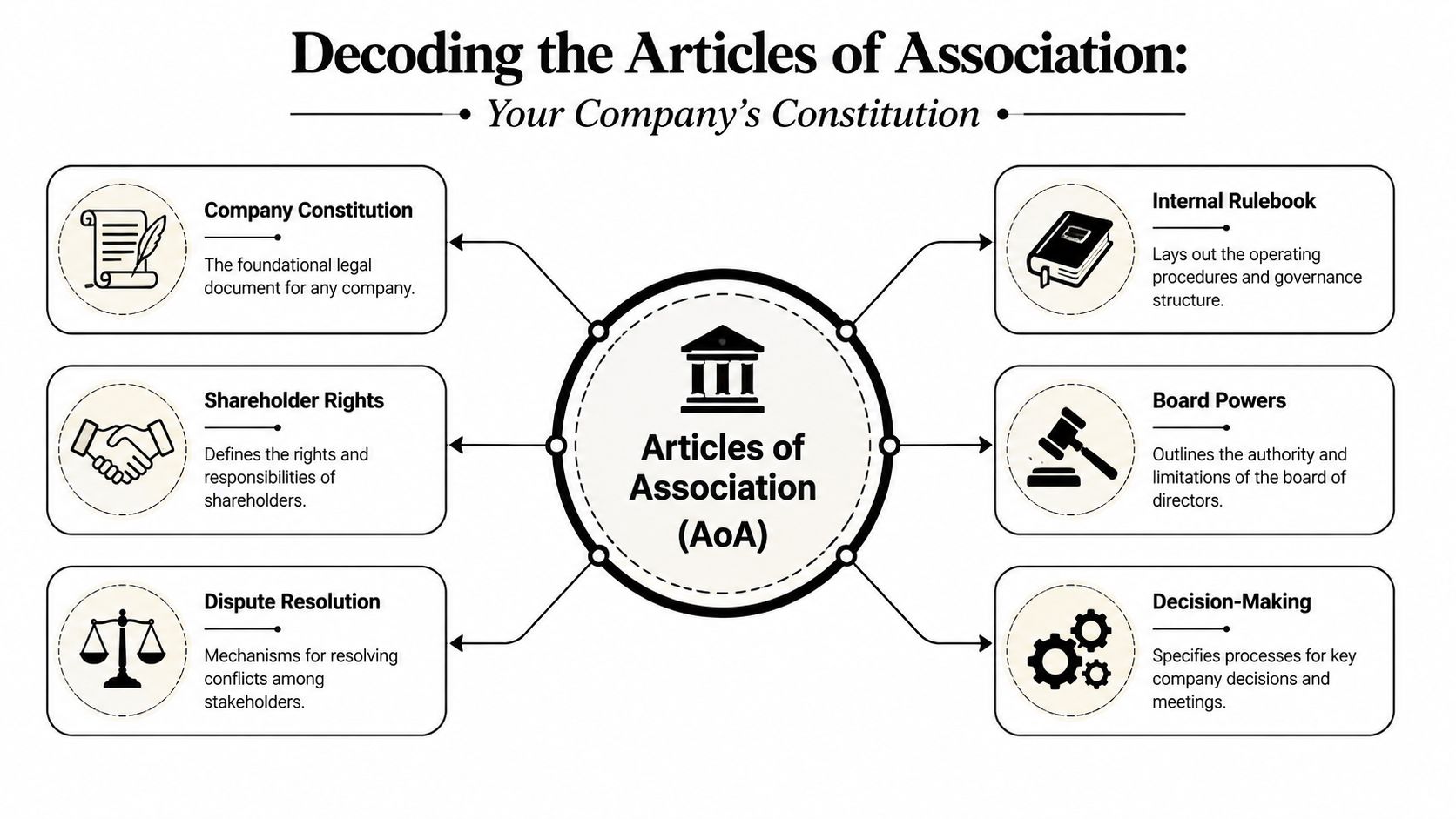
The easiest way to understand articles of association is to treat them as your company's constitution.
They are the internal rulebook that says how the company is governed, who holds which rights, how decisions are made, and what procedures must be followed when people disagree. In the UAE context, this isn't optional drafting. Article 19 of Federal Decree-Law No. 32 of 2021 requires every LLC to adopt Articles of Association on registration, and failure to file them means the company is legally unrecognised, as reflected in the reference to UAE Federal Decree-Law No. 32 of 2021 Article 19.
What belongs inside the Articles
At a practical level, the Articles usually define the following:
- Management authority: Which powers sit with directors or managers, and which require shareholder approval.
- Shareholder rights: Voting rights, economic rights, and any restrictions tied to different ownership positions.
- Meetings and resolutions: How meetings are called, what counts as quorum, and how resolutions pass.
- Profit distribution: Whether profits are distributed automatically, periodically, or only after approval.
- Transfers and exits: What happens if a shareholder wants to sell, transfer, or redeem an interest.
This is why founders often confuse the Articles with the Memorandum. They overlap in conversation, but they don't do the same job in modern practice. If you want a plain-language explanation of that distinction, this guide on what is memorandum of association helps frame it clearly, and this deeper note on Memorandum of Association UAE is also useful when you're comparing documents during setup.
Why this document carries more weight than founders expect
The Articles are where legal structure turns into operating reality. A trade licence lets you exist commercially. The Articles tell the owners how they must behave with one another.
That's why I often compare the document to a building's structural frame. People notice the paint, the branding, the office, and the sales pipeline. But if the frame is weak, the business feels fine until pressure hits it.
Practical rule: If a founder says, “We'll sort that out later between ourselves,” that issue belongs in the Articles now.
When the document is drafted properly, ordinary business decisions become routine. When it's drafted badly, even simple approvals can become arguments about authority.
Key Clauses That Define Your Company's Future
A good Articles of Association doesn't just satisfy a registry. It allocates power. That's why some clauses deserve much more attention than they usually get.

Share structure is really a control clause
Many founders focus on ownership percentages and ignore the rights attached to them. That's a mistake.
In UAE drafting practice, the share clause should do more than state who owns what. It should spell out whether there are different classes, whether voting rights differ, and what happens on redemption, transfer, or dissolution. If the wording is loose, later negotiations with investors or co-founders become much harder because the company's baseline rights are already unclear.
A simple point often changes the whole dynamic. Economic participation and control don't always have to move together. But if you intend that split, the document has to say so clearly.
Director appointment and removal is where disputes become visible
This is one of the most sensitive parts of any UAE Articles. It decides whether the company can replace management cleanly or whether one disagreement turns into deadlock.
In the UAE framework, the threshold for removing directors is not something founders should improvise around. The document must align with the mandatory position that applies to the relevant company type and authority. If that threshold is drafted incorrectly, the clause may create false confidence rather than actual control.
If your Articles make removing a failing director too easy, the business becomes unstable. If they make removal too hard, the business becomes trapped.
Board powers and reserved matters need balance
Some companies over-centralise. Others draft broad manager powers with almost no reservation to shareholders. Neither approach works well for long.
A practical Articles of Association usually separates:
- Routine authority for day-to-day contracts, staff decisions, and operations
- Reserved decisions for major borrowing, new share issues, changes in activity, or disposal of key assets
- Escalation rules when shareholders and management disagree on a major point
Legal drafting must reflect commercial reality. A small owner-managed consultancy needs a different balance from a multi-investor trading company.
Dividend policy prevents future resentment
Founders rarely argue about dividends at incorporation. They argue about them when one shareholder wants expansion and another wants cash.
A useful clause answers basic but important questions. Are distributions discretionary or expected? Must certain reserves be kept? Can management delay payment if working capital is tight? If the clause says too little, every profitable year creates a fresh negotiation.
Meetings, voting, and amendments should be usable
Voting procedures are often copied from templates without considering whether the shareholders can operate under them. Unrealistic quorum rules can delay action. Ambiguous notice provisions create procedural attacks later. Voting thresholds that ignore mandatory law can become unenforceable.
For context, in the UK, the Articles became the primary governing document after the memorandum lost most of its significance for new companies under the Companies Act 2006, and amendments typically require a 75% majority vote, as noted in this overview of Articles of Association under the UK framework. The lesson for UAE founders is not to copy the UK model. It's to understand that a constitutional document only works when its amendment mechanics and governance logic are internally coherent.
The UAE Difference Mainland vs Free Zone vs Offshore AoA
Many foreign founders run into trouble. They assume articles of association are mostly the same document with minor formatting changes. In the UAE, that assumption causes delays, rework, and avoidable legal risk.
A 2024 study found that 68% of foreign startups in the UAE faced initial compliance delays because they used misaligned AoA templates that did not match the chosen Mainland or Free Zone authority, according to the UAE Federal Competitiveness and Statistics Centre 2024 report reference.
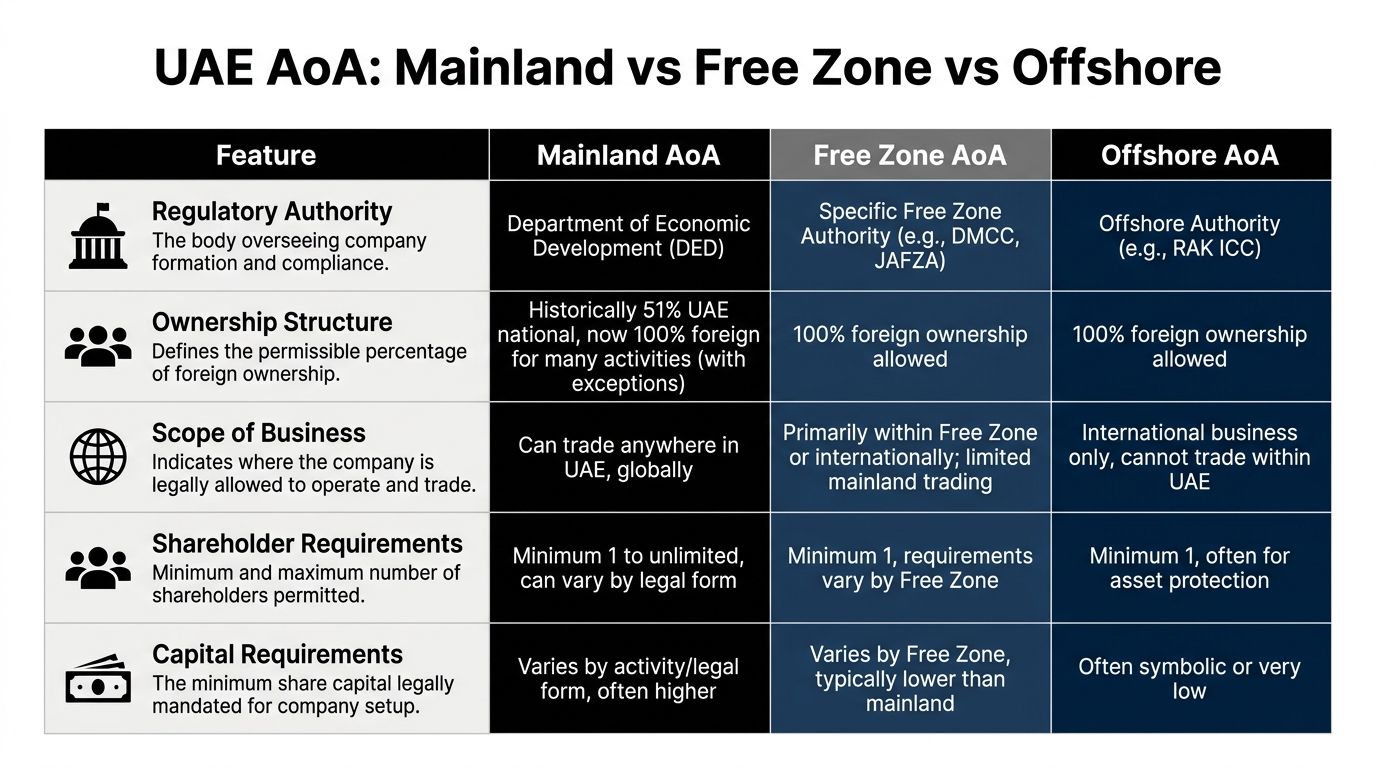
The practical comparison
| Structure | What matters most in the Articles | Typical drafting reality |
|---|---|---|
| Mainland | Compliance with federal company law and local authority requirements | Less room for creative drafting where mandatory rules apply |
| Free Zone | Alignment with the specific Free Zone's own regulations and templates | More flexibility in some zones, but only inside that zone's framework |
| Offshore | Asset holding, ownership clarity, and cross-border governance | Often narrower commercial purpose and different operating expectations |
Mainland companies need disciplined compliance
For a Mainland entity, the Articles have to fit the Federal Companies Law and the relevant licensing authority's expectations. This is not the place for borrowed UK language, venture-style US drafting, or a generic internet template.
Mainland Articles work best when they are direct, conventional, and jurisdiction-matched. If you want custom protections around voting, transfers, or management authority, they still need to sit inside the mandatory legal framework. Founders often resist that because they want “flexibility”. The problem is that a clause that conflicts with mandatory law doesn't create flexibility. It creates a false sense of protection.
Free Zones offer flexibility, but not universal flexibility
Many Free Zones allow more bespoke structuring than founders expect. That's one reason startups and foreign-owned businesses often prefer them. But a Free Zone is not one legal environment. DMCC, ADGM, DIFC, JAFZA, DAFZA, and others have their own forms, review styles, and governance expectations.
That means the right question isn't, “Can I customise my Articles in a Free Zone?” The right question is, “What does this specific Free Zone permit, expect, and reject?”
Some Free Zones are more open to customized clauses on management mechanics, investor rights, audit terms, or internal governance language. Others are much closer to authority-led templates. If you're still deciding between structures, a grounded comparison of mainland vs freezone Dubai is worth reviewing before anyone starts drafting.
A Free Zone doesn't solve a bad governance design. It only changes the legal room available to draft it properly.
Offshore entities serve a different purpose
Offshore companies are often chosen for holding assets, structuring ownership, or managing international business interests rather than operating directly inside the UAE market.
That changes what matters in the Articles. Operational clauses may be lighter. Ownership clarity, transfer mechanics, and authority to act across borders often become more important. Confidentiality expectations may also differ from those of a trading business that deals regularly with local regulators, landlords, staff, and service providers.
What works and what doesn't
What works:
- Jurisdiction-specific drafting
- Authority-approved language where needed
- Custom clauses tested against mandatory law
- Alignment between the Articles and any side shareholder arrangements
What doesn't work:
- Copying a UK or US template into a UAE filing
- Assuming one Free Zone's drafting style will pass in another
- Using “investor-friendly” language that overrides non-waivable rules
- Treating Offshore, Free Zone, and Mainland as paperwork variations of the same setup
Drafting and Registering Your Articles in the UAE
The drafting process should be handled as a workflow, not as a document exercise. Founders who treat it casually usually end up revisiting it under time pressure.
A practical sequence that usually works
Start with the commercial facts. Who owns the company, who manages it, how will money move, and what decisions need special approval? If those points aren't agreed first, legal drafting turns into guesswork.
Then move through the process in order:
Choose the jurisdiction first
Mainland, Free Zone, and Offshore structures don't use the same drafting assumptions.Use the authority's baseline format where applicable
Some authorities expect standard wording or specific clause order.Layer in custom provisions carefully
Add only the clauses that the business needs. More drafting is not always better drafting.Check consistency across documents
Trade name, activities, ownership details, and manager names must match the broader setup file.Complete notarisation or authority formalities
The exact process depends on the jurisdiction and legal form.File and retain the final registered version
The operative version is the one approved and registered, not the one circulated by email during drafting.
For founders who want a general legal drafting discipline before they start revising clauses, this overview of a battle-tested legal document process is useful because it explains how professionals reduce ambiguity before a document is finalised.
Where amendments usually become painful
Businesses often only think about amendments after incorporation. By then, the business may already have bank accounts, visas, contracts, and third-party approvals tied to the registered details.
Changes to company name, activity, shareholding, manager structure, or internal governance often require formal amendment steps and updated submissions. That's why the initial drafting should anticipate likely future moves. A company expecting investor entry, family ownership transfers, or management changes should build for that from day one.
Draft for the company you expect to become, not just the company you are registering this week.
A clear record of incorporation documents also matters later when authorities, banks, and counterparties ask for proof of legal standing. This guide to the certificate of incorporation UAE is a useful companion reference because it shows how the registered constitutional document fits into the broader company file.
Common AoA Pitfalls That Can Derail Your Business
Most Articles of Association problems are not dramatic drafting errors. They are ordinary shortcuts that look harmless at setup and become expensive later.
According to the UAE Ministry of Economy's 2024 report, 38% of rejected mainland LLC applications were due to incomplete or non-compliant AoA provisions, and the most common mistake was omitting the mandatory 75% shareholder approval threshold for director removal, as referenced in the UAE Ministry of Economy's 2024 Annual Report on Company Formation.
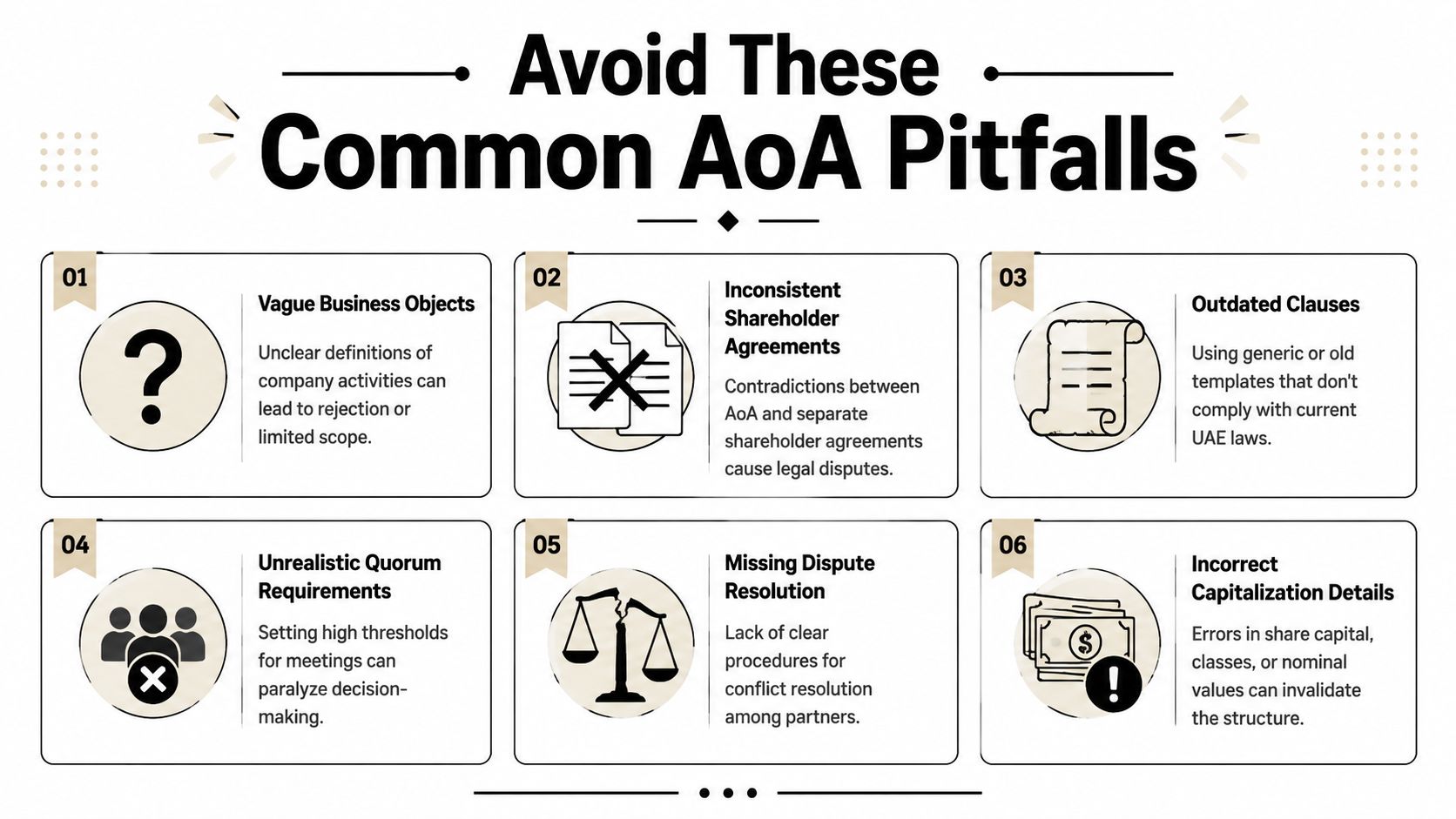
The mistakes seen most often
Some problems repeat so often that they are almost predictable.
Generic imported templates
A template from the UK, India, or a US website may use familiar concepts but still fail UAE review or create internal contradictions.Vague authority wording
If the manager's powers are drafted too broadly, shareholders feel exposed. If drafted too narrowly, the company struggles to function.Share clauses that look complete but aren't
Transfer rights, pre-emption logic, and redemption language often need more precision than founders expect.No real deadlock planning
Equal owners often assume goodwill will solve disagreements. It usually won't.Mismatch with side agreements
Founders sometimes sign a shareholder arrangement that says one thing while the registered Articles say another. That's a setup for conflict.
Why “we'll fix it later” usually backfires
An amendment is possible. But fixing Articles later is rarely clean.
By the time the issue appears, people's interests have shifted. One shareholder wants stronger protections. Another wants more control. A third party, such as a bank, investor, or buyer, may already be reviewing the company. The correction then becomes a negotiation, not an admin update.
The most dangerous pitfall is false enforceability
This is the trap I see most often with astute founders. They don't use a bad template. They use an ambitious one.
They add heavily customised clauses, investor-style controls, unusual quorum arrangements, or reduced voting thresholds and assume that because the wording is elegant, it is enforceable. That assumption is dangerous. A clause can be carefully drafted and still fail if it conflicts with mandatory UAE rules.
Good drafting is not about writing stronger words. It's about writing words the authority and the law will actually recognise.
The practical test is simple. If a clause is challenged tomorrow, will it still operate as intended under the governing law and the chosen jurisdiction? If the answer is uncertain, the document needs work before it is signed.
Frequently Asked Questions About UAE Articles of Association
Can my Articles of Association override UAE law
Not where the law is mandatory. That is the line many founders miss. A 2025 report from a Dubai legal committee found that 42% of private company disputes stemmed from unenforceable AoA clauses that tried to bypass mandatory statutory requirements, such as reducing voting quorums below legal limits, according to the DIFC Legal Committee 2025 report reference+Legal+Committee+2025+report). Customisation is possible, but only inside the legal space the relevant framework allows.
Can I use a template
You can start from a template. You should not finish there unless the business is very simple and the authority's standard form fully fits your needs. Templates are useful for structure. They are risky when founders assume they already solve control, profit, transfer, and dispute issues for a specific UAE setup.
Do I need a lawyer or consultant to draft it
For a basic company with straightforward ownership, an authority-led standard draft may be enough. For any business with multiple shareholders, investor plans, family ownership, management separation, or expected restructuring, professional help is usually sensible. The cost of proper drafting is almost always lower than the cost of correcting a weak document during a dispute.
What should I check before signing
Use this short checklist:
- Jurisdiction fit: Does the draft match Mainland, the specific Free Zone, or Offshore requirements?
- Control clarity: Is manager or director authority clear?
- Voting compliance: Are thresholds lawful and workable?
- Ownership mechanics: Do transfer, exit, and profit provisions reflect the actual agreement?
- Document consistency: Does the Articles text align with any side agreements and filing documents?
If those five points are solid, the company usually starts from a much stronger position.
If you're forming a company in the UAE or reviewing an existing structure, Smart Classic Business Hub can help you assess whether your Articles of Association fit your jurisdiction, ownership model, and business goals. A careful review at the setup stage is often the simplest way to avoid rejections, deadlocks, and expensive amendments later.