
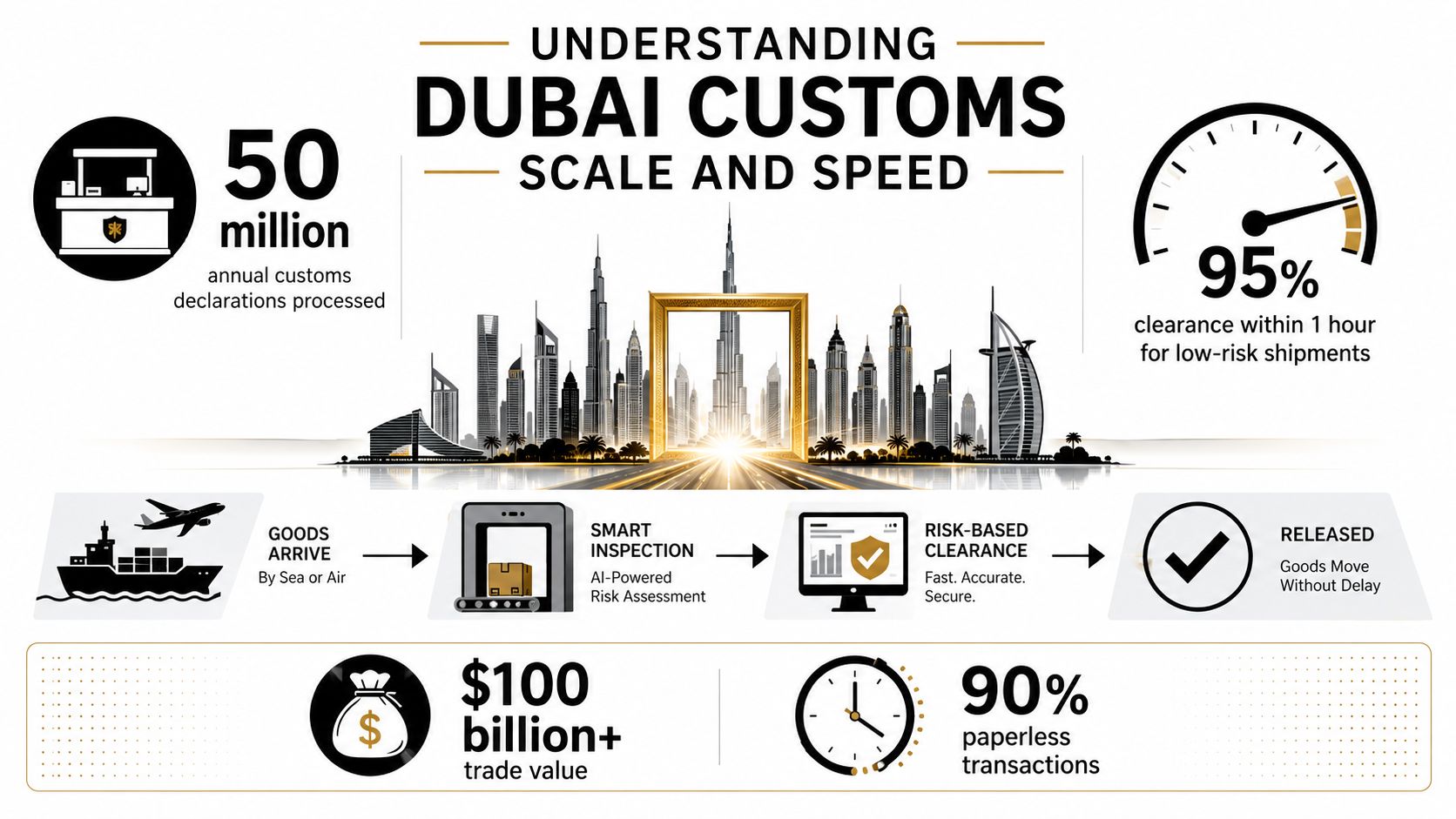
Dubai Customs processed over 30.4 million customs transactions in 2023, and that scale is the story behind customs clearance Dubai. The system isn't slow because it's old, it's complex because it's built to move huge volumes while still catching counterfeit goods, enforcing border controls, and routing risky shipments for review Dubai Customs 2023 update. If your paperwork is clean, the process can be fast. If your documents disagree with each other, even slightly, that's where the delays start.
Understanding Dubai Customs Scale and Speed
Dubai's clearance environment rewards preparation because the machinery behind it is already working at a massive pace. In 2023, Dubai Customs said it handled 84,000 daily customs transactions on average, which tells you the system is designed for throughput, not hesitation Dubai Customs 2023 update. In the same year, it also reported 333 intellectual property dispute cases involving more than 15 million counterfeit goods valued at around AED 73.4 million, so clearance in Dubai is not just about moving cargo, it's also about enforcement Dubai Customs 2023 update.
What automation actually changes
The most useful change is not speed for its own sake, it's predictability. Dubai Customs said 98% of customs clearance and release transactions could receive automatic approval in the most automated channels in 2023, which means a large share of clean shipments never need a person to touch them Dubai Customs 2023 update. That only helps if your filing is internally consistent.
A clean declaration can move very quickly. Dubai Customs also reported that the Smart Workspace platform reduced declaration processing time to less than four hours and saved companies 1.4 million work hours in 2023 Gulf News coverage of Dubai Customs declaration processing. But if your shipment is flagged for review, the clock changes immediately. Automation doesn't remove inspection, it just helps clean cargo avoid unnecessary human handling.
Practical rule: the system is fast when the paperwork is already right, not when the broker hopes the system will be forgiving.
For importers, the right mental model is simple. You're not buying speed, you're earning it through accurate data. That's why resources like used personal effects customs delays are useful even if your cargo isn't personal effects, they show how quickly incomplete filings can lose time once a shipment leaves the ideal lane.
The Complete Customs Clearance Workflow
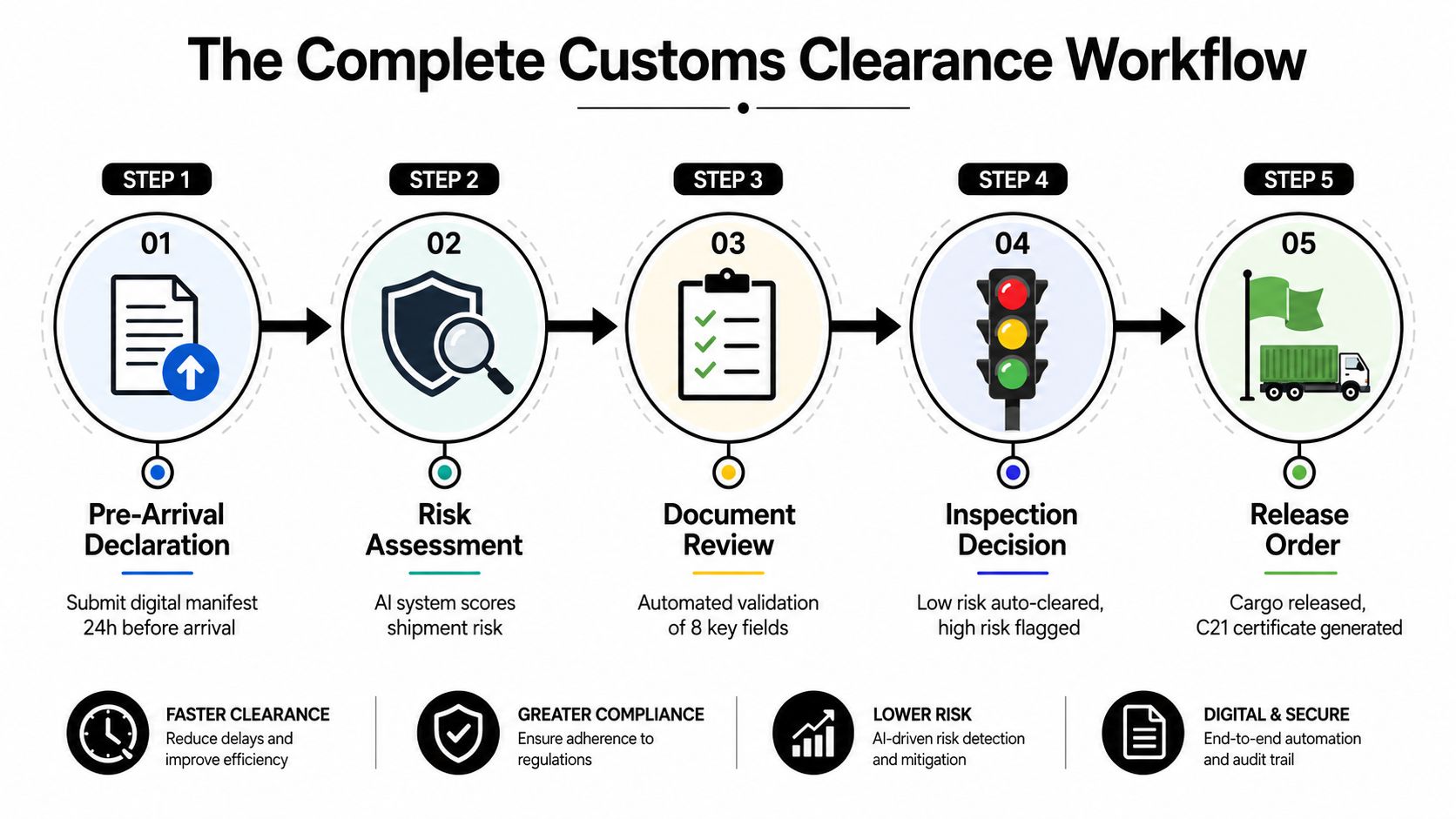
The Dubai process is digital first, but it still follows a strict sequence. The cleanest filings begin before cargo arrives, because the system makes decisions based on what you've already declared, not what you promise to explain later. That's why the best importers treat clearance as a pre-arrival task, not a port-side task.
The digital sequence that matters
The workflow starts with pre-arrival importer registration and FTA linkage, then moves to carrier manifest filing, delivery order collection, Mirsal 2 Bill of Entry submission, online duty and VAT payment, risk-based channeling, and final Cargo Release Order issuance Dubai customs clearance workflow. Each step depends on the one before it being complete, so small errors at the beginning tend to become expensive later.
The practical part most founders miss is that data accuracy must be finished before arrival. Dubai Customs uses green, yellow, and red channel routing, so a clean shipment can be released immediately on the green path, while yellow and red cases require documentary or physical review Dubai customs clearance workflow. The routing decision isn't random in the casual sense, it's risk-based. If your description is vague, your consignee details don't align, or your classification looks weak, the system has a reason to slow you down.
What each handoff means in practice
The importer or broker submits the declaration in Mirsal 2, which is the central filing point. If the shipment lands in a review channel, customs may ask for supporting documents or an inspection before release Dubai customs clearance workflow. That's why front-loading clean data is more valuable than rushing the filing.
If the first filing is wrong, every later step gets more expensive.
For businesses still working out how their import code, trade licence, and customs registration fit together, it's sensible to review an import setup resource such as import code renewal before the first shipment lands. The right registration foundation avoids a surprising amount of downstream friction.
Required Documents and Common Validation Errors
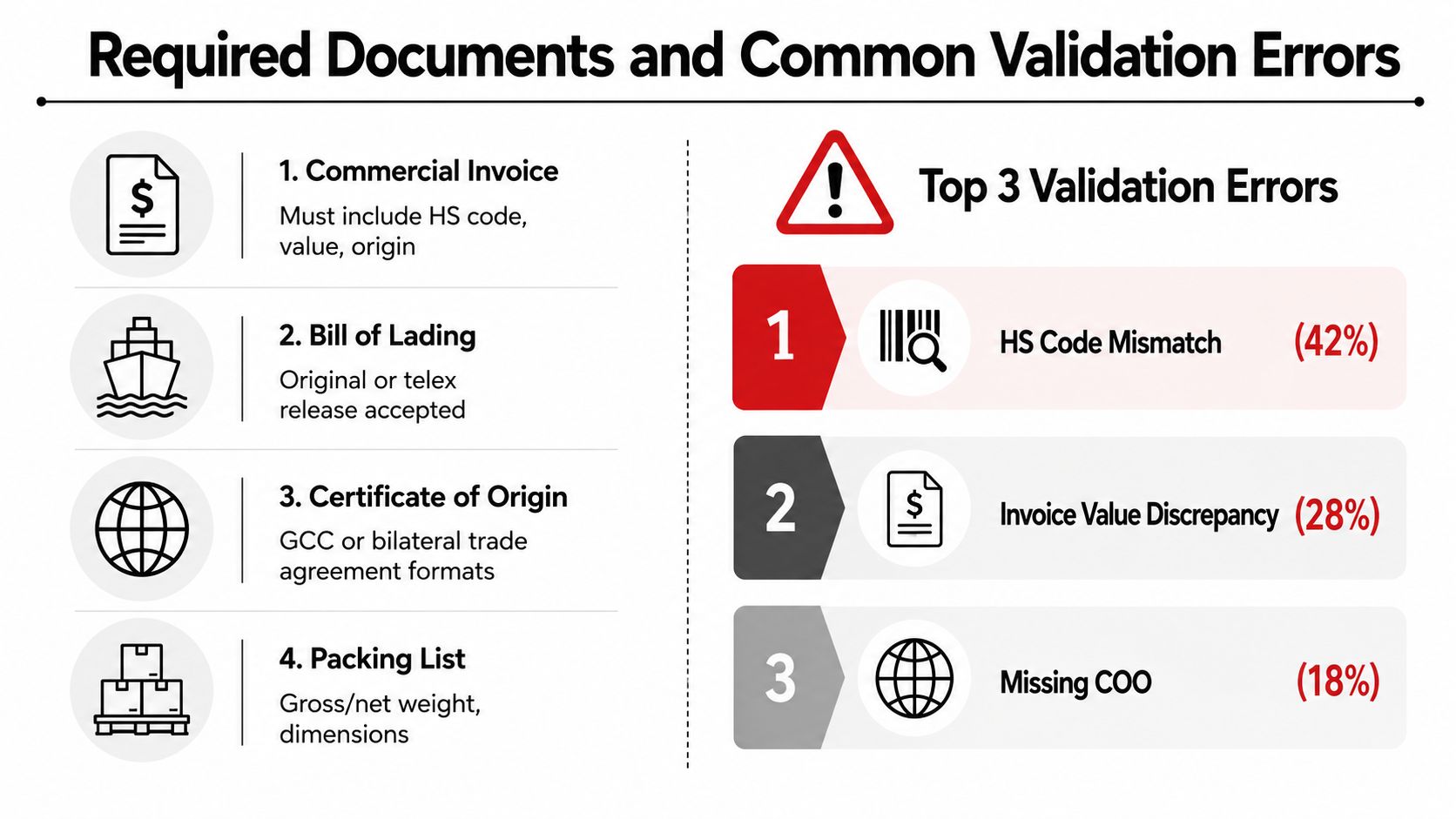
Most delays in Dubai don't come from duties. They come from document mismatch. Customs officers and automated checks compare the invoice, packing list, declaration, certificate of origin, transport document, and permits line by line, and the process gets much less forgiving when those records don't agree.
The core documents that must align
The standard document set is straightforward, but each item has to match the others. You'll normally need a commercial invoice, packing list, certificate of origin, bill of lading or airway bill, and any product-specific permits Dubai Customs customer guide booklet. The issue isn't just whether the document exists. It's whether every document describes the same shipment in the same way.
The most common failure point is the commercial invoice. Dubai Customs relies on it to verify the cargo value, the parties, the origin, and the classification basis Dubai Customs customer guide booklet. If the invoice says one thing and the packing list says another, manual review becomes far more likely. A vague description like “parts” or “goods” gives the process no useful signal.
What to validate before Mirsal 2 filing
The easiest control point is pre-filing validation. Before anything is submitted, check that the HS code is consistent across the declaration and support files, the importer code is correct, and the VAT/TRN registration is active and correctly recorded Dubai Customs customer guide booklet. That's the point where a founder can still fix a problem without turning it into a port delay.
A good validation pass should be line by line, not document by document.
- Match descriptions exactly: Use the same product wording on the invoice, packing list, and declaration.
- Check the HS code once, then check it again: Classification disputes usually start with one weak assumption.
- Confirm consignee and importer data: Names, licence details, and registration numbers should line up.
- Verify permit status early: Regulated goods need approvals before cargo creates urgency.
For a more detailed classification framework, it's worth cross-checking a dedicated reference like HS code Dubai before the supplier issues the final invoice. That one step often saves the most time.
Calculating Customs Duties and VAT Implications
The headline duty rate gets too much attention. The risk sits in the valuation base, because Dubai Customs uses CIF, Cost, Insurance, Freight, under GCC customs law, which means the declared value should include the goods cost plus the costs needed to get them to the destination port Dubai Customs FAQ on valuation. If your CIF figure is incomplete, the duty and VAT calculation will be wrong before it starts.
CIF is where surprise charges begin
Many importers talk about duty as if it's calculated on the supplier's invoice alone. That's not how it works in Dubai. Freight, insurance, and the costs that form part of getting the cargo to the destination port belong in the customs value, and that's why landed-cost estimates often drift from the first spreadsheet Dubai Customs FAQ on valuation.
| CIF Valuation Components | Included in CIF | Common Mistakes |
|---|---|---|
| Goods value | Yes | Using only the supplier invoice and ignoring transport-related costs |
| Insurance | Yes | Leaving out cover arranged before arrival |
| Freight | Yes | Treating shipping as separate from customs value |
| Destination port costs tied to arrival | Often part of the landed valuation logic | Assuming all port charges can be ignored at declaration stage |
Why the duty rate is only half the story
The useful habit is to model duty and VAT from the customs value, not from a commercial invoice shortcut. Dubai Customs and the UAE Government guidance both point to correct classification and complete declarations as the core determinants of duty, VAT, and release timing, which is why valuation errors create disputes even when the cargo itself is compliant Dubai Customs customer guide booklet. If the CIF base is understated, your VAT base is also wrong.
That's why a simple FOB versus CIF conversation can cause trouble later. FOB might help you negotiate freight separately, but customs still wants the relevant value on the declaration basis it recognises. The practical takeaway is to align finance, logistics, and customs filing before the supplier finalises paperwork.
For a VAT-focused filing checklist, use VAT compliance checklist as a reference point when your shipment starts involving repeat imports or multiple invoices.
Free Zone Versus Mainland Clearance Rules
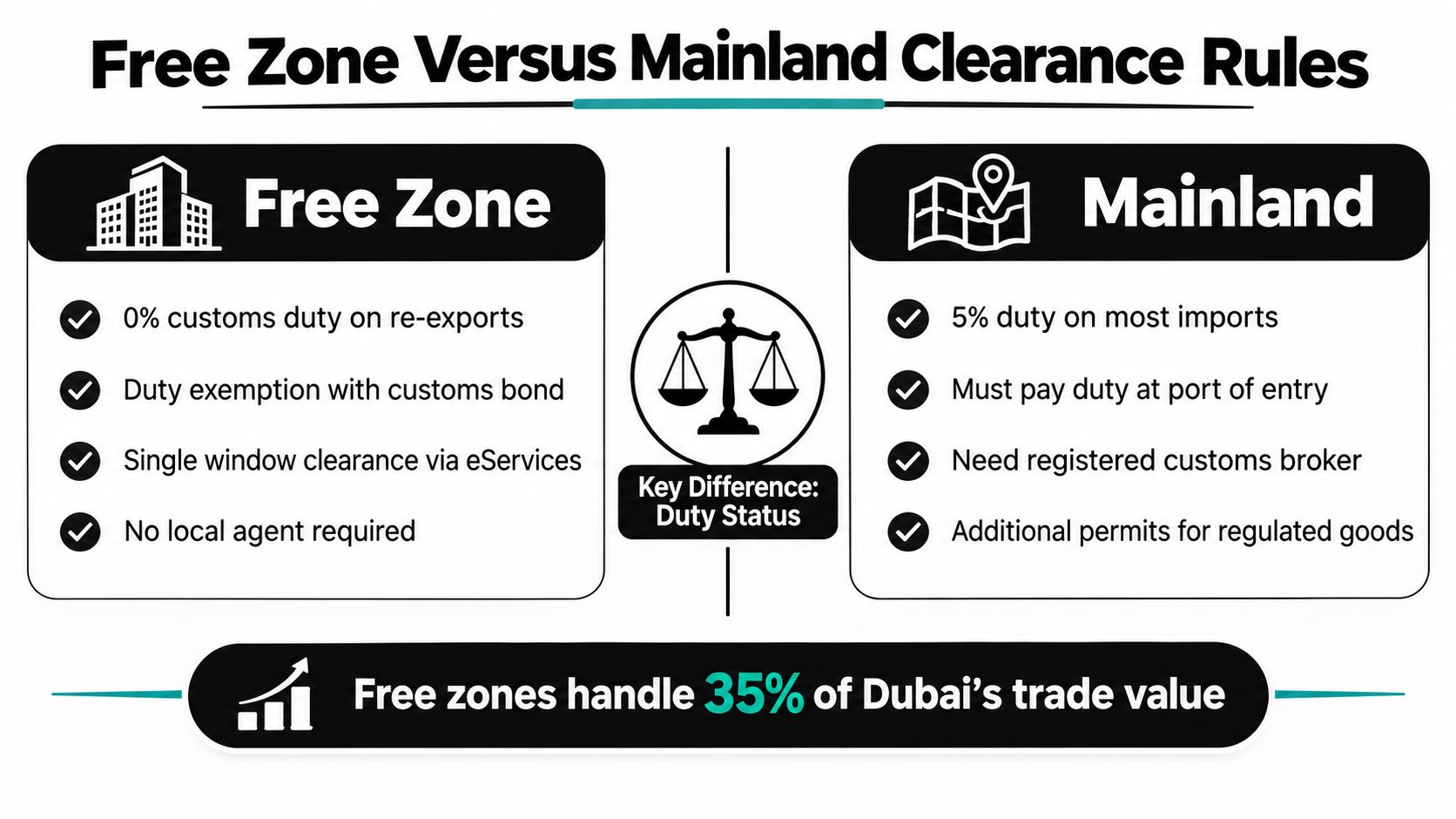
Dubai clearance behaves differently depending on where the cargo lands and where it is supposed to go next. A free zone setup is a customs structure as much as a tax structure. Mainland imports are filed for local circulation, so the declaration, payment timing, and release process follow a different path.
Where duty is suspended and where it isn't
Goods entering a free zone can stay under duty suspension, which is why re-export and transshipment models often use that route Free zone and mainland comparison. Mainland imports go through normal import clearance and duty payment when the goods are intended for local sale Free zone and mainland comparison. That choice affects the whole operating model, not just the customs line item.
The trade-off is practical. A company selling directly to UAE customers usually needs mainland clearance because the cargo is entering the local market. A regional hub moving stock onward has a different goal, so free zone treatment often fits better.
How the documents shift with the jurisdiction
The paperwork also changes with the route. Free zone movements often use different declaration types and warehouse procedures, while mainland entry requires the full import file and immediate customs treatment Free zone and mainland comparison. If cargo later moves from a free zone into the mainland, that transfer becomes a new customs event, not a simple warehouse handoff.
The part that causes trouble is usually not the zone itself. It is the mismatch between the declared route and the actual movement of stock. A shipment set up for local retail should be cleared for mainland release from the start. A shipment meant for re-export should not be forced into a structure built for domestic sale. The licence, storage point, invoice trail, and customs declaration have to match before the first container lands.
Handling Delays and When to Hire a Customs Broker
Even compliant shipments can pause. The difference between a short delay and a painful one usually comes down to whether the issue is a document query or a physical inspection. A query can often be resolved with better paperwork. An inspection means the cargo is already in a more expensive lane.
What usually triggers a hold
The common delay triggers are predictable. Vague product descriptions, invoice and packing list mismatches, HS code inconsistencies, unclear Incoterms, and missing permits for regulated goods are the biggest ones. When customs can't confidently match the declaration to the cargo, it pushes the shipment into review.
A document query is the lighter problem. It usually gets solved once the broker or importer supplies clearer information. Physical inspection takes longer because the cargo has to be presented and checked. In practice, that's the point where time starts slipping away from the original ETA.
When a broker stops being optional in practice
Technically, not every clearance requires a broker. In reality, once a shipment involves regulated goods, high value, repeated classification decisions, or no in-house customs expertise, a licensed broker becomes the sensible route. A broker brings filing discipline, HS classification support, and the ability to respond quickly when customs asks for amendments.
That's also where a customs-support provider can fit into the workflow. Smart Classic Business Hub, for example, lists Documents Clearing among its government-relations services, which can help founders who need structured support around filings and approvals. It isn't a substitute for accurate supplier paperwork, but it can reduce friction when the business doesn't yet have a dedicated import-compliance function.
For practical delay-avoidance guidance, a resource like find faster customs clearance is useful because it focuses attention on the kinds of errors that turn a simple hold into a longer interruption.
Practical rule: hire help before the shipment gets complicated, not after the hold message arrives.
A reliable clearing agent should be registered with Dubai Customs, comfortable with your product category, and able to explain exactly why a declaration is being routed a certain way. If they can't explain the reason for a delay, they probably can't fix it quickly either.
Compliance Checklist and Next Steps
The cleanest importers use the same discipline every time. They check product classification before shipment, reconcile the supplier documents before filing, and keep proof of payment and release after cargo is cleared. That routine matters more than any theoretical duty-rate discussion because the process rewards consistency.
A practical shipment checklist
- Verify HS codes early: Confirm classification before the supplier issues the final invoice.
- Review document consistency: Match invoice, packing list, origin certificate, and transport document line by line.
- Confirm CIF value: Make sure freight and insurance are treated correctly in the customs valuation.
- Validate registration details: Check importer code, trade licence status, and VAT/TRN data before Mirsal 2 submission.
- Retain records: Keep the clearance file organised for audit and future reference.
The habit that protects businesses is simple. Validate before you submit, not after customs asks questions. That applies to valuation, product descriptions, permits, and jurisdiction choice. Once those basics are in place, Dubai's system can move quickly.
For official reference points, keep the Dubai Trade portal, the Dubai Customs customer guide, and the Federal Tax Authority registration page in your compliance workflow. If your shipment involves regulated goods, mixed origins, or repeated valuation questions, get professional input before the cargo is booked.
If you want a cleaner import process in Dubai, Smart Classic Business Hub can help you organise the company-side work that sits around customs, from setup and compliance to VAT-aware support and government relations. Visit Smart Classic Business Hub to discuss how their team can help you prepare the right documents, reduce avoidable filing errors, and keep your next shipment moving.