
The official cost of a UAE Tax Residency Certificate is AED 550 for an FTA-registered applicant, AED 1,050 for an unregistered individual, and AED 1,800 for an unregistered company, before any hard-copy or third-party costs. The bigger expense can be preparing evidence that you qualify, then satisfying the foreign tax office that will use the certificate.
A cheap application isn't good value if your residence records don't support it. Before paying, separate the government invoice from the work needed to prove your position.
Official FTA Fees for a UAE Tax Residency Certificate
The applicant's registration status determines the electronic certificate fee, not whether they describe themselves as a freelancer, investor or business owner. The UAE Federal Tax Authority's certificate service publishes the following schedule under Cabinet Decision No. 65 of 2020, including a non-refundable AED 50 submission fee and an additional AED 250 per printed copy.
FTA tax residency certificate fees
| Applicant | Submission fee | Electronic certificate | Total electronic | Hard copy extra | Total with one print |
|---|---|---|---|---|---|
| Person registered with the FTA | AED 50 | AED 500 | AED 550 | AED 250 | AED 800 |
| Natural person not registered with the FTA | AED 50 | AED 1,000 | AED 1,050 | AED 250 | AED 1,300 |
| Legal person not registered with the FTA | AED 50 | AED 1,750 | AED 1,800 | AED 250 | AED 2,050 |
Read the submission fee and electronic certificate fee as separate charges. A quotation that mentions only the certificate issuance charge doesn't show the complete official electronic cost.
Choose the applicant's status, not their job title
A natural person is an individual applying in their own name. A legal person is a company or other juridical entity applying in its own identity.
Registered means an existing FTA tax registration, such as VAT or corporate tax registration. An Emirates ID, residence visa or trade licence doesn't, by itself, establish that status.
That distinction matters for founders. Your company's registration isn't automatically your personal registration, and an EmaraTax login isn't the same thing as a tax registration for the applicant.
Before selecting a category, check:
- Applicant identity: Is the certificate for you personally or for your company?
- Registration evidence: Does the relevant FTA registration belong to that applicant?
- Delivery requirement: Has the receiving bank or tax office requested paper?
Keep the government charge separate
These totals exclude professional assistance, translation, document attestation, courier services and other third-party costs. Ask an adviser to itemise their own charge rather than present everything as an FTA fee.
The submission charge is non-refundable. Treating an application as a low-cost eligibility test can therefore waste money, even before you pay for document preparation.
Practical rule: Mark the fee row that matches the applicant, then check whether the evidence supports an application. A lower tariff doesn't mean a lower-risk filing.
Do not order a printed certificate just because it sounds more official. First, determine what the recipient will accept, including whether it requires legalisation or a specific form attached.
What the Certificate Actually Proves
Say a founder receives dividends from abroad and the paying institution asks for proof of UAE tax residence. A Tax Residency Certificate, or TRC, confirms the applicant's UAE tax-resident status for the period stated on it.
Think of it as a tax passport stamp, not permission to live or operate a business in the UAE. It isn't a residence visa, VAT certificate or corporate tax registration certificate; the distinction between immigration status and tax status also matters when arranging residency in the UAE.
Proof isn't automatic relief
Foreign tax offices may request the certificate when reviewing dividends, interest, royalties or employment income. Banks may ask for it during residence checks, while founders may need it to support their position abroad.
Blue Sage Tax & Accounting Inc.’s explanation of tax treaty relief for dual-country income illustrates why relief depends on the relevant treaty. Its US–India context isn't guidance on a UAE treaty.
A TRC doesn't cancel foreign tax by itself or prove that a company meets every substance requirement. Check the electronic certificate for:
- Identity: The correct applicant.
- Coverage: The period the recipient needs.
- Issuer: Confirmation that the FTA issued it.
Eligibility Tests That Change the Real Cost
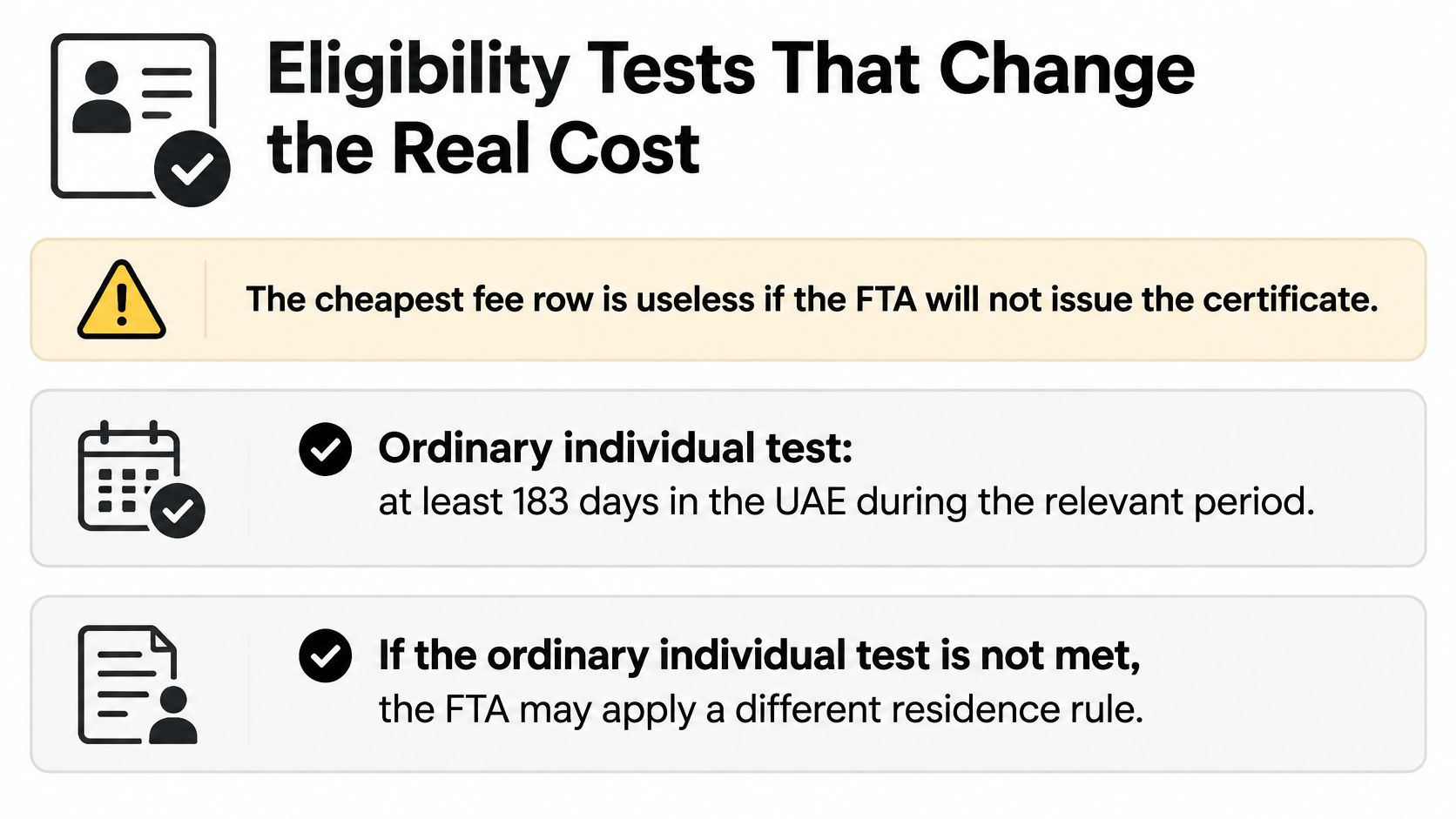
A frequent traveller can qualify for the lowest fee category and still lack a convincing residence file. Tax registration determines the charge; it doesn't settle whether the FTA should issue the certificate.
The FTA's Tax Resident and Tax Residency Certificate guide addresses presence-based eligibility, including the ordinary 183-day route and circumstances involving at least 90 days but fewer than 183 days, where UAE income or business activity and permanent-residence evidence may matter. Its guidance identifies documents such as an EJARI, title deed, utility bill or long-term rental contract as relevant residence evidence.
Start with the stay record
Don't estimate presence from memory or from how long you've held a visa. Prepare official entry-and-exit records and compare them with your passport evidence for the period you're claiming.
Eligibility route by days present in the UAE
| Days present in the UAE | Route | Evidence to prepare |
|---|---|---|
| 183 or more days in the period | Ordinary individual test | Official stay-day records and passport evidence |
| At least 90 but under 183 days | Shorter-presence route with additional conditions | Stay records, relevant UAE income or business evidence, and permanent-residence documents |
| Under 90 days in the period | Weak or unlikely qualification under the summarised presence guidance | Residence and personal or financial connection evidence for assessment of another applicable residence rule |
These are preparation routes, not a complete legal determination. In particular, being below the shorter presence threshold isn't a reason to assume that no other residence rule could apply.
A newly relocated founder may have a visa but insufficient history for the requested period. An investor may own a business yet have little evidence of an available UAE home. Both should resolve those gaps before filing.
Budget for evidence, not just submission
Preparing the file can involve obtaining records, correcting inconsistent names and collecting documents from employers, landlords or company administrators. Useful preparation includes:
- Presence documents: Official stay records and clear passport copies.
- Home evidence: A tenancy contract, EJARI, title deed or relevant utility documentation.
- Economic connections: Employment, income or business records that support the claimed route.
- Company evidence: The licence, constitutional documents and relevant management records.
For individuals, understanding personal tax in the UAE helps separate residence questions from assumptions about whether particular income is taxable.
A company needs its own assessment. A shelf licence doesn't explain who manages the entity, where decisions are made or whether its documents support the requested certificate.
Paying a preparer buys assistance with the file. It doesn't buy a residence finding or foreign treaty acceptance.
A foreign authority may separately examine residence, centre of vital interests, beneficial ownership and its own supporting forms. The useful budgeting question is therefore whether you're ready to substantiate the claim, not merely whether you can afford the filing.
How to Apply and When You Pay
Prepare the application around the recipient's purpose. If a foreign tax office needs evidence for a particular period, align the requested certificate with that period before uploading documents.
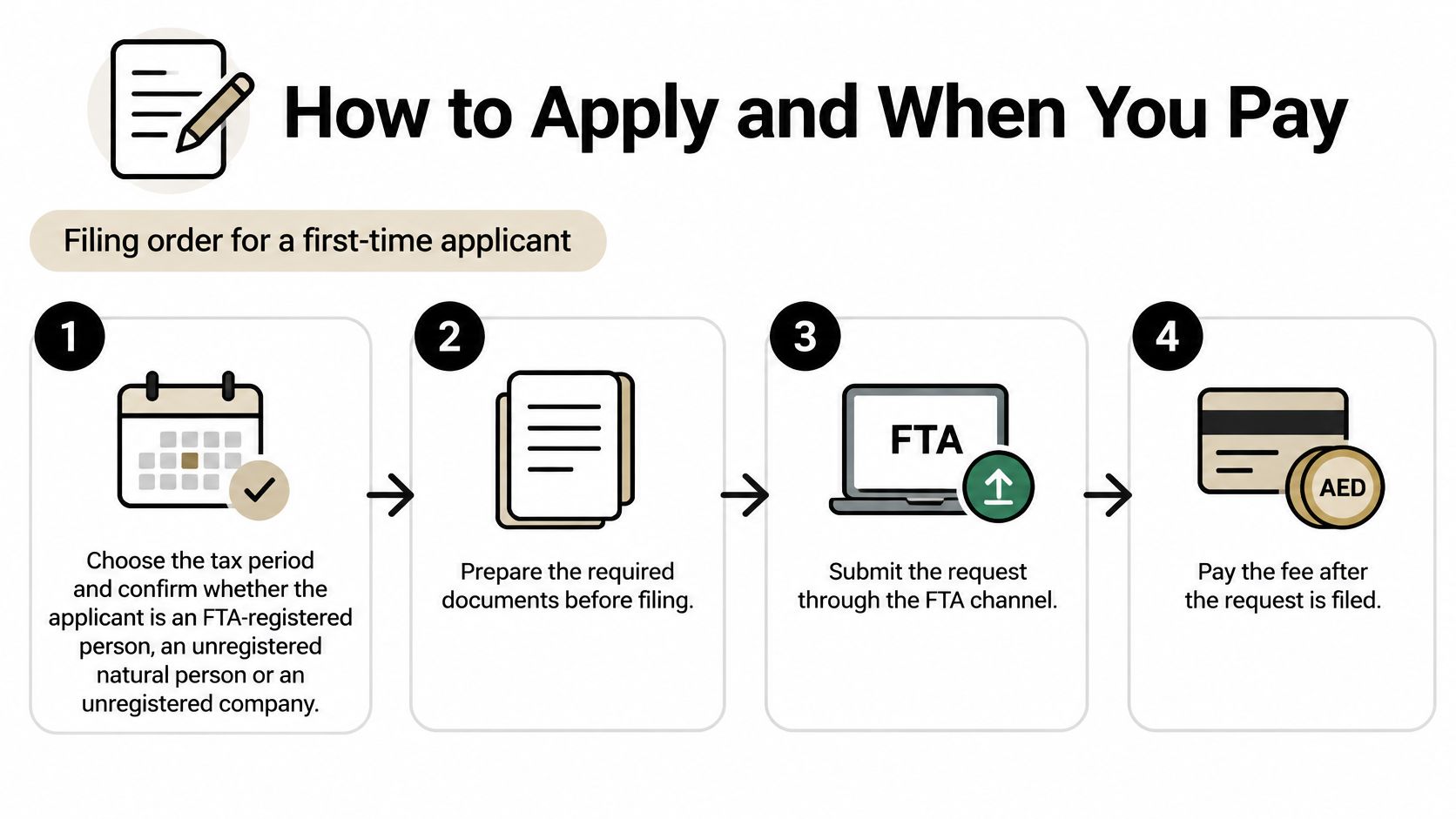
The filing sequence below separates preparation, submission and issuance. Follow the payment prompts in EmaraTax rather than assuming that an adviser's invoice means the government application has been completed.
Prepare and submit
Choose the period and applicant category. Confirm whether the request concerns an FTA-registered person, an unregistered individual or an unregistered legal person. Also establish whether the certificate is for treaty purposes or another use.
Open or sign in to EmaraTax. Use the account and applicant profile appropriate to the request. Check names and registration details before proceeding.
Upload the matching evidence. Use clear scans with complete page edges, readable stamps and consistent filenames. Include identity evidence and the residence or company documents relevant to the application.
Submit and pay the submission charge. Review the declaration, attachments and selected period before authorising payment. Save the application reference and receipt.
Complete issuance and delivery
Pay the applicable electronic certificate charge when requested for issuance. Keep this payment distinct from any professional-service invoice.
Download and inspect the certificate. Check the applicant's name and covered period before sending it abroad. Save the PDF alongside the application records.
Order paper only if required. Obtain confirmation from the recipient before paying for printing and arranging delivery.
Arrange legalisation after issuance if necessary. Confirm the destination authority's requirements before commissioning attestation or translation.
Don't plan around a guaranteed completion date. Allow time for a query cycle, particularly where stay records, residence evidence or company documents need clarification.
If the FTA requests a missing tenancy document, provide that document with a clear explanation. Re-uploading the entire file without identifying the answer makes the response harder to review.
An adviser can help organise evidence and manage follow-up, but don't confuse a quicker document-preparation service with a faster official decision. Ask what any advertised priority service covers.
Many recipients can work with an electronic PDF. Confirm acceptance directly, especially when a bank's document checklist differs from the foreign tax authority's requirements.
Translation Notarisation and Other Extra Costs
The government invoice isn't an all-inclusive price for making a certificate usable abroad. Extra costs arise from the documents you start with and the requirements imposed by the recipient.
Ask who requires each extra and what document it applies to. That question often prevents unnecessary translation, printing or authentication.
Match the service to its trigger
| Extra | When it may be needed | What to confirm before paying |
|---|---|---|
| Translation | The receiving authority can't accept the document's language | Accepted language and translator credentials |
| Notarisation | A document or declaration requires notarised authentication | Precisely which document needs notarisation |
| Ministry of Foreign Affairs attestation | The recipient requires a legalised certificate or authenticated supporting document | Required authentication sequence |
| Courier | Physical delivery is necessary | Destination, recipient and delivery requirements |
| PRO or consultancy assistance | You want help preparing, filing or answering queries | Scope, exclusions and follow-up charges |
| Company document preparation | Corporate records are missing, outdated or need certification | Required version and certification standard |
| Stay and tenancy records | Residence evidence must be obtained or corrected | Relevant period and applicant details |
Translation isn't part of the certificate tariff. Don't translate every passport page, contract, and bank statement automatically; identify what the application or recipient needs.
Notarisation and attestation aren't interchangeable either. Before arranging document attestation in the UAE, ask whether the recipient wants authentication of the certificate itself, a supporting document or both.
Request a file-specific quotation
For a company, preparation may involve the memorandum, shareholder records, incorporation documents or signatory authorisation. Those costs relate to the state of the corporate file, not just to the fact that the applicant is a company.
For an individual, the work may instead involve obtaining a stay extract, replacing an unreadable tenancy agreement or collecting employment evidence. Don't accept a generic package without checking which tasks you need.
The FTA certificate tariff doesn't price these third-party services. Ask providers to quote for the actual documents, language, certification requirements and delivery destination.
Spending test: Add an extra only when a named recipient or a documented gap requires it.
A useful quotation separates government charges, document preparation, filing assistance and optional services. It should also explain whether responses to FTA queries are included, so an initially cheap filing service doesn't become an open-ended engagement.
Three Budgets for People and Companies
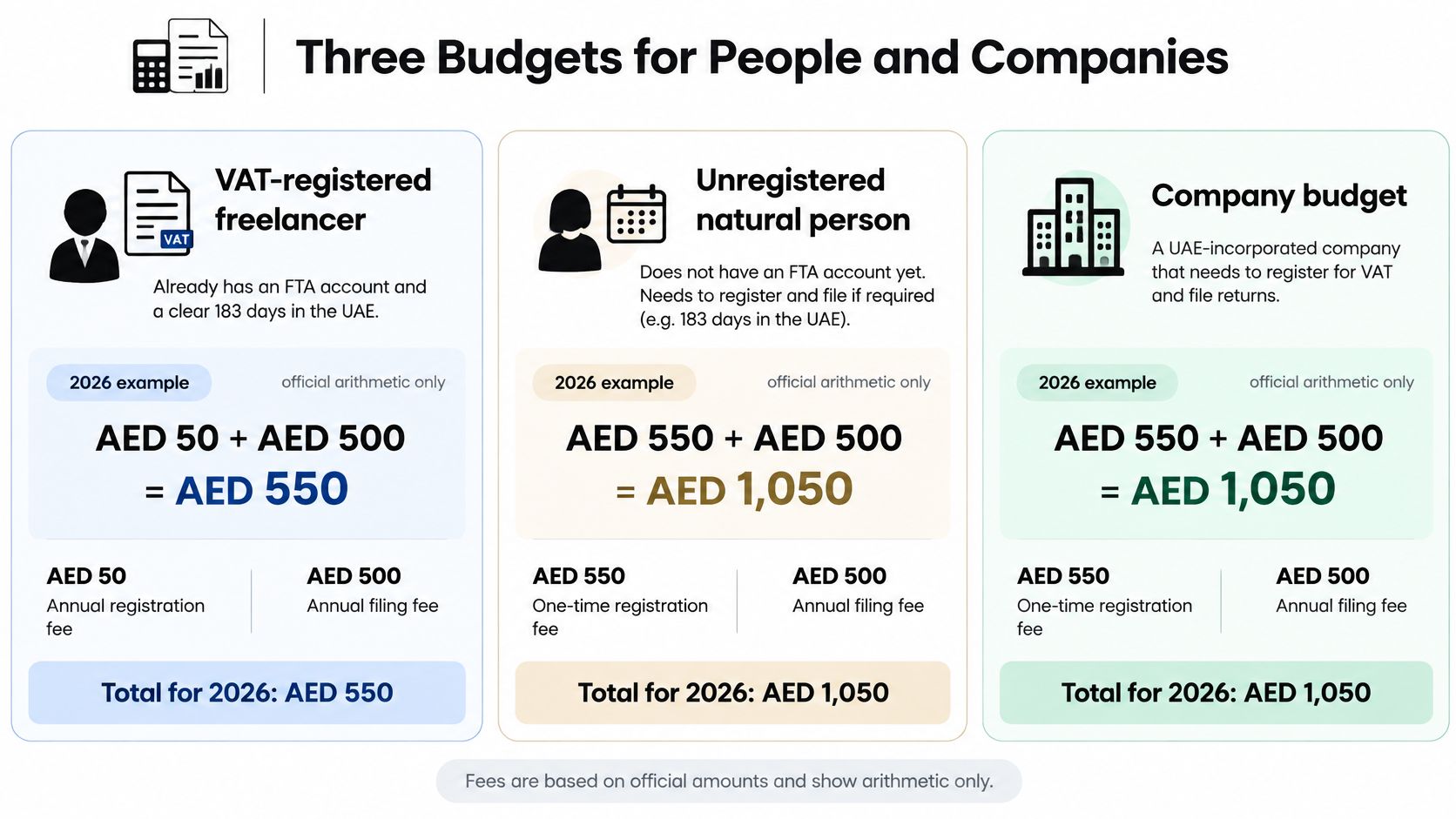
The following hypothetical applicants show how the official arithmetic works. They aren't quotations for a complete service, and their circumstances don't guarantee approval.
Keep the government subtotal separate from the cost of fixing the file. Translation, attestation and adviser charges belong outside the official totals and should be added only when required.
The registered freelancer
Say a VAT-registered freelancer applies personally and has a clearly documented stay record. First confirm that the tax registration belongs to the individual who needs the certificate, rather than to a separate company.
The official calculation is the registered-person submission charge plus its electronic issuance charge. If the recipient accepts the PDF, there's no reason to add printing because the applicant is self-employed.
The newly established founder
Consider an unregistered founder who hypothetically spent 120 days in Dubai and has an EJARI and UAE salary evidence. Their personal application belongs in the unregistered natural-person category, even if they own a registered company.
The practical work is aligning the stay record, home evidence and income documentation with the requested period. Having each document isn't enough if they concern different dates or identities.
The unregistered free-zone company
A free-zone company applying in its own name uses its own status, not its owner's personal registration. Its certificate supports the company's residence position, not automatically the residence or treaty entitlement of its shareholders.
The corporate file should explain the legal entity and support any relevant management questions. A licence copy alone is a poor substitute for a coherent company record.
Worked official budgets
| Scenario | Status | Electronic total | With one hard copy | What can waste the submission fee |
|---|---|---|---|---|
| VAT-registered freelancer, hypothetically present for 183 days | FTA-registered person | AED 50 + AED 500 = AED 550 | AED 800 | Unclear stay days |
| Founder hypothetically in Dubai for 120 days with EJARI and salary | Unregistered natural person | AED 50 + AED 1,000 = AED 1,050 | AED 1,300 | Weak residence or income evidence |
| Unregistered free-zone company | Unregistered legal person | AED 50 + AED 1,750 = AED 1,800 | AED 2,050 | Shelf licence without supporting management evidence |
For each applicant, the sensible comparison is between self-filing with a complete file and paying for clearly defined preparation help. Don't compare a government-only subtotal with an adviser's full-service quotation as though they purchase the same work.
Even an orderly company application doesn't settle every question abroad. The receiving authority still applies the relevant treaty and its own procedures to the entity, income and claimant concerned.
Frequently Asked Questions
Is the submission fee refunded after rejection?
No. Treat it as money spent when you submit, not a deposit returned if the FTA declines the application.
Do I always need a hard copy?
No. Ask the receiving bank or tax office whether it accepts the electronic certificate before ordering paper or arranging delivery.
Does paying a consultant speed up FTA review?
Don't assume so. A consultant can prepare documents and respond to queries, but a professional-service charge isn't evidence of an official express route.
Does the certificate guarantee treaty relief abroad?
No. It supports a claim; it doesn't replace the foreign authority's assessment. The recipient may need additional forms or evidence about the income and the person entitled to it.
Can a company apply with only a trade licence?
Don't treat the licence as a complete application file. Prepare the relevant constitutional, identity and authorisation documents, together with any supporting management evidence requested.
Does the certificate need translation?
Only if the application or receiving authority requires an accepted language version. Confirm whether a certified translation is necessary before commissioning one, and keep that charge separate from government fees.
Decide Whether to File Now
The cost of a tax residency certificate in the UAE is easiest to control before submission. Identify the applicant, choose the correct fee category and establish what the recipient wants to receive.
Then assess whether the documents tell a consistent story. A registered applicant still needs evidence supporting the residence claim; an unregistered individual needs the documents relevant to their residence route; a company needs a usable corporate file.
File when the evidence is ready
- Proceed: The requested period, applicant identity and supporting records agree, and you understand the recipient's requirements.
- Pause: Stay records are incomplete, residential evidence doesn't match the period, or company documents are missing.
- Seek targeted help: Another country disputes residence, the treaty position is unclear, or the application concerns a complex ownership structure.
Don't pay merely to discover which documents you should have collected. Obtain missing evidence first, then submit through EmaraTax and retain the application, receipts and issued PDF.
If you use a preparer, agree on document preparation, submission and query handling before authorising the work. Keep responsibility for reviewing the applicant details and final certificate.
File now if you can substantiate the claim. Wait if you're relying on a visa, a licence or an adviser's assurance instead of evidence.
Smart Classic Business Hub offers tax residency certificate support, PRO services and business compliance assistance for UAE individuals and companies. Visit Smart Classic Business Hub to discuss your applicant category, document gaps and a clearly itemised scope of filing support.