
You're probably here because a bank, foreign regulator, or parent company has asked for a Certificate of Good Standing and nobody's being helpful about what that means in Dubai. The document sounds simple until you realise the issuing authority changes by jurisdiction, the acceptance rules change by use case, and a certificate that works for one party can be rejected by another.
In Dubai, the practical mistake is treating this as a formation document. It isn't. A certificate of good standing is a compliance status document that shows an existing entity is still in proper standing with its registrar or licensing authority at the moment it's issued, which is why the answer always starts with one question, where is the company registered?
What a Certificate of Good Standing Proves
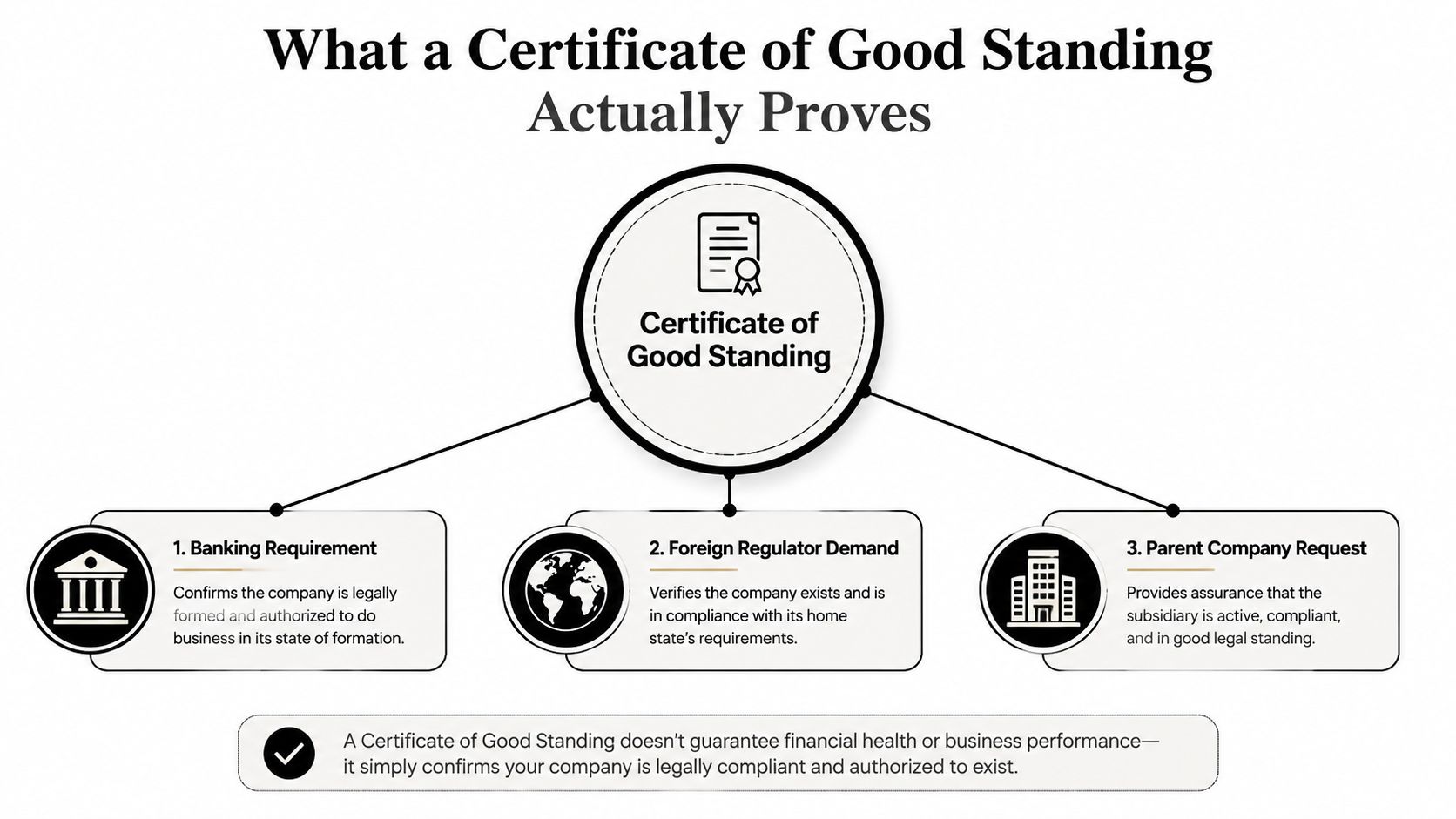
A Certificate of Good Standing Dubai is not the paper you use to prove a company was formed. It is the paper you use to show the company is still active, still licensed, and still acceptable for a bank, regulator, or parent company to deal with for a transaction, renewal, or filing. That is why banks, foreign regulators, and parent companies ask for it after incorporation, not at the incorporation stage.
A status snapshot is the cleanest way to read it. It sits alongside the trade licence, the incorporation certificate, and the Incumbency Certificate, but it does a different job from each one. If a recipient needs proof of formation, the incorporation document is the right file. If they need proof of current standing, the good standing certificate is the right file. If they need current officeholders and structure, they may be asking for an incumbency document instead.
Practical rule: do not ask the authority for “the good standing certificate” until the receiving party confirms the exact document name and whether they want a company status letter, an incumbency certificate, or both.
The document also behaves like a recurring compliance checkpoint. Dubai Development Authority requires applicants to log in to the AXS portal, create a new request, choose “Certificate of Good Standing / Incumbency Certificate application”, complete the application, pay the fee, and wait for acknowledgement before anything is issued. DHA's professional process adds another timing rule, because the good standing certificate cannot be applied for before 3 months of an active licence. Those rules show that this is a post-licensing verification tool, not a startup incorporation form, and they sit in a different lane from the incorporation paperwork explained in the Certificate of Incorporation in the UAE guide.
The practical sequence is simple. Identify the issuer first, then match the document type to the recipient's purpose. If you get that wrong, the application may still go through, but the certificate can still be useless to the party that asked for it.
Who Issues the Certificate by Jurisdiction
The mistake I see most often is people assuming there's one Dubai authority for every company. There isn't. The issuer depends on whether the entity is mainland, free zone, or offshore, and the document name may also shift depending on the registrar and the use case.
Mainland, free zone, and offshore are not interchangeable
For many mainland and Dubai Development Authority cases, the route runs through the authority's online portal, often with a status document or combined good standing and incumbency output. In free zones, the registrar usually issues its own version, and the label can be slightly different even when the purpose is the same. Offshore companies work through their own registry channel and tend to receive corporate letters that satisfy the same underlying need, but not always under the same title.
| Jurisdiction | Issuing Authority | Typical Use Case |
|---|---|---|
| Mainland Dubai | Relevant Dubai licensing authority, often via the service channel tied to the licence | Bank KYC, regulator submission, corporate verification |
| Free zone | Free zone registrar such as DMCC, Dubai Healthcare City Authority, or other zone-specific authority | Parent company review, licensing proof, cross-border filing |
| Offshore | Offshore registrar tied to the company's incorporation route | Overseas branch setup, restructuring, due diligence |
DMCC's guidance is a useful reminder that this is not just a one-time corporate ritual. Member companies that are subsidiaries, branches, or joint ventures must submit proof that the parent company remains in good standing every 2 years, which shows how the certificate functions as an ongoing governance check rather than a one-off filing. That recurring requirement matters if you manage a group structure, because your next request may not be for a bank at all, it may be for internal corporate housekeeping.
Pick the lane before you touch the portal
If the licence sits under Dubai Development Authority, start there. If the business is licensed by a free zone registrar, use that registrar's own process. If it is offshore, go straight to the offshore registry and don't waste time on mainland-style forms that won't map to your entity.
The best practical shortcut is the licence number. That one line tells you more than most websites do. Once you know the registrar, you know where the certificate lives, what it will be called, and what kind of use case it's likely to satisfy.
Eligibility and What Gets Applications Bounced
Authorities do not issue a certificate just because the company exists. They check whether the licence is active, whether the entity is in compliance, and whether the records on file match the records in the application. If the file is messy, the request may sit in limbo even when the company looks healthy from the inside.
The non-negotiables
The cleanest applications usually share the same basics, and the official checks are pretty consistent. The company needs a valid, active trade licence, there should be no outstanding fines or penalties, and the ownership and contact details on record need to match the information in the portal. If those details drift, the request can stall because the authority can't reconcile who is asking for what.
One Dubai guide also sets a practical activity benchmark, the certificate is generally not issued at company formation, but only after at least 1 year of activity with 12 months of accounting records, a valid Business Trade Licence, VAT Registration Number, books of account, and year-end financial statements. In my experience, that benchmark is where many founders overestimate how “ready” their company really is. A live bank account and a trading invoice do not replace proper records.
A certificate request is often a compliance test, not an admin task. If the licence file and accounting file don't line up, the authority sees that before you do.
For healthcare professionals, DHA is even more explicit about timing. A Good Standing Certificate cannot be applied for before 3 months of an active licence, and DHA's service guide requires the request to be opened, fields reviewed, and tabs turned green before payment and submission. DHA also assigns the reference number only after the process is completed successfully. That means the critical rejection point is often not the final approval, it's the incomplete form you thought was “almost done.”
Silent disqualifiers that waste time
The applications that bounce usually have boring problems, not dramatic ones.
- Expired licence: the authority won't treat a dead licence as a live status.
- Pending renewal: a licence mid-renewal can freeze the request.
- VAT gaps: deregistration or inconsistent VAT records can trigger a review.
- Mismatch in records: shareholder names, contact details, or signatory data don't match.
- Uncleared fees: even a small unresolved penalty can block approval.
- Incomplete activity history: no proper accounting trail, no clean issuance.
If the company's compliance file is tidy, the process is routine. If it isn't, the certificate exposes the mess instead of hiding it.
Documents, Application Channels, and Fees
A lot of wasted time comes from over-preparing the wrong pack or under-preparing the right one. The file should be simple, but it has to be internally consistent. If the authority asks for supporting papers and one date or name doesn't line up, the request may stop even if every document looks official on its own.
What usually belongs in the file
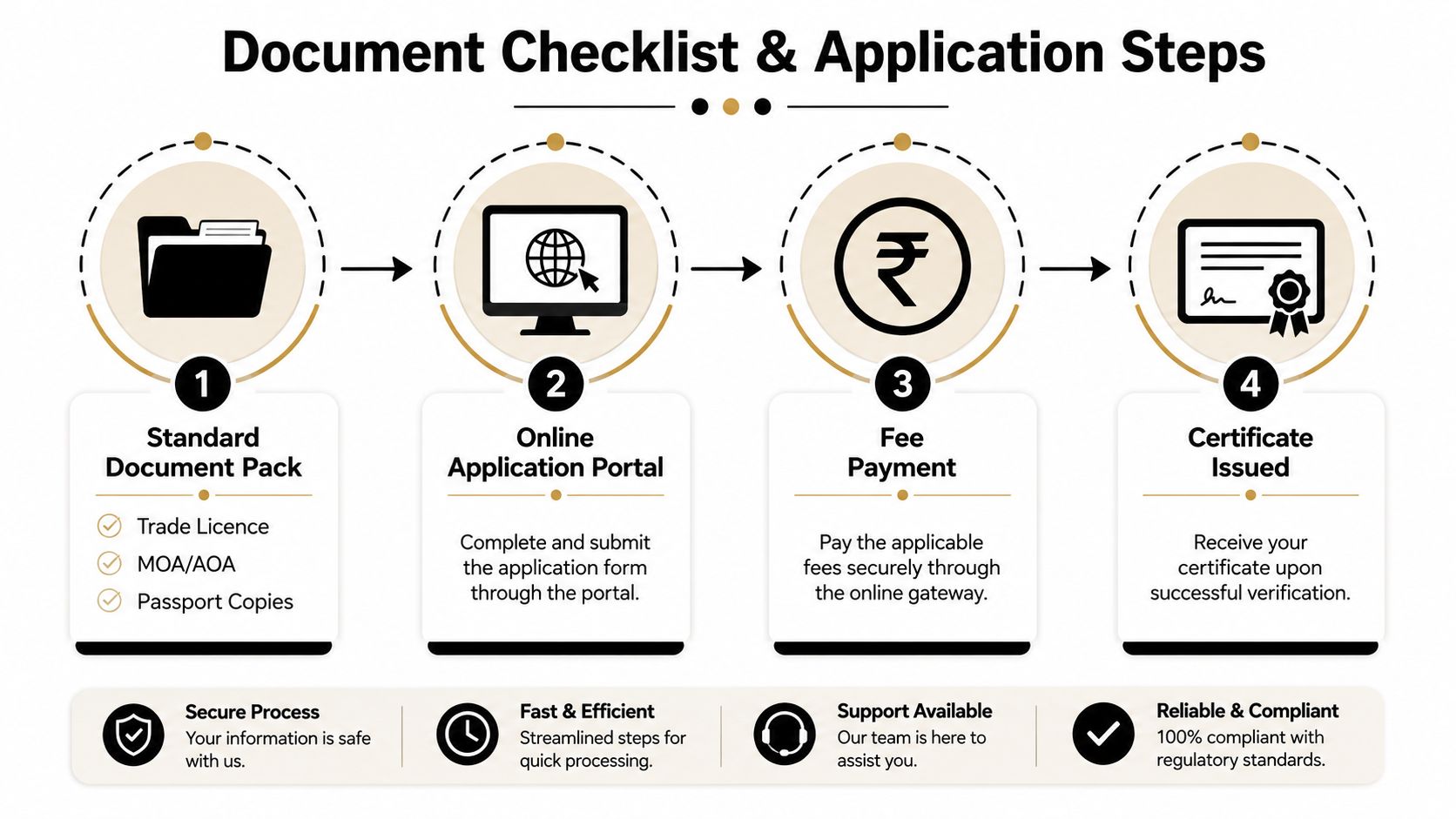
The standard pack often includes a copy of the trade licence, MOA or AOA, passport copies for shareholders and directors, Emirates ID where applicable, Ejari or tenancy evidence, recent audited financials or management accounts, and a No Objection Letter if a previous consultant or PRO is being replaced. Some authorities ask for more, some ask for less, but that set covers the common evidence trail.
DHA's Sheryan workflow shows the cleanest control pattern. The applicant opens the request, the system auto-populates licence history where available, any pre-2011 employment details must be added manually if needed, the terms are accepted, and the form is reviewed until all tabs turn green before payment and submission. That is the standard you want even when the portal looks less polished. Don't pay until every visible field has been reconciled.
How the online flow usually works
The sequence is normally straightforward, even if the portal interface isn't.
- Log in to the authority portal.
- Choose the correct service request.
- Upload the required documents.
- Pay the fee.
- Receive the acknowledgement or reference number.
DHA's official service description confirms the broader sequence as submission, document upload, fee payment, authority review, and issuance through Sheryan. Dubai Development Authority uses the AXS portal pattern for its good standing and incumbency request. Once you know the portal, the rest is just file discipline.
Fees and timing in the real world
Government fees vary by lane and service design, and manual review takes longer than digital issuance. In practice, you're usually dealing with a government fee band of AED 200 to AED 1,000, plus possible service and attestation charges, with processing that can range from same-day digital issuance to 5 to 10 working days where manual checks are involved. The important part is not the number alone, it's whether your authority can issue the document electronically or needs a person to review the file first.
If you want a clean filing workflow for the supporting forms around this request, the structure used in legal services form templates is a useful reference point. The point isn't the template itself, it's the discipline of keeping names, dates, and signatories aligned before you submit.
Legalisation, Attestation, and Translation Needs
The certificate you get from the authority is often not the final version the other side wants. A local bank may be satisfied with the original document, but a foreign regulator, embassy, or overseas bank can ask for extra layers before it accepts anything. That's where people lose time, because they assume “issued” means “accepted everywhere”.
The layers after issuance
The first layer can be notary public stamping inside the UAE, which is often used to support downstream authentication. After that comes MOFAIC attestation for cross-border use when the destination party wants the UAE seal on the document. Depending on the country, you may also need embassy attestation or an apostille if the destination is in a treaty framework that accepts it. A certified Arabic-English translation may also be needed if the receiving party works in a language other than the one on the certificate.
A UAE bank will often just want the attested original or the version issued directly by the authority, if that is sufficient for its KYC team. A UK or EU counterparty may ask for an apostille. A Saudi or Egyptian counterparty will usually expect UAE attestation through MOFA and the relevant embassy path. The point is simple, ask the receiving side first, because the acceptance rule determines the paperwork chain.
Don't treat attestation as an afterthought. It's part of the document's usability, not a decorative extra.
DHA's professional good standing process helps show why timing stretches even when the certificate itself is issued digitally. Once a request is processed, the document may still need several follow-on steps before it can be used outside the UAE. DMCC's recurring requirement for parent-company proof every 2 years reinforces the same point, the certificate often sits inside a longer compliance calendar, not a single filing event.
For a healthcare-professional example, the good conduct certificate guide is useful because the authentication logic is similar, even though the regulator and recipient may be different. The mechanics of who stamps what matter just as much as the certificate itself.
Common Use Cases and How They Shape the Application
The right certificate is rarely requested in the abstract. It's usually tied to one of four pressures, a bank wants fresh KYC, a tender team wants proof the company is clean, a foreign registry wants to see the company's status before it allows a new branch, or a parent company wants the file for audit or restructuring. Each use case changes what the recipient expects, and sometimes what it will reject.
Bank, tender, overseas filing, or group audit
For a corporate bank account or annual bank KYC renewal, the bank usually cares about the latest corporate status and shareholder data, plus whatever else its compliance team asks for. For a government tender bid, the buyer may care less about the wording of the certificate and more about whether the company can show clean standing and no obvious compliance issues.
For overseas branch registration, the foreign registrar often wants a recent certificate and may also want attestation or legalisation. For a parent-company audit or restructuring, the group team usually cares that the certificate is recent enough to show current status and that the company documents match the ownership chain on file.
The practical validity window many teams work around is about 3 to 6 months, because older documents are more likely to be queried or rejected by the recipient. That window is not a universal rule, but it is a realistic operating assumption when you're trying to avoid rework.
Don't confuse company standing with professional standing
Many applicants make an avoidable mistake. A company certificate is not the same as a professional good standing certificate for a healthcare practitioner. DHA and MoHAP run separate professional processes, and Dubai Healthcare City Authority uses its own Certificate of Good Standing/Current Status route for licensed healthcare professionals. If you send the wrong category, the recipient will usually reject it without much discussion.
For teams handling multiple jurisdictions or repeated documentation flows, business consultancy services can be useful when the job includes document mapping, filing coordination, and recipient-specific formatting. The value isn't in outsourcing the judgment entirely, it's in reducing the number of times someone has to guess which certificate a regulator or bank wants.
Match the use case to the output
If the request comes from a bank, ask whether they need company status, incumbency, or both. If it comes from an overseas authority, ask whether they need a recent issue date and attestation. If it comes from a parent company, ask whether the group wants the local certificate or proof tied to the wider ownership file. The document is only useful when it matches the use case, not just when it exists.
Pitfalls, Mistakes, and When a Consultancy Pays for Itself
A bad application usually fails for dull reasons. The company applied too early, the licence was still in renewal, the VAT file did not match the record, or the portal request was opened under the wrong account. Those are file-control problems, and they are the ones that waste time.
The mistakes that cost real time
The most common ones are easy to avoid if someone checks the file before payment.
- Applying before the activity threshold: some authorities want evidence of real operating history, not just incorporation.
- Using a licence in renewal: a half-finished renewal can block the certificate.
- Ignoring VAT registration gaps: mismatched tax records often trigger questions.
- Using the wrong portal: mainland, free zone, and offshore routes are not the same.
- Skipping the No Objection Letter: changing the consultant or PRO without it can stall the file.
- Assuming no apostille is needed: foreign recipients often want more than the local certificate.
If the receiving party is outside the UAE, confirm the attestation chain before you pay for the certificate. Fixing that after issuance takes longer and costs more.
Some applications are worth outsourcing. Multi-attestation flows, group recertification cycles, and files that fail on one unverified field are the obvious cases. A Dubai consultancy such as Smart Classic Business Hub can handle the portal routing, document collation, and follow-up with the relevant authority without making the founder chase every step. If that setup is part of your process, our guide to PRO services in Dubai explains the kind of work that sits behind it.
For a founder with a clean file, self-application can still make sense. If the licence is active, the records match, the financials are ready, and the recipient's requirements are clear, the portal request is usually manageable in one sitting. If any of those pieces are shaky, outside help is cheaper than fixing a rejected file twice.
Use this as a quick self-check, licence active, fines cleared, financials in place, portal access in the right name, attestation requirements mapped before payment. If one item is off, stop and fix it first.
If you need this handled without trial and error, Smart Classic Business Hub can map the correct issuing authority, prepare the document pack, and manage the filing path for your entity type. Visit Smart Classic Business Hub to get the right certificate request moving with fewer delays and fewer rejected submissions.