
The call often comes at the worst time. A Dubai consultancy gets a formal complaint from a client who says the advice caused a loss. A shop in a free zone gets an injury report after a customer slips near the entrance. A founder who thought the company was “covered” suddenly learns the policy doesn't match the risk.
That's why business liability insurance matters in the UAE. It is not just a document for a file, it is the layer that decides whether one third-party claim becomes a manageable problem or a cash-flow event that slows hiring, delays expansion, and distracts management for months.
Why Your UAE Business Needs Liability Insurance
A young UAE business can look stable right up until a claim lands on the desk. A consultant is accused of giving advice that led to a contract loss, or a customer says they were injured on premises. The legal argument starts quickly, and the business owner usually discovers, too late, that “general insurance” was never the same thing as the right liability cover.

Business liability insurance exists to help handle claims from other people, not losses inside your own books. In plain terms, it responds when a third party says your business caused bodily injury, property damage, reputational harm, or financial loss tied to your services. For a founder, the practical value is simple, it shifts a legal and settlement risk away from operating cash.
UAE entrepreneurs often underestimate how quickly ordinary operations create exposure. A client visit, a delivery, a subcontractor job, or a service error can trigger a dispute even when the business has followed every rule on paper. For a useful overview of the coverage logic, the ISU Insurance Services liability coverage guide is a straightforward reference point.
Practical rule: if a stranger, client, supplier, or visitor can blame your business for a loss, liability planning is already relevant.
For UAE founders, the question is rarely whether a claim is possible. It is whether the business has the right policy type, the right limit, and the right exclusions mapped to what it does. A limited liability company structure helps organise the legal entity, but it does not replace insurance, which is why a proper setup should also align with the company structure described in this UAE limited liability company guide.
The mistake is treating liability cover as a box-ticking cost. The better approach is to see it as operating infrastructure, especially for service firms, customer-facing businesses, and companies signing client contracts that shift risk back to the supplier.
Key Types of Business Liability Insurance in the UAE
A claim in the UAE usually starts with a simple mismatch. A business assumes one policy will cover every dispute, then finds out the loss came from a different part of the operation. Retail footfall, advisory work, employee injury, board decisions, and goods in transit all create different liability profiles, so the policy has to match the risk.
Commercial General Liability and professional risks
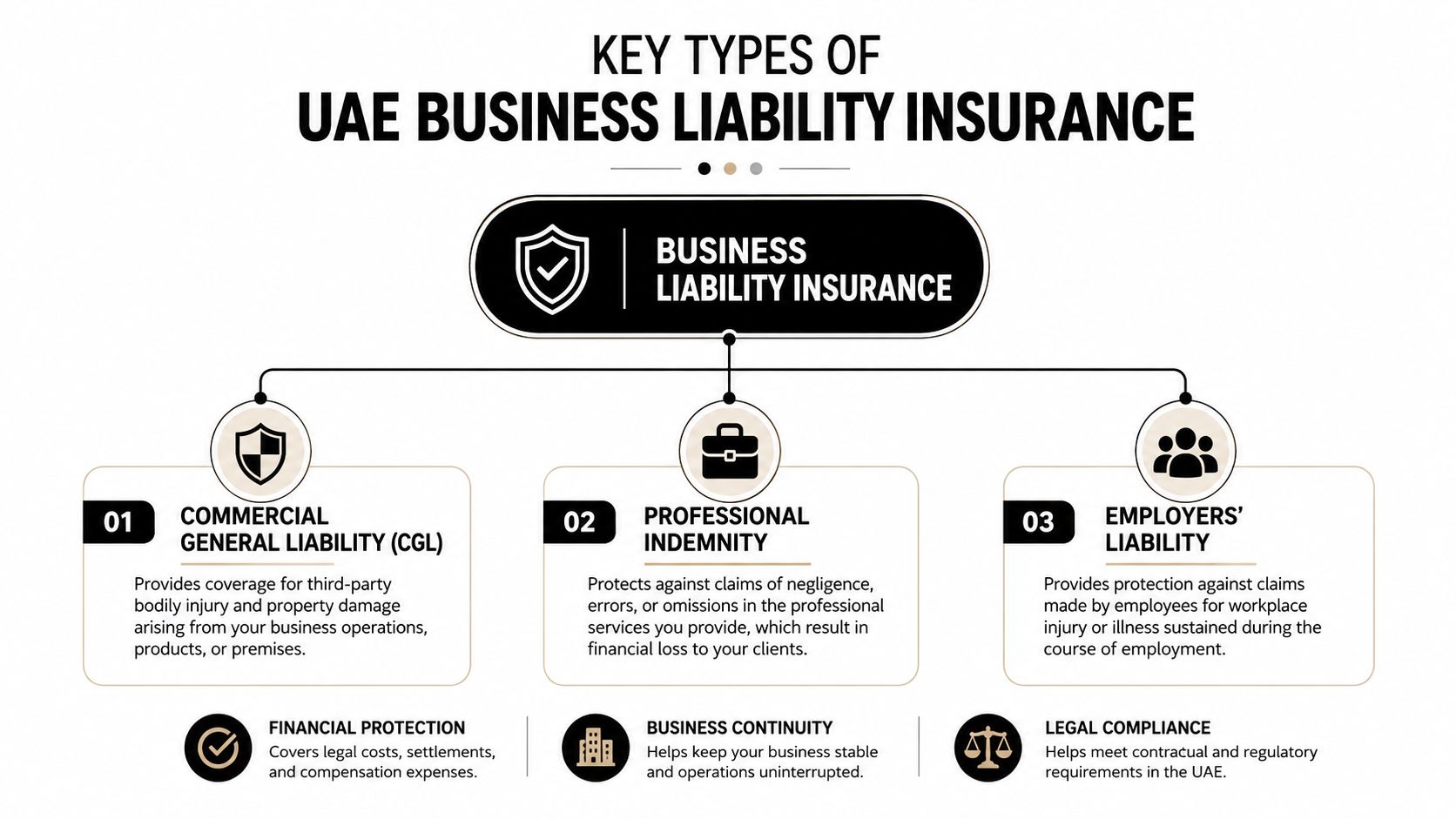
Commercial general liability, or CGL, is the policy many businesses reach for first because it handles third-party bodily injury, property damage, and related personal or advertising injury. It suits firms with customers on site, delivery activity, or physical operations. A customer slipping in a lobby or damaging a display is a CGL issue, not a professional indemnity issue.
Professional indemnity covers a different kind of exposure. It responds when the complaint is about advice, design, planning, analysis, or another service-based error that allegedly caused a client loss. That distinction matters because an advisory mistake can fall outside CGL completely. Consulting, legal, accounting, marketing, engineering, and corporate-services firms need to map the exact services they provide, then check whether the wording matches those services.
A business can run safely on site and still face a claim over the advice it gave.
Employer, director, and product exposures
Employers' liability deals with employee injury or illness claims linked to the workplace. Mainland businesses tend to feel this pressure most directly because workforce risk sits inside day-to-day operations and contract obligations. The practical issue is not just whether staff are covered, but whether the policy wording reflects how people work on site, off site, or through subcontracted arrangements.
Directors and officers, or D&O, protects the decision-makers when management decisions are challenged. It becomes relevant if shareholders, lenders, regulators, or counterparties say the board mishandled duties, disclosures, or governance. For founders, that risk can appear earlier than expected once outside investors, formal reporting, or tighter contracts come into play. See our directors and officers insurance guide for a clear explanation of how this coverage works.
Product liability applies to businesses that manufacture, import, distribute, or sell goods. Once a product causes harm after it leaves your control, the issue is no longer only a sales problem. It becomes a liability problem. Trading firms, consumer goods companies, food businesses, and equipment suppliers should not assume a basic office policy will respond if a product defect causes injury or damage.
The practical rule is to match the policy form to the claim form. Physical incidents point one way. Service errors point another. Employment disputes, board claims, and product defects each need separate review, and the wording should be tested before you sign, not after the first complaint. A broker who understands UAE placement can help compare those gaps, and Smart Classic is useful here because it can review how the cover fits the way the business operates.
Legal and Contractual Requirements Across UAE Jurisdictions
The UAE does not treat every company the same way. Mainland entities, free zone companies, and offshore structures operate under different regulatory expectations, and insurance obligations often follow that structure. The result is that two businesses doing similar work can face very different compliance pressure.
Mainland companies typically face the clearest employment-related insurance expectations, especially around worker protection and workplace responsibility. Free zones may impose their own insurance requirements depending on the activity, licence type, and premises rules. Offshore companies often have fewer local operational obligations, but they still have to satisfy contract terms, lender requirements, and the standards of any jurisdiction where they do business.
| Jurisdiction | Mandatory Coverage | Commonly Recommended | Key Regulatory Body |
|---|---|---|---|
| Mainland | Depends on activity and workforce obligations, often including employers' liability and other operational cover | CGL, professional indemnity, product liability where relevant | Mainland licensing and sector authorities |
| Free zone | Varies by free zone and licence activity | CGL, professional indemnity, employers' liability, product cover for trading businesses | Free zone authority |
| Offshore | Usually fewer local operational mandates | Contract-driven liability cover, professional indemnity, D&O for governed entities | Offshore registrar and contractual counterparties |
A contract can matter more than a licence. If a client requires minimum liability limits, specific cover wording, or proof of insurance before work starts, then the policy has to meet that standard even if the regulator says less. That is where many businesses fall into a quiet compliance gap, because the policy may satisfy the licence file but fail the contract file.
Contract first, licence second: if your customer paper sets a limit or demands a policy type, that requirement can be just as binding in practice as a regulatory one.
Free zones deserve close attention because the rules are not uniform. Some are light-touch on general trading risks, while others are much stricter for professional, technical, or customer-facing activities. Offshore structures sit at the opposite end, where local licensing pressure may be lower, but cross-border contracts often push insurance standards higher.
The safest approach is to review insurance alongside structure, not after it. If the company is still being formed, or if the activity mix is changing, the insurance question should be part of the setup conversation, not a later patch.
How to Choose the Right Coverage and Limits
Start with what the business does, not with what a brochure says is “standard.” A customer-facing retailer, a consultancy, a logistics firm, and a B2B software company all have different claim paths, even if they are the same size. The best policy is the one that matches your working reality.
A good way to think about the choice is to ask four questions.
- What can go wrong physically? If clients visit your premises, if goods move through your site, or if staff work onsite at third-party locations, CGL becomes more important.
- What can go wrong through advice or service delivery? If your revenue depends on recommendations, reports, designs, filings, or execution quality, professional indemnity needs serious attention.
- Who can claim against you? Employees, customers, suppliers, landlords, and counterparties each point to different policy issues.
- What do your contracts demand? Client agreements, lender terms, and landlord leases can all set higher limits or specific liability wording.
Multi-million-dirham limits are usually more realistic than bare-minimum thinking for UAE businesses, especially where a single large claim can bring defence costs, settlement, and indemnity together in one event. Globally, small-business programmes often start around $1 million per occurrence and $2 million aggregate in primary limits, while higher-risk operations may need more capacity through umbrella or excess layers, according to the 2026 market discussion in Sandstone Insurance's small-business gap analysis. The number itself is a benchmark, not a UAE rule, but it gives founders a useful floor to test against.
If you want a practical checklist while comparing quotes, the UAE enterprise risk compliance checklist is a useful prompt for spotting missing cover, policy gaps, and contract misalignment. It is especially helpful when you are deciding whether a quote is solid or just cheaply priced.
Underinsurance usually starts with one wrong assumption, that the first limit offered is the limit you need.
Umbrella or excess cover becomes relevant when your base policy is structurally too small for the business model. That happens more often in customer-facing sites, contractor-heavy work, logistics, and advisory businesses with bigger contract values. The right question is not “What is the cheapest premium?”, it is “What claim would break us, and does the policy survive that scenario?”
Understanding Estimated Costs and Premium Factors
Premiums are not fixed, and they should not be treated like rent. Liability pricing moves with the shape of the business, the sector, the contract profile, and the market cycle. That is one reason the cost question is so hard to answer with a single figure and why founders need to focus on drivers, not just quotes.
The historical evidence shows why. In Ireland, the Central Bank found that for employers' liability, public liability, and commercial property combined, insurers' operating profit across 2009 to 2019 was 5% of total income, while 63% of total income went to claims and claims-related expenses. It also showed that the overall average premium for package policies, which made up 86% of policies, fell by 16% from 2009 to 2013, then rose by 24% from 2013 to 2019, leaving the average premium 4% higher in 2019 than in 2009, in the regulator's 2021 review of business insurance costs.
That history matters for UAE businesses because it shows liability insurance is a risk-sensitive expense, not a static overhead. A company may feel stable for years and still see pricing change as claims severity, sector risk, or coverage design shifts. The regulator also warned that averages can mislead because business size, claim severity, and sector exposure vary so much.
In market terms, the global liability insurance market was valued at about $309.49 billion in 2025 and is projected to reach $524.66 billion by 2034, implying a 6.04% CAGR, according to the dataset in the brief. That is a projection, not a UAE local market total, but it reinforces how central liability cover has become across commercial insurance.
For cost planning, turn to the variables that move the premium:
- Turnover and activity type tell the insurer how often exposures arise.
- Employee count affects workplace and operational risk.
- Claims history signals how likely repeat loss behaviour may be.
- Contract size and client profile change the severity of a potential claim.
- Limit size and deductible choice affect how much risk the insurer retains.
If your business invoices in multiple currencies, cost comparisons can become messy fast. A useful reference for keeping premium budgeting clean is handling multiple currencies in accounting, because the quote may look cheaper in one currency while the actual cash planning picture sits elsewhere.
The best pricing question is simple. Ask what is covered, what is excluded, and what changes the premium at renewal. If the answer stays vague, the quote is probably not as good as it looks.
The Claims Process and Essential Documentation
A liability claim starts before the insurer is called. The first job is to secure the scene, stop the loss from getting worse, and write down what happened while the details are still fresh. If the business waits until the story has drifted, the claim file weakens and disputes become easier.
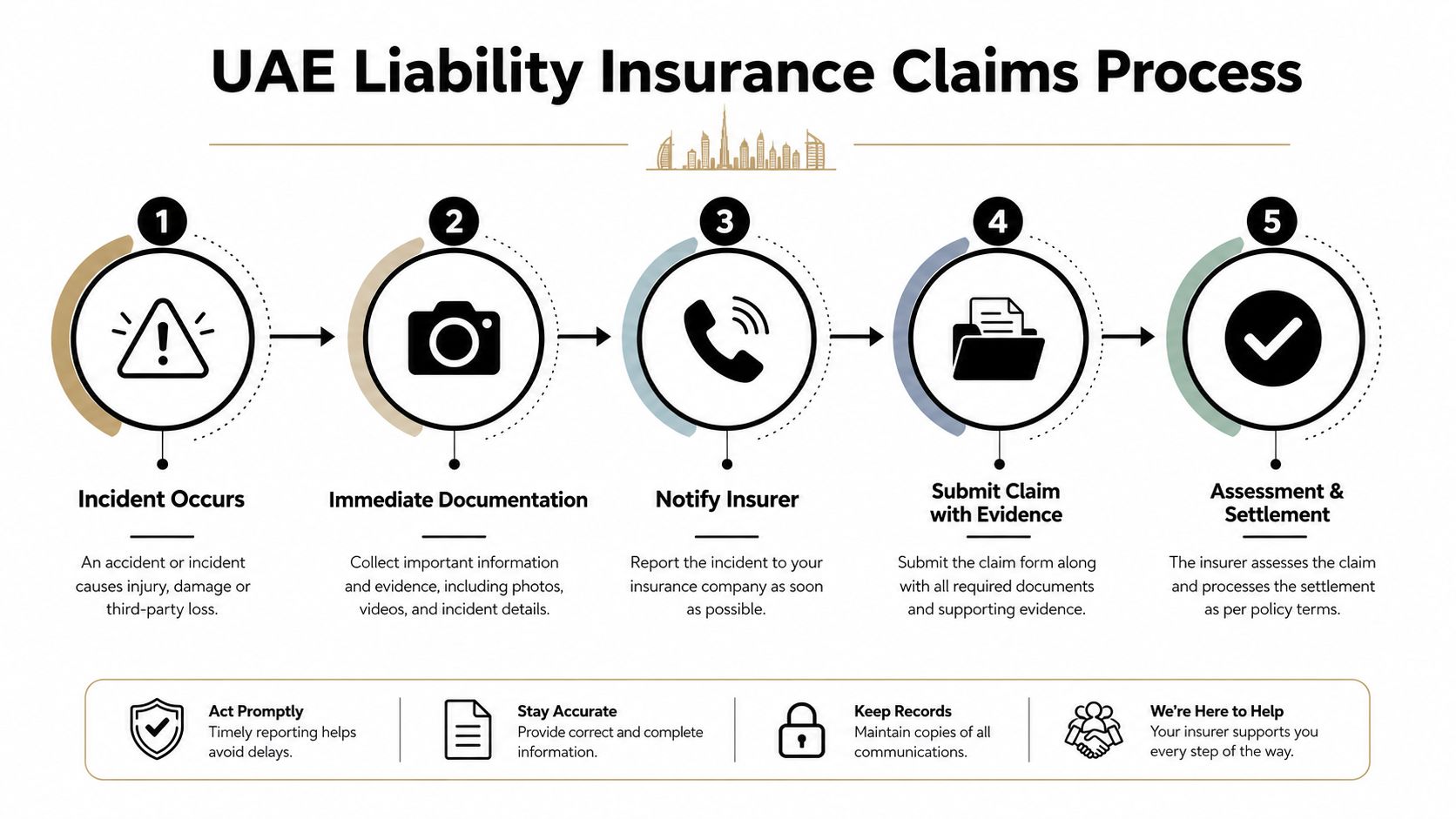
The strongest claim files usually include the same core items.
- Incident report: record the date, place, people involved, and a neutral description of events.
- Photos or video: capture the condition of the site, equipment, or property immediately after the incident.
- Witness details: note names and contact information while memories are still accurate.
- Contract documents: keep the signed agreement, scope of work, service order, or purchase terms.
- Correspondence trail: retain emails, messages, complaint letters, and any admission or denial.
- Financial records: show invoices, payments, repair costs, or related commercial loss.
Notification timing matters because late notice can create friction even where the underlying claim is valid. The insurer needs enough information to assess whether the event falls within the policy wording, whether exclusions apply, and whether defence or settlement costs may follow. If the business is unsure, it should notify early and let the claims handler sort coverage questions later.
Keep the file factual. Commentary, blame, and guesswork only make a dispute harder to resolve.
A broker or consultant who knows the local market can help translate policy wording into claim reality. That support matters when the incident involves mixed issues, such as a customer complaint combined with a service error or a contractor dispute layered over property damage. The cleaner the documentation, the less room there is for delay.
Practical Checklist for Entrepreneurs and SMEs
Use a simple review process before renewal or when launching a new activity.
- List your real exposures. Separate physical, professional, employment, product, and management risks.
- Check your structure. Mainland, free zone, and offshore setups can change what is required and what is merely advisable.
- Read the exclusions first. Don't start with the premium, start with what the policy refuses to pay.
- Test limits against one bad day. A serious claim should not wipe out the business in one hit.
- Align insurance with contracts. If the client wants a specific limit or wording, match it before signing.
- Build a claims file now. Keep incident templates, contract copies, and photo records ready.
If you want the insurance plan to sit inside a broader operating framework, the business continuity planning guide is a sensible companion reading. Insurance works better when it sits alongside formation, compliance, and record-keeping, not as a standalone purchase.
For UAE founders, the practical move is to review cover before a dispute forces the issue. Tighten the wording, raise the limit where the risk demands it, and make sure the policy matches the way the business earns money.
Smart Classic Business Hub helps entrepreneurs build that structure with company formation, compliance, and practical business support that fits UAE operations. If you're setting up, restructuring, or checking whether your liability cover matches your licence and contracts, visit Smart Classic Business Hub and use the guidance to make a cleaner, safer insurance decision.