
Bereavement leave in the UAE means a legally mandated paid absence after the death of a family member. Under Federal Decree-Law No. 33 of 2021, the entitlement is 3 days of paid leave if a spouse dies, and 5 days of paid leave if a parent, child, sibling, grandchild, or grandparent dies.
That answer usually comes up when a business owner receives a difficult message from an employee and has to respond quickly, kindly, and correctly. In practice, the legal minimum is only part of the issue. The harder part is knowing how to handle payroll, what to document, when to allow extra time off, and how to support someone without creating confusion or inconsistency across the team.
The bereavement leave meaning in the UAE isn't just about defining a term. It's about understanding that grief creates an immediate workplace issue with legal, human, and administrative consequences. If you run a small company, those consequences often land on your desk personally.
An Employee Needs Time Off What Are the Rules
A manager gets a message early in the morning. An employee says there has been a death in the family and they need to leave immediately. In that moment, the right response starts with empathy, but it also needs structure.
In the UAE, bereavement leave is not a favour and not an informal arrangement between manager and employee. It sits within the labour framework as a recognised leave category tied to a death in the family. That matters because the employee should not be told to use ordinary holiday first, and payroll should not treat the absence as unpaid by default.
What the employer needs to do first
When this happens, keep the first step simple:
- Acknowledge the message quickly: Confirm that the employee can step away and that HR or the line manager will follow up on any paperwork later.
- Check the relationship to the deceased: The relationship determines the statutory entitlement.
- Record the leave correctly: Treat it as bereavement leave, not annual leave or sick leave.
- Escalate only what is necessary: If your HR team uses formal labour-service checks for broader compliance questions, keep those tools separate from the immediate response. For related government service navigation, many employers use Ministry of Labour inquiry services guidance.
What tends to go wrong
Small businesses usually make one of three mistakes.
The first is delay. The employee is asked to wait for approval while several managers discuss policy. The second is misclassification. The leave is deducted from annual leave because nobody created a separate code. The third is overcomplication. HR asks for documents immediately, even when the employee has just reported the death.
Practical rule: approve the immediate absence first, then sort out administration once the employee has breathing room.
A sound response protects both sides. The employee gets the dignity of clear support. The business gets a consistent process that can be repeated fairly the next time a difficult situation arises.
What Bereavement Leave Is and What It Is Not
The simplest way to understand bereavement leave meaning is this. It is an emergency support measure for a moment of loss. It is not a planned break from work.
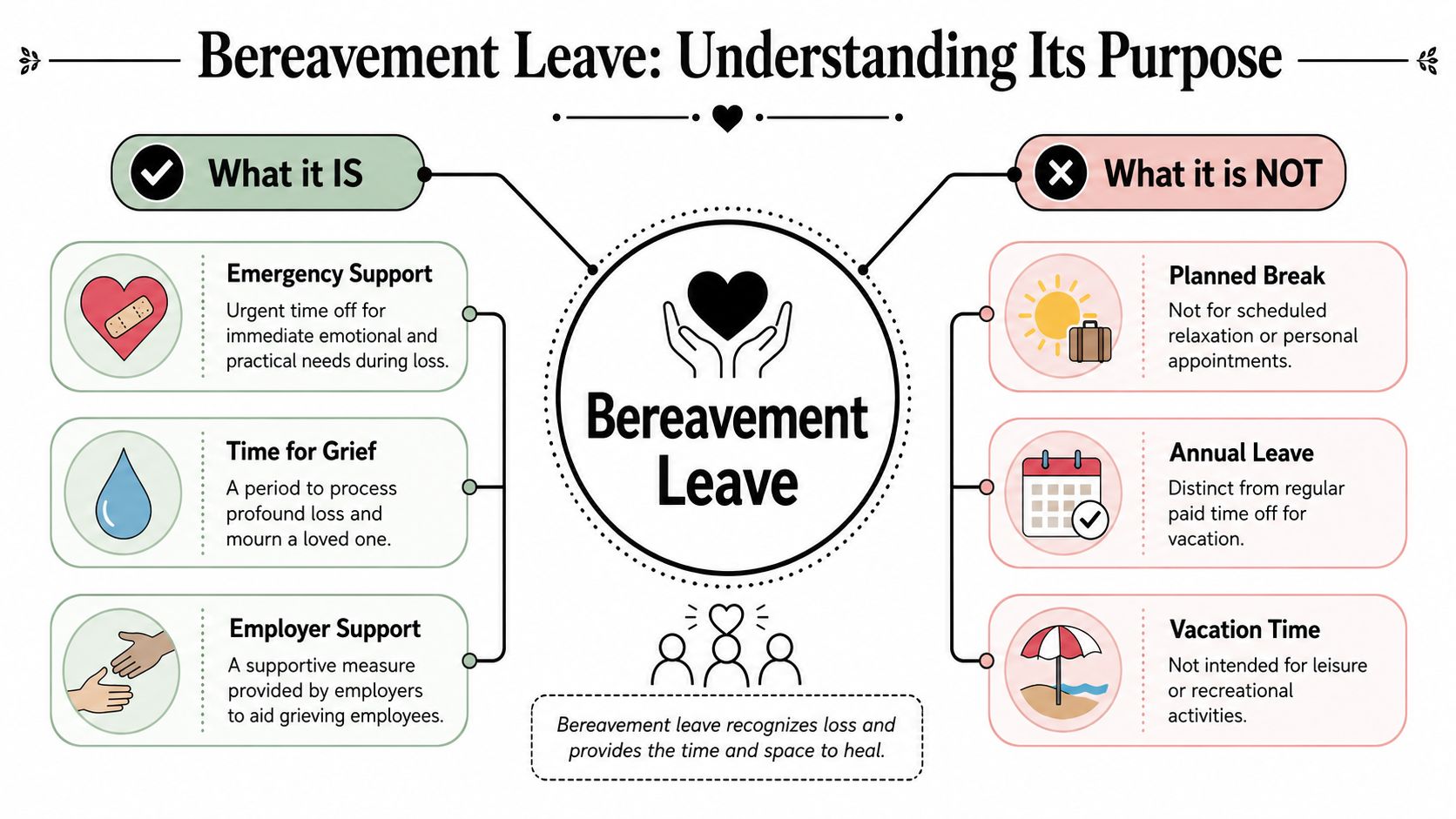
If annual leave is a scheduled stop in the working year, bereavement leave is the emergency brake. It exists because an employee may suddenly need time for funeral arrangements, family obligations, travel, or the inability to function normally in the immediate aftermath of a death.
What it is
Bereavement leave has a specific workplace purpose.
- It responds to a death in the family: The trigger is a bereavement event, not personal preference.
- It protects income for the entitled period: In the UAE labour context, it is treated as a paid absence rather than a general PTO drawdown.
- It creates space for urgent practical matters: Funeral rites, immediate family coordination, and essential administrative tasks often happen in the same short period.
Regional HR guidance also treats it as a distinct leave type commonly tracked as BL in systems, rather than folded into annual leave balances, as noted in this explanation of what is bereavement leave.
What it is not
Confusion starts when employers describe every absence as “leave” and assume the categories are interchangeable. They are not.
Bereavement leave is not annual leave. Annual leave is planned and usually requested in advance. Bereavement leave arrives without warning.
It is not sick leave either. Sick leave addresses the employee's own health condition. Bereavement leave responds to a family death and the immediate consequences of that event.
It is also not a benefit that employees “save up” or “cash in” later. If there is no bereavement event, there is no reason for the category to be used.
A company that frames bereavement leave as just another absence code usually handles it poorly in real life.
Why the distinction matters in company culture
Language shapes behaviour. If your managers think bereavement leave is interchangeable with holiday, they will ask the wrong questions. They may focus on balances, notice periods, or workload coverage before recognising the employee's immediate need.
A better approach is to train managers to see bereavement leave as a short, protected response to crisis. That framing improves both compliance and humanity. It also reduces awkward conversations that can damage trust long after the employee returns.
UAE Bereavement Leave Law Explained
For UAE employers, the legal position is clear. Bereavement leave is a statutory right, not a discretionary courtesy. According to this summary of Federal Decree-Law No. 33 of 2021, the UAE provides 3 days of paid bereavement leave if a spouse dies, and 5 days of paid bereavement leave if a parent, child, sibling, grandchild, or grandparent dies. The same source notes that this framework replaced Federal Law No. 8 of 1980 and took effect in 2022.
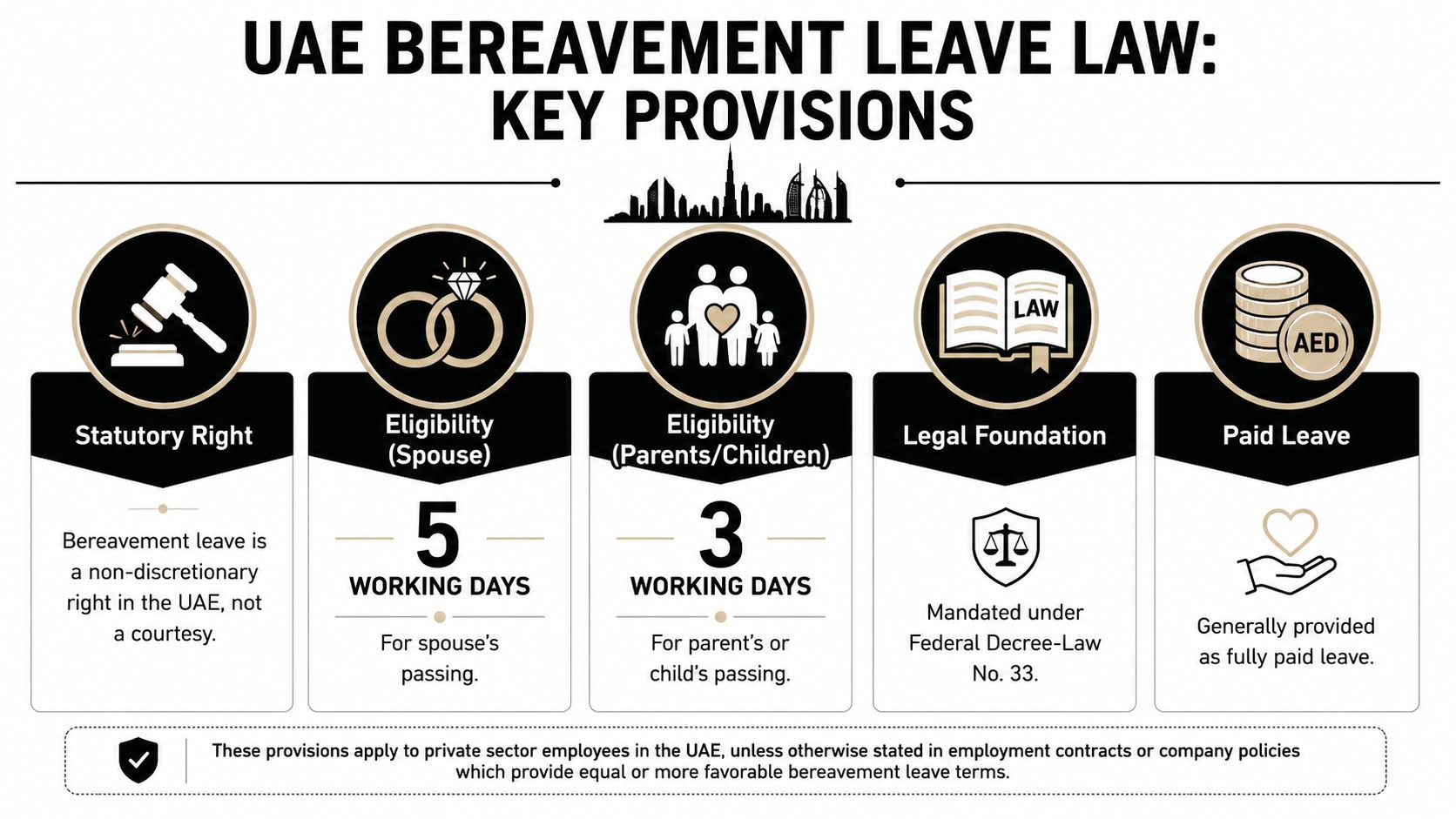
That point changes the whole employer mindset. You are not deciding whether to “allow” bereavement leave. You are deciding how to administer a legal entitlement properly.
What the law means operationally
The law gives a baseline, not a complete operating manual. Employers still have to translate the entitlement into a real process.
That process should answer these questions:
| Legal question | Practical employer answer |
|---|---|
| Is bereavement leave optional? | No. Treat it as a statutory leave category. |
| Is it paid? | Yes, for the entitled period. |
| Does relationship matter? | Yes. The entitlement is tied to the employee's relationship to the deceased. |
| Can you replace it with annual leave? | You shouldn't force substitution for the statutory entitlement. |
Where employers often misread the issue
Some businesses think compliance ends once the leave is “approved.” It doesn't. If payroll deducts salary, if the absence is misclassified, or if managers apply one standard to senior staff and another to junior staff, the company has still mishandled the situation.
Another common mistake is treating the minimum entitlement as the complete answer. Legally, that may be enough for the first few days. Practically, it often isn't. Employees may need overseas travel, additional family responsibilities, or a phased return to work.
Key compliance point: the law sets the floor. Your internal policy determines whether the experience feels organised and fair.
What a business owner should take from this
Keep the legal rule simple in your handbook and manager guidance. State the entitlement clearly. State that it is paid. State which family relationships qualify. Then add internal rules for notification, documents, payroll handling, and requests for extra time.
That combination is what turns a legal obligation into a workable company process.
Creating a Compassionate and Compliant Policy
The statutory minimum is necessary, but it is rarely sufficient as a full company policy. A significant pressure point in UAE workplaces is what happens when an employee needs more time than the law expressly provides. As noted in this regional discussion of bereavement leave, mainstream explanations often stop at saying bereavement leave is short and paid or unpaid, while leaving employers unclear about the overlap with annual leave, unpaid leave, and internal policy.
That gap is where good employers distinguish themselves. A strong policy doesn't just repeat the law. It answers the questions your managers will face.
What a practical policy should include
At minimum, your written policy should cover the following:
- Eligible relationships under law: List the statutory category clearly so there is no guesswork.
- Company extensions beyond law: Decide whether you will also allow discretionary leave for relationships not covered by statute, such as a long-term partner or another close family connection recognised by your company.
- How extra time off works: State whether additional days can be taken as annual leave, unpaid leave, or another approved arrangement.
- Notification expectations: Allow informal first notification by call or message. Formal paperwork can come later.
- Documentation standards: Request reasonable evidence, but don't design the process as if you are investigating misconduct.
A comparison worth building into your handbook
| Provision | UAE Legal Minimum (Federal Decree-Law No. 33) | Recommended Best-Practice Policy |
|---|---|---|
| Leave category | Statutory bereavement leave | Separate bereavement leave category plus discretionary extension rules |
| Pay treatment | Paid during statutory entitlement | Paid statutory leave, with clear options for annual or unpaid leave if more time is needed |
| Documentation | Not fully detailed in mainstream summaries | Simple, reasonable documentation requested after the immediate absence |
| Non-statutory relationships | Not addressed in the legal minimum | Manager and HR discretion under written criteria |
| Communication | Legal entitlement exists | Manager script, HR workflow, and return-to-work check-in |
What works and what does not
What works is clarity with room for judgement. A good policy gives managers firm boundaries but doesn't force them into cold, mechanical behaviour.
What does not work is a policy that sounds compassionate and then collapses in practice because nobody knows who approves extra time, what payroll does, or when documents are due.
A practical drafting standard is to split the policy into two parts. The first part states the legal entitlement. The second part explains discretionary support. Keep those distinct so your team never confuses mandatory rights with company goodwill.
If you want managers to act compassionately, don't leave them to improvise under pressure.
Sample policy language
You don't need legal poetry. You need language that can be applied consistently:
Employees are entitled to bereavement leave in accordance with UAE labour law. The company will record this leave separately from annual leave and maintain pay during the statutory entitlement. Where an employee needs additional time due to travel, family responsibilities, or the circumstances of the loss, the company may approve an extension through annual leave, unpaid leave, or another approved arrangement.
That kind of wording gives the business room to operate without blurring the employee's legal right.
The human side still needs structure
Managers often ask what to say, not just what to approve. A short condolence message from the company can help if it is sincere and measured. For teams that need help with tone, this Firacard resource for team compassion is useful as a communication reference.
If your payroll and wage processes are formalised, align the policy with your wage systems as well. That matters because pay continuity is part of handling bereavement leave properly, especially in environments already working within WPS requirements in the UAE.
Administering Bereavement Leave Correctly
A sound policy fails quickly if HR and payroll don't execute it properly. In the UAE labour context, bereavement leave is a legally recognised short-term paid leave tied to the employee's relationship to the deceased, and the practical implication is that employers should code it as a distinct category in HR and payroll systems, often as BL, while preserving salary continuity, as explained in Darwinbox's bereavement leave glossary.

That one operational point solves many downstream problems. If the leave sits in the system as annual leave, the employee loses balance incorrectly. If it sits as unpaid leave, payroll may disrupt salary. If it sits as a manager note only, reporting becomes inconsistent.
A practical admin workflow
Use a simple sequence that your team can follow every time:
- Receive the request: Accept first notice through the fastest available channel, usually call, message, or email.
- Log the category correctly: Enter the absence as bereavement leave or BL in the HR system.
- Confirm pay treatment: Tell payroll that the statutory entitlement remains paid.
- Request documents later: Ask for supporting evidence at a reasonable point, not during the initial shock period.
- Assess extension requests separately: If the employee needs more time, process that under annual leave, unpaid leave, or another approved policy route.
Documentation without friction
Most employers want to know what evidence is appropriate. The answer is simple. Ask only for what your policy requires and only when it is practical for the employee to provide it.
Good documentation practice usually includes:
- A clear request trail: Keep the manager's note or employee message on file.
- Reasonable evidence: If your company requests a death-related document, allow time for submission.
- Approval notes for extensions: Record whether extra time was treated as annual leave or unpaid leave.
Administrative discipline matters most when emotions are high. That is when inconsistent decisions multiply.
Payroll and return-to-work handling
Your payroll team should know that bereavement leave is not a generic absence bucket. It affects pay treatment differently from annual and unpaid leave, so the code must be right from the start. If you need your payroll team to align that coding with broader leave-pay rules, this guide on how to calculate leave salary in UAE is a useful operational reference.
When the employee returns, keep the check-in brief and respectful. The manager doesn't need a formal interview. They need to confirm the employee is back, clarify any pending paperwork, and adjust workload if necessary.
FAQ for UAE Employers and HR Managers
Do we need to ask for a death certificate immediately
No. Immediate proof should not be your first concern. Approve the short absence, then request supporting documents later under your policy. The process should feel controlled, not suspicious.
What if the funeral is overseas and the employee needs longer away
Company policy matters most. The statutory entitlement may be short, but an employee may need extra time for travel or family responsibilities. Handle the extension through annual leave, unpaid leave, or another approved option set out in your policy, and record that extra time separately from the statutory portion.
Can bereavement leave apply to a close friend or a relative not covered by law
That falls into discretionary policy, not the legal minimum. If your business wants to support those cases, say so explicitly in writing. If you don't define it, managers will make inconsistent decisions.
Should employees on probation be treated differently
If the employee is covered by your employment framework, don't let probation become an excuse for poor handling. A statutory leave entitlement should not be treated as a reward for completing probation. From a management perspective, the better question is how to administer the leave properly, not whether compassion starts only after probation ends.
Can we ask the employee to use annual leave instead
For any statutory entitlement, that is the wrong starting point. The legal category should be used first. Annual leave becomes relevant only if the employee asks for or needs additional time beyond that baseline.
What should the manager say when the employee returns
Keep it brief, respectful, and practical. A simple acknowledgement is enough. Confirm whether they need any short-term adjustment in workload, and avoid turning the conversation into a forced emotional discussion.
A fair bereavement process is one that remains clear on paper and humane in the room.
If you're setting up a company in the UAE or tightening your HR and payroll processes, Smart Classic Business Hub can help you build compliant internal systems that match local requirements without making day-to-day operations harder. Their Dubai-based team supports business owners with setup, PRO services, payroll-related guidance, accounting, and broader compliance planning so your policies work in practice, not just in a handbook.