
A founder in Dubai can run a perfectly active business and still feel uncertain about its accounting. One adviser recommends full IFRS. Another says IFRS for SMEs is sufficient. The tax team asks for revenue evidence, while the auditor wants a clear trail from invoices to the final financial statements.
That uncertainty is common because accounting standards compliance isn't a matter of choosing software or submitting a return. It affects how your ledger is designed, how you recognise revenue, how you document decisions, and how confidently an auditor, lender, investor, or regulator can understand your business.
The UAE has created a reporting environment where international consistency matters. A practical approach starts with one question: which reporting framework applies to your business now? From there, you can build the records, controls, reconciliations, and audit evidence needed to support corporate tax and statutory reporting.
Introduction to Accounting Standards Compliance in the UAE
Accounting standards are often treated as a finance department concern. For a founder, they're better understood as the rules that turn business activity into a reliable financial story.
Suppose your company sells annual software subscriptions. Customers may pay at the start of the arrangement, but the service is delivered over time. If your books record the entire payment as revenue immediately, your cash position may be correct while your reported performance is misleading. The accounting framework helps determine how that transaction should appear in the financial statements.
The same issue arises with construction contracts, retainers, leases, inventory, related-party transactions, and foreign currency balances. Without a consistent framework, two businesses with similar operations could present their results differently. That makes comparison harder for lenders, investors, auditors, and regulators.
For UAE businesses, compliance also supports practical objectives:
- Bank discussions: Lenders generally need financial information they can interpret and test.
- Investor confidence: Shareholders and potential investors want a consistent basis for evaluating performance.
- Tax preparation: Corporate Tax calculations must begin with reliable accounting records and an accepted framework.
- Audit readiness: A clear trail reduces the need to reconstruct decisions at year-end.
- Growth planning: Management can make better decisions when revenue, costs, assets, and liabilities are classified consistently.
The UAE's reporting environment has a strong international orientation. Peer-reviewed GCC research found that UAE companies had the region's highest average IFRS compliance level at 79.3%, compared with Oman at 77.0%, Qatar at 74.3%, Bahrain at 74.1%, and Kuwait at 72.6%. The same research reported a UAE mean compliance score of 0.82 in one comparative dataset. These figures indicate a market where standardised reporting is an established expectation, not an optional polish applied only by large companies. (GCC IFRS compliance research%20Firm-Characteristics-and-the-Level-of-IFRS-Compliance-and-Disclosure-in-GCC-Countries.pdf))
This guide follows a decision path. First, understand the UAE framework. Next, identify whether full IFRS or IFRS for SMEs fits your circumstances. Then connect that choice to VAT records, audit obligations, tax reporting, monthly controls, and preparation for IFRS 18, which will affect presentation and disclosure from 2027.
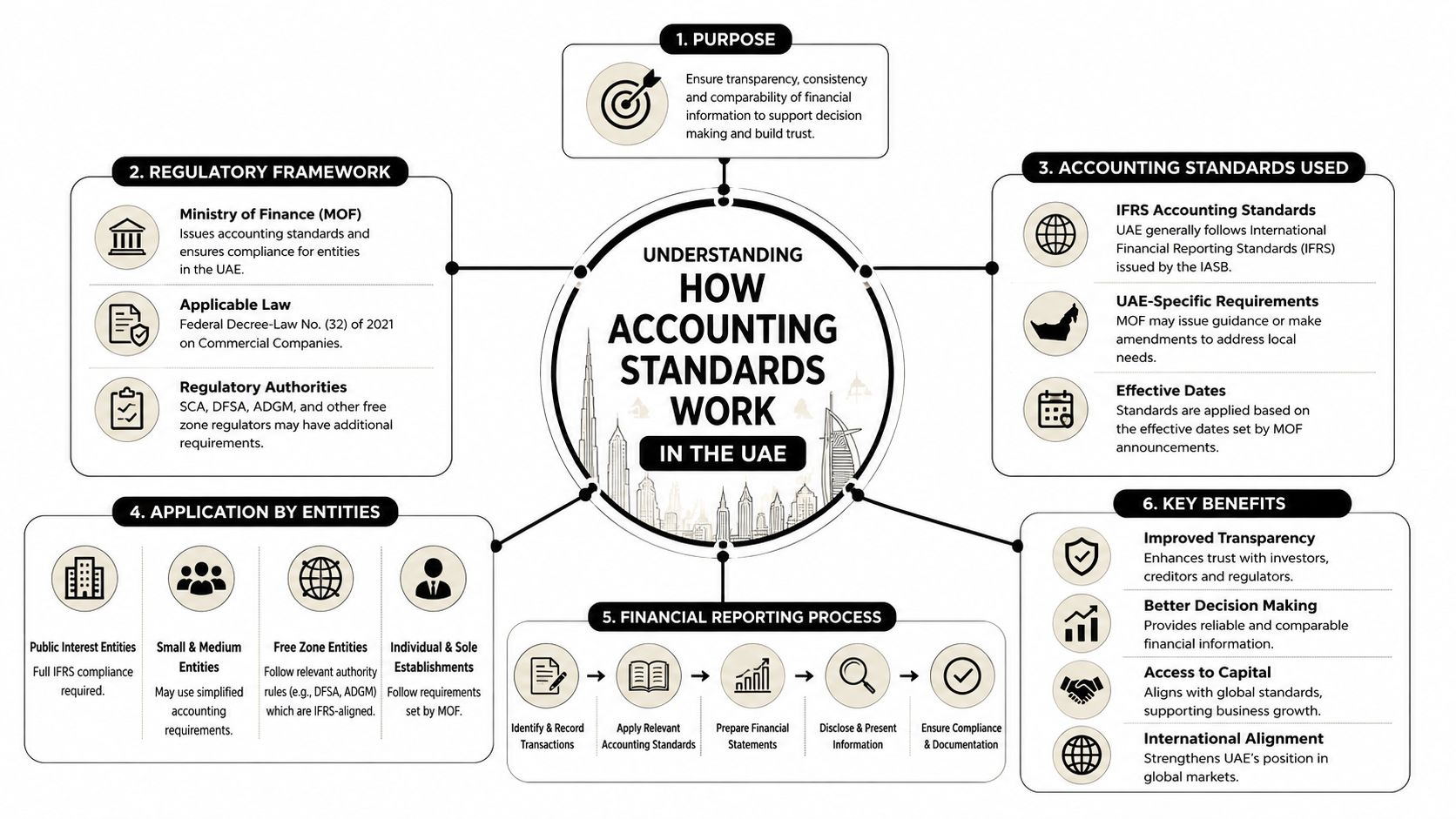
Understanding How Accounting Standards Work in the UAE
Think of accounting standards as a common language. Your business speaks through sales invoices, payroll, bank payments, contracts, assets, and liabilities. IFRS provides the grammar that converts those events into financial statements others can read and compare.
The UAE doesn't have a separate national accounting standards framework. Instead, IFRS Accounting Standards form the core basis for regulated reporting. The IFRS Foundation's UAE jurisdiction profile states that IFRS is required for companies listed on NASDAQ Dubai, the Dubai Financial Services Authority, and Abu Dhabi Securities Exchange. IFRS for SMEs is permitted in the country. The UAE Commercial Companies Law No. 2 of 2015 also requires IFRS for financial statements. (IFRS Foundation UAE jurisdiction profile)
That doesn't mean every company has the same reporting workload. It means your records must be capable of supporting the accepted framework that applies to your entity, revenue position, tax posture, and reporting obligations.
What IFRS conformance means operationally
IFRS conformance goes further than placing a logo on the accounts. It requires an IFRS-conforming ledger, an appropriate disclosure set, and an audit trail that supports the figures and the judgements behind them.
In practice, your finance team should be able to answer questions such as:
- Which account records this transaction?
- What policy determines its recognition and measurement?
- What source document supports the entry?
- Who reviewed the treatment?
- Can the same policy be applied consistently next month?
A well-designed chart of accounts is therefore a compliance control, not just a bookkeeping convenience. Revenue categories should connect to contract terms. Lease records should connect to agreements. VAT ledgers should reconcile to returns. Bank balances should connect to statements and reconciliation evidence.
For businesses strengthening that foundation, a practical resource on statement reconciliation foundations can help clarify how source statements support accounting records and review procedures.
Core principle: Your financial statements are only as reliable as the policies, source documents, reconciliations, and review evidence behind them.
This is why early alignment matters. Changing the framework or rebuilding the ledger after transactions have accumulated can require reclassification, policy decisions, and additional audit work. Establishing the right structure at the beginning gives the business a cleaner route to tax reporting, financing discussions, and future expansion.
Choosing Between Full IFRS and IFRS for SMEs
The most useful starting point is the UAE Corporate Tax framework. The Federal Tax Authority confirms that, from 2023, only IFRS and IFRS for SMEs are accepted for Corporate Tax purposes. Under Ministerial Decision No. 114 of 2023, businesses with revenue not exceeding AED 50 million per tax period may use IFRS for SMEs. (Federal Tax Authority Accounting Standards Guide)
That creates a revenue-threshold decision tree, but revenue isn't the only consideration. Entity type, listing status, group structure, statutory reporting, lender requirements, and consolidation needs can all influence the practical choice.
| Criteria | Full IFRS | IFRS for SMEs |
|---|---|---|
| Corporate Tax acceptance | Accepted framework | Accepted framework |
| Revenue position | Available where the business uses or requires full IFRS | Available where revenue doesn't exceed AED 50 million per tax period, subject to the applicable rules |
| Reporting detail | More extensive recognition, measurement, presentation, and disclosure requirements | Designed as a simplified framework for eligible small and medium-sized entities |
| Listed or regulated reporting | Generally relevant where full IFRS reporting is required | May not satisfy a separate regulator, exchange, lender, or group requirement |
| Group reporting | Suitable where the group's consolidated reporting uses full IFRS | May be suitable where the group and applicable statements can use IFRS for SMEs |
| Policy decision | Useful where future funding, listing, international consolidation, or complex transactions are expected | Useful where the entity qualifies and a simpler reporting structure is appropriate |
A founder below the threshold shouldn't assume IFRS for SMEs is automatically correct. If the company is part of a tax group, it may need consolidated statements under IFRS or IFRS for SMEs. A free zone location also doesn't, by itself, answer the framework question. The relevant analysis should consider the entity's revenue, legal structure, tax position, and reporting audience.
Decision test: Choose the accepted framework that fits your current legal and tax position without creating avoidable conversion work for the group or the next stage of growth.
You can review the practical implications in this guide to accounting standards for SMEs, then ask your accountant to document the conclusion. Keep evidence supporting the revenue position used to justify IFRS for SMEs. That evidence should be easy to retrieve if your accounting policy is reviewed.
Key Compliance Pillars Every UAE Business Must Manage
Framework selection sets the direction, but daily controls determine whether the records remain reliable. UAE businesses should connect three areas: VAT accounting, audit evidence, and Corporate Tax reporting. Each area supports the others, much like three linked checks on the same transaction.
VAT accounting must agree with the books
VAT data should not live in a separate spreadsheet disconnected from the general ledger. Sales and purchase invoices, credit notes, tax codes, input VAT, output VAT, and return adjustments need one controlled process.
A monthly review can catch errors before filing. Compare VAT control accounts with transaction reports, inspect unusual tax codes, and investigate differences between invoice dates, supply dates, and posting dates. Retain the calculations and documents that show how each return was prepared.
Record keeping forms the bridge between bookkeeping and regulatory evidence. Businesses can use this guide to UAE accounting record keeping requirements as a checklist for organising invoices, contracts, reconciliations, and other supporting records.
Audit obligations depend on the business profile
An audit examines more than the final figures. It tests whether the statements, accounting policies, estimates, and evidence tell a consistent story. The auditor may request contracts, invoices, bank reconciliations, asset schedules, related-party records, revenue analysis, and explanations for unusual movements.
Audited statements may also be relevant because of an entity's tax or group position. UAE-focused guidance identifies them as relevant for tax groups, qualifying free zone persons, and businesses with revenue above AED 50 million for tax periods starting 1 January 2025. (UAE IFRS advisory coverage) Check the obligation against the entity's circumstances rather than relying on its trade licence alone.
Corporate Tax reporting starts with accounting policy
Corporate Tax calculations depend on financial information prepared under an accepted framework. If revenue recognition differs between management accounts, tax workings, and statutory statements, the business needs a documented explanation.
Keep these points consistent:
- Revenue: Apply a documented policy to timing and classification.
- Expenses: Support entries and classify them consistently.
- Related parties: Identify transactions and balances clearly.
- Group reporting: Make consolidation adjustments traceable.
- Threshold evidence: Retain revenue calculations supporting the selected framework.
Software, approval workflows, and document controls can support an evidence-management process. Teams reviewing regulatory compliance tools for accountants should treat them as organisation aids, not substitutes for a suitable policy or professional review. This matters when revenue approaches a framework threshold, because 2026 system choices should capture the data needed for full IFRS, IFRS for SMEs, and the IFRS 18 changes planned for 2027.
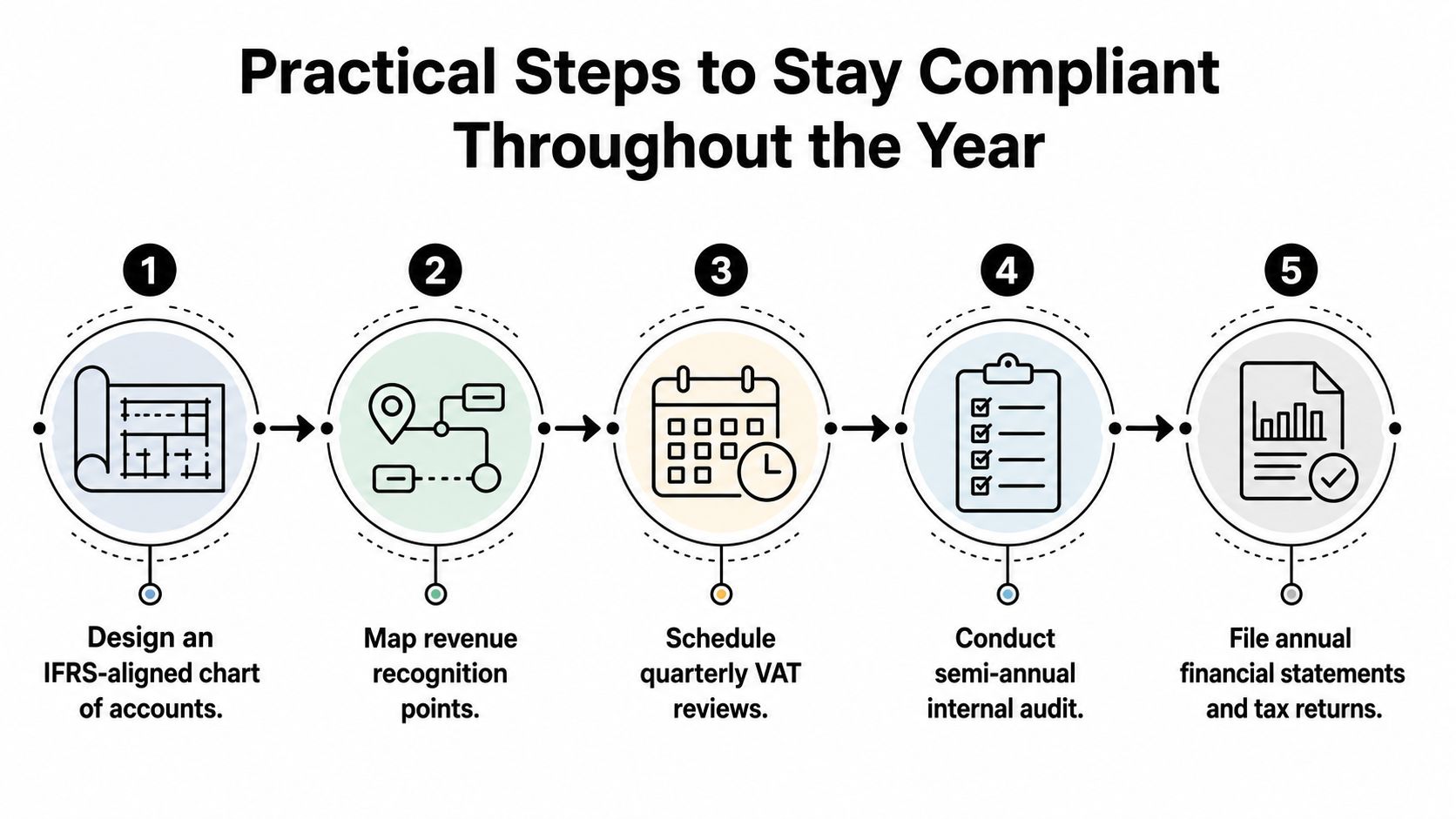
Practical Steps to Stay Compliant Throughout the Year
Compliance becomes manageable when the business treats it as a repeating operating cycle rather than a year-end rescue project.
Start with the chart of accounts
Design the chart of accounts around the reporting framework and the way management reviews the business. Separate revenue streams that have different contract terms or recognition patterns. Create clear accounts for VAT, intercompany balances, shareholder transactions, fixed assets, leases, and accruals.
Avoid creating a new account every time a team member wants a more detailed view. Use a controlled structure with reporting dimensions where the system supports them. This keeps statutory reporting clear while allowing management to analyse customers, projects, locations, or departments.
Map revenue before the first difficult contract
For each material revenue stream, document what the customer receives, when control or service delivery occurs, what consideration is variable, and which evidence supports recognition. A consultancy with milestone billing shouldn't assume that invoice timing automatically determines revenue timing.
Link the policy to the contract review process. When sales staff change payment terms, add services, or offer credits, finance should know before the transaction reaches the ledger.
Make the monthly close a control point
A disciplined close usually includes:
- Bank reconciliations: Match ledger balances to statements and investigate outstanding items.
- Receivables review: Examine ageing, disputed invoices, credit notes, and recoverability.
- Payables review: Check unrecorded liabilities and supplier statement differences.
- VAT reconciliation: Tie VAT control accounts to transaction reports and return workings.
- Cut-off testing: Confirm that income and expenses belong in the correct reporting period.
- Balance sheet review: Require an explanation and supporting schedule for significant balances.
The purpose isn't to create unnecessary administration. It is to catch errors while the transaction history is still familiar.
Build the audit file as you go
Store contracts, invoices, reconciliations, approvals, calculations, and policy memos in an organised digital structure. Name files consistently and restrict editing rights where appropriate. If a reviewer asks why an entry was posted, the answer should be found in the supporting evidence, not reconstructed from memory.
A simple close calendar can assign each task to a person, set a review step, and record completion. The resulting history demonstrates that controls operated throughout the year.
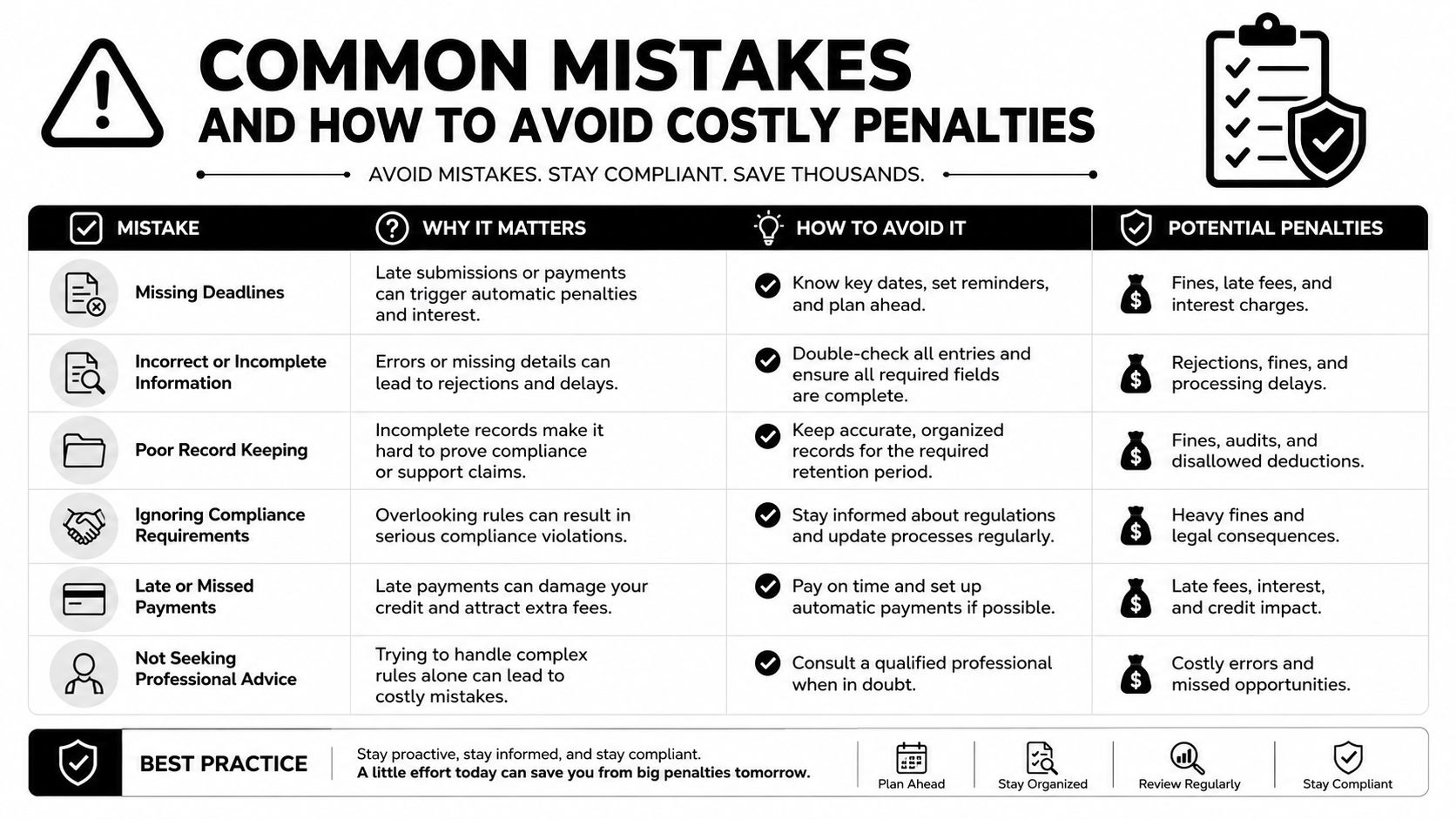
Common Mistakes and How to Avoid Costly Penalties
A founder may choose a reporting framework from a quick online explanation, record sales only when cash arrives, or postpone VAT checks during a busy month. Each shortcut can leave the final accounts difficult to explain. The practical test is simple: can the business show why it chose its framework, how it measured revenue, and where each reported figure came from?
Mistake one is choosing the framework by reputation
Full IFRS can sound more professional, while IFRS for SMEs may appear easier. Neither label, by itself, proves that the choice is suitable. The decision depends on the entity's position, group relationships, reporting requirements, and revenue analysis.
Prepare a short framework memo. Record the entity type, revenue position, relevant reporting needs, group connections, and conclusion. Keep the supporting records with it. Revisit the memo when the business joins a group, changes its activities, or approaches a reporting threshold.
Mistake two is treating the revenue threshold as a casual estimate
The AED 50 million threshold linked to IFRS for SMEs eligibility is assessed by tax period under UAE Corporate Tax guidance. Maintain a revenue report that states what was included, which period it covers, and how the total agrees with the ledger.
This creates a decision tree for growing businesses. If the documented analysis supports IFRS for SMEs and no other reporting requirement points to full IFRS, that framework may be appropriate. If revenue reaches the threshold, or the group and reporting context requires wider information, reassess the choice and document why full IFRS applies. An informal management estimate is weak evidence when accounts or tax workings are reviewed.
Mistake three is separating VAT from financial reporting
Manual VAT entries added after the books close can put tax codes, credit notes, and adjustments out of line with the accounting records. Set tax coding within the invoicing and purchasing workflow. Reconcile the VAT control accounts before filing, then investigate differences rather than carrying them into the next period.
Mistake four is waiting for the auditor to identify weak evidence
An auditor should not be the first person to find missing reconciliations or unsupported estimates. Before the audit, ask an independent reviewer to trace selected balances from the financial statements to the ledger and source documents. The external audit process explains the stages and the evidence teams may need to prepare.
Mistake five is ignoring IFRS 18 until its effective date
IFRS 18, which replaces IAS 1 for periods beginning on or after 1 January 2027, is not yet in effect, but preparation should begin now. The change concerns presentation and disclosure, so it can affect account groupings, management performance measures, comparative information, reporting packs, and system outputs.
That makes 2026 a system-choice checkpoint. A platform or chart of accounts selected without the later presentation needs in mind may create conversion work when 2027 reporting begins. Review the current profit and loss structure, identify information that is not captured clearly, and confirm that the accounting system can produce the required analysis.
Building a Future Ready Compliance Strategy
A future-ready strategy starts with a clear sequence. Identify the accepted framework, document why it applies, design the ledger around that framework, and connect transactions to source evidence. Then make VAT reviews, reconciliations, close procedures, tax calculations, and audit preparation part of the normal operating rhythm.
The UAE's measurable IFRS compliance environment means businesses shouldn't treat reporting quality as a last-minute formality. Early alignment can make it easier to answer lender questions, support investors, prepare group statements, and identify performance issues before they become expensive.
The next review should be practical:
- Confirm whether full IFRS or IFRS for SMEs is appropriate.
- Reconcile the revenue threshold analysis to the ledger.
- Test whether VAT records agree with the accounting system.
- Inspect the audit trail for significant balances and estimates.
- Assess whether the current chart of accounts can support IFRS 18 preparation.
- Assign an owner and deadline to every remediation item.
Smart Classic Business Hub offers VAT-compliant accounting and bookkeeping, IFRS-related SME guidance, audit coordination, and broader business compliance support for UAE companies. Treat compliance as operating infrastructure, not paperwork, and use professional help when your framework, group structure, tax position, or reporting requirements are difficult to interpret.
Smart Classic Business Hub can review your accounting framework, bookkeeping controls, VAT records, and audit readiness in line with your UAE business structure. Visit Smart Classic Business Hub to discuss the specific compliance steps your company should take before its next reporting cycle.