
The most popular advice on free zone corporate tax is also the most dangerous. Pick a free zone, get the licence, pay nothing. That's wrong. A licence puts your company inside the UAE tax regime. It doesn't remove it. What protects you isn't where you're registered. It's how each dirham of revenue is classified, who paid it, and whether you can prove it under audit.
Why Free Zone Registration Alone Does Not Mean 0% Tax
Free zone companies aren't outside Corporate Tax. They're taxable persons with a conditional preference. Only a Qualifying Free Zone Person, or QFZP, can apply the preferential rate, and only to Qualifying Income. The rest of the profit doesn't inherit that treatment by association. That's the distinction most founders miss when they compare free zones by licence price.
The regime works by income stream, not by entity. A QFZP may apply 0% to Qualifying Income from transactions with other Free Zone Persons where the recipient is the beneficial recipient and no Excluded Activity is involved, while income from a UAE or foreign permanent establishment, most immovable property income, and non-qualifying intellectual property income is generally subject to 9%, as set out in the Ministry of Finance announcement on new corporate tax decisions for free zones. One company can therefore have both treatments in the same year.
Practical rule: Don't ask whether your company is tax-free. Ask whether this invoice is.
That shift changes the questions you should ask before incorporation:
- Activity test: Does the exact activity that earned the revenue qualify, or is it excluded?
- Customer test: Is the customer a Free Zone Person, a mainland person, or overseas?
- Evidence test: Can your contracts, invoices, and ledger codes prove that split without reconstruction later?
If you can't answer those three, the free zone name won't answer them for you. The failure point isn't usually incorporation. It's month four, when a new customer type or service line appears and nobody reclassifies the revenue. By filing season, the accounts show one blended profit figure. The preference needs the opposite. It needs segmentation from day one, organised around activity and customer status.
How the UAE Regime Taxes Free Zone Entities
Federal Corporate Tax arrived as a nationwide, profits-based system, with a deliberate carve-out to preserve the free zone model. The arithmetic has three anchors. Mixing them up is where bad structuring starts.
The Three Numerical Anchors
For businesses generally, taxable income up to AED 375,000 is taxed at 0% and taxable income above AED 375,000 is taxed at 9%, while a QFZP may apply 0% to qualifying income and non-qualifying taxable income is generally subject to 9%, per the UAE government portal guidance on Corporate Tax rates and thresholds. Read that carefully. The first anchor is a threshold for ordinary taxable persons. The second is a status-based preference for a defined class of income. They're not the same relief, and they don't stack in the way founders often assume.
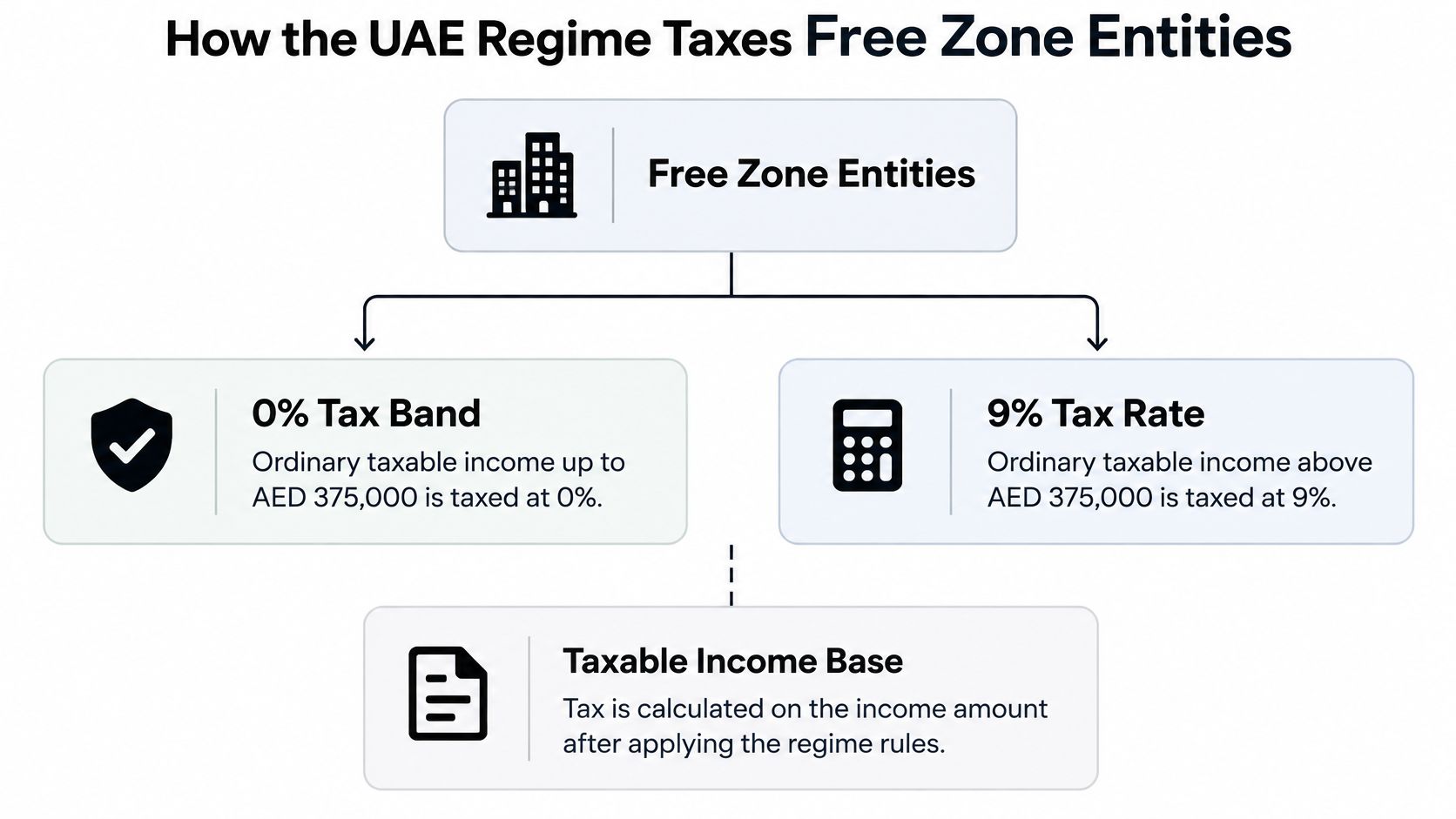
The policy logic matters for how you'll be assessed. The preference recognises the historical role of free zones in UAE economic development. It wasn't designed as a blanket exemption for any company with a free zone address. That's why eligibility turns on legal status, activities, income classification, and continuing compliance. You're not claiming an identity. You're evidencing a set of conditions, every tax period.
Who Each Anchor Applies To
An ordinary mainland company lives entirely in the threshold world. Its result depends on total taxable income. A free zone company lives in two worlds at once. It must first establish QFZP status. Then it must split its income. Qualifying streams get the preference. Non-qualifying streams don't, even if they're small, occasional, or commercially incidental to the main trade.
- Ordinary taxable person: One taxable income figure, tested against the threshold.
- QFZP: Status test first, then a stream-by-stream classification of revenue.
- Free zone company that fails QFZP conditions: Treated as an ordinary taxable person, with consequences covered in the comparison below.
That ordering, status then classification, should drive your bookkeeping design. If your chart of accounts can't show the split, you don't yet have a defensible position. You have an intention.
Free Zone and Mainland Treatment Side by Side
The headline rates look similar. The conditions attached to them don't. A mainland company's treatment is comparatively simple to predict. A free zone company's treatment is better when it fits, and worse when it fails, because failure has a long tail.
| Factor | Free zone entity | Mainland entity |
|---|---|---|
| Basis of preference | QFZP status plus Qualifying Income classification | No equivalent status test |
| Income tested | Stream by stream, by activity and customer | Total taxable income |
| Transactions with non-free-zone persons | Qualify only for specified qualifying activities | Ordinary trading income |
| Excluded Activities | Can taint expected treatment | No free zone classification to lose |
| Place of activity | Relevant activities performed in or from within the free zone | No free zone location condition |
| Permanent establishment elsewhere | Profits attributed outside the zone taxed separately | Assessed under ordinary rules |
| Cost of failure | Loss of regime for an extended minimum period | No comparable lock-out |
The lock-out is the point founders underprice. A free zone company must be a juridical person incorporated, formed, or registered in a free zone and perform relevant activities exclusively in or from within it, and if conditions fail it can lose the regime for a minimum of five years and face 9% on taxable income above AED 375,000, while profits attributable to a permanent establishment outside the free zone are subject to 9%, according to the Ministry of Finance release on Cabinet and Ministerial Decisions for free zones.
Where Each Structure Fits
A free zone structure fits when customers, activities, and place of performance naturally align with the qualifying rules. Export services, free-zone-to-free-zone trading, and specified qualifying activities performed from within the zone are the natural profile. The structure is working with the grain.
A mainland structure fits when the commercial centre of gravity is mainland customers, mainland premises, or activities that don't qualify. Founders who need that market often get a cleaner answer from a mainland licence than from a free zone licence plus workarounds. Our detailed comparison of mainland and free zone company formation in Dubai sets out the licensing side of that choice. The tax side follows the same logic. Don't force mainland revenue through a free zone vehicle and hope classification won't notice.
A mixed group can be legitimate. A free zone entity does the qualifying work. A mainland entity does the rest. But that only works if functions, contracts, and people genuinely sit where the invoices say they do. Paper separation without operational separation is an audit finding waiting for a date.
Substance, Nexus and Filing Obligations to Maintain
Classification gets you the right answer on paper. Substance is what lets you keep it. Reviewers increasingly focus on whether the business in the zone is real enough for the income booked there. A low-cost licence, a flexi-desk, and fully outsourced operations may not evidence that.

QFZPs must maintain adequate substance, comply with transfer-pricing and arm's-length requirements, prepare audited financial statements, and stay within the permitted de minimis limit for non-qualifying revenue, and all free-zone persons must register for Corporate Tax regardless of QFZP status, as summarised in the PwC Tax Summaries guidance on UAE tax credits and incentives. Registration isn't optional because you expect a nil liability. Filing isn't a formality because the rate is preferential.
What Auditors Actually Look For
Auditors test correspondence. The licence says one thing. Do the people, premises, and decisions match?
- People: Employees or secondees with roles that match the revenue-generating activity, not just administration.
- Premises: Space proportionate to the activity, used for that activity.
- Decision-making: Board minutes and approvals showing key decisions taken by people in the UAE, with dates and attendees.
- Operational records: Inventory control, service delivery logs, shipping documents, and timesheets tied to invoices.
Businesses using overseas contractors face an extra layer, since the place of performance and control affect both substance and permanent establishment risk. If your model relies on people outside the UAE, it helps to navigate international contractor tax rules before you assume the work is performed from within the zone. Outsourcing doesn't automatically break substance. Undocumented outsourcing, where you can't show who did what and who controlled it, is the problem.
Temporary disruption counts too. Shipment rerouting, a warehouse move, or staff working from another jurisdiction can change where activities are performed mid-year. Document the change when it happens, including dates and commercial reasons, and re-test the affected revenue. Silence in the file reads as if nothing changed. Your records should also track filing dates throughout the year, and the UAE corporate tax filing deadlines calendar is a useful reference to pin to that process.
Mixed Models and Group Structures in Practice
Pure models are rare. Most clients arrive with a blend, and the blend is where the preference leaks. The pattern is consistent. The original activity qualifies. The added activity doesn't get tested.
Take a distributor with free zone warehousing. Goods are stored and shipped from the zone. That part of the story is coherent. Then mainland sales grow, handled by the same staff, invoiced by the same entity, coded to the same revenue account. The tax question is no longer about warehousing. It's about each sale. Customer status, place of performance, and activity now differ across invoices that look identical in the ledger.
A second revenue line is a second tax analysis. Treating it as a footnote to the first is how preferences get lost.
A startup shows the same risk in a different shape. It incorporates for product trading. Customers then ask for implementation help, training, or agency work. The team says yes, because commercially it should. But the 0% treatment depends on how revenue is classified, not on the free zone name, and transactions with non-free-zone persons qualify only for specified activities while excluded activities can invalidate the expected treatment even for a free zone licence holder, as the Ministry of Finance corporate tax overview for the UAE makes clear. A service bolted onto a trading licence can produce a different answer from the product sale it accompanies.
Groups and Related Parties
Related-party flows add a pricing question to the classification question. A free zone entity sells to a mainland affiliate. The invoice is real. The price still has to be arm's length, and the affiliate has to be the beneficial recipient of what it's paying for. If margin accumulates in the free zone entity because the price was set to put it there, classification won't save the position.
- Beneficial recipient: The customer must receive and use the benefit, not pass it straight through.
- Function match: The entity booking the margin should perform the functions and bear the risks that justify it.
- Documentation: Intercompany agreements should predate the transactions, not narrate them afterwards.
Getting that file right means preparing defensible transfer pricing documentation for related party transactions alongside the revenue mapping, not as a separate year-end project. In a group, structure follows function or it fails. Decide who negotiates, who holds stock, who bears credit risk, and who employs the people. Then invoice accordingly. Reversing that order is the classic error.
Practical Steps to Keep Free Zone Tax Benefits
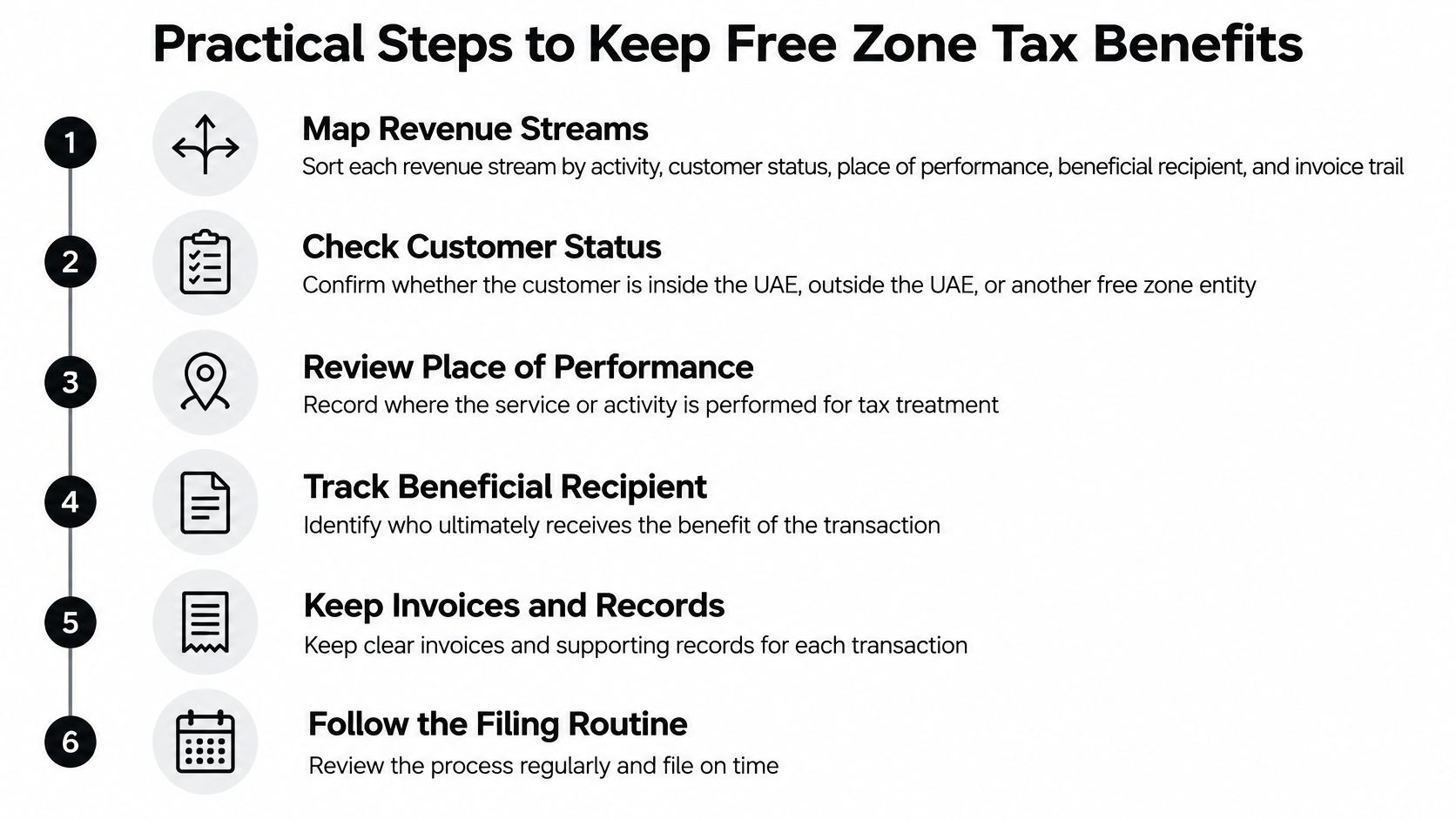
Protection is a monthly routine, not a filing-season exercise. Build the map first. Then monitor the one ratio that can end the preference.
Map Every Revenue Stream
Create one register. One row per stream, not per client. Record these fields and review them whenever the business model shifts:
- Activity: The exact service or trade that earned the revenue, matched to your licence.
- Customer status: Free Zone Person, mainland person, or overseas person, evidenced by licence or registration documents.
- Place of performance: Where the work was done, and by whom.
- Beneficial recipient: Who ultimately receives the benefit of the supply.
- Evidence trail: Contract, invoice, delivery proof, and accounting code for each stream.
Segment the ledger to mirror the register. Qualifying and non-qualifying revenue should never share a code. Costs need an allocation method too, documented in advance, because profit follows revenue classification. If your accountant has to reconstruct the split from invoice PDFs in month thirteen, the system has already failed.
Monitor the De Minimis Ratio
The de minimis test uses the lower of 5% of total revenue or AED 5 million of non-qualifying revenue in a tax period, and for AED 20 million of annual revenue the 5% limb equals AED 1 million, so non-qualifying revenue above that amount would exceed the ceiling, under Ministerial Decision No. 265 of 2023 on Qualifying and Excluded Activities.
Two features catch people out. It's a revenue test, not a profit test, so low-margin non-qualifying work consumes the allowance fast. And the ceiling shrinks with total revenue at smaller scale, because the percentage limb bites first. Forecast both limbs monthly. Don't discover in December that a profitable November contract breached the year.
Before accepting mainland customers, opening a foreign branch, adding property income, or launching a new service, run the forecast with the new stream included. If the ratio breaks, restructure before you sign, not after you invoice.
Choosing the Right Structure and Your Next Step
Choose the structure last. First, list what you'll sell, who will buy it, and where the work will happen. That order sounds obvious. Most failed structures reverse it, starting with the cheapest licence and bending the business to fit.

Match the Profile Before You Incorporate
A free zone entity suits a business whose qualifying activities, customer base, and UAE substance naturally align. If that alignment needs constant exceptions, it's the wrong vehicle. A mainland entity suits a business selling mainly to mainland customers or performing work on the mainland. A mixed group suits a business with separable functions, and only where each entity has the people and records to support its share.
- Free zone: Qualifying activities, free zone or overseas customers, real substance in the zone.
- Mainland: Mainland customers, mainland delivery, simpler income profile.
- Mixed group: Separable functions, documented intercompany pricing, separate ledgers and staff.
Also test the plan, not just the present. A structure that fits this year's trading model may not fit next year's consulting line, property purchase, or overseas branch. Build the review trigger into your governance. Any new activity, customer category, or jurisdiction gets a classification check before launch.
Decision test: If you'd need to explain away half your revenue to keep the preference, you've chosen the wrong structure.
Getting the Structure and Records Aligned
Formation and accounting have to be one conversation. Smart Classic Business Hub is a Dubai-based management consultancy that handles company formation across free zone, mainland, and offshore jurisdictions, alongside VAT-compliant accounting, audit, and corporate finance advisory. Presented plainly, that's the relevant combination for this decision. The entity choice, the revenue map, and the audit file are designed together rather than reconciled later.
Your next step is specific. Draft a one-page revenue map covering current and planned income streams, with activity, customer status, place of performance, and expected value for each. Bring your licence, customer list, intercompany agreements, and current chart of accounts. Test that map against QFZP status, the de minimis ceiling, and your substance evidence in a single review. If a stream doesn't fit, you'll know whether to move it, reprice it, or accept the standard rate on it, before the tax period closes and the options narrow.
Bring us your revenue map and we'll test your free zone, mainland, or mixed structure against the QFZP classification, substance, and filing rules, then set up the formation and VAT-compliant accounting to support it. Book a consultation with Smart Classic Business Hub to review your income streams before your next tax period closes.