
You can do everything “right” for year-end filing and still get caught out in the UAE if your books don't line up with the authority that cares about them. A free zone renewal can stall because the audit file is incomplete, a tax review can raise questions about supporting schedules, or a bank can ask for evidence that was never assembled during the year. That's the point where audit advisory services stop being a formality and start becoming a control system.
What Audit Advisory Services Actually Mean in the UAE
A Dubai founder I know once treated the annual audit as a final tidy-up. The accounts were drafted, the filing deadline was close, and the team assumed the auditor would “just check the numbers”. Then the request came back for clean supporting schedules, documented controls, and clearer evidence around how the books had been maintained through the year.
That kind of moment is common because the UAE framework is broader than a simple year-end review. Federal Decree-Law No. 41 of 2023 defines the profession around auditing, reviewing financial information and statements, and other assurance and related services, while the Ministry of Economy and Tourism's legislation page points to the implementing regulation under Cabinet Decision No. 48/2022 and related standards rules as set out in the official decree text+of+2023.pdf/431e51c1-1de2-8565-1abb-652aab209671). In practice, that means the work is not just about checking ledgers, it's about helping management show that the records can survive scrutiny.
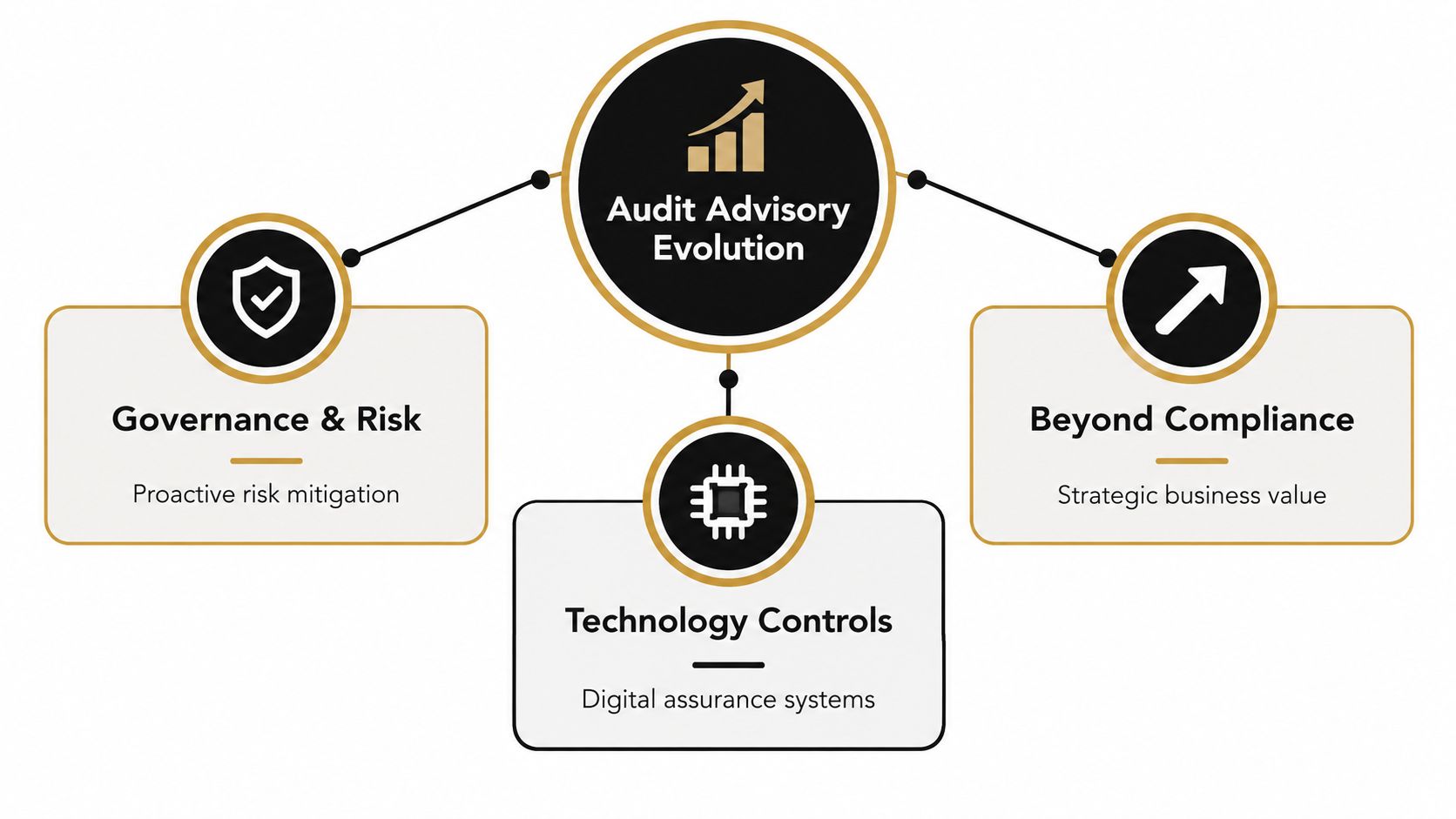
From annual file to ongoing control
The useful shift is to think of audit advisory as a bridge between raw accounting data and regulatory confidence. That bridge matters more in the UAE because oversight is layered, with the Ministry of Economy, the Emirates Association of Accountants and Auditors, and sector bodies such as the DFSA, FSRA, and SCA all part of the picture, and DFSA-regulated firms must use registered auditors under the framework described in the official decree+of+2023.pdf/431e51c1-1de2-8565-1abb-652aab209671).
Practical rule: if your finance team waits until the auditor arrives to assemble proof, you're already late.
Modern advisory work looks at how the records are built, not just how they read at the end. That includes the discipline behind approvals, reconciliations, supporting schedules, and the way management explains judgement areas. A helpful external primer on why this matters in funding and diligence discussions is pass audit and secure funding, because investors often care about the same evidence trail that regulators do.
For many SMEs, this is the difference between “the audit was done” and “the business was ready”. If you want a plain-language explanation of audit basics before going deeper, the overview at what is company audit is a useful starting point.
Why the broader definition changes business behaviour
Once owners see audit advisory as a control exercise, the priorities change. They stop asking only whether accounts can be signed, and start asking whether the underlying process is clean enough to support tax, licensing, financing, and governance demands at the same time. That's the commercial value, because it reduces the chance that a routine request becomes a delayed renewal or a stalled transaction.
Navigating UAE Audit Rules Across Mainland, Free Zone, and Regulator
A mainland SME can prepare its accounts correctly and still face delays if its licence authority, tax obligations, and audit requirements are treated as one rulebook. A free zone entity may need different renewal evidence, filing formats, or auditor arrangements. The practical task is to identify which authority applies before assembling the audit file.
The governance shift that changed expectations
UAE audit oversight has tightened through specific regulatory milestones. A Grant Thornton UAE paper records that the Abu Dhabi Accountability Authority introduced mandatory auditor rotation for regulated companies in October 2014. Under its Statutory Auditor Appointment Rules, auditors were rotated every four years. The paper also notes that the 2015 commercial companies law required public joint stock companies to appoint auditors through shareholder approval, with terms limited to one renewable year and no more than three consecutive years in the paper on the changing role of audit in the UAE. These measures made independence and oversight part of the operating framework rather than an informal year-end concern.
In October 2023, the UAE issued Federal Decree-Law No. 56 of 2023 to establish the UAE Accountability Authority, replacing the Supreme Audit Institution as the supreme authority for financial control and integrity in the official Ministry of Justice source. The change primarily concerns public financial control, but it also reinforces the direction of travel for organisations that must produce defensible financial records.
Before 2014, a mainland SME could treat the audit as a once-a-year filing exercise. After the ADAA rotation rules and the 2023 Accountability Authority, the same SME faces documented independence and evidence expectations throughout the year.
What this means for private firms and free zones
Private companies must separate the requirements that apply to their legal form from those imposed by their authority. A mainland company may need to coordinate accounting records with corporate tax filings and licence renewals. A free zone company may face authority-specific templates, renewal evidence, or restrictions on which auditors can sign its accounts. DIFC and ADGM entities add their own regulatory expectations, particularly where a registered auditor is required.
Automation for regulatory requirements can help teams track deadlines, document requests, and recurring compliance tasks across those rulebooks. It does not replace professional judgement. It reduces the risk that an overlooked filing, approval, or supporting document becomes a renewal delay.
A clean audit file is rarely produced in one busy month. It comes from a system that expects review throughout the year.
Start by mapping the authority, legal structure, tax position, and auditor requirement. Then build the evidence file around those obligations. The external audit process provides a practical reference for how the engagement typically progresses.
Scope of Services and Deliverables Explained
A good audit advisory engagement in the UAE doesn't stop at the statutory audit opinion. It usually starts with a readiness review, expands into controls work, and ends with evidence that management can use for regulators, banks, or group reporting.

What firms now expect from the engagement
RSM notes that UAE firms commonly package statutory audits with internal audit, regulatory compliance, ESG sustainability assurance, cybersecurity and IT assurance, and AML/CFT or UBO compliance reviews in its audit and assurance offering. That mix reflects what clients face, overlapping obligations that affect finance, operations, access rights, approvals, and evidence retention.
The practical deliverables usually include:
- Control design testing, to see whether the control exists and is documented properly.
- Operating effectiveness testing, to check whether the control is working as intended in day-to-day use.
- Evidence packs, so the company can answer a regulator or bank before a request turns into urgency.
- Exception logs, which show where segregation of duties, reconciliations, or access controls need repair.
Many teams underestimate the value of advisory. They think they need a report, when they really need a cleaner operating model. If finance staff, operations staff, and IT administrators all hold overlapping permissions, the audit file will expose it eventually, but advisory work gives the business a chance to fix the structure first.
Where the technical work is strongest
The strongest advisory engagements are practical, not theoretical. They identify where approvals are informal, where supporting evidence is scattered, and where the ledger no longer matches the operational story. That matters because external reviewers don't just want balances, they want proof that the balances came from a controlled process.
**Good advisory leaves fewer surprises for the audit. Bad advisory produces a polished memo and an unchanged process.
For businesses that keep the accounting function partly in-house, the boundary between bookkeeping and assurance can get blurry. A useful internal reference on that separation is accounting and bookkeeping services in Dubai, especially where companies need the books to be audit-ready rather than just up to date.
How to scope the work properly
The mistake I see most often is buying a standard package and assuming it fits. A trading company with a simple supply chain has different risks from a free zone services firm with revenue recognition judgement, and both differ from a regulated group with UBO and sanctions-screening concerns. The scope should follow the risk, not the brochure.
A well-scoped engagement usually answers three questions. What needs to be tested, what evidence already exists, and what gaps would cause pain if a bank, licensor, or auditor asked next week. If the adviser can't answer those clearly, the service is probably too thin.
Who Needs Audit Advisory and When
The simplest answer is that more UAE companies need audit advisory earlier than they think. The better answer is that the trigger depends on revenue, legal form, free zone rules, and whether the business sits inside a tax group or a regulated activity.
The statutory triggers that change the timeline
In the UAE, taxable persons that are not part of a tax group must prepare audited financial statements once revenue exceeds AED 50 million, and any Qualifying Free Zone Person must be audited regardless of revenue according to the UAE audit checklist guidance. Many major free zones also require annual audited statements for licence renewal, which means the audit is tied to continuity of operations, not just annual filing.
That creates a very different planning horizon. If your company only starts preparing after the year closes, you're already compressing the time available to resolve reconciliations, evidence gaps, and policy issues. It's much safer to build the file throughout the year, especially when IFRS-aligned books and revenue recognition evidence will be needed to support the submission.
Comparing the practical need by business type
A mainland SME often needs advisory because the filing consequences are indirect at first. The books must be disciplined, but the pressure may not show up until tax, banking, or investor due diligence becomes active. A free zone entity feels the pressure sooner because renewal timing can force the issue.
A tax group sits in another category. Once group reporting is involved, the advisory work needs to cover consolidation logic, intercompany balances, and documentation discipline across entities. That's a different level of readiness from a standalone company that only needs one file.
Rule of thumb: if the authority can stop your licence, your renewal, or your filing, audit advisory is no longer optional housekeeping.
The bad approach is to buy a broad, annual-only service and hope it catches everything. The better approach is to choose the scope that matches the actual trigger, then add readiness support for the months when evidence is being generated. That way the company isn't paying twice, once for cleanup and once for correction.
For SMEs, the practical question isn't “Do I need an audit?” It's “Which rule reaches me first, and what records must already exist when it does?” That framing saves time, reduces friction, and avoids the common mistake of treating every UAE entity as if it follows the same rulebook.
Choosing the Right Audit Advisory Partner
The right adviser in the UAE needs more than accounting literacy. They need to understand how mainland, free zone, DIFC, and ADGM requirements differ, and they need to know how tax, AML, and licensing issues can surface in the same file.
What to look for before you sign
Start with local regulatory fluency. If a firm can't explain which authority is likely to care about your company's records, it will struggle when deadlines get close. The same applies to process, because audit advisory is less useful when it ends with a file handover and no explanation of the control gaps that created the risk.
The other signal is whether the adviser connects audit preparation with tax controls and AML evidence. The LexisNexis Gulf Tax Winter 2025 commentary notes that regulators are increasing scrutiny of documentation, beneficial ownership, and sanctions-screening obligations, while fee pressure in the UAE is high and discretionary advisory spend has softened in the winter 2025 tax publication. That combination means many firms delay preventive support until the problem is already urgent.
Where advisory value is actually created
The most useful partner reduces downstream pain. That means fewer surprises at licence renewal, fewer missing schedules when a bank asks questions, and fewer delays when management wants accounts signed. It also means the adviser is willing to say when the scope should be narrower, because the cheapest service is not the one with the lowest fee, it's the one that avoids rework.
Here's the trade-off:
- Lower-cost, reactive support can work for a simple entity with clean records and no special licensing pressure.
- Preventive support costs more up front, but it usually pays back in smoother renewals, less back-and-forth, and stronger evidence discipline.
- Over-scoped advice adds expense without improving readiness, which is why the adviser's judgement matters as much as their technical skill.
The best partner doesn't just tell you whether the file is ready. They tell you where the file will break before anyone else sees it.
One practical option in this market is Smart Classic Business Hub, which combines audit-related support with broader company, tax, and accounting services. That kind of integrated setup can help when a business needs its records aligned across formation, bookkeeping, and audit readiness rather than managed in separate silos.
How Smart Classic Delivers Audit Advisory in the UAE
Smart Classic Business Hub is built around the fact that UAE compliance rarely sits in one lane. A founder may need company formation help, VAT-compliant accounting, and audit preparation at the same time, while an operating SME may need financial management support, feasibility work, or help coordinating the documents that sit behind a statutory audit.

A joined-up service model for SMEs
What matters here is not just the list of services, but how they fit together. If the accounting function is clean, the audit file is easier to defend. If the company formation and licence structure are clear, the adviser can map the correct reporting obligations faster. If the client also needs legal support or recruitment help, fewer moving parts fall through the gaps.
That kind of joined-up approach is useful for entrepreneurs who don't want to manage five separate vendors for one compliance cycle. It's also practical for international investors who want a single operating view of the business while they expand in the UAE. Smart Classic Business Hub is one option for that model, alongside other professional firms that work across setup, accounting, and audit-readiness support.
The point is simple. Audit advisory works best when it isn't isolated from the rest of the compliance stack. A business that aligns bookkeeping, tax preparation, and audit support has a much easier time responding to licence, lender, and regulator questions.
If your company is entering a renewal cycle, preparing for a tax filing, or trying to clean up the file before an audit starts, the next move should be practical. Speak to a team that can review your records, identify what's missing, and build a compliance plan that fits the authority you answer to. Visit Smart Classic Business Hub to discuss the audit advisory support your UAE business needs and put a cleaner filing process in place before the next deadline lands.