
You've just closed a large wholesale order on Friday. By Sunday, you're dealing with a missed filing window, a payroll run that hasn't gone out, and a bank reconciliation showing supplier invoices that nobody can locate. The problem isn't that your business lacks activity. It's that sales, payroll, VAT, and financial records aren't moving through one controlled process.
That's where professional accounting and bookkeeping services in Dubai earn their place. The right provider doesn't just post transactions or produce a year-end report. They connect source documents, reconciliations, payroll, VAT reporting, corporate tax preparation, and management accounts into a repeatable monthly close.
Why Dubai Founders Need More Than a Spreadsheet
Your sales ledger balances, but the VAT return uses the wrong invoice date, payroll was approved from an outdated staff file, and corporate tax provision is missing from the management accounts. This is how a spreadsheet becomes a control risk. It may work while transactions are few. Once supplier accounts, employees, and tax obligations grow, it cannot reliably connect the records that management and regulators rely on.
VAT raised the operating standard for UAE businesses on 1 January 2018, when the UAE introduced VAT at a standard rate of 5%. The registration thresholds and filing deadlines belong in the compliance calendar below, not in an isolated spreadsheet. A proper bookkeeping process must retain transaction-level records, tax invoices, input and output VAT classifications, credit notes, reconciliations, and filing support, as outlined in this UAE tax and accounting guide.
The monthly close is one control cycle
Every month should run through one controlled sequence. Source documents are collected, transactions are posted, banks and cards are reconciled, payroll is checked, and management accounts are reviewed. The same closing data then supports the VAT return and corporate tax provision.
A missing supplier invoice can understate expenses, change recoverable input VAT, alter reported profit, and leave the bank reconciliation unresolved. Payroll has the same dependency. Salary processing, WPS documentation, gratuity provisions, and management accounts should use one organised data set, with clear approval before the close is locked.
Practical rule: If your VAT return, payroll file, and management accounts come from separate spreadsheets, you don't have a control cycle. You have three potential error streams.
The UAE corporate tax regime adds a second review layer. It applies to financial years starting on or after 1 June 2023, with 0% on taxable income up to AED 375,000 and 9% above that threshold, according to the UAE government corporate tax guidance. The accounting team must separate accounting profit from taxable profit, identify deductible and non-deductible expenses, and retain evidence for related-party transactions.
Your provider should set a fixed monthly close timetable. Assign ownership for document collection, reconciliation, payroll approval, VAT review, tax provisioning, and management reporting. The workflow must also reflect whether the company is mainland, free zone, or offshore, and whether revenue crosses the AED 50 million audit threshold. A spreadsheet can support that process, but it should not control it.
What Core Accounting and Bookkeeping Services Cover
A serious proposal for accounting and bookkeeping services in Dubai should describe deliverables, not just promise “full support”. Ask what you'll receive, when you'll receive it, and who reviews it.
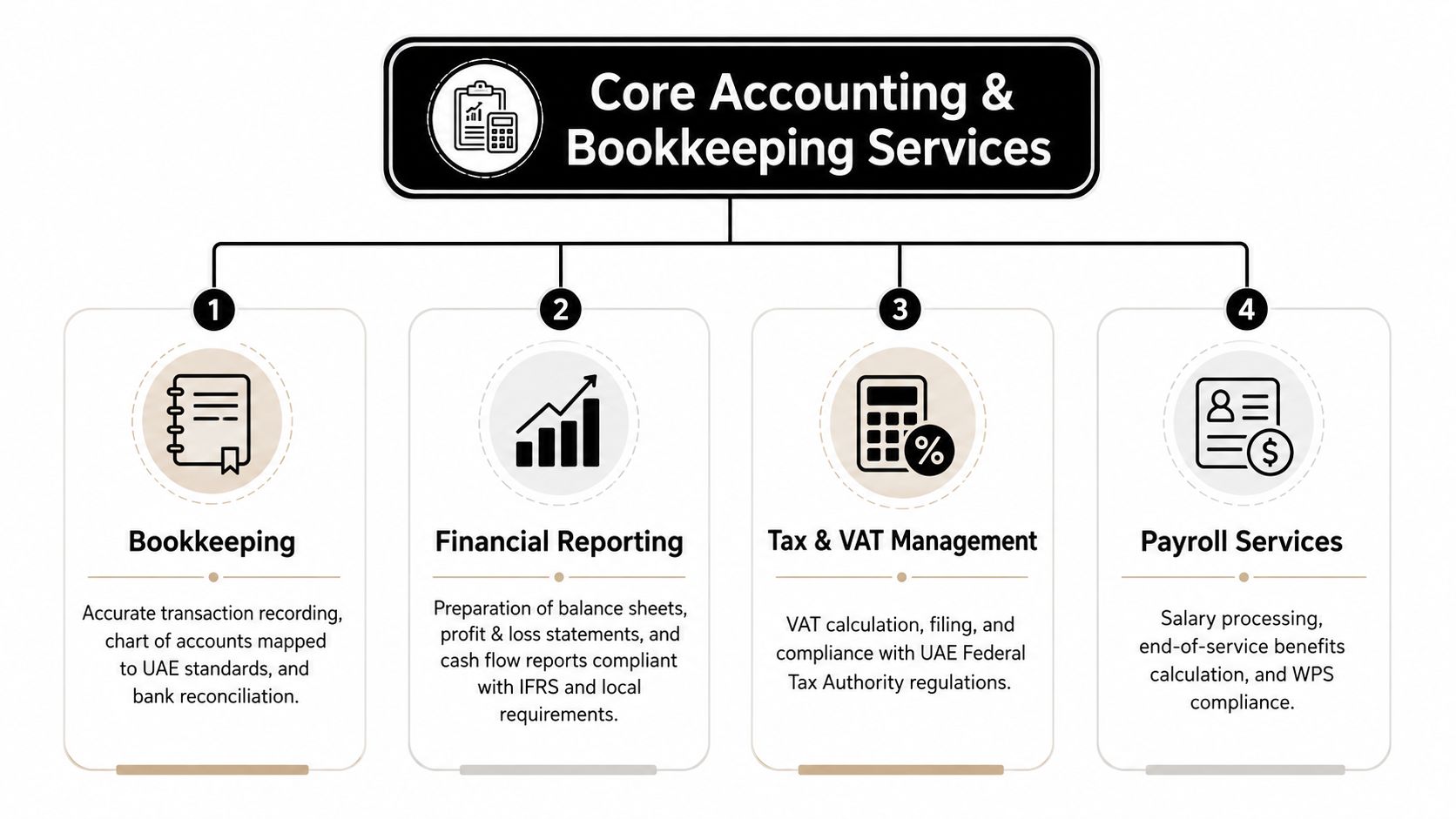
Bookkeeping creates the evidence base
The provider should configure a chart of accounts that reflects the business model and supports UAE reporting requirements. The recurring work normally includes:
- Transaction posting: Sales, purchases, expenses, receipts, payments, journals, and other source documents are recorded in the accounting system.
- Bank and card reconciliation: Book balances are matched against statements, with unreconciled items investigated rather than carried forward indefinitely.
- Receivables and payables: Customer ageing, supplier ageing, outstanding invoices, credit notes, and payment status are maintained.
- Asset records: Fixed assets, additions, disposals, depreciation, and supporting documentation are tracked in a fixed-asset register.
The tangible output should include an updated ledger, reconciled bank accounts, an ageing report, and a VAT reconciliation file. You should be able to trace a reported figure back to an invoice, receipt, bank entry, or approved journal.
Payroll needs its own approval trail
Payroll support should cover salary calculations, WPS file preparation, leave and deduction inputs, gratuity provisioning, and end-of-service benefit calculations. Where relevant, the provider should also coordinate payroll information relating to UAE nationals and the applicable reporting process.
Don't accept a payroll service that only sends a payment schedule. You need an approved payroll register, evidence of employee changes, salary instructions, and a record showing who authorised the final file.
Financial statements turn records into decisions
Monthly management accounts should normally include a profit and loss statement, balance sheet, cash position, and commentary on material movements. Quarterly reviews can focus on gross margin, receivable collection, supplier exposure, working capital, and budget performance.
Annual statements should be prepared on an IFRS-aligned basis where applicable. The UAE's accounting environment has moved from basic ledgers towards standards-based financial management, shaped by developments including the Dubai International Financial Centre and Dubai Financial Services Authority, as discussed in this overview of financial transparency in Dubai. For a practical discussion of reporting choices, founders can also review accounting standards for SMEs and these 2026 finance strategy insights.
Audit support protects the year-end timetable
Audit support should include a prepared audit file, lead schedules, reconciled balances, explanations for unusual entries, liaison with the appointed auditor, and assistance with adjusting journals. A signed trial balance alone isn't enough if the supporting schedules are incomplete.
Regulatory Requirements and Filing Deadlines That Drive the Work
Your accounting calendar should follow regulatory triggers, not the bookkeeper's preferred routine. The VAT registration thresholds were covered earlier. The work after registration is operational: confirm the assigned tax period, reconcile sales and purchases, check tax invoices and credit notes, and prepare the return from a ledger that agrees with the supporting documents.
VAT return timing depends on the tax period assigned to the business. Some companies file monthly and others quarterly, so your provider must verify the cycle in the tax records instead of assuming it. A missed deadline usually starts with incomplete bookkeeping, not the final submission itself.
Corporate tax creates a separate calendar for the same records. The regime applies to relevant financial years, and returns generally fall due within the prescribed period after the tax period ends. Keep the tax computation, supporting schedules, elections, and evidence for deductions together with the underlying ledger. The UAE tax and accounting guide provides a useful compliance reference, while the UAE record-keeping requirements set out the documents the business should retain and control.
| Obligation | Trigger or Threshold | Filing Frequency | Penalty Risk |
|---|---|---|---|
| VAT return | Assigned tax period | Monthly or quarterly, depending on the FTA-assigned period | Late or unsupported filings can create FTA exposure |
| Corporate tax return | End of the relevant tax period | Generally within the prescribed filing period | Late filing and unsupported deductions create compliance exposure |
| Record retention | VAT and corporate tax record requirements | Continuous document control | Missing evidence can affect VAT recovery and tax deductions |
| Statutory audit | Revenue above the AED 50 million threshold, or specific free zone requirements | Annual where applicable | Late or incomplete audit evidence can delay reporting |
The provider should run one control cycle across bookkeeping, VAT, corporate tax provisioning, and payroll month-end close. Each month, bank balances, receivables, payables, payroll journals, tax accounts, and fixed assets should be reconciled. The resulting ledger then supports VAT filings and the corporate tax provision, while payroll evidence confirms that salary entries and employee changes are complete.
The document workflow matters as much as the filing date. Preserve tax invoices, credit notes, bank statements, general ledgers, payroll files, fixed-asset registers, inventory records, and submitted returns in an audit-ready format. The UAE record-keeping guidance explains why reconciliation between source documents, ledgers, and submitted returns cannot be treated as optional. Once revenue crosses the audit threshold, add audit schedules and evidence requests to the monthly close rather than assembling them at year-end.
Mainland, Free Zone, and Offshore Accounting Differences
The licence type changes the accounting workload. Founders often compare mainland and free zone structures based on setup cost or perceived tax advantages, but the accounting question is narrower and more useful: What books, audit evidence, tax analysis, and related-party documentation will this entity need?
Mainland companies carry the broadest routine workload
A mainland company generally faces the widest filing surface when it trades locally. The accounting function must support VAT where registration is triggered, corporate tax calculations, payroll records, financial statements, and document retention. A statutory audit becomes particularly important when revenue approaches the AED 50 million threshold identified in UAE guidance, while entity-specific legal or licensing requirements can create additional obligations.
Mainland groups also need to watch transactions with related parties, especially where a mainland company trades with a free zone entity or another connected business. The books must show the commercial basis of the transaction and preserve supporting agreements, invoices, and pricing analysis.
Free zone entities need eligibility discipline
A free zone company isn't automatically entitled to favourable corporate tax treatment. The provider must assess whether the entity qualifies as a Qualifying Free Zone Person, separate qualifying and non-qualifying income, maintain adequate substance, and prepare records that support the position.
Free zone companies can also face audit requirements imposed by the relevant authority, including circumstances where audited financial statements are required regardless of revenue. Related-party dealings can create transfer pricing documentation needs, particularly where the entity works with mainland parties.
Offshore structures still need transparent records
Offshore entities registered in structures such as JAFZA Offshore or RAK ICC may have a narrower operating profile and different tax treatment for qualifying foreign income. That doesn't mean the company can operate without books. UBO declarations, ownership records, bank evidence, contracts, and beneficial ownership transparency remain practical record-keeping requirements.
| Factor | Mainland | Free Zone | Offshore |
|---|---|---|---|
| Core accounting focus | Local trading, VAT, corporate tax, payroll, and management accounts | QFZP eligibility, income segregation, audit evidence, and related-party records | Foreign activity, ownership records, banking support, and transparency documentation |
| Audit consideration | Revenue above AED 50 million and other applicable triggers | Free zone authority rules and QFZP requirements can apply | No general statutory audit mandate is assumed, but authority or banking requirements may still matter |
| Transfer pricing | Relevant for related-party transactions | Particularly important for dealings with mainland or connected entities | Relevant where related-party transactions exist |
| Tax analysis | Accounting profit adjusted to taxable profit | Qualifying and non-qualifying income must be distinguished | Treatment depends on the entity's activities and qualifying income |
| Best accounting setup | Full monthly close with tax and payroll integration | Strong classification and evidence controls | Lean records with robust ownership and transaction documentation |
The right structure depends on the activity, not the marketing label. This mainland versus free zone comparison is useful for founders weighing the accounting consequences before incorporation.
Typical Dubai Accounting Packages and What They Actually Cost
Pricing only becomes meaningful when the provider defines the workload. A low monthly fee may cover a small number of transactions but exclude payroll, tax filings, catch-up work, audit support, and year-end adjustments.
For a micro-SME with fewer than 25 transactions a month, a typical package may sit around AED 1,500 to AED 2,500 monthly. That often includes cloud bookkeeping, bank reconciliation, monthly management accounts, and one VAT return per quarter. It usually won't include extensive cleanup, multiple bank accounts, inventory accounting, payroll, or corporate tax work.
A mid-tier SME package commonly falls between AED 3,000 and AED 6,000 monthly. The stronger proposals at this level add payroll for up to 10 employees, fixed-asset maintenance, corporate tax provisioning, and ESR filing. Confirm whether “payroll” means preparation only or includes WPS file support, employee changes, gratuity calculations, and approval coordination.
Premium engagements start at AED 7,000 upwards and are designed for more complex businesses. They may include audit liaison, transfer pricing documentation, multi-entity consolidation, board reporting, and dedicated CFO advisory. These inclusions are not automatic, so they should appear explicitly in the engagement letter.
| Package tier | Monthly fee (AED) | Typically included | Usually billed extra |
|---|---|---|---|
| Micro-SME | AED 1,500 to AED 2,500 | Cloud bookkeeping, routine reconciliation, management accounts, one quarterly VAT return | Cleanup, payroll, high transaction volume, corporate tax projects |
| Mid-tier SME | AED 3,000 to AED 6,000 | Bookkeeping, payroll for up to 10 employees, fixed assets, tax provisioning, ESR filing | Audit fees, complex tax analysis, transfer pricing, extensive catch-up work |
| Premium | AED 7,000 upwards | Audit liaison, consolidation, transfer pricing support, CFO advisory | Specialist legal, tax opinions, authority representation, exceptional projects |
Year-end audit fees can sit outside the retainer and may add AED 8,000 to AED 25,000, depending on scope, as can certain AML filings, ESR notifications, and other compliance projects. A separate bookkeeping service cost guide can help you compare how providers describe pricing, but your quote still needs a transaction-volume definition, an overage rate, and a clear list of bundled returns.
Ask three questions before comparing prices:
- What counts as a transaction? Clarify whether invoices, bank lines, payroll entries, and journals are counted separately.
- What happens above the limit? Require the per-transaction or revised-volume rate in writing.
- Which returns are included? Confirm VAT, corporate tax support, ESR, audit coordination, and amendments separately.
How the Engagement Process Works Step by Step
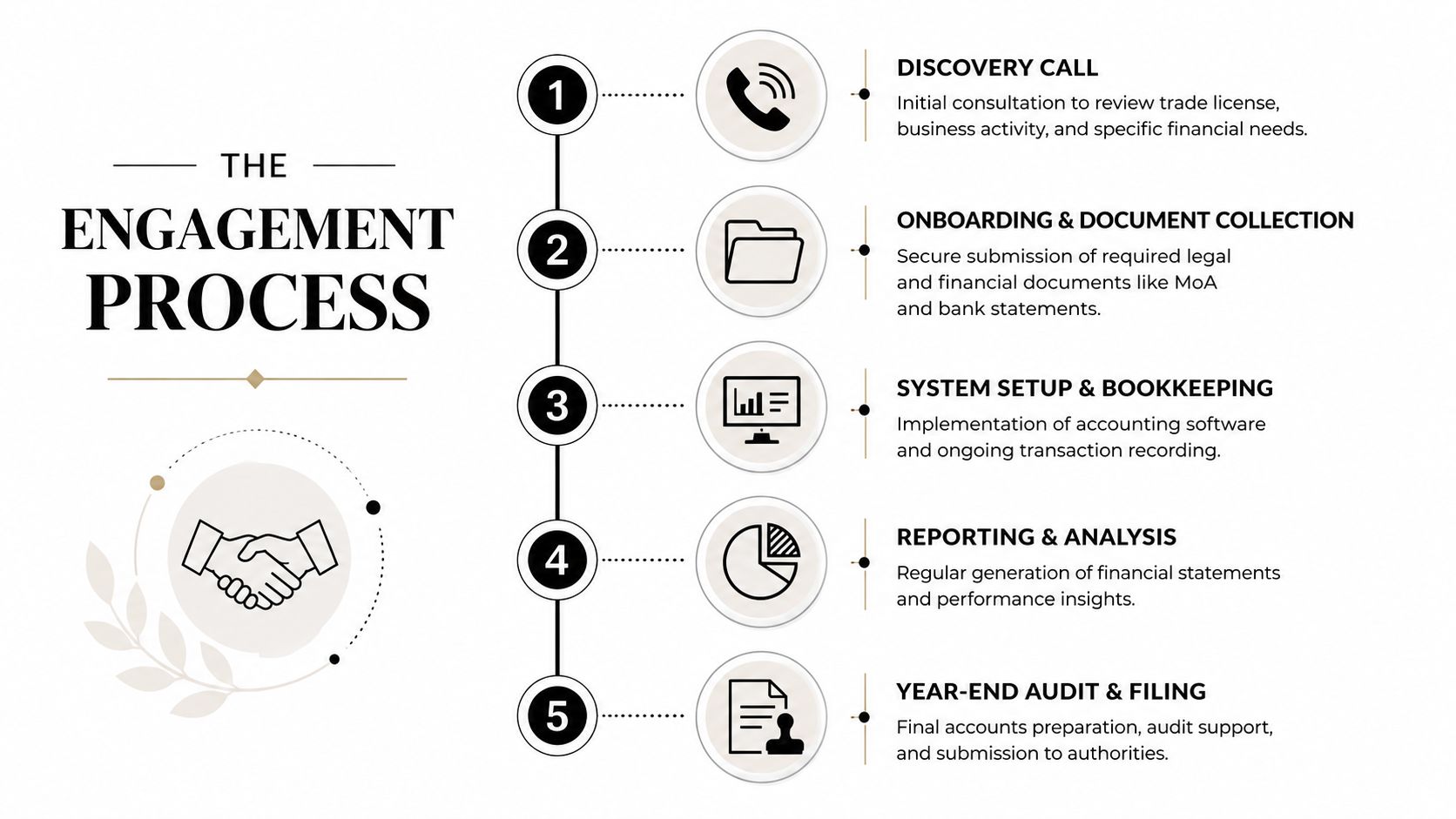
A properly managed engagement starts with diagnosis, not a generic package. The provider needs to understand the legal entity, trade licence, activity, transaction flow, employees, tax registrations, and existing software before quoting accurately.
1. Discovery and document collection
The first call should review the trade licence, business activity, transaction volume, employee count, bank accounts, current accounting platform, and unresolved compliance matters. Onboarding normally requires the trade licence, MOA, VAT registration certificate, corporate tax registration, prior bank statements, existing ledgers, and chart of accounts.
The provider should also identify missing records immediately. A business with incomplete prior periods needs a cleanup plan before recurring bookkeeping begins.
2. System setup and recurring close
The team can migrate or configure platforms such as Xero, QuickBooks, or Zoho Books, then connect bank feeds and establish document-upload rules. The chart of accounts should distinguish revenue streams, VAT categories, payroll costs, fixed assets, related-party balances, and tax adjustments.
The monthly close then runs in a fixed order:
- Collect and post documents: Record sales, purchases, expenses, receipts, payments, and journals.
- Reconcile balances: Match bank, card, receivables, payables, payroll, and control accounts.
- Process payroll: Prepare the payroll register and WPS file for approval.
- Prepare tax outputs: Build the VAT summary and corporate tax provision from reconciled figures.
- Issue management accounts: Deliver the profit and loss statement, balance sheet, cash position, and exception commentary.
A practical target is to complete the recurring close within 10 working days of month-end, provided the client supplies documents and approvals on time. The workflow should also include quarterly VAT work, corporate tax provisional preparation, and any applicable ESR activity.
3. Year-end and audit coordination
At year-end, the provider prepares financial statements, lead schedules, supporting reconciliations, and the audit request list. They should communicate directly with the appointed auditor, track open queries, post approved adjustments, and keep the final accounts package organised.
Use a clear engagement letter, with digital signing if appropriate. An overview of affordable eSign for accounting contracts can help a small business compare contract-signing options before onboarding.
Real Client Scenarios and How the Service List Adapts
The service list doesn't change because a provider uses different terminology. It changes because the entity's transactions, tax position, payroll profile, and audit exposure change.
Mainland retail SME
Consider a mainland retailer generating AED 18 million in mixed-tax revenue. The priority isn't a polished annual report. It's daily point-of-sale reconciliation, matching card settlements to sales, investigating cash variances, classifying purchases correctly, preparing the monthly VAT return, and running WPS payroll for 22 staff.
The provider should monitor inventory movements, supplier credit notes, discounts, refunds, and payment gateway reports. Management accounts need to show gross margin by category or outlet, not just a single annual revenue figure.
Free zone consultancy
A free zone consultancy that qualifies as a Qualifying Free Zone Person has a different risk profile. Its accounting team needs to preserve evidence supporting the qualification, separate qualifying from non-qualifying income, document substance, and track related-party transactions.
The business may have fewer operational transactions than a retailer, but classification quality matters more. A mislabelled service invoice or undocumented related-party charge can weaken the tax analysis, even when the ledger appears tidy.
Scale-up approaching the audit threshold
A growing company nearing AED 50 million in revenue needs to stop treating audit preparation as a year-end event. The team should strengthen monthly management accounts, close balance-sheet reconciliations promptly, maintain transfer pricing files, and resolve unusual entries before the auditor receives the ledger.
| Client Profile | Licence Type | Priority Deliverables | Risk Watchouts |
|---|---|---|---|
| Retail business with AED 18 million mixed-tax revenue and 22 staff | Mainland | POS reconciliation, VAT return preparation, inventory controls, WPS payroll, margin reporting | Missing invoices, refunds, payment gateway differences, payroll approval delays |
| Consultancy qualifying as a QFZP | Free zone | Income segregation, substance evidence, related-party records, management accounts | Loss of support for qualifying treatment, weak transfer pricing documentation |
| Fast-growing business nearing AED 50 million revenue | Mainland or free zone | Audit-ready close, financial statements, transfer pricing files, board reporting | Late reconciliations, unsupported balances, delayed audit preparation |
These examples show why a competent provider reweights the same control cycle. Bookkeeping, payroll, tax, and reporting remain connected, but the review points must match the entity.
A Practical Checklist Before You Sign With a Provider
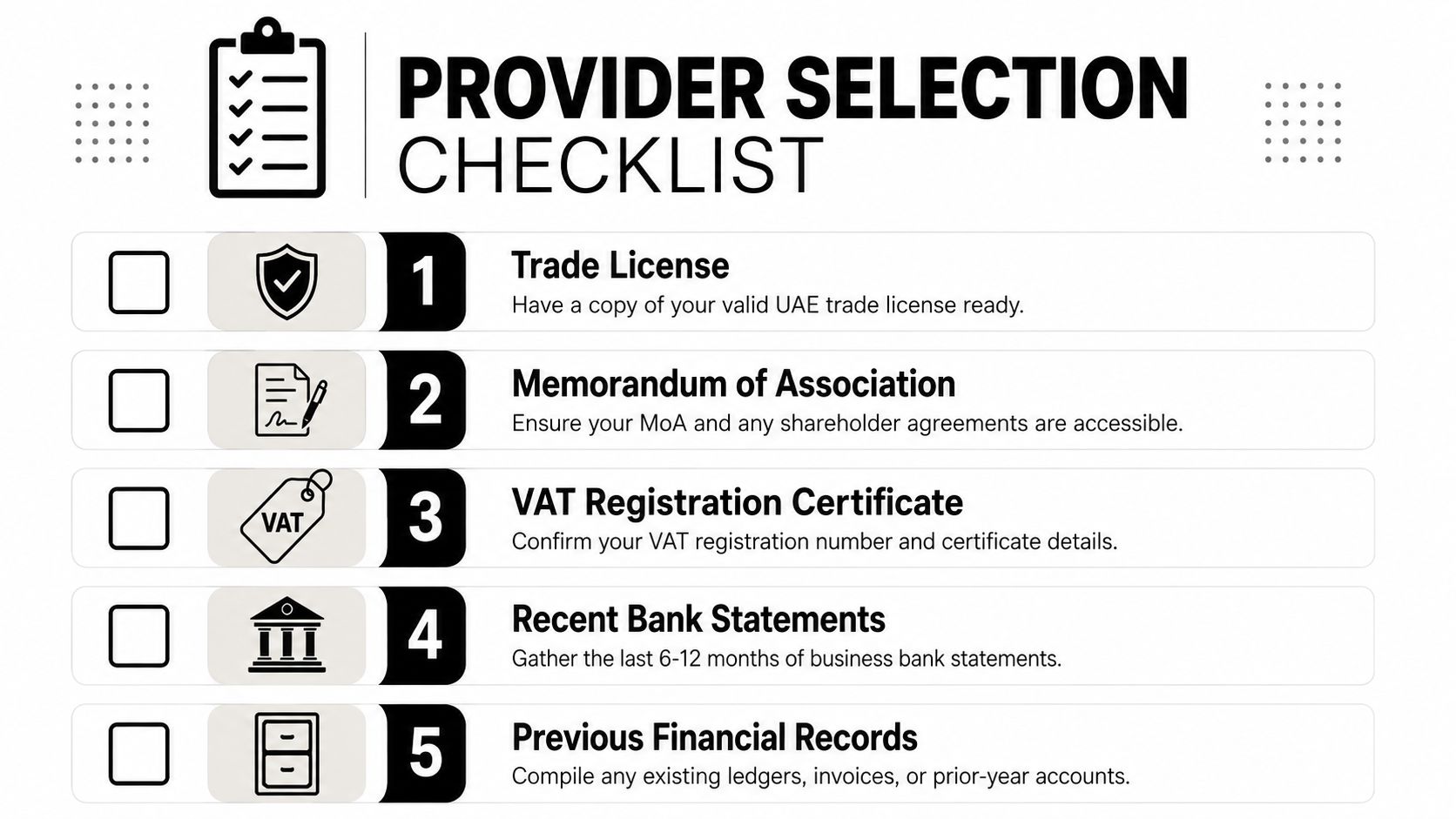
Take this checklist into the first sales call. If the provider can't answer the operational questions, a polished proposal won't rescue the engagement.
Prepare the information they'll need
Have the following ready:
- Trade licence: Provide the current licence and confirm the licensed activity.
- Corporate documents: Keep the MOA, shareholder information, and relevant amendments accessible.
- Tax records: Supply the VAT registration certificate and corporate tax registration details.
- Bank records: Gather recent business bank statements and identify every account used for company activity.
- Payroll information: Prepare employee data, salary records, leave inputs, deductions, and WPS access requirements.
- Prior accounts: Share existing ledgers, financial statements, audit reports, VAT returns, and unresolved reconciliations.
- Software access: Arrange controlled access to Xero, QuickBooks, Zoho Books, document storage, and bank feeds.
Confirm who controls each decision
Ask who approves the VAT return before submission, who signs the WPS file, who reviews management accounts, and who can authorise journal entries. Your provider should maintain a visible approval trail rather than rely on informal WhatsApp messages.
Then ask these questions directly:
- Which qualified accountant reviews the bookkeeping and tax work?
- How are FTA queries, amendments, and potential errors escalated?
- Is transfer pricing documentation included or quoted separately?
- What happens when revenue approaches the AED 50 million audit threshold?
- How are missing documents and unreconciled balances reported?
- What is the deadline for client approvals each month?
- Which VAT returns, corporate tax tasks, ESR filings, and audit services are included in the retainer?
- How does the provider protect and return your accounting data if the engagement ends?
A good provider will answer with a workflow, named responsibilities, review points, and deliverables. Don't sign based on a vague promise of “complete accounting support”. Sign when you understand exactly what gets done every month, what evidence you receive, and what costs sit outside the package.
Smart Classic Business Hub provides VAT-compliant accounting, bookkeeping, audit record organisation, and wider UAE compliance support for entrepreneurs and SMEs. If your business needs a connected monthly close across VAT, corporate tax, payroll, and management reporting, visit Smart Classic Business Hub to discuss the right service scope for your entity.