
You've submitted the bank account application, prepared employee visa documents, or agreed a supplier contract. Then a portal search shows your trade license as pending, expired, or inconsistent with the record held by another authority. The next step stops, even though the business may look fully established on paper.
That situation is common because trade license status in the UAE is more than a document label. It's a live compliance signal that can affect banking, visas, contracts, customs registration, and dealings with government departments. A reliable verification process starts by identifying which authority issued the licence, what the current status means, and which underlying requirement is holding it there.
Understanding Trade License Status in the UAE
A founder once came to us after a bank requested confirmation that the company was active. The founder had a signed lease, an approved business activity, and an initial approval certificate. On the authority's system, however, the final trade licence hadn't been issued. The bank treated the application as incomplete, and the company couldn't move forward with the account opening.
That outcome wasn't unusual. Initial approval allows a business setup process to continue, but it isn't the same as an active trade licence. Dubai's business setup process includes activity selection, legal-form selection, trade-name registration, initial approval, constitutional documents, premises, additional approvals, and final submission of documents and fees. The licence status reflects where the business sits within that chain, not whether somebody has uploaded a document.

Why the status field matters
The UAE's National Economic Register, or NER, is the country's largest unified database of business licences across all seven emirates. When the Ministry of Economy announced the register on 1 October 2024, it said the database contained 1.5 million active and cancelled commercial licences. The Dubai business setup guidance explains why this matters in practice. Users can check licence details, economic activities, and trade-name availability through a federal platform.
That central visibility makes status verification more useful, but it doesn't remove the need to understand the issuing authority. A record may show that a company exists while a separate process remains blocked because a renewal, tenancy record, external approval, or final issuance step is incomplete.
Practical rule: Treat trade license status as a live registry attribute. Don't rely on an old PDF when a bank, immigration department, customs authority, or contracting party needs evidence of current good standing.
A status check should therefore answer four questions:
- Does the legal entity currently hold a valid licence?
- Has the final licence been issued, or is the application still progressing?
- Which activities and legal form are recorded?
- Is there a problem behind the status that blocks the next transaction?
Founders dealing with cross-border suppliers, tax registrations, or overseas counterparties may also benefit from an international trade and tax guide that explains the wider compliance context. For a plain-language introduction to the UAE concept itself, the guide on what a trade licence in the UAE is provides useful background before you investigate a specific record.
Why Trade License Status Acts as a Legal Milestone
Dubai's approval process draws a firm line between permission to proceed and permission to operate. A business can receive initial approval while still needing constitutional documents, a suitable business location, additional government approvals, and final document submission. Until the authority issues the final approved trade licence, the company hasn't reached the operational milestone that many downstream systems require.
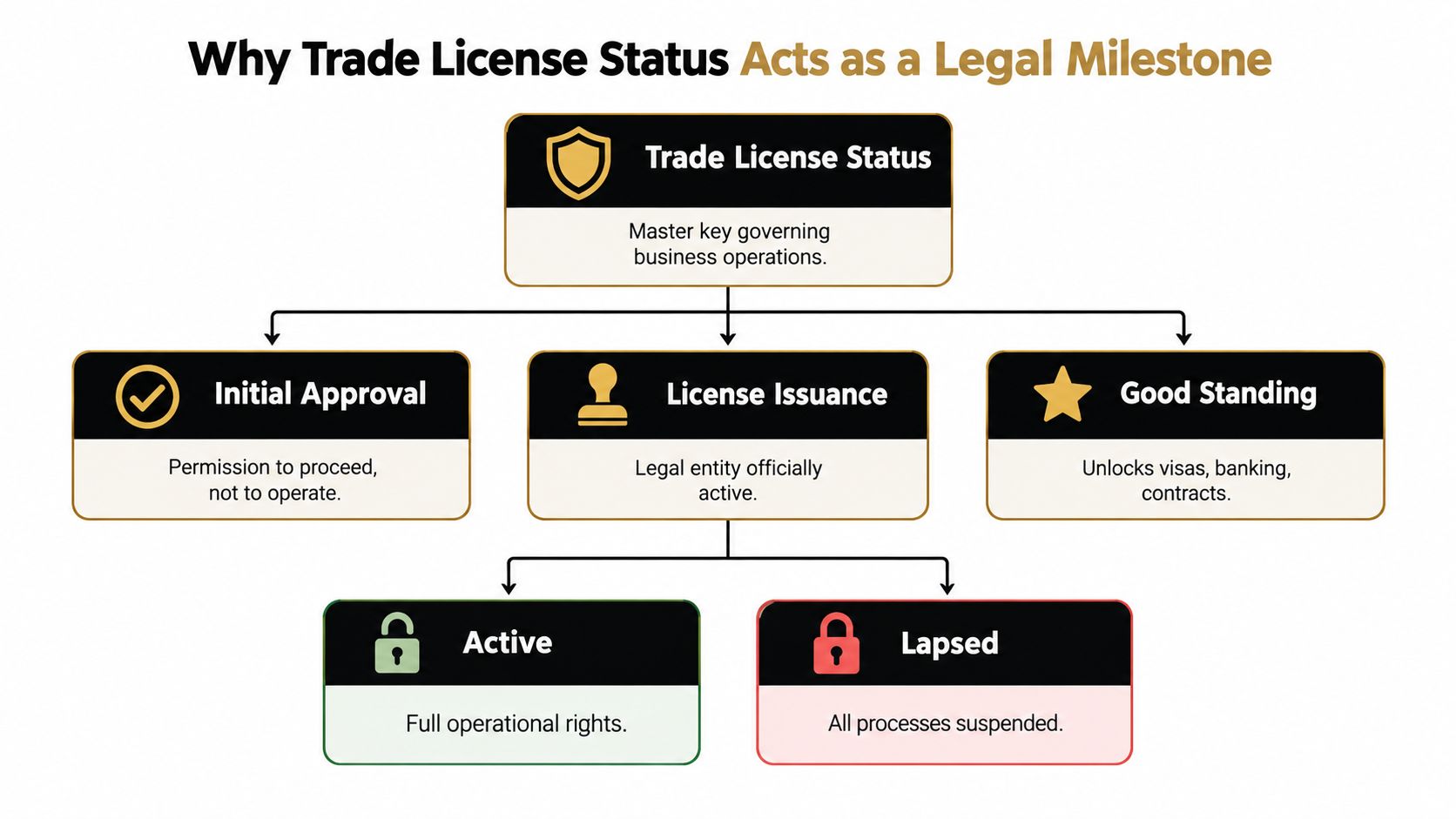
Initial approval isn't the operating licence
The distinction becomes clear with customs registration. Dubai Customs requires a final approved Trade Licence, not an initial approval certificate. That means a company may have passed an early screening stage but still lack the evidence needed to register for a downstream government service. The official Dubai business setup options guidance also states that mainland company licensing is handled by the Dubai Department of Economy and Tourism.
This is why status functions as a control point. It determines whether another authority can accept the company for a related service. A pending record may allow the founder to complete setup tasks, but it won't necessarily support customs, banking, visas, or contracting.
Active status and good standing
Active usually means the licence has been issued and remains within its validity period. It doesn't guarantee that every other compliance obligation is complete, but it gives counterparties and authorities a current legal record to verify.
Good standing is the stronger operational condition. Banks may ask for a current licence and supporting corporate documents. A government department may compare the licence details with immigration, premises, or registration data. A supplier may want confirmation that the entity can lawfully enter into the proposed contract.
The same principle applies across mainland and free zone structures, although the relevant authority and portal differ. A free zone company may have a current record within its zone system while a federal lookup provides a broader verification point. A mainland company may need to resolve an emirate-level issue before its public-facing record accurately reflects its operating position.
A trade licence is not just proof that a company was formed. Its current status helps determine what the company can do next.
When a status is unclear, don't ask only whether the licence is “valid”. Ask which transaction the current status is supposed to support and what evidence that transaction requires. That approach exposes the blocker faster than repeatedly downloading the same certificate.
How to Check Trade License Status Across UAE Portals
Start with the National Economic Register when you need a federal view of the business record. The NER is designed to centralise licence visibility and lets users check licence details, activities, and trade-name availability. Use the company's exact registered name and compare the result with the licence copy supplied by the business.
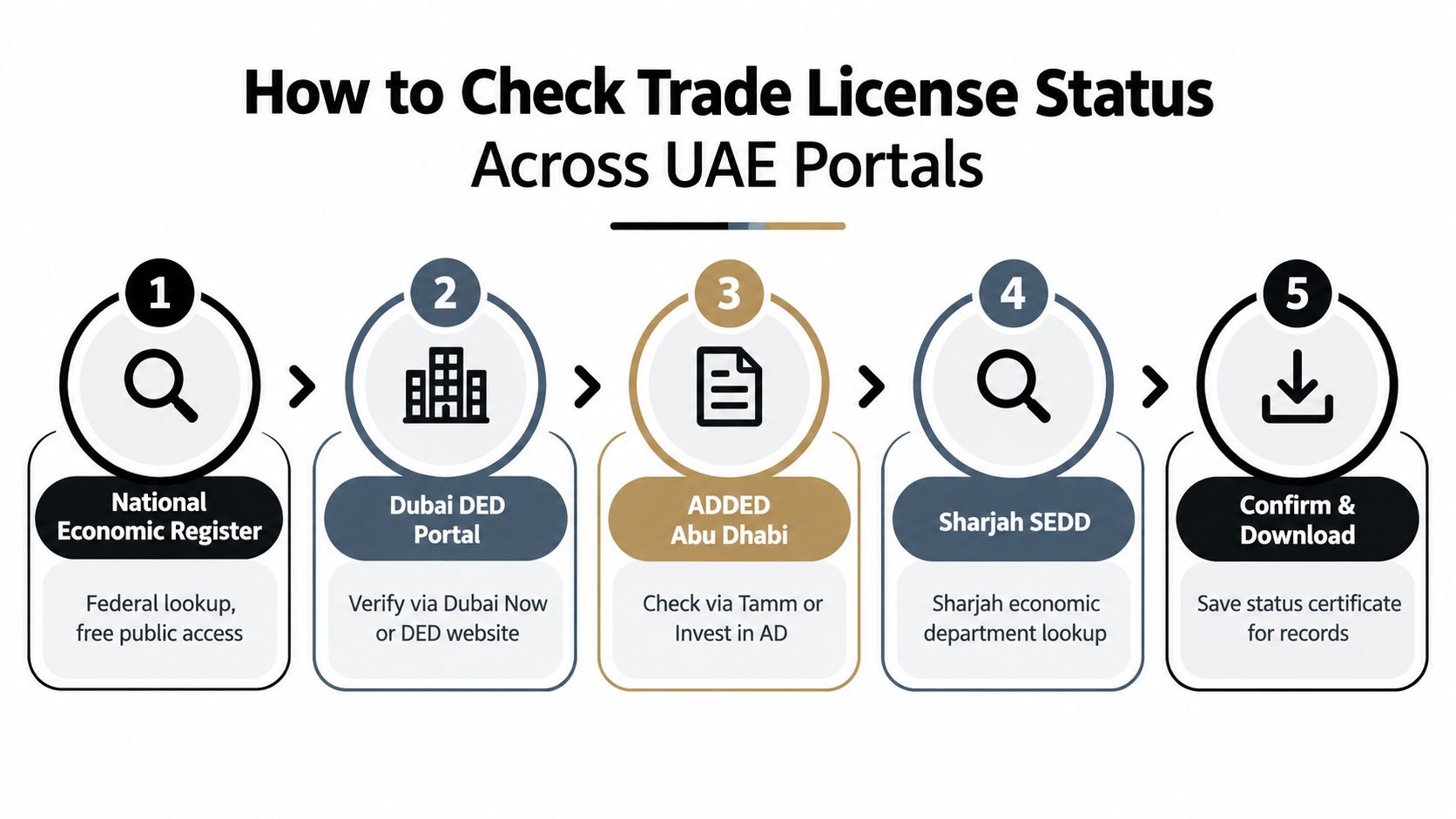
A practical verification sequence
Search the federal register first. Record the legal name, licence number, activity information, issuing emirate, and displayed status. Save the result or certificate if the service provides a downloadable record.
Check the issuing emirate or free zone authority. For a Dubai mainland company, use the Dubai Department of Economy and Tourism's relevant digital services. For an Abu Dhabi entity, use the responsible Abu Dhabi economic authority channel. Sharjah businesses should check the Sharjah economic authority's system. Free zone companies must use the portal of the zone that issued the licence.
Compare the records, not just the labels. Check the spelling of the legal name, activity, licence number, issue date, expiry date, and legal form. A mismatch may indicate an update that hasn't propagated, a record attached to the wrong entity, or a document that no longer reflects the authority's current data.
Match the status to the transaction. A bank may need a current licence and corporate documents. Customs may require the final approved licence. Immigration-related work may depend on an active licence and the company's establishment records. The right check depends on the next action.
Keep an evidence file. Save the current licence, portal result, payment receipt, application reference, tenancy evidence, approval letters, and correspondence. This gives the authority or bank something specific to review instead of a general request to “check the status”.
When portals disagree
Don't assume that the more favourable status is automatically correct. If the NER shows an active record but the issuing authority shows an unresolved renewal or amendment, contact the issuing authority and ask which record controls the blocked service. If the emirate portal shows an issued licence but a bank's verification fails, ask the bank whether it needs a current certificate, a translated document, or a different corporate record.
For Dubai businesses handling online government payments, the Dubai DED payment guidance can help identify the appropriate payment route. Payment confirmation alone, however, doesn't prove that the licence has moved to active status. Verify the updated record after the authority processes the transaction.
Trade License Status Meanings and What They Block
A status should be read as an operational instruction. The same company may be able to complete one administrative task while being unable to open a bank account, sponsor employees, or sign a regulated contract.
| Status | What it generally indicates | What it can block |
|---|---|---|
| Pending | The application, amendment, renewal, or approval chain hasn't reached completion. | Final registrations, some banking checks, customs access, and activities that require an issued licence. |
| Approved | The authority has accepted the relevant application or stage. | An approval may still be insufficient if the final trade licence hasn't been issued. |
| Active | The licence is issued and currently valid in the relevant registry. | It may still require supporting records for banking, visas, premises, or regulated activities. |
| Suspended | The authority has restricted the licence because of a compliance, payment, document, or regulatory issue. | New transactions, renewals, visa work, government services, and sometimes ordinary operations. |
| Expired | The validity period has ended without a completed renewal. | Renewal-related activity, visa processing, banking reviews, contracting confidence, and government interactions. |
| Cancelled or terminated | The licence no longer supports the company's current operation. | Trading under that licence, employee sponsorship linked to it, and reliance on the entity for new contracts. |
Pending and approved
Pending is a location in a process, not a diagnosis. The cause could be a missing tenancy record, an external approval, a trade-name issue, an unpaid fee, or a document review. Ask the issuing authority which task remains open and request the application reference in writing.
Approved needs careful interpretation. If it refers to initial approval, the company has permission to continue setup but hasn't necessarily reached legal operating status. If it refers to final licence issuance, download the final document and confirm that the registry has updated.
Suspended and expired
A suspended licence demands a cause-led response. Repeating a payment or uploading the same document won't solve a suspension caused by a regulatory hold. Identify the authority that applied the restriction, obtain the reason, and prepare the exact evidence requested.
An expired licence is more urgent than an ordinary renewal reminder. Dubai free zone guidance links timely annual renewal with lawful continuity and good standing. An expired record can undermine a bank review, delay visa processing, and make a counterparty question whether the company can lawfully perform a contract.
Cancelled and terminated
Cancellation or termination means the company must stop treating the old licence as a usable operating credential. Before forming a new entity, check whether the former company has outstanding liabilities, immigration matters, leases, tax records, or authority obligations. A new licence doesn't automatically resolve unfinished obligations attached to the old one.
Processing Times, Holds, and Rejection Reasons
Authorities don't publish one universal processing window that applies to every UAE licence application. Timing depends on the emirate or free zone, the activity, the legal form, the premises, external approvals, document quality, and whether the request is a new issuance, renewal, amendment, or reinstatement.
That makes the status history more useful than a vague promise about speed. A recent application with no request for further evidence may be progressing normally. A file that has stopped after an authority requested a document has a specific blocker, even if the portal still says pending.
Common holds behind the status
Tenancy evidence: The business location may not yet be accepted, the tenancy record may not match the company details, or the premises may not support the selected activity. Ask the licensing authority whether the location record has been approved, rather than assuming the signed lease is enough.
No objection or external approval: Some activities require another government or regulatory body to review the application. The licensing authority may be waiting for that response, so sending the same incorporation documents again won't move the file.
Trade-name conflict: A proposed name may be unavailable, inconsistent with the activity, or too similar to a protected name. Prepare alternative names and confirm the naming issue before revising other documents.
Incomplete activity selection: The chosen activity may not accurately describe the intended service, or the activity may require a different legal form or approval route. Correcting the activity early is usually more effective than trying to justify an unsuitable selection later.
Document mismatch: Names, passport details, signatures, legal-form information, and shareholder details must align across the application. A small inconsistency can trigger a request for clarification.
How to separate delay from rejection
A delay usually has an open application and a defined next action. A rejection has a decision that requires correction, reconsideration, or a fresh application. Ask for three details: the current stage, the missing requirement, and the authority or department responsible for clearing it.
Keep correspondence factual. Include the application reference, legal name, licence type, affected activity, date of the last update, and the transaction being blocked. This gives the officer enough context to direct the file instead of sending a generic status reply.
Next Steps by Trade License Status and Business Type
The right next step depends on both the status and the jurisdiction. A pending Dubai mainland application follows a different file owner and document path from an expired free zone licence, even if both show up as unresolved in a dashboard.
Mainland licence pending
Check the Dubai authority record and compare it with the NER entry. Then identify whether the missing item is tied to the activity, legal form, trade name, constitutional document, premises, additional approval, or final fee submission. Do not start a second application until the authority confirms that the first file cannot be completed. Duplicate records usually make the process harder to clear.
If a bank or customer is asking for proof, send the application reference and state that final issuance is still pending. Do not describe initial approval as an active trade licence, because it does not yet give full operating rights.
Free zone renewal gap
Use the free zone's own renewal channel first, then confirm the updated record through the available federal lookup. Ask for the renewal requirements, outstanding amount, penalties, and any effect on visas or establishment records. A free zone operator should also check whether the zone has restricted new services while renewal remains incomplete.
The Dubai trade licence renewal service from Smart Classic Business Hub is one example of professional support for businesses that need help coordinating renewal and related compliance work. The authority still controls the official decision and the status update. For the formal renewal path, use the Dubai trade licence renewal service once, and keep the rest of the file aligned with the zone's own process.
Suspended or expired record
Prepare the current licence copy, shareholder and manager identification, tenancy evidence, payment receipts, approval letters, immigration records, and any correspondence explaining the hold. The exact document set varies by authority, so ask for the written requirements before sending a large, unstructured file.
Escalate to a qualified adviser when the issue affects sponsored employees, more than one jurisdiction, a bank compliance review, or a regulated activity. The value is in mapping the dependency chain and speaking to the right authority, not in resubmitting the same forms.
Terminated licence
Stop using the terminated record for new contracts and registrations. First confirm whether the company needs liquidation, reinstatement, a fresh formation, or closure of outstanding records only. These are different routes. Choosing the wrong one can leave the business with unresolved obligations.
Protecting License Good Standing and Avoiding Escalation
Licence management works best as a recurring control, not an annual scramble. Dubai free zone businesses renew their trade licences annually, and the Dubai Development Authority states that timely renewal supports lawful operation under zone regulations. The NER adds a central verification layer, so banks, authorities, and counterparties can check whether the company's record remains current.

Build controls around the expiry date
Set an internal renewal review before the licence reaches its end date. Confirm the premises, activity, shareholder information, establishment records, visas, and required approvals before the renewal request is submitted. This exposes a tenancy or document issue while there's still time to correct it.
Banking and tax administration should sit on the same calendar. A bank may request updated corporate records during due diligence, while VAT or corporate tax work may depend on accurate legal-entity information. A current licence doesn't replace tax compliance, but inconsistent company data can make both processes harder to manage.
Understand the cost of delay
Public Dubai-focused guidance reports an administrative fine of AED 250 per month of delay after expiry, with further consequences possible for operating on an expired or non-existent licence. The same guidance describes risks including visa-processing blocks and eventual cancellation after prolonged non-renewal. Review the Dubai Development Authority licence renewal requirements and the available Dubai trade licence renewal guidance before assuming that a short delay is harmless.
The financial charge is only one part of the exposure. A delayed renewal can affect employee mobility, supplier confidence, banking evidence, government applications, and the company's ability to demonstrate lawful continuity.
Control principle: Renew before expiry, verify the registry after renewal, and keep evidence of every payment and approval.
If a bank or contracting party needs proof of continuing status, a Dubai certificate of good standing guide can help clarify what evidence may be relevant. The exact document accepted depends on the requesting organisation and the issuing authority.
Quick Action Checklist for Every Trade License Status
Use this sequence before taking another operational step:
Identify the issuer. Confirm whether the licence is mainland, free zone, or issued by another emirate.
Check the NER record. Compare the legal name, licence number, activity, and displayed status with the licence copy.
Check the authority portal. Review the issuing authority's record for pending payments, document requests, renewal holds, or external approvals.
Name the blocked transaction. Decide whether the immediate issue is banking, visas, customs, contracting, premises, or another government service.
Prepare targeted evidence. Gather the application reference, current licence, tenancy record, identification, approval letters, receipts, and authority correspondence.
Use the correct remedy. Complete the missing approval for a pending file, issue the final licence after initial approval, renew an expired licence, or obtain the reason and release conditions for a suspension.
Escalate with facts. Contact the responsible authority or a qualified UAE business setup adviser when records conflict or visa, banking, immigration, or liquidation consequences are involved.
Don't rely on a screenshot that only says “active”. Save the underlying certificate or official result, record the date checked, and repeat the check after any renewal, amendment, ownership change, or authority payment.
Smart Classic Business Hub helps UAE businesses with company formation, trade licence renewal, PRO services, VAT-compliant accounting, audit, tax residency, and liquidation support. If your trade license status is blocking banking, visas, renewal, or another government process, visit Smart Classic Business Hub for practical guidance on the next step.