
Most business owners in Dubai face the same question at some point. The numbers on the dashboard exist, the sales team is busy, costs are moving, and the market feels active. But are the results actually strong, or are they just happening in a fast market?
That uncertainty is where benchmarking analysis becomes useful.
A proper benchmarking analysis doesn't just compare one figure against another. It tells you whether your pricing, margins, operating model, and commercial assumptions are credible against the market you operate in. In the UAE, that matters for two reasons. First, it sharpens decision-making. Second, under the corporate tax regime, it can become a compliance requirement rather than a management exercise.
For founders, SMEs, and foreign investors, that shift is important. Benchmarking is no longer something large corporates do for annual strategy decks. It's now tied to transfer pricing, feasibility studies, expansion planning, and audit readiness. If you're setting up a new entity, assessing a new activity, pricing related-party services, or testing whether a business plan is realistic, benchmarking gives you a factual base instead of guesswork.
Introduction Beyond Guesswork What Benchmarking Analysis Really Means
Benchmarking analysis is best understood as a business compass. It helps a company work out where it stands, what “good” looks like, and where the gap sits between current performance and credible market performance.
In practice, that comparison can focus on different things. One business may benchmark operating margins. Another may benchmark warehousing energy use, customer acquisition efficiency, or the pricing of management fees between related entities. The method changes with the objective, but the principle stays the same. Compare like with like, adjust for differences, and use the result to support action.
Benchmarking is not just a report
Many firms treat benchmarking as a document they commission once and file away. That approach misses the point. A useful benchmarking analysis should influence decisions such as:
- Market entry choices: Which activity has room to compete in Dubai or a specific free zone
- Pricing decisions: Whether your related-party charges or service fees can be defended
- Operational improvement: Which process is underperforming against peers
- Feasibility assumptions: Whether revenue and cost estimates are realistic before launch
For entrepreneurs preparing a feasibility study in the UAE, benchmarking is one of the fastest ways to remove weak assumptions from the plan. A feasibility report based only on optimism usually fails when real costs, customer behaviour, and tax requirements appear.
Practical rule: If a business decision depends on whether your number is “normal”, “strong”, or “weak”, you need benchmarking.
Why it matters more in the UAE now
The UAE business environment rewards speed, but speed without evidence creates risk. A company can expand quickly, set up several entities, centralise services in one group company, and start charging management fees or support costs across the group. Commercially, that may make sense. Tax-wise, it needs support.
That is where benchmarking analysis has moved from optional to operational. Under the current UAE tax framework, businesses with related-party transactions need to prove that those arrangements reflect market conditions. That means benchmarking is part of compliance, not just strategy.
The strongest benchmarking work in the UAE does two jobs at once. It helps management make better decisions, and it builds documentation that can survive scrutiny later.
The Four Essential Types of Benchmarking
Not every benchmarking exercise asks the same question. Some compare one branch to another. Some compare your firm to a direct rival. Others look outside the sector to borrow a stronger process. Knowing the type matters because the data, effort, and outcome are different.
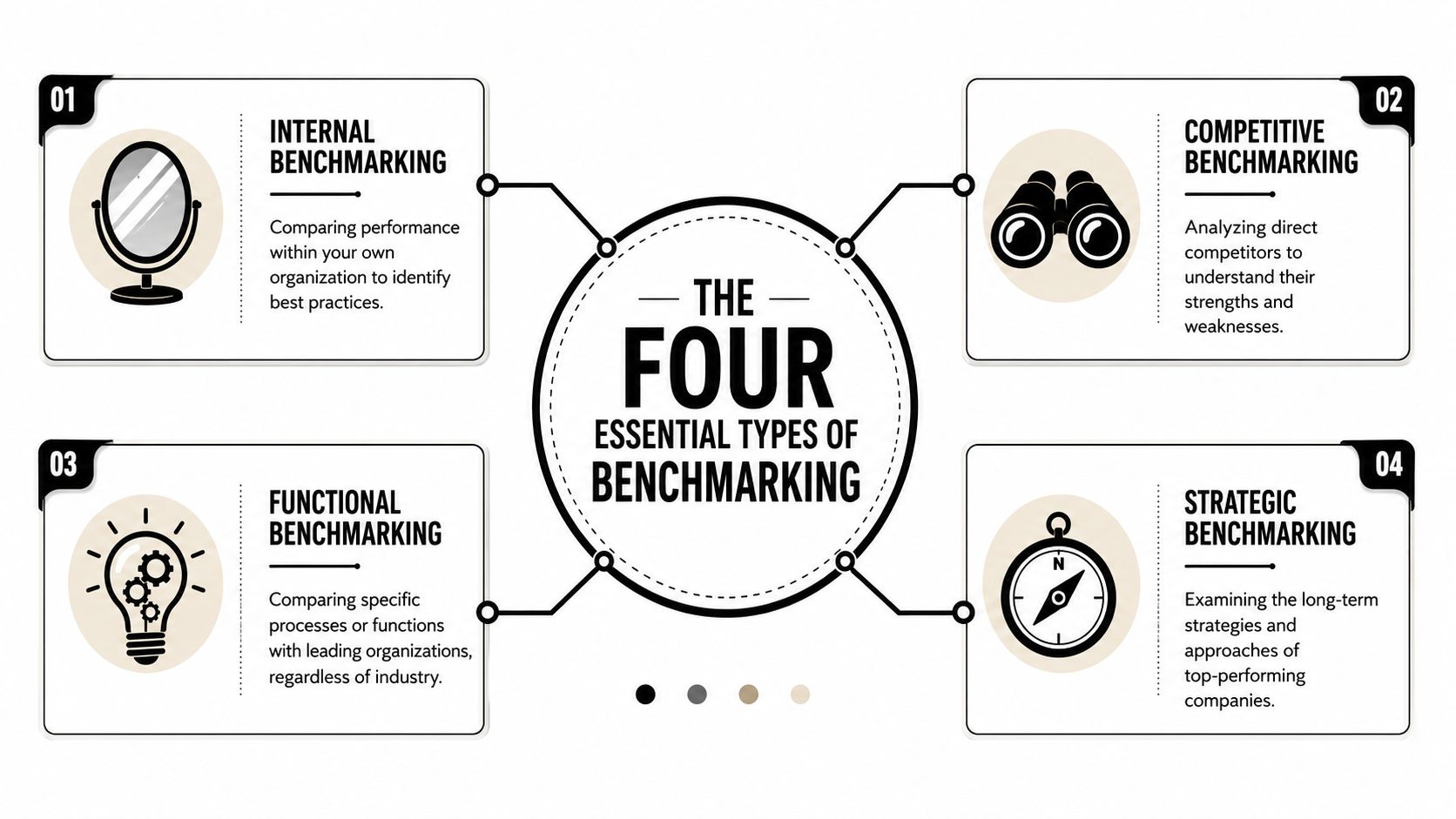
Internal benchmarking
This is the simplest starting point. Internal benchmarking compares performance inside your own organisation.
A Dubai business with operations in mainland and free zone entities might compare support costs, billing cycles, staff productivity, or branch-level profitability. A founder can also compare current results against the company's own prior periods to spot improvement or slippage.
Internal benchmarking works well because the data is accessible and definitions are usually consistent. It works less well when management assumes that internal best performance automatically equals market best performance. It doesn't.
Competitive benchmarking
This is the version commonly associated with benchmarking. You assess direct competitors to understand where you are stronger, weaker, overpriced, slower, or mispositioned.
For a new F&B concept, that may mean comparing menu positioning, delivery model, and location economics. For a consulting firm, it may mean comparing service packaging, response speed, and retainer structure. In digital businesses, marketers often benchmark channel efficiency. If your team wants a simple commercial example of comparing advertising efficiency, Menza's ROAS analysis is a useful reference because it shows how a benchmark is only meaningful when tied to business model context.
Functional benchmarking
Functional benchmarking looks at one capability rather than the whole business. A logistics company may learn from a healthcare provider's scheduling discipline. A retailer may learn from a bank's customer service workflow. Industry match matters less here than process quality.
This type is especially useful in the UAE because many firms are operationally young. They don't always need a direct competitor to learn something valuable. They need a better billing workflow, procurement control, or onboarding process.
Process benchmarking
Process benchmarking goes narrower still. It examines a specific workflow and asks how it should operate.
A good UAE example comes from industrial energy management. In the AE region, energy performance benchmarking in the industrial sector follows a four-step continuous improvement cycle. The initial assessment compares Energy Use Intensity values against jurisdiction-specific property type distributions, showing how process benchmarking can reveal operational cost savings according to the ACEEE paper on energy performance benchmarking.
Some of the best benchmarking wins come from fixing one repeated process, not redesigning the entire company.
A quick way to choose the right type
| Situation | Best benchmarking type |
|---|---|
| You run multiple branches or entities | Internal |
| You need to know how you stack up against direct rivals | Competitive |
| One function is weak, but the answer may sit outside your sector | Functional |
| A repeatable workflow is causing cost or delay | Process |
The mistake is using one type for everything. A transfer pricing file won't be built on casual competitor review. A customer service improvement plan won't improve because you copied tax comparables. Match the method to the decision.
The UAE Corporate Tax Law and Benchmarking
For many UAE businesses, benchmarking analysis becomes essential the moment related-party transactions appear. That includes management fees, intra-group services, executive compensation, loans, royalties, and cross-border support arrangements.
Under UAE Federal Decree-Law No. 47 of 2022, businesses must conduct a full benchmarking study to validate that related-party transactions comply with the Arm's Length Principle, and the arm's-length range is typically calculated using the interquartile range from the 25th to the 75th percentile. Transactions outside that range require adjustment and justification, as explained in this overview of UAE transfer pricing benchmarking requirements.
What the Arm's Length Principle means in plain language
The rule is simple in concept. If two companies in the same group transact with each other, the pricing should resemble what independent parties would have agreed in comparable circumstances.
Suppose a holding structure in Dubai has one entity providing management support to another. If that fee is too high, it may shift profit artificially. If it is too low, it may understate the value of the service. The tax authority expects the business to support that price with a market-based method.
Many SMEs run into trouble. They treat internal charges as administrative entries rather than taxable positions. The FTA won't look at them that way.
Why entity-level thinking often fails
The benchmarking exercise must be tied to the transaction, not just the overall company result. A group with several related-party arrangements can't usually rely on one broad profitability story and assume everything is covered.
That matters in common UAE structures where one entity handles shared staff, intellectual property, central procurement, or regional business development. Each arrangement may need separate support depending on the functions performed, risks assumed, and contractual terms.
A profitable group is not automatically a compliant group. Transfer pricing is tested transaction by transaction.
Where this affects new business setups
Businesses forming an LLC in the UAE often start with simple structures and then add complexity quickly. A mainland operating company may receive support from an offshore holding entity. A free zone company may license know-how to a related distributor. An owner may centralise administration in one company and recharge the cost elsewhere.
Those steps can be commercially sensible. They also create documentation obligations.
What compliant businesses do differently
The firms that handle this well usually follow three habits:
- They map transactions early: They identify related-party arrangements before year-end.
- They document commercial logic: They record what service, asset, or financing is being provided.
- They benchmark before problems appear: They don't wait for an audit query to start building support.
Benchmarking in the UAE tax context isn't about producing a polished PDF after the fact. It's about proving that the pricing framework of the business makes sense while there is still time to correct it.
Executing Your Benchmarking Analysis A 5 Step Process
A useful benchmarking analysis follows a disciplined process. Skip one stage and the output becomes fragile. In UAE tax and feasibility work, fragile analysis is expensive because management may rely on it, and regulators may question it.
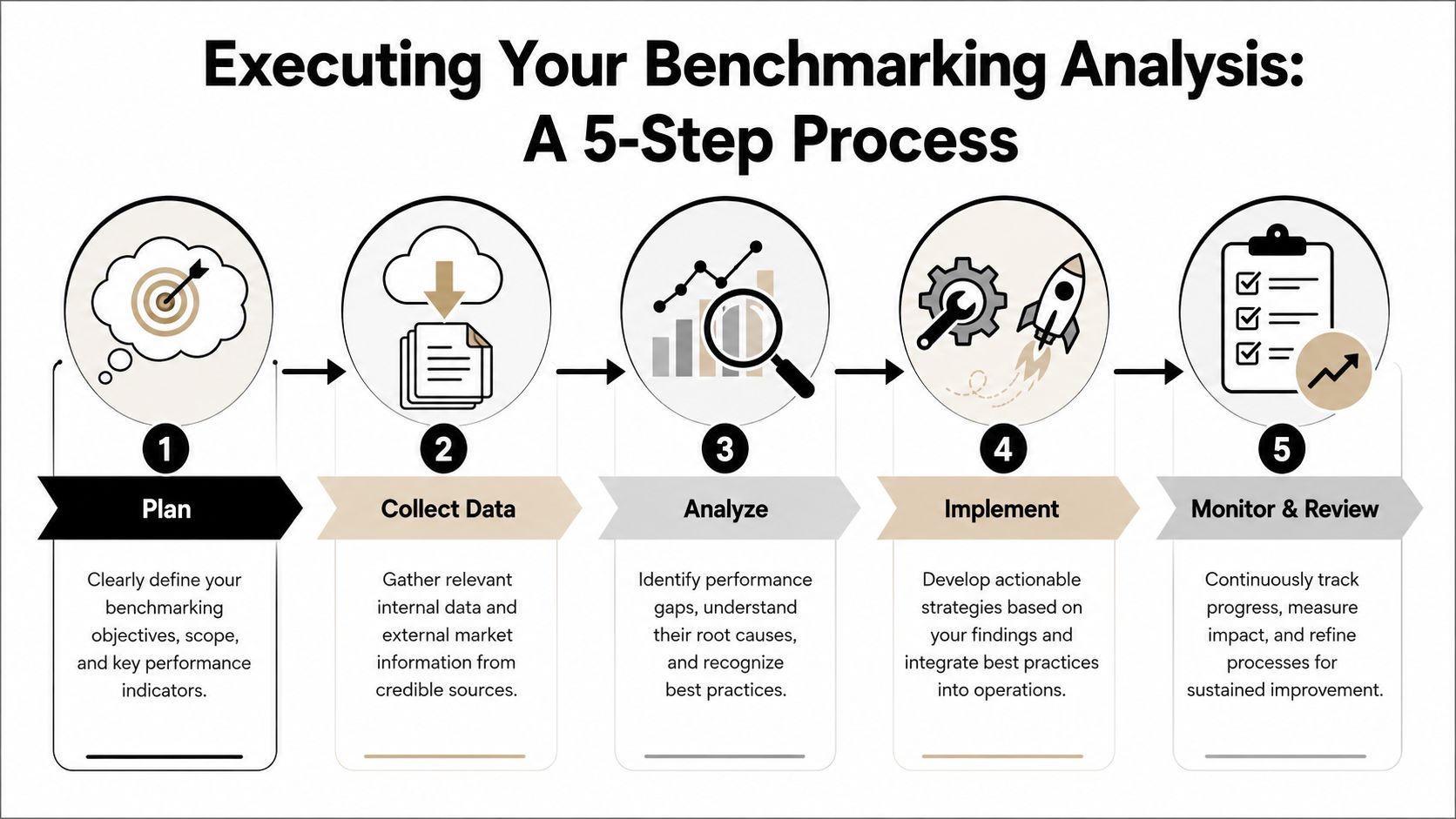
1. Plan the scope properly
Start with the decision you need the analysis to support. That sounds obvious, but many projects fail because the brief is vague. “Benchmark our business” isn't a workable instruction.
A better brief identifies the transaction, process, or feasibility assumption being tested. It also defines the right performance indicators. In transfer pricing, that may mean selecting the relevant profit level indicator. In a market entry study, it may mean comparing cost structure, pricing logic, and operating model rather than headline revenue ambition.
2. Collect data from defensible sources
The data stage is where good projects separate from weak ones. In UAE transfer pricing work, the FTA does not mandate a specific database but recognises approved commercial databases such as Orbis and Bloomberg. The process also involves quantitative and qualitative screens, and often uses multi-year averaging, typically three years, to smooth business cycle distortions according to this guidance on UAE benchmarking searches and databases.
That has practical implications. You don't just pull a list of companies and stop there.
Use a screening approach such as:
- Start with geography: Prefer UAE comparables where possible.
- Check financial usability: Remove entities with missing or unreliable financial data.
- Apply commercial filters: Exclude companies with different products, risk profiles, or functions.
- Review consistency: Make sure the set of comparables fits the tested transaction.
3. Analyse and adjust
Once you have candidate comparables, the real work begins. Raw data almost always needs interpretation.
A company may operate in a different market segment. Another may have a materially different risk profile. One year of unusual results may distort the picture. This is why simple averages often mislead. The analyst needs to normalise the data, identify outliers, and decide whether economic adjustments are needed.
Benchmarking analysis isn't a spreadsheet exercise. It is a judgement exercise supported by data.
4. Report the method, not just the conclusion
A weak report says, “your number is acceptable.” A strong report shows how that conclusion was reached.
That means documenting the tested party, search strategy, filters used, reasons for rejecting comparables, calculations, and the final conclusion. If the report is ever reviewed by management, auditors, investors, or the FTA, the method matters as much as the answer.
5. Implement and monitor
A benchmarking analysis only creates value when the business acts on it. If the result shows that pricing should change, contracts should be revised, or a feasibility model is too optimistic, management has to update the underlying decision.
Use monitoring to keep the work current:
- Track material changes: Restructuring, new service lines, and revised contracts can alter comparability.
- Refresh internal data: Your own numbers should be updated regularly, even if the market set remains stable.
- Revisit assumptions: A benchmark built for launch-stage decisions may not fit a scale-stage business.
This final step is often ignored because it feels less technical. In reality, it's where the commercial payoff sits.
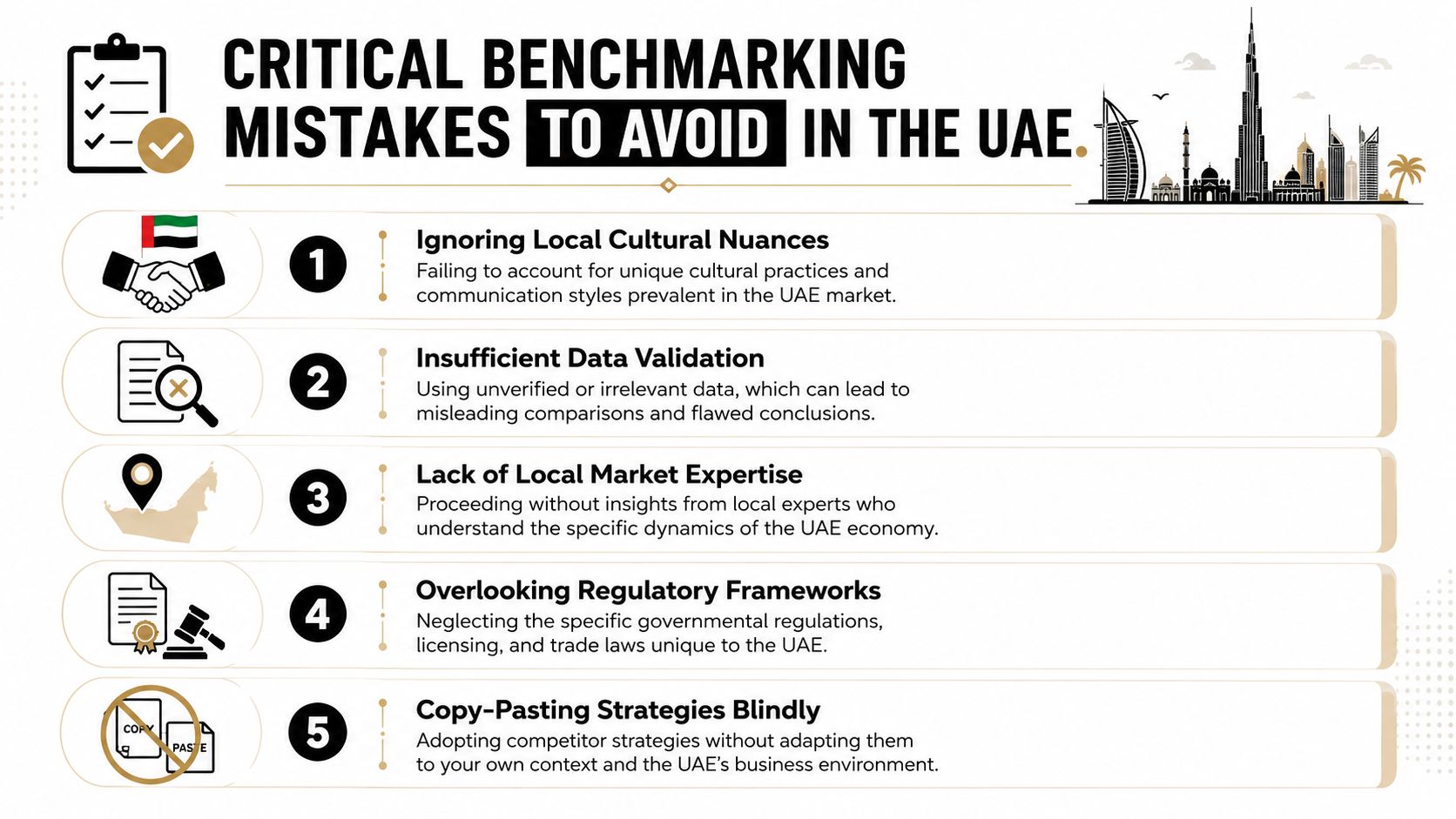
Critical Benchmarking Mistakes to Avoid in the UAE
The biggest benchmarking mistakes in the UAE are rarely technical in appearance. They usually begin with convenience. A business grabs the easiest data set, copies a foreign template, accepts a cheap report, or assumes one exercise will cover every future year.
That approach creates two problems. The first is poor decision-making. The second is weak compliance support.
Using global comparables without economic adjustment
This is one of the most common failures. When UAE local comparables are limited, some businesses jump straight to GCC, wider Middle East, or global data and treat the output as ready to use.
The issue is that public databases don't always offer enough UAE-specific independent companies, and without adjusting for economic climate differences, benchmarking results can become misleading. That gap is highlighted in this discussion of economic adjustments in UAE transfer pricing benchmarking.
A comparable from another market may have a different cost base, tax environment, labour profile, or market maturity. If those differences affect pricing or margins, the benchmark needs adjustment or stronger justification.
Treating benchmarking as a one-off task
A benchmarking file can become outdated faster than many owners expect. Contract terms change. A group restructures. One entity takes on more risk. A free zone company begins servicing new markets. The original study may no longer reflect the transaction.
That doesn't mean you repeat everything unnecessarily. It means the business should treat benchmarking as part of ongoing governance rather than year-end paperwork.
Buying the cheapest report
Some low-cost reports look acceptable on the surface because they include charts, peer names, and broad conclusions. The problem usually appears when someone asks harder questions. Why were these companies selected? Why were others excluded? Are the functions really comparable? Was the data adjusted?
Cheap benchmarking often costs more later because management relies on weak analysis and then pays to rebuild it properly.
If the provider can't explain the screening logic in plain language, the report probably won't hold up under scrutiny.
Ignoring data validation
Businesses sometimes assume that downloaded data is automatically reliable. It isn't. Databases are useful tools, not final answers.
Check for common issues:
- Outdated filings: A company may appear active but lack relevant financials for the tested period.
- Functional mismatch: Similar industry labels don't guarantee similar business activities.
- Incomplete narratives: Financial data without context can hide restructuring, extraordinary items, or product mix differences.
Copying strategy instead of learning from it
In commercial benchmarking, another trap appears. A company sees a competitor's pricing model, branch design, or staffing structure and tries to replicate it immediately. That isn't benchmarking. That's imitation without context.
The better question is why the competitor's model works, and whether the same conditions apply to your business, customer segment, and regulatory setup in the UAE. Good benchmarking sharpens judgement. It doesn't replace it.
How Smart Classic Hub Enables Data Driven Decisions
Businesses rarely struggle because they lack ambition. They struggle because the numbers behind key decisions aren't tested properly. That issue appears early in company formation, again in feasibility planning, and later in tax compliance and performance management.
Smart Classic Business Hub's value sits in turning business decisions into evidence-based decisions. That matters in a market where founders often move quickly across structure, licensing, staffing, tax, and commercial planning at the same time.

Benchmarking inside formation and feasibility work
During company setup, benchmarking helps narrow choices that otherwise look equally attractive on paper. A proposed activity may be legal to register, but that doesn't make it commercially sensible. Jurisdiction choice, operating cost assumptions, and service model all benefit from comparison against realistic market conditions.
In feasibility studies, benchmarking does even more. It tests whether a planned revenue model is credible, whether cost assumptions are understated, and whether proposed margins are plausible for the type of activity being launched. That is the difference between a business plan that attracts confidence and one that is an exercise in template completion.
Better data leads to better management systems
Once a business is operating, benchmarking becomes a management discipline. Targets should not be selected because they sound ambitious. They should be selected because they reflect what the business can reasonably achieve in its market and structure.
That is why a strong performance management system matters. It creates a framework for turning benchmark findings into monitored execution. Without that layer, benchmarking often remains a slide deck rather than an operating tool.
A related issue is data quality. If the source data is weak, the conclusions will be weak as well. For business owners who want a plain-language reminder of why this matters, the article on the impact of poor data quality offers a useful perspective.
Where expert support changes the outcome
A consultant adds the most value when the business faces one of these situations:
| Business situation | Why support helps |
|---|---|
| New entity launch | The commercial plan needs realistic assumptions, not generic optimism |
| Group restructuring | Related-party transactions need to be identified and documented properly |
| SME budget pressure | The scope must be phased so the work is useful without becoming oversized |
| Audit readiness | The method, not just the result, must be defensible |
The practical advantage isn't just access to tools or databases. It's knowing where to narrow the scope, where to push for stronger comparables, and where a simpler approach is defensible.
The real benefit
The strongest advisory work does not produce more paperwork. It reduces avoidable decisions.
That includes launching with unrealistic pricing, using an entity structure that creates tax friction, adopting KPIs that don't fit the business model, or relying on unsupported related-party charges. When benchmarking is built into formation, planning, and compliance work from the start, the business gains clarity earlier and fixes fewer mistakes later.
Frequently Asked Questions About Benchmarking in Dubai
Most Dubai business owners don't ask whether benchmarking is useful. They ask whether it is practical, affordable, and worth doing now rather than later. Those are the right questions.
How much does a benchmarking study cost for an SME in Dubai
Cost depends on scope. For SMEs in Dubai, a Light Competitor Scan can cost AED 18,000 to AED 24,000, while a full transfer pricing analysis reaches AED 25,000 to AED 30,000, according to this overview of the benchmarking cost dilemma for UAE SMEs.
The practical answer is to phase the work. Start with the decision that carries the highest risk or highest value. For one business, that is transfer pricing compliance. For another, it is a feasibility model before launch. A smaller, focused scope often produces a better outcome than a broad but shallow study.
What if there are no good UAE comparables in my industry
That happens often, especially in specialised sectors and private markets. The answer isn't to give up and use random global companies. The answer is to broaden the search carefully, justify the geography, and document any economic adjustments needed to improve comparability.
For many smaller businesses, guidance is necessary. The method can still be defensible, but only if the logic is documented clearly.
Can a startup use benchmarking without historical data
Yes. A startup doesn't need its own history to benchmark. It can benchmark assumptions.
That includes market entry pricing, expected cost structure, staffing model, service delivery approach, and realistic margin expectations. For founders, this is often more valuable than reviewing internal numbers because there may not be enough internal history to learn from yet.
Is benchmarking only about finance and tax
No. Finance and transfer pricing are the most urgent uses today, but benchmarking also supports operations, market positioning, innovation, and strategy.
In the AE region, benchmarking analysis for innovation and competitiveness can use a two-stage cluster methodology that first identifies stronger regions through competitiveness and innovation scores and then selects peers with similar resource bases. That framework is outlined in this research on regional benchmarking for innovation and competitiveness. The lesson for businesses is practical. Compare yourself to peers that are not only stronger, but structurally relevant.
How should a founder think about benchmarking as the company grows
Treat it as a decision tool, not a one-time project. At launch, benchmark assumptions. During growth, benchmark performance. When related-party transactions appear, benchmark compliance positions. As the business becomes more data-driven, broader strategy work also improves. Founders interested in that leadership angle may find Legitt AI's data strategy insights useful as a companion read.
If you need help turning benchmarking into a practical business tool, whether for feasibility, company formation, transfer pricing support, or management reporting, Smart Classic Business Hub can help you build a clearer, more defensible decision framework for the UAE market.