
Dubai added 8.9% workforce growth by Q3 2025 while operating establishments grew 6.6%, according to the Ministry of Human Resources and Emiratisation, reported by Gulf News. That should change how you think about the labour market dubai opportunity.
This isn’t a market where you set up first and “sort hiring out later”. If you’re entering Dubai in 2026, labour strategy is part of market-entry strategy. Your company structure, visa plan, payroll budget, compliance process, and recruitment channel all affect whether you scale cleanly or spend months fixing avoidable mistakes.
Most guides stay at headline level. That’s useless for an investor. You need a decision framework. Where is demand concentrated? Which legal obligations bite early? When do salary expectations move faster than your budget? Which setup choice limits hiring flexibility? Where do you need professional support from day one? Those are the questions that matter.
Understanding the Dubai Labour Market in 2026

8.9% workforce growth and 6.6% growth in operating establishments by Q3 2025 should shape your 2026 hiring plan from day one. Dubai is expanding fast, and that changes the economics of every early staffing decision.
Treat labour planning as part of market entry, not an admin task for later. In Dubai, growth at the macro level shows up quickly in micro decisions. Salary pressure rises faster in specialist roles. Good candidates leave the market quickly. Visa sequencing affects start dates. Poor company setup choices create hiring limits that are expensive to fix after launch.
Dubai keeps attracting employers for one simple reason. It gives foreign investors access to an international workforce at scale. You are not entering a closed domestic market. You are entering a regional hiring hub where companies recruit across borders, compete for multilingual talent, and build teams around speed.
That creates opportunity, but it also raises the standard. If your business depends on specialist hires in sales, tech, finance, operations, or project delivery, you need role priorities, compensation ranges, and visa ownership mapped before you finalise your first budget.
Where competition is strongest
Demand is concentrated in sectors tied to expansion, digital adoption, and regulated business activity. In practice, that means stronger hiring pressure in technology, financial services, construction, infrastructure, and high-skill professional roles.
The practical issue is not just whether talent exists. It is whether you can hire that talent on your timeline and at your planned cost.
A fast-growing market rewards prepared employers. It punishes slow ones.
If two firms want the same finance manager, solutions architect, project lead, or Arabic-English client partner, the winner is usually the employer with a clear package, a clean visa process, and an approved structure for onboarding. Foreign investors often focus too much on headline salary and ignore the full hiring system behind it.
What investors should do before launch
Use this framework to test your entry plan:
- Map hiring by business-critical roles first. Do not start with a generic headcount target. Identify the roles that directly affect revenue, compliance, and delivery.
- Budget for total employment cost, not salary alone. Your numbers need to cover visa processing, medicals, insurance, onboarding time, leave exposure, and replacement risk.
- Match recruitment timing to operating reality. If revenue depends on licensed staff or client-facing managers, start earlier than you think you need to.
- Set compliance ownership internally. One person should track labour records, visa status, payroll alignment, and contract administration from the start.
- Verify government-side status regularly through official labour inquiry support tools, such as these Ministry of Labour inquiry services in the UAE.
Here is the blunt assessment. If your model depends mainly on cheap labour, Dubai is the wrong place to be careless. The market rewards organised employers with clear systems and realistic budgets.
Worker confidence matters too. In an optimistic job market, candidates compare offers aggressively and resign faster when employers delay decisions or create uncertainty. That is why macro growth data matters at the company level. Strong market sentiment turns small internal mistakes into hiring losses.
The right conclusion is straightforward. Enter Dubai with a hiring plan that matches growth conditions, regulatory demands, and actual recruitment friction. If you do that early, you keep control over cost, timing, and compliance. If you do not, the market will make those decisions for you.
Navigating Key Labour Laws and Emiratisation Mandates

Dubai does not punish employers for minor paperwork mistakes alone. It punishes weak operating models. Foreign investors run into trouble when contracts, payroll, visa status, leave records, and internal reporting sit with different people and no one checks whether they align.
Treat labour compliance as an operating system, not an admin task. Growth in Dubai brings faster hiring, tighter scrutiny, and less room for informal processes. That macro reality affects small decisions immediately. The wording in an offer letter, the owner of payroll approvals, and the timing of a visa application all shape your cost base and your risk exposure.
What matters in labour law from day one
Start with control. If your legal setup and your hiring plan are disconnected, you create avoidable problems that later show up as delayed onboarding, payroll disputes, renewal issues, and expensive corrections.
Focus on five points first:
- Use the correct contract format. The contract must match the role, working arrangement, and sponsorship position.
- Write working terms clearly. Hours, leave, probation terms, compensation structure, and notice periods should be documented from the start.
- Build a clean final settlement process. Many new employers often make preventable errors during this stage.
- Store labour records in one controlled system. Keep contracts, payroll records, leave balances, and employee files easy to retrieve.
- Assign one accountable owner. Someone inside the business must oversee labour and immigration coordination end to end.
For official status checks and procedural confirmation, use the Ministry of Labour inquiry services in the UAE instead of relying on fragmented advice from agents or staff.
Compliant employers in Dubai do not improvise. They document, assign ownership, and check every employment step against the approved structure.
Emiratisation should shape hiring design early
As noted earlier, demand in Dubai is concentrated in professional and management roles. That matters because Emiratisation targets affect private sector workforce planning, especially for businesses that expect to scale beyond a small founding team.
Do not leave this until headcount rises. By then, your structure is already set, your managers are hired, and your easiest compliance options are gone.
Emiratisation affects practical decisions at company level:
- which roles you create first
- whether you centralise support functions or hire by department
- how you balance expat hires against roles that can support national hiring pathways
- how much onboarding and retention budget you need
- whether your managers are prepared to supervise a mixed workforce properly
This is a workforce design issue. If you build an all-expat team and plan to fix it later, you will spend more on recruitment, training, and reorganisation than you needed to in the first place.
How investors should handle Emiratisation
Use a simple framework.
First, identify roles that can realistically support Emiratisation from the start. Administrative, client service, operations support, analyst, coordinator, and management-track positions usually need early review.
Second, tie hiring approvals to compliance review. Every new role should be checked against your licence position, current headcount mix, and likely future obligations.
Third, budget beyond the hire itself. Recruitment cost is only one part of the equation. Onboarding time, manager attention, retention planning, and internal progression matter if you want a stable structure rather than a paper exercise.
Fourth, keep senior ownership on it. This should not sit loosely with an office manager or external recruiter. Leadership needs visibility because the consequences are operational, not just regulatory.
The operating model that works
Use this structure from the beginning:
| Priority area | What you should do |
|---|---|
| Contracts | Match employment terms to the actual role, work model, and approved company setup |
| Payroll process | Document salary, leave, deductions, and final settlement procedures before the first hire starts |
| Government interaction | Give one internal owner responsibility for labour and immigration coordination |
| Emiratisation planning | Review which roles can support compliance targets before building the first full hiring wave |
| Audit readiness | Keep records organised for quick checks, renewals, and corrections |
For serious expansion in the Dubai labour market, integrate legal compliance with hiring strategy from the start. Do that well and you keep control over hiring speed, cost, and regulatory risk.
Benchmarking Salaries and Benefits to Attract Top Talent
A salary gap of even 10 to 15 percent can knock you out of the shortlist for strong Dubai candidates. That matters more in 2026 because growth sectors are pulling talent faster than new entrants expect, while labour rules and visa processing still shape how quickly you can convert an offer into a start date.
This is the mistake foreign investors keep making. They treat compensation as a spreadsheet exercise, separate from market timing, role scarcity, and compliance cost. In Dubai, those decisions sit together. If you underprice a revenue-critical hire, your launch slips. If you structure benefits badly, your offer looks amateur. If your payroll and leave terms are unclear, candidates assume the business is not ready.
As noted earlier, market reviews show sustained pressure in specialist digital and technical hiring. Apply that reality to your own planning. Budget current-market packages for roles tied directly to sales growth, delivery capability, or regulated operations. Do not wait until interviews start to find out your numbers are weak.
Where investors misprice the hire
Underbudgeting usually shows up in three places.
- Specialist capability. AI, cloud, data, cybersecurity-related, and digital growth roles cost more because the supply is tight and experienced candidates have options.
- Operational middle management. Investors often price for junior staff and senior leadership, then ignore the managers who run teams, reporting, and day-to-day execution.
- Benefits design. A poorly structured package hurts credibility fast, especially with candidates who have worked in the UAE before and know what a properly run employer should offer.
The macro trend is clear. Dubai keeps attracting new businesses, regulated sectors are getting tighter, and skilled professionals can compare offers quickly. Your micro decision is simple. Set pay by role impact and replacement difficulty, not by what sounded reasonable in another market.
Build an offer that looks credible
A competitive package is not just base salary. It is proof that you understand how employment works in the UAE and that your company can administer terms properly from day one.
Use this checklist:
- Base salary aligned to market pressure. Pay for the role you need filled now, not the version of the role you hoped would be cheaper.
- Health insurance. Treat it as standard.
- Clear annual leave terms. State accrual, approval process, carry-forward rules, and payout method clearly. If your team needs a working reference, use this leave salary guide for UAE employers.
- End-of-service handling. Experienced candidates look for signs that final settlements, payroll records, and exits are managed correctly.
- Allowances only where they serve a purpose. Housing, transport, school, or travel support should reflect seniority, mobility needs, and sector norms.
- Probation and review structure. Set review dates, reporting lines, and confirmation criteria in writing.
A clean, well-documented offer often beats a slightly higher but disorganised one.
Budget by business impact, not job title
Use a three-part framework before you approve any package. First, identify which hires protect revenue. Second, identify which hires protect compliance and operational continuity. Third, identify which hires can stay flexible for the first 6 to 12 months.
| Role type | Budget approach |
|---|---|
| Revenue-critical | Pay at a level that attracts proven performers quickly and reduces hiring delays |
| Compliance-critical | Budget for accuracy, experience, and properly documented terms from the start |
| Support roles | Keep costs controlled, but avoid offers that create churn or weak execution |
This approach helps you connect market growth with real hiring choices. A strong salary benchmark is not about paying the most. It is about knowing where speed matters, where structure matters, and where restraint is sensible.
If you are still building your hiring process, a modern guide to recruitment is a useful reference. Use it to shape your funnel, then adapt it to Dubai salary expectations, visa timing, and compliance requirements.
Get this section wrong and you lose time, candidates, and control of your first-year budget. Get it right and your hiring plan becomes much easier to execute.
Your Strategic Guide to Recruitment Channels and Timelines
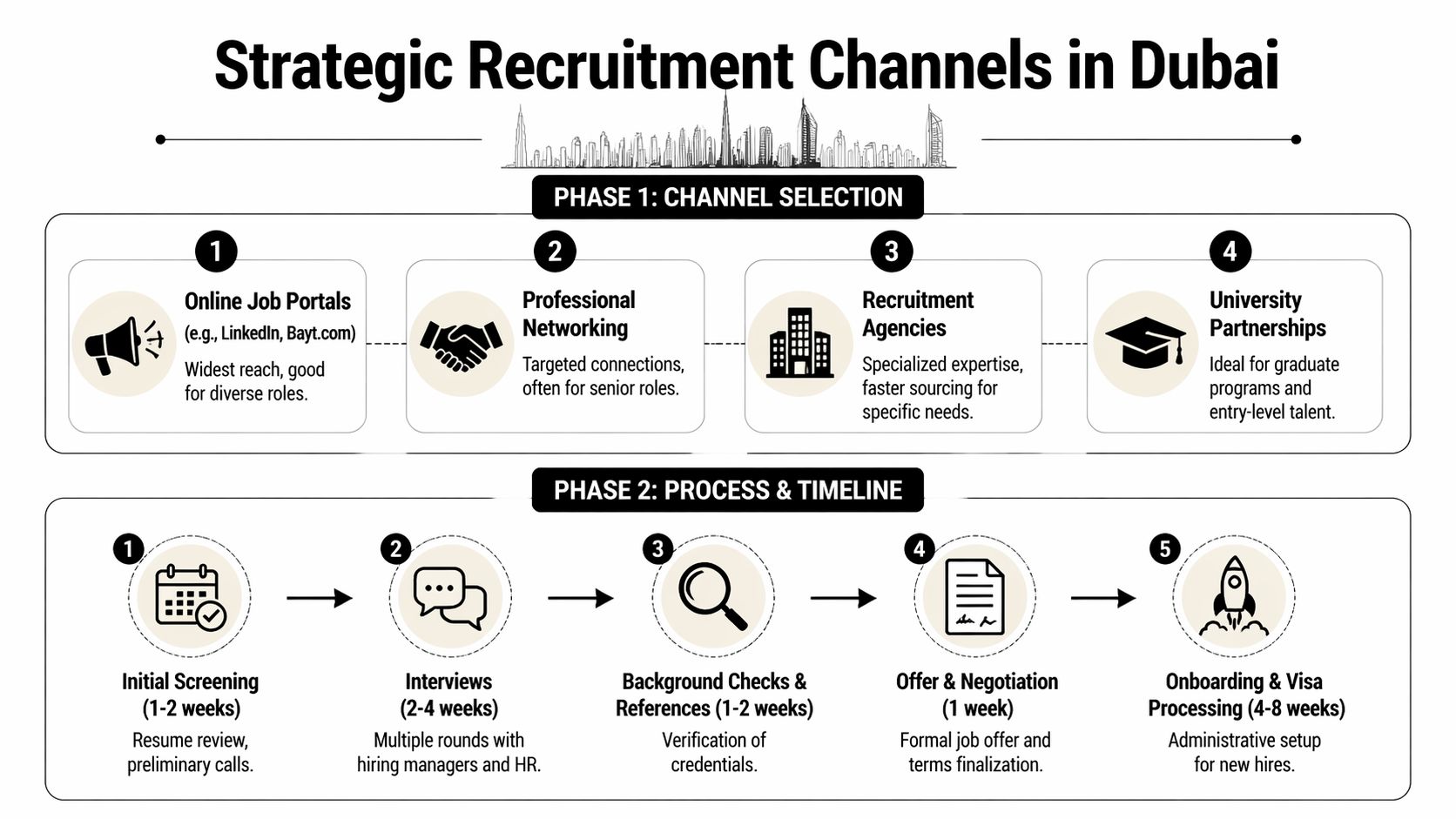
Recruitment in Dubai goes wrong when employers use one channel for everything. That’s lazy hiring. Different roles need different channels, and your timeline has to account for screening, negotiation, approvals, and visa administration.
If you want a broader framework for structuring candidate funnels, interview stages, and team responsibilities, a modern guide to recruitment is a practical companion read. Apply that thinking locally, then adapt it to Dubai’s compliance and visa realities.
Pick the channel based on the role
Don’t ask which recruitment channel is “best”. Ask which one fits the role.
- Online job portals work well for broad visibility and mid-volume applications. Use them for sales, operations, admin, support, and many mid-level professional roles.
- Professional networking works better for senior hires, trusted referrals, and commercially sensitive roles. In Dubai, relationships still matter.
- Recruitment agencies make sense when the role is specialised, confidential, or urgent. They’re often the right choice for technical leadership and hard-to-fill positions.
- University partnerships can support graduate hiring and junior pipeline building, especially if you want trainable talent rather than polished experience.
Build your hiring timeline backwards
One of the biggest practical mistakes in labour market dubai planning is treating hiring as a single event. It’s a sequence. Start date is the end of the process, not the start.
Use a realistic timeline model:
- Initial screening. Shortlist quickly and reject quickly.
- Interviews. Keep the number of rounds disciplined. Long interview chains lose candidates.
- Verification. Confirm references and credentials before you make internal promises.
- Offer stage. Move decisively. Delays here signal internal confusion.
- Onboarding and visa processing. Unrealistic planning usually collapses at this stage.
The infographic above captures that process flow clearly, including the fact that onboarding and visa processing can outlast the interview phase.
Use flexible work models, but don’t improvise
Recent reforms introduced flexible, part-time, and remote work permits, creating more room for startups and SMEs to access talent pools beyond the classic full-time model, according to the verified summary linked to the UAE labour reform overview.
That’s useful. It also creates compliance traps.
This is the proper approach:
- Use part-time or flexible arrangements when demand is variable. Good for early-stage functions like marketing, finance support, or specialised advisory capacity.
- Use remote models when the role doesn’t require physical presence. But confirm that the legal structure, permit, and actual work arrangement align.
- Don’t mix freelance behaviour with employee treatment. If someone functions like an employee, structure it properly.
- Don’t let urgency override paperwork. Informal hiring decisions become expensive later.
Fast hiring is good. Unstructured hiring is expensive.
The timeline investors should actually expect
Without citing fixed timelines beyond the process shown in the infographic, the right mindset is simple. Senior hires can move fast in conversation and then slow down in documentation. Junior hires can be sourced quickly and still stall during onboarding. Cross-border candidates add another layer of timing risk.
So build around these operating rules:
| Hiring situation | Best move |
|---|---|
| Urgent specialist role | Use an agency and prepare approval documents before shortlisting |
| Generalist mid-level role | Combine job portals with direct outreach |
| Early-stage startup hiring | Use flexible work models carefully, with compliance review |
| Leadership hire | Prioritise references, alignment, and contract precision over speed |
If your launch date depends on people being in seats, recruit earlier than you think you need to.
Choosing Your Business Structure for Optimal Hiring
Your business structure determines more than ownership and licensing. It shapes how you hire, where you can operate, how visas are managed, and how much friction you’ll carry into growth.
Foreign investors often make expensive mistakes. They choose a structure because setup looks faster or cheaper, then discover later that hiring flexibility, operational scope, or compliance demands don’t fit the business they’re building.
The hiring lens matters more than the setup brochure
Most setup comparisons focus on ownership, cost, and office requirements. That’s incomplete. If you plan to build a real team in Dubai, your main question should be this: which structure supports the employment model I need over the next few years?
A useful outside primer for founders comparing company forms is understanding LLC meaning and benefits. But in Dubai, you need to go further. You must connect structure to labour operations.
Hiring Comparison: Mainland vs. Free Zone vs. Offshore
| Feature | Mainland Company | Free Zone Company | Offshore Company |
|---|---|---|---|
| Ability to hire local staff | Strong option for building a larger local team | Suitable for hiring within the zone framework | Not designed for local operational hiring |
| Access to UAE market | Best for direct onshore trading and broad local activity | Often more limited for direct mainland activity unless structured properly | Not suitable for active local trading operations |
| Visa processing practicality | Works well for active trading businesses with local staffing needs | Often streamlined within zone systems, but varies by authority | Generally not the route for employing an on-the-ground team |
| Emiratisation exposure | More relevant for firms within the applicable private sector framework | Can vary depending on setup and activity | Usually outside the practical hiring discussion because local staffing isn’t the model |
| Scalability for operations | Strong if you plan sales, service delivery, and local contracts | Strong for specific sectors, regional hubs, and controlled operating models | Weak if your plan depends on employees in Dubai |
| Best fit | Investors building a substantive operating company | Investors prioritising ownership simplicity and zone-specific advantages | Investors focused on holding assets or international structuring, not local staffing |
When mainland is the right answer
Choose mainland if you want direct access to the UAE market and expect meaningful local hiring. It’s usually the correct route for companies that need sales staff, operations teams, project personnel, customer-facing employees, and broad commercial freedom.
But mainland comes with more labour planning discipline. If your structure sits within the private sector framework where Emiratisation matters, you can’t treat hiring as a back-office issue.
When free zone works better
Free zone can be the smarter choice if your model is specialised, internationally oriented, or operationally lean. It often suits consulting, digital services, holding activity with real substance, regional support functions, and founder-led businesses that want a more controlled setup environment.
That said, free zone isn’t a shortcut around employment reality. You still need proper contracts, visa handling, payroll discipline, and a coherent team structure. If you intend to scale into broader UAE operations, check whether your free zone choice supports that future cleanly.
Offshore is not a hiring vehicle
This should be blunt. If your plan is to build and manage a working team in Dubai, offshore is usually the wrong vehicle.
Offshore has its place. It can work for holding, international ownership, and certain asset structures. It doesn’t solve your labour market dubai needs if you need employees on the ground.
Fair hiring starts with the right structure
Verified background data also points to a harder truth. Structural barriers can exist in the market, including salary discrimination based on nationality and deskilling of foreign workers, as discussed in the research on migrant labour experiences in the UAE. That’s exactly why your company should be designed for transparent, compliant, defensible hiring from the start.
A proper structure helps you standardise:
- Offer terms
- Job grading
- Reporting lines
- Document handling
- Equal treatment processes
Good employers in Dubai don’t just hire legally. They hire in a way that holds up under scrutiny and attracts better people.
Securing Visas and Work Permits The Essential Process

Visa processing is where many investors lose momentum. Not because the system is impossible, but because they underestimate how many moving parts need to line up. Offer terms, licence details, establishment records, employee documents, medical steps, ID procedures, and immigration submissions all have to match.
Treat the process as operational infrastructure. If you leave it to ad hoc admin, you’ll create delays for no good reason.
The basic process employers need to control
The sequence is straightforward in principle:
- Issue the offer and confirm role details
- Prepare the permit and immigration paperwork
- Complete the required medical and identity steps
- Finalise residence status and onboarding records
- Activate payroll and internal HR documentation
If you want a general international explainer on employer-side documentation logic, understanding work permit requirements gives a useful baseline. In Dubai, though, local execution matters far more than generic theory.
Which visa types matter most
For most investors and operating businesses, the main practical categories are:
- Employment visas for staff you hire directly
- Investor visas for owners actively establishing and operating a business
- Golden visas where the applicant qualifies under the applicable route
- Family visas when founders or employees later sponsor dependants
- Freelance-related routes in the correct jurisdictional framework where applicable
Each route has different documentary expectations and timing implications. Don’t assume you can switch casually between them after setup. Your company structure, licence activity, and personal status all affect what’s practical.
Where professional help becomes non-negotiable
You can fill forms yourself. That doesn’t mean you should run the process alone.
A proper PRO-led approach helps you manage:
- Government portal submissions
- Document consistency
- Status tracking
- Employee communication
- Renewal planning
- Avoidable rejection points
For founders handling their own residency or sponsoring key staff, a practical local reference is this guide on how to get UAE residence visa.
The smart move is simple. Founders should spend time on revenue, partnerships, and hiring decisions. They shouldn’t spend it chasing immigration corrections.
If your business launch depends on key hires arriving on time, visa administration is not clerical work. It’s a critical path item.
Frequently Asked Questions About Hiring in Dubai
Can I hire freelancers instead of employees
Yes, in the right structure and with the right permit position. Don’t use a freelance label to avoid proper employment obligations. If the person works under your control like an employee, structure the relationship correctly.
How serious is Emiratisation for a new business
Very serious if your business falls within the relevant private sector framework. The wrong approach is to postpone planning. Build role design and workforce planning with Emiratisation in mind from the start.
Can an employee work part-time for another company
It may be possible under the current flexible and part-time permit environment, but only if the arrangement is legally documented and compatible with the employee’s status. Don’t approve side arrangements informally.
Should I choose free zone just because setup looks easier
Not if your business model needs broad local trading and local team growth. Structure should follow operating reality. A cheap or fast setup that blocks hiring flexibility later is a bad investment.
What’s the biggest hiring mistake foreign investors make
They hire before building a compliance system. Then contracts, payroll, leave handling, and visas all become reactive. That’s when disputes and delays start.
Do I need a recruitment agency
Not always. Use agencies when the role is specialist, urgent, or commercially sensitive. For generalist hiring, a mix of job portals, networking, and direct outreach often works better.
How do I attract better candidates in a crowded market
Look organised. Strong candidates judge your company by the speed of feedback, the clarity of the offer, the quality of your onboarding process, and whether your employment terms make sense.
If you're entering the UAE and want the business structure, labour compliance, visa process, and operational setup handled properly from day one, Smart Classic Business Hub is the kind of local partner worth speaking to. They help foreign investors and growing businesses set up in the right jurisdiction, manage PRO and visa processes, stay compliant, and build the foundations needed to hire and scale in Dubai without avoidable friction.