
A Tax Residency Certificate in the UAE is an official document that proves you're a UAE tax resident, and for treaty purposes an individual generally needs 183 days of physical presence within a consecutive 12-month period to obtain it. It matters because this is the document foreign tax authorities usually expect when you want to rely on a double taxation agreement instead of being taxed twice on the same income.
A common version of this problem starts like this. You've moved your life and business to Dubai, your clients are international, your UAE residence visa is active, and you assume your tax position is straightforward. Then your home country, or a country where your income arises, asks for proof that the UAE is your tax home. The visa alone doesn't settle that question.
That's where many founders, consultants, remote professionals, and investors get caught out. They understand company setup, visas, banking, and invoicing. They don't always realise that tax residency and immigration residency are different things, and that frequent travel can undermine an otherwise valid tax plan.
Your Gateway to Global Tax Efficiency
A common problem starts after the move to Dubai is already done. The company is set up, the residence visa is active, the bank account works, and business is coming in from abroad. Then a foreign tax authority asks for proof that the UAE is your tax residence before granting treaty relief or accepting your filing position.
At that point, assumptions stop helping. A visa does not prove tax residence. A trade licence does not prove it either. If you earn, invest, or hold assets across borders, the missing document can turn a clean tax plan into a dispute, a delayed refund, or tax paid twice before the issue is sorted out.
A Tax Residency Certificate, or TRC, is the document used to support that position with the UAE authorities' confirmation of tax residence.
Why investors care about it
People searching for what is tax residency certificate usually have a practical concern. They want to know whether this document will help defend income from being taxed twice, reduce friction with foreign tax authorities, and support a filing position that stands up under review.
It often does, but only if the facts support the application.
The overlooked risk is extended absence from the UAE. Many founders, consultants, and internationally mobile investors spend heavily on structuring, then undermine the result by being out of the country too often. If your eligibility depends on physical presence, frequent travel is not a side issue. It is the issue.
In practice, the TRC matters most for:
- Individual taxpayers who need to show foreign authorities that the UAE is their tax residence for treaty purposes
- Business owners and company directors whose income, dividends, or fees are reviewed in more than one jurisdiction
- Consultants, remote professionals, and investors who travel constantly and need to track whether extended absence could break the residence position they plan to rely on
A TRC has value because foreign tax authorities usually want formal proof before they allow treaty benefits or accept a residence claim.
For the right applicant, this is not administrative paperwork. It is part of tax risk control.
What Is a Tax Residency Certificate Really
A Tax Residency Certificate is the Federal Tax Authority document used to confirm that an individual or company is treated as tax resident in the UAE for the relevant period. In practice, it is the document foreign tax authorities, banks, counterparties, and withholding agents may ask for when a residency position needs formal support.
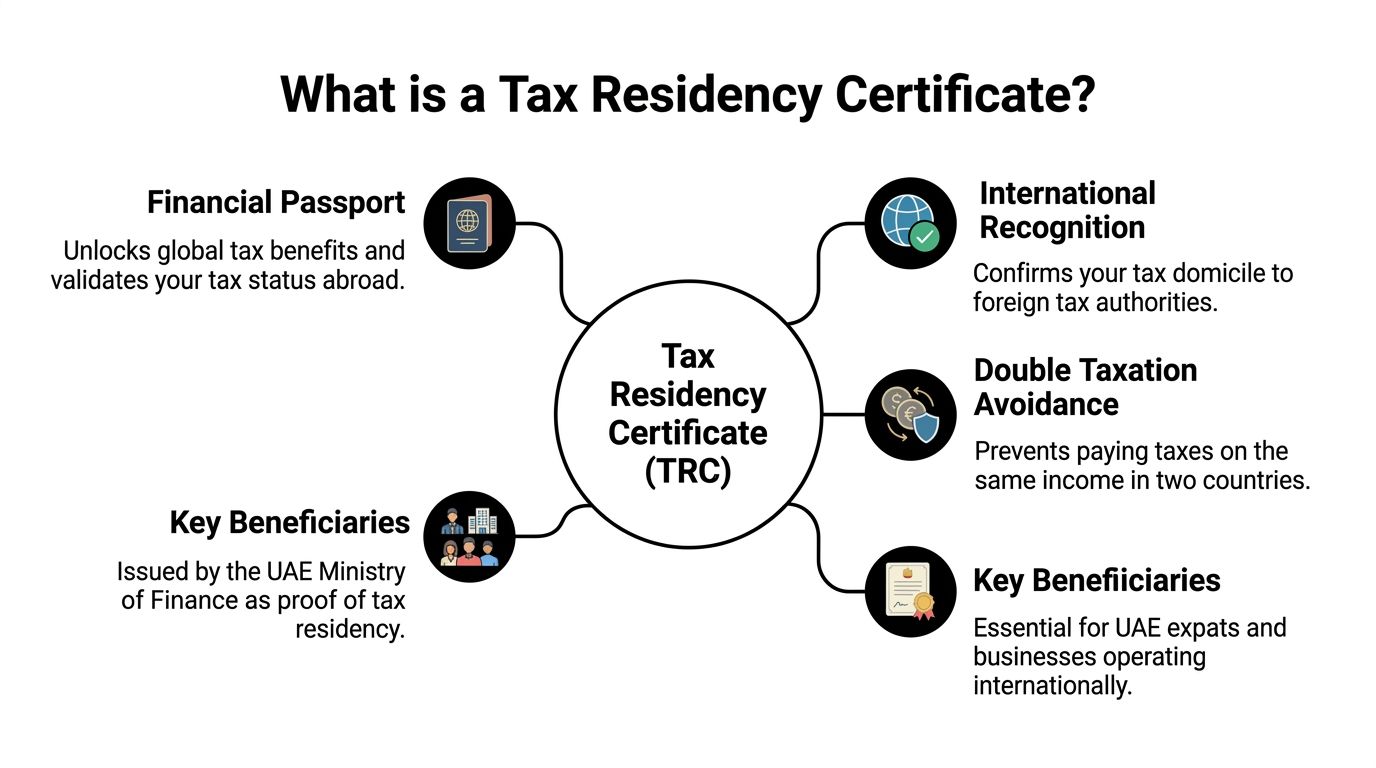
The certificate supports a claim. It does not create one.
That distinction matters more than many investors expect. I often see founders assume that a UAE visa, a tenancy contract, or a company setup automatically solves the tax residence question. It does not. The TRC is evidence based on underlying facts such as residence status, qualifying presence, and, for some applicants, whether their actual pattern of time in and out of the UAE supports the application.
What the certificate does
The function is practical. If a foreign authority asks why treaty relief should apply, why reduced withholding should be available, or why the UAE should be treated as the taxpayer's country of residence, the TRC is one of the main documents used to support that position.
It is commonly used in cases involving:
- Foreign-source income: where overseas income may be taxed differently if UAE residence can be shown
- Cross-border payments: where another country wants formal residence evidence before applying treaty treatment
- Legacy tax ties: where an investor has left a previous home country but still faces residency questions there
- Frequent international travel: where the applicant needs to show that extended absence has not weakened the residence position behind the certificate
The last point is often missed. For internationally mobile business owners, the biggest risk is not the application form. It is spending too much time outside the UAE, then discovering the residence position is weaker than expected when the certificate is needed.
What it does not do
A TRC has limits, and those limits matter.
| Point | Practical meaning |
|---|---|
| It doesn't replace your visa | Immigration status and tax residency are separate |
| It doesn't fix weak facts | If your physical presence, personal ties, or management position do not support UAE residence, the certificate alone will not cure that |
| It isn't open-ended | It is issued for a specific period and must be renewed if ongoing proof is needed |
Treat the TRC as documentary support for a tax position that must already make sense on the facts. If the travel pattern, timing, and records are clean, the certificate is highly useful. If extended absence has broken the required presence test, the paperwork becomes much harder to defend.
Why This Certificate Is a Non-Negotiable for UAE Expats
Most UAE expats don't need a TRC because someone told them it's a good idea. They need it because more than one country may have a reason, or claim, to tax the same income.
Take a simple example. An Indian IT consultant lives in Dubai and bills a client in Germany. The consultant may assume that living in the UAE settles the issue. It often doesn't. A foreign authority may still ask where the consultant is tax resident and whether treaty benefits are available. Without formal proof, the consultant can end up arguing from scratch.

Who usually needs it most
This issue comes up repeatedly for people whose business life is international but whose paperwork still reflects more than one jurisdiction.
- Freelancers and consultants: especially when invoicing overseas clients who ask for residence evidence.
- Foreign investors: particularly when their home country continues reviewing their residency position.
- Remote workers and founders: where work is done from the UAE but income is connected to another country.
- UAE-based companies: when international counterparties or foreign authorities want tax residence support.
The cost of skipping it
The biggest mistake is waiting until a foreign tax question arrives. By then, you're no longer planning. You're reacting.
A TRC is often the document that allows a taxpayer to show that the UAE is the relevant tax residence under treaty logic. Without it, the treaty may still exist in theory, but proving entitlement becomes harder in practice. That gap is where disputes, delays, and extra tax exposure tend to appear.
If your income crosses borders, documentation matters as much as structure. A clean company setup won't help much if you can't prove tax residence when asked.
This is why the certificate becomes essential for many expats. It isn't about collecting one more UAE document. It's about defending the tax position that your whole relocation strategy depends on.
Checking Your Eligibility for a UAE Tax Residency Certificate
A common problem looks like this. An investor lives in Dubai, runs meetings across London, Riyadh, and Singapore, and assumes a UAE residence visa settles the tax residence question. Then a foreign bank, tax adviser, or withholding agent asks for a UAE TRC, and the travel pattern becomes the issue.
Eligibility for a UAE Tax Residency Certificate is decided on evidence, not intent. A visa, a lease, or a company licence helps, but none of them replaces the residency tests the authorities apply.
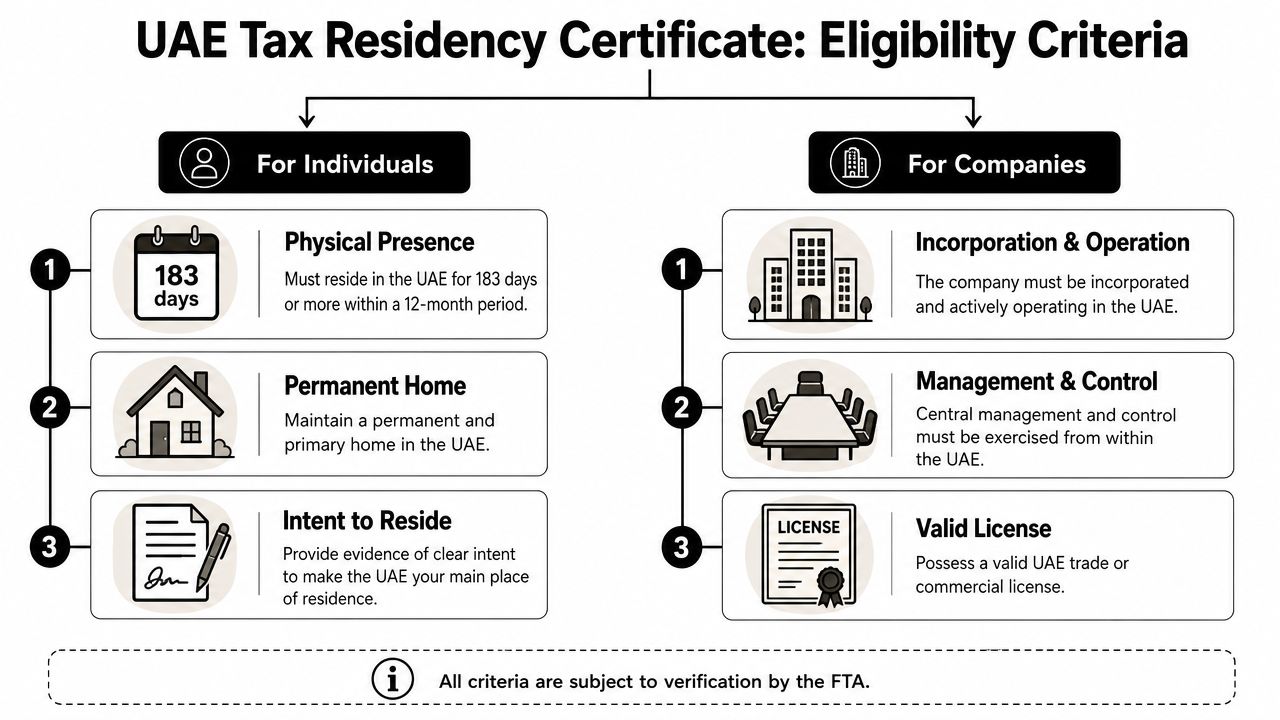
For individuals
For individual applicants seeking a TRC for Double Taxation Agreement purposes, the practical benchmark is physical presence in the UAE for 183 days in a consecutive 12 month period, as explained in EY's guidance on UAE tax residency determination.
That is the part many internationally mobile founders and consultants underestimate.
The primary risk is extended absence. A few long work trips, a summer outside the UAE, or repeated regional travel can push a person below the threshold before they realise it. By the time they start the application, the passport stamps and entry records usually tell a cleaner story than their calendar memory does.
There is also a separate domestic residence framework under which some individuals may qualify with fewer days if other conditions are met. That can matter for local tax residence analysis. It should not be treated as a safe shortcut if the goal is treaty relief abroad. In practice, if a foreign authority, payer, or adviser expects a treaty-based UAE residence certificate, the 183-day standard is the safer working assumption.
A simple way to assess the position is this:
| Applicant type | Practical test |
|---|---|
| Individual seeking treaty-purpose TRC | Plan around the 183-day physical presence rule |
| Individual relying on domestic residence rules | Other ties may help, but they do not automatically secure treaty recognition |
Keep your own travel log. I advise clients to check it quarterly, not at year end. That gives you time to correct course if travel is getting too heavy.
For companies
Companies are judged differently. The core question is whether effective management and control sit in the UAE.
That means the company should be able to show that real decision-making happens here. The tax authority will look past the licence and ask whether the facts support the story. Board decisions, signatory patterns, management records, office use, and day-to-day control should all point in the same direction.
Typical indicators include:
- Valid trade licence: the company must be properly licensed in the UAE.
- Management evidence: records should show that strategic decisions are made in the UAE.
- Operational consistency: the application should match how the business runs.
- Substance in practice: the company should not appear to be directed from another country while using the UAE only on paper.
Trade-offs matter. A founder may spend part of the year overseas building clients or managing suppliers, which is commercially sensible. But if the company's key decisions are consistently made outside the UAE, the TRC file becomes weaker. The same travel pattern that hurts an individual on day count can also hurt a company on management and control.
The safest approach is straightforward. For individuals, monitor physical presence early and treat extended absence as a compliance risk. For companies, make sure the control position is real, documented, and consistent with how the business is managed.
How to Apply for Your TRC in the UAE A Step-by-Step Guide
A common mistake happens before the application even starts. An investor flies in and out of the UAE all year for deals, assumes the residence visa is enough, then discovers the TRC file depends on records they did not keep properly. The portal is straightforward. The core task is proving the facts behind the application.
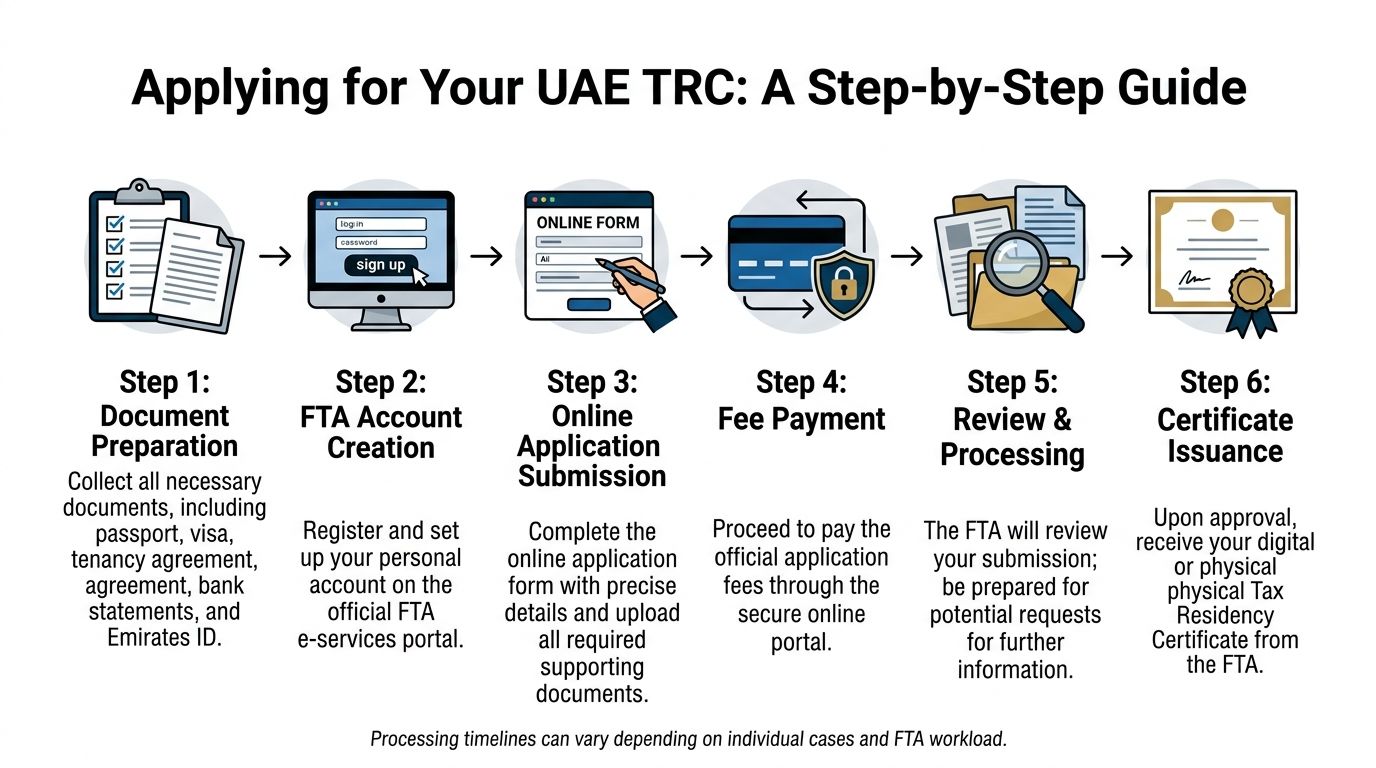
The application is submitted through the Federal Tax Authority's online system, using the services listed on the official FTA portal. In practice, timing depends less on the form itself and more on whether your documents are complete, consistent, and easy for the reviewer to verify. Fee levels, issuance format, and common supporting documents are also summarized in ClearTax's UAE TRC guide, but I would not rely on any third-party summary without checking the current FTA process before filing.
Step 1 Check your position before you apply
Start with eligibility, then move to paperwork.
For individuals, the first practical check is your day count and travel history. If you travel often, pull your entry and exit record early and compare it against your own calendar, boarding passes, and passport stamps. Many otherwise credible applicants encounter difficulties at this stage. The issue is not only whether you spent enough time in the UAE, but whether you can document it cleanly if the file is reviewed closely.
For companies, review who made decisions, where they were made, and whether the records support that position.
Step 2 Build a document file that matches the facts
Good applications are consistent from the first page to the last. Names, dates, addresses, licence details, and ID numbers should match across every document.
For individuals, the file usually includes:
- Passport
- Emirates ID
- Valid residence visa
- Entry and exit report
- Proof of UAE accommodation, if requested
- Supporting financial or employment records, where relevant
For juridical persons, the file often includes:
- Trade licence
- Constitutional documents
- Lease or tenancy documents
- Corporate Tax registration details, where applicable
- Bank statements or audited financials, if requested
- Records showing management and control in the UAE
The trade-off is simple. Filing early with a weak file often creates more delay than waiting a few days to organize the documents properly.
Step 3 Complete the FTA application carefully
Once your file is ready, log into the FTA system and complete the TRC request.
Keep the submission clean:
- Use the same spelling and format shown on official documents
- Upload readable copies
- Group supporting records logically
- Check the certificate period you are applying for
- Pay the applicable fees and save the payment record
Small inconsistencies cause avoidable questions. A mismatched passport number, an unclear visa copy, or dates that do not align with the travel record can slow the file down.
Frequent business travel does not automatically block a TRC application. Poor travel records often do.
Step 4 Track the application after submission
Do not assume submission means the job is done.
Monitor the portal and registered email for follow-up requests. If the FTA asks for clarification, respond with a direct answer and a clean supporting document, not a bundle of loosely related files. Reviewers want to verify the point quickly.
This matters most for applicants with heavy international travel. If your UAE presence is close to the threshold, any request tied to travel history should be handled carefully and consistently.
Step 5 Prepare for the next certificate now
A TRC is not a set-and-forget document. If you use it for treaty relief, banking, group structuring, or overseas tax authority queries, renewal planning should start well before the current certificate expires.
The practical habit is to keep records throughout the year. Save travel logs. Keep accommodation evidence. For companies, keep board minutes and management records in order. Applicants who treat extended absence as a live compliance issue usually have a much easier renewal cycle than those who try to reconstruct the year at the last minute.
Common Pitfalls When Applying for a TRC
The biggest misunderstanding in this area is simple. A UAE residence visa is not the same thing as UAE tax residency. A visa gives you the right to reside. A TRC application asks whether your facts support tax residence under the relevant rules.
That distinction becomes painful when someone spends large parts of the year outside the UAE and still assumes their visa status will carry the application. It often won't.
The extended absence risk
The overlooked issue is the Extended Absence risk. The FTA's guidance has been updated, but there is no explicit grace-period formula for days lost abroad on business travel. That leaves a real compliance gap for entrepreneurs who travel heavily and still need to satisfy the strict treaty-purpose presence test, as discussed in KPMG's review of UAE tax resident and TRC guidance.
International founders frequently travel for valid commercial reasons, often reducing their available days in the UAE. Supplier meetings, investor roadshows, trade fairs, family emergencies, and client visits can all eat into UAE days. The problem is that the rule still looks at physical presence.
Frequent travel isn't automatically a problem. Untracked travel is.
If you're close to the threshold, one long trip can create a serious issue. Not because anyone doubts you live in the UAE in a general sense, but because the certificate depends on a specific presence standard for treaty use.
Other mistakes that cause trouble
The next set of problems is less dramatic but just as common.
Weak day-count evidence
Applicants sometimes rely on memory, flight emails, or rough estimates of time spent in the UAE. The application process expects documentary support. If your entry and exit record doesn't support your claim, your file weakens immediately.
Treating company ownership as enough
Owning a UAE company does not prove that the company is managed and controlled from the UAE. If real strategic decisions happen elsewhere, the company's TRC position becomes harder to defend.
Inconsistent documents
Small mismatches create unnecessary friction. Different spellings, outdated IDs, incomplete licences, or records that don't align with the application narrative can all trigger delays.
What works better
A stronger approach is operational, not theoretical.
- Track travel early: keep a live record of your UAE presence rather than reconstructing it later.
- Review threshold exposure: if you travel often, monitor whether you're drifting too close to the line.
- Match the narrative to the evidence: every claim in the application should be visible in the supporting documents.
- For companies, document real control: board decisions, management activity, and operating records should support UAE control in substance, not just in form.
Most TRC problems don't come from difficult law. They come from casual assumptions.
Secure Your Tax Status with Smart Classic Business Hub
A UAE Tax Residency Certificate is one of the most useful documents an international investor or founder can hold, but only when the facts behind it are solid. The substantive effort isn't just filing the application. It's checking eligibility properly, preparing the right evidence, and avoiding the travel and substance issues that often derail otherwise sensible plans.
Smart Classic Business Hub helps entrepreneurs, SMEs, and foreign investors handle that process from start to finish. The team supports eligibility reviews, document preparation, TRC applications, and follow-up, with practical attention to the details that matter most, especially physical presence for individuals and effective management and control for companies.
If you want a clean, defensible UAE tax residency position, get advice before you apply, not after a foreign authority starts asking questions.
Frequently Asked Questions About the TRC
A common situation looks like this. An investor has a UAE residence visa, a lease, and a local company, but spends long stretches outside the country closing deals, visiting suppliers, or managing operations abroad. Then the TRC application is reviewed, and the day-count position becomes the weak point.
That is why these questions matter in practice.
| Question | Answer |
|---|---|
| What is a tax residency certificate in simple terms? | It is an official UAE document issued by the Federal Tax Authority confirming that an individual or company is treated as a UAE tax resident for the relevant period. It is commonly used to support treaty claims and other cross-border tax positions. |
| Does a UAE residence visa automatically mean I can get a TRC? | No. A residence visa helps, but it does not prove tax residency by itself. For individuals, physical presence is often the point that decides the application. |
| How long is the certificate valid? | It generally applies to a specific tax period and is commonly treated as valid for one year. |
| How much does the application cost? | Fees depend on the applicant type and whether optional services, such as a hard copy, are requested. Check the current Federal Tax Authority schedule before filing, because charges can change. |
| How long does the process usually take? | The application is submitted online and is often processed within a short period if the file is complete. Missing documents or inconsistencies usually cause the delay, not the portal itself. |
| Can a company apply for a TRC? | Yes. The company must be able to show that effective management and control sits in the UAE, with records and supporting documents that match that position. |
| Can a free zone company get a TRC? | Yes, if it meets the requirements. Free zone status does not prevent a TRC application, but it also does not solve the substance and management questions automatically. |
| What is the biggest mistake individuals make? | Assuming a visa, tenancy contract, or company ownership is enough. For internationally mobile founders and investors, extended absences often create the main problem because the physical presence record no longer supports the application. |
The practical point is simple. A TRC supports facts that already exist. If you travel heavily, track your days carefully before you apply, especially if your schedule includes repeated long trips that can put the 183-day position under pressure.
If you want help securing your UAE tax residency position, Smart Classic Business Hub can guide you through the full process, from eligibility review and document checks to TRC application support and compliance planning. It's the practical way to avoid mistakes, protect treaty access, and keep your cross-border tax position organised.