
You're probably seeing ILOE insurance pop up in onboarding papers, HR reminders, visa discussions, or work permit questions and wondering whether it's just another optional add-on. It isn't. In the UAE, this sits in the same category as the compliance items people ignore at their own risk.
For employees, the issue is simple. If you're eligible and haven't subscribed, you can face penalties. For founders and managers, the issue is different but just as practical. Even though the employer generally doesn't pay for the policy, ILOE still affects hiring, onboarding, employee questions, and work permit continuity.
That's why the better question isn't only what is ILOE insurance. It's how this mandatory scheme fits into day-to-day employment, visa status, and business operations in the UAE.
What Is ILOE Insurance and Why It Matters in the UAE
A common UAE hiring scenario goes like this. An employee joins a company, completes visa formalities, starts work, and assumes every mandatory employment item was handled during onboarding. Months later, that employee learns ILOE was their own responsibility, not the employer's, and a compliance issue has already started to build.
ILOE stands for Involuntary Loss of Employment insurance. It is a mandatory UAE unemployment insurance scheme for eligible employees in the private sector and federal government, later extended to cover employees in free zones and certain semi-government entities. The purpose is practical: if an insured employee loses a job for reasons outside their control, the scheme can provide temporary cash support for a limited period.
For employees, that means ILOE is not just another HR form. It is an individual compliance requirement tied to continued participation in the UAE employment system. For founders, HR leads, and new business owners, the point is different. You usually do not fund the policy, but you still need to explain it clearly because staff often assume the company has already taken care of it.
That distinction causes real confusion during company formation, hiring, and visa processing. In practice, ILOE sits at the intersection of employment compliance, worker protection, and workforce mobility. It does not replace gratuity. It does not work like a savings product. It is a separate mandatory scheme with its own subscription and claims rules.
Practical rule: Treat ILOE as the employee's legal subscription duty, and treat employer communication about it as a risk-control step during onboarding.
The broader policy logic is straightforward. The UAE wants a structured safety net for job loss without shifting the full cost to employers. That matters in a fast-moving hiring environment where people change roles, move between mainland and free zone businesses, and compare job security across sectors. For useful context on how this fits into the wider Dubai hiring environment and workforce trends, it helps to view ILOE as part of the country's formal employment framework, not as an optional benefit.
If you are comparing ILOE with other forms of salary replacement cover, this income protection insurance guide helps clarify the difference between job-loss insurance and broader personal income cover.
Understanding Your ILOE Category and Costs
A common problem shows up right after hiring. An employee asks HR to deduct ILOE from salary every month, HR assumes the worker will handle it personally, and no one checks the salary category until a fine or claim issue appears later.
Your ILOE cost depends on one figure only. Basic salary. That figure decides your category, your premium, and your maximum monthly benefit if you qualify to claim.
The two categories
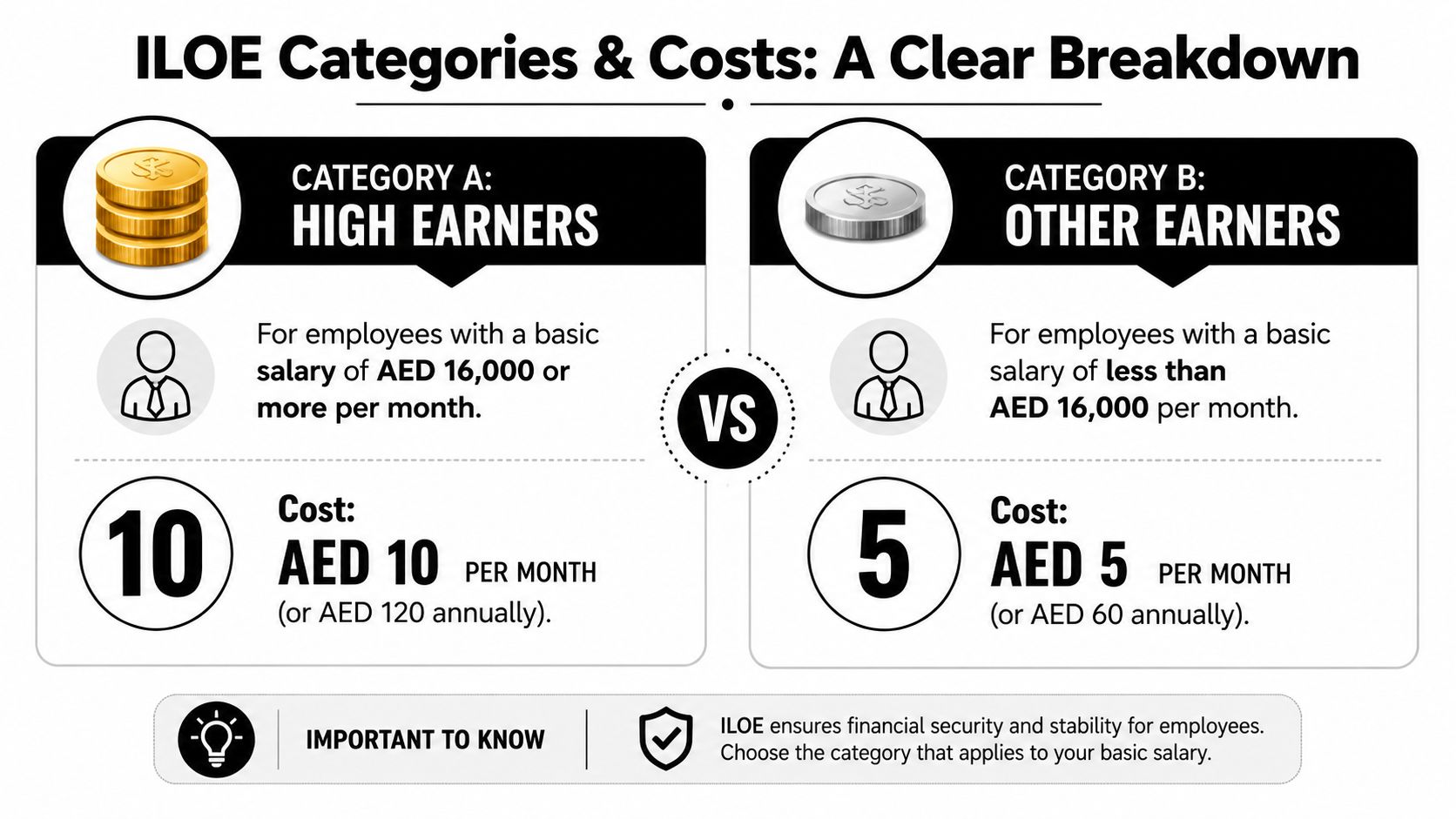
As noted earlier, the scheme started as a mandatory requirement from 1 January 2023. The pricing structure is straightforward. Category A applies if your basic salary is AED 16,000 or below. Category B applies if your basic salary is above AED 16,000.
The usual premium levels are:
- Category A: AED 5 per month or AED 60 plus VAT per year
- Category B: AED 10 per month or AED 120 plus VAT per year
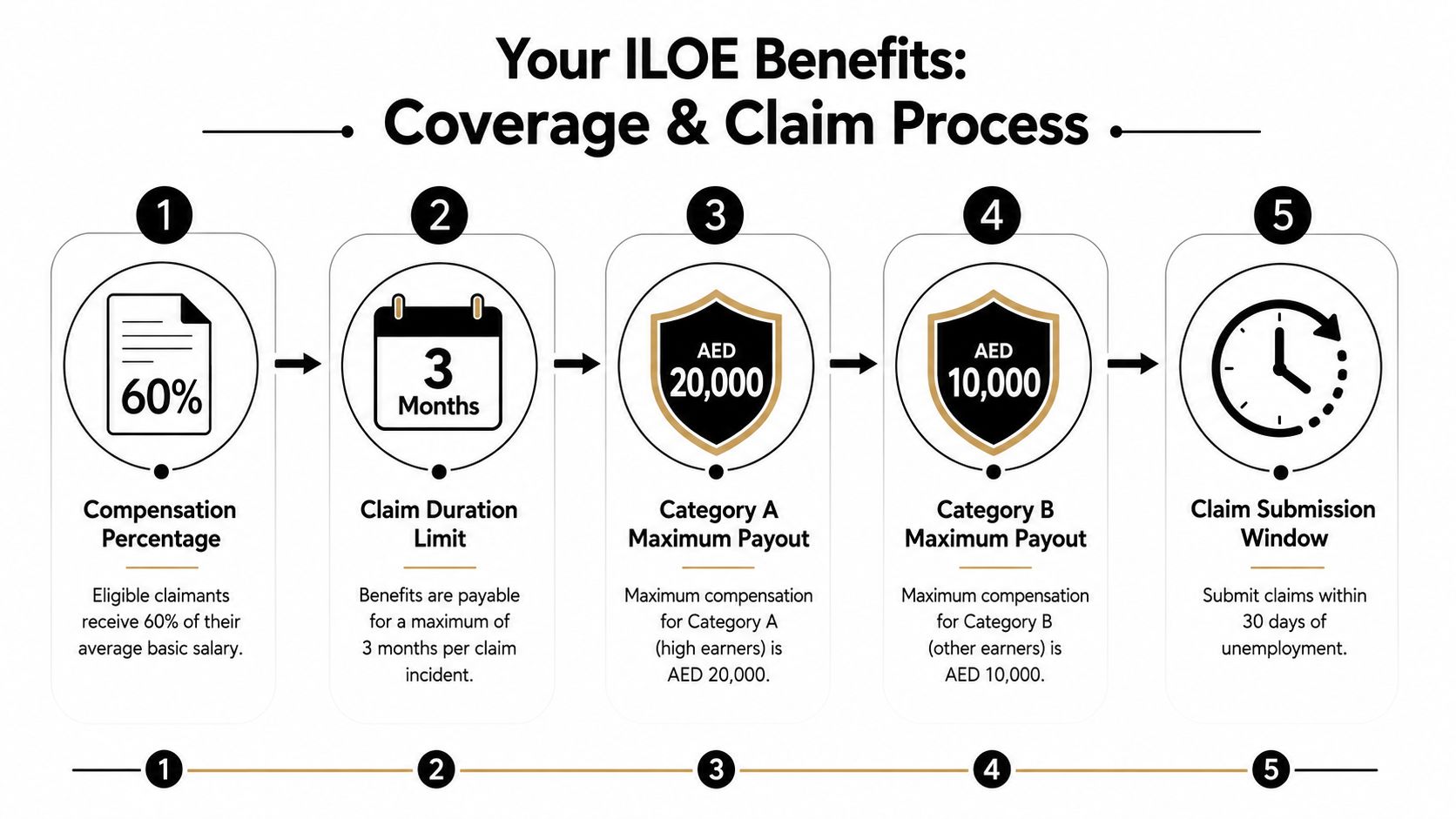
The benefit calculation also follows the same split. Compensation is based on 60% of average basic salary, subject to a cap of AED 10,000 per month for Category A and AED 20,000 per month for Category B, for up to three months. Failing to subscribe can lead to an AED 400 fine.
The practical mistake is simple. Employees often look at total package, not the basic salary stated in the labour contract. Housing, transport, commission, and other allowances do not place someone into Category A or Category B.
ILOE Insurance Categories at a Glance 2026
| Feature | Category A | Category B |
|---|---|---|
| Basic salary band | AED 16,000 or below | Above AED 16,000 |
| Premium | AED 5 per month | AED 10 per month |
| Annual premium | AED 60+VAT | AED 120+VAT |
| Payout basis | 60% of average basic salary | 60% of average basic salary |
| Monthly payout cap | AED 10,000 | AED 20,000 |
| Maximum claim duration | Up to three months | Up to three months |
The upfront payment point many people miss
For many subscribers, the cost discussion does not end with the monthly premium. The subscription route may require an upfront payment period, which is why employees are often surprised when the amount due is higher than a single month's fee.
In practice, if someone asks what ILOE insurance is going to cost, the right answer is: confirm the salary category first, then check the available payment method and subscription term. Looking only at the monthly figure can be misleading.
The administrative mistake I see most often is not refusal to subscribe. It is choosing the wrong salary category because the employee checks total pay instead of the basic salary on the contract.
For employers and founders, this matters during offer structuring as well. If you are planning total hiring costs, this UAE employment visa cost guide helps place ILOE within the wider cost of employing staff legally in the UAE.
Who Must Subscribe to ILOE Insurance
A common problem starts on day one of employment. A new hire receives a reminder about ILOE, assumes HR has already handled it, and ignores it. Months later, a fine appears, or worse, the employee loses a job and discovers there was no valid subscription in place.
For UAE employees, the default position is simple. If you are a salaried employee in the private sector, federal government, or many free zones, you should expect ILOE to apply to you.
For business owners, the practical point is different. Your responsibility is usually not to pay or file the policy on behalf of staff, unless your company chooses to manage that administratively. Your responsibility is to make sure employees know the requirement, understand whether they fall within scope, and do not confuse visa status with exemption.
Employees who usually fall within the scheme
ILOE generally applies to:
- Private sector employees working for UAE-registered companies
- Federal government employees
- Many free zone employees, subject to the rules that apply to that free zone and employment structure
The point that creates confusion is free zone employment. Some employees assume that a free zone visa automatically means the scheme does not apply. That is often wrong. Free zone status and ILOE eligibility are not the same issue.
Employees who are usually exempt
The groups commonly treated as outside the mandatory scope include:
- Investors and business owners in their own company
- Domestic workers
- Temporary contract workers
- Individuals under 18
- Retirees who already receive a pension and have returned to work
This distinction matters for founders. A company owner holding investor status is not treated the same way as an employee on payroll under the standard labour framework. I see this mistake regularly in small companies where the founder assumes their own visa category and the staff category are identical. They are not.
The practical test to use
If there is any doubt, check the position against three points:
- Are you employed as an employee, not just registered as an owner or investor?
- Are you working under a private sector, federal, or qualifying free zone employment arrangement?
- Are you outside a separate regime with its own employment rules, such as certain financial free zones?
If the answer is yes to all three, treat ILOE as likely applicable and verify the employment record early through the Ministry of Labour inquiry services.
That last step is where employees and entrepreneurs both save time. Employees avoid fines and missed coverage. Employers avoid preventable disputes with staff who assume the company was supposed to complete the process for them.
Navigating ILOE Coverage and Claiming Benefits
When people ask what is ILOE insurance, they usually mean one of two things. First, do I have to buy it? Second, what happens if I lose my job? The claim side is where the fine print matters.
What the cover is designed to do
The scheme pays temporary income support after involuntary job loss. It doesn't respond to every end of employment. The difference between employer-initiated termination and voluntary resignation is central to whether a claim works.
A practical example makes this clearer. An employee is made redundant, receives a termination letter confirming the job loss wasn't voluntary, and has maintained the required subscription history. That person may have a valid claim. Another employee resigns because they want a career break. That person won't.
The conditions that decide the outcome
This ILOE claims article states that the scheme has supported over 17,000 beneficiaries since launch. The same source says a subscriber must have paid premiums for at least 12 consecutive months, must submit a claim within 30 days of termination, and must prove involuntary job loss with a termination letter. It also states that the scheme excludes job losses caused by resignation or disciplinary action, and that compensation stops immediately if the claimant finds new employment or leaves the UAE.
The broader operational detail in that same source is useful too. It says claims require a termination letter stating involuntary job loss, salary slips or bank statements covering the salary-verification period, and an Emirates ID. It also notes that payouts are typically processed within two weeks if the claim is eligible.
A practical claim checklist
If someone has just lost their job and believes they qualify, this is the practical order of work:
- Confirm the reason for termination: The letter should clearly support involuntary loss of employment.
- Check your subscription history: Gaps in premium continuity can create problems.
- File fast: The claim window is short, so waiting until visa pressure builds is a mistake.
- Prepare salary evidence: The insurer needs to verify the average basic salary basis.
- Monitor status after filing: If you secure another job or leave the UAE, payments stop.
For official support channels and related labour process checks, many people also look at Ministry of Labour inquiry services while handling termination and compliance questions.
Missed deadlines sink more claims than complicated legal arguments. If the paperwork is valid, speed matters.
A Step-by-Step Guide to Getting Your ILOE Policy
A common UAE compliance problem looks like this. An employee changes jobs, assumes HR handled ILOE, and only checks when a fine appears or a work permit transaction stalls. For founders and managers, the mistake is different. They assume the company must arrange it for staff, even though the obligation generally sits with the employee.

The official channels to use
Use the official ILOE channels only. Subscription and account servicing are handled through the ILOE portal, the smart app, or the call centre at 600 599 555, as noted earlier in the article's source material.
For practical purposes, that matters for both employees and business owners. Employees need a direct way to verify that the policy is active and paid. Employers should know the process well enough to brief staff correctly, but that does not mean the employer becomes the policyholder by default.
The practical subscription sequence
Confirm that you are subscribing as an employee
Start with your actual status under your visa and labour arrangement. Founders, partners, and investor-visa holders often find this point confusing. ILOE is built around eligible employees, not every person attached to a business licence.Select the correct category based on basic salary
Use the basic salary figure from the employment contract, not the total package with allowances. Choosing the wrong category creates avoidable correction work later.Prepare your Emirates ID and personal details
The registration data must match current records. If your name, ID details, or employment records are inconsistent, fix that first instead of forcing the application through.Subscribe through the portal, app, or call centre
The digital route is usually faster. The call centre is useful if the employee is unsure about category, eligibility, or prior registration status.Pay and store the confirmation properly
Keep the receipt, policy confirmation, and any payment reference in one place. If a claim comes up later, missing payment proof creates unnecessary friction.
What employers should do, and what they should not assume
In practice, good employers include ILOE in onboarding and offboarding checklists, especially in SMEs and free zone companies where compliance gaps appear faster. That is sensible risk control. It reduces staff confusion, helps avoid complaints, and prevents last-minute HR fire drills.
But there is a limit. ILOE is not a substitute for end-of-service benefits, payroll planning, or visa compliance. It is a separate mandatory scheme tied to the individual employee's subscription status.
Teams that manage higher policy volume often look at insurance quoting automation examples to improve process handling, but for ILOE the basic rule is simpler. Use the official channel, choose the right salary category, and keep your payment record.
The cleanest setup is also the safest one. Correct employee status, correct salary category, current ID records, and saved proof of payment.
Common Exclusions and Compliance Pitfalls to Avoid
An employee loses a job, assumes ILOE will cover the gap, then learns the file does not qualify because the exit reason, subscription status, or records do not match the scheme rules. That is a common problem in the UAE, especially when staff assume HR handled everything for them.
Exclusions that stop a claim
ILOE does not pay solely because employment ended. The reason for termination and the employee's status during the claim period both matter.
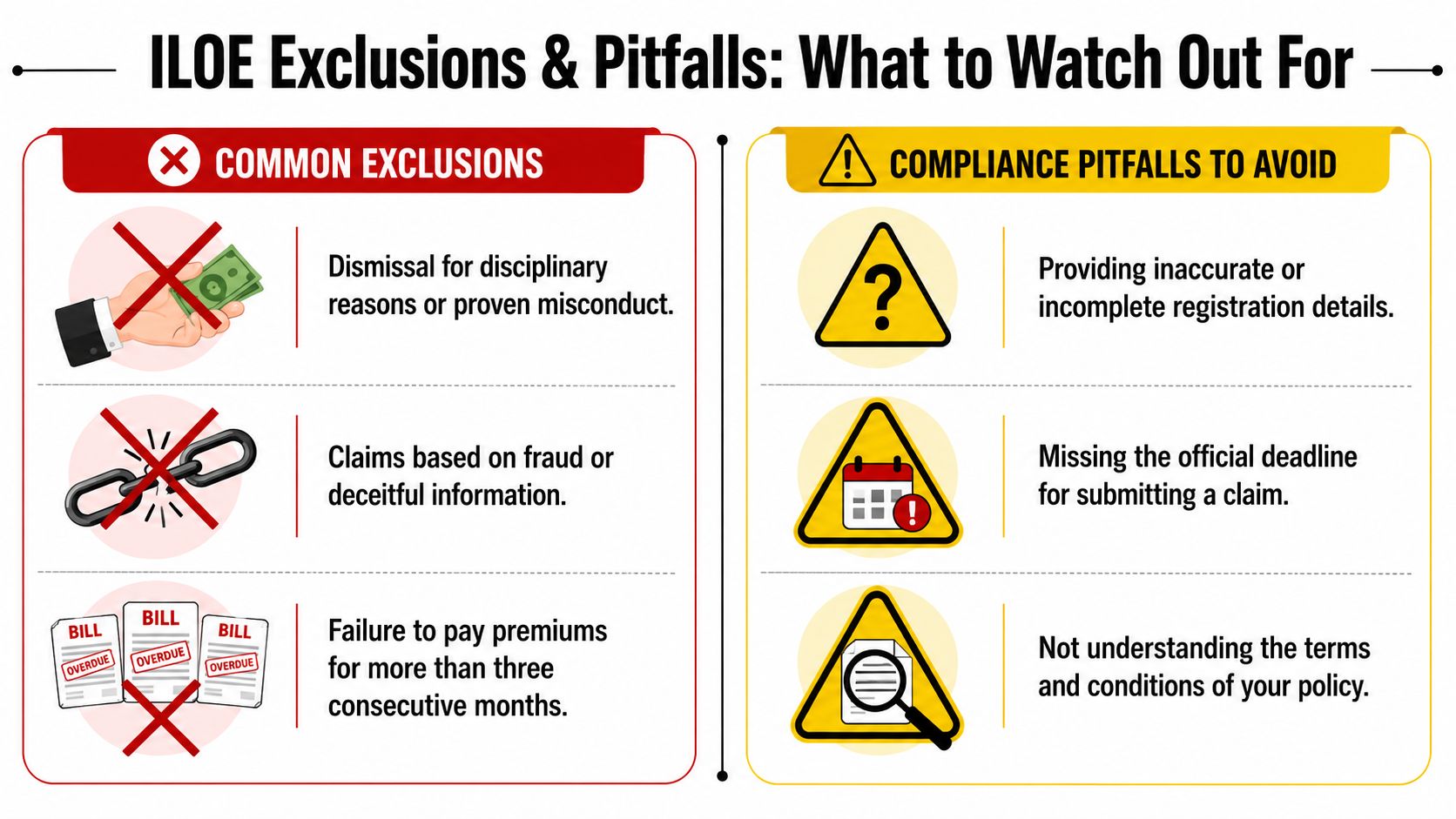
Common claim blockers include:
- Resignation. Voluntary departure does not qualify for unemployment compensation.
- Dismissal for disciplinary reasons. If the separation is tied to misconduct or a disciplinary finding, the claim is usually rejected.
- Leaving the UAE during the payout period. Compensation can stop if the claimant no longer remains in the country as required under the scheme conditions.
- Starting a new job. Payments stop once the person is re-employed.
Documentation is often the hidden problem. If the termination record, payroll history, ID details, or policy records do not line up, the claim can stall even before the eligibility question is fully reviewed.
Compliance mistakes that create avoidable trouble
The practical mistake is assuming mandatory means automatic. It does not. An eligible employee still needs an active subscription, paid premiums, correct category details, and records that support the claim.
Missed premiums create problems quickly. So does ignoring reminders, using the wrong salary category, or relying on an employer to register the policy without checking. For founders and SME owners, the business setup angle gains significance. ILOE sits next to visa administration and labour compliance, but it does not replace either one, and the employer's legal obligation is narrower than many teams assume.
There is also a real penalty risk for employees who do not comply, as noted earlier in the article. In practice, the bigger issue is timing. People often discover the gap during a work permit, visa, or job transition, when there is very little room to fix old errors.
For employers, the trade-off is straightforward. The company may not be required to fund or manage an employee's ILOE policy, but silence creates HR friction, onboarding confusion, and disputes at exit. Good operators deal with that by adding one simple control: tell staff clearly that ILOE is their responsibility, then keep a record that the guidance was given.
Teams that want to improve process discipline often review insurance quoting automation examples. The lesson applies here too. Clear workflows, clear ownership, and saved records prevent small compliance misses from turning into expensive delays.
The main risk is not only a fine. It is finding a compliance gap when a termination, visa update, or labour process is already under pressure.
ILOE Insurance Frequently Asked Questions
Do business owners or investors need ILOE?
Usually, no, if they fall into the owner or investor category rather than the eligible employee category. This is one of the biggest misunderstandings in company setup. Founders often assume everyone attached to a company must subscribe in the same way. That's not how the scheme is typically applied.
Do golden visa holders need ILOE?
A visa category by itself doesn't answer the question. The main issue is whether the person is working as an eligible employee under the scheme's scope or sits outside it as an investor, owner, or another exempt category. The employment status matters more than the label people use in conversation.
Does the employer have to pay for staff ILOE?
No. The earlier source on the scheme states that employers are not required to register employees or pay premiums on their behalf. But smart employers still mention ILOE during onboarding because staff often assume the company already handled it. That's where avoidable disputes begin.
Are free zone employees included?
Most are. The verified guidance cited earlier says free zone employees are generally included, but financial free zones like DIFC operate under separate rules. If someone works in a free zone and is unsure, they should verify the exact framework rather than rely on a generic answer.
What if someone misses premiums or delays action?
That creates risk on two fronts. First, there's the compliance side, which can lead to penalties or permit complications. Second, there's the claim side, where weak payment history or delay can undermine a future benefit request. In practice, the safest approach is simple: subscribe correctly, keep the records, and don't leave checks until a problem appears.
If you're setting up a company, hiring staff, sorting visas, or trying to keep your UAE compliance clean from day one, Smart Classic Business Hub can help you handle the wider business setup and regulatory side properly. That includes the practical questions around employment structure, free zone versus mainland decisions, PRO support, and the compliance workflows that sit around requirements like ILOE.