
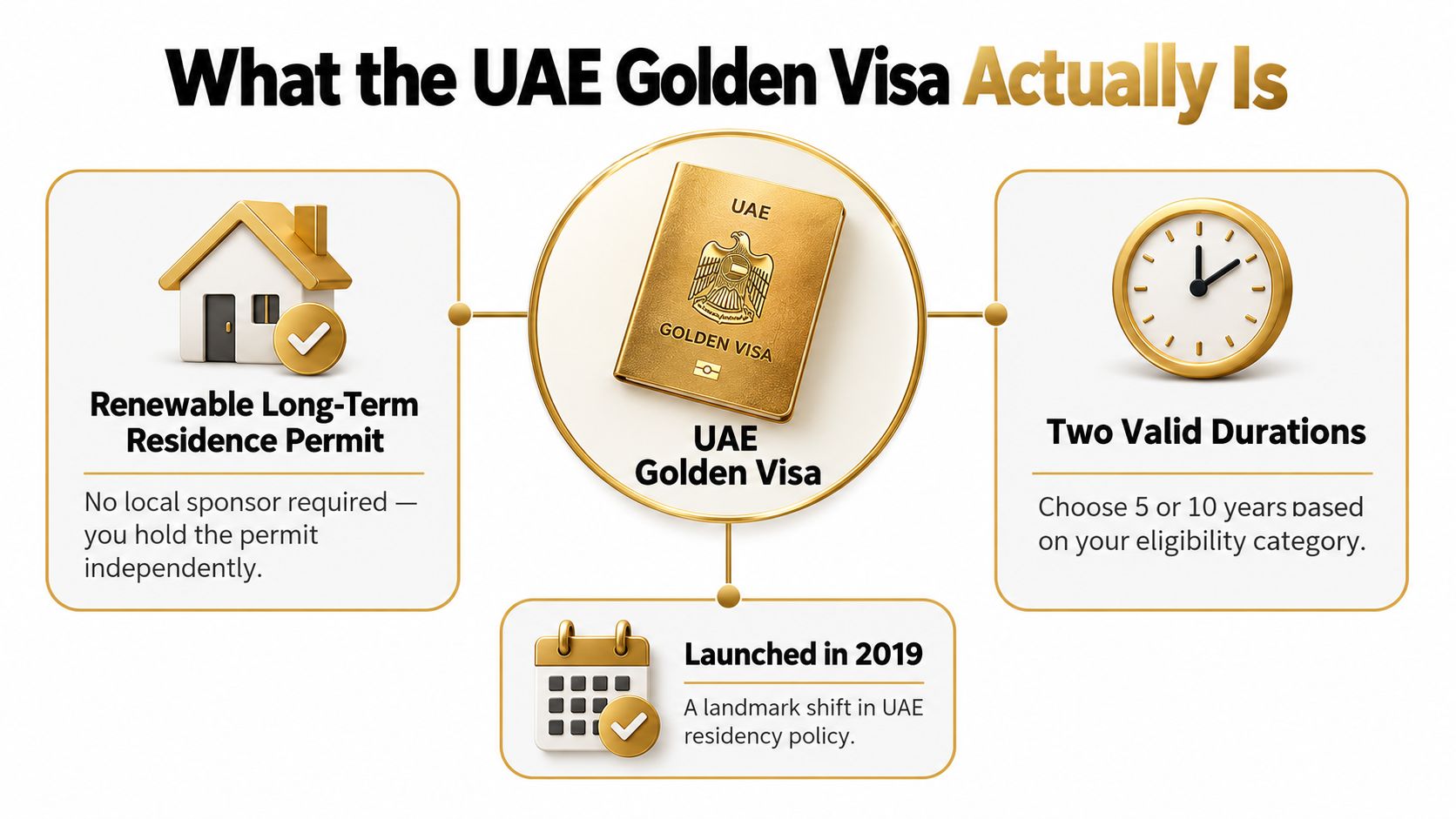
The UAE Golden Visa is a renewable long-term residence permit lasting 5 or 10 years, issued without a local sponsor to investors, entrepreneurs, specialists, students and other approved contributors. It gives eligible foreign nationals more independence to live, work, study, invest and establish businesses in the UAE.
You may be asking this after seeing property advertisements promising residency, considering a move from an employer-sponsored visa, or hearing that a company licence automatically qualifies an entrepreneur. Those assumptions create problems because the Golden Visa isn't one single permit with one universal test. It's a multi-track residence framework, and every track has its own evidence requirements.
A property purchase, salary, degree, business project or academic record may support an application, but the approval depends on whether the applicant proves the correct category through recognised documents. The UAE calls the programme Golden Residency, although "Golden Visa" remains the term widely used.
What the UAE Golden Visa Actually Is
At its simplest, the Golden Visa is a renewable UAE residence permit that doesn't generally require a traditional employer or family sponsor. Depending on the category and the applicant's continuing eligibility, it lasts 5 or 10 years. The permit is designed for people whose contribution to the UAE goes beyond a conventional employment relationship.
The UAE introduced the programme in 2019 as a shift away from short-term, sponsor-linked residency towards a longer-term model for internationally mobile people. At its launch in November 2019, the Federal Authority for Identity and Citizenship said the first group included 6,800 people from more than 70 countries, with combined investments exceeding AED 100 billion. Those launch figures are recorded in the Federal Authority's announcement of the Golden Visa platform.
What sponsor-free means in practice
With an ordinary employment residence visa, the employer normally plays a central role in maintaining your residency. A Golden Visa holder can generally change employers, operate independently or establish a business without transferring residence sponsorship each time, provided the relevant eligibility conditions remain satisfied.
That independence can matter to a founder leaving employment, a specialist moving between roles, or an investor who doesn't want residence tied to a job. Qualifying family members can also be included, which makes the framework relevant to households rather than only individual applicants.
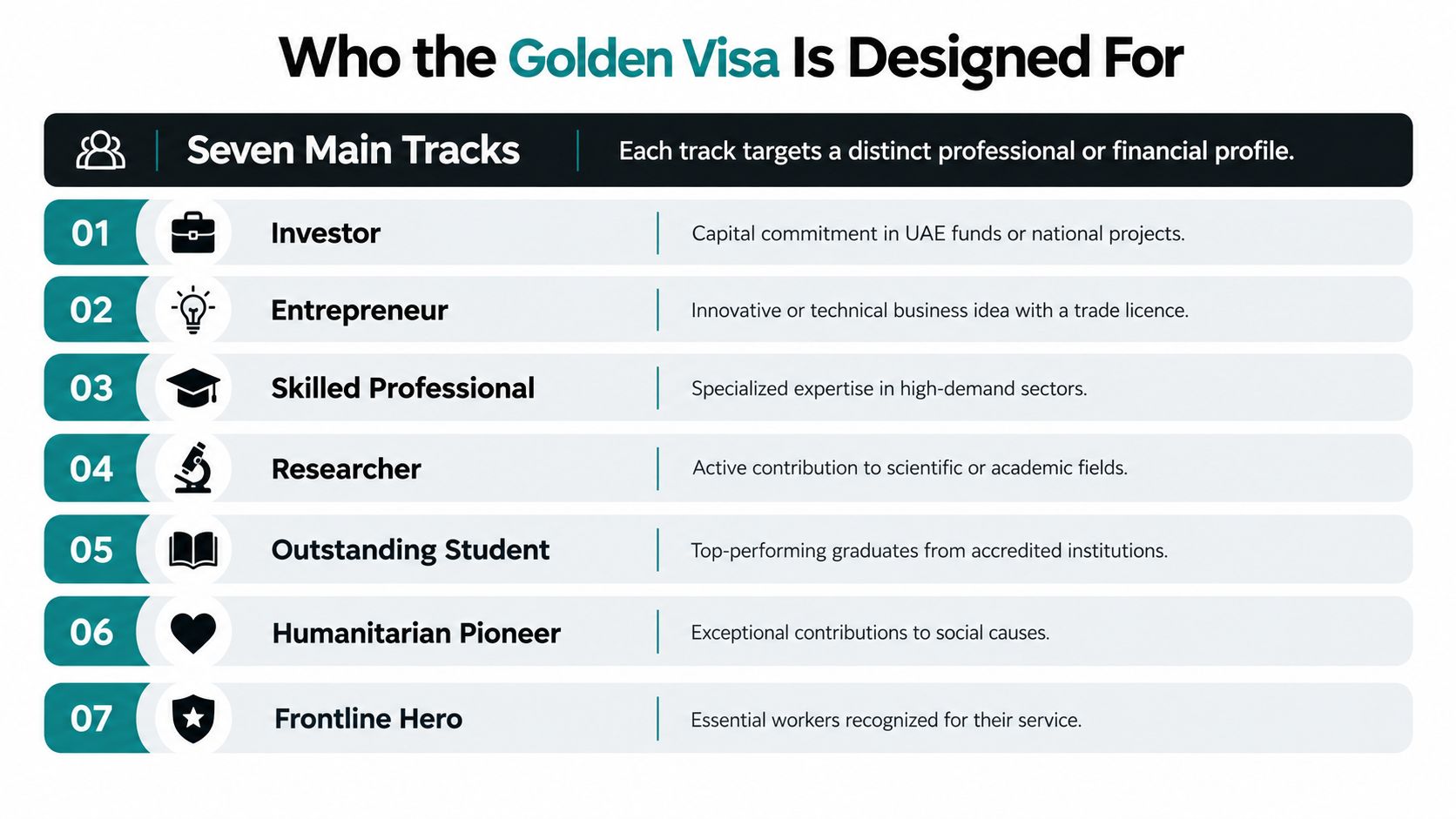
The programme covers investors, entrepreneurs, skilled professionals, researchers, outstanding students and graduates, humanitarian pioneers and frontline workers. The government therefore treats residency as a way to attract both capital and talent, not as a reward for buying property.
Practical rule: “Sponsor-free” doesn't mean “condition-free”. You still need to prove the category you apply under and maintain the conditions attached to it.
The rest of the process becomes clearer once you stop asking, “How much does the Golden Visa cost?” and start asking, “Which category do I qualify for, and what evidence proves it?”
Golden Visa vs Standard UAE Residence
A standard residence visa can be entirely suitable when your UAE stay is connected to one employer, a family sponsor or a defined work assignment. The Golden Visa becomes more relevant when you need continuity beyond one job, one sponsor or one conventional employment arrangement.
| Criterion | Golden Visa | Standard Residence |
|---|---|---|
| Sponsor requirement | Generally no UAE sponsor is required | Usually linked to an employer, family sponsor or another sponsoring entity |
| Duration | Renewable for 5 or 10 years, depending on category | Often shorter and tied to the sponsor's continuing status |
| Employer switching | You can generally change employers without replacing the underlying residence basis, if eligibility continues | Changing jobs usually requires sponsor and immigration action |
| Family coverage | Qualifying family members may be included under the applicable rules | Family residence normally depends on the sponsor's status and conditions |
| Eligibility basis | Investment, entrepreneurship, professional expertise, academic achievement or other recognised contribution | Employment, family relationship, business ownership or another standard residence route |
| Time outside the UAE | The framework provides more flexibility for extended absence than ordinary residence, subject to the applicable rules | Extended absence can create cancellation or re-entry complications |
The practical advantages are clear. A founder can leave an employer and continue building a UAE business. A property investor can hold residence without taking a UAE job. A specialist can move between employers without making every career change an immigration reset. The UAE residency options overview can help you compare the Golden Visa with other residence routes.
Who still needs standard residence
The Golden Visa isn't automatically the better choice for everyone. An employee who has a straightforward employer-sponsored role may find a standard residence route more direct. A newly hired worker who hasn't yet built the investment, professional or academic evidence required for Golden Residency may also need to begin with ordinary employment residence.
A visit visa is different again. It allows a person to enter or remain temporarily under its conditions, but it doesn't provide the long-term residence rights associated with a Golden Visa. The correct comparison is therefore not “Golden Visa versus work visa”. It is independence and category-based eligibility versus sponsor-based residence.
Don't rely on a marketing phrase such as “lifetime freedom” or assume that sponsor-free residence removes every compliance obligation. Your passport, medical fitness, insurance, identity records and category evidence still matter.
Who the Golden Visa Is Designed For
The UAE Golden Visa covers several profiles because the programme is intended to attract different forms of value. Investors bring capital, entrepreneurs bring new projects, professionals bring specialised skills, and students can develop into long-term contributors.
The seven main tracks
- Investor: A person who meets the qualifying financial or investment conditions through public investment, company ownership or real estate.
- Entrepreneur: A founder or business owner with a technical project supported by the required institutional evidence.
- Skilled professional: A UAE-employed specialist whose occupation, qualification and salary meet the applicable criteria.
- Researcher: A person making a recognised contribution to scientific or academic work.
- Outstanding student: A high-performing student or graduate who meets the relevant academic and recency requirements.
- Humanitarian pioneer: An individual recognised for exceptional service or contribution to humanitarian causes.
- Frontline hero: An essential worker whose service receives the required recognition.
This structure explains why calling the programme a “property visa” is misleading. Real estate is one possible route, but it sits alongside professional, entrepreneurial, research and academic pathways.
It also explains why two applicants can receive very different document requests. A property investor proves ownership and value. An entrepreneur proves the nature and credibility of a project. A skilled professional proves occupation, degree and salary. A student proves academic performance and institutional status.
The category determines the evidence file. The evidence file, not the label used in an advertisement, determines whether the application is credible.
Investor and Real Estate Eligibility
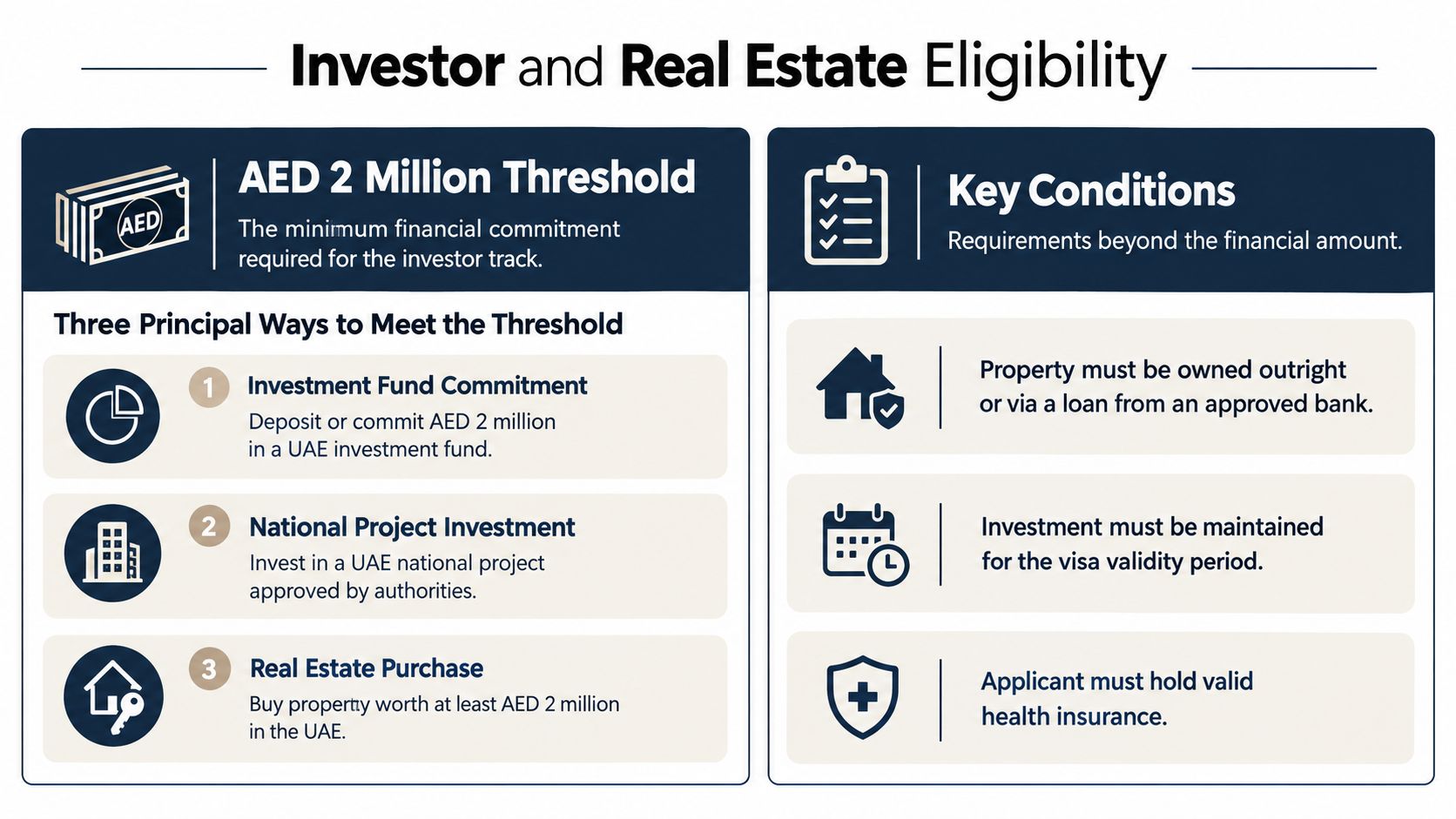
A property purchase can look substantial on paper and still leave an applicant short of the Golden Visa requirements. Financial routes begin with a principal threshold of AED 2 million, yet each route applies its own ownership, registration and financing rules. The approval decision rests on the evidence file, not on a bank balance or purchase receipt alone.
Public investment routes
An applicant may potentially qualify by placing at least AED 2 million with an investment fund or UAE national bank. A UAE company or establishment with capital of at least AED 2 million, or a qualifying ownership share at that value, can provide another route. For the wider company and fund options, see the UAE investor visa requirements guide.
Company owners may also use a tax-based route by demonstrating annual federal tax payments of at least AED 250,000. The threshold refers to annual federal tax payments, not company revenue, so official tax records are required.
The official UAE Golden Residency service guidance describes the applicable investment routes and conditions. Public-investment Golden Residency is generally associated with 10 years, while real-estate investment residency is generally associated with 5 years.
Real estate route
A real-estate applicant generally needs one or more UAE properties with a combined registered value of at least AED 2 million. The competent real-estate registration authority must document ownership.
The sale agreement and the registered value can tell different stories. Before applying, check the title deed, ownership percentage, property status, and the authority's valuation and registration records. A contract shows the agreed transaction price, while the authority's records establish the asset used for the residence application.
The investment capital must be fully owned by the applicant and cannot be financed through a loan under the relevant investment conditions. The source and structure of funds therefore matter alongside the property's headline value.
Evidence beats intention: A signed purchase agreement shows a transaction. A registered title and supporting authority documents show an eligible asset.
Prepare the evidence file before applying:
- Property evidence: Title deed or official registration document showing the qualifying value and ownership.
- Bank evidence: Bank or fund letter confirming the qualifying deposit or investment.
- Company evidence: Trade licence, constitutional documents and proof of capital or ownership share.
- Tax evidence: Official records supporting the applicable annual federal tax payments.
- Financial records: Audited or official documents where the authority requires stronger proof of ownership and source.
Investment migration programmes also require scrutiny of the underlying transaction. For context on compliance and investor-protection concerns in a different residency-by-investment programme, read the RegisterCompany.ie analysis of the shutdown. It provides background only, not UAE eligibility guidance.
Entrepreneur Talent and Student Pathways
The non-investor routes prove a different proposition. Instead of showing that you committed qualifying capital, you must show that your project, professional contribution or academic record fits the relevant category.
Entrepreneurs need more than a licence
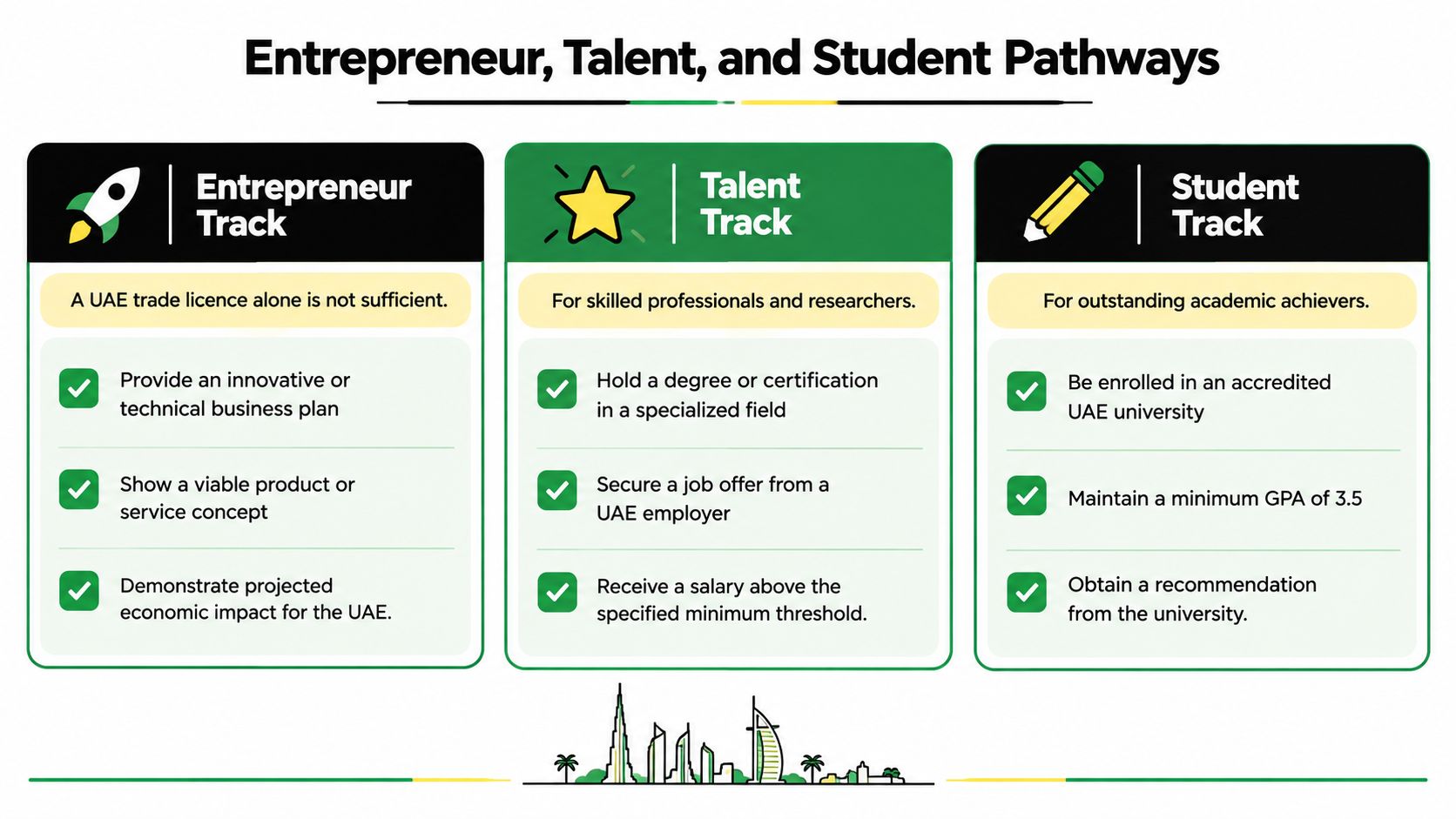
A UAE trade licence doesn't automatically make its holder eligible for the entrepreneur track. Official criteria require evidence of a technical project, documentation establishing the project's value and a recommendation or confirmation from an approved business incubator or the relevant emirate authority.
A useful entrepreneur evidence file could include the business model, product explanation, innovation rationale, valuation material, licence documents and institutional endorsement. The authority needs to understand what the project is and why it qualifies, not see that a company exists.
Skilled professionals
Abu Dhabi's published criteria for skilled professionals include employment in the UAE, an occupational classification at Level 1 or Level 2, a bachelor's degree or equivalent and a minimum monthly salary of AED 30,000. Regulated professions may also require a UAE practising licence. These conditions are set out in the Abu Dhabi guidance for skilled professionals.
The key mistake is treating salary as the only test. The occupation, employer relationship, qualification and any professional licence must align. A high salary in an occupation that doesn't fit the required classification may not produce the result the applicant expects.
Graduates and students
Academic pathways use both performance and timing. Eligible UAE graduates may need a GPA of at least 3.5 from an A-classified university or 3.8 from a B-classified university, with graduation generally within the previous two years. Certain UAE high-school graduates may qualify through a minimum score of 95%.
That means transcripts, graduation certificates, university classification and recommendation documents can matter as much as the application form. Students shouldn't wait until documents are difficult to obtain. Academic evidence is often easier to organise while the institution's records and contacts are readily available.
Step-by-Step Application and Documents
A successful application usually starts before anyone submits an online form. The applicant must first choose the correct category and build an evidence file that answers the authority's likely questions.
- Confirm the pathway. Decide whether the application is based on public investment, real estate, entrepreneurship, professional expertise, academic achievement or another approved category.
- Organise the evidence. Gather passport, photographs, Emirates ID records where applicable and category-specific documents. Investors may need a title deed or bank letter. Entrepreneurs may need a trade licence, project material and incubator confirmation. Specialists may need an employment contract, salary certificate, degree attestation and occupational classification. Students may need graduation certificates, transcripts and institutional recommendations.
- Select the correct channel. Federal applications generally go through the Federal Authority for Identity and Citizenship, while Dubai applications are handled through the General Directorate of Residency and Foreigners Affairs. Amer centres can assist with in-Dubai processing.
- Obtain an entry permit if needed. Applicants outside the UAE may need the appropriate entry permit before completing the residence process.
- Complete medical and biometric requirements. The applicant must follow the required medical screening and identity-enrolment steps.
- Receive the residence documentation. Once approved and completed, the applicant receives the relevant electronic residence record and identity documentation.
- Add eligible family members. Family applications should be prepared with relationship, identity and dependency documents rather than treated as an afterthought.
The exact route, authority and document list can vary by emirate and category. A consultant can help coordinate the file, but the applicant remains responsible for providing accurate evidence.
Validity Renewal and Family Inclusion
Golden Residency is designed to continue beyond the initial approval. Its duration is generally 5 or 10 years, depending on the category, and it can be renewed when the holder still meets the applicable conditions.
That matters because changing jobs or operating independently doesn't remove the need to preserve the original eligibility basis. A skilled professional should maintain evidence of the qualifying role and salary. An investor should keep ownership and investment records in order. An entrepreneur should retain current project and institutional documentation where relevant.
The framework also supports residence for qualifying family members. Spouses and children may be included under the applicable rules, while dependency, age and unmarried-status requirements can affect dependent sons and daughters. Parents may also be covered in some circumstances, subject to the relevant conditions.
The UAE family visa requirements guide is useful when planning the household file separately from the principal applicant's category evidence.
Think of renewal as a revalidation exercise, not a rubber stamp. Before the permit expires, check that passports, Emirates IDs, insurance, ownership records, employment evidence and family documents still match the basis on which residence was granted.
Common Mistakes and How a Consultant Adds Value
Most avoidable problems begin with weak evidence rather than an inability to fit any category. Applicants commonly rely on a property purchase price without confirming registered title, present loan-financed capital as personal funds, assume a trade licence proves entrepreneurship, or overlook the required occupation classification and salary level.
A consultant's value is practical when it connects each risk to a specific action. Smart Classic Business Hub can help organise the evidence file, coordinate with the relevant federal or Dubai authority, arrange medical and biometric steps, and prepare family-linked paperwork. For property applicants, independent mortgage guidance for expats can also help clarify financing considerations before an investment is used as the foundation for a residence application.
The same support may extend to company formation, tax residency and compliance where the applicant is establishing a UAE business alongside the Golden Visa process. The important question isn't whether someone promises an easy approval. It's whether the documents accurately prove the category you selected.
Smart Classic Business Hub helps applicants assess investor and entrepreneur pathways, organise supporting documents and coordinate UAE company formation, visa processing and compliance services. If you're deciding which Golden Visa route fits your circumstances, visit Smart Classic Business Hub to discuss your evidence file and next steps.