
A feasibility study is a go or no-go analysis for a business idea. In the UAE, that usually means budgeting AED 30,000 to AED 40,000 for a core desk-research package over 4 to 5 weeks, AED 40,000 to AED 90,000 for many small commercial or retail studies, and AED 100,000 to AED 190,000 for large industrial or multi-location projects, depending on the depth of market research, financial modelling, and operational analysis involved.
If you're reading this, you're probably at the most dangerous stage of a new venture. The idea feels strong, the market seems active, and people around you may already be telling you to move quickly. In the UAE, that instinct can be expensive. Fast decisions often collide with licensing rules, location mismatches, underestimated operating costs, and demand assumptions that don't hold up once money is committed.
That's why the right answer to what is feasibility study isn't “a report” or “a formality”. It's your first serious risk-management tool. Before you lease space, apply for a licence, hire staff, or pitch investors, you need a structured way to test whether the business can work in the market you want to enter.
A proper feasibility study forces your idea to face reality. It asks blunt questions. Is there enough demand? Can the operation run smoothly? Will the numbers hold up after licensing fees, visas, rent, tax, and working capital needs are included? Are you setting up in the right jurisdiction for your customer base?
Practical rule: If a founder is emotionally committed before the analysis starts, the feasibility study matters even more.
Your UAE Business Idea Is It Viable
A strong business idea in Dubai often sounds convincing in conversation. “There's demand.” “The market is growing.” “Competitors are already doing it.” None of those statements is enough to justify investment.
A feasibility study tests whether your idea is viable under real UAE conditions. That means commercial reality, operational reality, financial reality, and regulatory reality. It is not the same as enthusiasm, and it is not the same as a business plan. A business plan explains how you intend to operate. A feasibility study asks whether the venture should move forward in the first place.
What a feasibility study actually does
A feasibility study answers one central question: should you proceed, revise, or stop?
That sounds simple, but in practice it saves founders from predictable mistakes such as:
- Choosing the wrong market entry route: A company may need mainland access because its actual customers sit outside a free zone ecosystem.
- Overestimating demand: Interest in a concept doesn't always convert into steady sales.
- Underpricing the launch: Founders often miss setup costs that are obvious only after proper financial modelling.
- Ignoring operational friction: Supply chains, staffing, logistics, and infrastructure can weaken a business before it opens.
In the UAE, this matters more because the market rewards precision. A concept that works in one district, one emirate, or one licensing structure may fail in another.
Why founders get this wrong
Many entrepreneurs think the biggest risk is competition. It usually isn't. The bigger risk is building on assumptions you haven't tested.
A feasibility study acts like a pressure test. If the business still makes sense after customer research, cost modelling, legal review, and operational analysis, you can move with much more confidence. If it doesn't, you haven't failed. You've avoided funding the wrong version of the idea.
The best feasibility studies don't just approve projects. They kill weak assumptions early, while they're still cheap to fix.
The Five Pillars of a Comprehensive Feasibility Study
A feasibility study only works if it tests the business from every angle that can cause a launch to stall, bleed cash, or require a reset after setup. In the UAE, that matters early. A concept can look promising in a pitch deck and still fail once licensing rules, location economics, staffing constraints, and customer acquisition costs meet reality.

The strongest studies examine five areas together: market, technical, financial, legal, and operational feasibility. If even one is weak, the business case can become unreliable. I have seen founders approve a project because demand looked real, then discover the licence structure was wrong, the site economics did not work, or the operation needed more people than the model could support.
Market feasibility
Market feasibility tests real demand, not interest at a distance.
That means identifying the buyer, the buying trigger, the realistic sales volume, and the alternatives already competing for the same spend. In Dubai, this often requires a narrower view than founders expect. A concept that attracts office professionals in DIFC may not translate to a residential catchment in Jumeirah or a price-sensitive audience in Sharjah.
Useful market analysis should answer three questions:
- Who is the paying customer? The user and the buyer are not always the same.
- Why would they switch? Price, convenience, speed, credibility, or location usually drives the decision.
- Can demand repeat? One-time curiosity does not support a stable business.
Technical feasibility
Technical feasibility checks whether the business can be delivered consistently with the infrastructure, systems, suppliers, and physical setup available.
Often, many attractive ideas start to weaken. A cloud kitchen may have demand, but the delivery radius, kitchen layout, municipality requirements, and supplier lead times can still make the model hard to run profitably. A logistics business may look viable until warehouse access, fleet routing, customs handling, or last-mile coverage are tested properly.
Execution problems start here. If the service cannot be delivered reliably, marketing will not save it.
Financial feasibility
Financial feasibility turns the idea into numbers that can survive scrutiny.
The model should reflect setup costs, working capital needs, operating expenses, pricing pressure, and the time required to reach break-even under realistic assumptions. In the UAE, that usually means including licence fees, visa costs, fit-out, deposits, payroll, insurance, utilities, and rent assumptions based on the actual district, not a generic estimate.
A detailed model also needs downside cases. If sales ramp slower than planned, or lease costs come in higher, the founder should know the impact before signing anything.
Legal feasibility
Legal feasibility shapes the structure of the project from day one.
In the UAE, the choice between mainland and free zone setup can affect customer access, regulatory obligations, tax treatment, office requirements, and growth options. Sector-specific approvals can also change the timeline and cost base. If a business depends on importing goods, handling client data, serving regulated industries, or operating from a specific jurisdiction, those points need review before money is committed.
Treating legal review as paperwork is expensive. It often forces a redesign after branding, leasing, hiring, or procurement has already started.
Operational feasibility
Operational feasibility answers the question founders often avoid. Can this business run well every day with the team, process, and control structure available?
This pillar covers staffing, service delivery, procurement, quality control, reporting lines, and management capacity. A founder may have funding and demand, but still struggle because the business depends on specialist hires who are hard to recruit, supplier coordination that is too fragile, or day-to-day oversight that the current team cannot provide.
This is usually where good ideas fail in practice. The model works on paper, but the operation breaks under normal pressure.
| Pillar | What it should prove |
|---|---|
| Market | Customers exist and can be reached at a cost the business can sustain |
| Technical | The product or service can be delivered reliably with the required setup and systems |
| Financial | The business can cover its costs, absorb pressure, and still justify the investment |
| Legal | The venture can be set up and run in line with UAE rules and approvals |
| Operational | The team, process, and suppliers can support daily execution without recurring failure |
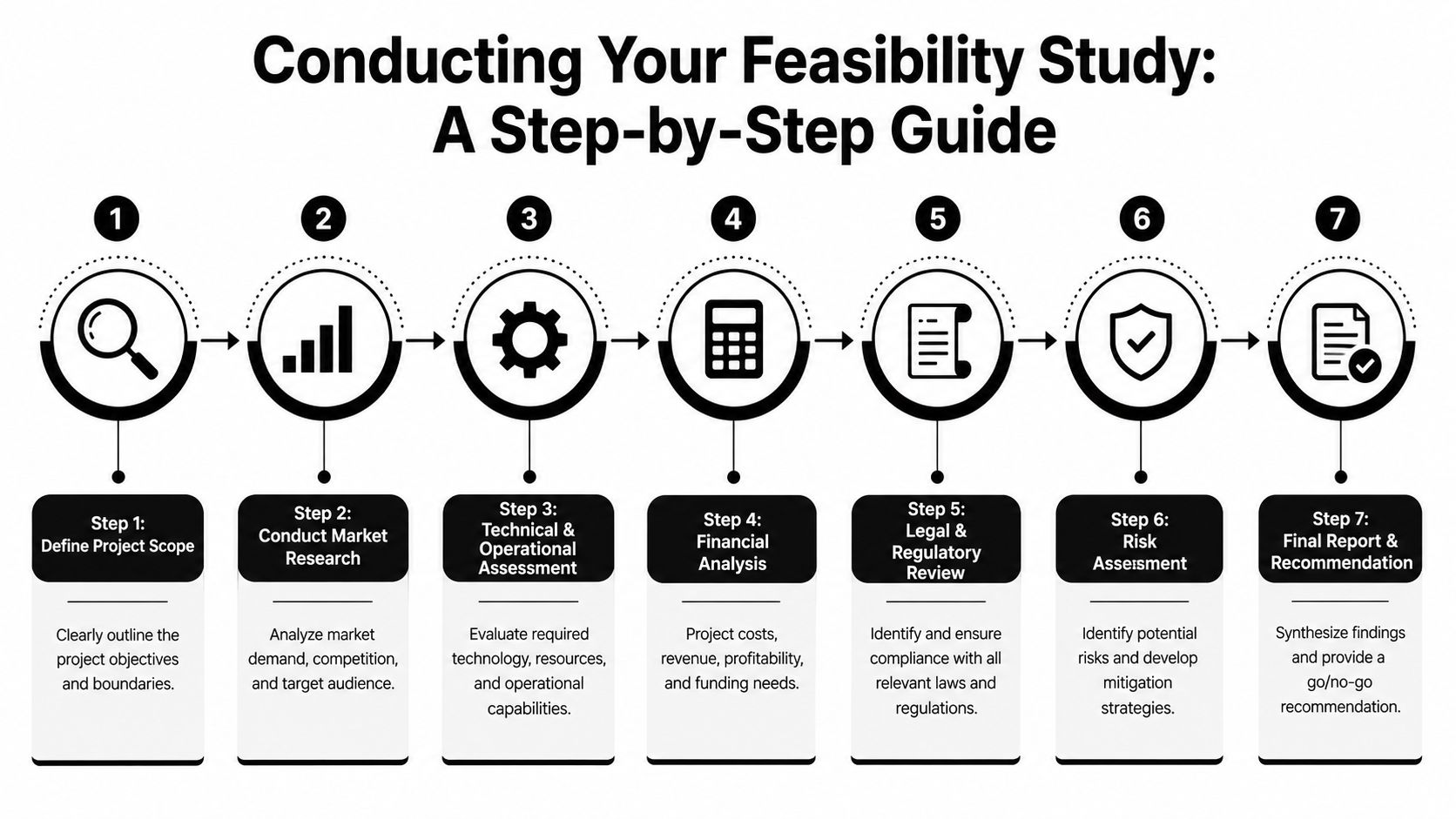
Conducting Your Feasibility Study A Step-by-Step Guide
A founder signs a lease in Jumeirah, orders fit-out drawings, and starts hiring. Three months later, footfall is weaker than expected, delivery demand is higher than dine-in, and the unit economics only work at a price point the target customer will not accept. That is what happens when a business launch starts with confidence instead of validation.
A feasibility study is the first real risk-control step. In the UAE, where setup costs, licensing choices, rent commitments, and staffing decisions can lock a business into expensive mistakes early, the sequence matters as much as the conclusion.
Define the exact business case
Start by pinning down what is being tested. That means the offer, target customer, location logic, price range, legal structure, and launch scale.
Vague ideas produce vague conclusions.
“I want to open a premium café in Dubai” is not a business case. A usable starting brief identifies who will buy, which areas are realistic, how much traffic must come from offices versus residents, whether the model depends on delivery, and what average ticket size is required to cover rent and payroll. If those points are still fuzzy, the study is not ready for financial modelling.
Test demand with field evidence
After scope is clear, gather proof from the market. Use customer interviews, competitor visits, supplier discussions, public industry data, and direct observation.
In the UAE, desk research rarely covers enough ground. A retail concept in Dubai Marina and the same concept in Mirdif can produce very different results because the customer mix, rent pressure, and visit patterns are different. A B2B service aimed at mainland SMEs needs a different validation process from a niche industrial operation in Jebel Ali, where procurement cycles, technical requirements, and access to distribution matter more than brand visibility.
The point is simple. Do not ask whether the idea sounds good. Ask whether buyers will pay enough, often enough, under real operating conditions.
Turn findings into working assumptions
Raw research has no value until it changes the plan. I often see founders collect useful information, then ignore it because it weakens the original concept. That is where bad launches begin.
If customer interviews show stronger demand for takeaway than dine-in, the space requirement changes. If comparable operators rely on high-volume delivery platforms, staffing and packaging costs change. If buyers resist the intended price point, revenue assumptions change. Every serious feasibility study should force revisions before money is committed.
A disciplined process usually follows these steps:
- Define the concept clearly. Set the business model, customer segment, location criteria, and ownership assumptions.
- Collect market evidence. Review competitors, speak to potential customers, and check demand patterns.
- Assess delivery requirements. Confirm suppliers, staffing availability, systems, premises, and operating constraints.
- Build the financial model. Convert tested assumptions into projected revenue, costs, working capital, and cash flow.
- Confirm regulatory fit. Check whether the activity, jurisdiction, approvals, and structure match the business model.
- Stress-test the weak points. Examine lower sales, delayed break-even, cost increases, hiring gaps, or supplier disruption.
- Make a decision. Proceed, revise the model, phase the launch, or stop.
A good study gets narrower and sharper as it progresses.
End with a commercial decision
The final output is a decision brief, not a document written to impress investors with length.
Sometimes the right answer is yes. Often the right answer is yes, but only with changes. In UAE engagements, that usually means choosing a different jurisdiction, reducing initial capex, changing the unit size, narrowing the target segment, or launching in phases instead of committing to a full rollout on day one.
That outcome saves money. Even more valuable, it saves management time, which is usually the first resource founders waste when the original assumptions were never tested properly.
Anatomy of a Professional Feasibility Study Report
When a feasibility study is done properly, the final report reads like a decision file. It shouldn't feel academic. It should let a founder, investor, lender, or board member understand the opportunity, the risks, and the conditions required for success.
I usually judge the quality of a report by one simple standard. Can a third party read it and understand why the project should proceed, change, or stop without needing a separate verbal explanation?
What a complete report should contain
A professional UAE feasibility report often follows a structure like this:
| Section Number | Section Title | Purpose |
|---|---|---|
| 1 | Executive Summary | Summarises the business concept, major findings, key risks, and recommendation |
| 2 | Project Overview | Defines the business model, scope, objectives, and assumptions |
| 3 | Market Analysis | Examines target customers, competitive landscape, demand conditions, and positioning |
| 4 | Technical and Operational Review | Assesses infrastructure, supply chain, delivery model, staffing, and operational readiness |
| 5 | Legal and Regulatory Review | Reviews licensing, jurisdiction, tax, and compliance considerations |
| 6 | Financial Projections | Presents the model, assumptions, viability indicators, and funding needs |
| 7 | Risk Assessment | Identifies major risks and the proposed mitigation approach |
| 8 | Recommendation | Gives the final go, revise, phase, or no-go conclusion |
| 9 | Appendices | Includes supporting research, interview summaries, assumptions, and detailed schedules |
The sections that matter most
The Executive Summary should be tight and direct. If it hides the recommendation or softens obvious risks, that's a warning sign.
The Market Analysis should explain actual buyer behaviour, not just describe the sector in general terms. Many weak reports sound informed because they include broad industry commentary. That isn't enough. The section has to show why this concept, in this location, for this target audience, has a commercial path.
The Financial Projections should show the assumptions behind the numbers, not only the outputs. If revenue is projected, the report should make clear what customer volume, pricing logic, and ramp-up pattern support it.
A report becomes useful when every conclusion can be traced back to a tested assumption.
The Recommendation is where the consultancy earns its fee. It should not merely say the project is attractive. It should state the conditions for success, the points of caution, and what must be done before launch.
From Data to Decision Interpreting Study Results
A founder in Dubai sees a polished feasibility report, notices a healthy projected profit in year two, and approves the launch. Six months later, the business is short on cash, customer acquisition costs are higher than expected, and the break-even target is slipping every month. The report did not fail. The decision-making did.
That is the point where a feasibility study proves its value. It is not a document to justify a launch. It is a filter that shows whether the business can survive real operating conditions in the UAE market.
What the numbers should help you decide
The financial model should answer management questions.
Break-even point shows the sales volume or utilisation level needed to cover operating costs. For a restaurant in Jumeirah, that may come down to table turnover and average spend. For a business setup consultancy in Dubai, it may depend on monthly client volume and conversion from enquiries to signed mandates. If break-even rests on aggressive assumptions, the project carries more risk than the headline forecast suggests.
Payback period shows how long your capital stays exposed before the business returns the initial investment. That matters in the UAE, where fit-out costs, security deposits, licensing fees, and early payroll can put pressure on cash long before the operation stabilises.
ROI helps compare opportunity against risk. A project may show an acceptable return on paper and still be the wrong decision if the assumptions require perfect execution, heavy discounting, or a faster ramp-up than the market is likely to support.
One more point matters just as much. Profit does not protect a business from a cash shortage.
A serious feasibility study includes the core financial statements and the assumptions behind them. That detail matters because different reports answer different questions. The income statement shows whether the model can generate profit. The cash flow forecast shows whether the business can stay liquid while getting there. The balance sheet shows what the business will need to carry in assets, liabilities, and working capital. Founders who focus only on projected profit often miss the pressure points that cause delays, emergency funding needs, or early failure.
Read the assumptions before you accept the conclusion
In practice, I look at assumptions before I look at the recommendation. That is where weak studies usually show themselves.
If a retail concept assumes premium pricing in a location with inconsistent footfall, that needs testing. If a clinic model assumes fast patient acquisition without a clear referral strategy, the forecast is exposed. If an e-commerce business assumes low delivery costs across the Emirates without accounting for returns and failed drops, margins can disappear quickly.
A credible study makes those assumptions visible and testable. It should be clear how revenue is built, what cost base is fixed, what cost base rises with demand, and how sensitive the outcome is to slower sales or higher operating expenses.
A practical decision framework
Useful feasibility results usually lead to one of four decisions:
- Proceed now: Demand is supported by evidence, margins are workable, cash flow is manageable, and the operational plan fits the market.
- Proceed with changes: The opportunity is real, but the pricing, location, cost structure, staffing plan, or jurisdiction setup needs revision.
- Delay and retest: The concept may work, but not under current timing, current funding, or current market conditions.
- Do not proceed: The business only works under optimistic assumptions that are unlikely to hold in live trading.
The strongest founders do not ask, "Can I make this report say yes?" They ask, "What has to go right for this business to work, and do I have evidence for that?"
That is the shift from data to decision. In the UAE, where setup costs are front-loaded and errors are expensive, that shift can save far more than the cost of the study itself.
Navigating the UAE Market Specific Feasibility Factors
A founder in Dubai can have a sound product, a realistic budget, and early customer interest, then still lose money because the business was set up in the wrong place, under the wrong activity, with the wrong operating assumptions. That is why a feasibility study in the UAE is not paperwork. It is the first serious de-risking step.

Mainland and free zone are strategic choices
In the UAE, jurisdiction changes the business model. A consulting firm selling to government-related entities, a restaurant serving local foot traffic, and an e-commerce brand importing stock into a warehouse do not face the same setup decision.
Mainland often makes sense when revenue depends on broad access across the UAE, local contracting flexibility, or a physical presence close to customers. Free zones can work well when the business benefits from industry clustering, specific authority rules, international ownership preferences, or trade-oriented operations. The right answer depends on how the company will win customers, invoice them, hire staff, and deliver service.
A useful feasibility study tests that fit before incorporation. It should examine:
- Customer access: where demand sits and whether the chosen setup supports legal, practical delivery
- Licence fit: whether the planned activity matches what the authority will approve
- Commercial impact: how the setup affects sales, procurement, banking, staffing, and future expansion
Regulatory and tax exposure affects viability early
In the UAE, compliance assumptions belong in the first model, not the cleanup phase after launch. Corporate tax, VAT exposure, sector approvals, ownership structure, and intellectual property protection all affect the economics of the project.
I have seen this play out in simple ways. A health-related concept can look attractive until approval timelines and professional licensing requirements are added. A trading company can show healthy projected margins until customs handling, documentation, and tax treatment are reflected properly. A digital business can underestimate risk if its licence activity does not match what it is selling.
These are not legal footnotes. They affect launch timing, cost base, reporting obligations, and investor confidence.
Local operating assumptions change the numbers
A generic financial model misses how business gets set up and run in the UAE. The study needs local operating logic built into the forecast from day one.
That usually includes:
- Licensing and approvals: activity selection, authority requirements, and renewal costs
- Visa planning: how many staff the business needs, when they are needed, and what that means for cost and administration
- Premises: office, retail, warehouse, or industrial space, based on the activity and authority rules
- Operating support: PRO services, banking setup, bookkeeping, audit readiness, and recurring compliance work
Weak studies commonly fail at this point. They treat setup as a one-time registration exercise. In practice, UAE structure affects speed to launch, overhead, hiring capacity, and working capital pressure.
For founders who want outside help, firms such as Smart Classic Business Hub provide feasibility studies alongside company formation, compliance, and corporate finance support in Dubai. That can help when the study needs to connect directly to execution.
In the UAE, a poor structure can damage a good business before the first invoice is issued.
Feasibility Study Costs and Timelines in the UAE
A founder in Dubai can spend AED 25,000 on setup, branding, and deposits in a matter of days. Then they hesitate over the study that was supposed to test whether the business should launch at all. That is the wrong place to save money.
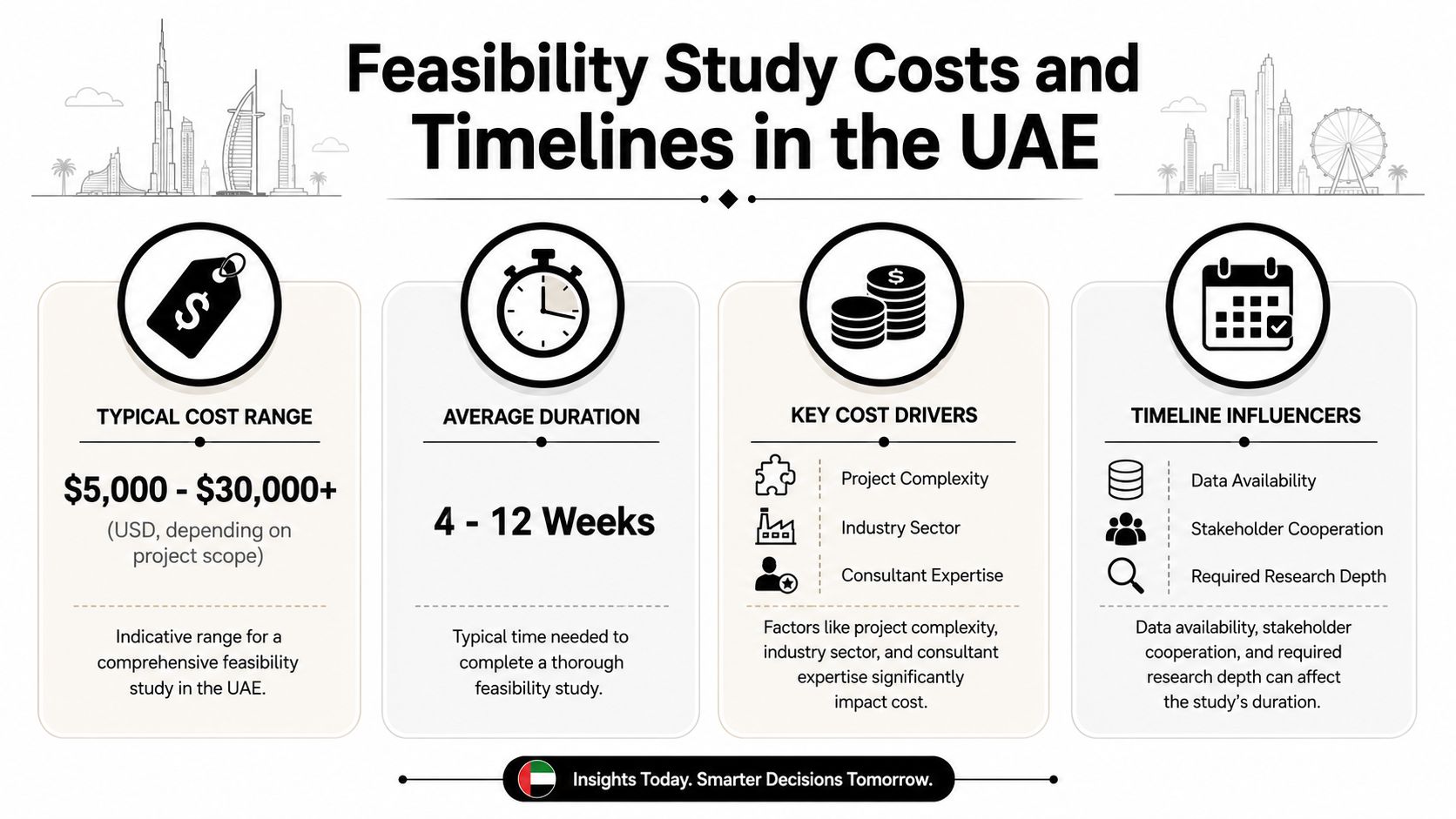
In the UAE, the cost of a feasibility study depends on the risk you need to remove before committing capital. A simple service business with one licence activity, a modest team, and limited capex needs less work than a food concept with multiple outlets, municipality approvals, fit-out costs, and tight gross margins.
A lighter study built on desk research, competitor review, and a high-level financial model will sit at the lower end of the range. Once the brief includes customer interviews, site analysis, demand validation, operational planning, or investor-grade financial modelling, fees rise quickly. The timeline rises with it.
What you should expect to pay
For a straightforward SME project, founders in the UAE typically see feasibility work priced from the tens of thousands of dirhams upward. Smaller studies with limited scope are often completed within a month or so. More detailed assignments, especially those involving primary research or multiple business scenarios, often run for several weeks longer.
For larger projects, the budget can increase materially. Industrial ventures, real estate-linked concepts, healthcare facilities, logistics operations, and multi-site rollouts usually need deeper market testing, technical review, and a more detailed operating model. That means more analyst hours, more stakeholder input, and a longer reporting cycle.
The practical point is simple. Study cost should match decision risk.
What actually drives the fee
Consultants do not price these projects on page count. They price them on the work required to answer the decisions that matter.
Typical cost drivers include:
- Research depth: Desk research is faster. Interviews, surveys, field visits, and demand testing require more time and coordination.
- Model complexity: A single-location concept with simple revenue lines is easier to assess than a project with phased expansion, variable pricing, or imported supply dependencies.
- Technical inputs: Manufacturing, healthcare, logistics, education, and regulated sectors often need specialist review beyond standard commercial analysis.
- Decision use case: A study prepared for internal founder use is different from one that needs to stand up to lender, investor, or board scrutiny.
- Geographic scope: Dubai only is one brief. Dubai plus Abu Dhabi, Sharjah, or a wider GCC rollout is a different assignment.
I often tell clients to ask a better question than "What does the study cost?" Ask "What mistake is this study preventing?" In many UAE launches, one wrong location decision or one bad demand assumption costs far more than the study itself.
Why the timeline matters
A short timeline is not always a problem. It can fit a narrow brief. But a serious launch decision in the UAE rarely benefits from speed alone.
Research takes time. Interviews need to be scheduled. Competitor checks need to be verified. Financial assumptions need to be tested against local operating reality. If a consultant promises a detailed market, operational, and financial assessment in a few days, the scope is either very limited or the work is too thin to support a real investment decision.
That matters even more if the study will be shown to a bank, investor, or procurement team. In those cases, the report is not just a planning document. It becomes part of the case for why the project deserves funding or approval.
A useful study does not delay launch for the sake of process. It gives founders enough evidence to proceed with conviction, revise the model, or stop before the expensive mistakes begin.
Your First Smart Investment A Professional Study
A feasibility study won't build the business for you. It will do something more important first. It will tell you whether the version of the business in your head can survive contact with the UAE market.
That's why I don't treat it as an optional planning exercise. In Dubai, founders rarely fail because they lacked ambition. They fail because they launched before they had evidence, or because they built on assumptions that should have been challenged at the start.
A professional study gives you a cleaner decision. Sometimes that decision is yes. Sometimes it is no. Often it is yes, but only if you change the location, narrow the customer segment, restructure the setup, or phase the rollout. That clarity is where the value sits.
If you're asking what is feasibility study, the practical answer is simple. It is the first serious investment in reducing avoidable risk. It protects capital, sharpens strategy, and gives lenders, partners, and investors something far more useful than confidence alone. It gives them a reasoned case.
If you're planning a launch, expansion, or investor-backed project in the UAE, Smart Classic Business Hub can help you assess the venture before you commit capital. Their Dubai-based team supports founders and companies with feasibility studies, company formation, finance advisory, and compliance work so the decision to proceed is grounded in local market and regulatory reality.