
You’re probably comparing Ajman with Dubai, Sharjah, and a few free zones right now, with the same questions most founders ask. Can I keep setup costs under control, get the licence without weeks of rework, open a bank account smoothly, and avoid tax problems later?
That’s the right way to think about a trading license in ajman. The licence itself is only the start. The stronger decision is choosing the right structure, aligning the activity list with what you’ll sell, and setting up the company in a way that won’t create trouble when VAT, Corporate Tax, renewals, banking, and expansion come into play.
Why Ajman Is Your Next Smart Business Move
Entrepreneurs often approach Ajman as the lower-cost option. That’s incomplete. The better reason to consider Ajman is that it gives many trading businesses a cleaner starting position: lower setup friction, practical jurisdiction choices, and enough flexibility to launch without overcommitting on overhead.
Ajman’s momentum also matters. In 2024, the emirate recorded a 25% increase in commercial licenses issued, contributing to an overall 16% increase in total licenses, while the Business Confidence Index reached 135 points, according to the Ajman DED announcement on 2024 licence growth and business confidence. That combination tells you something practical: businesses aren’t only entering Ajman, they’re doing so in an environment with visible investor confidence.

Ajman works well when cost discipline matters
If you’re launching a trading company, especially as a first-time UAE founder, the biggest mistake is treating setup as a branding exercise. A lean structure usually works better. Ajman gives you room to start with a practical licence and then expand once revenue, supplier relationships, and banking are stable.
A lot of founders also want optionality. They may begin with import, distribution, online sales, or regional sourcing, then later add warehousing, retail channels, or cross-border activity. That’s where activity planning becomes more important than a superficial inquiry into which emirate is cheapest.
The real decision starts before the application
The first serious choice isn’t the trade name. It’s whether your trading model belongs on the mainland or in a free zone. That affects how you invoice, where you can trade directly, what office setup makes sense, and how smoothly your compliance will run later.
Practical rule: If a founder only compares licence sticker prices, they usually miss the bigger costs created by the wrong structure.
For founders looking at free zone routes specifically, this Ajman Free Zone company setup guide is a useful starting point before you shortlist your activity mix.
Mainland vs Free Zone The First Critical Decision
Most problems with a trading license in ajman start with a wrong jurisdiction choice. Founders choose based on the cheapest package, then realise later that supplier contracts, local market sales, banking questions, or operational approvals don’t fit the structure they picked.
The better approach is simple. Choose based on where you will trade, how you will fulfil, and what kind of compliance trail you need.
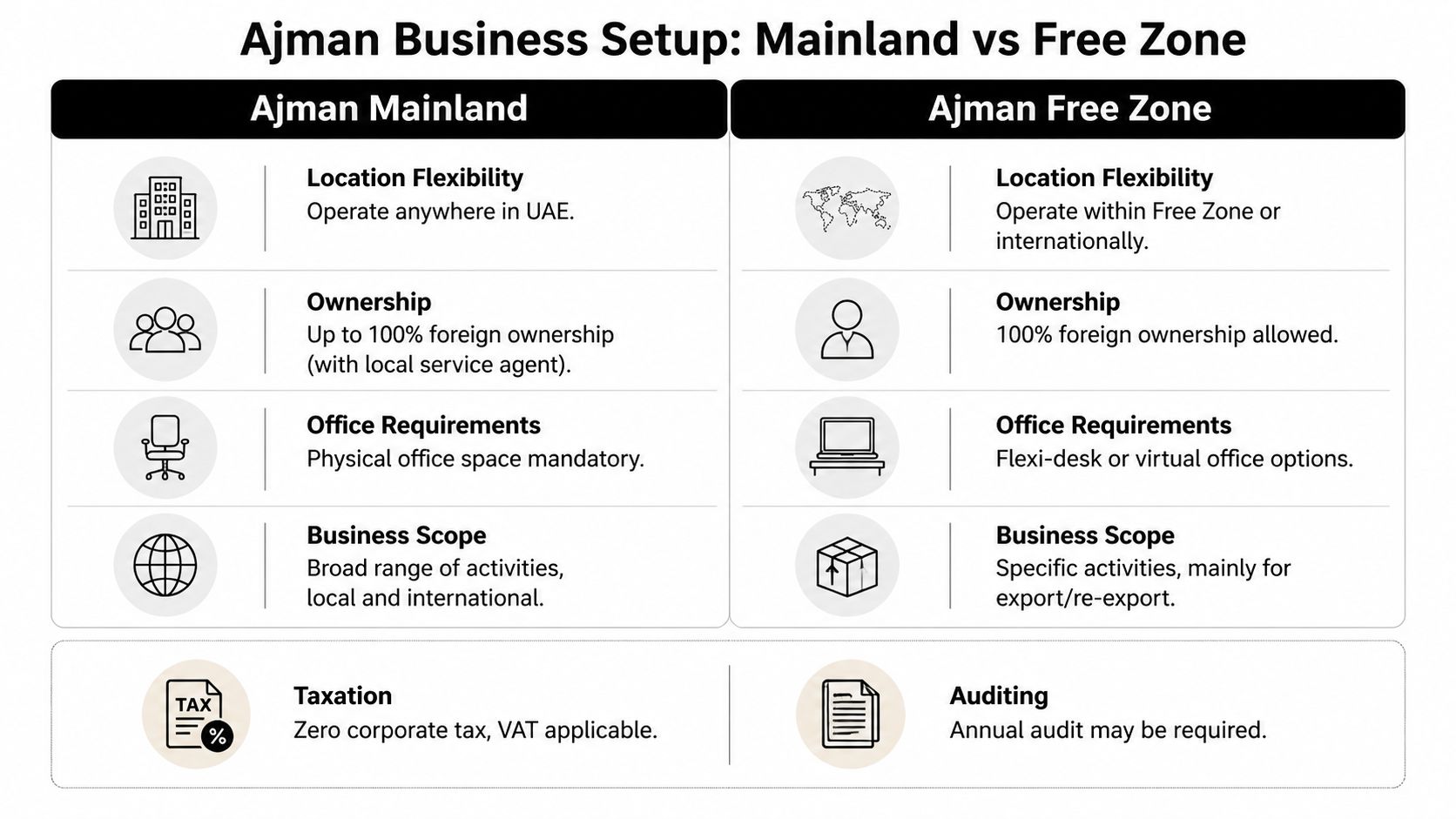
Choose mainland if UAE market access is the priority
Mainland Ajman DED is usually the better fit when your core plan is direct access to the UAE market. If you’ll sell to local customers, supply retailers, operate from a physical office, or need a structure that aligns closely with domestic commercial activity, mainland is often the cleaner route.
It also suits founders who don’t want to explain a more layered operational model to banks, landlords, suppliers, and counterparties. In practice, straightforward structures often move faster operationally.
Choose free zone if low-friction launch matters more
Ajman Free Zone is often the better fit when the business is export-oriented, digitally led, or designed to start lean. According to the Ajman Free Zone licensing overview published by PKPI, trading licences start around AED 5,000 to 7,000, while mainland setups range from AED 12,000 to 20,000 for initial setup. The same source notes that the free zone supports over 1,500+ business activities, offers 100% foreign ownership, and provides zero corporate tax for zone-based operations.
That pricing difference is meaningful, but the setup logic matters more than the headline cost.
Ajman Mainland vs Free Zone at a Glance
| Factor | Ajman Mainland (DED) | Ajman Free Zone (AFZ) |
|---|---|---|
| Best for | Direct UAE market trading | Export, re-export, lean startup models |
| Ownership | 100% foreign ownership for most trading activities | 100% foreign ownership |
| Office expectation | Physical office is typically part of the setup logic | Flexi-desk or lighter facility options may suit early-stage businesses |
| Operating model | Local and international trade with wider domestic positioning | Zone-based or international trade, depending on activity and operating plan |
| Cost profile | Higher initial setup range | Lower entry-point packages available |
| Founder profile | Traders building UAE-facing operations | Founders testing market entry with tighter setup budgets |
What works and what doesn’t
Some founders assume free zone always means “better” because it’s cheaper. That’s not how it plays out in real operations.
What usually works
- Mainland for local trade: If you’ll invoice UAE customers directly and build a domestic sales network, mainland usually reduces friction.
- Free zone for staged expansion: If you want to start with lower commitments and focus on sourcing, online sales, or international distribution, free zone can be efficient.
- Activity matching: The closer your licence activities match your real business model, the fewer problems you’ll have later with contracts, customs, and banking.
What usually doesn’t
- Buying a licence package before defining the revenue model: Cheap setup can become expensive if the structure blocks how you trade.
- Using a vague “general trading” idea without product planning: Broad wording sounds flexible, but practical banking and compliance questions still come later.
- Ignoring future finance needs: A structure that is cheap at issuance can be awkward when you need credit lines, supplier terms, or bank comfort.
If you expect to scale quickly, choose the setup a bank can understand easily, not just the one a consultant can sell quickly.
If you’re also weighing broader UAE setup logic, this comparison of mainland vs freezone business structures helps frame the trade-off beyond Ajman alone.
Navigating the Application Process Step by Step
Once the jurisdiction is clear, the application itself is manageable. Delays usually come from avoidable mistakes: vague activity selection, a trade name that triggers objections, missing supporting documents, or regulated activity approvals that weren’t considered early.
The Ajman approval process generally runs in three phases. Based on the Khaleej Times breakdown of Ajman trade licence processing, Planning takes 2 to 5 days, Documentation takes 3 to 7 days, and Licensing takes 5 to 10 days. The same source notes that regulated activities requiring federal approval can add 7 to 14 days, while complete applications achieve a 95%+ first-time approval rate.

Planning phase
To build a good application, you define the legal form, select the activity or activity set, decide the jurisdiction, and reserve the trade name.
Trade name issues are more common than founders expect. Names that are too close to existing registrations, too broad, or inconsistent with the proposed business can slow things down. The fastest approvals usually come from names that are simple, relevant, and cleanly documented.
Activity selection matters even more. If you’re trading cosmetics, machinery, garments, food products, electronics, or mixed consumer goods, don’t assume one broad description solves everything. The wording on paper should reflect the actual revenue model.
Documentation and submission phase
Once the structure is fixed, the file has to be assembled correctly. Many applicants lose time during this step because they treat documentation as clerical work rather than compliance work.
A strong submission usually has these characteristics:
- Identity documents are consistent: Passport copies, IDs, and shareholder details match exactly across forms.
- Corporate documents are ready: If the structure requires constitutional documents, they must reflect the same ownership and business intent shown in the application.
- Premises documents align with the jurisdiction: Mainland setups need office-related compliance handled properly, while free zone setups follow their own facility rules.
- Any regulated approvals are identified early: Some sectors won’t move on ordinary timelines.
Licensing and issuance phase
After review and payment, the licence is issued and the company moves into post-registration tasks. That often includes establishment-related formalities, immigration file steps where applicable, and preparation for bank account opening.
Founders often relax too early at this stage. Licence issuance is not the end of the operational setup. It’s the point where the company becomes visible to banks, counterparties, and tax obligations.
A practical way to avoid delay
The process works best when you treat it as a sequence, not as a pile of forms.
Define the trading model first
Decide what you’ll buy, sell, store, import, export, or distribute. Don’t leave this vague.Map the activity list to actual operations
If the business will include e-commerce alongside physical goods trading, flag that early.Check whether approvals outside the core authority are needed
This matters most for regulated or higher-risk activity groups.Prepare the banking story before licence issuance
Banks often ask operational questions that founders should have answered before they incorporated.
A fast licence with weak planning often creates slower banking, slower onboarding, and more expensive corrections later.
What founders usually underestimate
They underestimate post-licence sequencing. A founder may secure the company file quickly but then discover that the bank wants clearer invoices, supplier agreements, ownership transparency, or a better explanation of the activity mix.
That’s why the application process should be managed with the end in mind. If the company will need VAT registration, corporate banking, staff visas, local supplier contracts, or import-related documentation, the setup file should support those steps from day one.
Assembling Your Document Checklist and Avoiding Pitfalls
Most applicants think documentation is the easy part. It isn’t. Documentation is where many Ajman applications slow down, especially when the founder is overseas, the ownership chain is layered, or the business activity has been chosen too casually.
According to the Shuraa guide on Ajman trade licence documentation and compliance, 15% to 20% of initial applications are affected by common issues such as misaligned business activity codes, inadequate capitalization documentation, and non-compliance with Ejari requirements for mainland offices. The same source notes that all foreign documents must be officially translated into English or Arabic.

The core checklist
Most trading licence files revolve around three document layers.
| Document group | What usually belongs here | Why it matters |
|---|---|---|
| Personal documents | Passport copies, Emirates ID copies if applicable, passport-size photos | Confirms shareholder identity and residency status |
| Corporate formation documents | MOA, AOA, shareholder resolutions where relevant, power of attorney if using a representative | Defines legal control and business structure |
| Operational compliance documents | Tenancy or facility-related documents, NOCs if needed, pre-approvals for regulated sectors, translated supporting documents | Links the legal entity to a compliant operating setup |
The mistakes that actually cause trouble
The most common issue is activity mismatch. A founder says the business will do one thing, but the selected licence activity reflects something narrower, broader, or different. That creates problems not only at issuance, but later with invoicing, customs, suppliers, and banks.
The second issue is weak support for capitalization or operational readiness. Even where the licence is technically issuable, weak documentation can create friction when the business tries to open accounts or justify commercial substance.
The third issue is mainland premises compliance. If the office side of the file isn’t aligned properly, the licence can stall at the wrong time.
How to reduce rework
Use this checklist before submission:
- Match every activity to a real revenue stream: If you can’t explain how it earns money, don’t add it casually.
- Translate foreign documents properly: Informal translations create avoidable rejection or clarification cycles.
- Keep names and signatures consistent: Small inconsistencies across shareholder documents waste time.
- Check tenancy logic early for mainland: Don’t leave premises compliance to the last stage.
- Prepare supporting narrative for banks: If the structure is simple on paper but complex in practice, write down the explanation before the bank asks.
Clean documentation does more than get the licence issued. It reduces the chance that your first bank review becomes a second due diligence exercise.
Beyond the Licence Renewal Compliance and Tax Essentials
A trading license in ajman doesn’t become safer once it’s issued. It becomes more exposed. The company begins transacting, invoicing, importing, exporting, collecting payments, and building a financial trail. That’s when compliance quality starts to matter.
Most setup guides stop too early. They explain issuance, office options, and sometimes visas. They don’t explain what happens when the business starts creating taxable transactions, cross-border purchases, stock movement, or mixed activity lines.
The compliance gap most founders discover late
The Worldwide Formations note on Ajman licensing blind spots highlights that many guides fail to explain how mainland versus free zone structure affects VAT registration, reverse-charge treatment, and corporate tax nexus under the UAE Federal Corporate Tax regime introduced in 2023. For new businesses, that’s a serious gap.
That gap matters most when the business is not purely local and not purely export-only. A lot of Ajman companies sit somewhere in the middle. They may buy from abroad, store or route goods through the UAE, sell to local customers, run e-commerce channels, or combine commercial trading with service elements.
VAT and Corporate Tax need planning before first invoices
A few practical questions usually reveal whether the structure was planned properly:
- Will the company trade only within the UAE, or also across borders?
- Will goods move physically through the company, or will the business arrange drop-shipping or third-party fulfilment?
- Will the entity carry one commercial activity, or multiple activities under one licence?
- Will suppliers invoice the Ajman entity directly, or through another group company?
The wrong time to ask these questions is after the first quarter of trading.
What founders should do after issuance
The safest operating habit is to treat tax and renewal compliance as part of setup, not as later admin.
- Build bookkeeping early: Don’t wait until renewal season or tax filing pressure starts.
- Separate personal and company flows: Mixed usage is one of the fastest ways to create accounting confusion.
- Review invoice structure from the start: Poor invoice discipline creates VAT and audit problems later.
- Document cross-border flows clearly: Goods, title transfer, fulfilment point, and counterparty location all matter.
- Check whether the licence structure still matches actual trading behaviour: Businesses evolve faster than licence files.
For businesses that need operational guidance on the registration side, this UAE VAT registration guide is a practical next reference.
Renewal is not only a government task
Renewal affects legal continuity, visa continuity, and how counterparties view the business. A licence that’s renewed on time but supported by weak accounting still creates risk. Banks and commercial partners don’t just look for an active licence. They look for a company that behaves like an organised business.
That’s why the strongest Ajman setups aren’t just inexpensive. They are compliance-ready. The licence, accounting records, contracts, invoices, and activity profile all tell the same story.
Partnering for Success How Smart Classic Business Hub Helps
A common Ajman scenario looks like this. The licence is issued, the founder starts trading, then the first bank compliance request arrives, supplier paperwork does not match the licensed activity, and bookkeeping is still sitting in a folder of PDFs and WhatsApp screenshots. The problem is no longer company formation. The problem is whether the business can operate cleanly without expensive correction work.
That is where experienced setup support saves money. The job is to structure the company properly the first time, with the licence, documents, banking file, and tax position all pointing in the same direction.
Where support changes the outcome
The biggest setup mistakes in Ajman usually happen before submission, but they only become visible after issuance. A low-cost package can turn expensive if it creates amendments, delays bank onboarding, or forces the business to rebuild its accounting trail after trading has already started.
Practical support usually covers:
- Jurisdiction selection: choosing mainland or free zone based on how the business will sell, deliver, import, and collect payment
- Activity matching: aligning licence activities with the products, commercial model, and expected expansion
- Document control: preparing ownership records, tenancy evidence, and supporting papers in a form banks and authorities can review without confusion
- PRO handling: managing approvals, submissions, and sequencing so the file does not stall on preventable issues
- Post-licence compliance setup: putting basic bookkeeping, VAT logic, and Corporate Tax readiness in place early
- Bank-readiness: presenting a clear business story supported by consistent documents
This matters more for trading businesses than many founders expect. If an Ajman company imports consumer goods, sells online, and plans to work with local distributors later, the file needs to make commercial sense from day one. Banks review that. Tax agents review that. Serious counterparties review that.
Why combined setup and compliance support works better
Founders often split setup, accounting, and PRO work across different providers to save on upfront cost. Sometimes that works. Often it creates gaps. One adviser selects broad activities, another books revenue differently, and the bank asks questions neither side prepared for.
A coordinated approach reduces that friction. Smart Classic Business Hub handles company formation, PRO support, VAT-compliant accounting, audit coordination, and related UAE business setup work. The practical benefit is consistency. The licence file matches the operating model, and the finance side is not treated as an afterthought.
That becomes important quickly in Ajman. A business may start small, then need a corporate bank account with proper transaction explanations, supplier agreements, invoices that support VAT treatment, and records that can stand up during renewal or tax review. Fixing that after six months usually costs more than setting it up properly at the start.
The strongest setup is the one that still makes sense after the business starts growing.
Bank-readiness starts before the bank application
Many founders ask about banking only after the licence is issued. By then, the quality of the company file is already set. If the activity description is vague, the ownership trail is incomplete, or the business model is hard to explain, delays are predictable.
A bank-ready Ajman trading company should be able to show, clearly:
- what it sells
- who owns it
- where it operates
- how goods or services move
- why the selected activities fit the core business model
- how revenue and expenses will be recorded
That is the standard we work to. It saves time at setup, reduces cleanup later, and gives the business a better base for VAT, Corporate Tax, and future growth.
Frequently Asked Questions About Ajman Trading Licences
Can I start with one activity and add more later
Yes, but it’s better to choose carefully at the start. Adding or changing activities later is possible, but amendments create extra process and can affect how banks or counterparties understand the business. If you already know the company will combine trading channels, structure that properly from day one.
Do I always need a physical office for a trading license in ajman
It depends on the jurisdiction and package logic. Mainland structures usually have stronger office-related requirements, while free zone setups may offer lighter facility options. The right question isn’t only whether an office is required. It’s whether your operating model, compliance profile, and banking plan will still make sense with the facility type you choose.
How long does the process usually take
The timing depends heavily on activity type, document quality, and whether external approvals are needed. Straightforward files move much faster than regulated or poorly prepared ones. If the documents are complete and the activity is clear, the process is usually more predictable.
Can a free zone trading company sell in the UAE market
It depends on how the sales model is structured. Founders should not assume that a low-cost free zone package automatically suits direct local market trading. This is one of the most common strategic mistakes and should be reviewed before the application is submitted.
What’s the biggest mistake first-time founders make
They focus on issuance and ignore what comes after. The licence gets approved, but VAT readiness, Corporate Tax impact, accounting discipline, and bank-readiness are left for later. That usually costs more than doing the setup properly in the first place.
If you’re planning a trading company and want the structure, paperwork, and compliance side aligned from the start, Smart Classic Business Hub can help you assess the right Ajman setup, prepare the application, and organise the post-licence requirements that founders often overlook.