
You've landed a role in Dubai, or you're setting up a company and need a practical base fast. Business Bay usually ends up on the shortlist because it's central, well connected, and full of furnished and semi-furnished options. Then the search starts, and the confusion starts with it. One listing says “partition”, another says “master room”, a third looks cheap until you ask whether DEWA, internet, or deposit are included.
That's where most new arrivals get caught. They compare the advertised rent, not the usable monthly cost or whether the room arrangement will support the documents they need for visa, banking, address proof, or a stable move. In Business Bay, those details matter as much as the room itself.
Navigating Your Arrival in Business Bay
A typical Business Bay move looks like this. You arrive on an entry permit, stay in a hotel or serviced apartment for a few days, and start searching for a room because committing to a full apartment straight away feels too expensive. If that's your position, sort your immigration side first as well. Your UAE entry permit process affects how quickly you can move from temporary accommodation into something longer-term and properly documented.

Business Bay isn't a niche rental pocket. It has a deep, active market. One market snapshot tracked 238,361 recorded rent contracts in the area through June 4, 2026, with an all-contract median annual rent of AED 75,600 and a median of AED 917 per square foot. The same snapshot showed the apartment-only read at AED 85,000 annually and AED 892 per square foot in Business Bay rent data from Palm Observer.
That matters even if you're only renting a room. Room pricing doesn't exist separately from apartment pricing. In Business Bay, most room offers sit inside larger units that someone has already leased, furnished, or subdivided.
Practical rule: If you only compare room ads against other room ads, you'll miss the real benchmark. Compare them against the cost of the underlying apartment as well.
New professionals usually want three things at once. They want a central location, a manageable monthly spend, and paperwork that won't create problems later. You can get two of those easily. Getting all three takes care.
Decoding Room Types Bed Space to Master Room
Dubai room listings use terms that can confuse anyone new to the market. In Business Bay, the same flat can be marketed in several ways depending on how the current tenant or operator has divided the space.
What each room type usually means
Here's the working glossary most renters need:
| Type | What it usually means | Privacy | Best for |
|---|---|---|---|
| Bed space | A sleeping space in a shared room | Lowest | Short-budget stays |
| Partition | A sectioned-off area created inside a larger room or hall | Low | Renters prioritising price over privacy |
| Private room | A proper room with a door, shared bathroom in many cases | Medium to high | Professionals wanting stability |
| Master room | A larger bedroom, often with attached bathroom | Highest among shared options | Renters wanting more autonomy |
A bed space is the cheapest form of shared living. You're not renting a room. You're renting a place within a room. It can work for someone who has just arrived and needs a temporary base while sorting visa formalities, but most professionals outgrow it quickly.
A partition is common in Business Bay searches because it brings the headline price down. It's usually a section created with temporary walls, dividers, or panels inside a hall or oversized room. The trade-off is obvious once you view it. Sound travels. Storage is limited. Privacy is partial, not real.
Where the market tends to cluster
Property Finder shows yearly apartment rents beginning around AED 10,833 in some listings, while monthly apartment rents typically range from AED 3,800 to AED 17,000 and weekly rates from AED 2,000 to AED 4,700 in Business Bay apartment listings on Property Finder. The same market context also shows private-room and partition supply concentrated at entry points such as AED 2,500 to AED 2,800 per month.
That tells you something important. The cheaper room formats exist because someone is trying to bridge the gap between a whole-unit lease and per-occupant income. For the renter, that means the room type matters more than the ad title.
Consider the practical differences:
- Bed space works if you need the lowest entry cost and can live with rotating housemates.
- Partition suits people who want more separation than a bed space but still accept compromise on ventilation, noise, and storage.
- Private room is where many working professionals settle because it feels closer to normal living.
- Master room usually costs more, but attached bathroom access can remove a lot of daily friction.
A “master room” in a well-managed shared flat often feels more expensive upfront and cheaper emotionally after two weeks.
What tends to work and what usually doesn't
What works in Business Bay is simple. A proper room with clear house rules, known utility terms, and a realistic occupancy level.
What usually doesn't work is chasing the lowest listing without asking how many people live in the unit, who holds the main lease, whether guests are allowed, and whether your stay is documented properly. A cheap room can become expensive if it creates stress, repeated moves, or document problems.
Calculating the True Cost of Renting a Room
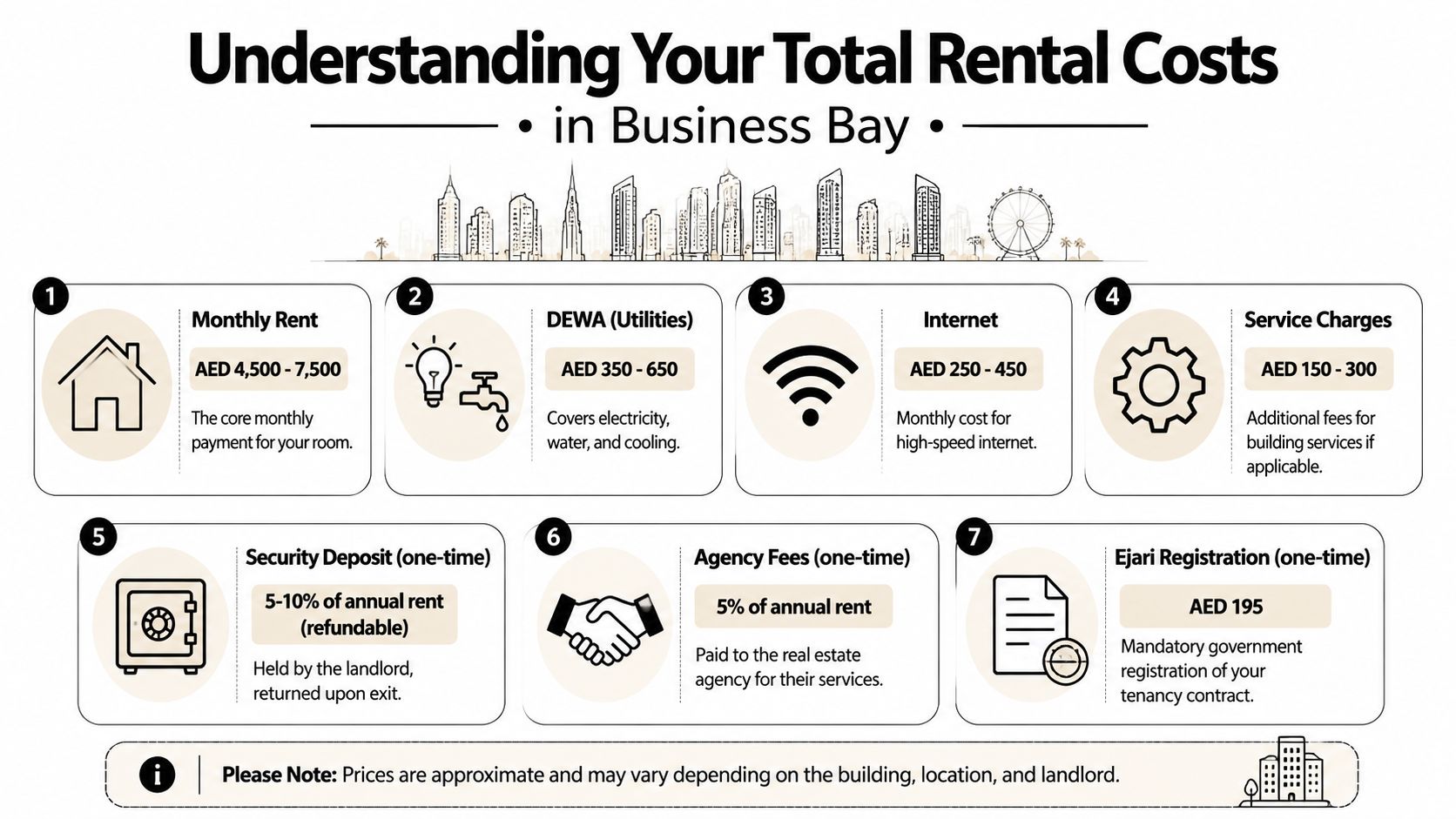
The ad price is only the starting point. In Business Bay, the actual monthly cost depends on what's bundled and what's not. That's why two listings with similar rent can produce very different total costs.
The affordability gap in the area is wide. A current market snapshot shows Business Bay's median monthly rent for rental homes at AED 10,400, while active listings include studios at AED 22,000. At the same time, room-share listings on aggregator sites show partition price points like AED 2,500 to AED 2,800, which is exactly the spread highlighted in Business Bay affordability data from UD Property. That gap explains why so many expats start with rooms for rent in Business Bay instead of whole apartments.
What the rent advert usually leaves out
Ask these questions before you treat any room as affordable:
Utilities included or separate
Does the price include DEWA, cooling, and building-related charges, or will the flatmates split them monthly?Internet included or not
Some shared flats include Wi-Fi. Others quote a low rent and add internet later.Deposit terms
You need to know who holds the deposit, how it's refunded, and under what conditions deductions happen.Cleaning and maintenance
Some operators include regular cleaning of common areas. Others leave it to the tenants, which often creates friction.Guest policy and access
A room can look perfect until you realise the building, flat manager, or main tenant has restrictive visitor rules.
If the advertiser avoids these questions, treat that as a warning.
Why the cheapest option often isn't cheapest
A partition at the bottom end of the market can still make sense for a short landing period. But low advertised rent often comes with hidden trade-offs. You may face separate utility contributions, limited kitchen access, crowded bathrooms, or a weak agreement that doesn't support your longer-term needs.
A more expensive private room can be better value if it includes the practical basics in one number. That's especially true if you're working long hours, need a stable base for onboarding, or don't want to move again after a month.
This is the same logic operators use when they optimize rent-by-the-room operations. They don't look at headline rent alone. They look at occupancy, included services, turnover, and whether the offer remains viable after real operating costs. Renters should think the same way.
A better way to compare room offers
Use this short decision filter:
- Start with the monthly rent
- Add every recurring charge you can identify
- Ask whether the price is fixed or shared-variable
- Check whether the stay gives you usable paperwork
- Assess whether you'd still accept the room if you had to stay six months
Cost check: If you don't know what you'll pay in a normal month after bills and house rules are applied, you don't know the real rent.
Many first-time renters focus on surviving month one. The better approach is to ask whether the room still works in month three, when your work routine, commute, and document needs become more serious.
Your Step by Step Expat Rental Process and Documents
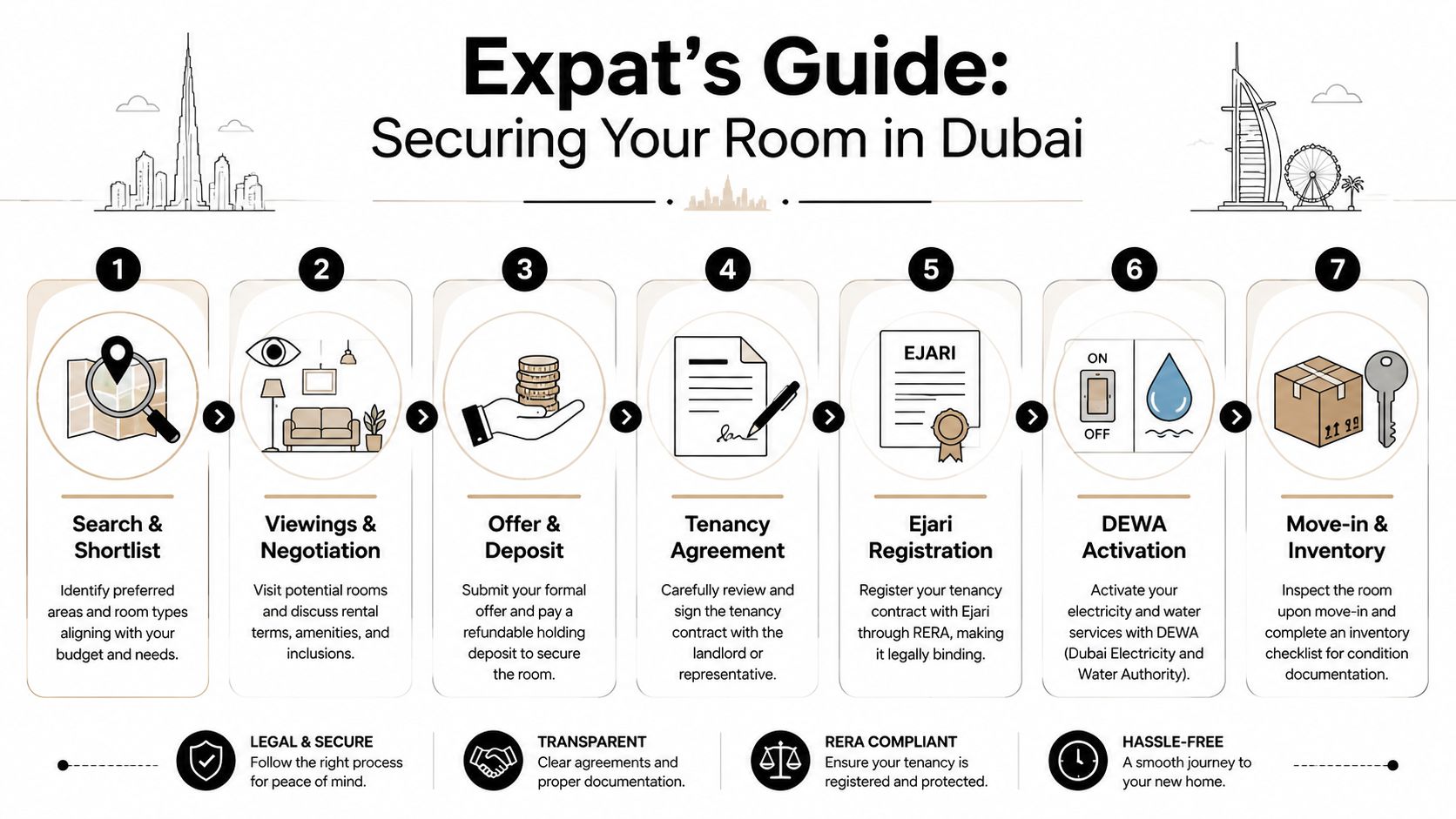
Most rental stress comes from doing things in the wrong order. People pay a holding amount before verifying who controls the unit, or they move in before checking whether the arrangement supports their residency needs.
A cleaner process reduces both risk and panic.
The practical order that works
Search and shortlist first. Filter by room type, commute, and whether the ad clearly states inclusions. Don't waste time chasing vague listings with no photos of the actual room.
View before paying anything substantial. If you're overseas, ask for a live video call that shows the room, bathroom, kitchen, entrance, and building lobby. Pre-recorded clips are useful, but they're not enough on their own.
Confirm who is renting to you. It could be the landlord, the main tenant, a management operator, or an agent. That distinction affects everything from payment method to contract quality.
Read the agreement line by line. If it's a room arrangement rather than a full-unit tenancy, the agreement may be much lighter than what many expats expect. That doesn't always make it wrong, but it does mean you must understand your rights and limitations.
The compliance question most people ask too late
One of the biggest gaps in the market is contract clarity around shorter and longer stays. Current content rarely explains the practical difference, even though many renters care less about the cheapest rent than whether the room comes with the documentation, tenure, and service structure needed for compliance and mobility, as noted in Business Bay stay and contract guidance from Sonder.
That issue becomes serious when you need any of the following:
- Address support for official use
- Stable tenure for onboarding or family processes
- Clear occupancy rights so you're not relying on an informal verbal promise
- A move-in structure that won't collapse if the main tenant leaves
If you may need proof of residence later, ask that question before you transfer a dirham, not after you move in.
Documents you should prepare
For most expat room searches, keep these ready in digital form and printed if possible:
Passport copy
This is the basic identity document almost every landlord, operator, or agent will ask for.Visa page or status document
Some providers want to know whether you're newly arrived, changing status, or already resident.Emirates ID copy, if issued
Once available, this often becomes the primary local ID for rental administration.Employment or company-related proof, if requested
Some landlords want reassurance that rent will be paid consistently.
If your move is tied to company formation or employment sponsorship, your housing choice should align with your immigration path. That's why many new arrivals sort their UAE residence visa process alongside accommodation rather than treating them as separate admin tasks.
Formal tenancy versus informal room agreement
A full formal tenancy usually gives stronger clarity. An informal room arrangement may give speed and lower upfront commitment. Neither is automatically better. It depends on what you need the room to do.
Use this quick comparison:
| Arrangement | Usually better for | Main caution |
|---|---|---|
| Formal tenancy structure | Stability and clearer documentation | Higher commitment |
| Informal room agreement | Fast move-in and flexibility | Weaker paper trail |
| Serviced or managed stay | New arrivals needing simple setup | Often costs more |
If your priority is speed, an informal setup may be enough. If your priority is residence-linked certainty, be much stricter.
Finding Trusted Listings and Avoiding Rental Scams
Business Bay room inventory appears across portals, classified sites, social groups, and word-of-mouth networks. Each channel has its own pattern.
Property portals often give cleaner presentation and better building-level detail. Classified sites and social groups usually show more room-share stock, including partitions and bed spaces. The trade-off is that room-share inventory can be less standardised, and the listing quality varies a lot.
How to read a listing before you book a viewing
Use the underlying apartment economics as a sense check. Bayut's rental index shows a current apartment rent of AED 138 per sqft in May 2026, and a practical example notes that an 800 sq ft 1-bedroom could lease for around AED 80,000 in Bayut's Business Bay rental index. You don't need to underwrite the landlord's business model, but you should recognise when a room offer looks disconnected from the likely cost of the unit.
If a listing looks unusually cheap for the location, ask what explains it. Sometimes the answer is harmless. Sometimes the room isn't legal, isn't private, or isn't available on the terms advertised.
Red flags that deserve immediate caution
Payment before viewing
If someone pressures you to transfer money before any proper viewing or live verification, step back.No clear contract
Verbal promises about notice periods, deposit returns, or included bills rarely end well.Refusal to identify the lease holder
You need to know whether you're dealing with the landlord, agent, or current tenant.Overly polished ad, weak details
Generic building photos and lifestyle images aren't enough. Ask for the actual room.Too-good-to-be-true furnished claims
Compare the offer against normal expectations for furnished setups. A helpful external checklist on requirements for furnished housing is useful for spotting what a legitimate, complete offering should usually clarify.
The safer way to proceed
A careful renter verifies three things every time:
- The room exists
- The advertiser controls it legitimately
- The written terms match what was promised
Don't let urgency force a bad transfer. In Dubai, fast decisions are normal. Blind decisions are expensive.
Good listings survive scrutiny. Bad ones try to outrun it.
Short Term vs Long Term Stays Which is Right for You
This choice depends less on preference and more on what stage of the move you're in. A short stay solves uncertainty. A long stay solves stability.
Business Bay has a strong flexible-accommodation profile. AirROI reported average annual revenue of $23,818, based on a $249 nightly rate and 40.3% occupancy for the period from June 2025 to May 2026 in AirROI Business Bay short-term rental data. That tells you something simple. There is real demand for flexible stays in this area, and that demand often supports premium pricing.
When short stay makes sense
Choose short stay if you've just arrived and still need to finalise any of the following:
- your employer onboarding
- your company setup timeline
- your visa status conversion
- your real commute pattern
- your preferred building or street cluster
A monthly furnished setup can be expensive compared with a room in a shared flat, but it buys you time and fewer moving parts. You usually get furniture, services, and a simpler arrival process.
When longer stay is the better call
Go longer term when your admin life has settled. If your work location is fixed, your residency path is clear, and you know Business Bay suits your day-to-day routine, a more stable room arrangement often makes more sense than continuing on premium short-stay terms.
The trade-offs are familiar:
| Option | Main advantage | Main downside |
|---|---|---|
| Short stay | Flexibility | Higher effective cost |
| Longer stay | Stability | More commitment |
| Managed furnished stay | Easier setup | Less pricing efficiency |
For a broader framework on Short vs long term lease benefits, it helps to compare flexibility, administration, and total spend together rather than looking at rent in isolation.
The question to ask yourself
Don't ask only, “What can I afford this month?” Ask, “What problem am I solving?”
If you need flexibility while your legal and work setup is changing, short stay can be the right answer. If you need predictability and a more settled base, longer-term room rental usually wins.
How Professional Services Streamline Your Move to Dubai
Many perceive their move has three separate tracks. Visa. Business setup or employment paperwork. Housing. In practice, they overlap.
A room that looks cheap can become unusable if it doesn't support your compliance needs. A residence process can slow down if your documents, timelines, and local admin aren't lined up properly. Founders feel this even more because they're often handling company registration, bank preparation, tenancy decisions, and personal relocation at the same time.
That's where professional coordination helps. Not because you can't do the steps yourself, but because the cost of getting them out of order is high. Visa support, document handling, and local admin guidance remove a lot of avoidable friction. If your move includes company formation, sponsorship planning, or broader relocation support, it's worth understanding how Dubai PRO and business support services fit into the process.

The smartest move isn't always finding the lowest rent. It's finding a room that matches your real budget, your paperwork needs, and your next six months in Dubai.
If you're moving to Dubai and want help aligning your visa, business setup, PRO work, and relocation decisions, Smart Classic Business Hub can guide the process so you spend less time dealing with paperwork and more time getting settled properly.