
You're probably here because a banker, a formation consultant, or a frustrated founder told you the same thing in different words. The account is “zero balance”, but the key question is whether your company, your residency status, and your paperwork fit the product you're trying to open.
RAKBANK's RAKstarter account is the product people mean when they search for the RAK Bank zero balance account. It's a business banking option for startups in the UAE, and the bank positions it for enterprises with a valid UAE trade licence that have been operational for less than one year (RAKBANK RAKstarter Account). That is the right starting point. The wrong starting point is assuming “zero balance” means “easy approval” or “anyone can open it”.
The better way to think about it is simple. First, identify the exact account type. Second, match the document stack to the bank's eligibility rules. Third, compare the fee model with what you'll do inside the account. If you skip that order, you waste time on applications that were never a fit.
What the RAK Bank Zero Balance Account Actually Is
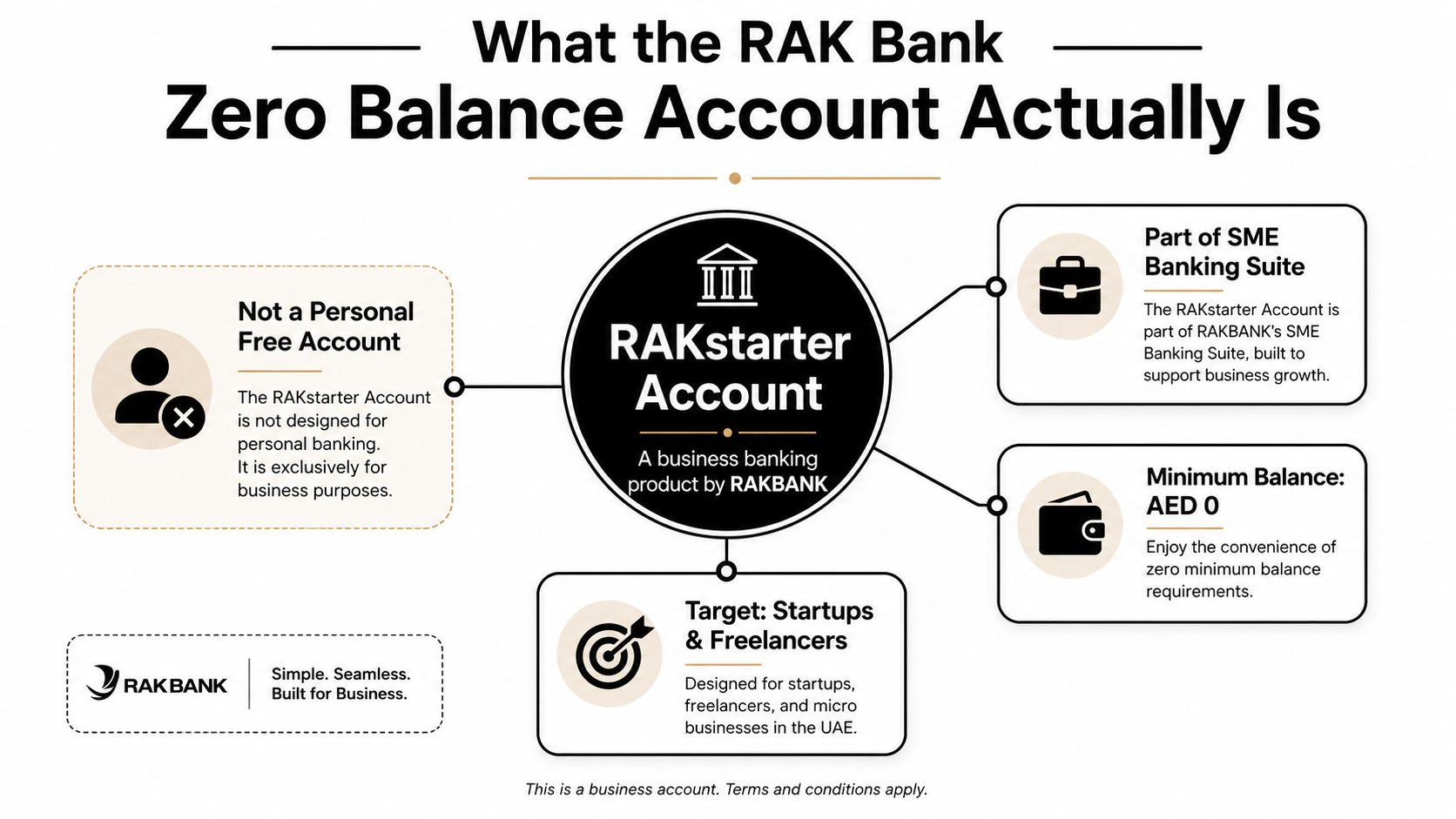
RAKstarter is RAKBANK's zero-balance business bank account for startups, not a personal free account dressed up with a business label. The bank's own business banking page says it is designed for enterprises with a valid UAE trade licence that are operational for less than one year (RAKBANK RAKstarter Account). That matters because the eligibility is tied to the business's age and legal status, not just the founder's appetite for a low-fee account.
Where it sits in the bank's lineup
RAKBANK is treating RAKstarter as part of its business banking stack, not as a generic retail current account. If you're still comparing product types, it helps to understand what a current account does in practice, because business accounts are built for operating flows, not just storing cash. That distinction is exactly why founders get misled by “zero balance” headlines and end up applying for the wrong product.
The bank's own digital banking channels also support this framing. RAKBANK points users to digital banking assistance for RAKstarter, which signals a low-friction servicing model rather than a branch-led process (RAKBANK digital banking access). In plain English, this is designed for founders who want account access without treating banking like a full-day appointment.
Practical rule: If you're opening a company account for invoices, supplier payments, and day-to-day business movement, treat RAKstarter as a business tool. If you're looking for a personal wallet with no minimum, you're probably in the wrong lane.
The label sounds broad, but the use case is narrow. That's the key to the whole topic.
Zero Balance Structure, Fees, and What They Really Mean
A zero balance label only answers one question, whether the account needs a parked cash buffer. It does not tell you whether the product fits your business model, your paperwork, or the bank's compliance checks. For founders who want to keep capital working, that distinction matters more than the headline.
RAKBANK's zero-balance business option is presented by UAE business-banking guides as an account with no minimum balance and no account charges for zero balance, with the same guides also describing AED 0 minimum balance and AED 0 monthly fee for the zero-balance business setup. That is useful for cash-conscious founders, but only if the rest of the account structure matches the way the business moves money. See the UAE guide on RAKstarter fees and treat it as a fee reference, not a substitute for checking the current bank schedule.
What the zero-balance label does and doesn't cover
A zero-balance structure removes the old problem of frozen working capital. You do not have to leave money sitting in the account just to keep it open. For a freelancer invoicing irregularly, a small SME paying suppliers, or a founder still testing demand, that is the primary appeal.
The limit is simple. No minimum balance does not mean no cost at all. The practical cost comes from usage, not the marketing phrase on the product page. Transfer behaviour, card activity, service channels, and compliance requests all shape what you pay in time and effort.
Here is the clean way to read it.
| Fee Component | Zero-Balance Business Option | Older Personal Account Reference |
|---|---|---|
| Minimum balance | AED 0 | Older guides still mention AED 3,000 |
| Monthly fee | AED 0 | Older guides mention a AED 26.25 penalty if the balance falls below the threshold |
| Product type | Business account for startups | Personal-account walkthroughs and older tutorials |
Older UAE content creates confusion because it mixes personal-account language with newer business-account references. That is how founders end up comparing the wrong products and expecting the wrong behaviour at onboarding. A business owner, a freelancer working through a business setup, and a salaried resident do not get screened the same way.
If you want a second reference point before applying, use this zero-balance business account guide for UAE founders to compare fee logic, then verify the current charge schedule with the bank. The product still needs to match your document stack and account use, not just your preference for avoiding a balance requirement.
For founders comparing service layers as well as fees, virtual card providers for startups can make spending control easier after the account is open. That does not replace the bank account. It just makes the operating setup cleaner once payments start moving.
The mistake is choosing a zero-balance account on the label alone. The better move is to match the account type to the business profile, the KYC load, and the transaction pattern.
Who the Account Is Built For in 2026
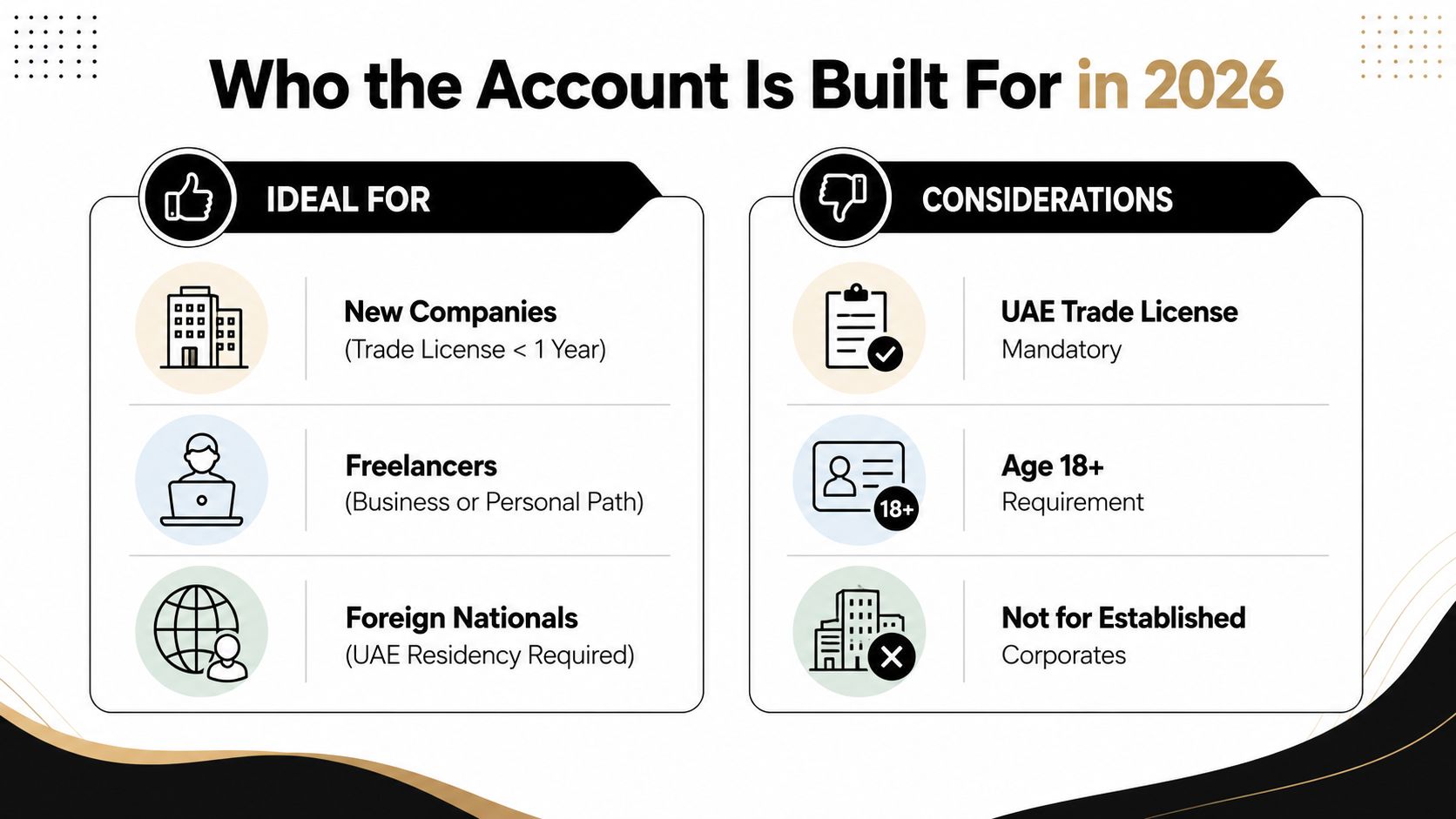
A founder who has just secured a UAE trade licence usually needs a business account that does not trap cash in a minimum balance rule, and that is the lane RAKstarter is built for. RAKBANK positions RAKBANK RAKstarter Account for enterprises with a valid UAE trade licence that have been operating for less than one year. That makes it a practical fit for early-stage businesses that want to keep working capital free while they prove revenue.
Best fit profiles
RAKstarter suits founders who already have the right business setup and need a bank account that matches that setup, not a personal account dressed up as a business tool.
- New companies with a fresh trade licence, especially if transaction volumes are still uneven and every dirham needs to stay available for operations.
- Freelancers who operate through a business path, provided their documents match the account type they are applying for and the income trail is clear.
- Foreign nationals with UAE residency, because local residency and an Emirates ID usually make the compliance review easier.
- Early-stage founders who care more about keeping cash in the business than getting extra banking features they will not use yet.
The fit is straightforward. If you are still testing your market, chasing first invoices, or waiting for receivables to stabilize, a zero-balance business account makes more sense than locking funds into a maintenance threshold.
For founders who also want tighter spending control after onboarding, virtual card providers for startups can complement the bank account once payments start moving. That comparison matters because card tooling helps with control, but it does not replace the bank relationship or the KYC review behind it.
Who gets delayed or rerouted
The wrong profile gets held up fast. Established corporates with a long trading history usually need a fuller business account than a startup-labelled product, and applicants whose licence, activity, and documents do not line up often get stuck in review.
Freelancers face a different kind of friction. Some can fit a business account path, while others are pointed toward a different account type depending on how they prove income and how the bank classifies their profile. If your revenue is irregular or your paperwork does not come from a standard employer setup, expect more questions and a slower decision. That does not mean automatic rejection, but it does mean the file has to be clean before you submit it.
Founders comparing banking to lighter fintech tools should treat the comparison as a fit check, not a status symbol. Fintech options can be useful for payment convenience, but a bank account still has to survive compliance review and match the business use case.
Documents You Need and Where Applications Stall
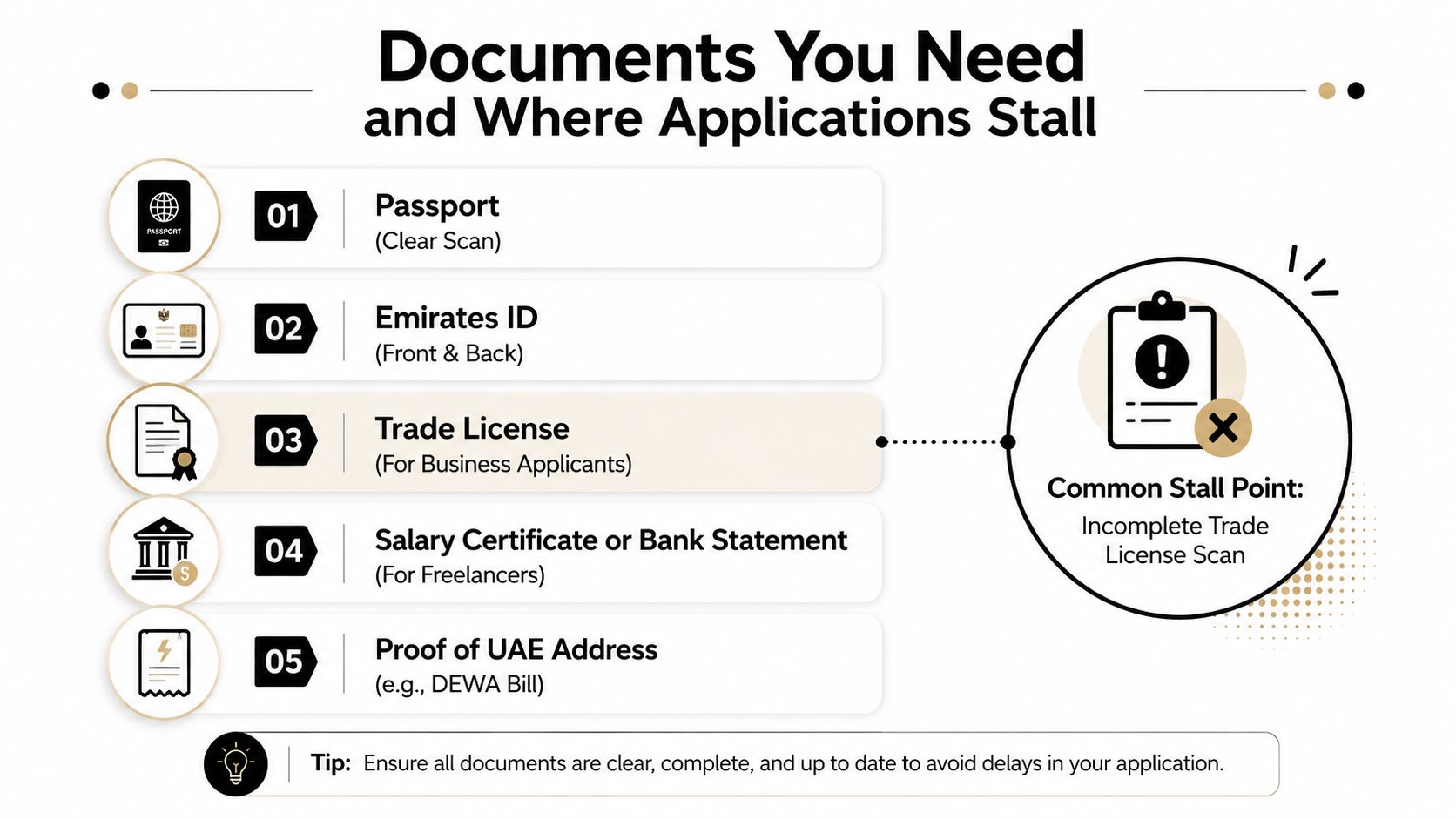
The document stack is where most applications succeed or fail. Third-party UAE guides describe recent RAKBANK-style onboarding flows as asking for passport, Emirates ID, trade licence for business applicants, proof of income such as a salary certificate or bank statement, and in some cases tax-residency disclosure and extra verification steps (2026 onboarding walkthrough). If your file doesn't tell a coherent story, the application slows down immediately.
The core file
The practical document set usually looks like this:
- Passport scan, clear and readable.
- Emirates ID, front and back.
- Trade licence, for business applicants.
- Salary certificate or alternative proof of income, especially where salary proof is not straightforward.
- Tax-residency disclosure, where requested.
- Address proof, if the bank asks for it.
The bank is not collecting these for decoration. It wants to match identity, residency, business activity, and income source. That's how compliance teams decide whether a file is bankable.
Where applications stall
The usual bottleneck isn't the first upload. It's the follow-up request. Recent explainers show applicants being asked for bank-statement uploads from another bank, face scans, ID scans, passport checks, and alternative proof-of-income documents when the standard salary evidence isn't enough (2026 onboarding walkthrough). That tells you exactly where the friction sits.
If you're a freelancer or founder without a traditional salary certificate, don't pretend the bank won't ask. Prepare a stronger file up front. If you're a business owner, make sure the trade licence scan is complete and legible, because a partial or poor scan can push the file back into review.
Useful habit: Upload the document that proves the story you're telling. If the account purpose is business, the bank should not have to guess why your money will move through it.
This is also where applicants lose time by splitting their identity documents across different file versions. Keep one clean set, match the spelling across documents, and make sure your declared purpose lines up with the account type.
Application Channels and Step-by-Step Process
RAKBANK pushes applicants toward digital onboarding for RAKstarter, which is the right setup for founders who want to avoid branch visits and keep the paperwork moving in one place. For UAE business owners, the key question is not whether the account is zero balance. It is whether your account type, document stack, and fee model fit how you run the business. That is where personal products and business products get mixed up, and that mismatch slows everything down.
How to move through the application
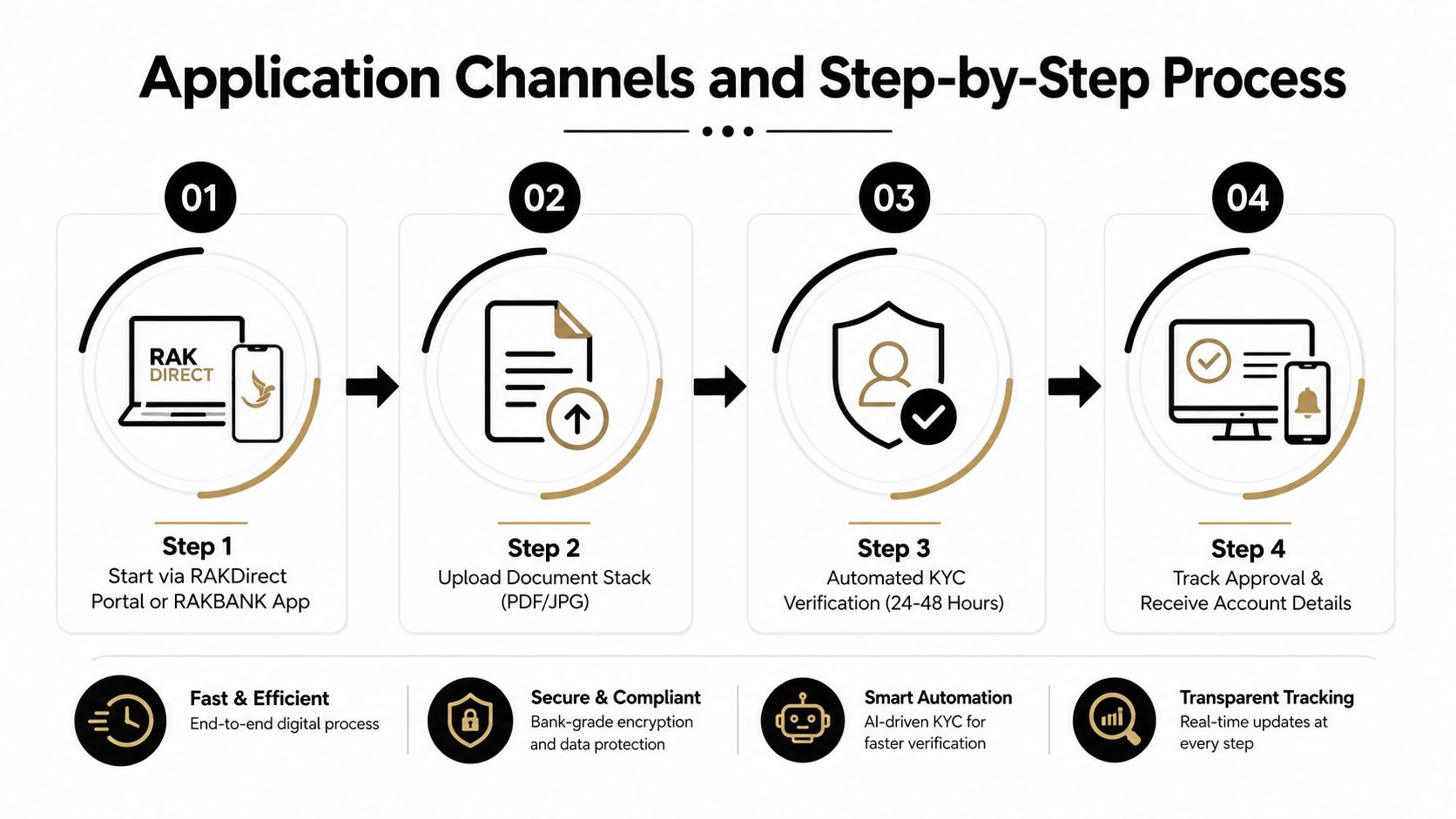
Start through the RAKDirect portal or the RAKBANK app, then upload the document stack in the format the bank asks for. That is the clean route for applicants who want to keep the process digital and avoid back-and-forth at a branch. For founders, a key advantage is control, you can prepare the file, submit it, and track the response without losing time to repeated appointments. RAKBANK also publishes its digital banking access details for customers who want the online route explained by the bank itself.
A digital file also needs to hold up under compliance review. That includes the kind of consent flow and document handling covered in e-sign compliance for finance, because onboarding only works if the bank can trust the signatures, identity checks, and record trail tied to the application.
The sequence is straightforward:
- Start the application through the digital channel.
- Upload your documents in a clean, legible format.
- Complete KYC checks and any extra verification the bank asks for.
- Track approval and activation until the account details are issued.
What speeds it up
Good files move faster than vague files. If your business structure is simple, your residency is clear, and your document names match, the bank has fewer reasons to pause the review. If your setup is unusual, raise it early with support instead of waiting for the file to stall in compliance. That advice is especially useful for freelancers, foreign investors, and owners whose income proof does not look like a standard salaried case.
For founders who want procedural help, a UAE business consultant can line up the trade licence activity, signatory documents, and application purpose before submission. Smart Classic Business Hub is one option in that category, especially when the setup file and the banking file need to match cleanly. If you want a practical reference point before you apply, use Smart Classic's business account resource to compare how the account path is usually presented to UAE businesses.
Keep one principle in mind. The application is not only about getting the form in. It is about removing the reasons a compliance team will ask the same question twice.
RAKstarter vs Other RAKBANK and UAE Business Accounts
RAKstarter fits a very specific case. It is a business account path for a fresh UAE company that wants zero minimum balance pressure, not a personal everyday account and not a full corporate banking package. That distinction is where many founders waste time, because banks split products by use case, licence type, and onboarding risk, not by the marketing label on the homepage.
The clean comparison
A personal zero-balance account serves individual spending and salary-style activity. A business account exists for trade licence holders, startup onboarding, and company-level banking behaviour. If you blur those two, you end up gathering the wrong documents and asking the bank to approve a profile it was never meant to approve.
Use the account type to match the job:
- Choose RAKstarter if you have a new UAE business, a valid trade licence, and you want a business account with no minimum balance pressure.
- Choose a personal zero-balance path if your banking need is personal and your current eligibility fits that route.
- Choose a broader UAE business account if you need more banking functions, a more developed company profile, or a structure that sits outside startup criteria.
Comparison pages help because they separate account purpose from fee language. If you are still sorting out which category fits your case, start with a practical no minimum balance account guide for UAE and compare the product intent before you compare the fee model.
Where RAKstarter wins and where it doesn't
RAKstarter works well when your main goal is to keep cash available and open a startup account without a minimum-balance burden. It works poorly if you need the widest corporate banking toolkit from day one. That is a trade-off, and you should treat it that way.
The fitter profile matters more than the headline. A freelancer has to check whether the activity belongs in a business route or a personal route. An SME owner has to see whether the file looks like a startup or an established operator. A foreign investor has to line up residency, licence, and signatory details in a way the bank can verify without back-and-forth.
Practical Tips Before You Apply and What to Do Next
Apply only after you line up the account purpose with the documents. If you're opening a business account, the bank should see business documents first, not a pile of mismatched identity files and an unclear revenue story. If your income proof is thin, solve that before you hit submit.
Use this short checklist:
- Match the licence activity to the purpose you declare.
- Keep identity documents consistent across all files.
- Prepare alternative income proof if you don't have a standard salary certificate.
- Expect KYC follow-up if your structure is new, freelance-led, or cross-border.
- Escalate early if the digital flow stalls.
If the process gets stuck, don't keep resubmitting the same file. Ask what exact item is missing, then correct that one issue. If your business setup, visa status, and banking profile don't line up, bring in a consultant before the bank turns a fixable mismatch into a delay.
The RAK Bank zero balance account is useful, but only for the right profile and the right paperwork. Treat it as a business banking decision, not a marketing slogan, and you'll save yourself weeks of wasted back-and-forth.
If you want help aligning your trade licence, residency status, and banking file before you apply, Smart Classic Business Hub can review the structure and map the right UAE setup path for your case. They handle company formation, PRO support, and banking-oriented compliance preparation, so you're not guessing your way through KYC.