
Thinking about setting up an LLC in Dubai? You're making a smart move. This isn't just about starting a company; it's about plugging your venture directly into one of the world's most energetic and pro-business economic hubs.
Why Dubai Is a Top Choice for Your New LLC
Dubai’s appeal goes way beyond its stunning skyline. For entrepreneurs like us, it’s a launchpad built on solid economic ground, smart policies, and massive opportunities. Sitting at the crossroads of Europe, Asia, and Africa, the city gives you unmatched access to global markets. Plus, its world-class infrastructure means you can hit the ground running.

This is about more than just a great location; it's about the incredible momentum here. The UAE government has been rolling out the red carpet for businesses, and recent changes have made it simpler than ever for foreign investors to get started, attracting a flood of global talent and capital.
A Magnet for Global Investment and Talent
The numbers don't lie. Even with global uncertainty in 2020, the UAE saw 19,050 new business registrations. Fast forward to mid-2024, and the total number of registered companies has exploded from 405,000 to over 1.021 million.
That’s a staggering 152% jump, with over 616,000 new businesses added in just a few years. It's clear proof that the reforms to simplify processes like LLC setup are working.
This growth is no accident. It’s driven by key advantages that make forming an LLC in Dubai so compelling:
- Smart Government Policies: Initiatives like the Instant License service can get your LLC up and running in just a few days. It’s all about speed and efficiency.
- 100% Foreign Ownership: This is a game-changer. For most business activities, you can now own 100% of your mainland company without needing a local partner.
- A Tax-Friendly Environment: With zero personal income tax and a very competitive corporate tax rate, your business has more capital to reinvest and grow.
Choosing to set up an LLC in Dubai is a strategic decision. You're not just getting a trade license; you’re positioning your business at the heart of global commerce, in an ecosystem built for long-term success.
More Than Just a Licence
Your LLC licence is your key to unlocking a host of powerful benefits. It gives you unrestricted access to the local UAE market and the ability to bid on lucrative government contracts—freedoms you won’t find with other company structures.
It also makes getting residency visas for yourself, your family, and your employees much more straightforward. This is a huge advantage when it comes to attracting and keeping the best talent from anywhere in the world.
To really get a feel for what’s possible, take a look at our guide on the 5 benefits of setting up a business in Dubai.
Choosing Your Business Jurisdiction: Where Should You Plant Your Flag?
Picking where to register your company is easily the most critical decision you'll make when setting up in the UAE. This isn't just about paperwork; it's a strategic choice that defines who you can do business with, your ownership rights, and your company's long-term potential.
Think of it as choosing the right soil for a specific plant. Your business goals are the plant, and the jurisdiction is the soil. Let's break down the three main options—Mainland, Free Zone, and Offshore—through real-world scenarios to see which one fits you best.
Mainland LLC: Your All-Access Pass to the UAE Market
If your business model involves trading directly within the UAE, a Mainland LLC is your only real option. This is the setup for anyone who wants to sell goods or services to customers or other businesses anywhere across the seven emirates. It's the key to unlocking the entire local economy.
Imagine you're opening a boutique marketing agency. You plan to serve clients in Dubai's finance district, run workshops in Abu Dhabi, and consult for retailers in Sharjah. A Mainland licence is non-negotiable here.
- Total Market Freedom: You can set up your office anywhere, from a high-rise on Sheikh Zayed Road to a local community centre, and deal with any customer in the country.
- Government Work: This licence makes you eligible to bid on lucrative government contracts, a huge part of the UAE's economy.
- Physical Presence: Want to open a shop, a clinic, or a restaurant? The Mainland lets you choose a location that puts you right in front of your target audience.
The big idea behind a Mainland company is unrestricted access. It removes all geographical handcuffs within the UAE, making it the default choice for businesses with a local focus, whether you're a consultant, a restaurant owner, or a large trading firm.
Free Zone Company: The Global Business Hub
Let's switch gears. Say you’re a tech entrepreneur developing a SaaS platform for an international client base. Your customers are in Europe, Asia, and North America. You don't plan on selling to the local UAE market, but you need a tax-efficient, globally respected base to operate from.
This is the perfect scenario for a Free Zone.
A Free Zone is a special economic area with its own regulator and rules. The UAE has over 40 of them, many tailored to specific industries—like Dubai Media City for media companies or DMCC for commodities trading.
For that SaaS startup, a Free Zone offers some fantastic perks:
- 100% Foreign Ownership: This is the classic Free Zone advantage, giving you complete control over your company.
- Tax Benefits: While the UAE now has a 9% corporate tax for Mainland firms earning over AED 375,000, 'Qualifying Free Zone Persons' can still benefit from a 0% tax rate on their qualifying income.
- Easier Setup: The registration process is generally quicker and less bureaucratic than a Mainland setup.
The catch? You can't trade directly with the UAE Mainland. If you want to sell your services to a Dubai-based company outside your Free Zone, you'll need to go through a local distributor or agent. It adds a layer of complexity, but for businesses focused on international markets, it's a trade-off well worth making.
For a more detailed comparison, our article on Mainland vs Free Zone in Dubai goes into much greater depth.
To help you see the differences at a glance, here’s a quick breakdown of the three main jurisdiction types.
Mainland vs Free Zone vs Offshore: A Quick Comparison
| Feature | Mainland LLC | Free Zone Company | Offshore Company |
|---|---|---|---|
| Market Access | Full access to the entire UAE market. | Limited to its own free zone and international markets. Requires an agent for mainland trade. | No access to the UAE market. International trade only. |
| Ownership | 100% foreign ownership is now possible for most activities. Some strategic sectors still require an Emirati partner. | 100% foreign ownership is standard. | 100% foreign ownership. |
| Visas | Eligible for employee and investor visas. The number depends on office size. | Eligible for employee and investor visas. The number is typically based on the package chosen. | Not eligible for any UAE residency visas. |
| Office Space | Must lease a physical office space anywhere in the mainland. | Can lease a physical office or use a flexi-desk within the specific free zone. | No physical office is permitted. Only a registered agent's address is used. |
| Taxation | 9% corporate tax on profits above AED 375,000. | 0% corporate tax on "qualifying income" for Qualifying Free Zone Persons. | 0% corporate and income tax. |
| Best For | Local trade, retail, services, restaurants, and government contracts. | International trade, consulting, e-commerce, and specific industry clusters (e.g., tech, media). | Holding company, asset protection, international invoicing, and real estate ownership. |
This table should give you a clear starting point, but the best choice always comes down to your specific business plan.
Offshore Company: The International Asset Tool
Finally, we have the Offshore company. This is a completely different animal. It’s not for running an active, day-to-day business inside the UAE. Instead, it’s a legal instrument designed for holding international assets and investments.
Picture an investor from overseas who wants to buy a portfolio of properties in London and Singapore. They need a secure, tax-neutral entity to hold these assets, and they want it based in a reputable jurisdiction like the UAE. They don't need a UAE office, staff, or visas.
This is precisely what an Offshore company—registered in places like JAFZA or RAKICC—is built for.
People use an Offshore setup for a few key reasons:
- As a Holding Company: To own shares in other businesses around the world.
- For Asset Protection: To separate business assets from personal liability in a stable legal environment.
- For Global Invoicing: To manage international trade and billing without needing a physical base in the UAE.
It's vital to understand that an Offshore company is a non-resident entity. It can't do any business within the UAE, it can't rent a physical office, and it can't be used to get residency visas. It’s a pure-play tool for managing global finances and assets.
Getting Your Dubai LLC Up and Running
Once you've zeroed in on the right jurisdiction for your new company, it's time to navigate the administrative steps that bring it to life. This isn't just about paperwork; each stage is a building block for the legal and operational foundation of your business. The process here is impressively efficient, but the secret to a smooth setup is getting the details right from the very beginning.
This flowchart gives you a bird's-eye view of how a company goes from an idea to a fully licensed entity across Dubai's main jurisdictions.
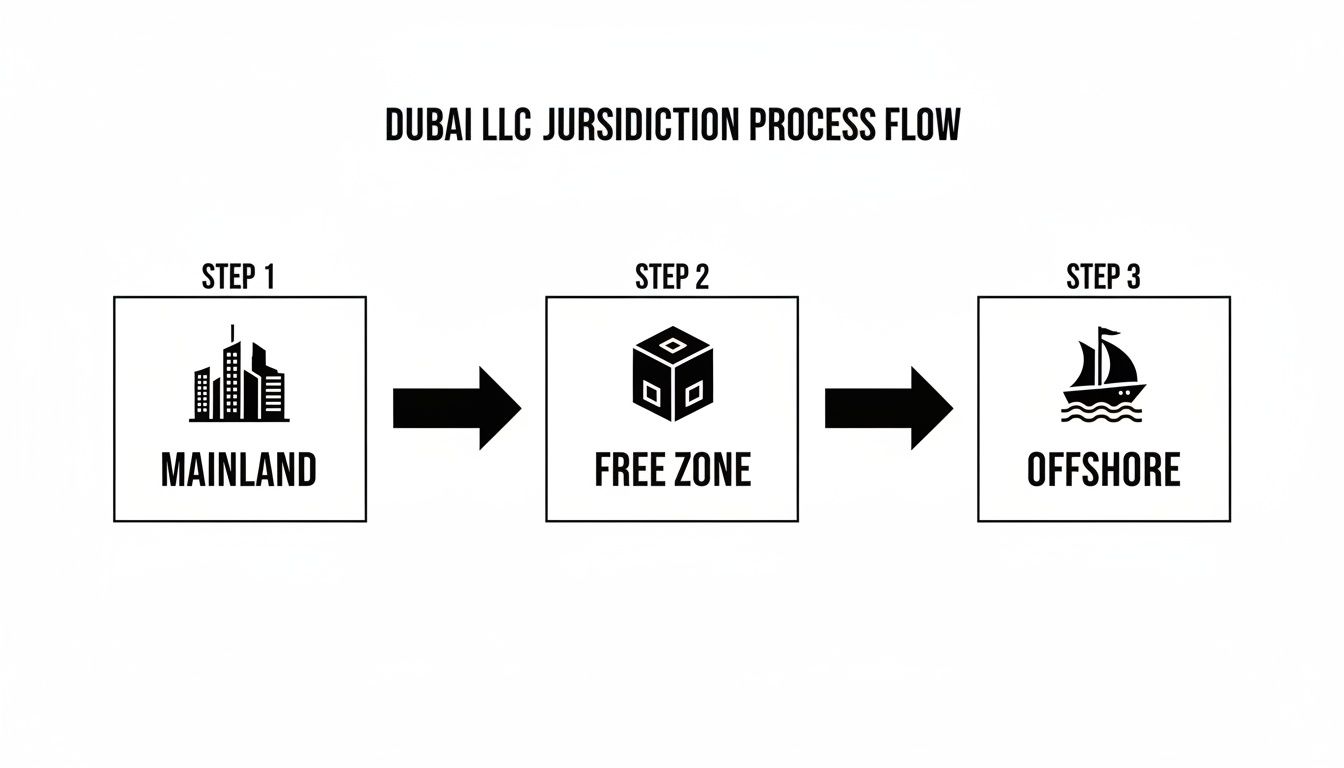
As you can see, the path for a Mainland, Free Zone, or Offshore company is distinct. The destination is the same—a licensed, operational business—but the journey to get there is unique for each.
Securing Your Business Identity
Your company’s story begins with its name. In Dubai, a trade name is more than just a branding decision; it's a legal identifier that must be approved and reserved with the Department of Economy and Tourism (DET). There are strict rules you need to follow to avoid having your application kicked back.
For example, your name can't violate public morals, include religious or political terms, or use names of government bodies. It also has to be completely unique. A common mistake is getting attached to a name that sounds great but is legally unavailable, which sends you right back to square one.
Tip from experience: Always come prepared with at least three trade name options, listed in order of your preference. This simple bit of prep work can save you a huge amount of time if your first choice is rejected. The authorities can just move to your next option without needing to circle back with you.
Getting the Green Light with Initial Approval
With your trade name locked in, the next hurdle is getting Initial Approval. You can think of this as the DET giving your business concept a nod of approval. This certificate officially confirms the government has no objection to you setting up shop and gives you the go-ahead for the next legal steps.
This stage is critical because you have to declare exactly what your business will do. You’ll select these from a list of over 2,000 approved business activities. It's essential that the activities you pick are a perfect match for what you actually plan to do. Any mismatch here can lead to fines or other headaches down the road.
Crafting Your Legal Blueprint
The Memorandum of Association (MoA) is basically the constitution for your LLC. It lays out the company's structure, the rights and duties of the shareholders, how profits and losses are split, and the overall rules of governance. For any LLC, this document must be drafted in both English and Arabic.
Don’t rush this. The MoA is a binding legal document that governs your internal business relationships and has to be notarised by a public notary in the UAE. For most entrepreneurs, this is where getting professional guidance is a no-brainer. You want to be sure every clause is crystal clear, legally sound, and protects everyone involved.
Establishing Your Physical Presence
For a Dubai Mainland LLC, having a physical office is non-negotiable. You simply cannot get your final trade licence without a registered tenancy contract, known as an Ejari. This is your proof to the authorities that your business has a legitimate physical address in the emirate.
Your office choice isn't just about finding a good location; it has a direct impact on your visa eligibility. The number of employment visas your company can apply for is often linked to the square footage of your office. This is a key strategic decision that affects your long-term growth and hiring plans. For a more detailed walkthrough of the entire setup journey, you might find our guide on how to register a company in the UAE useful.
Final Submission and Licence Issuance
Once you have your trade name, initial approval, notarised MoA, and Ejari all sorted, you’re on the home stretch. All these documents are submitted to the DET, along with payment for the licence fees. After a final review to ensure everything is in order, the DET will issue your official Trade Licence.
The entire process is a testament to the UAE’s commitment to being a world-class place to do business. The efficiency is remarkable; according to World Bank data, setting up a mainland LLC can take just 3.5 days for married men, involving only two main procedures. This streamlined approach helped the UAE become home to 1.021 million active companies by mid-2024, a staggering 152% jump from 2020, as economic reforms continued to attract global entrepreneurs.
This final licence is your key to the city—your official permission to start operating, hiring staff, and kicking off your business journey in Dubai.
Alright, let’s talk numbers. Budgeting for your Dubai LLC formation is one of the most critical steps, and getting it right from the start saves a world of headaches later on. Let's break down exactly what you should expect to pay and how long it all takes.
The costs really fall into two buckets: the one-time fees to get your company legally established and the recurring annual expenses to keep it running and compliant.
Your Initial One-Time Setup Investment
This is the upfront capital you'll need to get your trade license in hand. Think of it as your ticket to enter Dubai's dynamic business world. The final figure will depend heavily on your specific business activity and whether you choose mainland or a free zone, but we can map out a pretty clear picture.
For a mainland LLC, you should realistically budget somewhere between AED 15,000 and AED 35,000. This range usually bundles everything you need to get started:
- Fees for initial approval and reserving your trade name.
- The drafting and legal attestation of your Memorandum of Association (MoA).
- The trade license issuance fee, which is often the biggest chunk of the cost.
- Your establishment card and various other government processing fees.
If you go the free zone route, the entry point can be a bit more accessible. Initial costs often start as low as AED 8,000 and can go up to AED 25,000 or more. The final price depends on the specific free zone and the package you choose, which frequently includes the license, registration, and sometimes even eligibility for a basic visa.
Getting your budget right from day one is non-negotiable. I've seen too many entrepreneurs get caught off guard by an overlooked government fee or underestimate their annual renewal costs. This can create serious cash flow problems before you've even made your first sale. Plan for everything you expect, and always keep a cushion for the unexpected.
Recurring Annual Costs to Keep Your LLC Running
Your financial planning doesn't end once you have that shiny new trade license. To keep your LLC active and in good standing, there are several annual costs you need to factor into your operational budget.
The biggest recurring expense is your trade license renewal, which is typically a similar amount to the initial government fee for the license. Another major cost is office rent. For mainland companies, having a physical office with a registered tenancy contract (Ejari) is a must, and prices can vary dramatically depending on the location and size. Free zones offer more flexibility here, with options like cost-effective flexi-desks.
Don't forget these other recurring costs:
- Visa Renewals: For yourself, any partners, and your employees.
- Establishment Card Renewal: This is a standard yearly administrative requirement.
- PRO Service Fees: If you're using a consultant for ongoing government paperwork and liaison.
- Accounting and Audit Fees: These are mandatory to stay compliant with UAE regulations.
How Long Does It Really Take to Set Up?
One of Dubai's biggest draws for entrepreneurs is speed. The government has worked hard to streamline its processes, making the UAE a world leader in business efficiency. In fact, a wave of business-friendly reforms helped the UAE's business landscape grow by a staggering 152% between mid-2020 and mid-2024, with over 616,000 new companies joining the market. This incredible growth, which you can read more about in this comprehensive overview, is partly fueled by services like Dubai's Instant License, which can get an LLC formed in as little as 3.5 days.
While an instant license is a fantastic option for certain activities, a more realistic timeline for a standard LLC formation—from your first consultation to holding the license—is between one and three weeks. This timeframe allows for proper name approval, document drafting, and final submission without cutting any corners on critical steps.
After that, you'll move on to visa processing and opening your corporate bank account. You can expect each of those steps to take an additional two to four weeks, on average.
What to Do After You Get Your License
Holding your newly issued trade licence is a huge milestone. It’s the official document that brings your business to life, but don't pop the champagne just yet—the real work is just beginning. Think of the licence as your passport; now you need the visas and bank access to actually start your journey.

This next phase is all about building the operational framework around your LLC. It's about getting the right cards, processing visas for yourself and your team, and navigating the often-tricky world of UAE corporate banking. Let's walk through what comes next.
Securing Your Establishment Card
First things first: apply for your company’s Establishment Card. This small plastic card, issued by the immigration authorities, is deceptively important. Without it, your company simply cannot sponsor any visas—not for you as an investor, nor for any employees you plan to hire.
The Establishment Card essentially registers your new LLC with the General Directorate of Residency and Foreigners Affairs (GDRFA). It’s the key that unlocks your ability to build a team and establish your own residency in the UAE. Thankfully, the application is usually straightforward and completed within a few working days.
Processing Investor and Employee Visas
With the Establishment Card in hand, you can finally kick off the visa process. This is often a multi-stage journey involving entry permits, medical fitness tests, and biometrics for the Emirates ID.
- Investor or Partner Visa: As a shareholder, you're eligible for an investor visa. This grants you residency in the UAE and is a prerequisite for sponsoring your family members.
- Employee Visas: For any staff you hire, the company will act as their sponsor. A key rule to remember for mainland companies is that the number of employee visas you can get is directly linked to the size of your physical office space.
This stage requires meticulous attention to detail. I’ve seen countless applications delayed because of a tiny error in a form or a missing document. It’s always wise to have a second pair of eyes check everything.
Opening Your Corporate Bank Account
This is, without a doubt, the most challenging post-licensing step for most new businesses in the UAE. Banks here have incredibly stringent compliance and Know-Your-Customer (KYC) requirements to combat money laundering. Just waving your new trade licence isn't enough to get an account approved.
You need to assemble a comprehensive file that tells a clear, convincing story about your business. Be ready to provide:
- A Detailed Business Plan: Show where your funding is coming from, who your target clients are, and your revenue projections.
- Founder Profiles: Banks want to see the professional background and experience of the company's shareholders.
- Proof of Business Address: Your Ejari (registered tenancy contract) is non-negotiable.
- Supporting Invoices or Contracts: If you have any existing or potential client contracts, include them. They are powerful proof of your business's legitimacy.
A common mistake is underestimating the bank's due diligence. The bank’s compliance officer needs to be absolutely confident that your business is legitimate, has a real physical presence, and has a clear, lawful purpose. Arriving unprepared is the fastest way to get your application rejected.
Staying Compliant from Day One
Once you're up and running, your focus shifts to ongoing compliance. Ignoring these responsibilities can lead to hefty fines and serious legal trouble down the line.
Your first priority should be understanding your tax obligations. If your company's annual revenue is expected to exceed AED 375,000, you must register for Value Added Tax (VAT) with the Federal Tax Authority (FTA). You'll then be required to file VAT returns periodically.
On top of that, maintaining proper books of accounts is not just good practice—it's the law. All companies in the UAE are required to keep accurate financial records that comply with International Financial Reporting Standards (IFRS). These records are essential for your annual audit and for filing your corporate tax return. Do yourself a favour: get a solid accounting system set up from the very beginning. It will save you from a world of stress later.
Your Top Questions About Forming an LLC in Dubai
Even with a clear plan, setting up a new company always brings up a few specific questions. It's completely normal. Let’s tackle some of the most common queries we get from entrepreneurs, giving you the direct, practical answers you need.
Do I Still Need a Local Sponsor for a Mainland LLC?
This is the big one, and the answer has been a complete game-changer for international entrepreneurs. For the vast majority of commercial and professional activities, the answer is no—you no longer need a local Emirati sponsor to own 51% of your mainland LLC.
Thanks to some landmark legal reforms, 100% foreign ownership is now the standard for over 2,000 business activities. This gives you complete control over your mainland business, a privilege that used to be exclusive to free zone companies.
It's important to remember, though, that a handful of strategic sectors—think banking or key public services—still have local partnership rules. Always double-check the specific ownership requirements for your chosen business activity before you dive in.
How Many Visas Can I Get with My New LLC?
Visa eligibility is a make-or-break factor, especially if you plan on building a team. The number of residence visas your LLC can sponsor isn't just a random number; it's directly tied to the physical space your company rents.
- For Mainland LLCs: The rule of thumb is based on the size of your registered office. Authorities typically grant one visa for every 80-100 square feet of office space. Simply put, a bigger office means a bigger visa quota.
- For Free Zone Companies: This is usually determined by the specific package you buy. A basic flexi-desk setup might come with one or two visas, while leasing a proper physical office within the free zone will naturally give you a much higher quota.
Your office choice isn't just about having a place to work. It's a strategic move that dictates how much your company can grow. If you underestimate your space needs now, you might find yourself unable to hire the people you need down the road.
Can I Run My LLC From Home or a Virtual Office?
The answer to this really hinges on where you decide to set up.
If you’re forming a Dubai Mainland LLC, a physical office with a registered tenancy contract (Ejari) is non-negotiable for getting your trade licence. For most standard mainland licences, you can't use a virtual office or run the business from a residential address.
Free zones, on the other hand, are built for flexibility. Many offer flexi-desk or co-working packages that meet their commercial address requirement. This makes them a fantastic, cost-effective option for startups and solopreneurs who don’t need a full-time physical office just yet.
What on Earth is an Ejari and Why Does it Matter So Much?
Ejari (which literally means 'my rent' in Arabic) is the government's online system for registering tenancy contracts in Dubai. For any mainland LLC, a registered Ejari for your commercial office is an absolute must-have.
Think of it as the official government stamp that proves your company has a physical address. Without a valid Ejari, you simply cannot complete the final steps of your trade licence application. It’s the key that unlocks everything else, from getting your licence issued to opening your corporate bank account.
What Happens if I Choose the Wrong Business Activities?
Getting your business activities right on your licence is critical. The Department of Economy and Tourism (DET) has a list of over 3,000 approved activities, and your licence must accurately reflect what your company actually does.
Operating outside the scope of your licence can lead to hefty fines and, in serious cases, the suspension of your trade licence. If your business evolves and you start offering new services, you have to formally amend your licence to add those new activities. It's the only way to stay compliant and keep your business running smoothly.
Feeling your way through the details of LLC formation is exactly what we do best. The team at Smart Classic Business Hub has the local know-how to guide you through every decision, ensuring your setup is smooth, compliant, and ready for success. Start the conversation with a free consultation today.