
The most popular advice about internal audit services in UAE is also the least useful for many founders: wait until the annual audit, hand over the ledger, and assume the auditor will identify anything serious. That approach confuses two different functions. A statutory audit examines financial statements for an independent opinion. Internal audit tests whether the business can prevent errors, fraud, operational leakage, and technology failures before they reach the year-end accounts.
For a lean UAE company, the largest exposure may not be an incorrect journal entry. It may be one employee who can create a supplier, approve a payment, edit accounting records, and control online banking access. VAT compliance won't correct that weakness. A clean set of accounts won't prove that access rights, approval workflows, backups, and related-party transactions are properly controlled.
Practical internal audit is therefore a targeted operational and digital risk shield. It gives owners a structured way to find weaknesses, assign responsibility, set remediation deadlines, and verify that corrective action was completed.
Redefining Internal Audit for UAE Businesses
Many SME owners see internal audit as a second statutory audit, usually performed after the financial year closes. That view creates a costly blind spot. The statutory auditor's work centres on the financial statements and the evidence supporting them, while internal audit examines how the business operates and whether its controls work in practice.
UAE federal governance rules define internal audit as an independent, objective assurance and advisory activity designed to add value and improve operations through systematic evaluation of governance, risk management, and oversight. The UAE federal governance framework also places emphasis on independence, risk oversight, internal-audit reporting, and follow-up.
What a useful engagement delivers
A credible engagement should begin with a risk-based scope, not a generic checklist. The auditor should understand how money, data, approvals, inventory, employees, and suppliers move through the business before deciding what to test.
A practical assignment normally includes:
- Process walkthroughs: Follow a transaction from initiation to approval, recording, payment, and reconciliation.
- Control testing: Check whether controls are both properly designed and consistently performed.
- Prioritised findings: Separate urgent exposure from low-impact procedural improvements.
- Named owners and deadlines: Give management responsibility for each corrective action.
- Follow-up verification: Confirm that the fix exists and operates, rather than closing an issue because a policy was written.
For example, reviewing the hire-to-retire cycle can reveal access and approval gaps that a finance-only review misses. Teams assessing payroll, onboarding, employee changes, leavers, and benefits may also find it useful to review hire-to-retire HR processes as part of the wider control map.
Practical rule: If an audit report doesn't identify who owns each issue, when the issue will be fixed, and how completion will be tested, it is closer to a health check than an effective internal-audit function.
Why the distinction matters
An external auditor may identify a material financial reporting concern, but that work isn't designed to examine every operational control or every technology permission. Internal audit works between reporting periods and asks a different question: what could go wrong in the way this business operates, and what evidence shows that the risk is controlled?
That distinction is particularly important for family-owned companies, fast-growing startups, and businesses where founders still approve most decisions. Informal trust can support early growth, but it becomes fragile when transaction volume, staff numbers, third-party systems, and bank relationships expand.
Regulatory Drivers and Corporate Tax Thresholds
The UAE's governance environment has moved beyond a narrow focus on whether financial statements are prepared. Federal Law No. 12 of 2014 established a formal framework for regulating the auditing profession and licensing audit practitioners through the Ministry of Economy. The Companies Law that followed strengthened governance expectations for public joint-stock companies and gave the Securities and Commodities Authority responsibility for auditor accreditation controls in those companies.
The Ministry of Economy has described internal audit as an integral part of sound corporate governance, including the design of internal-audit systems, evaluation of resource use, and support for risk evaluation and management. A study of UAE listed-company governance reported that the average number of listed companies subject to governance controls increased from approximately 89 during 2015 to 2019 to 106 during 2020 to 2023, with 11 audit firms registered with the Securities and Commodities Authority in 2023 and a reported 96.1% compliance level among companies. These figures come from the study of UAE governance development.
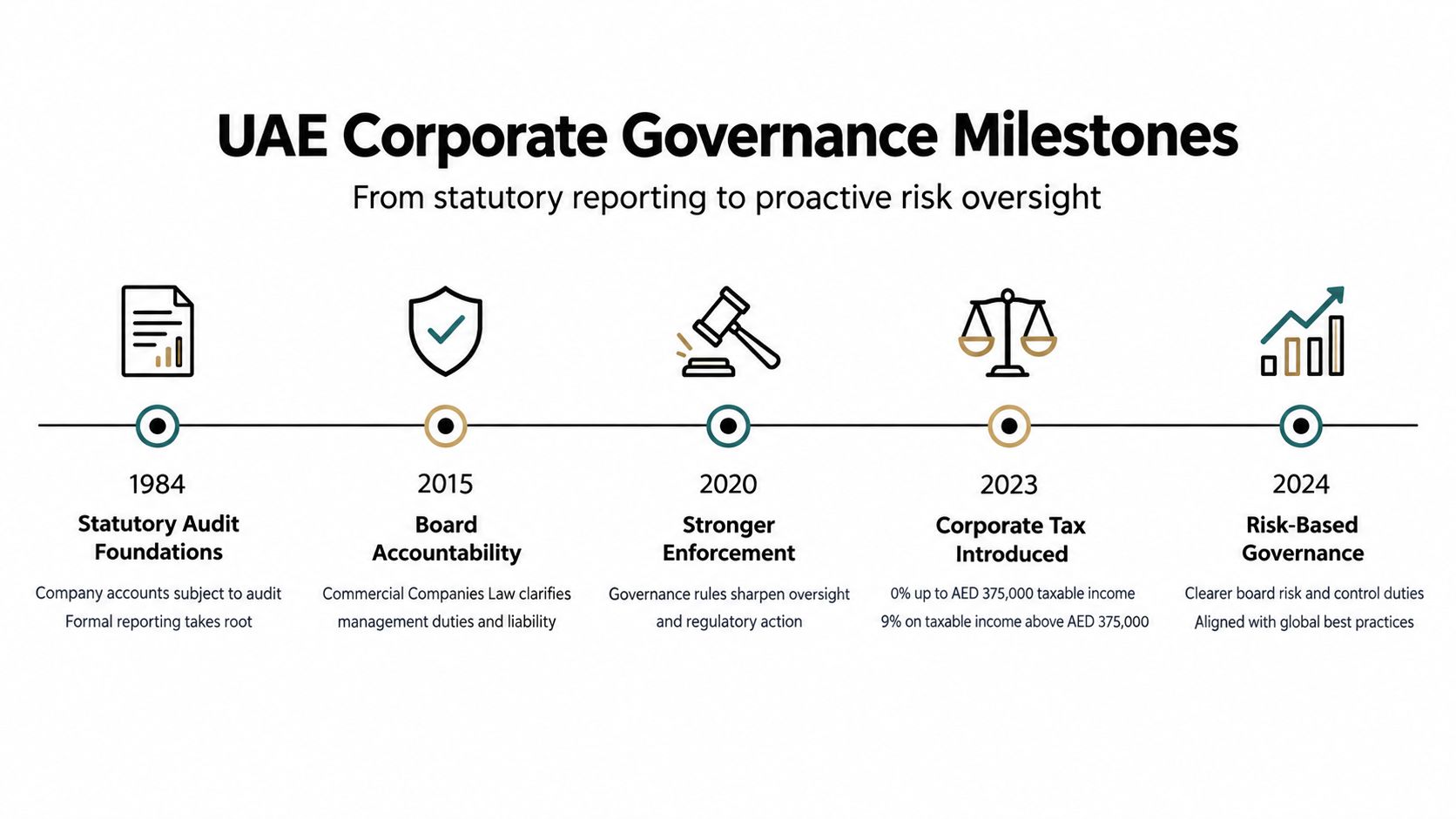
Corporate tax creates an evidence problem
UAE Corporate Tax guidance states that taxable persons with revenue exceeding AED 50 million during the relevant tax period may be required to maintain audited financial statements, as set out in the Federal Tax Authority's Corporate Tax guide. The threshold isn't merely an accounting milestone. It creates a documentation challenge for revenue recognition, deductible expenditure, related-party transactions, reconciliations, and tax adjustments.
An internal-audit programme should test the evidence chain from contract and invoice through the general ledger, tax computation, and return-supporting schedules. It should also examine who can change records, whether approvals are retained, and whether source documents can be produced when management needs to defend a position.
Businesses planning around corporate tax should coordinate internal controls with a documented corporate tax planning approach. The purpose isn't to replace the statutory audit or tax return process. It's to identify unsupported balances, inconsistent classifications, and missing approvals before they delay reporting or weaken the defensibility of the company's records.
Strong tax governance depends on the quality of the underlying evidence, not only on the final tax calculation.
Growth changes the control expectation
A small business may manage through direct founder oversight. That model becomes unreliable as employees gain separate responsibilities and the company relies on cloud systems, outsourced payroll, external bookkeepers, and multiple bank users. Internal audit gives management a repeatable way to test whether authority still matches accountability.
The right response isn't to impose a large-company bureaucracy on a young business. It is to document the few controls that protect cash, data, tax records, and decision rights, then increase the scope as the business becomes more complex.
The Modern Scope of Assurance and Risk Oversight
Internal audit is now a test of how the business operates in practice, not only how its accounts are presented. For a UAE SME, the review should connect governance, risk management, operations, fraud exposure, and technology controls across digital sales channels, cloud accounting, outsourced IT, remote approvals, and shared data platforms.
A 2024 UAE Pulse of Internal Audit survey found that 52% of organisations lacked internal-audit personnel with sufficient expertise to conduct IT audits, according to Protiviti's UAE survey report. That gap matters to owners because a finance-only review may miss weaknesses in the systems that create, approve, store, and transmit financial information.
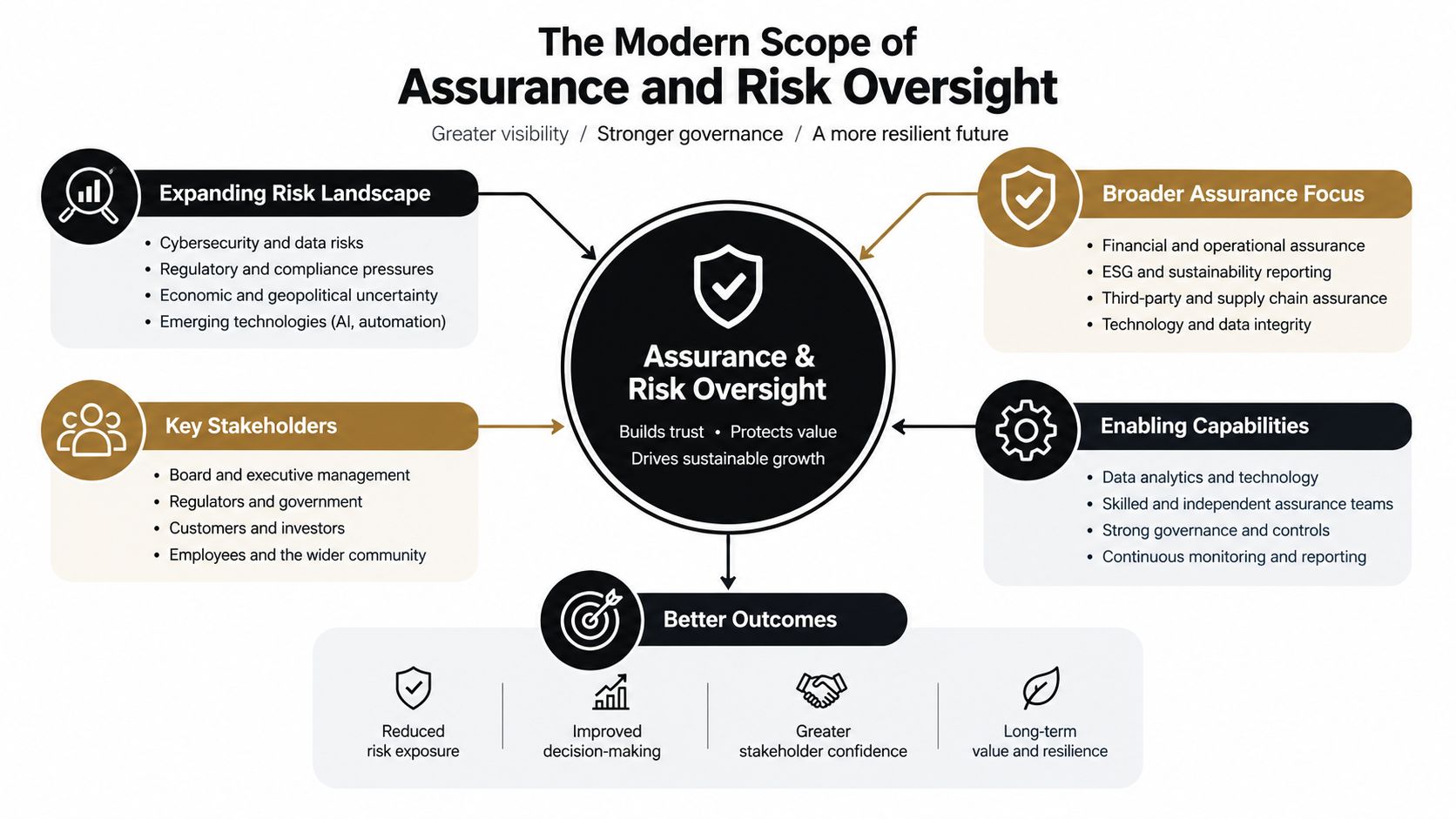
The audit should start with risk ownership. Identify the people responsible for cash, customer records, procurement, payroll, technology, and regulatory reporting. Then test whether their authority, monitoring duties, and escalation routes match the risks they are expected to control.
The review can cover:
- Governance: Test authority limits, policy ownership, committee duties, and escalation routes.
- Financial controls: Examine reconciliations, payment approvals, journal entries, revenue records, and expenditure support.
- Operations: Review procurement, inventory, contracts, payroll, customer onboarding, and service delivery.
- Fraud exposure: Assess segregation of duties, unusual transactions, override rights, and management monitoring.
- Technology controls: Inspect access rights, administrator accounts, system changes, backups, recovery arrangements, and outsourced providers.
- Remediation: Track overdue actions and assign unresolved issues to the responsible management or board-level forum.
For entities covered by the federal framework, the board must establish an impartial Audit and Risk Committee independent of executive management. The committee reviews financial statements, internal controls, risk-management systems, internal-audit reports, required expertise, and the effectiveness of internal audit.
Evidence should settle the question. If access is described as restricted, inspect the user listing, approval record, leaver process, and periodic review. If payment approval is required, trace an invoice through the system to bank release and test whether an override route exists.
This approach produces advice management can act on. A report that repeats international frameworks without identifying the exposed process, responsible owner, corrective action, and proof of completion offers limited protection. Businesses comparing audit advisory services should ask how the provider will test controls in the company's actual systems, not just describe recommended policies.
Uncovering Digital and Cybersecurity Vulnerabilities

A company can submit accurate VAT records while leaving its cash exposed. In a growing UAE services business, one finance employee may create suppliers in the cloud accounting platform, prepare payments, approve invoices within a delegated limit, and hold administrator access to online banking. That combination allows a fictitious supplier to be added and funds to be transferred without an independent control stopping the transaction.
The weakness is usually organisational, not technical. Access rights and approval rules were never redesigned as the team expanded.
An internal audit should test the live system and transaction trail. Written policies show the intended process, but user permissions, approval logs, change histories, and bank releases show what can really happen.
Start with the points where a lean team can bypass separation of duties:
- Cloud accounting access: List administrators, preparers, approvers, and users able to export or delete records.
- Supplier creation: Confirm that new suppliers receive independent verification and approval.
- Payment workflows: Trace an invoice through approval to bank release, then test whether an override is available.
- Banking access: Review user roles, approval combinations, dormant accounts, and leaver removal.
- Change logs: Check whether edits to invoices, supplier details, journals, and tax records are recorded and reviewed.
- Backups and recovery: Confirm that backups exist, access is restricted, and restoration has been tested.
- Outsourced IT: Establish provider responsibilities, escalation contacts, and evidence that access is controlled.
The SCA framework extends attention beyond financial statements to internal control and risk-management effectiveness. Weaknesses in digital access and payment workflows require corrective action, as discussed by Forvis Mazars UAE.
Rank findings by consequence rather than by how easy they are to describe. A minor documentation gap may matter less than a permission that could divert cash, expose customer data, interrupt payroll, or create regulatory exposure.
Owners can find the risk assessment checklist and adapt it to their accounting platform, suppliers, bank accounts, and outsourced providers. It remains a starting point. The auditor must validate permissions, inspect evidence, and test whether controls hold during month-end pressure or staff absence.
Technology risk also affects operational continuity. Documented business continuity planning identifies what to restore first, who can make decisions, and how the business will operate if a platform, employee, supplier, or facility becomes unavailable.
Scaling Audit Intensity to Business Maturity
The right audit scope depends on how the business makes money, where it holds risk, and how decisions are divided between people. A startup doesn't need the same audit architecture as a listed company, but it still needs controls that protect cash and records.
| Business Stage | Primary Audit Focus | Key Controls Tested |
|---|---|---|
| Early-stage startup | Cash protection and basic accountability | Segregation of duties, bank reconciliations, payment approvals, user access, founder-related transactions |
| Growing SME | Process reliability and tax evidence | VAT records, payroll, procurement, inventory, receivables, related-party transactions, cloud accounting permissions |
| Established or regulated business | Enterprise risk and board oversight | Risk-based planning, control-owner reporting, remediation tracking, committee oversight, technology risk, financial reporting controls |
| Listed public joint-stock company | Effectiveness of formal governance arrangements | COSO-aligned internal controls, risk-management arrangements, management remediation, independent effectiveness assessment |
Start with the control that can hurt you fastest
For an early-stage company, the first review should usually focus on cash movement, bank access, reconciliations, supplier onboarding, and the ability to amend accounting records. These controls are inexpensive to document and expose weaknesses that founders may not see while approving transactions personally.
A growing SME needs a wider process view. Payroll changes, inventory movements, customer credit, procurement decisions, related-party dealings, and tax adjustments can each create risk when responsibility is spread across a lean team. The review should follow complete transactions, not inspect isolated documents.
Listed entities face a more formal expectation. The Securities and Commodities Authority's 2025 framework requires UAE-listed public joint-stock companies to establish COSO-aligned internal-control and risk-management arrangements, with independent auditors providing an opinion on effectiveness, according to EY's explanation of the SCA ICFR framework.
Don't buy a large-company audit programme before you have secured the basic points of failure. Scale the testing as authority, transaction complexity, and regulatory exposure grow.
Digital exposure should also be considered at each stage. A lean company reviewing threat intel from stealer logs may identify why administrator access, password hygiene, and leaver controls deserve attention even when no accounting error has appeared.
Choosing an Independent and Strategic Partner
For a UAE SME, the right audit partner is defined by how well it exposes operational and digital risk, not by the length of its report. A permanent internal-audit department may be unnecessary. A provider that can work independently at the points of highest exposure may offer better coverage, provided responsibilities are separated from bookkeeping, VAT accounting, system administration, and management decisions.
Independence must be built into the engagement. If one team maintains the ledger, approves accounting treatments, configures the cloud accounting platform, and audits those activities, it may be reviewing its own work. That limits challenge and makes the conclusions harder for owners or an Audit and Risk Committee to rely on.
Before appointment, ask the provider to show how the engagement will work in practice. The answers should cover:
- Scope design: How will it identify high-risk processes before proposing testing?
- Independence safeguards: Will the audit team remain separate from bookkeeping, tax preparation, payroll processing, and operational decisions?
- Technology capability: Can it examine cloud permissions, payment workflows, administrator access, backups, and outsourced IT controls?
- Reporting discipline: Will each finding state the risk, root cause, responsible owner, deadline, and evidence needed for closure?
- Follow-up method: How will it confirm that management corrected the issue?
- Escalation route: Who receives overdue or high-risk findings when management does not act?
- Evidence retention: How will working papers and supporting documents be organised for later review?
A useful provider will test the controls behind revenue, suppliers, staff access, systems, and regulatory obligations rather than issue a generic checklist. For example, it should be able to trace a payment from supplier setup through approval, release, bank reconciliation, and review. That approach often reveals weaknesses hidden by clean-looking ledgers.
Outsourcing gives an SME access to specialist skills without maintaining a full in-house function. It can also provide independent challenge when founders are closely involved in daily decisions. The trade-off is practical: an external team needs access to systems, records, process owners, and decision-makers, and it must spend time understanding how the business operates.
A report alone rarely changes behaviour. A stronger arrangement includes periodic reviews, management action tracking, and a defined follow-up cycle. The provider can recommend controls and challenge overdue actions, while management remains responsible for accepting risk, making decisions, and implementing agreed changes.
Securing Your Operations with Smart Classic
Internal audit becomes valuable when it connects regulation to the way a business operates in practice. A UAE founder doesn't need a report filled with abstract control language. They need to know whether a departing employee still has access, whether supplier changes are independently checked, whether tax records reconcile to source documents, and whether the business can continue if a key platform becomes unavailable.
Smart Classic Business Hub offers UAE audit services alongside VAT-compliant accounting records and tax-related audit materials. Its broader advisory work includes internal-control strengthening, risk management, operational-efficiency improvement, and co-sourced or outsourced internal-audit support. That combination can help businesses address immediate control failures while keeping the review connected to finance, tax, expansion, recruitment, and wider business planning.
The practical choice is not between compliance and growth. Good controls support growth by clarifying who can decide, who must review, what evidence must be retained, and when an issue needs escalation. They also help owners distinguish a manageable process weakness from a risk that could affect cash, reporting, customer trust, or continuity.
For founders and SME owners, the sensible starting point is a focused diagnostic. Map the money flows, review system permissions, test approval and reconciliation controls, identify the most exposed processes, and create a remediation register with named owners. That approach delivers more protection than commissioning a broad year-end exercise that arrives after the damage has already occurred.
Smart Classic Business Hub provides audit, accounting, tax, and advisory support for UAE businesses that need stronger controls without duplicating their statutory audit. Visit Smart Classic Business Hub to discuss a risk-based internal-audit scope covering finance, operations, technology access, and remediation follow-up.