
You've probably done the first search already. You typed “UAE import export license”, opened a few guides, and assumed the process would be a straightforward application followed by a permit in your inbox.
That assumption causes more trouble than most first-time traders expect.
In practice, setting up a trading business in the UAE isn't difficult when the sequence is right. It becomes expensive and slow when the sequence is wrong. The biggest mistake I see is simple. Founders secure a trade licence, start speaking with suppliers, and only discover the critical gap when their first shipment can't clear customs.
Debunking the Single UAE Import Export License Myth
A founder gets the company formed, receives the trade licence, lines up a supplier, and books the first shipment. Then customs clearance stalls because one approval is still missing.
That pattern is common in the UAE because the term import export license suggests there is one document for the whole process. There isn't. In practice, trading businesses need two separate approvals. First, a trade licence with the right commercial activity. Second, a Customs Client Code to clear goods through customs.
That distinction matters because the two approvals do different jobs.
The trade licence gives the company legal authority to conduct the business activities listed on the licence. The Customs Client Code activates the company for import and export operations at the customs level. If one is in place without the other, the business exists legally but cannot complete the full trading cycle.
The Correct Two-Part Structure
A workable setup follows this order:
- Company formation and trade licensing
- Customs registration and activation
Treat them as linked steps, not one bundled approval.
I regularly see new traders assume the licence is the finish line. It is not. It is the start of operational setup. Customs registration is a separate process, and if it is left until the first shipment is ready, delays are predictable. Storage charges, missed delivery dates, and awkward supplier conversations usually follow.
Where founders get caught out
The problem is not just missing customs registration. The licence itself also has to match the business model.
If the approved activity does not cover the kind of trading the company plans to do, the company may need an amendment before customs registration or before a shipment moves. That issue shows up later than many founders expect, usually when documents are being checked under time pressure. Fixing it at that stage is slower and more expensive than getting it right at formation.
A simple rule avoids most of this confusion:
A UAE trading business is not operational for import or export just because the trade licence has been issued. It also needs customs registration.
Why the myth is expensive
The phrase single import export license causes planning mistakes. Founders build timelines around company formation only. Banks, customs, counterparties, and logistics providers do not work on that assumption.
Some setups also require supporting items before customs registration is completed, such as final company documents and banking readiness. That is why a business can look fully established on paper and still be unable to release cargo.
Remember the structure clearly. In the UAE, import and export operations depend on a correctly licensed company plus a separate Customs Client Code. Missing that split is one of the fastest ways to lose time in a trading setup.
Choosing Your Business Jurisdiction Mainland vs Free Zone
A founder sets up a company in a free zone on Monday, signs a UAE buyer on Tuesday, and by the time the first shipment is ready, the sales route is already more complicated than expected. I see this often. The company exists, but the jurisdiction does not fit how the business plans to trade.
That choice matters early because it affects licensing, customs handling, invoicing flow, warehousing options, and how goods reach customers inside the UAE. It also affects how much restructuring you may need later.
The practical difference
A mainland company usually fits businesses that plan to sell directly into the UAE market. If your customers are local retailers, contractors, distributors, or public sector buyers, mainland is usually the cleaner route from day one.
A free zone company often suits businesses built around import, export, re-export, and regional distribution. It can also work well for founders who want a trade-focused setup environment and operations centered on cross-border movement rather than direct local sales.
The question is not which option sounds simpler. The question is where your revenue will come from and how your goods will move.
| Feature | Mainland Company | Free Zone Company |
|---|---|---|
| Core use case | Direct trading across the UAE market | Cross-border trade and zone-based operations |
| Licensing authority | Department of Economy and Tourism or equivalent emirate authority | Relevant Free Zone Authority |
| Selling into the UAE market | Directly aligned with local trade | Often requires an added structure or local channel for mainland sales |
| Operating model | Better for businesses building local commercial reach | Better for businesses focused on import, export, and re-export |
| Expansion path | Suits companies expecting UAE market growth | Suits companies building regional trading flows |
| Office and facility planning | Physical premises often play a larger operational role | Facility options depend on the free zone package and intended customs activity |
How this links back to the licence versus customs issue
Founders often confuse two separate decisions.
Choosing mainland or free zone decides where the company is formed and which authority issues the trade licence. It does not remove the second requirement discussed earlier. The business still needs customs registration before it can operate as an importer or exporter in practice.
That is why jurisdiction should be chosen with the full operating chain in mind, not just the company formation stage.
Questions to answer before you file
These are the questions I ask clients before we submit anything:
- Where will the first 10 customers be based? If they are mainly in the UAE, mainland usually deserves priority.
- Will you import goods for local sale, or mainly re-export? Re-export models often fit free zone structures better.
- Do your goods need special approvals? Regulated products can create extra authority checks, so the setup should reduce friction, not add to it.
- Who will clear the goods? If you plan to handle customs activity directly, align the company structure with that process early.
- Do you need warehousing now or later? Storage, fulfilment, and physical inspection requirements can influence the right jurisdiction more than founders expect.
One wrong assumption here can force a licence amendment, a distribution workaround, or a change in operating model after the business is already active.
What founders often get wrong
The common mistake is choosing based on a headline benefit. Lower setup cost, a familiar free zone brand, or the idea of wider market access on paper are not enough.
A free zone setup can be efficient for international trade. It becomes awkward if the primary business model is direct UAE sales. Mainland can be the right call for local trading, but it may come with more moving parts at setup, especially if the founder has not planned the office, approvals, and customs side properly.
Good jurisdiction planning saves more than formation time. It prevents operational delays that show up later, when cargo is booked, invoices are issued, and customers are already waiting.
Assembling Your Pre-Application Toolkit
A founder gets the trade licence approved, assumes the hard part is over, then hits a wall when customs registration starts asking for documents that were never prepared properly. That delay is common, and it usually starts long before the application reaches a government desk.
The pre-application stage is where the file either holds together or starts to unravel. For an import and export business, that means preparing for two separate tracks from the outset. The trade licence is one track. Customs readiness is the other. If your paperwork only supports the licence, you can still end up unable to clear goods.

Start with activity precision
Many applications weaken here.
Your trade licence must clearly cover the trading activity you intend to use. If the activity is vague, too broad, or missing import and export relevance, the problem usually appears later, when you apply for customs registration or try to deal with banks, freight forwarders, or port procedures. A licence amendment at that stage costs time and usually disrupts launch plans.
Prepare your product list early. Use descriptions that make sense commercially and can also be matched to customs classifications and regulatory approvals. If you plan to trade in multiple categories, define that properly now instead of trying to retrofit the licence after the company is active.
Build the file for both licensing and customs use
A workable pre-application pack usually includes:
- Identity documents: clear passport copies for shareholders, the appointed manager, and visa or entry records where required.
- Trade name approval: the reserved company name from the relevant authority.
- Initial approval: the authority's permission to proceed with company registration.
- Premises evidence: lease or office documentation that matches the jurisdiction's requirements.
- Signatory documents: powers of attorney, board resolutions, or authority records if someone other than the shareholder will sign or represent the company.
The key is consistency. The shareholder names, manager details, business activity, office documents, and signatory powers should all point to the same operating model. If one document suggests a passive holding structure and another suggests active trading and customs use, the file raises questions.
Prepare shipment paperwork before your first shipment exists
Founders often leave shipping documents for later. That is a mistake.
Even at setup stage, you should know what your standard shipping file will need, because it affects supplier onboarding, customer invoicing, and customs handling from day one. The standard set usually includes the commercial invoice, packing list, bill of lading or airway bill, certificate of origin, and customs entry or exit documents. If your products are regulated, add the relevant product approvals and permits to that preparation list early.
This does not mean every document must be issued before incorporation. It means the business should be structured to produce them correctly as soon as trading starts.
Don't ignore the financial and authority trail
Financial records matter earlier than many founders expect. Banks may ask for proof that the business activity, ownership structure, and transaction flow make commercial sense. Customs authorities may also look for a file that shows the company is set up to trade credibly, not just exist on paper.
For a new company, the practical step is simple. Keep the corporate file clean from the start. Use the same names, addresses, and business descriptions across incorporation documents, tenancy records, bank submissions, and future customs registration paperwork.
The strongest file is not the thickest one. It is the one with no contradictions.
What a usable toolkit should achieve
Before submission, check the file against three questions:
- Can the company's legal identity be verified without gaps?
- Does the licence activity match the goods and trading model?
- Will the same file support the later Customs Client Code application without rework?
That last question matters more than many founders realise. There is no single import export licence that finishes the process on its own. A good pre-application toolkit is built to support both the trade licence and the separate customs registration that makes the business operational.
The Official Application and Registration Process
A founder gets the trade licence approved, announces the business is ready, then learns the first shipment still cannot clear because the customs registration was never completed. That mistake is common in the UAE. The licence creates the company. The Customs Client Code makes the trading operation usable.
The application process only works cleanly when those two approvals are treated as separate milestones. According to Navire Logistics' guide to obtaining an import export business licence in the UAE, the sequence typically runs through legal entity formation, trade name reservation, office setup, MOA approval, application submission, customs registration, and final licensing. The same guide notes a typical timeline of 10 to 15 working days, with setup cost influenced by jurisdiction, office requirements, and company structure.

Step one to step three
The first three steps decide whether the rest of the file moves quickly or gets pushed back for corrections.
Legal entity formation
Set up the company in the jurisdiction you already chose, either mainland or the relevant free zone. The activity wording matters here. If the licence is drafted too narrowly, you may end up amending it before customs registration or before dealing in certain product categories.Trade name registration
Reserve the name early and keep it consistent across every document. Small mismatches between the reserved trade name, incorporation papers, tenancy contract, and ID records create avoidable delays.Office space acquisition
Office space is part of the compliance file, not a cosmetic step. If the lease, Ejari, or premises document does not meet the authority's standard, the trade licence may still be issued while the customs side stalls.
Step four and step five
This is usually where file quality starts to separate prepared applicants from rushed ones.
Memorandum of Association approval
The MOA must reflect the ownership structure, signatory powers, and business activity accurately. A vague or incomplete MOA causes problems later because customs and banking teams both rely on the same corporate record. Fixing that after submission costs more time than getting it right at drafting stage.
Initial application submission
Submit the incorporation file to the relevant licensing authority with the approved name, office documents, shareholder papers, and constitutional documents. The practical point here is consistency. Authorities are not looking for a dramatic business story. They are checking whether the company description, owners, addresses, and authorised signatories match across the full file.
Customs registration is the point many founders misunderstand
The trade licence is not the final approval for an import export business. The separate customs registration is what allows the company to clear goods lawfully through the UAE customs system.
For Dubai-based operations, that usually means applying for a Customs Client Code after the licensing file is in place. The supporting documents commonly include the licence, lease documents, and identification records for the authorised signatory. In practice, customs registration is often delayed by document mismatches, incomplete constitutional drafting, or missing personal documents from the signatory.
Field note: I have seen founders spend days chasing freight timelines when the real problem was much earlier. Their customs file was not submission-ready, even though the company was already incorporated.
That is why experienced advisors review the customs pack before filing it, not after rejection. It is faster to prevent a mismatch in the MOA, tenancy file, or Emirates ID record than to explain it later to multiple authorities.
Final approval and practical readiness
Once the licence is issued and the customs registration is approved, the business is structurally ready to trade. Structurally ready does not mean every shipment can move without further checks. Product controls, permits, classification, and VAT treatment still need attention once operations begin.
A disciplined application process usually includes these checks before anyone books a shipment:
- Confirm the licensed activity wording matches the trading model.
- Review lease and premises records before filing for customs registration.
- Match all signatory details across passport, visa, Emirates ID, and company records.
- Check the MOA line by line for ownership, activity, and signing authority errors.
- Prepare for digital filings because customs submissions depend on clean portal use and accurate uploads.
Handled properly, the process is straightforward. Handled casually, it creates the exact delay many founders were trying to avoid by “getting the licence first.”
Managing Post-License Customs and VAT Compliance
The first real test usually comes after the licence is issued.
A founder books a shipment, sends the supplier invoice to the freight forwarder, and assumes the file is ready. Then customs asks for a corrected product description, a matching origin document, or a product approval that no one checked in advance. The company has a trade licence and a Customs Client Code, but the cargo still sits.

That is the part many new traders miss. There is no single import export licence that carries the whole operation. The trade licence gets the business formed. The Customs Client Code gets you into the customs system. After that, every shipment has to stand on its own paperwork, classification, duty treatment, and VAT position.
Shipment documents must match each other
Customs problems often come from inconsistency, not missing paper.
A standard shipment file usually includes:
- Commercial Invoice: seller, buyer, goods description, quantities, and declared values
- Packing List: carton count, weights, dimensions, and packing details
- Bill of Lading or Airway Bill: carrier document showing transport terms and destination
- Certificate of Origin: confirms where the goods were produced
- Customs Entry or Exit record: clearance evidence issued through the customs process
The practical rule is simple. The description on the invoice, packing list, origin document, and customs declaration should describe the same goods in the same way. If one document says “accessories,” another says “electronic parts,” and the HS classification suggests something more specific, expect questions.
HS codes affect cost, risk, and clearance speed
HS codes are not a back-office detail. They drive duty treatment, determine whether approvals are needed, and shape how customs reads the shipment.
I usually tell clients to build a usable product master before regular trading starts. That means each SKU or product line has a settled description, origin, HS code, and any permit requirement attached to it. Relying on a supplier's casual invoice wording is one of the fastest ways to create avoidable delays.
A shipment can be commercially correct and still fail clearance if the classification does not fit the goods.
Duty, VAT, and approvals need checking before you price the deal
Many traders start with a rough assumption that imports will attract duty and VAT. That is a reasonable starting point, but it is not a pricing method. The actual treatment depends on the goods, their origin, the customs procedure, and whether any relief or exemption applies.
Product controls add another layer. Food, cosmetics, health-related items, chemicals, and certain electronics can require authority approvals or conformity steps before release. If those checks happen after the cargo lands, storage costs start building immediately.
Experienced setup and compliance support earns its fee. The expensive mistake is not paying for advice. It is quoting a customer on the wrong landed cost, or discovering at arrival that the goods need approvals no one planned for.
VAT discipline matters after the first shipment
VAT issues usually surface. The goods clear, the sale happens, and months later the records do not properly support input VAT recovery or the treatment of export sales.
Keep the operating discipline tight:
- Review import documents against VAT records after each clearance
- Store customs entries, invoices, and shipping documents together for audit support
- Check whether zero-rating or standard-rating applies before issuing sales invoices
- Reconcile landed cost assumptions against actual duty, VAT, and clearance charges
- Escalate unusual transactions early if goods are re-exported, transferred, or held in bonded arrangements
Strong traders do not treat customs and VAT as paperwork to clean up later. They treat them as part of margin control, cash flow control, and delivery planning.
Common Pitfalls That Can Derail Your Trading Business
Most UAE trading problems aren't dramatic. They're procedural. A founder misses one requirement, assumes one approval covers another, or submits documents that don't agree with each other. Then the business starts late, pays more, and loses momentum.
The most damaging mistakes are usually avoidable because they happen in plain sight.
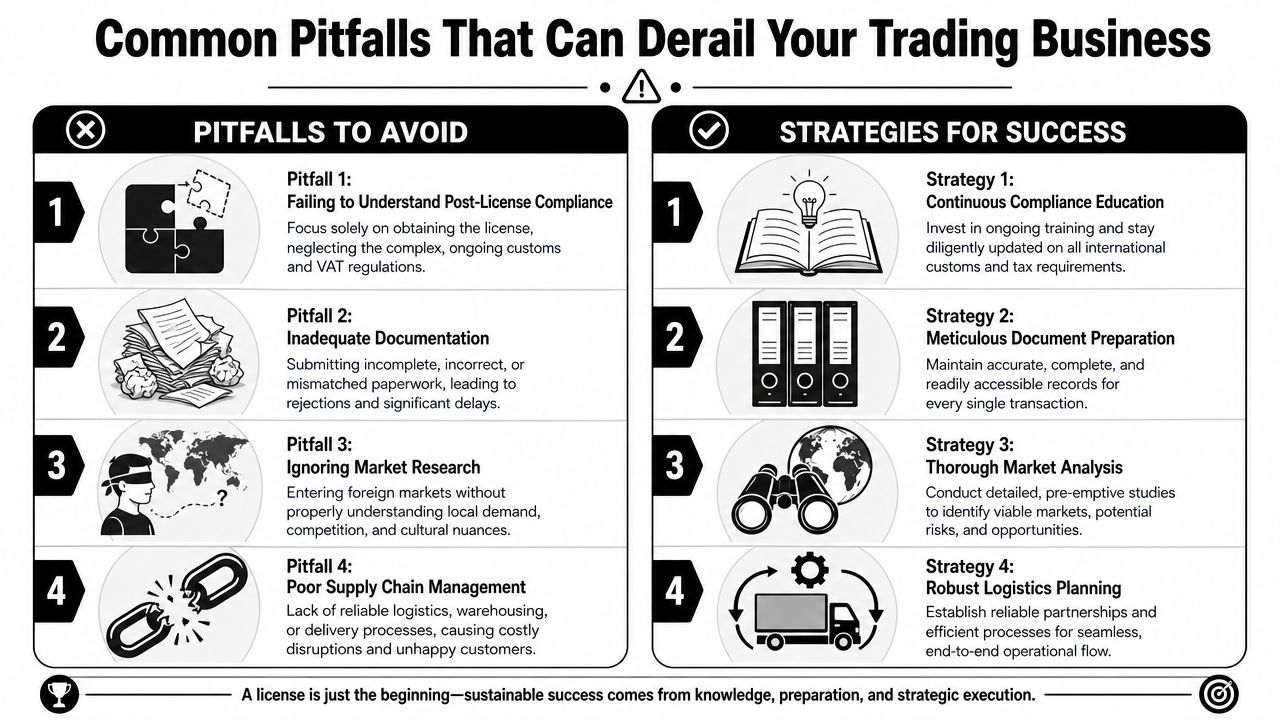
Four mistakes that come up repeatedly
- Treating the trade licence as the whole job: the licence alone doesn't complete customs readiness.
- Using mismatched business activities: if the licence wording and the goods being traded don't line up, the file becomes harder to defend.
- Ignoring office requirements: customs processes rely on proper lease documentation, so a weak office setup can hold up a valid business plan.
- Leaving compliance until the first shipment: by then, every correction feels urgent and expensive.
What strong operators do differently
The businesses that move smoothly tend to follow a stricter discipline:
| Pitfall | Better approach |
|---|---|
| Licence-only thinking | Build the company and customs path together |
| Loose product descriptions | Prepare a precise product list before filing and shipping |
| Last-minute documentation | Verify corporate, customs, and shipment documents in advance |
| Reactive VAT handling | Review tax obligations as the business grows, not after a problem appears |
The issue isn't complexity alone
A lot of founders assume delay means the authorities are difficult. Often, the underlying issue is fragmented preparation.
One document says one thing, another says something slightly different, and the shipment paperwork introduces a third version. Customs teams don't resolve those inconsistencies for you. They stop the process until you fix them.
The safest trading business isn't the one with the cheapest setup. It's the one built on documents that agree with each other from the start.
Where entrepreneurs should be careful
If you're entering the UAE market for the first time, be especially careful about three areas:
- Activity selection on the licence
- Customs readiness before cargo movement
- Shipment documents prepared at item level, not in generic terms
That's the practical difference between a business that is merely incorporated and a business that is ready to trade.
If you want a faster, cleaner route through company formation, customs readiness, and ongoing VAT-compliant support, Smart Classic Business Hub helps entrepreneurs and companies set up and operate in the UAE with hands-on guidance across mainland and free zone registration, PRO services, accounting, audit, and broader compliance needs.