
You're probably at the point where the idea is solid, the market looks promising, and Dubai keeps coming up in every serious conversation about where to launch. Then you start reading setup guides and the process suddenly feels crowded with unfamiliar terms, jurisdiction choices, and paperwork that seems to multiply every time you open another tab.
The fastest way through it is to treat how to register business in Dubai as a sequence of decisions, not a pile of forms. The right structure, licence, and jurisdiction shape everything that follows, from who you can trade with to what you'll need for banking and compliance later. A focused resource on search for software investors in UAE can also be useful if you're building a venture-backed company and want to line up the commercial side before you commit to a setup route.
Your Blueprint for a Dubai Business Launch
A founder with a sharp software idea can move from excitement to confusion very quickly in Dubai. One day you're comparing mainland and free zone options, the next you're staring at trade names, MOAs, and licence categories that seem designed for insiders. The answer isn't to memorise every term, it's to make the first few decisions in the right order.
The business idea matters, but it doesn't sit above the legal structure. In Dubai, the path starts with where you'll operate, what activity the licence will cover, and whether your ownership model fits the jurisdiction. That's why a good launch plan is less about filing and more about matching the company's legal shape to the way you expect to trade.
Practical rule: if a setup adviser can't explain the jurisdiction, licence activity, and banking implications in plain language, the file probably isn't ready yet.
A new founder often thinks the registration step is the finish line. In practice, it's the point where the business begins to take legal form, and that form will affect everything that comes after. If you choose well at the start, you reduce rework, avoid unnecessary approvals, and make the later banking stage much easier to manage.
Mainland Free Zone or Offshore The First Critical Choice
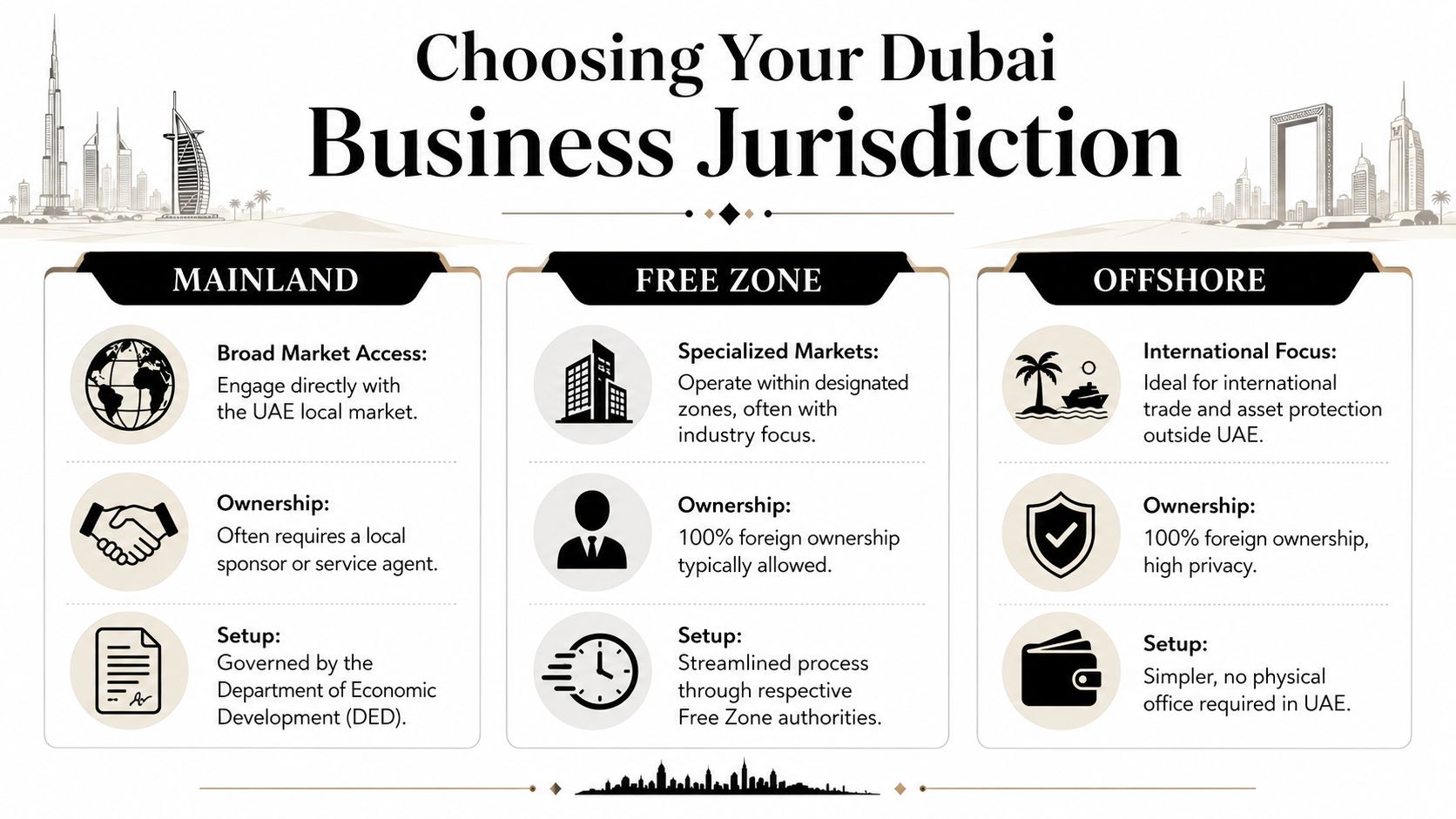
Dubai's setup decisions begin with jurisdiction, and this choice shapes your market access, ownership, and operating model. The official starting-business guidance asks applicants to choose a licence, choose a legal form, check foreign-ownership eligibility, and check whether extra approvals are needed, which tells you a lot about how the system really works, the jurisdiction drives the pathway as much as the idea does Dubai's starting a business guidance.
Mainland fits direct UAE trading
Mainland is the route for businesses that need broad access to the local market. The UAE government's mainland process also ties the licence to activity, location, approvals, and fee payment, so mainland is not just “open a company and start selling,” it's a regulated operating framework UAE mainland business steps.
The ownership picture has changed sharply. Most activities allow 100% foreign ownership on the mainland, so a local Emirati partner is no longer the default requirement in most sectors Dubai starting a business. That's a major reason many foreign founders now take mainland more seriously than they did a few years ago.
Free zones suit controlled environments
Free zones still appeal to founders who want a more contained setup with an authority that understands their sector. They're often used by international service businesses, import-export models, and companies that want a clear administrative framework with a dedicated zone authority.
That said, the practical benefit isn't just ownership. You also need to ask what substance the business will need later, because free-zone advantages depend on actual operations, not just the licence on paper. For founders comparing routes, the most useful internal explainer is this mainland versus free zone overview, because the key difference is often commercial, not just administrative.
Offshore serves a different purpose
Offshore is usually the wrong fit if you want a visible local operating base in Dubai. It's better viewed as a structure for international trade or asset holding, not a general-purpose retail or service platform inside the UAE.
A simple way to decide is to work backwards from the customer. If the company needs direct UAE market access, mainland usually makes more sense. If the operation is designed around a zone-based framework or international activity, free zone or offshore may fit better, but only if the banking and operational model support that choice.
Navigating Licences Legal Structures and Paperwork
Once the jurisdiction is clear, the next decision is the business activity itself. That matters because the licence is tied to the approved activity, and a mismatch here is one of the easiest ways to create delay. The government doesn't treat a trade licence as a generic permission slip, it links the company to a defined commercial purpose.
The legal form comes right behind that. An LLC, a sole establishment, or a civil company each carries different ownership and liability consequences, so the right choice depends on who owns the business and how exposure should be handled. A founder setting up a service firm will not always need the same structure as someone building a shareholder-backed operating company.
Practical rule: the legal form should follow the ownership and risk profile, not the other way around.
Get the file ready before you submit
For a free zone setup, authorities typically require a coloured passport scan, address proof under 3 months old, a photo, a short CV, and a 1-page business plan Foundster formation process guide. The biggest mistakes are usually simple, a mismatched activity code or an incomplete identity pack, and those issues can stretch the process because someone has to send the file back for correction.
For mainland work, the paperwork often becomes more layered. If the ownership structure involves multiple shareholders or a corporate shareholder, legalisation can become a real time sink because attestation, apostille, and MOFA steps may be required before the file is acceptable. That's why a document matrix by jurisdiction is more useful than a generic checklist.
If you're comparing what a licence covers and what it doesn't, this business licence overview is a practical companion. It helps to separate the activity you want from the permissions the licence grants.
One more point matters here. Contracts and shareholder documents should be clean before filing, because bad drafting creates downstream disputes that are far more expensive than getting the agreement right up front. For a useful drafting perspective, preventing business lawsuits is worth reading alongside the setup file, especially if multiple parties are involved.
The Step-by-Step Registration Process Unpacked
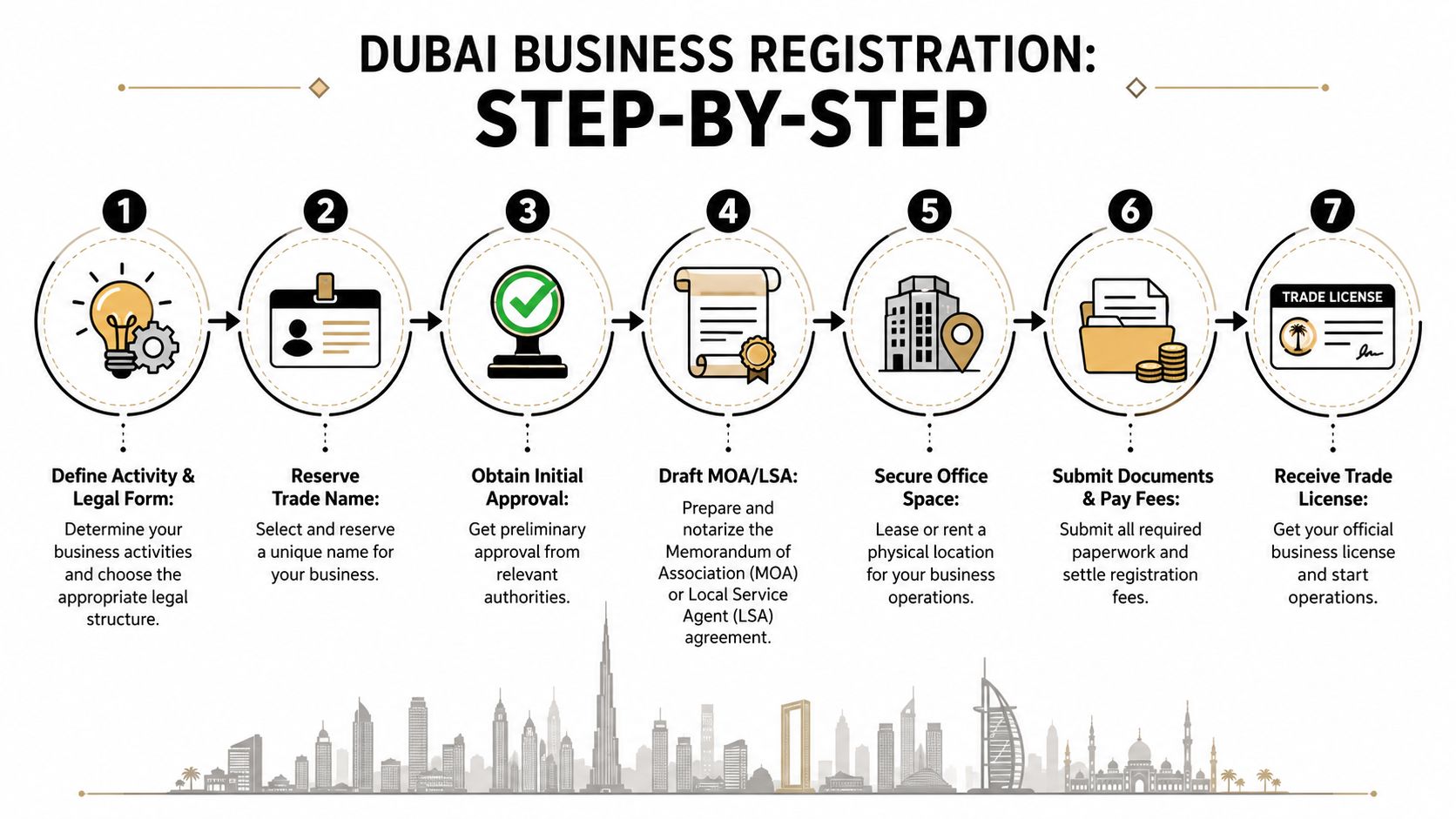
Dubai's digital systems have made the front end of registration faster, but the process still has a clear sequence. The UAE's Basher platform can establish mainland businesses in 15 minutes for the initial administrative stage, yet the full workflow still includes location selection, extra approvals for some activities, and fee payment before the commercial licence is issued UAE mainland business steps. That distinction matters because many founders confuse administrative speed with operational readiness.
The sequence that actually works
Start with the activity and legal form. If these two are wrong, everything after them slows down.
Then move to the trade name. It has to be unique and compliant, so don't assume a brand name that works in another country will pass in Dubai without adjustment.
Initial approval comes next. That stage signals that the authorities have no objection to the proposed business, but it isn't the licence yet. It means the file can proceed.
After that, mainland structures may require MOA drafting, and in some cases notarisation or physical shareholder attendance. Free zone companies usually follow a lighter route, but they still require KYC, verification, and final licence issuance.
Don't ignore the practical bottlenecks
The official path and the practical path aren't the same thing. Mainland setups often need a secured location before the licence is fully issued, while some activities require extra clearance from external authorities. If your activity is regulated, that approval can become the longest part of the process.
A lot of founders also underestimate how much time is spent just correcting paperwork. A clean submission is faster than an optimistic one, and a complete file beats a rushed file every time. That's why preparation before filing usually saves more time than chasing speed after filing.
Beyond the License Visas Banking and Tax Essentials
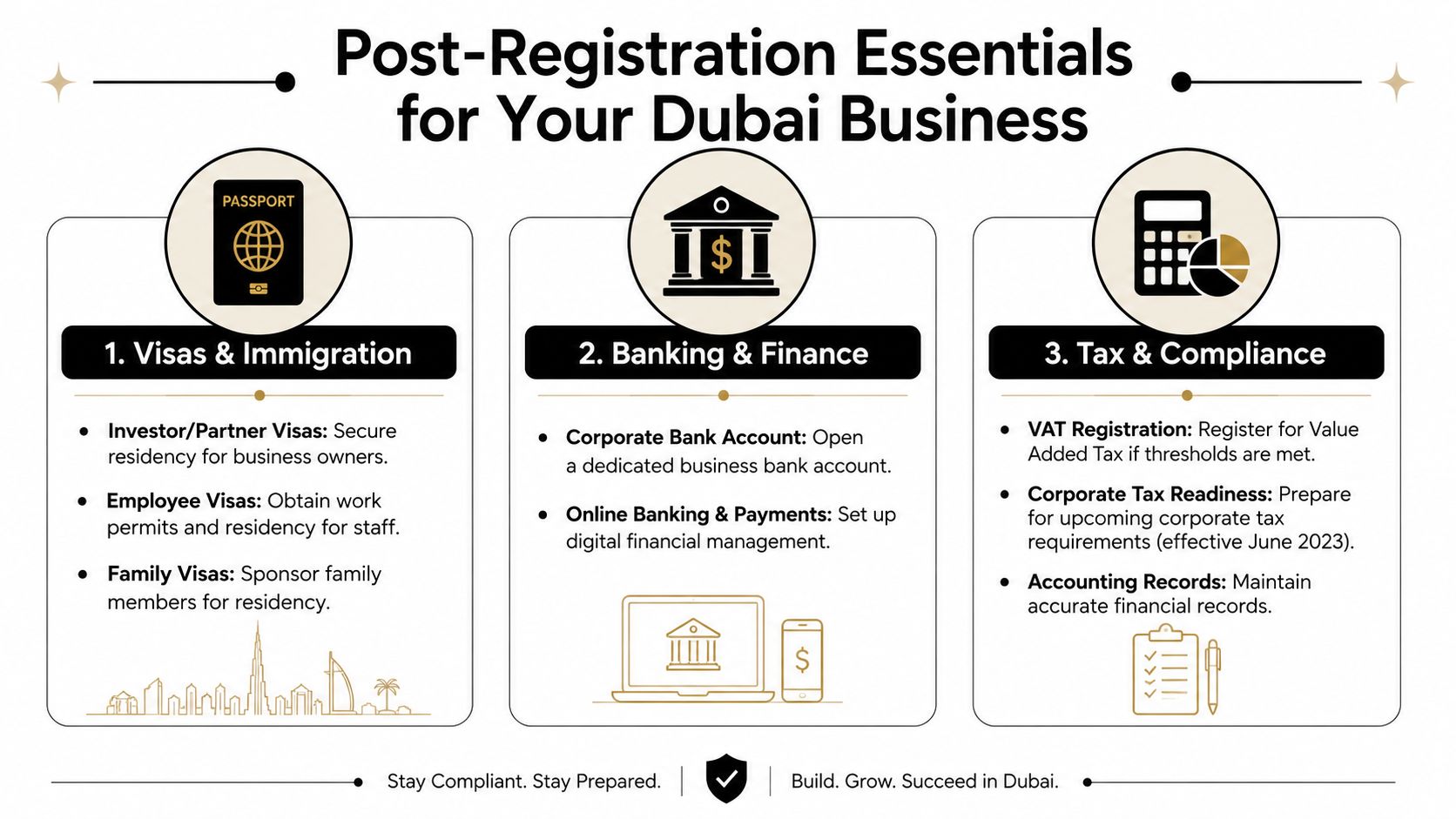
A trade licence is important, but it doesn't make the business operational on its own. The next layer is visas, banking, and tax readiness, and that's where many first-time founders lose momentum. A company can be officially registered and still not function smoothly if the bank account is delayed or the ownership structure doesn't support the intended tax position.
Visas and immigration need planning
If you're the owner, the visa route should be aligned with the company structure from the start. Employee visas, family visas, and partner visas all depend on the company being able to sponsor under the right conditions, so visa planning should happen alongside the licence rather than after it. That's where PRO support becomes useful, because immigration and labour steps rarely happen in isolation.
Banking can slow the launch
The bank account is often the surprise delay. Recent UAE-focused guidance notes that opening a corporate bank account can add 4 to 8 weeks to the launch timeline after the licence is issued Centuro Global on Dubai company setup. In practical terms, that means a company can be registered and still not be fully ready to invoice, collect, or pay smoothly.
That's also why payment planning matters. If your business will handle international transactions, a resource on reduce international payment fees can help you think through processing costs before the first invoice goes out.
Tax and substance affect real operations
Free-zone tax treatment isn't automatic just because the company sits in a free zone. The same guidance notes that tax advantages depend on substantive economic presence and qualifying income rules Centuro Global on Dubai company setup. That means the operational reality matters, office presence, staff, records, and the way the business earns money.
If your activity creates VAT exposure, the compliance file should be handled early rather than after cash flow starts moving. A useful companion is this VAT registration guide, because banking, invoicing, and tax setup tend to interact more than founders expect.
Staying Compliant and When to Seek Expert Help
Ongoing work starts after incorporation. Trade licence renewal, lease renewals, visa renewals, and ongoing records all sit behind the glamour of the launch stage. If the company has a legal structure that triggers economic substance reporting, that filing also has to be kept current.
The most common mistakes are predictable. Founders pick the wrong activity, underestimate the banking timeline, or assume every jurisdiction works the same way. Those errors don't just slow things down, they can force extra approvals, re-documentation, and re-submission.
A competent setup consultancy adds value precisely where the process gets messy. Smart Classic Business Hub handles company formation across mainland, free zone, and offshore structures, along with PRO work, VAT-compliant accounting, tax residency support, audit, and liquidation. That kind of support matters because setup decisions and compliance decisions are connected from day one.
The cheapest file is rarely the cheapest launch if it has to be rebuilt three times.
For a founder, the goal is not just to get a licence issued. It's to have a company that can bank, invoice, hire, and stay compliant without constant firefighting. That's why strategic help is usually a cost control measure, not a luxury.
If you're ready to move from research to action, speak with Smart Classic Business Hub and get a setup plan that matches your activity, jurisdiction, and banking needs before you file anything.