
You're ready to submit a visa file, open a company, onboard a key employee, or complete an overseas immigration pack. Then one line stops everything: Police Clearance Certificate required.
In Dubai, that request is common. It shows up in employment files, business setup paperwork, licensing steps, and cross-border immigration applications. What catches people out isn't the idea of the certificate. It's the overlap. You may need a UAE Good Conduct Certificate and a separate certificate from your home country, both with different rules, different acceptance standards, and different expiry expectations.
That's where applicants often lose time. They apply for the wrong certificate, use the wrong issuing authority, or wait too long to deal with attestation and translation. Remote workers face this too. If you're checking wider mobility requirements, this overview of Expat Global Medical for global remote workers is useful because police clearance often sits alongside insurance, residency, and document compliance.
I see the same pattern repeatedly. The question isn't only How can I get police clearance. Instead, the question is which certificate you need, who must issue it, how recent it must be, and what you can do if one authority delays or refuses to issue it. If your case involves an emirate-specific route, practical guidance on the Sharjah police clearance certificate process can also help you avoid selecting the wrong service path.
Navigating the Police Clearance Requirement in the UAE
A police clearance certificate is a background check document. In the UAE, many people know it as a Good Conduct Certificate. It confirms whether the issuing authority has a criminal record against the applicant in its system for the relevant period or jurisdiction.
For founders and visa applicants, the problem usually starts with assumptions. Someone hears “get police clearance” and assumes any certificate will do. It won't. The authority asking for it may want a UAE-issued certificate, a home-country certificate, or both. Some want a federal route. Others accept a local police authority issue. Some insist on legalisation or sworn translation.
Where people usually get stuck
The friction points are usually practical, not legal theory:
- Wrong issuing body. A person applies through one police channel when the receiving authority expects another.
- Name mismatch. Passport name, Emirates ID name, and old residence records don't line up exactly.
- Timing mistakes. Applicants secure the certificate too early, then discover it has aged out for the actual submission stage.
- Cross-border overlap. UAE and home-country applications run on different tracks and finish at different times.
Practical rule: Ask the receiving authority one direct question before you apply: “Do you require a UAE police clearance, a home-country police clearance, or both, and do you need attestation or translation?”
That one check saves more time than is often realised.
What actually works
The efficient approach is to treat police clearance as a document chain, not a single form. Identify the end use first. Then work backwards through issuing authority, supporting ID documents, authentication, translation, and expiry window. If you're handling business setup or a visa filing, this should be done early, not after the rest of the file is ready.
Getting Your Police Clearance Certificate Within the UAE
If your visa file, licence application, or overseas submission is ready except for the UAE police clearance, speed matters. The local process is usually straightforward for current residents, but delays still happen when applicants choose the wrong channel, submit a name that does not match their identity records, or realise too late that they also need fingerprints for a separate home-country application.
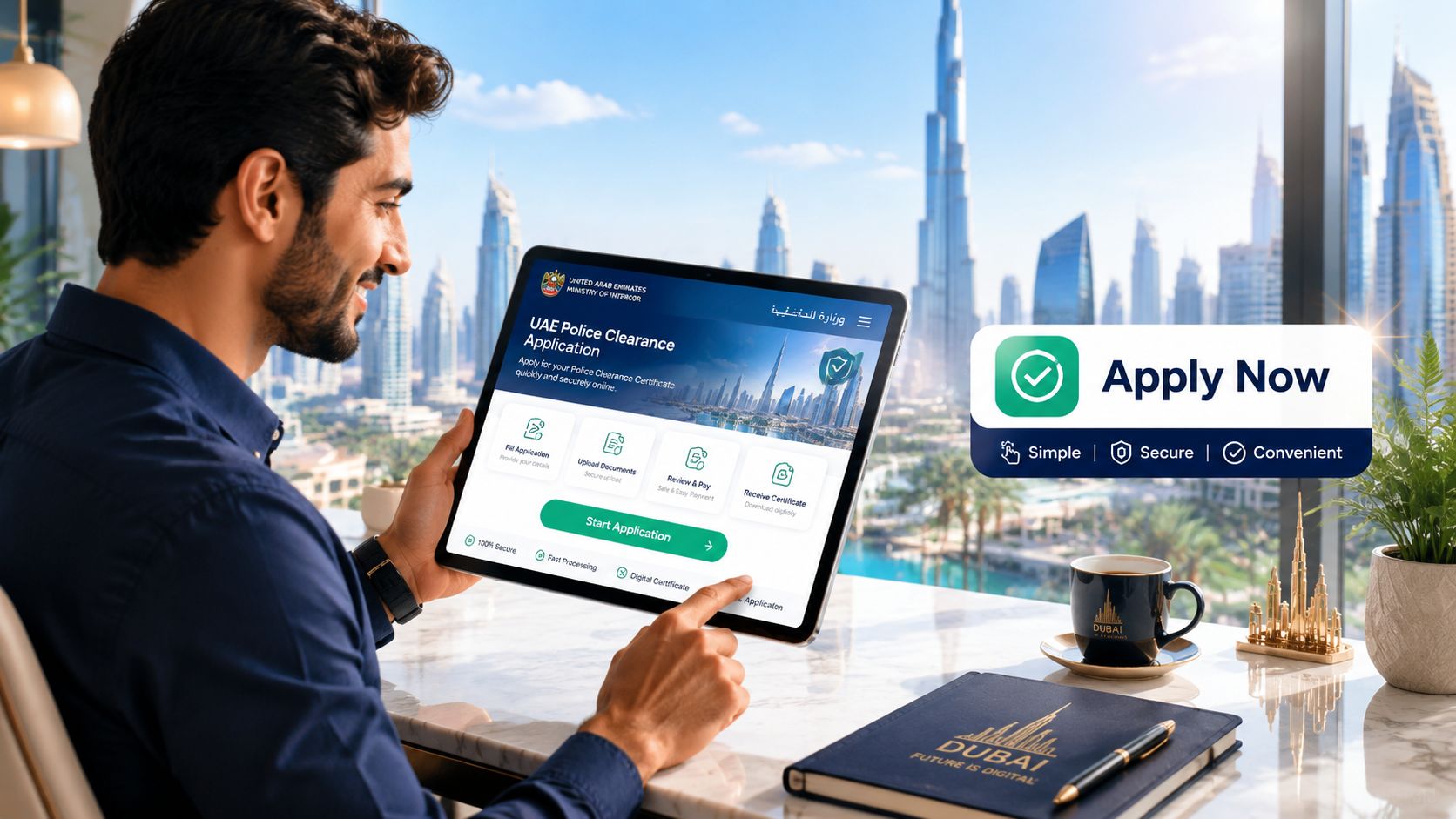
For residents and former residents, the UAE process is now largely digital. In many standard cases, the certificate can be issued quickly if your identity records match and no extra review is triggered.
The two practical routes
The route matters because the receiving authority may care about the issuing channel, especially if your file is tied to a specific emirate or federal record.
Dubai Police channel
This is often the right option when your records are linked to Dubai and the end user accepts a Dubai-issued certificate.MOI or ICP federal channel
This route can be more suitable if you want a central government path or your identity verification sits better within the federal system.
If your case is tied to Dubai, this guide to the Dubai police clearance certificate process gives a useful breakdown of the local route.
What to prepare before you apply
Get the file ready before you open the portal. That saves more time than rushing into the application and fixing errors after payment.
In a standard UAE application, you will usually need:
- Passport details. The application name should match your passport exactly.
- Emirates ID details. Current residents should use the active record connected to their status.
- Valid contact details. Use your own email and mobile number so you can receive OTPs and follow-up requests.
- Old UAE record details if you are a former resident. Some former residents need extra identity checks if their Emirates ID has expired or older records are incomplete.
Name consistency causes more trouble than the application form itself.
A shortened middle name on one record, a full surname on another, or a passport renewed after your UAE residence ended can all trigger manual review. If your documents do not line up, prepare a supporting explanation and any old ID copies before you submit.
If your passport, Emirates ID, visa record, or older UAE documents show different versions of your name, deal with that issue at the start. It is one of the most common reasons a simple application turns into a follow-up case.
How to get the certificate without rework
Use the channel that matches the end use. Complete the form exactly as your main identity document shows it. Upload clear scans, pay through the official portal, and watch for any request for additional verification.
The avoidable mistakes are predictable. Applicants choose a service option because the title looks close enough, rely on outdated identity documents, or enter a shared email address that they cannot access later. Former residents also run into trouble when they assume an old UAE file will auto-populate cleanly. Sometimes it does. Sometimes it needs manual checking.
There is also a practical overlap many applicants miss. If you need a UAE police clearance and a separate certificate from your home country, run both tracks with the same identity format from day one. Use the same passport spelling, the same date format where possible, and the same supporting records. That reduces the risk of ending up with two certificates that refer to you slightly differently.
If your home-country application requires fingerprint cards, arrange that in parallel rather than waiting for the UAE certificate to be issued first. This overview of Business Mail Boutique fingerprint services is a useful reference for applicants dealing with fingerprint-based overseas clearances.
Securing a Certificate from Your Home Country
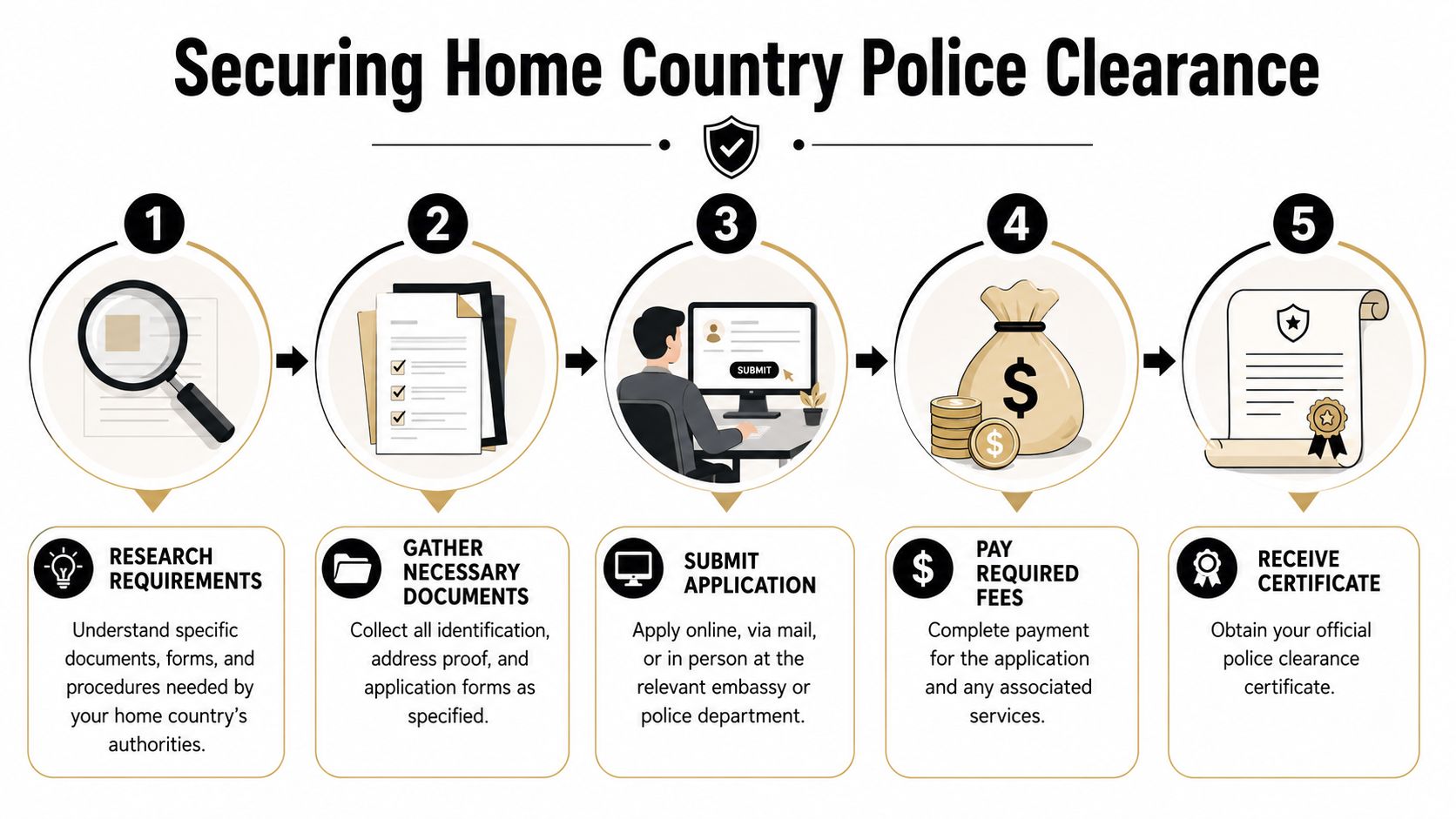
The UAE certificate is only part of the puzzle for many expats. A licensing body, immigration authority, employer, or free zone may also ask for a police clearance from your country of nationality or from another country where you previously lived.
That second certificate is usually more complicated. The difficulty isn't just the application. It's the fact that every country handles background checks differently. Some allow online filing. Some require fingerprints. Some process through a police authority, others through a justice ministry or central records office. Some issue a document that's usable straight away. Others require apostille or embassy legalisation before the UAE authority will accept it.
Route one through your embassy or consulate
This is often the cleanest route when your country supports overseas applications.
You contact your embassy or consulate in the UAE and confirm:
- Whether they process police clearance requests directly
- Whether fingerprints are required
- Which ID documents they accept
- Whether they issue the certificate or only forward your application home
This route works well when the embassy has a defined process and your case is straightforward. It's less efficient when the mission only acts as a verifier and processing still happens back home.
Route two through an agent or family member in your home country
This route is common when the home-country authority allows a representative to file on your behalf. In practice, it often requires a signed authorisation, copies of identification documents, and sometimes fingerprint cards or notarised papers.
This can be faster in the right country, but it carries more execution risk. Documents go missing. Representatives submit incomplete files. A local office may reject an application if the authorisation wording is too narrow or if a copy isn't certified as required.
The part many applicants leave too late
Getting the certificate issued doesn't always make it usable in the UAE. You may still need one or more of the following:
| Requirement | Why it matters |
|---|---|
| Apostille | Needed in jurisdictions that use Hague-style document recognition for overseas use |
| Legal attestation | Often required when apostille doesn't apply or when the receiving authority requests a full legalisation chain |
| Arabic translation | Some UAE authorities want a formal Arabic translation for a foreign-language certificate |
Don't assume the issuing country's “official” certificate is automatically valid in the UAE. Validity for issue and validity for use are not the same thing.
The best working method is parallel tracking. Start the home-country request as soon as you know it may be needed, even if your UAE police clearance will likely finish first. Most submission failures happen because one document is ready and the other is still somewhere in the legalisation chain.
Key Details Fees Timelines and Validity
A common real-world problem looks like this: the UAE certificate is issued quickly, but the overseas file is still waiting on fingerprints, legalisation, or translation. By the time everything is ready to submit, one certificate is already close to expiry. That is why fees, processing time, and validity need to be planned together, not checked one by one.
For UAE applications, use the official digital route linked to your identity record. The usual path is the MOI or ICP channel, followed by payment and any extra verification the system asks for. If you are comparing terminology before you apply, this guide to a UAE good conduct certificate process helps clarify the label many applicants, employers, and advisers use for the same type of document.
The figures you can treat as a baseline
Some applicants make planning decisions based on forum comments or old screenshots. Use current authority guidance at the point of application, and treat older published figures as a starting point only.
| Item | Baseline detail |
|---|---|
| Dubai Police individual fee in the UAE | Starts from AED 100 for individuals in the UAE |
| Typical Dubai Police completion time | About 1 working day if the file does not need extra verification |
Those numbers are useful for budgeting and sequencing. They are not a promise. Fees can vary by channel, applicant status, and whether extra service steps apply.
How to plan the timeline properly
The application stage is often the shortest part of the process. The delay usually sits around the certificate, not inside it. For a UAE-issued certificate, that can mean an identity mismatch or a manual review. For a home-country certificate, the longer hold-up is often outside the police authority itself, such as fingerprint capture, document certification, courier transit, apostille, attestation, or translation.
Ask a better question at the start. Do not ask only how fast the certificate can be issued. Ask which final authority will review it, what form they accept, and how long the full document chain takes.
I tell clients to map the last approval point first. If the end user is a foreign immigration authority, a UAE free zone, or an embassy, their acceptance rules matter more than the issue date alone.
Validity is where many files fail
A police clearance can be genuine, correctly issued, and still unusable because it is too old for the receiving authority. This is one of the most expensive timing mistakes in visa and company setup work because the document itself may be fine, but the submission window has closed.
There is no single validity rule that works across all cases. Some authorities focus on the issue date. Others care about the date of final submission, interview, or visa filing. A certificate that works for one country or one UAE process may be rejected in another.
The practical fix is timing discipline. Order the certificate late enough to stay valid, but early enough to absorb delays if the file needs legalisation, translation, or correction. In cross-border cases, that balance matters more than speed alone.
Troubleshooting Common Police Clearance Issues
The biggest myth in this area is that once you apply, the rest is administrative routine. It isn't. Police clearance problems are usually document problems in disguise.
A rejection often has nothing to do with criminal history. It can come from inconsistent identity data, wrong service selection, unclear scans, or an authority mismatch. That's why blindly resubmitting the same file rarely helps.
When the application stalls or gets rejected
Start by checking the basics in the exact order below:
- Name consistency. Compare passport, residence record, Emirates ID, old visas, and any home-country ID.
- Jurisdiction fit. Confirm you requested the certificate from the authority the end user accepts.
- Purpose mismatch. Some forms ask why the certificate is needed. If that field is wrong, it can create unnecessary follow-up.
- Document quality. Low-resolution uploads still cause avoidable delays.
If your file has changed over time because of marriage, transliteration differences, or passport renewal, attach supporting records early rather than waiting for a rejection notice.
When the certificate is unavailable
However, many guides do not address potential complications. In real cases, a certificate may be delayed, impossible to issue, or marked unavailable by the country involved. U.S. immigration guidance notes that when a police clearance certificate can't be obtained, applicants may need a notarised affidavit explaining why it was impossible to get, and that certificates often need to be less than two years old at the time of interview, according to Boundless guidance on obtaining a police clearance certificate.
That doesn't mean every UAE authority will accept the same fallback. It means you need to shift from application mode to evidence mode.
What to prepare when things go wrong
Use a contingency file. It should include:
- Proof of attempt. Submission receipts, embassy emails, courier tracking, or rejection messages.
- Identity support. Clear copies showing you are the same person across all records.
- Explanatory statement. A factual timeline of what you requested, when, and what response you received.
- Affidavit if required. Only if the receiving authority accepts that format.
If an authority says a certificate is unavailable, ask what substitute evidence they will accept before you spend time legalising the wrong fallback document.
The practical lesson is simple. A delayed certificate isn't always the primary issue. The key issue is whether you can show that you took the correct steps and whether the receiving authority has a documented alternative.
Simplify Your Application with Professional PRO Services
Police clearance looks simple from the outside because the first step is often an online form. The complexity sits behind that form. You may be juggling a UAE certificate, a home-country certificate, fingerprints, translations, legalisation, and a deadline tied to a visa or licence submission that won't move for your convenience.
That's why business owners usually benefit from treating this as an execution task, not a research task. You don't need more generic advice once the file is live. You need someone to verify document fit, sequence the applications properly, and catch problems before they become rejections.
Where professional support helps most
A practical PRO team is useful in four moments:
| Situation | What support usually solves |
|---|---|
| Tight filing deadlines | Faster coordination across document collection, submission, and follow-up |
| Multiple jurisdictions | Better sequencing between UAE and overseas requirements |
| Identity inconsistencies | Early document review before submission |
| Attestation and translation chains | Less confusion over what must be legalised and in what order |
For example, Smart Classic Business Hub handles document guidance, application support, and related PRO coordination for UAE business and visa processes. That matters when the police clearance certificate is only one part of a wider file and timing across all documents has to line up.

What works better than doing it ad hoc
The strongest approach is to organise the job around the receiving authority, not around whichever certificate seems easiest to obtain first. That means confirming document acceptance, checking whether the certificate needs translation or legalisation, and making sure timing works for the actual submission date.
If you're an entrepreneur, investor, or employee moving through setup and immigration steps at the same time, the value of PRO support is less about convenience and more about risk control. It prevents duplicate applications, mismatched records, and late surprises.
Good PRO support doesn't replace the issuing authority. It reduces avoidable mistakes before your documents reach that authority.
If you need help coordinating a UAE police clearance, a home-country certificate, or the wider document chain for company formation or visa processing, Smart Classic Business Hub can assist with the practical steps, document review, and PRO follow-up so your file moves in the right order.