
You've found a Dubai unit, spoken to the landlord, and started calculating the fit-out. The numbers look manageable until someone asks the questions your spreadsheet avoids. Which licence activity covers the actual operation? Will the premises support the required approvals? What happens to cash flow if opening is delayed, rent rises, or customer demand lands below your assumption?
That's where feasibility study services earn their place. A proper UAE feasibility study isn't a polished pitch deck. It's a decision-control document that tests demand, approvals, operating costs, funding needs, break-even exposure, and downside risk before you commit to licensing, fit-out, staffing, or debt.
For Dubai SMEs, this distinction matters. The UAE market-focused analysis of feasibility planning reports average cost overruns of 27% for projects launched without structured feasibility analysis, compared with 9% for projects supported by a detailed study. That gap can decide whether a mainland, free zone, or offshore launch remains financeable.
The Dubai Founder Who Almost Opened a Second Branch on Guesswork
A café operator we'll call Omar had a profitable neighbourhood location and a clear plan for growth. He found a second unit in JLT, negotiated the lease, and committed AED 380,000 to fit-out, believing the branch would reach break-even by month 14.
Halfway through construction, the assumptions began to unravel. The proposed trade licence activity didn't match the full operating model. Kitchen extraction required additional work, and the liquor-free footprint changed the revenue mix Omar had used in his forecast. Supplier margins were also thinner than expected, while projected footfall depended heavily on peak periods rather than repeat local demand.
The revised model moved break-even from month 14 to month 26. The business might still have worked, but not with the same cash buffer, staffing plan, or repayment assumptions. By then, the cheque had cleared and the fit-out was already underway.
Practical rule: If a licence, premises approval, or demand assumption can change your break-even date, test it before signing the lease.
Dubai founders regularly juggle mainland licensing costs, free zone visa structures, landlord deposits, fit-out obligations, and premium locations that carry very different occupancy economics. A founder may understand the brand and the product perfectly, yet still underestimate the effect of approval delays, staffing requirements, delivery commissions, or low weekday utilisation.
A feasibility study would have forced Omar's team to verify the permitted activity, map the approval route, test supplier assumptions, and model footfall sensitivity before committing capital. That's the role of feasibility study services. They turn enthusiasm into a documented go, conditional go, or no-go decision while the founder can still change the plan.
The UAE-focused guidance on project feasibility studies describes the typical study as a 3- to 5-year analytical model covering demand, operations, capital requirements, break-even sensitivity, and risk. That horizon is long enough to expose the difference between an attractive opening month and a sustainable business.
What a Feasibility Study Actually Is in the UAE Context
A feasibility study is an evidence-based assessment of whether a proposed venture can work commercially, operationally, financially, and legally before major capital is committed. It doesn't promise success. It identifies the conditions under which the project could succeed, the risks that could prevent it, and the changes needed before launch.
That makes it different from a business plan. A business plan explains how you intend to operate and grow. A pitch deck presents the opportunity persuasively to investors. A feasibility study challenges both documents by asking whether the assumptions are defensible.
The document behind the decision
A UAE feasibility study usually brings together:
- Demand evidence, including the target customer, catchment, competitors, pricing, and purchasing behaviour.
- Operational requirements, including location, capacity, staffing, suppliers, equipment, and workflow.
- Financial modelling, including revenue assumptions, operating expenses, capital needs, cash flow, and break-even.
- Regulatory mapping, including the proposed jurisdiction, activity, approvals, and compliance dependencies.
- Risk analysis, including downside scenarios and specific mitigations.
For industrial, healthcare, and education projects, the study can become a practical gatekeeping document because approval authorities need to see that the proposed activity is viable and aligned with the relevant regulatory strategy. The UAE project guidance cited above specifically identifies this relevance for regulated sectors.
The authority may be reviewing whether the activity is commercially and operationally credible. The lender is reviewing whether the business can generate enough cash to support repayment. The landlord is concerned about the tenant's ability to sustain the lease. The founder needs to know whether the project deserves more capital.
Why narrative-only plans fail
A narrative business plan can say that demand is strong, the location is ideal, and the management team is experienced. A lender-grade feasibility study must show how those claims affect the model.
If a clinic depends on a particular staffing structure, the staffing cost must appear in the forecast. If a restaurant depends on delivery orders, delivery commissions and order volume must be tested. If a school depends on regulatory approvals and enrolment, the timing and ramp-up assumptions must be visible.
Banks may also request supporting analysis for larger SME lending applications. Don't assume a generic plan will satisfy a relationship manager. Ask the bank for its preferred format early, then build the feasibility model around the information its credit team will challenge.
The Six Modules Every UAE Feasibility Study Needs
A credible study should answer six practical questions. These aren't decorative chapters. They're the areas a lender, landlord, licensing officer, or experienced operator will test first.
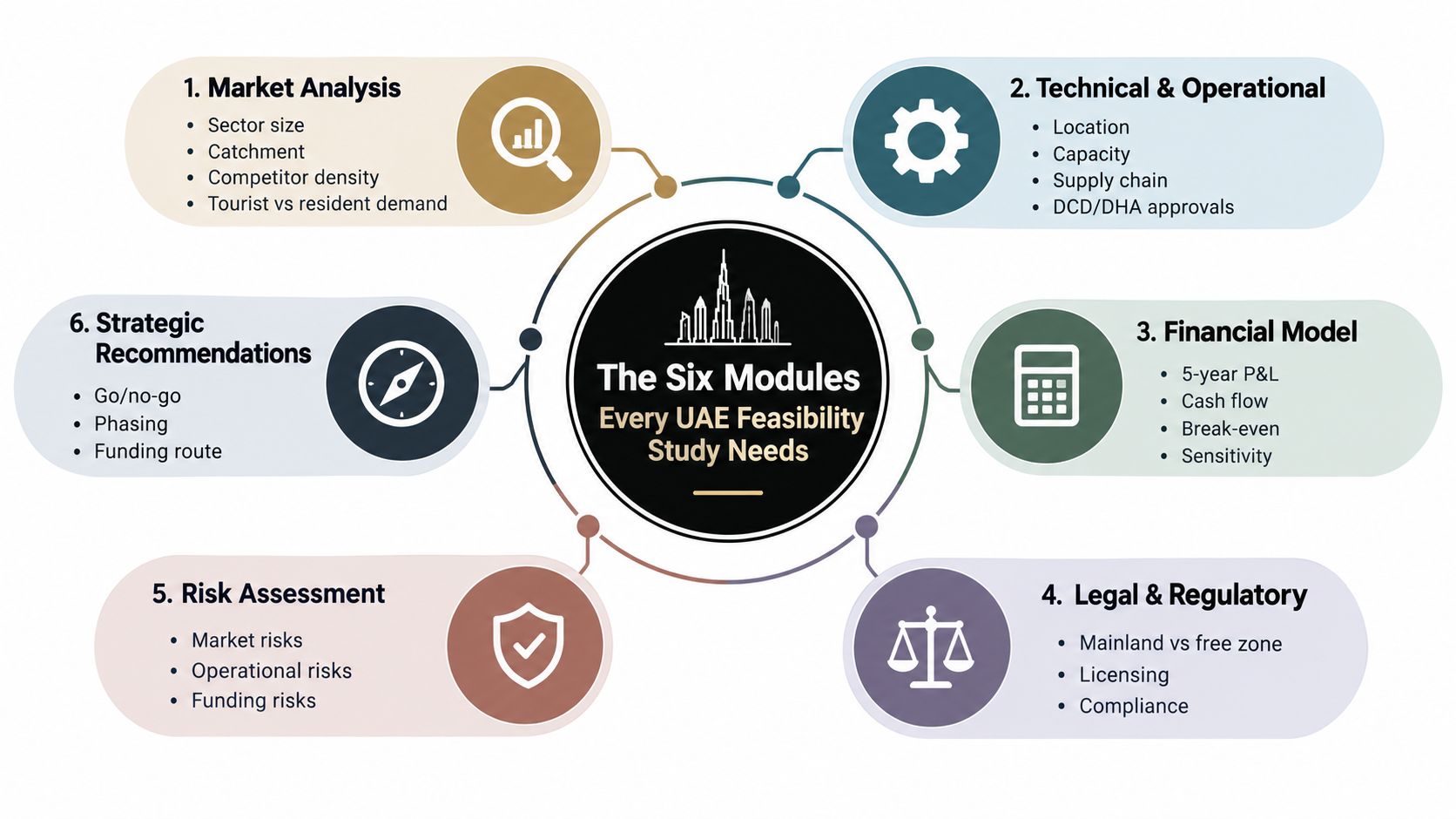
1. Market analysis
Who will buy, where are they, and why will they choose this venture?
A Dubai market analysis should go beyond a broad sector summary. It should examine the catchment, competitor density, customer segments, pricing, access, parking, tourist and resident demand, and the difference between stated interest and actual purchasing behaviour.
For a café, that might mean site visits at different trading periods, competitor menu reviews, delivery platform observations, and interviews with potential customers. For a business-to-business service, it could mean testing buyer budgets, procurement cycles, and existing supplier relationships.
2. Operational plan
The operational section asks whether the proposed structure can legally and practically deliver the service.
It should address the mainland versus free zone decision, licence activity, visa allocation, premises requirements, supplier dependencies, equipment, staffing, technology, and approval sequencing. A low-cost registration route isn't useful if the selected jurisdiction restricts the activity or makes the operating model impractical.
3. Financial projections
The model should connect assumptions to profit and loss, cash flow, balance sheet movements, and funding requirements. UAE studies commonly use a multi-year model, with the cited local guidance describing a 3- to 5-year analytical period.
Revenue must be built from operating drivers, not a top-line guess. A clinic might use consultations, treatment mix, working days, and practitioner capacity. A warehouse might use storage capacity, utilisation, handling fees, and contract timing.
4. Capital requirement
The question is not, “How much does the fit-out cost?”
A useful capital schedule includes founder equity, debt, deposits, licensing, equipment, pre-opening expenses, working capital, professional fees, and a sensible cash buffer. The model should show when each amount is needed, because a project can be profitable on paper and still fail from a cash timing problem.
5. Break-even and sensitivity
A base case alone is not a decision tool. Test the assumptions that can move the result, such as rent, staffing, foreign exchange exposure, supplier pricing, opening delays, customer volume, and average transaction value.
The UAE feasibility study guidance from Velmont Crest identifies break-even and sensitivity analysis as core decision-grade modules because lenders and regulators challenge the assumptions behind the narrative.
6. Risk register
A risk register should name the risk, its likely effect, its owner, its trigger, and its mitigation. Include regulatory, market, operational, funding, supplier, staffing, and exit risks.
A risk register that says “competition is high” is weak. A useful register explains what level of demand, pricing pressure, or opening delay would require a change in the plan.
Pricing Models, Timelines and What Drives the Fee in Dubai
There isn't one correct price for feasibility study services in Dubai. The fee reflects the amount of evidence, modelling, regulatory interpretation, and revision required.
The local pricing guidance available for UAE studies describes a broad range, from approximately AED 10,000 to AED 18,000 for a single-market internal study, rising to AED 100,000 to AED 250,000 or more for work involving substantial research and complex sectors. The same source notes that delivery can take 4 weeks to 4 months, depending on complexity. See the UAE feasibility study pricing and scope guidance for the underlying range.
| Study Type | Price Range (AED) | Timeline | Typical Use |
|---|---|---|---|
| Single-market internal study | 10,000 to 18,000 | Several weeks | Early screening, internal go or no-go decision |
| Comprehensive regulated or capital-intensive study | 100,000 to 250,000+ | Up to 4 months | Healthcare, education, industrial, institutional, or complex financing cases |
What changes the quote
Primary research is usually the first cost driver. Interviews, surveys, site visits, competitor checks, customer testing, and field observations take more time than summarising published market information.
Regulatory complexity also matters. A straightforward professional service and a healthcare, education, food, or industrial project won't require the same approval mapping. The report should identify the relevant authority, activity, premises, staffing, and documentation dependencies.
Financial model depth changes the workload. A simple internal review may need a limited operating model. A bank-ready report may require linked profit and loss, cash flow, balance sheet, debt assumptions, sensitivity tables, and documented sources.
Language versions, management workshops, lender revisions, and supporting schedules can all affect the fee. So can the quality of the information you provide. If the consultant must rebuild supplier quotes, staffing assumptions, lease inputs, and capital schedules from incomplete records, the engagement takes longer.
Offshore registration doesn't automatically make the study cheaper. The jurisdiction may change the licensing analysis, but the analytical work still depends on the business model, sector, evidence requirements, and funding objective.
Clarify exclusions before signing. A standard feasibility scope may not include detailed MEP design, final architectural drawings, visa cost advice, legal drafting, tax opinions, or authority fees unless those items are expressly included.
Sector Examples That Shape the Scope of a Study
A generic template is rarely enough for a UAE launch. The sector determines which assumptions deserve primary research, which approvals can delay the project, and how aggressively the financial model needs to be stress-tested.
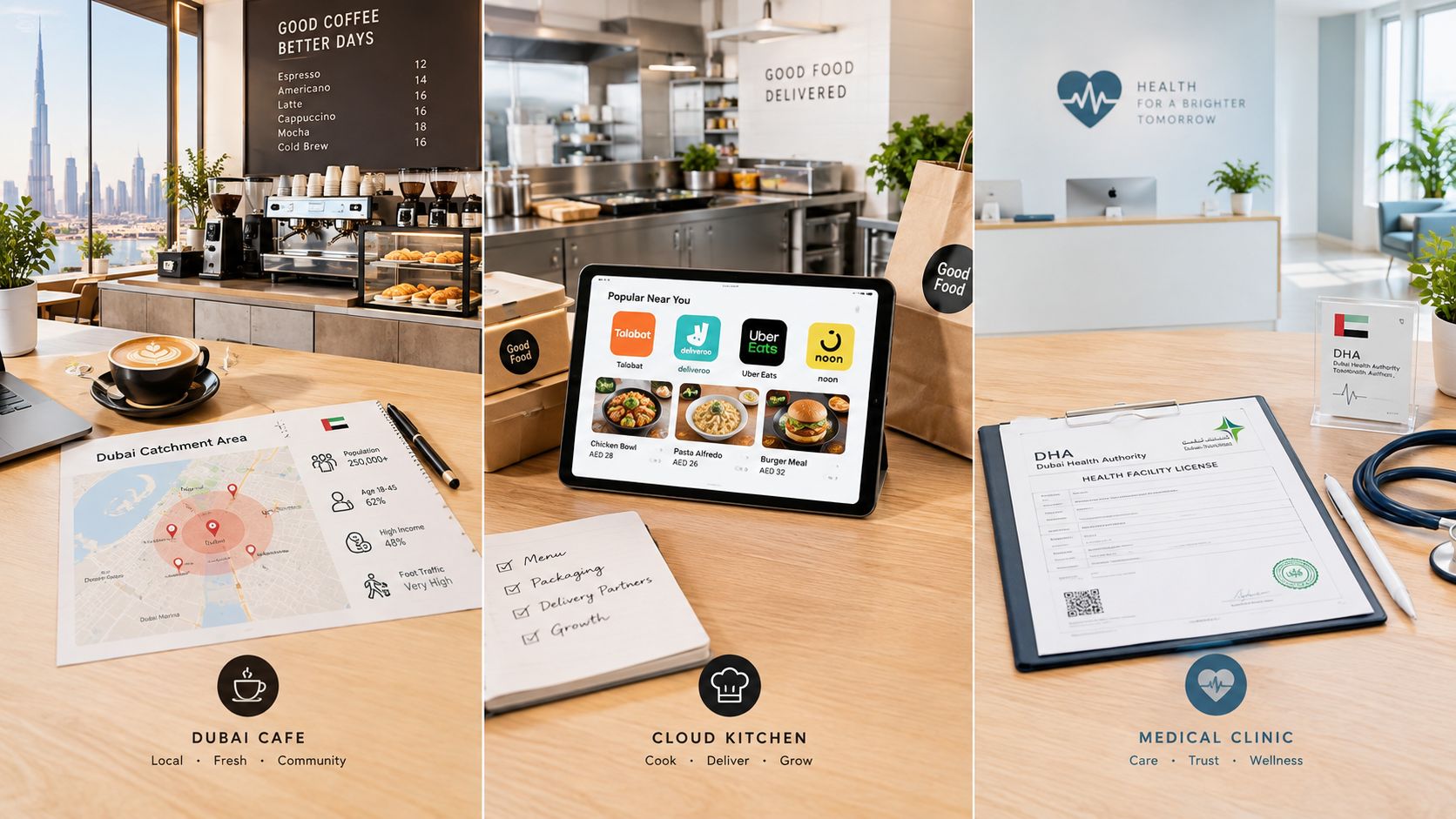
F&B needs evidence from the trading area
For a Dubai café or cloud kitchen, the report should start with the catchment, not the menu. Researchers need to understand nearby offices, residences, parking, pedestrian movement, delivery demand, competitor pricing, menu gaps, and peak-period concentration.
A cloud kitchen may avoid some front-of-house costs, but it introduces different risks. Delivery platform saturation, commission structures, packaging, dispatch capacity, and customer acquisition costs can reshape the contribution margin. A café serving office workers may face a very different weekday pattern from a destination concept serving residents and visitors.
The operational section should also map food approvals, kitchen design requirements, extraction, waste handling, and the relevant premises pathway. Primary research on competitors and local customer behaviour may matter more than a lengthy national market overview.
Healthcare and education need regulatory precision
A clinic, nursery, or education project requires deeper regulatory mapping. The study should identify the relevant licensing route, premises classification, professional requirements, staffing structure, approval sequence, and operating limitations.
The financial model must connect those requirements to capacity and revenue. A clinic can't assume unlimited consultations if practitioner availability, room configuration, or approval conditions restrict throughput. An education project must connect enrolment assumptions to facility capacity, staffing, fees, and the timing of approvals.
Superficial feasibility work becomes expensive. The report needs to show which assumptions are confirmed, which are pending, and what happens if the opening date moves.
Industrial and logistics projects need a longer view
For light manufacturing, logistics, or industrial projects, location and infrastructure can dominate the analysis. Options in areas such as JAFZA or DAFZ may need comparison across land or warehouse availability, power, access, waste handling, labour, utilities, customs considerations, and required approvals.
The study should also examine equipment procurement, commissioning, production capacity, supply contracts, offtake, maintenance, and working capital. Industrial projects often need a longer payback view than a small service business, so the model must reflect ramp-up, utilisation, and the timing of major capital expenditure.
A report that uses the same research depth for a café and a factory is not efficient. It's incomplete in different places.
Why Bank Readiness Matters More Than the Pitch Deck in the UAE
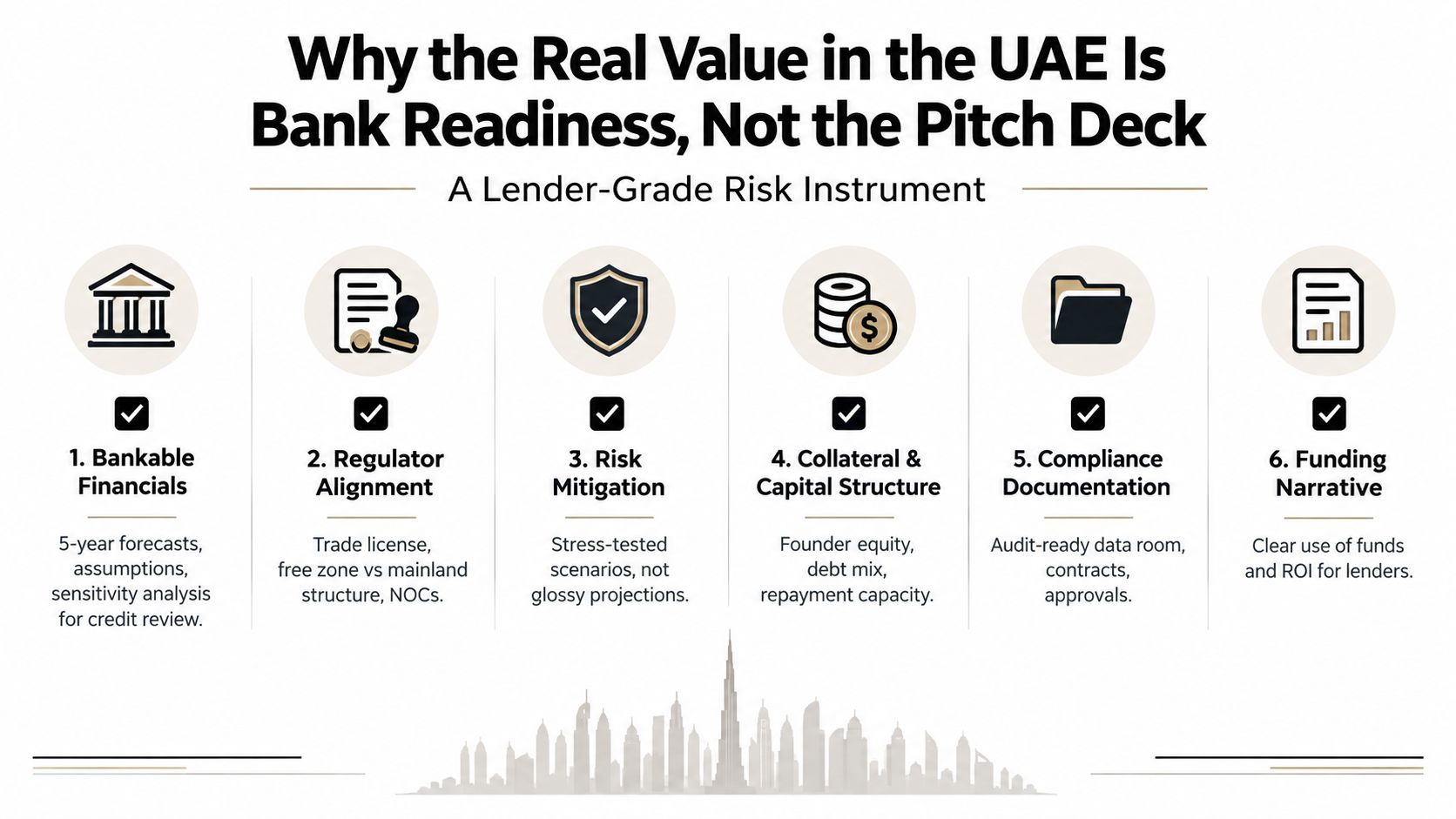
A Dubai founder may have a persuasive pitch deck and still face delays when a bank asks how the forecast supports repayment. A feasibility study earns its fee when it exposes that gap before the founder commits capital, rather than polishing a story for investors.
The CBUAE MSME Survey Report for 2020 recorded that 17% of MSMEs sought bank financing, with about half of those applicants succeeding. The practical lesson for UAE SMEs is clear: bank finance requires preparation. A founder needs a coherent, challenge-ready file that connects the licence, premises, operating plan, funding requirement, and cash flow.
What lender-ready means
A lender-grade report should make the credit review easier by showing:
- Traceable revenue assumptions, linked to customers, capacity, pricing, and trading periods.
- Conservative cash flow, with debt service considered alongside payroll, rent, suppliers, and tax obligations.
- Sensitivity tables, showing the effect of weaker demand, higher rent, staffing changes, cost increases, or delayed opening.
- A clear use of funds, separating equipment, fit-out, working capital, deposits, and refinancing.
- An organised evidence file, containing quotations, lease information, licences, contracts, management details, and approvals.
A bank's credit team examines repayment capacity, the founder's contribution, the reliability of assumptions, and the effect of a weaker trading period. It needs to see how an AED funding request becomes productive assets or working capital, then returns through operating cash flow.
Bank-readiness test: If a relationship manager cannot trace a forecast figure to an operating assumption or supporting document, expect questions and delays.
A pitch deck may secure attention. It rarely answers the detailed questions that determine whether an SME facility progresses. A bespoke feasibility model is more useful when it reconciles the licensing plan, operating model, capital structure, and cash flow in one lender-grade document.
When to Commission a Feasibility Study and How Smart Classic Helps
A Dubai founder can lose months of cash by signing a second-branch lease before checking demand, fit-out costs, staffing, and the time needed to reach break-even. Commission feasibility study services before signing a long lease, ordering equipment, applying for a regulated activity, hiring a large team, or submitting a funding application.
The work earns its cost when the decision involves substantial capital, regulatory dependencies, multiple shareholders, or a repayment obligation. It is especially useful for a second branch, entry into another emirate, a new sector, or a business shifting from founder-funded operations towards external finance. In each case, the report should control risk, support licence and approval decisions, and give a lender a model it can test.
The right and wrong use cases
| Scenario | Recommendation | Typical AED Range |
|---|---|---|
| Regulated healthcare, education, or F&B launch | Commission a sector-specific study | 10,000 to 18,000 for internal scope, higher for full-scope work |
| Second branch or major expansion | Commission a demand, site, and cash-flow study | 10,000 to 18,000 for a focused scope |
| Bank finance application | Commission lender-ready modelling and evidence review | Higher than a basic internal study, depending on lender requirements |
| Industrial or complex operating project | Use a phased engagement with technical and financial depth | 100,000 to 250,000+ for full-scope work |
| Low-cost online service with simple operations | Usually skip a full study and use a focused financial review | Qualitative screening may be sufficient |
| Sole proprietor with limited capital and no external funding | Skip unless a licence, lease, or approval risk is material | A full study may not earn its cost |
Do not buy a heavyweight report because it sounds professional. A simple online consultancy with low fixed costs and no lender or regulator requesting detailed evidence may need only a focused financial review. A Dubai café, clinic, warehouse, or education centre faces different exposure because premises, approvals, staffing, and working capital can consume cash before revenue stabilises.
What the handover should look like
Smart Classic Business Hub can structure the work around an initial scoping call, information collection, sector and competitor research, regulatory mapping, financial modelling, sensitivity analysis, and a final decision report. Agree the output before work starts. That agreement should cover the six modules, assumptions requiring confirmation, revision process, and excluded authority or design services.
For a Dubai mainland, free zone, or offshore project, require a handover sequence tied to the next action. It may produce a revised licensing route, a bank information pack, a phased launch plan, or conditions to resolve before signing.
A consultant should explain the model rather than deliver a PDF. The handover should identify the assumptions that matter most and support discussions with the licensing authority, free zone, landlord, or bank when that support is included in scope.
Smart Classic Business Hub offers UAE-focused feasibility studies, financial models, business planning, and company setup support for founders assessing mainland, free zone, and offshore projects. Visit Smart Classic Business Hub to discuss your sector, funding requirement, and the evidence you need before committing capital.