
When you're serious about entering the UAE market, hiring feasibility study consultants in Dubai isn't just another expense—it's the first, and arguably most critical, investment you'll make. These experts deliver an objective, data-driven reality check on your business concept, helping you sidestep costly mistakes before you’ve even spent your first dirham on rent.
Why Expert Feasibility Consultants Are Your First Smart Investment in Dubai

Jumping into Dubai's dynamic market without a clear roadmap is a massive gamble. Passion and a brilliant idea are crucial, but on their own, they won't pay the bills. This is where professional feasibility consultants prove their worth, acting as a strategic partner to de-risk your venture from day one.
Their job goes way beyond just crunching numbers they find online. They provide a critical, impartial perspective on your business idea, grounding it firmly in local market realities. Think of them as your on-the-ground intelligence team, tasked with uncovering the hidden challenges and lucrative opportunities you’d almost certainly miss from the outside.
Moving Beyond Data to Actionable Insights
A common trap entrepreneurs fall into is treating a feasibility study as a mere box-ticking exercise to satisfy investors or get a bank loan. In reality, a well-executed report is a strategic blueprint that shapes every single decision that follows.
A seasoned consultant in Dubai will dissect the core pillars of your proposed venture:
- Market Viability: Is there a real, sustainable demand for what you're selling among your target audience in Dubai? Or is it just a solution looking for a problem?
- Operational Practicality: Can your business model actually work within the local regulatory and logistical framework? This covers everything from supply chain complexities to securing the right kind of commercial real estate.
- Financial Soundness: Do the numbers genuinely add up? This means detailed projections of startup costs, ongoing operational expenses, realistic revenue forecasts, and, of course, the potential return on investment (ROI).
This kind of rigorous analysis prevents a fatal error: launching a business that looks fantastic on a spreadsheet but is completely impractical in the real world. For example, a consultant might find that while demand for a niche retail concept is sky-high, the astronomical rental costs in prime locations would make profitability a distant dream.
A feasibility study isn't about confirming what you want to hear; it's about challenging your assumptions with hard evidence. It’s the difference between building your business on solid rock versus shifting sand.
The Growing Demand for Expert Guidance
The value of this kind of local expertise is clearly reflected in market trends. The overall UAE consulting market shot up by 15.2% last year, hitting a value of $1.1 billion, with most of that activity concentrated in Dubai and Abu Dhabi.
This growth isn't just a statistic; it shows how essential consultants have become for anyone trying to navigate the emirate’s sophisticated and often complex economic environment. You can read more about the UAE's growing consulting market and how it’s shaping new business ventures.
Decoding a Comprehensive UAE Feasibility Study
A feasibility study isn't just a thick document you file away; it's a deep-dive analysis made up of several interconnected parts. Getting a handle on these components is essential, as it’s the only way to really gauge the quality of the report you get back from your feasibility study consultants in Dubai. A truly solid study goes way beyond a simple thumbs-up or thumbs-down on your idea.
What you should be looking for is a 360-degree view of your potential venture, one that clearly flags the strengths you can build on and the weaknesses you need to manage. Each section feeds into the others, building a complete picture of the business landscape you're about to step into. Think about it: massive market demand doesn't mean much if the technical side is impossible to execute locally, or if the financial projections just don't add up.
The Four Pillars of a Dubai Feasibility Report
A comprehensive study is built on four core areas. Each one tackles a different set of critical questions that, when answered together, determine if your project has what it takes to succeed in the UAE.
- Market Feasibility: This is the first real stress test for your business idea. It digs into the actual demand, pins down your target audience in Dubai, sizes up the competition, and evaluates different pricing models. The big question here is: is there a genuine gap in the market, or are you walking into a crowded space?
- Technical Feasibility: This is where things get practical. It’s all about the operational side—the technology you'll need, logistical hurdles, your staffing requirements, and whether your potential locations are even suitable. Can you realistically get the resources and infrastructure you need in your chosen spot?
- Financial Feasibility: Now we're talking numbers. This pillar projects your startup costs, forecasts revenue streams, estimates ongoing operational expenses, and calculates your breakeven point. Most importantly, it determines the potential return on investment (ROI). Will this venture actually be profitable and sustainable?
- Legal Feasibility: This part is non-negotiable, especially in the UAE. It’s about navigating the different legal structures—like choosing between mainland vs. free zone—and making sure you’re compliant with all the local licences, permits, and industry-specific rules.
To give you a clearer picture, here’s a breakdown of what each part of the study should be telling you.
Key Components of a Dubai Feasibility Study
A good feasibility study is structured to answer very specific questions. This table breaks down the core pillars and the kinds of answers you should expect to find in a well-researched report.
| Study Component | Objective | Example Questions Answered |
|---|---|---|
| Market Feasibility | To assess market demand, competition, and customer behaviour. | Who is my target audience in Dubai? What is the current market size and growth potential? Who are my main competitors and what are their weaknesses? |
| Technical Feasibility | To determine the operational viability, including resources, technology, and logistics. | What technology and equipment do I need? Can I source the necessary raw materials locally? What are the staffing and skill requirements? |
| Financial Feasibility | To evaluate the financial viability, profitability, and funding requirements. | What are the total startup costs? What are my projected revenues for the first three years? When will the business break even? What is the expected ROI? |
| Legal Feasibility | To ensure compliance with all local laws, regulations, and licensing requirements. | Should I set up on the mainland or in a free zone? What specific trade licences are required? Are there any industry-specific regulations I need to know? |
Each of these components is a piece of a larger puzzle. A weakness in one area can undermine the strengths in another, which is why a holistic view is so critical for making an informed decision.
Context Is Everything: Location and Industry Matter
The depth and focus of each pillar will shift dramatically depending on your business. For instance, a feasibility study for a new restaurant in Jumeirah will zoom in on foot traffic analysis, the spending habits of local demographics, and the logistics of sourcing fresh ingredients.
On the other hand, a study for a fintech startup in the Dubai International Financial Centre (DIFC) would go deep on regulatory compliance within that specific financial free zone, cybersecurity infrastructure, and the technical scalability of its platform. This ability to adapt is the mark of a high-quality analysis. You can learn more about shaping your business strategy by exploring our guide on conquering the UAE market.
A feasibility study isn't just a report; it's a customised strategic tool. Its value lies in how specifically it addresses the unique variables of your industry and chosen jurisdiction within Dubai.
These studies often turn up major opportunities. For example, recent analyses in Dubai highlight staggering market potential, like the UAE's tech sector being projected to surpass $40 billion by 2026, and e-commerce revenue booming at an annual growth rate of 9.5%. This makes these reports invaluable for validating business models in high-growth areas. You can find more insights from the experts who analyse these market trends at PKF UAE.
How to Select the Right Feasibility Study Consultant
Choosing a partner to assess your business idea is one of the most critical decisions you'll make at this early stage. Get it right, and your consultant acts as a strategic co-pilot. Get it wrong, and you could end up with a generic, copy-paste report that offers little real-world value.
Your goal is simple: find a firm that digs deeper than surface-level data. You need a team that provides a truly critical analysis of your venture’s potential, specifically within Dubai's unique and fast-paced market.
Think of the selection process as your first round of due diligence. You aren't just buying a document; you're investing in specialised expertise, local intelligence, and an objective viewpoint that can save you from incredibly costly mistakes down the line. A top-tier consultant doesn't just tell you what you want to hear—they challenge your assumptions with hard facts and boots-on-the-ground insights.
Beyond the Brochure: Zero in on Industry Specialisation
Generalist firms that claim to cover every industry from hospitality to fintech might have broad knowledge, but they almost always lack the deep, specific insights that make a feasibility study genuinely useful. You need a consultant who speaks your industry's language and intuitively understands its specific hurdles and opportunities in the Dubai context.
For instance, a consultant with a strong background in the F&B sector will already know the nuances of Dubai Municipality regulations, the best locations for high foot traffic versus delivery-only "dark kitchens," and the painful complexities of supply chain logistics for importing speciality ingredients.
A consultant's true value isn't just in their analytical skills. It's in their network and the experience they've built within your specific niche. They should know the key market players, the regulatory headaches, and the unwritten rules of the game before your project even kicks off.
Verifying Local Knowledge and a Proven Track Record
Any firm can put "Dubai market expert" on its website, but you need to see the proof. The key is to look for tangible evidence of their experience and a portfolio of work you can verify. A reputable feasibility study consultant in Dubai will be completely transparent about their past projects and their methodology.
When you're vetting potential partners, use a simple checklist to make sure they tick the essential boxes:
- Verifiable Case Studies: Ask for anonymised examples of past studies they’ve done for businesses similar to yours. Pay attention to the depth and specificity of the analysis.
- Data Gathering Methods: How do they actually collect their primary data? Do they just pull from public databases, or are they conducting on-the-ground surveys, interviewing local industry experts, and doing real competitor analysis?
- Understanding of Local Regulations: This is a big one. Test their knowledge. Ask specific, tricky questions about mainland versus free zone setups, or the exact licensing requirements relevant to your industry. Their answers will tell you a lot.
This flowchart breaks down the core stages of a typical feasibility study process in Dubai, highlighting the key areas any competent consultant must have mastered.
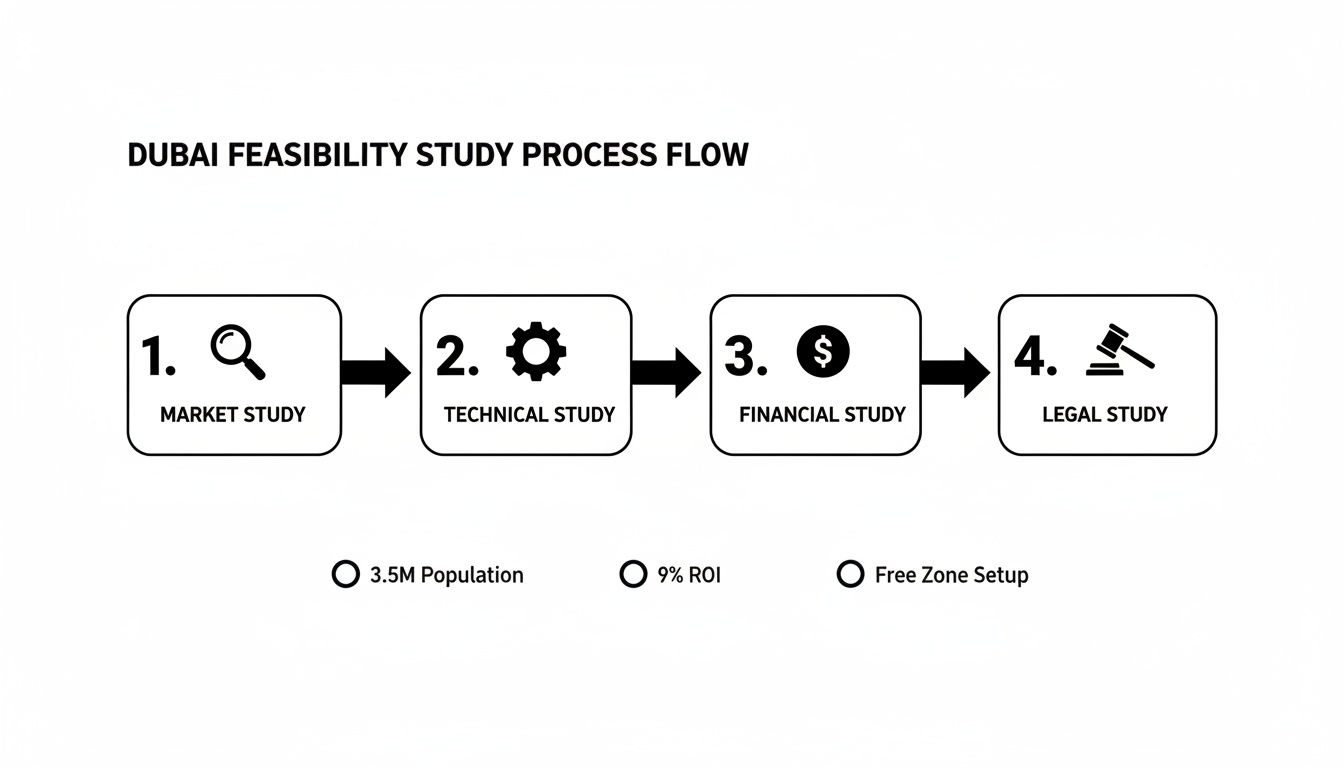
As you can see, each phase—market, technical, financial, and legal—logically builds upon the last to form a complete and defensible assessment of your idea.
Essential Questions for Your Initial Consultation
Your first meeting or call with a potential consultant is your best shot at gauging if they're the real deal. Don't just ask about pricing. Come prepared with a list of pointed questions that cut to the chase. The quality and confidence of their answers will reveal the true depth of their expertise.
Here are a few you should definitely ask:
- Can you walk me through your process for primary market research for a project like mine? This immediately separates the firms that do real fieldwork from those who just repackage online data.
- Based on what you know so far, what are the top three challenges you foresee for my business idea in the Dubai market? A good consultant will be able to identify potential red flags right away.
- How do you model your financial projections, and what are the core assumptions you typically use for a new venture here? This helps you understand the realism and rigour of their financial analysis.
- Who, specifically, will be the lead analyst on my project, and what is their direct industry experience? You need to ensure an actual expert is handling your study, not a junior associate learning on the job.
Choosing the right partner is absolutely fundamental to your venture's success. For more guidance on finding the right experts for your entire business journey, check out our insights on selecting the best business setup consultants in Dubai.
Budgeting for Your Feasibility Study: Costs and Timelines
One of the first questions on any entrepreneur's mind is, "How much will this cost?" When it comes to a professional feasibility study in Dubai, there's no single price tag. The investment really depends on the scale and complexity of your business idea.
Think of it this way: a straightforward analysis for a small retail kiosk will naturally require a different level of resources than a deep dive into a new manufacturing facility or a large-scale tech venture. The final cost is shaped by the depth of the research, whether we need to conduct on-the-ground surveys, and how intricate the financial modelling needs to be. More complexity simply means more expert hours, which is reflected in the price.
Breaking Down the Costs
So, what can you realistically expect to invest? Costs for feasibility studies in Dubai can vary quite a bit. A study for a small-scale retail or commercial venture might start from AED 40,000 and go up to AED 90,000. For large-scale industrial or highly complex projects, the fees can range anywhere from AED 100,000 to AED 190,000.
If you're looking for a more focused package that covers the essentials—like solid desk research and financial projections—you might see figures in the AED 30,000-40,000 range. This kind of study typically takes about four to five weeks to complete. For a closer look at market rates, you can explore more pricing insights on a feasibility study in the UAE.
Remember, this isn't just an expense; it’s an investment in clarity and de-risking your venture. To put this cost into the broader context of your startup budget, check out our guide on the cost of starting a business in Dubai.
Here’s a quick overview of what you can expect based on project size.
Estimated Feasibility Study Costs and Timelines in Dubai
This table outlines typical investment levels and project durations based on the complexity and scale of the business venture.
| Project Scale | Estimated Cost (AED) | Typical Timeline |
|---|---|---|
| Small-Scale (e.g., Retail, Cafe) | AED 40,000 – AED 90,000 | 4 – 6 Weeks |
| Medium-Scale (e.g., Service Co, Tech) | AED 90,000 – AED 150,000 | 6 – 8 Weeks |
| Large-Scale (e.g., Industrial, Plant) | AED 150,000 – AED 190,000+ | 8 – 12+ Weeks |
These figures give you a solid baseline for planning. Your final quote will always be tailored to the specific scope we agree on.
Mapping a Typical Project Timeline
Beyond the budget, it's just as important to have realistic expectations about the timeline. A proper feasibility study isn't something that can be knocked out in a weekend. It follows a structured process to ensure the results are both thorough and reliable.
Here’s a snapshot of what a typical project flow looks like:
Weeks 1-2: Kick-off and Data Gathering
This is where we sit down together, brief the feasibility study consultants in Dubai, and lock down the exact scope. We then kick off both primary and secondary research, which includes initial market scans and pulling together existing industry data.Weeks 3-4: In-depth Analysis
Now, the real work begins. The consultants dive deep into the market analysis, technical assessments, and start building out the financial models. This is usually the most intensive phase of the project.Weeks 5-6: Report Drafting and Presentation
All the findings are compiled into a draft report. We'll walk you through it, discuss the initial conclusions, and refine the analysis based on your feedback before the final presentation.
Remember, a rushed feasibility study often leads to superficial insights. The timeline is designed to allow for rigorous analysis, not just to meet a deadline. Giving your consultants the necessary time ensures you get the actionable intelligence you're paying for.
Turning Your Feasibility Report into a Business Reality

With a positive feasibility study in hand, the real work begins. Don't think of this report as the finish line; it’s the launchpad for your entire business journey in Dubai. Its whole purpose is to get your validated idea off the paper and into the real world as an operational company.
The most direct next step is turning the report's findings into a powerful business plan. Think of it this way: the study answers, "Is this a good idea?" The business plan answers, "How are we going to make it happen?" Every part of your study—from the market analysis to the financial projections—is now the foundation for a rock-solid and convincing plan.
From Report Data to a Compelling Business Plan
Your feasibility study is a goldmine of validated information. The financial projections, market sizing, and competitive analysis are no longer just guesses; they're well-researched conclusions you can confidently stand behind.
Here’s how you can translate the report’s key sections directly into your business plan:
- Executive Summary: Lead with the core conclusion from the feasibility study. Starting with that "green light" immediately establishes credibility.
- Market Analysis: Lift the data on the competitive landscape and your target audience straight from the study. Use it to build out your market positioning and marketing strategy.
- Financial Projections: The cash flow forecasts, startup cost estimates, and ROI calculations become the backbone of your financial plan. This is the section that gets investors and banks to listen.
Taking this data-driven approach massively strengthens your pitch to banks, angel investors, or venture capitalists. A plan backed by a third-party feasibility study shows you’ve done serious due diligence.
A feasibility study gives you the confidence to act. A business plan gives you the roadmap to execute. One without the other is incomplete.
Making Key Decisions on Company Formation
The legal feasibility section of your report is crucial for the next practical steps. It gives you the "why" behind choosing the right legal structure and jurisdiction for your company setup in Dubai.
Now you can make informed decisions on the big setup questions:
- Jurisdiction Choice: Will you set up on the mainland to trade directly with the entire UAE market, or in a free zone like DMCC or DIFC for perks like 100% foreign ownership and tax exemptions? Your study should have weighed the pros and cons for your specific industry.
- Licensing and Visas: The report will have identified the exact trade licence you need and outlined the visa eligibility for you and your future staff. This info lets you start the application process without any guesswork or delays.
The demand for feasibility study consultants in Dubai is climbing as fast as the region's economy. The MEA management consulting market, valued at USD 12.13 billion in 2026, is projected to hit USD 21.59 billion. Just look at the UAE’s IT services market—valued at USD 5.88 billion in 2024, it's expected to rocket to USD 12.88 billion by 2033. The opportunity is immense. Discover more insights about UAE market growth potential.
This process is all about turning abstract analysis into concrete actions, moving you from the planning stage to officially launching your business in one of the world's most dynamic markets.
Got Questions About Feasibility Studies in Dubai?
If you're getting ready to commission a report, it's completely normal to have a few questions floating around. Getting clear on the process from the start is the best way to set the right expectations and build a solid working relationship with your chosen feasibility study consultants in Dubai.
Let's tackle some of the most common queries we hear from entrepreneurs and investors.
What if the Study Comes Back Negative? Is That a Waste of Money?
Absolutely not. In fact, a study that flags your idea as non-viable isn't a failure—it's a massive win for your wallet. Think of it as successful risk mitigation.
Discovering a fatal flaw on paper, before you’ve poured your life savings or investor capital into it, is one of the smartest things you can do. A "no-go" recommendation from a detailed report is what stands between you and a potential financial nightmare.
But it’s more than just a red light. A good report will tell you why the concept won’t fly. Maybe the market is already jam-packed with competitors, or perhaps the operational costs will eat up any potential profit. These insights are pure gold because they often point you towards a pivot—a small tweak or a new direction that could turn a flawed idea into a genuinely profitable one.
The real goal of a feasibility study isn’t just to hear 'yes.' It's to get the right answer, even if that answer is 'no.' It protects your capital and points you toward a venture that actually has a fighting chance.
Is a Feasibility Study Just a Fancy Name for a Business Plan?
This is a classic mix-up, but they are two very different documents with distinct jobs. They’re sequential, not interchangeable.
- A feasibility study is all about investigation. It’s designed to answer one crucial question: "Should we even do this?" It tests whether an idea has legs to stand on.
- A business plan is your strategic roadmap. It comes after you've confirmed the idea is viable and answers the next question: "Okay, how are we going to do this?"
You always, always do the feasibility study first. The findings from that study—the hard data, the market analysis, the financial projections—become the rock-solid foundation for your business plan. Without it, your business plan is just a collection of educated guesses and wishful thinking.
How Involved Do I Need to Be During the Study?
Your consultants are there to do the heavy lifting—the research, the number-crunching, the analysis. But your involvement is what makes the final report truly valuable. You're the one with the vision and the intimate knowledge of your concept.
Think of it as a partnership. Your key roles are:
- Nail the Brief: The clearer and more detailed your initial brief, the better the outcome. Lay out your goals, your assumptions, and any specific questions you absolutely need answered.
- Stay Available: Your consultants will inevitably have questions as they dig in. Quick, clear responses from your end keep the project moving and ensure the analysis stays locked on your vision.
- Be a Critical Reviewer: When drafts land in your inbox, go through them with a fine-tooth comb. Are the assumptions logical? Does the data make sense? Do the conclusions feel earned? This is your chance to challenge things and ask for clarification.
Your active participation ensures the final report from your feasibility study consultants in Dubai isn't just some dusty document but a practical, actionable tool that genuinely sets you up for a successful launch in the UAE.
Navigating Dubai's market requires expert guidance from start to finish. At Smart Classic Business Hub, we don't just assess your idea; we help you build it into a reality. From in-depth feasibility studies to seamless company formation, our team is ready to support your venture. https://smartclassic.ae