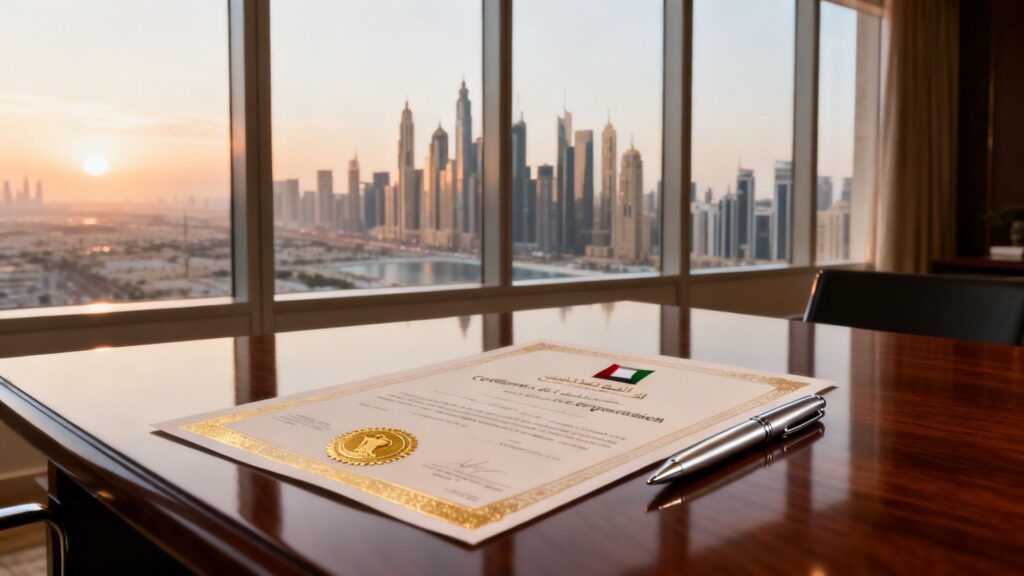
When you hear "Dubai company formation services," what should come to mind isn't just paperwork. Think of it as having an expert guide to navigate the entire process of launching your business in the emirate, from getting your legal registration sorted to handling visa applications. These services are your ticket to correctly navigating the distinct rules of Mainland, Free Zone, and Offshore setups, making sure your company is compliant from day one.
Why 2026 Is the Year to Start Your Business in Dubai
If you’re looking to position your business in one of the world's most energetic and forward-thinking economic hubs, the time is now. Dubai's pro-business government, strategic global location, and world-class infrastructure have always made it a prime spot for entrepreneurs. But 2026 is shaping up to be a truly golden opportunity, driven by huge economic reforms and incredible momentum.
This isn't just a feeling in the air; the numbers are staggering. The UAE government has set an ambitious goal to host two million companies by the end of the decade. This push is backed by major legal changes, like the updated Commercial Companies Law of 2021, which has thrown the doors wide open for new businesses. Since that law passed, the country welcomed nearly 760,000 new companies by the end of 2025. This brought the total number of active companies to over 1.4 million—a massive 118.7% growth in just over four years. You can read more about this huge expansion on Gulf News.
Capitalising on Economic Acceleration
This explosive growth is more than a government target. It’s a real, on-the-ground environment where new businesses aren't just allowed, but actively supported to succeed. For an entrepreneur like you, this means:
- A Growing B2B Ecosystem: More companies mean more potential clients, partners, and suppliers right on your doorstep.
- Increased Investor Confidence: The massive spike in company setups is a huge green flag for the market, pulling in even more foreign investment.
- A Deepening Talent Pool: As more top companies set up shop, Dubai becomes a magnet for skilled professionals from all over the world, making it easier to build your team.
Choosing to start a business in Dubai isn't just about entering a new market. It's about plugging your company into an economic engine deliberately built for speed and global reach.
Think of this guide as your strategic roadmap. We'll walk you through the entire journey, starting with the very first decision every entrepreneur here must make: picking the right jurisdiction. Getting to grips with the differences between Mainland, Free Zone, and Offshore setups is your first, most critical step. You can also learn more about the 5 benefits of setting up a business in Dubai in our detailed article.
In this environment, expert Dubai company formation services are not a luxury; they're a strategic tool. Having a knowledgeable partner helps you tap into the emirate's huge potential without getting bogged down in red tape, ensuring you can focus on what really matters—building your business.
Choosing Your Jurisdiction: Mainland, Free Zone, or Offshore?
Alright, let's talk about the first and most important decision you'll make when setting up your company in Dubai: choosing the right jurisdiction. Get this right, and you're building on solid ground. Get it wrong, and you could be facing unnecessary hurdles down the road.
This single choice will dictate where you can do business, who can own your company, and what your tax obligations will be. It's not just about picking a postcode; it's about choosing an entire business ecosystem with its own unique rules and advantages. The three main options on the table are Mainland, Free Zone, and Offshore. Each is designed for a very different type of business, and understanding the difference is crucial.
This decision tree helps cut through the noise. It boils the choice down to one key question: where are your customers?

As you can see, whether you plan to operate within the local UAE market or internationally is the biggest factor. Let's break down what each option really means for your business.
Mainland Companies: Direct Access to the UAE Market
Think of a Mainland company as opening your flagship store right in the heart of Dubai. Registered with the Department of Economy and Tourism (DET), this setup gives you the ultimate freedom to operate anywhere in the UAE. You can trade directly with any customer or business across all seven emirates, without restriction.
This is the go-to structure for any business that needs to be on the ground and fully integrated into the local economy—think retail shops, restaurants, construction firms, and local consulting services. A major game-changer recently is that 100% foreign ownership is now possible for most business activities, which has blown the doors wide open for international entrepreneurs.
Of course, this freedom comes with responsibilities. Mainland companies must comply fully with UAE labour laws, rent a physical office space registered with Ejari, and are subject to the 9% Corporate Tax on profits over AED 375,000. If you want to dive deeper into how this compares with a free zone, check out our detailed guide on mainland vs free zone setups.
Free Zone Companies: A Global Trade Hub
Now, imagine setting up in a specialised, high-tech business park custom-built for your industry. That's a Free Zone. Dubai has over 40 of them, each a self-contained economic area with its own rules, often catering to specific sectors like tech, media, commodities, or finance.
For international businesses, the benefits are incredibly compelling:
- 100% foreign ownership is standard.
- 0% corporate tax on qualifying income for businesses that meet the right criteria.
- 100% repatriation of profits and capital, no questions asked.
- Streamlined and simplified import and export procedures.
A Free Zone is a self-governing business ecosystem. It’s perfect for businesses that are focused on international trade, consulting, or providing services to clients outside the UAE.
While you can't trade directly with the mainland market from a free zone, you can always partner with a local distributor or set up a mainland branch office. This makes it a hugely popular choice for trading companies, e-commerce businesses, and global service providers using Dubai as their strategic base.
Offshore Companies: For Asset Protection and Investment
An Offshore company is a completely different animal. Registered in jurisdictions like Jebel Ali Free Zone (JAFZA) or Ras Al Khaimah International Corporate Centre (RAK ICC), it’s not a trading company in the usual sense. It's a non-resident legal entity used almost exclusively for international investment, holding assets, and protecting wealth.
Think of it as a secure, international vault for your assets. You cannot conduct business inside the UAE, you can't lease a physical office, and you can't get residence visas for your team. Its purpose is entirely external to the UAE market.
So, why would you set one up?
- To act as a holding company for your global assets or international subsidiaries.
- To own real estate in specific designated areas of Dubai.
- To facilitate international trade transactions and invoicing.
- For asset protection and sophisticated estate planning.
Choosing an offshore structure is a strategic financial move, not an operational one. It gives you a confidential, tax-neutral framework for managing your international investments, completely separate from the local UAE economy.
Mainland vs Free Zone vs Offshore at a Glance
To help you see the differences side-by-side, here’s a quick comparison of the three jurisdictions. This table summarises the key features we've discussed to guide your decision-making process.
| Feature | Mainland Company | Free Zone Company | Offshore Company |
|---|---|---|---|
| Ownership | Up to 100% foreign ownership for most activities. | 100% foreign ownership guaranteed. | 100% foreign ownership guaranteed. |
| Business Scope | Can trade directly anywhere in the UAE and internationally. | Can trade internationally and within its own free zone. Direct mainland trade requires a distributor or branch. | Cannot trade within the UAE. For international business and investment holding only. |
| Office Requirement | Mandatory physical office space with an Ejari. | Flexible options, from flexi-desks to physical offices. | No physical office allowed. Registered agent's address is used. |
| Visas | Visa eligibility is linked to the size of the office space. | Visa eligibility is typically based on pre-approved packages. | No eligibility for residence visas. |
| Corporate Tax | 9% on taxable income above AED 375,000. | 0% on qualifying income for compliant businesses. | 0% corporate tax. |
| Auditing | Mandatory annual audit. | Mandatory annual audit for most free zones. | Auditing is generally not required unless requested by authorities or for banking purposes. |
Ultimately, the best choice depends entirely on your business model. Are you targeting the local market? A Mainland company is your best bet. Focused on international trade from a tax-efficient hub? Look at the Free Zones. Is your goal purely asset holding and international investment? An Offshore company is what you need.
Your Step-By-Step Business Setup Blueprint

Setting up a company in Dubai can feel like navigating a maze, but it’s actually a very logical sequence. When you have a clear map, the process becomes much more straightforward. That's what this blueprint is for—to break the journey down into clear, manageable stages.
Working with expert Dubai company formation services turns what could be a bureaucratic headache into a simple checklist. We’ll walk you through each milestone, from your initial idea all the way to holding your official trade license. It all starts with the most foundational decision you’ll make.
Stage 1: Define Your Business Activity and Legal Structure
Before you even dream up a company name, you need to be crystal clear on what your business will actually do. The Department of Economy and Tourism (DET) and the various free zone authorities maintain a specific list of over 2,000 business activities.
The activity you choose directly determines the type of license you’ll need—Commercial, Professional, or Industrial. This is a critical first step. For instance, a consultancy would fall under a "Professional" license and might be structured as a Sole Establishment, whereas a trading business needs a "Commercial" license and is often set up as a Limited Liability Company (LLC). Getting this right from the start is key to staying compliant.
Stage 2: Reserve Your Trade Name
With your business activity sorted, it’s time to give your company a name. This isn’t just a branding exercise; it’s a formal approval process with its own set of rules.
You'll need to follow the guidelines set by the UAE authorities. Some key points to remember are:
- The name can't violate public morals or order.
- It must not be identical or too similar to an existing registered name.
- It has to be followed by the legal structure abbreviation, like LLC or FZCO.
A good business setup firm can quickly check if your preferred names are available and handle the reservation for you. This saves you from the back-and-forth of potential rejections and makes your business officially recognised by the government.
Stage 3: Secure Initial Approvals
Once your activity and name are approved, the next step is getting "initial approval." Think of this as the government giving you the green light to move forward with the rest of your application. It’s their way of saying they have no objections to your proposed business.
This isn’t just a rubber stamp. The initial approval certificate is a crucial document you'll need for later steps, like drafting legal papers and leasing an office. It’s the official permission slip that unlocks the next phase.
For certain specialised fields like healthcare, education, or finance, you'll also need extra approvals from specific ministries or regulatory bodies. This is where a consultant is invaluable, as they know exactly who to talk to and how to get these external permissions without holding up your timeline.
Stage 4: Prepare Legal Documents and Secure an Address
Now it's time to formalise your company’s legal foundation. This involves drafting and notarising your Memorandum of Association (MoA), which is essentially your company's constitution. It lays out everything from your business purpose to the shareholding structure and operational rules.
At the same time, you need a physical address. For a mainland company, this means leasing an office and registering the tenancy contract with Ejari. Free zones offer much more flexibility, with options ranging from virtual offices and flexi-desks to full-sized physical offices, depending on how many visas you need.
Stage 5: Finalise Your License and Visas
You’re on the home stretch. With all your paperwork in order—the initial approval, notarised MoA, and tenancy contract—you can submit the final application. Once you pay the final government fees, the authorities will issue your official trade license.
With the license in hand, you can kick off the visa process. This starts with applying for an Establishment Card, which registers your company with immigration and allows you to sponsor people. From there, you can process your own investor visa and then start bringing on your team by applying for employee visas and sponsoring their families. This is the last step that transforms your legal entity into a fully operational business in Dubai.
Decoding the Costs, Documents, and Timelines for Your Setup
Successfully launching your Dubai venture comes down to getting a firm grip on three things: the paperwork you'll need, the money it will cost, and the time it will take. Nailing these details from the get-go helps you budget properly and sidestep those frustrating, unexpected delays. This is exactly where professional Dubai company formation services come in, cutting through the red tape to make sure you're ready to hit the ground running.
Let's start with the paperwork. While the specifics can shift slightly between a mainland, free zone, or offshore setup, there’s a core set of documents you’ll almost always need to get your application moving.
Your Essential Document Checklist
Getting these items organized ahead of time will seriously speed things up. Keep in mind that for most foreign shareholders, these documents need to be notarized and attested first in your home country and then again by the UAE's Ministry of Foreign Affairs.
- Passport Copies: Clear, color copies for every shareholder and manager.
- Visa and Entry Stamp: If you're already in the UAE, a copy of your current visa or entry stamp is needed.
- Business Plan: A concise summary is fine, but it needs to clearly state your business activities, goals, and who you plan to sell to.
- Proof of Address: A recent utility bill for each shareholder will do the trick.
- Educational Certificates: For certain professional licenses, your attested degree or qualification certificate is a must.
- No Objection Certificate (NOC): If you're currently employed in the UAE on a residence visa, you’ll need a letter from your current sponsor giving you the green light.
Think of this checklist as your pre-flight inspection before taking off on your Dubai entrepreneurial journey. Missing just one item can ground your entire application, leading to delays and extra costs. A good business setup consultant is your co-pilot, making sure every form is filled out, stamped, and submitted correctly and on time.
A Transparent Breakdown of Costs
The final bill for your business setup depends entirely on your choice of jurisdiction, the type of license you need, and operational extras like visas and office space. It’s a good idea to map out your potential revenue and expenses. Learning how to create financial projections gives you a solid financial roadmap for your new venture.
Dubai's pro-business stance isn't just talk. The World Bank tracks new business density—a key indicator of a healthy startup ecosystem—and the UAE consistently punches above its weight in the region. To put a number on it, even during the global disruptions of 2020, an impressive 19,050 new businesses launched in Dubai. That kind of resilience says a lot. You can dive into the data yourself in the full World Bank report on new business registrations.
To give you a clearer idea, your expenses will fall into two buckets: one-time setup fees and recurring annual costs.
Estimated Costs and Timelines
Getting your company up and running can take anywhere from a few days to several weeks. It all depends on the jurisdiction, the complexity of your business, and how fast you can get all your documents in order.
Here’s a rough guide to what you can expect:
| Item | Estimated Cost (AED) | Estimated Timeline |
|---|---|---|
| Trade Name & Initial Approval | 1,000 – 2,500 | 1-3 Business Days |
| Trade License (1-Year) | 10,000 – 50,000+ | 2-10 Business Days |
| Establishment Card | 1,500 – 2,500 | 3-5 Business Days |
| Investor/Partner Visa | 3,500 – 6,000 per person | 7-15 Business Days |
| Office/Flexi-Desk (Annual) | 5,000 – 40,000+ | 1-2 Business Days |
Note: These are just estimates. The final costs can swing quite a bit depending on the specific free zone or mainland authority you choose.
With a solid plan, the right documents, and a realistic budget, you can navigate the setup process smoothly and efficiently.
Life After Launch: Visas, Banking, and Compliance

Getting your trade license is a huge win, but let's be clear: it's the starting gun, not the finish line. The next phase is all about turning that piece of paper into a living, breathing, and most importantly, a legally compliant business. This is where you secure residency, set up your banking, and get your long-term compliance in order.
Honestly, this is where many new entrepreneurs start to feel the pressure. The focus snaps from one-off setup tasks to the ongoing responsibilities that determine whether your business survives and thrives. It’s also where professional dubai company formation services really show their long-term value, going far beyond just getting you licensed.
Securing Your Place in Dubai with the Right Visa
First things first, you need to solidify your legal status in the UAE. Think of your new company as the key that unlocks residency—not just for you as the owner, but for your future employees and even your family. The entire process hinges on your company's Establishment Card, which is your business's official registration with the immigration authorities.
You have a few visa paths to consider, each with its own advantages:
- Investor Visa: This is the go-to option for business owners. It’s tied directly to your company and grants you residency as an investor in your own enterprise.
- Golden Visa: This is a long-term, 10-year residency visa for investors, entrepreneurs, and specialized talents who meet certain high-level criteria. It offers incredible stability and frees you from frequent renewals.
- Employee Visas: Once your company is up and running, you can sponsor visas for the staff you hire. This is how you build your team with talent from anywhere in the world.
Think of your company's Establishment Card as its passport. Without it, your business cannot sponsor anyone for a visa. Getting this card is the single most critical post-licensing step for activating your ability to live and hire in the UAE.
Opening Your Corporate Bank Account
A corporate bank account isn't just important; it's the financial lifeblood of your company. You simply can't operate without one. That said, opening a business account in the UAE has become a very meticulous process, thanks to strict global anti-money laundering (AML) and Know Your Customer (KYC) regulations.
Banks require a complete file that proves your business is legitimate and viable. This goes way beyond just showing them your trade license. You’ll need a solid business plan, detailed shareholder profiles, and often, proof of potential business contracts or invoices. Having a consultant who knows the landscape, prepares your file perfectly, and introduces you to the right banking managers can make all the difference between a quick approval and months of frustration.
If you want to understand the nuances, you can learn more about opening a bank account in Dubai in our dedicated guide.
Maintaining Ongoing Compliance
Once you're operational, the real work of staying compliant begins. The UAE's regulatory environment is straightforward, but it demands consistent attention. If you let things slip, you could face hefty fines, disruptions to your operations, or even the suspension of your trade license.
Here are the key areas of ongoing compliance you absolutely must get right:
- PRO Services: Public Relations Officer (PRO) services are your link to the government. They handle all the essential administrative tasks, like visa applications and renewals, labor card processing, and any other interactions with government ministries. It's a specialized job best left to the experts.
- Tax Compliance: Every business must figure out its tax obligations. This means registering for Corporate Tax if you meet the threshold, and for Value Added Tax (VAT) if your annual revenue tops AED 375,000. It requires careful bookkeeping, filing quarterly VAT returns, and submitting an annual Corporate Tax return.
- Annual Renewals: Your trade license, office lease (Ejari), and Establishment Card all have to be renewed every year. Missing these deadlines creates a domino effect, blocking visa renewals and racking up penalties.
To keep all these plates spinning, using robust compliance management solutions can be a lifesaver. These systems and services can automate reminders, track deadlines, and make sure all your duties are met on time. Staying compliant isn’t just about avoiding trouble; it’s about building a sustainable, trustworthy, and successful business in the heart of Dubai.
Frequently Asked Questions About Setting Up a Dubai Company
Jumping into the world of Dubai company formation can bring up a lot of very specific, practical questions. Getting straight answers is the best way to move forward with confidence. Here are the most common questions we hear from entrepreneurs, with real-world answers to clear up any confusion.
Can I Get a UAE Residence Visa Without a Physical Office?
Yes, you can, especially when you're just starting out. For many business types, you don’t need a full-blown physical office right away.
Most free zones offer cost-effective flexi-desk or virtual office packages. These are perfect for startups, freelancers, and consultants, and they satisfy the minimum requirements to get one or two residence visas.
However, if you're setting up a mainland company or need a larger number of visas, the rules change. In that case, you'll almost always need a registered physical office lease, which is known as an Ejari. A good consultant can point you to the most economical option that fits your specific visa and business needs.
What Is the Difference Between a Trade License and a Business License?
In the UAE, you'll hear these terms used interchangeably. They both mean the same thing: the official government permit that allows you to legally operate your business.
The official term is Trade License. What's more important than the name is the category your license falls under, as it must match your business activities. The main types are:
- Commercial License for buying and selling goods.
- Professional License for service-based businesses like consultancies.
- Industrial License for manufacturing and production.
The most critical thing is to make sure your license accurately covers everything you plan to do. This keeps you fully compliant and avoids any future headaches.
Do I Have to Pay Corporate Tax in Dubai?
Yes. The UAE introduced a federal Corporate Tax in June 2023. The standard rate is 9%, but it only applies to taxable income that goes above AED 375,000 per year. This tax applies to most businesses, including those on the mainland.
A huge advantage still exists for companies in a free zone. If your business meets the strict criteria to be a 'Qualifying Free Zone Person,' you can still enjoy a 0% tax rate on your qualifying income. Getting this right is a cornerstone of smart tax planning.
How Difficult Is It to Open a Corporate Bank Account in Dubai?
It has definitely become more challenging. Opening a corporate bank account in Dubai isn't as simple as it used to be, as banks are now incredibly strict with their checks. They perform rigorous Know Your Customer (KYC) and due diligence to verify that every new business is legitimate.
Just showing up with a new trade license is no longer enough. You need to present a solid file, including a detailed business plan, profiles of the shareholders, and proof of your business model and activities.
Using professional Dubai company formation services makes a massive difference here. They know exactly what banks are looking for, help you prepare all the necessary paperwork, and can introduce you to banking partners who are a good fit for your business, making the whole process much smoother.
At Smart Classic Business Hub, we simplify every step of your business journey, from initial setup to ongoing compliance. Let us handle the complexities so you can focus on growth. Explore our services at https://smartclassic.ae.