
You've found a partner, a first client, or a key hire. The conversations went well. Everyone sounds aligned. In Dubai's pace, it's tempting to move fast, send a simple confirmation by email, and start work.
That's usually the moment risk enters the business.
A founder often thinks contract drafting is something to handle later, once revenue is stable or the team is larger. In practice, the opposite is true. Early contracts shape who owns what, who pays when, what happens if delivery slips, which law applies, and how a dispute gets resolved if the relationship turns.
In the UAE, that matters more than many new business owners expect. You're not only dealing with commercial terms. You're dealing with business structures, cross-border counterparties, possible bilingual documents, digital signatures, VAT-sensitive invoicing, and different enforcement realities depending on where the company sits and where the counterparty operates.
Why a Handshake Is Not Enough in the UAE Market
A handshake works when nothing goes wrong.
It doesn't help much when a co-founder says equity was discussed differently, when a customer delays payment because the deliverables were never defined properly, or when a supplier insists a timeline was only “indicative”. These aren't rare legal dramas. They're ordinary business failures caused by vague terms.
In the UAE, informal deals create even more exposure because businesses often move across several layers at once. A mainland company may contract with a free zone entity. A foreign investor may sign remotely. A service provider may invoice monthly while operational work changes week to week. If the agreement doesn't record the actual arrangement clearly, everyone starts relying on memory and convenience.
What founders usually miss
Many founders assume a contract is mainly for court. It isn't. A good contract is for the months before any dispute. It tells the parties how to work together without constant renegotiation.
That includes basics such as:
- Scope of work so nobody argues about what was included
- Payment terms so invoices, milestones, and late payment expectations are clear
- Approvals and acceptance so one side can't delay sign-off indefinitely
- Liability allocation so commercial risk sits where the parties intended
- Exit mechanics so the relationship can end without chaos
A weak contract doesn't fail only in court. It fails in daily operations, when staff need instructions and the document gives them none.
There's a broader reason this has become a business discipline, not just a legal one. The global contract drafting software market was valued at USD 1.3 billion in 2023 and is projected to reach USD 5.2 billion by 2033, with a 13.8% CAGR from 2025 to 2033. That shift reflects how companies now treat contract creation as part of operations, compliance, and risk control.
The UAE reality
Dubai rewards speed, but speed without structure is expensive. If you're building a company here, your contracts aren't paperwork at the edge of the business. They sit in the centre of how the business runs.
A founder agreement protects the business before trust is tested. A client contract protects cash flow before collection becomes difficult. An employment agreement protects confidentiality before someone leaves.
That's why a handshake isn't enough. It records goodwill. It doesn't record enforceable expectations.
What Are Contract Drafting Services Really
Contract drafting services are the work of turning a commercial understanding into a document that people can use, follow, and enforce.
The easiest way to think about it is this. A contract is the architectural blueprint for a business relationship. If the blueprint is vague, the building may still go up, but cracks appear quickly. If the blueprint is precise, different people can work from it without guessing.
It's not filling in a template
A template can be useful as a starting point. It becomes dangerous when it pretends every business deal is the same.
Professional drafting usually involves several distinct tasks:
- Capturing the actual deal. What was promised, by whom, in what sequence, and subject to what conditions.
- Identifying legal and operational risk. Where can payment stall, performance drift, confidentiality fail, or authority be challenged.
- Writing for use, not display. The best contract is not the one with the most pages. It's the one your finance, operations, HR, and management teams can apply properly.
- Matching the business environment. In the UAE, that can mean considering free zone context, cross-border execution, VAT-sensitive wording, and language issues.
A lot of founders buy a “strong contract” and receive a polished document that doesn't reflect how their business works. That contract may look impressive but still fail in practice.
What good drafting changes
Poor contract discipline has a direct business cost. Contract management research compiled by Aavenir reports that inefficient processes can cost organisations 8.6% to 9% of annual revenue, and only 11% of businesses rate their contract management as “very effective.” Those figures explain why drafting and review now sit closer to finance and operations than they used to.
A useful way to judge drafting quality is to ask whether the contract answers the questions that usually trigger disputes:
| Business question | What a strong draft should do |
|---|---|
| What exactly are we buying or delivering | Define scope, exclusions, timing, and acceptance |
| When does payment become due | Tie payment to dates, milestones, or accepted deliverables |
| Who can approve changes | Set a clear variation process and authority level |
| What happens if the relationship fails | Include termination rights, notice rules, and post-termination obligations |
Practical rule: If your team has to ask “what did we agree?” more than once, the drafting wasn't finished.
A proper drafting service doesn't sell words. It reduces ambiguity.
Essential Contracts for Your UAE Business
The right contracts depend on the stage of the business. A new company doesn't need every document on day one, but it does need the right ones before money, people, or ownership become complicated.
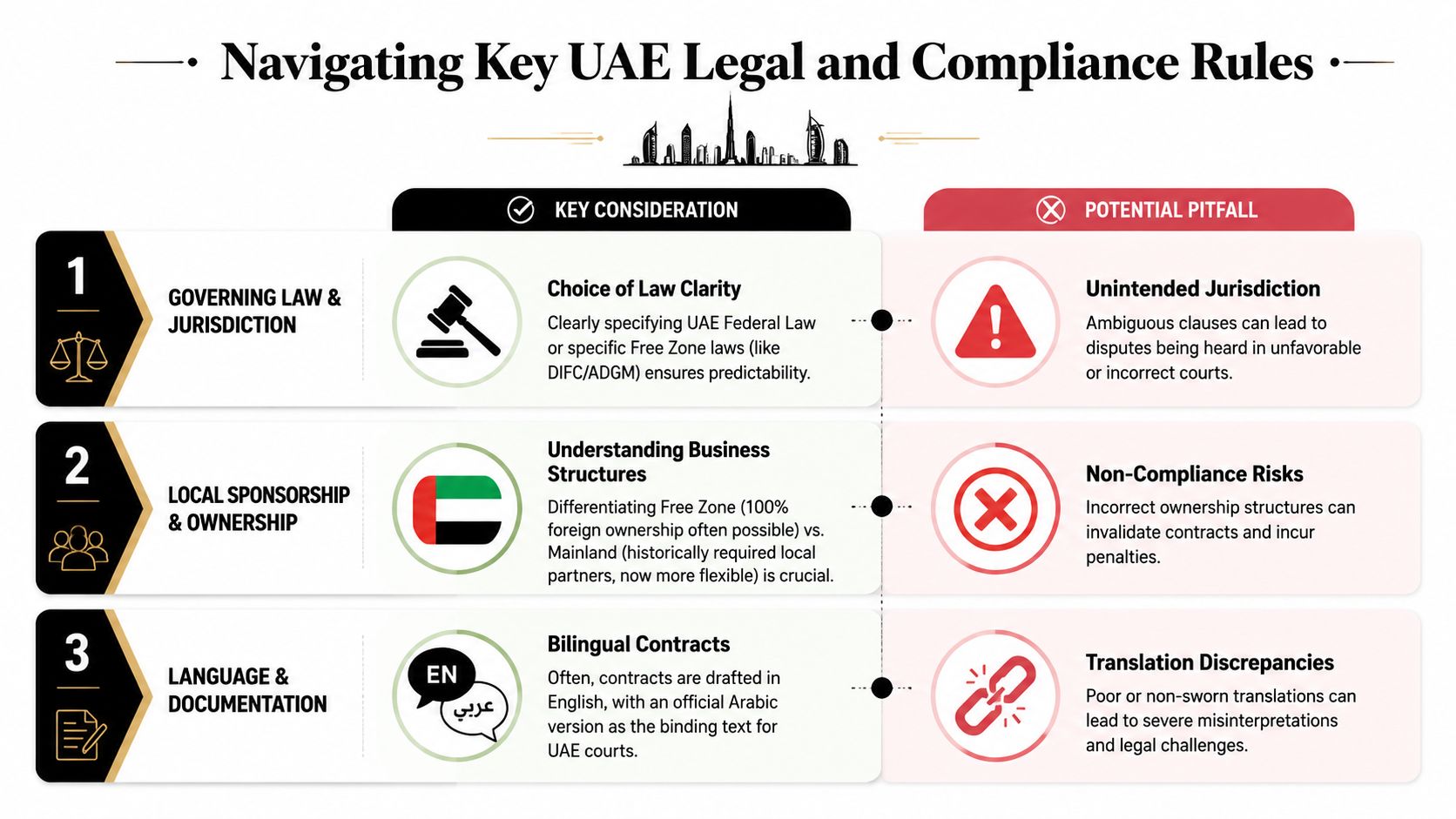
Foundational contracts
These sit under the business itself. If they're weak, later contracts inherit the problem.
Founder agreement
Useful when the business starts before roles, money, and ownership are fully settled. It should deal with decision-making, ownership expectations, responsibilities, and what happens if one founder exits early.Shareholder agreement
This becomes critical once ownership is split or investment is expected. The key issue is rarely the share split alone. It's voting, reserved matters, transfer restrictions, deadlock handling, and exit rights.Constitutional setup documents
These support the company's legal formation and structure. Founders often sign them during setup without thinking about how they interact with later shareholder rights or management powers. That gap causes confusion later, especially when investors or additional partners join.
If ownership is unclear at the beginning, every later success becomes harder to divide.
Operational contracts
Once the business is trading, these documents protect execution.
People and internal control
An employment contract should do more than confirm salary and role. It should align with the practical realities of confidentiality, duties, notice, handover, and access to client or company information. For senior hires, authority limits matter as much as compensation.
A non-disclosure agreement is often used too late. It should come before sensitive information is shared with consultants, freelancers, developers, distributors, or prospective partners.
Revenue and delivery
A client services agreement or sales agreement should define the commercial engine of the relationship. The most overlooked clause is often acceptance. If you don't state how work is accepted, a client can keep using the output while delaying approval and payment.
A service level agreement matters when ongoing performance is part of the deal. If response times, support windows, exclusions, or service credits are left vague, the provider's team ends up negotiating standards informally every week.
Suppliers, premises, and external relationships
A supplier contract should allocate quality expectations, delivery obligations, replacement rights, and payment triggers clearly. Small businesses often focus only on price and miss the operational consequences of delay or defective supply.
A commercial lease needs careful review because the business may depend on the premises for licensing, staffing, or customer access. Founders often look at rent first and miss fit-out obligations, use restrictions, renewal terms, and termination exposure.
A partnership, distribution, or joint venture agreement needs especially careful drafting in the UAE context because business relationships often span jurisdictions and operating structures. The contract should make responsibilities, branding rights, territory, exclusivity, and dispute pathways very clear.
Navigating Key UAE Legal and Compliance Rules
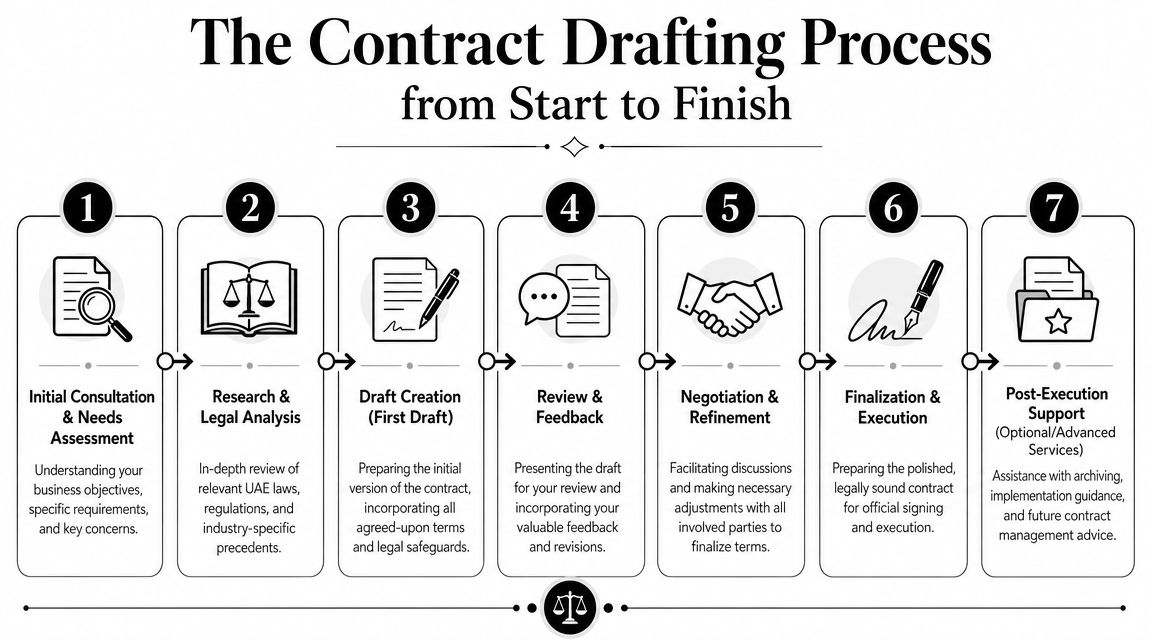
Many contract disputes in the UAE don't begin with bad intentions. They begin with assumptions. One side assumes the chosen court is obvious. Another assumes English wording will govern. Another assumes a digital signature is automatically enough for every context.
Those assumptions need to be tested before signature.
Mainland, free zone, and cross-border enforceability
A contract in the UAE should not treat governing law and jurisdiction as boilerplate. These provisions determine where disputes may be heard, which rules may apply, and how predictable enforcement may be.
This becomes important when the business setup, the assets, the staff, and the counterparty are not all in the same legal environment. A mainland operating company may sign with a free zone entity. A foreign parent may give instructions while the local company performs the work. If the agreement doesn't reflect that structure, the dispute clause may create more questions than answers.
The Dubai-focused legal overview published by Gates Shields notes that the UAE's GDP grew by about 3.6% in 2023 and highlights the country's strong position for foreign investment in West Asia. For founders and investors, that growth matters because more cross-border business usually means more contracts signed across mixed legal contexts.
Language and acceptance mechanics
English is widely used in business, but that doesn't remove the importance of language control. If a contract may need to be presented in an official setting, the wording needs to be consistent and deliberate from the start. Where bilingual drafting is appropriate, inconsistencies between versions can create real exposure.
Acceptance mechanics are just as important. Under the DIFC's Contract Law No. 6 of 2004, an agreement is concluded when valid offer and acceptance are communicated. The practical takeaway is simple. Don't leave acceptance vague. Define who can accept, how acceptance is given, and when it becomes effective.
Precision in acceptance clauses prevents a common problem: one side says the deal was final, the other says discussions were still open.
Electronic signatures and digital execution
The UAE recognises the legal standing of compliant electronic contracts and signatures under Federal Decree-Law No. 46 of 2021 on Electronic Transactions and Trust Services, as discussed in Sirion's contract drafting and review overview. For modern businesses, that's a practical advantage, especially when investors, founders, and counterparties are not in the same room.
But digital execution still needs process discipline. The contract should identify the correct parties, authorised signatories, signature sequence, and any documents that need accompanying resolutions or supporting authority records.
What works is a controlled execution process.
What doesn't work is emailing a final PDF around and hoping the signature trail can be reconstructed later.
The Contract Drafting Process from Start to Finish
A good drafting engagement is structured. It shouldn't feel mysterious, and it shouldn't begin with the drafter asking only, “Do you have a sample?”
The strongest process starts with the business deal, not the document.
How the work usually unfolds
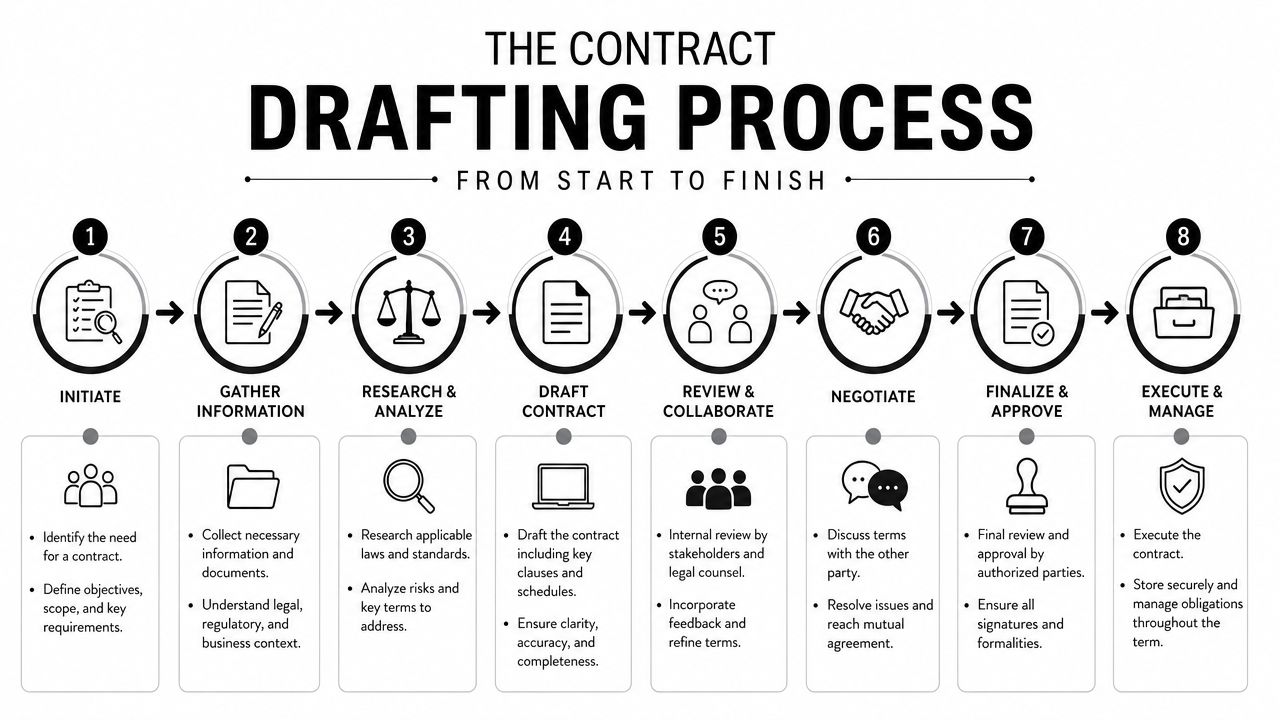
Commercial intake
The drafter needs to understand what you're selling, buying, hiring for, or investing in. If this stage is rushed, the draft will be technically neat but commercially wrong.Risk spotting
Practical issues are identified early. Payment delays, unlimited scope changes, weak confidentiality terms, unclear authority, and difficult exit scenarios usually surface at this stage.First draft preparation
The first draft should accurately reflect the operating model. It should avoid importing clauses from unrelated industries or foreign templates.Business review by the client
Founders often skip this and assume the draft is “legal”, so it must be right. That's a mistake. You need to test whether the obligations match how your team will perform.Negotiation and refinement
Most contracts improve here. This stage is less about aggressive wording and more about removing assumptions that would later cause friction.Execution and storage
Once signed, the document must be stored properly, with the final agreed version, annexures, and signature evidence kept together.
What a reliable provider should ask you
A serious drafter usually asks questions such as:
- Who is contracting. The founder, the local entity, the parent company, or an affiliate.
- What triggers payment. Time, milestones, delivery, or acceptance.
- Who has approval authority. On both sides.
- What happens if performance changes. Scope variation is one of the biggest practical gaps in service contracts.
- How the relationship ends. Immediate termination, notice periods, ongoing confidentiality, final invoices, and return of assets.
The draft is only half the job. The other half is making sure the signed version can be used by real people inside the business.
When this process is done properly, contract drafting services stop feeling like document production and start functioning as operating control.
Choosing Your Provider and Understanding the Costs
Not every provider solves the same problem.
Some founders need specialist legal drafting for a complex shareholder dispute risk, regulated arrangement, or major investment transaction. Others need a commercially sound set of operating agreements that align with setup, accounting, HR, and compliance reality in the UAE. The mistake is choosing based on price first and fit second.
What to evaluate before you hire
Use a short decision screen.
| What to check | Why it matters |
|---|---|
| UAE-specific experience | A provider should understand mainland and free zone realities, not just generic commercial wording |
| Commercial understanding | They should grasp how your revenue, staffing, and delivery model actually work |
| Execution awareness | A strong draft can still fail if signature authority, annexures, or language handling are sloppy |
| Communication style | If they can't explain risk clearly, you'll struggle during review and negotiation |
The UAE continues to attract foreign investors, and that makes local enforceability judgment more important. As noted earlier in the legal market context, buyers aren't just paying for a polished contract. They're paying for risk protection that works across the business environment they're entering.
Law firm, consultancy, or hybrid support
A law firm is usually the better fit where the matter is heavily negotiated, sensitive, or likely to become contentious. This often applies to shareholder arrangements, investment documents, major commercial disputes, or high-value strategic transactions.
A business consultancy with contract support can be a strong fit when the drafting sits inside a wider setup or compliance project. That works well for founders who need agreements to align with company formation, VAT processes, HR structure, and ongoing operations.
The right choice depends on the problem, not the label.
How fees are usually approached
Common pricing models include:
- Fixed fee for standard or clearly scoped documents
- Hourly billing for negotiations, multiple draft rounds, or uncertain scope
- Retainer support where the business needs recurring review across several agreements
Cheap drafting often costs more later because the omissions don't appear on invoice day. They appear when collection stalls, staff leave, or a partner disagrees about authority.
Ask the provider what is included, how many revision rounds are expected, whether negotiation support is part of the fee, and whether execution support is included. If those answers are vague, the scope probably is too.
Frequently Asked Questions About UAE Contracts
Can I use a contract template from another country
You can, but you shouldn't rely on it without review.
A foreign template may ignore UAE execution practice, local compliance concerns, language issues, or tax-sensitive wording. It may also include clauses that look strong but don't fit how your UAE entity operates. Templates are a drafting aid, not a finished solution.
Are electronic signatures acceptable in the UAE
Yes, compliant electronic contracts and signatures have legal standing in the UAE, as covered earlier. The practical issue is less about whether digital signing exists and more about whether the signing process, signatory authority, and document control were handled properly.
Do all founders need a shareholder or founder agreement
If more than one person is involved in ownership, management, or early contribution, some form of structured agreement is usually wise. The risk isn't only disagreement. The bigger issue is that informal understandings rarely deal well with exit, dilution, decision deadlock, or unequal contributions over time.
What clauses matter most in a service agreement
The most important clauses are usually the least glamorous:
- Scope and exclusions so work doesn't expand informally
- Fees and invoicing so payment timing is clear
- Acceptance and sign-off so approval can't be delayed without consequence
- Termination rights so either side knows how the relationship can end
- Liability and confidentiality so commercial damage is controlled
If those are weak, the rest of the document often won't save the relationship.
Why should VAT and tax issues affect contract drafting
Because the contract shapes how the transaction is described, invoiced, and performed.
The UAE-focused legal note on contract drafting and review points out that UAE VAT is 5% and that contracts increasingly need to account for tax and compliance issues, including service delivery, invoicing, agency structures, and economic substance considerations. A generic template often misses those downstream effects.
Is the goal simply to make the contract enforceable
No. Enforceability matters, but that's the floor, not the ceiling.
A good UAE contract should also help your team run the relationship properly. It should reduce day-to-day confusion, support clean invoicing, define authority, and avoid accidental compliance problems. The best contracts are the ones you rarely have to argue about because they were practical from the beginning.
If you're setting up, expanding, or tightening your commercial documents in the UAE, Smart Classic Business Hub can help you align contract support with the wider realities of company formation, VAT compliance, PRO work, and business operations, so your agreements protect the investment you're making in the market.