
Most founders start by searching for a UAE company liquidation checklist. That's usually the wrong first move. The paperwork only works when you've chosen the correct legal route, and a solvent mainland company, a free-zone entity with employees, and a distressed trading business don't belong on the same checklist.
The practical decision is simple: establish whether the company can settle its liabilities, employee entitlements, tax obligations, and government charges. If it can, a voluntary closure or strike-off may be appropriate. If it can't, treating the case as a clean administrative cancellation can expose shareholders, directors, and creditors to avoidable risk. UAE company liquidation services should therefore begin with a financial and jurisdictional diagnosis, not a form.
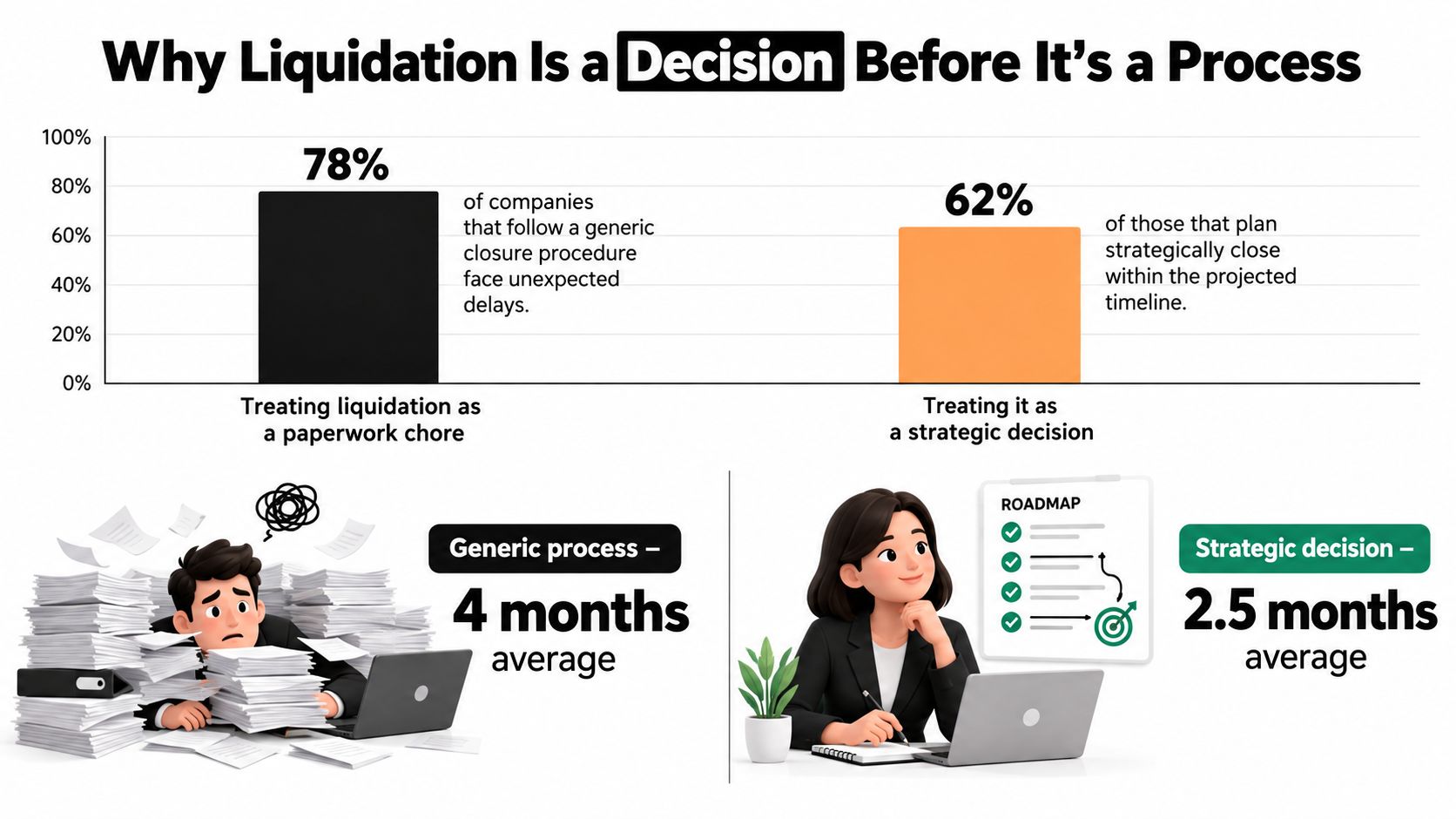
Why Liquidation Is a Decision Before It's a Process
Liquidation is often presented as a filing exercise. In Dubai, that approach causes trouble because the closure route depends on the company's solvency, liabilities, employees, tax position, licence authority, and unresolved disputes. A founder who submits a generic cancellation request before checking those factors may create rework, incur additional fees, or select a route that cannot legally address the company's debts.
Start with the balance sheet. Can the company pay its known creditors and complete its employee, tax, banking, lease, and government obligations? If yes, voluntary liquidation or an authority-led strike-off may be available, subject to the relevant regulator's requirements. If no, the company needs insolvency advice rather than a simple licence cancellation.
The UAE's formal insolvency framework makes this distinction particularly important. Under Federal Decree-Law No. 51 of 2023, a debtor may need to apply to the court to begin insolvency and liquidation procedures after it has stopped paying due debts for more than 50 consecutive working days. A creditor or group of creditors may also initiate the process where the unpaid claim is at least AED 200,000, following a 50-working-day notice period. The law was published on 29 November 2023 and came into force three months later, making it a recent milestone in the UAE's corporate exit framework.
The four checks before any application
- Solvency: Confirm whether all due and reasonably identifiable liabilities can be settled.
- People: Review visas, work permits, unpaid salary, end-of-service benefits, and labour disputes.
- Tax: Check VAT filings, deregistration status, corporate tax obligations, and any Federal Tax Authority correspondence.
- Jurisdiction: Identify whether the entity is mainland, free zone, or offshore, then confirm that authority's closure mechanism.
Visa status can change the order of work. Pending VAT filings can block tax clearance. A labour dispute can prevent the company from reaching final deregistration. A bank account with compliance restrictions can delay the last distribution or closure confirmation.
Practical rule: Don't ask a liquidation provider for a price until the provider has reviewed the company's liabilities and licence jurisdiction.
The correct route also affects director exposure and creditor treatment. A solvent business can organise an orderly exit and preserve evidence that obligations were addressed. A distressed business must move quickly, document its position, and avoid using strike-off as a substitute for insolvency proceedings.
Matching Your Company to the Right Closure Track
The regulator on the licence determines the practical workflow. A mainland company doesn't close in the same way as a DMCC entity, and an offshore company shouldn't automatically be pushed through a mainland-style liquidation file.
| Jurisdiction | Regulator / Authority | Governing Law | Typical Closure Mechanism |
|---|---|---|---|
| Mainland | Department of Economy and Tourism or relevant emirate authority, with federal clearances | UAE commercial companies and insolvency framework | Voluntary liquidation, strike-off where permitted, or insolvency-led liquidation |
| Free zone | The relevant free-zone registrar, such as DMCC, JAFZA, RAKEZ, IFZA, Shams, ADGM, or DIFC | Authority-specific regulations and procedural guidance | Portal-led closure, liquidation, deregistration, or strike-off |
| Offshore | Offshore registrar, such as JAFZA Offshore, RAK ICC, or Ajman offshore structures | Offshore company regulations and registrar rules | Strike-off, de-registration, or formal winding-up where required |
Mainland companies need a broader clearance map
Mainland files commonly involve the local economic department, labour authorities, immigration, tax administration, utilities, banks, landlords, and other counterparties. The exact clearance list depends on the company's activities, branches, employees, and premises. A company with several branches or regulated activities has more closure dependencies than a dormant entity with no staff.
Free zones operate as separate systems
Free zones have their own portals, forms, fee schedules, authorised signatory requirements, and document formats. Some require a liquidator; others may allow an authority-led closure for a clean entity. DIFC and ADGM are not alternative Dubai licensing counters, either. Their insolvency regimes contain structured legal pathways, including non-insolvent winding-up.
The ADGM Insolvency Regulations 2022 were enacted on 29 August 2022 and cover company insolvency and winding-up, including non-insolvent winding-up. In DIFC practice, a company may remain in liquidation for one to three years, depending on its size and complexity, as reflected in DIFC insolvency guidance.
Offshore structures may have the simplest route
An offshore entity with no liabilities, pending claims, or unresolved obligations may qualify for strike-off or de-registration instead of a full winding-up. That route isn't a shortcut around creditors. It's suitable only when the company's records and obligations support it.
Before signing anything, match the licence number to the regulator, confirm the authorised signatory, and ask for the authority's current closure checklist. That one exercise prevents many re-submissions.
How Mainland Liquidation Actually Works
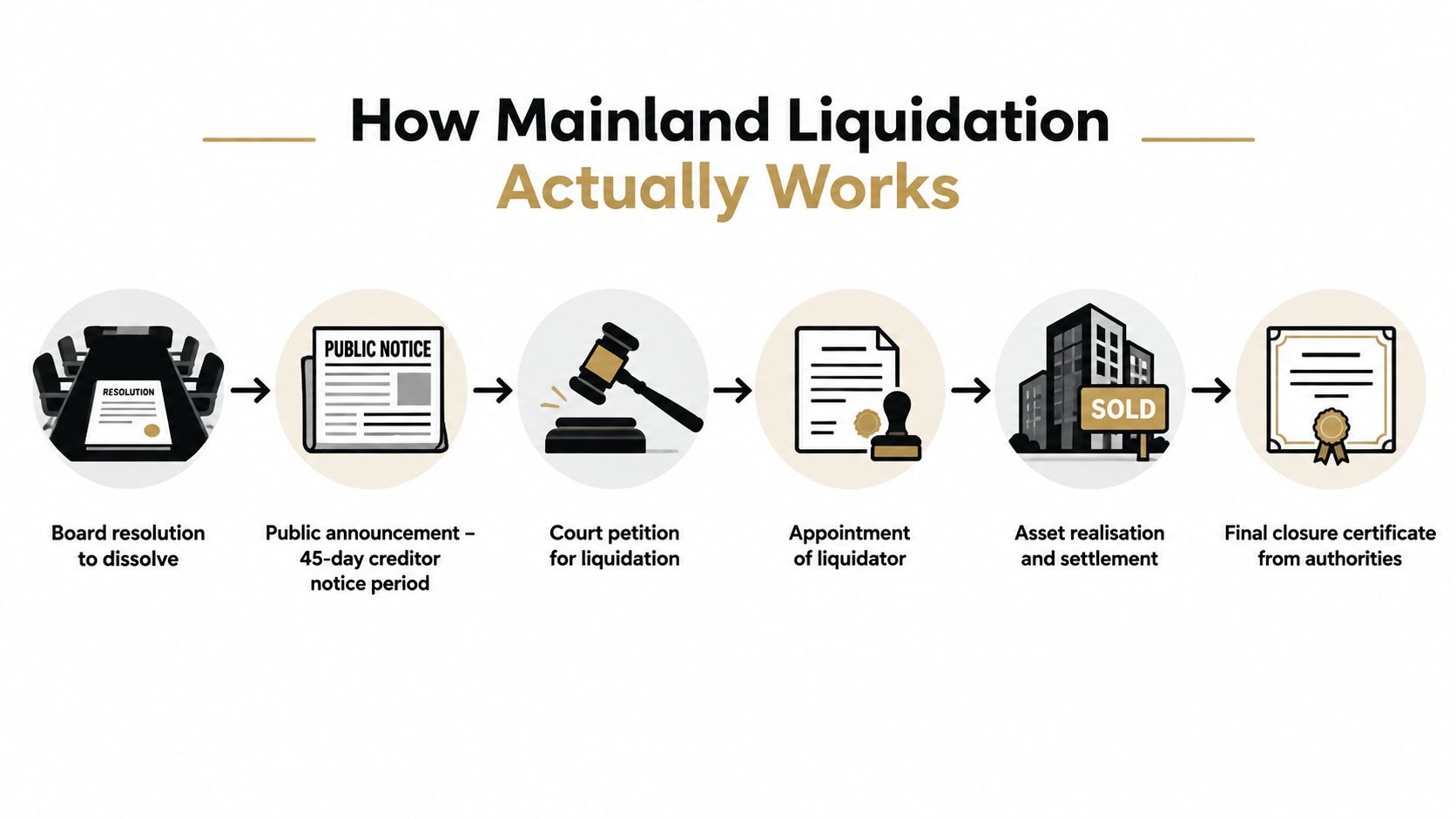
A mainland liquidation file moves through a sequence of corporate, publication, clearance, tax, and deregistration actions. The order matters. A founder can have settled the company's commercial debts and still face delay because a labour, tax, landlord, utility, or bank clearance is missing.
The shareholders first approve a notarised liquidation resolution and appoint a registered liquidator. The appointment isn't ceremonial. The liquidator becomes responsible for reviewing the company's position, handling creditor matters, preparing the required reports, and progressing the closure file. The authority then issues the relevant provisional liquidation certificate or acceptance, subject to the emirate and entity structure.
The company publishes a liquidation notice in two local newspapers, one in English and one in Arabic, creating a 45-day creditor notice period under the practical mainland workflow described in Dubai's business closure guidance. During that window, the liquidator gathers creditor statements, checks claims, and resolves objections.
The clearance layer causes most practical delays
After the notice period, the file moves through the obligations that founders often underestimate:
- Employees: Settle salary, end-of-service benefits, work permits, and visa cancellations through the relevant labour and immigration channels.
- Tax: Complete final VAT filings and deregistration, then address corporate tax deregistration and any FTA clearance requirement.
- Premises: Obtain landlord, Ejari, telecom, and utility confirmations where applicable.
- Banking: Settle outstanding charges, remove restrictions, and close the corporate bank account.
- Licensing: Clear branch licences, activities, permits, and any additional approvals linked to the trade licence.
- Reporting: Prepare the final liquidator report, accounts, audit materials, and deregistration application.
The Dubai closure process also shows why cancellation isn't a single-counter exercise. Each authority confirms a different part of the company's existence. A missing NOC can stop the file even after creditors have been paid.
The company isn't closed because operations stopped. It's closed when the authority accepts the final report and cancels the legal registration.
If the company has persistent payment failure, the matter may move beyond voluntary liquidation. Under the UAE insolvency framework cited earlier, exceeding 50 consecutive working days of non-payment due to incapacity can create a court application trigger. Court-supervised work adds procedural complexity, asset realisation, creditor distributions, and oversight.
That's why mainland founders should separate a clean solvent closure from a distressed liquidation at the first meeting. The next question is whether the free-zone authority can offer a more direct portal-led route.
Free Zone and Offshore Closure Mechanics
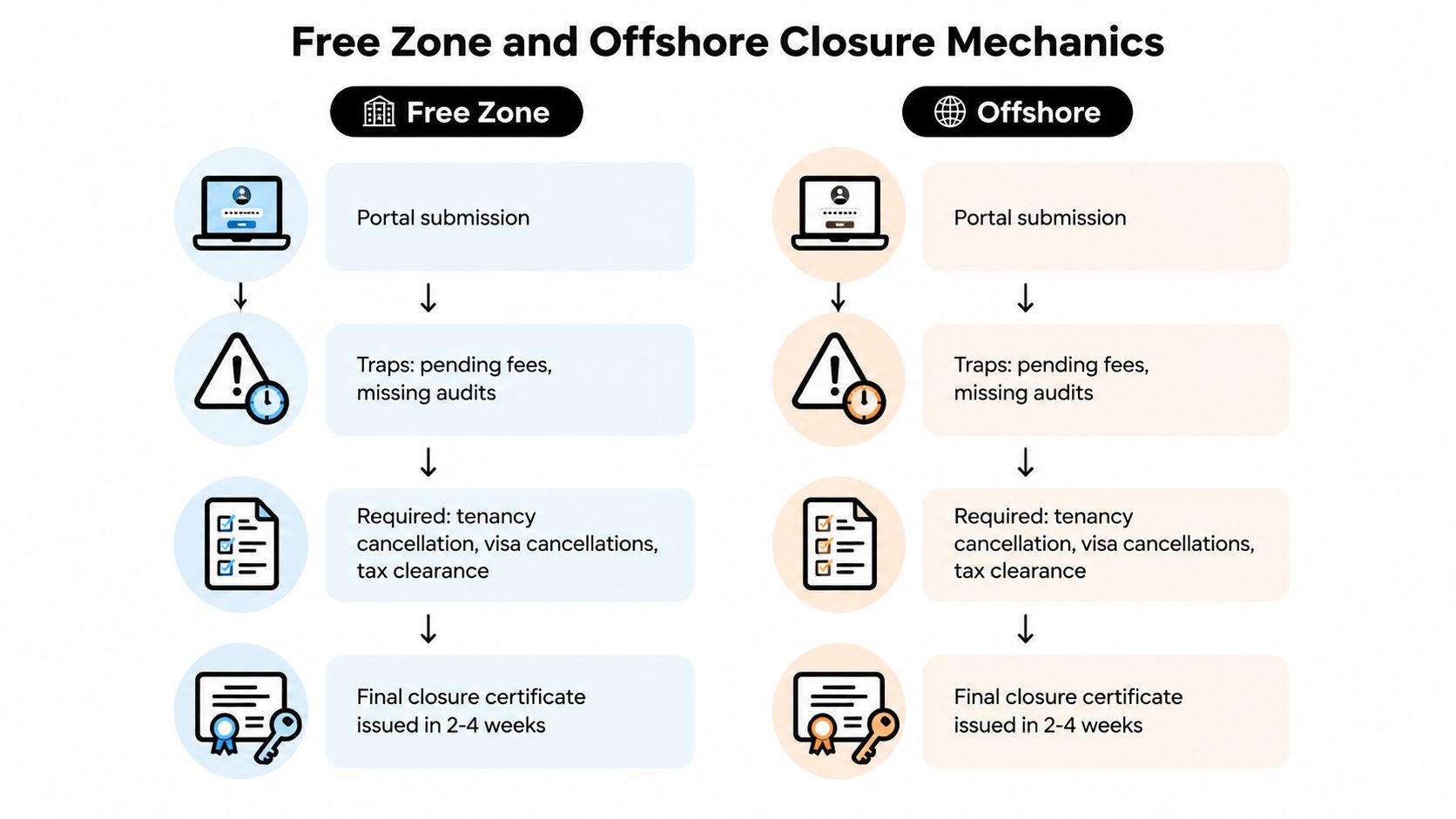
Free-zone closures feel more digital because many authorities manage applications through online portals. The digital interface doesn't remove the underlying obligations. It changes where the documents are submitted and which regulator controls the sequence.
A typical free-zone file begins with a shareholder or board resolution, followed by the authority's NOC or preliminary acceptance. The company then handles liquidator requirements, tax clearance, employee settlements, lease cancellation, and the final submission through the relevant portal. DIFC, ADGM, JAFZA, DMCC, RAKEZ, and other free zones each apply their own procedures, so a checklist from one authority can be misleading when used for another.
Free-zone files are authority-specific
A free-zone company may need:
- A valid resolution: The document must follow the authority's signing and attestation rules.
- A clean account: Outstanding renewal fees, penalties, or registrar charges can block submission.
- A tax position: Final VAT filings and deregistration, plus corporate tax deregistration where applicable, must be addressed.
- An employee file: Work permits, visas, salary obligations, and end-of-service amounts must be settled.
- A premises exit: Lease and tenancy records need to be cancelled or cleared.
- A final report: Some authorities require an audit or liquidator report before issuing the closure certificate.
The UAE liquidation checklist covering audit and tax deregistration highlights the importance of sequencing VAT deregistration, corporate tax deregistration, labour and visa cancellations, and final reporting. The practical lesson is direct: don't cancel the trade licence first and hope the remaining clearances sort themselves out.
Offshore strike-off has a narrow use case
An offshore company may qualify for strike-off or de-registration without a full winding-up. That option suits a company with no outstanding liabilities, creditor claims, employee obligations, or unresolved disputes. It isn't appropriate for an entity that owes money or has transferred assets without proper records.
Free-zone and offshore closures can therefore be faster in a clean file, but they're unforgiving when a required document is missing. The authority may return the application, and the founder then loses time correcting the issue, renewing documents, or obtaining an NOC that should have been secured earlier.
Timelines, Costs, and Where Budgets Slip
Budgeting for liquidation means pricing both the official charges and the delay risk. A low service quote may cover document preparation but exclude the audit, newspaper notice, tax work, employee settlement, translations, attestations, or authority penalties that arise during the file.
Published Dubai guidance commonly places mainland company closures at a minimum of 45 to 60 days, while free-zone closures are often 30 to 60 working days, depending on the authority and complexity, as summarised in this Dubai company closure guide. Other UAE guidance describes mainland liquidation as taking roughly three to six months, with DIFC and ADGM matters potentially extending to 12 months, depending on the structure and outstanding work.
| Jurisdiction | Typical Timeline | Estimated Cost Range (AED) | Common Hidden Costs |
|---|---|---|---|
| Mainland | At least 45 to 60 days for a clean administrative closure, with complex liquidations taking longer | A few thousand dirhams to AED 15,000–20,000+ depending on structure and requirements | Liquidator fees, newspaper notices, audits, tax work, employee settlements, NOCs, bank and lease closure |
| Free zone | Often 30 to 60 working days, subject to authority and complexity | A few thousand dirhams to AED 15,000–20,000+ depending on the authority and file | Portal fees, penalties, audit, visa cancellation, tax deregistration, translation, authority-specific clearances |
| DIFC or ADGM | Can extend substantially for complex or supervised matters, with practical guidance indicating up to 12 months in some cases | Depends on assets, creditors, liquidator scope, reporting, and authority fees | Professional fees, creditor work, asset realisation, court or registrar requirements |
| Offshore | Strike-off or de-registration may be available for a clean entity | Depends on the registrar, filings, outstanding fees, and professional support | Annual dues, registered agent charges, nominee or document issues, claims, reinstatement risk |
The UAE liquidation cost and route overview confirms that public guides place liquidation costs from a few thousand dirhams to AED 15,000–20,000+, with the final figure shaped by mainland versus free zone, liquidator charges, notices, audits, and deregistration work.
Where the quote stops being the final bill
Unfiled VAT returns can create an FTA block. Unpaid labour cards can prevent visa cancellation. Utilities and telecom accounts may remain open. A bank can delay closure while it completes compliance checks. Final accounts may require an audit before the regulator accepts the report.
Ask for a written scope that separates government fees, liquidator fees, audit, tax, publication, translations, employee work, and clearance follow-up. Don't compare providers on the headline number alone. Compare what happens when the file meets a problem.
Real Scenarios and the Pitfalls That Derail Them
The closure route becomes clearer when you look at the facts founders usually bring to the first consultation.
A solvent mainland consultancy
Two shareholders operate a mainland LLC with no employees and no known creditors. The right starting point is a solvent voluntary closure assessment, followed by the resolution, liquidator appointment where required, notice, clearances, final reporting, and licence cancellation.
The danger is assuming that “no employees” means “no final accounts”. If the authority or liquidator requires audit or final financial reporting, skipping that work can send the file back for correction. The avoidable pitfall was failing to confirm the complete authority checklist before submitting.
A free-zone technology startup
The business has no commercial debt, but it still has employees with active visas and work permits. The founder wants to cancel the licence immediately, yet the employment file remains open.
The practical answer is to calculate settlements, cancel permits and visas in the correct order, clear the lease and authority account, and then submit the closure file. Starting with the trade licence cancellation can leave the founder chasing documents after the company's operating permissions have changed. The issue isn't insolvency. It's poor sequencing.
A trading company with unpaid creditors
A trading company has bounced cheques, disputed invoices, and creditor claims. A strike-off application would not solve those liabilities. The company needs a legal assessment under the UAE insolvency framework and may require court-supervised liquidation, where the liquidator handles creditor claims and asset realisation.
The Federal Decree-Law No. 51 of 2023 provides the relevant framework for court-triggered insolvency action, including the 50-working-day non-payment threshold and the AED 200,000 creditor threshold after notice. The pitfall was treating a distressed company like a dormant one.
When Professional Liquidation Support Changes the Outcome
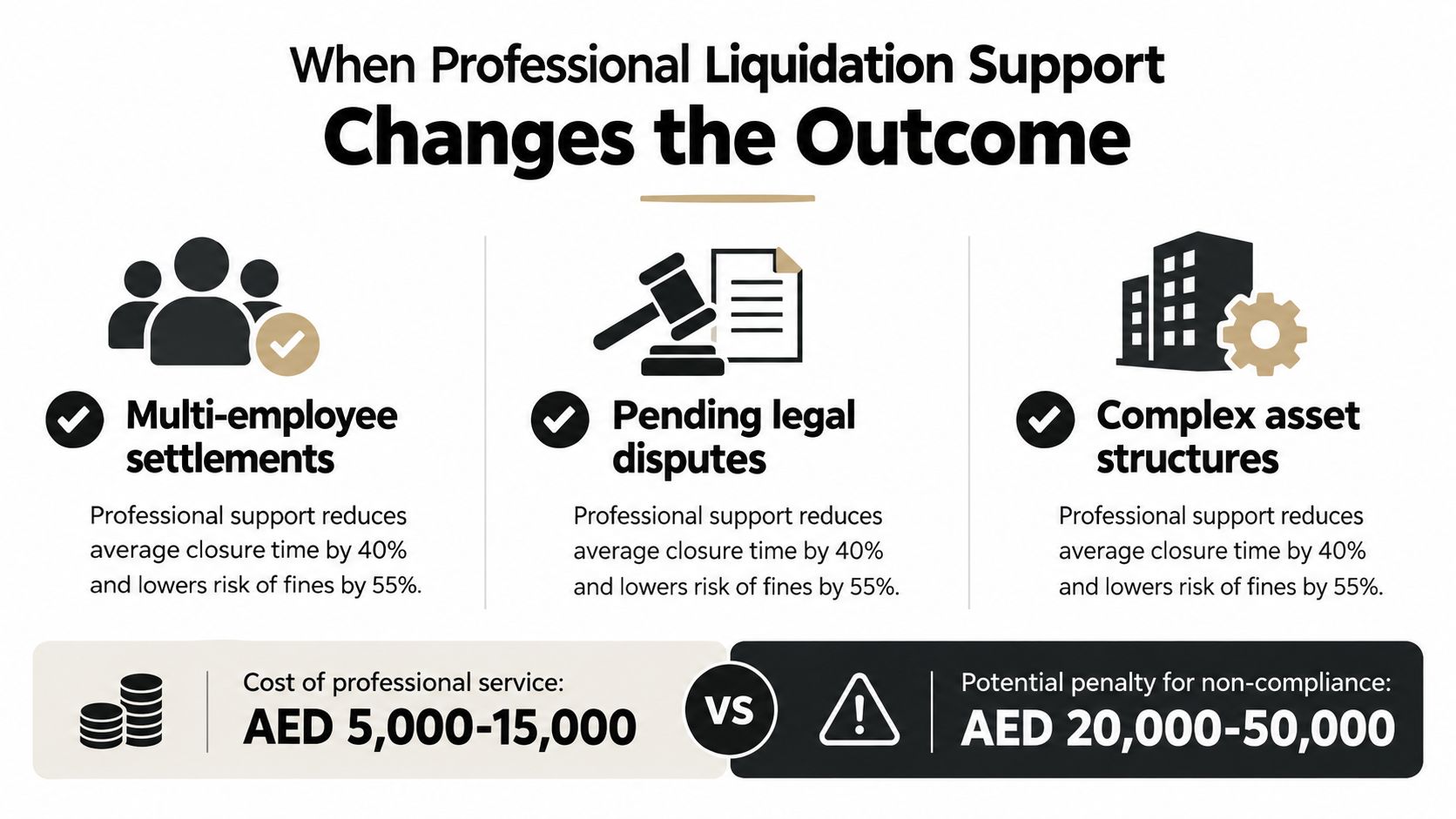
Professional liquidation services make sense when the file contains several moving parts and a founder can't personally control the sequence. This isn't a convenience upgrade. It's a risk-pricing decision.
The fee is easier to justify when the company has:
- Several employees: Settlements, work permits, visa cancellations, and gratuity disputes can interact.
- Tax exposure: Accumulated VAT filings, corporate tax deregistration, or an FTA review can block final closure.
- Free-zone penalties: Late renewal charges and authority-specific compliance issues may need resolution before the portal accepts the file.
- Creditor involvement: Claims, bounced payments, disputed liabilities, or payment incapacity require insolvency-sensitive advice.
- Complex records: Multiple branches, landlords, bank accounts, activities, or missing documents increase the chance of re-submission.
A capable provider reviews the company before promising a timeline. The work should include document preparation, authority coordination, tax and compliance follow-up, employee and landlord clearance support, liquidator coordination where required, and final deregistration administration. The Dubai business closure process makes clear why these tasks span several authorities rather than one cancellation counter.
The strongest provider will also tell you when the proposed route is wrong. If the company is insolvent, it shouldn't package court-sensitive liabilities as a routine strike-off. If it's solvent, it shouldn't push you into a heavier process without a reason.
Engage support as soon as one of four triggers appears: unpaid creditors, unresolved employee obligations, tax or audit exposure, or uncertainty about the regulator's closure route. Smart Classic Business Hub offers document review, authority coordination, tax and compliance follow-up, clearances, and final deregistration support for UAE company liquidation. Visit Smart Classic Business Hub to discuss your company's solvency, jurisdiction, and closure path before submitting an application.