
Dubai mainland company liquidation starts with an administrative baseline of about AED 4,060, but a realistic total budget typically runs AED 8,000 to AED 50,000 or more once liquidator, tax and liability work is included. The lower figure covers specified government charges, not the complete cost of closing a company.
That distinction catches founders out. A licence-cancellation quote can look small while leaving the liquidator's report, tax filings, employee dues and creditor settlements outside the scope. In practice, the company liquidation cost depends less on the cancellation form than on how cleanly the business can settle its affairs.
What Company Liquidation Cost Actually Covers in the UAE
Company liquidation is a compliance stack, not a licence-cancellation fee. The budget covers authority charges, professional work, tax closure, operational clearances and outstanding liabilities. Dubai's AED 4,060 administrative benchmark covers only part of that work, so founders should budget for the full closure process rather than rely on a headline cancellation price.
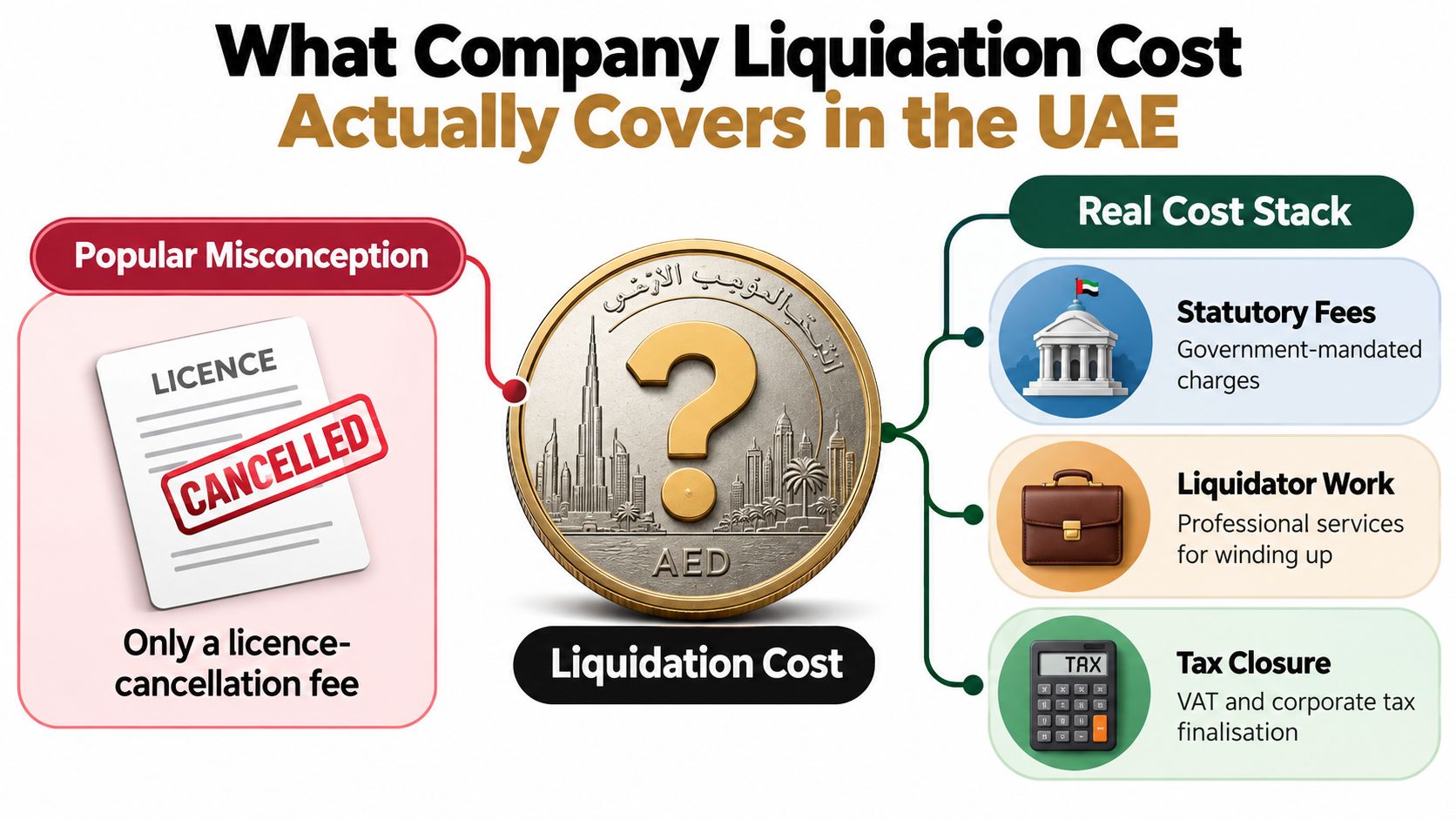
Separate the budget into three layers:
- Fixed authority charges: Government fees for dissolution, licence cancellation and related filings.
- Professional and process costs: Liquidator or auditor work, publication, PRO coordination, accounting and tax preparation.
- Company liabilities: Employee end-of-service benefits, unpaid rent, supplier balances, bank obligations, fines and tax penalties.
Liabilities are not service fees, but they still determine how much cash the company needs to close. A business with no employees, debts or unresolved filings takes less work than one with creditor disputes, overdue returns or incomplete books. The same licence type can therefore produce very different quotes.
The tax tail also matters. Tax filings and deregistration work may remain after the company has begun its closure, so a budget limited to authority charges can leave founders short of funds. Ask the provider to itemise each layer, identify exclusions and confirm whether creditor settlements and tax work are included. A quote that lists only cancellation charges is not a complete liquidation budget. For a broader perspective on closure planning, see Everglow Prosperity on company closure.
Statutory Fees and Authority Charges
Authority charges form the most predictable part of a liquidation budget, but the amount depends on the jurisdiction and its filing requirements. For Dubai mainland companies, the stated administrative component is approximately AED 4,060: AED 520 for the dissolution and liquidator-appointment certificate, AED 1,020 for trade-licence cancellation, and AED 2,520 for company dissolution. This is a benchmark for government charges, not the company's full closure bill. Dubai mainland fee guidance provides the breakdown.
Free zones set their own fees and procedures. Dubai Development Authority, for example, lists an FZ-LLC deregistration service fee of AED 1,500, plus AED 10 Knowledge Dirham and AED 10 Innovation Dirham. The filing also involves supporting documents and clearances. Its FZ-LLC deregistration requirements specify a members' resolution, auditor confirmation, English and Arabic newspaper advertisements, and Dubai Customs clearance where applicable. Budget for these requirements separately from the authority's service fee.
| Item | Mainland (Dubai) | Free Zone (FZ-LLC example) | Offshore |
|---|---|---|---|
| Authority or registry charge | Approximately AED 4,060 for the stated administrative components | AED 1,500 service fee, plus AED 10 Knowledge Dirham and AED 10 Innovation Dirham | Varies by registrar |
| Supporting requirements | Dissolution, licence cancellation and related filings | Resolution, auditor confirmation, advertisements and applicable clearances | Confirm the registrar's specific closure requirements |
| What the amount represents | Administrative benchmark, not total liquidation cost | Service and levy charges, not professional or liability costs | Authority charges only, where separately quoted |
No offshore fee schedule is established by these figures. Get the registrar's written charges before budgeting, rather than assuming an offshore closure costs less. For any jurisdiction, require a quote that separates authority charges from professional fees and disbursements. That breakdown shows which amounts are fixed and which may change after the company's records and obligations are reviewed.
Liquidator, Auditor, and PRO Service Fees
Professional fees turn liquidation into a compliance stack, not just a licence-cancellation task. Liquidator work may cost AED 3,000 to AED 15,000, while newspaper publication can add AED 1,500 to AED 5,000. These are indicative market estimates, not a fixed quote for every company. Dubai liquidation market estimates
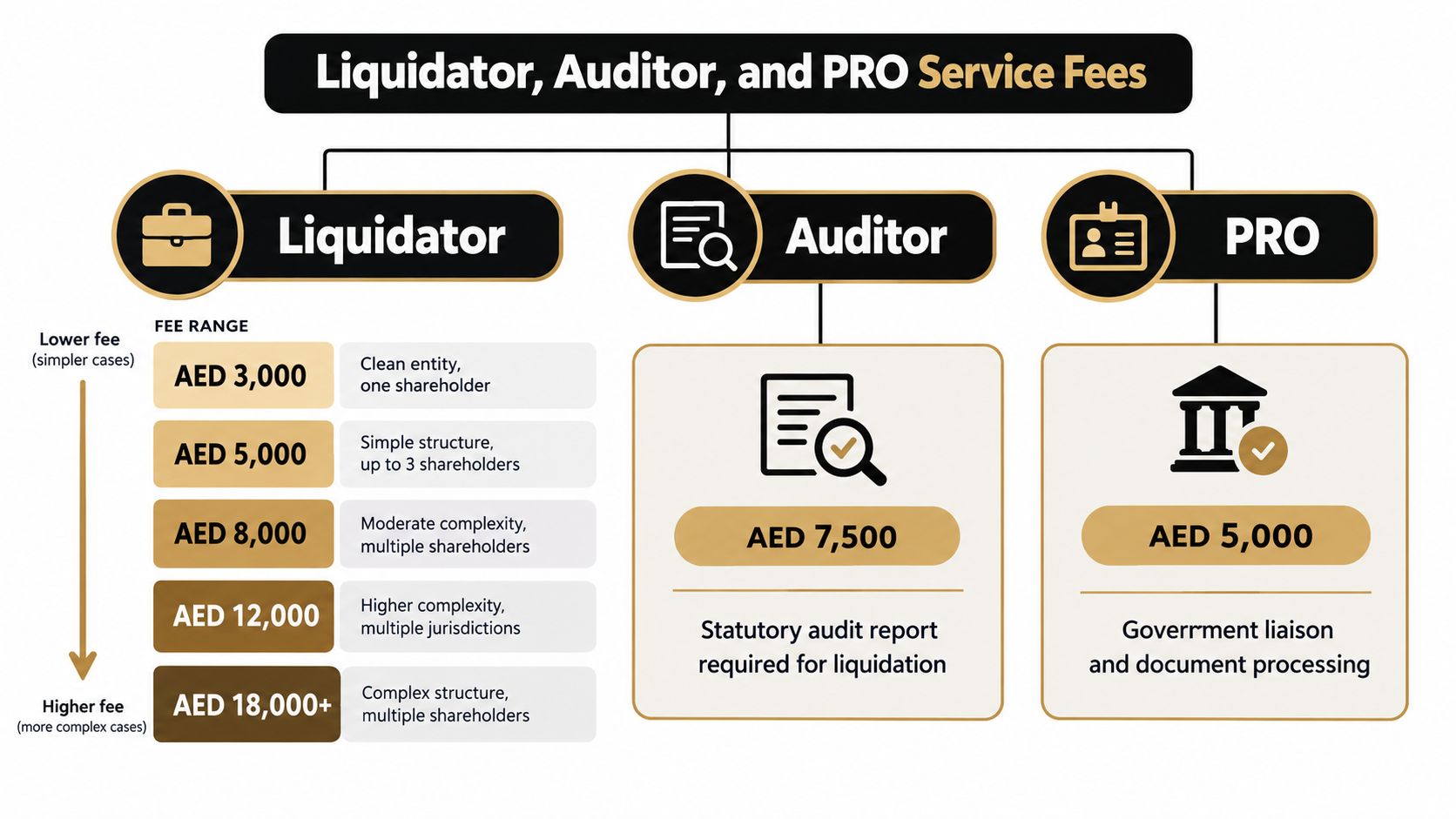
The company's condition drives the bill. Orderly records and no disputed claims usually mean less liquidator work. Reviewing assets, liabilities, creditor claims, or a possible court process calls for more time and judgement. Complexity, not just licence type, drives the professional bill.
Auditor and PRO work may be charged separately. Some free-zone procedures require an auditor confirmation letter, and PRO support may cover labour, immigration, and authority paperwork. Ask for each deliverable and its fee to be listed; “liquidation service” alone does not show what is included. For audit or financial reporting support, compare the scope of Smart Classic's audit and advisory services with the work your company needs.
Practical rule: Get the liquidator's identity, auditor deliverables, publication costs, and PRO scope in writing before appointing anyone. Confirm what triggers extra fees, including missing records, creditor questions, or delayed clearances.
Compare quotes by completed work, excluded third-party costs, and the rate for additional tasks, not by the opening price. A low initial fee can leave publication, auditor confirmation, and coordination outside the quote. Require a written breakdown that separates fixed charges from work that depends on the company's records and creditor position. That is how to judge the full professional cost before the file progresses.
VAT and Corporate Tax Closure Costs
Tax closure is one of the easiest parts of a liquidation to under-budget because it depends on the company's filing history, not just its licence. For VAT, the final return and payable tax are due no later than 28 days from the effective deregistration date. The FTA also requires outstanding returns, tax liabilities and administrative penalties to be settled before approving deregistration. Federal Tax Authority VAT deregistration guidance sets out the closure requirements.
Where mandatory VAT deregistration is late, the stated penalty is AED 1,000, with the same amount applying monthly thereafter up to AED 10,000. A separate requirement is to submit a mandatory deregistration application within 30 business days of the obligation arising. These deadlines make timing a cost issue: a company that delays may face penalties as well as extra professional time to reconcile its records and complete filings.
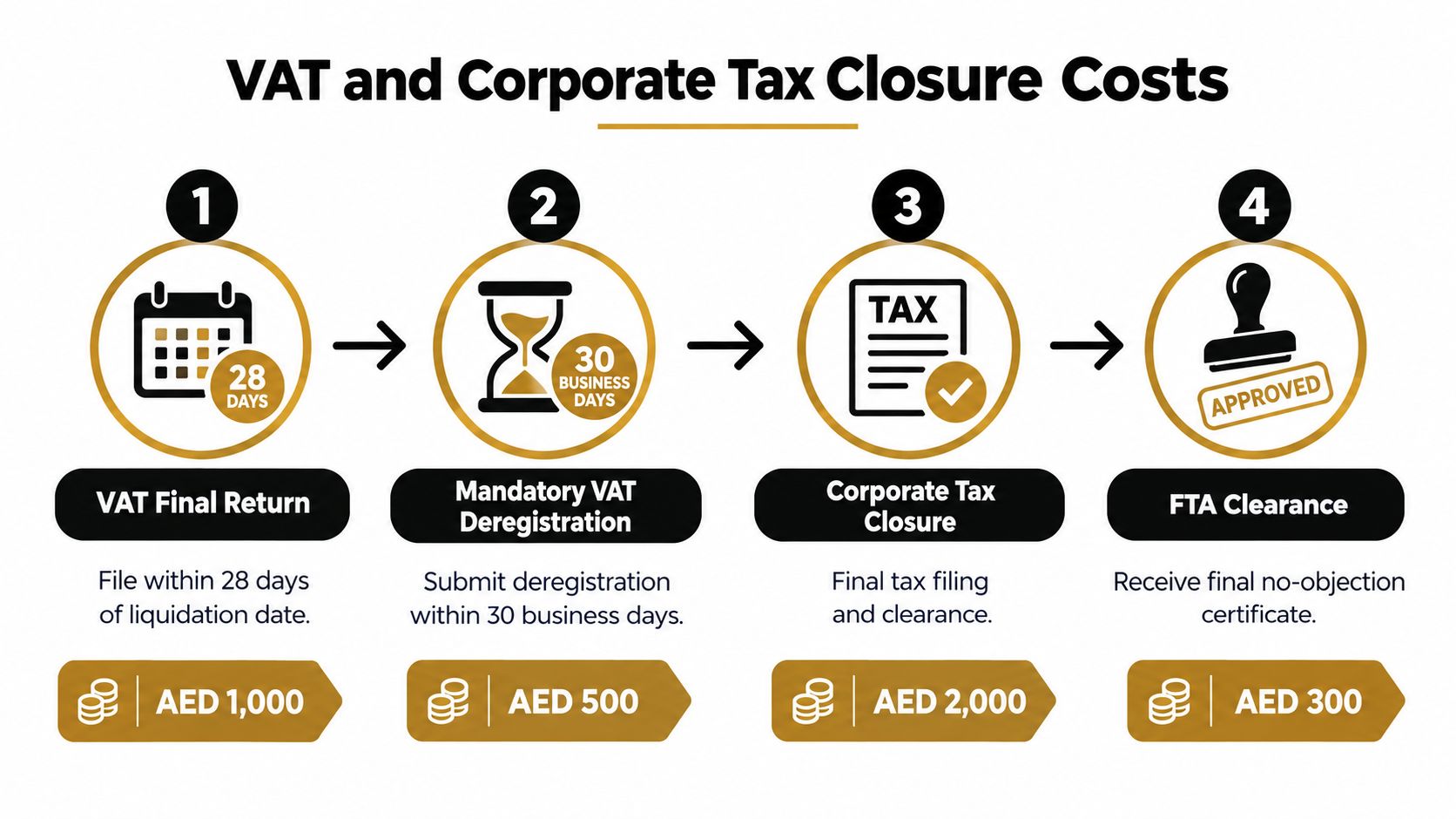
Corporate Tax has its own closure steps. A company must submit a Corporate Tax deregistration application within three months of cessation, dissolution or liquidation and settle all required returns, liabilities and administrative penalties. Don't assume that ending business activity or cancelling the licence automatically completes tax deregistration.
A sensible tax budget allows for ledger reconciliation, preparation of final returns, settlement of outstanding tax and a contingency for penalties. If the books are incomplete, accountants may need to trace transactions and correct records before they can produce reliable filings. Businesses reviewing their readiness can use Smart Classic's UAE VAT filing guidance alongside practical tax audit preparation advice, particularly where supporting records need attention.
Mainland, Free Zone, and Offshore Compared
The jurisdiction sets the closure process, but the total bill depends on more than the authority's fee. Compare each structure by its timeline, publication rules, auditor involvement and the professional work needed to settle tax, creditors and records. Those variable costs can outweigh the fixed authority charge.
Mainland closures include a creditor-notification stage, so outstanding claims and operational clearances affect how quickly a company can close. Budget for the time needed to resolve them, not just the licence cancellation. The required steps vary with the company's circumstances.
Free-zone authorities set their own filing and evidence requirements. Some may require auditor confirmation or public notices; others may require clearances tied to the company's activities. Ask for an itemised quote that identifies the relevant authority's requirements and any accounting, audit or PRO work. Smart Classic's mainland and free-zone comparison provides useful context when comparing the structures.
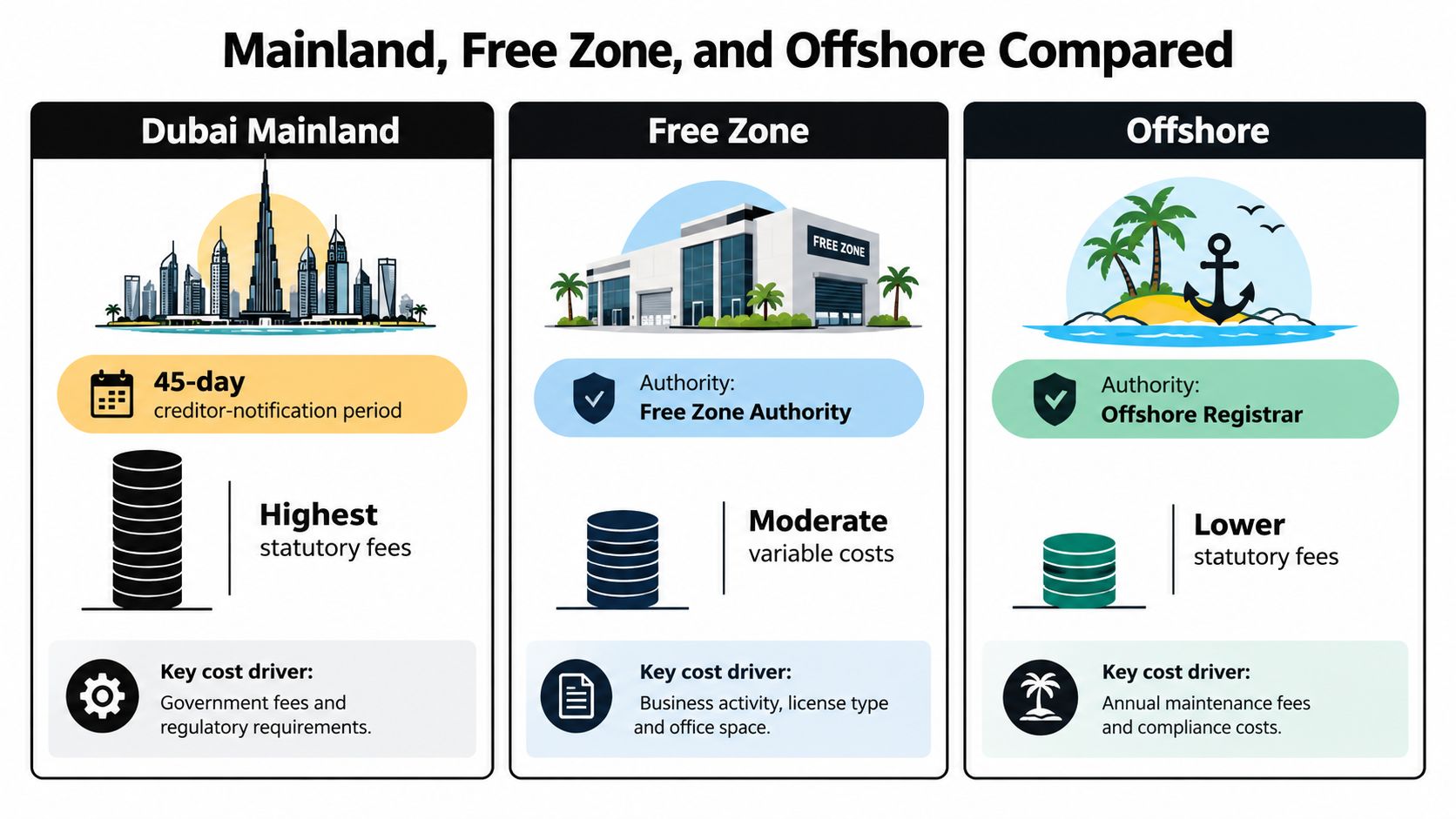
Offshore entities may face fewer authority steps, but a lower registrar charge does not settle the company's affairs. Professional support, applicable tax deregistration and documented liability settlement can still add cost. Check the full closure scope before treating an offshore quote as cheaper.
| Jurisdiction | Main process consideration | Cost profile |
|---|---|---|
| Dubai mainland | Creditor notification and operational clearances | Higher stated administrative baseline, plus variable professional and liability costs |
| Free zone | Authority-specific filings, publication and possible auditor involvement | Authority charges vary, and reports or clearances can add work |
| Offshore | Registrar requirements and any applicable tax or liability closure | Authority charges may be lower, while total costs depend on the company's affairs |
Employees, VAT registration, leases and customs exposure can change the workload in any jurisdiction. Compare the obligations and professional scope, not just the headline authority charge. A sound budget also allows for tax work after operational closure, since cancelling a licence does not itself complete tax deregistration.
Worked Examples From Real Budget Scenarios
Liquidation budgets are compliance stacks, not licence-cancellation fees. The authority charge is only one layer; the company's records, tax position, liabilities and required professional work determine the rest. These scenarios help identify cost drivers, but they are not fixed quotes.
Clean Dubai mainland LLC. Assume the company has no employees, VAT registration, creditors or overdue filings. The AED 4,060 administrative baseline gives a starting point, not a complete budget. Add the liquidator's work and any required publication or other professional services. With clean records and no liabilities, this is the simplest profile, but confirm the scope and fee in an itemised quote.
Free-zone FZ-LLC with employees, VAT and a small lease. Several clearances now need coordinating. Indicative free-zone closure costs may fall within AED 5,000–15,000, before additional work for staff, tax preparation or lease settlement. The authority may also require an audit or advertisement, so ask which steps are included and which are billed separately. Treat the range as a budgeting reference, not a price promise.
Distressed mainland LLC with creditors and overdue filings. Budget for more than a standard package. Creditor claims, incomplete books, tax corrections and possible court involvement can increase both professional work and the cash needed to settle liabilities. Complex or court-ordered cases may exceed AED 25,000–50,000; a mainland LLC with staff and VAT obligations may reach AED 15,000–25,000 or more. These indicative figures are not ceilings, and the final cost depends on the work and obligations involved.
Use your company's circumstances to test a quote:
- Clean records: Reduce uncertainty around accounting and final filings.
- Employees or leases: Allow for cancellation, settlement and clearance work.
- Tax arrears or creditors: Budget for payments as well as professional work, and expect possible delays.
Ask the provider to identify each included service and every likely extra charge. A low headline price is a poor comparison if it excludes work your company still needs.
Why Tax Clearance Usually Beats the Authority Fee
A low advertised liquidation price can be almost irrelevant if the company has incomplete ledgers or unresolved tax obligations. The Federal Tax Authority requires outstanding Corporate Tax returns, liabilities and administrative penalties to be settled before it approves deregistration. A final return may still be required for the period ending on the cessation date, even if the legal entity has already been liquidated. FTA Corporate Tax deregistration guidance describes the requirements and final-return considerations.
That creates a post-liquidation tax tail. The company may still need access to EmaraTax, final-return preparation, payment or refund follow-up, evidence retention and responses to FTA queries. Owners who stop bookkeeping as soon as they appoint a liquidator can leave the hardest part of the work until the company's records are less organised.
A cancelled licence is evidence of a closure step, not proof that every tax obligation has ended.
The cost driver is often the state of the books. If VAT ledgers, tax invoices, sales records or prior returns don't reconcile, a professional may need to clean up the accounting before completing the final filings. The same applies when tax adjustments or balances remain unresolved. That work can extend the engagement and increase the bill without changing the authority's basic fee.
Budget for tax work as a separate line: record reconciliation, final returns, deregistration administration, settlement funding and a penalty contingency. Don't bury those items inside a general “liquidation package” unless the provider states exactly what is covered. The best time to identify the tax tail is before dissolution begins, when the company can still retrieve records and answer questions efficiently.
Building a Realistic Liquidation Budget
Build the budget from the company's actual obligations, not from a package advertised for a simpler business. Start with a fact sheet, then ask providers to price the fixed and variable work separately.
Include these inputs:
- Entity and jurisdiction: Mainland, free zone or offshore, plus the specific licensing authority.
- People and operations: Employees, visas, leases, utilities, vehicles and any customs exposure.
- Tax position: VAT and Corporate Tax registrations, filing status, unpaid balances and penalties.
- Financial condition: Creditor claims, supplier balances, bank obligations and assets to realise.
- Records: Whether accounts, invoices, bank statements and tax filings are current and reconcilable.
Each answer points to a cost layer. The jurisdiction determines the authority process; employees and operating commitments create cancellation and settlement work; tax registrations trigger final filings and deregistration; and incomplete books increase accounting effort. Creditor disputes or unresolved liabilities can add further professional work and delay closure.
Ask for two separate figures in writing: fixed authority charges and variable professional, tax and liability costs. The scope should say whether the quote includes liquidator work, auditor certification, newspaper advertisements, immigration and labour clearances, customs clearance, final accounting, VAT deregistration and the final deregistration certificate. It should also explain what happens if records are missing or a clearance is delayed.
Smart Classic Business Hub provides company liquidation support that includes document preparation, authority coordination, tax and compliance follow-up, and final deregistration administration. Visit Smart Classic Business Hub to discuss your company's closure requirements and request guidance on building an itemised budget.