
You have a confirmed investor, a signed letter of intent, and three UAE company formation proposals on your desk. One adviser recommends a mainland licence through the Department of Economy and Tourism, another points you towards DMCC or IFZA, and a third suggests a JAFZA offshore structure. Each adviser says their option is the right one. Meanwhile, your investor wants progress, your first deal depends on a functioning entity, and your plans for visas and banking are already moving.
The pressure to choose quickly is understandable. It's also where founders make expensive mistakes. A company formation service shouldn't just submit a licence application. It should help you choose an entity that matches your market access, ownership, staffing, tax position, banking requirements, and long-term operating model.
The UAE's company base has expanded sharply since the commercial law reforms that enabled 100% foreign ownership in many activities. A UAE minister said about 760,000 companies joined the market from September 2021 through the end of 2025, taking the total to more than 1.4 million companies and representing 118.7% growth against the end of the first half of 2021. He also reported roughly 250,000 new companies in 2025 alone. The UAE government news report provides the formation figures.
That growth makes the basic choice more important, not less. You need to settle three questions before signing a proposal: which jurisdiction fits your activity, what the complete cost stack looks like, and who will manage compliance after the licence is issued.
The Founder Standing at the UAE Crossroads
The founder in this situation usually isn't struggling to understand the word “licence”. They're struggling to understand what the licence permits them to do six months later.
The mainland adviser focuses on direct UAE trading and government contracts. The free-zone adviser highlights ownership, packaged office solutions, and a simplified registration route. The offshore adviser offers a holding and international invoicing structure without the office and visa commitments associated with an operating company. All three may be correct for different businesses. None is automatically correct for yours.
The first question I ask is simple: Where will the revenue come from, and where will the work happen? A software company selling outside the UAE may need a different structure from a facilities-management company servicing mainland clients. A founder who needs local employees and investor visas has different requirements from an international holding company with no UAE staff.
Consultant's rule: Don't choose a jurisdiction because the first invoice is cheaper. Choose it because the structure won't obstruct your first serious customer, bank account, hire, or tax filing.
A proper company formation service translates your commercial plan into a legal and administrative setup. It should test the proposed activity, explain market-access limits, identify premises and immigration requirements, and show what happens after incorporation. If an adviser only discusses the trade licence and visa package, you're buying paperwork, not formation advice.
The UAE is now a crowded registration market. Dubai remains central to that activity. Dubai Chamber of Commerce added 71,830 new companies in 2025, taking active membership to 292,486 and recording a 13.2% year-on-year increase, its strongest annual growth in the Chamber's history. The reported Dubai Chamber figures are available through Markets Insider.
Your decision should therefore be practical. Start with the business model, then select the jurisdiction, then budget for the operating and compliance obligations that follow.
What Company Formation Services Actually Cover
A serious UAE formation provider manages a chain of decisions and filings rather than selling a single document. The work starts before the application.
Advisory and registration
The provider should first confirm your business activity and licence category. The activity can determine approval requirements, premises standards, permitted transactions, and whether you need additional government or sector authority consent.
The core registration work normally includes:
- Jurisdiction advice: Compare mainland, free zone, and offshore structures against your customers, staff, ownership, premises, and banking needs.
- Name reservation: Check availability, reserve the trade name, and manage a rejection or amendment if the authority objects.
- Initial approval: Submit the application to the relevant Department of Economy and Tourism or free-zone authority.
- Constitutional documents: Prepare the memorandum and articles of association, shareholder resolutions, powers of attorney, and related declarations.
- Premises: Arrange a mainland lease and Ejari where required, or select an appropriate free-zone office, flexi-desk, or approved address.
- Licence collection: Complete the final submission and collect the official trade licence and related registration documents.
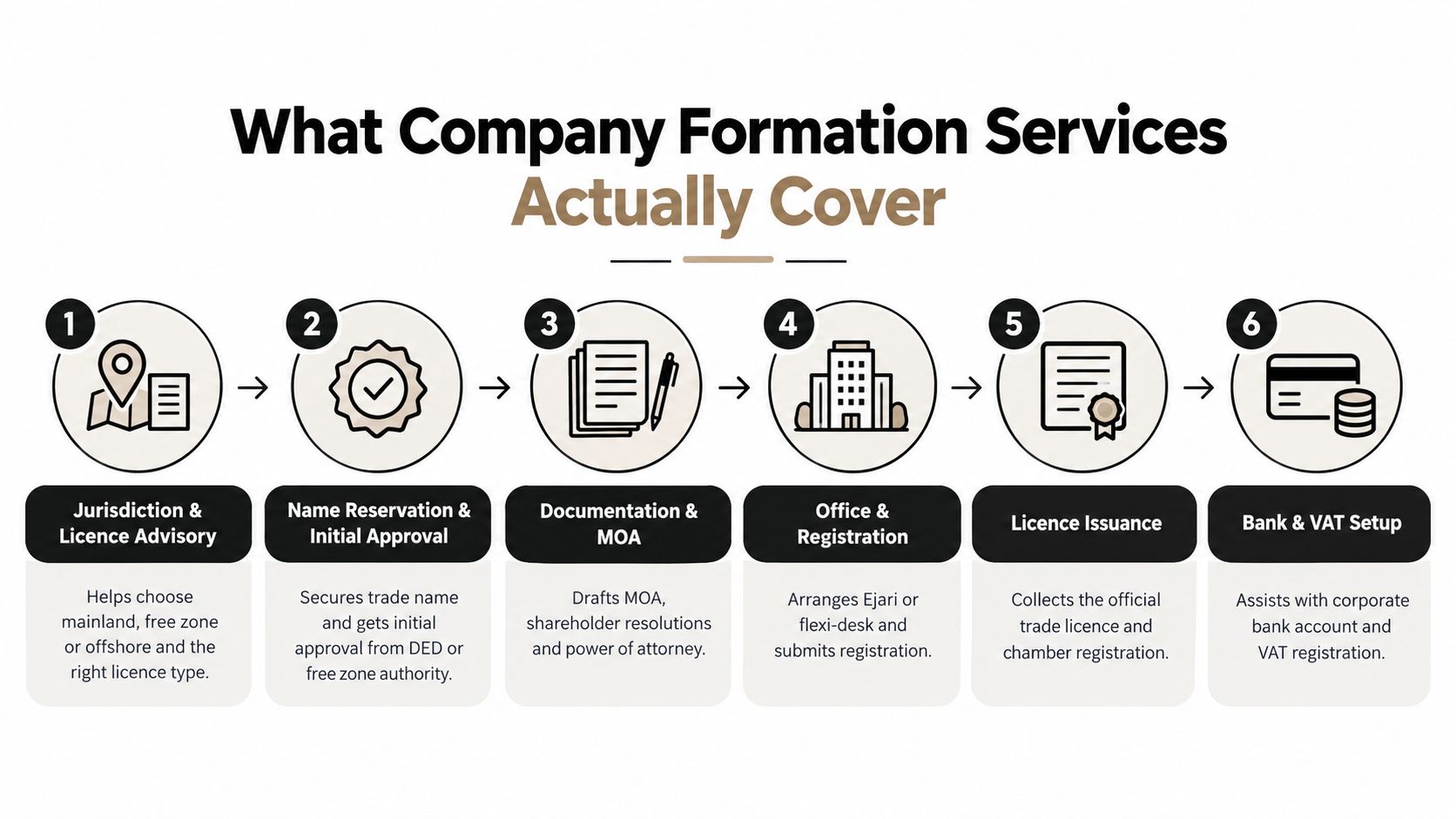
The official UAE platform identifies 40 free zones and distinguishes mainland businesses as the route intended for trading across the UAE. That makes jurisdiction selection a design decision, not a form-filling preference. The UAE government platform outlines business setup routes and jurisdiction considerations.
The work after licence issuance
The licence is the start of the operating file. A full-service provider should help with:
- PRO services: Government liaison with licensing, immigration, labour, and other authorities.
- Immigration registration: Establishment card, immigration file, and visa quota arrangements.
- Visa processing: Entry permits, status changes, medical appointments, biometrics, Emirates ID, and visa stamping.
- Banking support: Document preparation, account introductions where available, and responses to corporate KYC questions.
- Tax registrations: Corporate tax registration and VAT registration when applicable.
- Ownership and substance filings: Ultimate beneficial owner records and economic substance obligations where relevant.
- Accounting handover: Bookkeeping controls, chart of accounts, invoicing procedures, and filing calendars.
A freelance PRO may submit forms efficiently, but that doesn't make them a formation partner. The distinction is ownership of the whole setup. Your provider should understand how the activity, entity, premises, shareholders, tax registrations, invoices, and bank narrative fit together.
A licence proves registration. It doesn't prove that your company is ready to trade, invoice, hire, bank, and meet its filing obligations.
Mainland, Free Zone, or Offshore
A founder planning to sell locally, hire staff, or bid for government work needs a different structure from an exporter serving customers abroad. Choose the jurisdiction around your customers, physical operations, staffing plan, and money flows. The licence decision also shapes corporate tax, VAT, e-invoicing, banking KYC, and the evidence you must keep after incorporation.
The mainland route, licensed by the relevant emirate authority, is usually the strongest fit for direct UAE sales, dedicated premises, local hiring, and government contracts. 100% foreign ownership is available for many commercial and industrial activities, while mainland companies retain direct access to the domestic market and government work. The UAE company formation guidance explains mainland setup steps.
A free-zone company works well for export-led businesses, sector-specific activities, technology ventures, and intellectual-property holding structures. Free zones commonly offer dedicated registration processes and ownership flexibility. The trade-off is practical: direct onshore activity may require a distributor, extra approvals, or another compliant route, depending on the activity and current rules.
An offshore entity has a narrower role. It may suit asset holding, intellectual-property ownership, or international invoicing, but it is not a replacement for an operating UAE company. Offshore structures generally do not provide UAE residence visas or direct onshore trading rights. If you need employees, premises, or local customers, use offshore registration as a supporting structure rather than the main vehicle.
| Criterion | Mainland (DED) | Free Zone | Offshore |
|---|---|---|---|
| Ownership | 100% foreign ownership is available for many activities | Foreign ownership is generally available | Ownership depends on the offshore registrar and structure |
| UAE market access | Direct domestic trading and access to government contracting | Onshore trading may require an approved route or distributor | No direct onshore trading |
| Visa eligibility | Available where the company meets immigration and premises requirements | Available within the zone's eligibility and quota rules | Generally unavailable |
| Office requirements | Physical premises and lease requirements depend on the activity | Flexi-desk or office options may be available, subject to authority rules | No operating office requirement in the usual model |
| Tax and audit exposure | Subject to UAE tax rules and activity-specific obligations | 0% treatment is conditional for qualifying income, not automatic | Must be assessed under the applicable tax regime |
| Banking friction | Stronger commercial logic for local operating businesses, but KYC remains detailed | Bank review depends on activity, shareholders, substance, and customer base | Often higher scrutiny because the entity lacks local operating substance |
The structure also affects the credibility of your banking file. A local operating company with a clear customer base, premises, contracts, and invoices usually presents a stronger commercial explanation than an entity whose licence, revenue, and stated activity do not align.
Founders comparing Dubai structures can review this mainland versus free-zone comparison before requesting quotations.
My recommendation is direct. Choose mainland when UAE customers and government work drive revenue. Choose a free zone for export-led, sector-specific, or international operations. Choose offshore only when you can explain the holding or international invoicing purpose and show where the actual operating activity will take place. Ask any formation provider how its recommendation affects tax registration, invoice controls, e-invoicing readiness, and bank KYC after the licence is issued.
The Setup Process and a Realistic Timeline
The glossy promise is often “licence in a few days”. That may describe a clean application with a straightforward activity, complete documents, and no bank or immigration complications. It isn't a reliable planning assumption for every founder.
Plan the process in this order:
- Activity selection, one to two days: Confirm the precise activity, legal form, ownership, and licence category. Regulated or specialised activities may need external approvals.
- Name reservation, about one day: Submit the proposed trade name and prepare alternatives. A rejected name can interrupt the sequence.
- Initial approval, two to three days: The authority reviews the application and confirms that the proposed structure can proceed.
- Document preparation, three to five days: Draft and sign the MOA, AOA, shareholder resolutions, powers of attorney, and any required declarations. Foreign-issued documents may need notarisation, attestation, or certified translation.
- Office lease and Ejari, two to four days: Arrange the required premises. Delays often arise when the selected office doesn't meet the activity or licensing requirements.
- Licence issuance, three to seven days: Submit the final file, pay the relevant charges, and collect the licence.
- Establishment card and visas, seven to ten days: Open the immigration file, process entry permits and status changes, complete medical and biometrics, and proceed with Emirates ID and visa stamping.
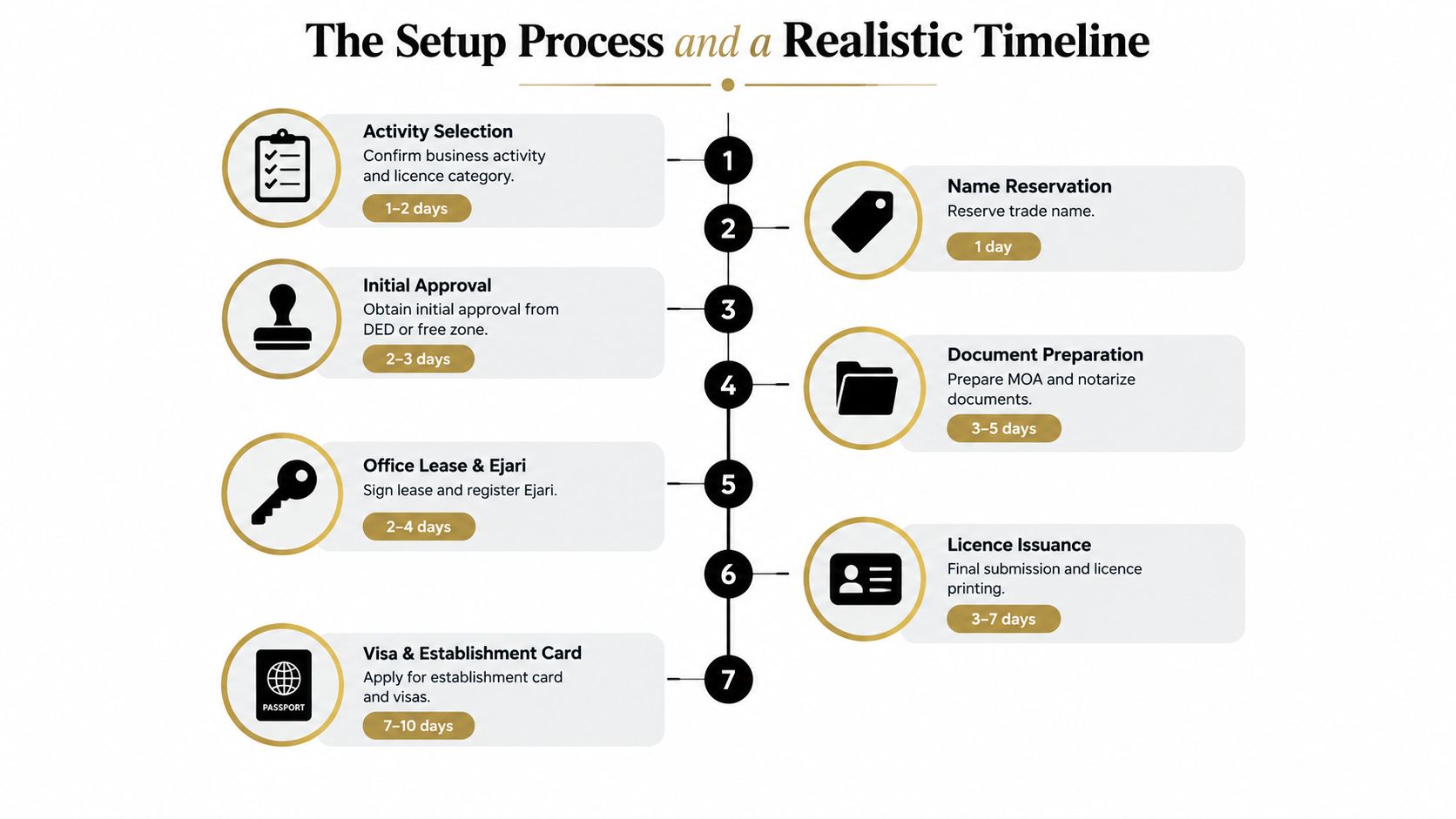
The setup authority controls the registration stages, but the founder controls much of the preparation quality. Have passport copies, shareholder details, proposed activities, business descriptions, ownership information, and source-of-funds explanations ready before submission. If a shareholder is a corporate entity, expect a deeper document trail and more KYC questions.
Banking is a separate workstream, not the final tick box. A bank may ask for contracts, invoices, a business plan, proof of address, expected transaction flows, shareholder information, and evidence of commercial substance. The company can be legally incorporated while the bank account remains under review.
Calendar expectation: Allow two to eight weeks for the complete setup journey, depending on the jurisdiction, activity, document readiness, office arrangement, immigration needs, and bank KYC. Treat any shorter promise as a best-case registration estimate, not a business-ready deadline.
Founders who want a practical sequence can use this guide to starting a business in the UAE alongside their provider's application checklist.
Documents, Costs, and the Fees No One Quotes Up Front
The headline licence fee is only one part of the budget. Ask for an itemised quotation that separates government charges, provider fees, premises, immigration, tax, accounting, and renewal costs.
Build the budget by layer
The first layer covers licensing and registration. It may include activity approval, name reservation, initial approval, trade name registration, licence issuance, and chamber registration. If the authority rejects a name or requests an activity amendment, you may face additional charges or processing work.
The premises layer varies sharply. A mainland operating company may need a physical office and an Ejari-registered lease. A free-zone company may qualify for a flexi-desk or shared facility, subject to the authority and activity. A virtual address can support correspondence, but it doesn't automatically satisfy operational or immigration requirements.
The document layer includes MOA and AOA drafting, notarisation, attestation, translation, corporate shareholder documents, and powers of attorney. Foreign shareholders often underestimate attestation requirements because documents issued abroad may need several validation steps before the UAE authority accepts them.
Costs that affect the real total
Include the following in your request for quotation:
- Registration charges: Activity, name, initial approval, licence, and chamber-related fees.
- Premises: Physical office, flexi-desk, Ejari, deposits, utilities, and access charges.
- Documentation: MOA, AOA, notarisation, attestation, translation, and legalisation.
- PRO work: Government liaison, submissions, amendments, and collection of documents.
- Immigration file: Establishment card, immigration registration, and quota-related processing.
- Visa expenses: Entry permit, status change, medical examination, biometrics, Emirates ID, and stamping.
- Banking facilitation: Document packs, banking introductions, and KYC response support.
- Tax and accounting: Corporate tax registration, VAT registration where required, bookkeeping, and return preparation.
- Renewals: Licence, premises, chamber, establishment card, visas, and recurring compliance services.
I won't give you false AED bands. The verified material for this guide doesn't establish reliable indicative ranges for mainland, free-zone, or offshore formation, and quoting invented figures would make the budget less useful, not more precise. Ask each provider for an all-in first-year estimate, followed by a separate renewal and recurring-compliance estimate.
| Cost Item | Mainland (AED) | Free Zone (AED) | Offshore (AED) |
|---|---|---|---|
| Licence and registration | Provider quotation required | Provider quotation required | Provider quotation required |
| Premises or address | Depends on approved premises and lease | Depends on flexi-desk or office package | Usually no operating office |
| MOA, attestation, and translation | Depends on shareholders and documents | Depends on shareholders and documents | Depends on registrar and documents |
| PRO and government liaison | Quoted separately or bundled | Quoted separately or bundled | Quoted separately or bundled |
| Immigration and establishment file | Relevant where visas are required | Relevant where visas are available | Generally not applicable |
| Tax registration and accounting | Quote based on activity and filings | Quote based on activity and qualifying-income analysis | Quote based on structure and transactions |
| Renewal exposure | Confirm annual charges and service fees | Confirm annual charges and service fees | Confirm registrar and compliance charges |
The cheapest proposal is often the one that leaves the most work outside the package. Compare deliverables, not just the first number on the page.
PRO Support, Visas, and Post-Setup Compliance
A licence does not keep a UAE company operational. The administrative file must stay current, with a clear calendar, accurate records, and named owners for every government deadline. PRO support handles the authority-facing work, while the founder remains responsible for making sure the system is funded and followed.
The visa pathway
For a company eligible to sponsor residents, the usual sequence includes an establishment card, immigration file, entry permit, status change where applicable, medical examination, biometrics, Emirates ID, and residence visa stamping. Investor and employee eligibility can differ. Visa capacity also depends on the licence, premises, authority rules, and immigration assessment.
Timing changes with nationality, location, document readiness, medical results, appointment availability, and authority review. Require a stage-by-stage estimate from the provider. A blanket promise that every visa will follow the same path is a warning sign.
The compliance calendar starts immediately
Treat corporate tax registration as an incorporation-stage responsibility for most legal forms; waiting until revenue arrives risks penalties and a rushed first filing. Free-zone status does not create a blanket tax holiday. A free-zone entity can retain 0% tax treatment on qualifying income only if it satisfies the Qualifying Free Zone Person conditions, including adequate substance, qualifying income, de minimis limits, no mainland election, and arm's-length pricing. The Kaizen UAE tax guidance summarises the relevant conditions.
VAT registration becomes mandatory when taxable turnover exceeds AED 375,000. The UAE tax guidance sets out the VAT registration threshold. Build bookkeeping and invoice controls before reaching that threshold. Weak records make registration, transaction reviews, and later filings harder.
Your post-incorporation checklist should cover:
- Corporate tax: Registration, accounting records, return preparation, and payment deadlines.
- VAT: Registration, compliant tax invoices, records, filing, and transaction treatment.
- Ultimate beneficial owner records: Keep ownership information accurate and update it when the structure changes.
- Economic substance: Assess whether the activity creates relevant obligations and whether the company can demonstrate appropriate substance.
- AML controls: Regulated and designated non-financial activities may require customer due diligence and reporting controls.
- E-invoicing: Prepare systems, data fields, customer records, and service-provider onboarding for the UAE's electronic invoicing framework. The Ministry of Finance framework in 2026 includes ASP onboarding deadlines for taxable persons regardless of entity type, so preparation should begin before the first filing cycle.
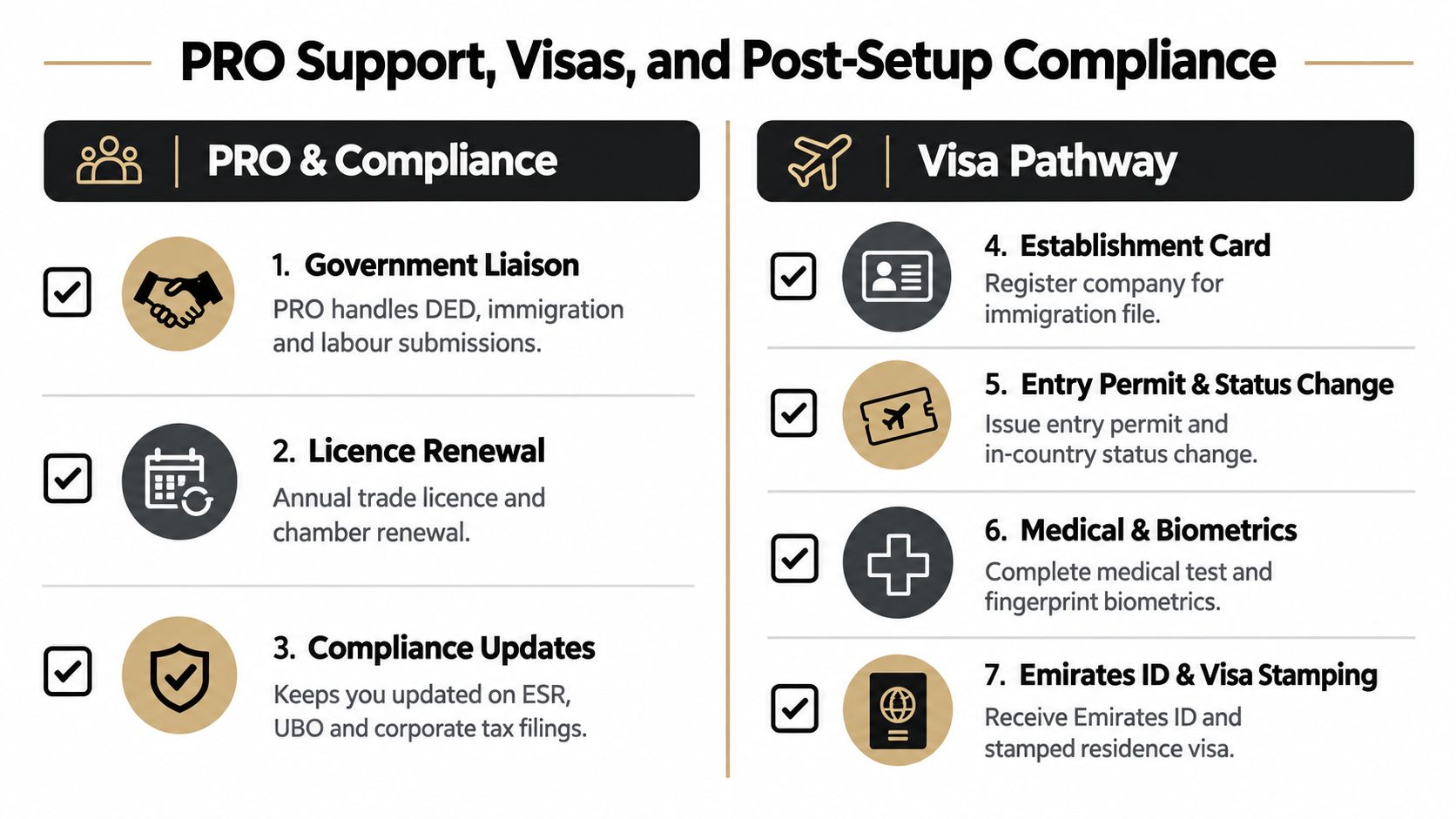
Operational standard: Your formation provider should hand over a renewal calendar, tax-registration status, bookkeeping requirements, immigration dates, and named owners for every outstanding task.
A provider that disappears after licence issuance leaves the founder exposed. If you need a dedicated government-liaison function, review corporate PRO services in Dubai and compare its stated deliverables with the formation proposal. Insist on clear ownership of tax, visa, banking KYC, and renewal tasks before signing.
Choosing a Formation Partner and How Smart Classic Simplifies the Path
Vetting a formation provider requires more than checking whether it has a polished website. Ask who will perform the work, which authority relationships they understand, what is included in writing, and what happens when the authority rejects a document.
Questions to ask before signing
- Who holds the advisory responsibility? You need a named adviser who can explain why a jurisdiction fits your activity.
- Is the PRO function in-house? An in-house team can provide clearer accountability than an undefined external referral.
- What is included in the fee? Request government charges, professional fees, premises, immigration, tax registrations, bank support, and renewals as separate lines.
- What happens after issuance? Confirm whether tax, VAT, UBO, bookkeeping, e-invoicing, and licence renewal support are included or charged separately.
- How is banking handled? The provider should help you prepare a credible business profile and document pack, without promising guaranteed approval.
- Can they show relevant references? Ask for experience with the same jurisdiction, activity type, ownership profile, and visa requirements.
- What is the escalation route? You should know who handles a rejected name, missing document, authority query, or delayed bank KYC review.
A useful external checklist is Kons Law business formation recommendations, particularly when you're comparing providers by scope, transparency, and ongoing support rather than by registration price alone.
Smart Classic Business Hub positions its service around the complete UAE lifecycle, including mainland, free-zone, and offshore formation, PRO support, tax and VAT work, accounting, audit, and related business services. In practical terms, a founder should expect a useful engagement to produce a day-one checklist, a renewal calendar, documented filing responsibilities, and an escalation path when an authority challenges the application.
The strongest model is one coordinated file. The same team should understand your ownership structure, licensed activity, premises, customer geography, expected transactions, visas, tax registrations, invoices, and bank KYC narrative. That reduces the risk of repeating the company story to a formation agent, a PRO, an accountant, and a bank relationship manager who each see only part of the picture.
Smart Classic Business Hub helps founders establish mainland, free-zone, and offshore companies while coordinating PRO work, tax registration, VAT-compliant accounting, banking documentation, and ongoing compliance. Visit Smart Classic Business Hub to discuss the jurisdiction and post-incorporation setup that fit your UAE operating model.